REVIEW 3 major objections 4 minor 28 references
Interactive Drawing Guidance for Anime Illustrations with Diffusion Model
T0 review · 3 major / 4 minor · reviewed 2026-08-06 · deepseek-v4-flash
Pith's one-line read An interactive drawing system for anime illustrations generates real-time guidance sketches from a hand-drawn sketch and text prompt, and its side-placement interface was preferred over fixed shadow guidance by 85.7% of user-study…
desk verdict A sensible systems paper with a genuine interface idea, but the preference study confounds placement with number of guidance sketches and is too small to support the central claim. read the letter →
The pith
A machine-rendered reading of the paper's core claim, the machinery that carries it, and where it could break.
The reading
What carries the argument
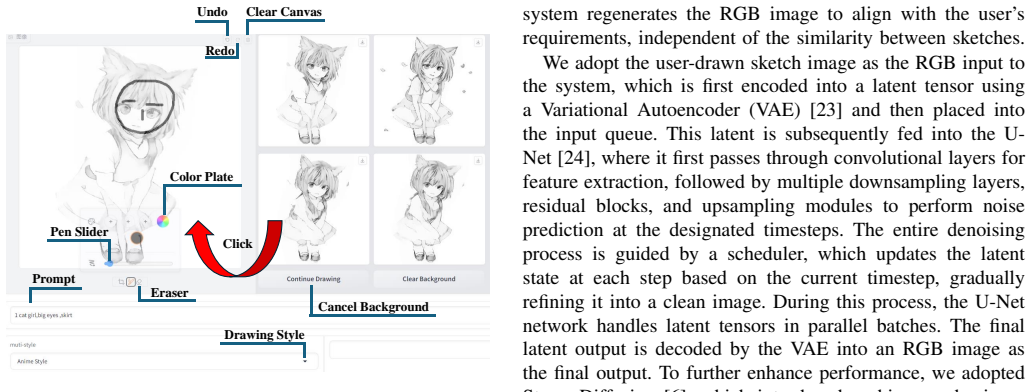
The load-bearing mechanism is the guidance-sketch loop: user strokes and a text prompt enter a real-time diffusion pipeline that renders an anime-style RGB image; a sketch generator converts that image into a rough line drawing; a custom denoising optimizer applies a recursive one-dimensional filter repeatedly to smooth the sketch while preserving edges; and the cleaned sketch is presented in an interface that keeps it beside the canvas, updating only after each stroke ends, with a cosine-similarity threshold deciding when to skip regeneration. A low-rank adaptation (LoRA) fine-tune on 40 anime images supplies the style, and an acceleration module fused into the pipeline keeps the loop interactive. The interface's optional 'pin to background' action is what distinguishes the proposal from shadow-guidance systems.
What would settle it
Run a controlled study in which the same set of guidance sketches is presented to the same users in both fixed-shadow and side-placement modes, and ask which interface they prefer; if preference does not track placement when sketch content is held identical, the central interface claim would be refuted.
Extended reading notes
Core claim
The central discovery claimed by this work is that the placement of generated guidance matters as much as the guidance itself. An interface that places four live-updating guidance sketches to the right of the canvas and lets the user pin one to the background when tracing is desired outperforms a fixed shadow-guidance interface in user preference: 85.7% of valid participants selected it as best matching their initial expectations, and 71.4% said it produced their desired outcome. The system achieves this by combining real-time diffusion generation with a LoRA-finetuned anime-style model, the Informative Drawings model for sketch extraction, and a recursive-filter optimizer that denoises rough sketches. The authors present this as an extension of existing sketch-guidance work from faces to general objects, with the interface flexibility as the key novelty.
Load-bearing premise
The comparison assumes that the two guidance interfaces showed users guidance sketches of equal quality, so the reported preference difference comes from where the sketch was placed rather than from what the sketches looked like.
Editorial extensions
If this is right
- Novices can produce more detailed anime sketches than they could with no guidance, since the system completes rough strokes into a full reference image.
- Experienced users gain a reference they can consult without tracing, because the guidance stays beside the canvas unless explicitly pinned.
- The skip-when-similar mechanism reduces wasted computation during repetitive strokes, letting the system keep up a real-time interactive pace.
- The same pipeline can be pointed at other styles by replacing the LoRA fine-tuning data, since the rest of the loop is style-agnostic.
- If the placement result generalizes, future drawing assistants should treat guidance position as a first-class design variable rather than a fixed overlay.
Reading between the lines
- A controlled follow-up that holds guidance-sketch content identical across the two placements would isolate the interface effect and test whether the 85.7% preference is caused by placement freedom rather than by subtle sketch-quality differences.
- The side-placement-plus-pinning design could be dropped into other sketch-to-image domains, such as character design, storyboarding, or 3D concept sketching, where fixed overlays often block redrawing.
- The skip-when-similar mechanism suggests a broader principle: guidance systems should spend computation on strokes that change a drawing's direction, not on repetitive marks, and that principle could be evaluated by measuring perceived responsiveness against regeneration frequency.
Editorial analysis
A structured set of objections, weighed in public.
Referee Report
Summary. The paper presents an interactive drawing guidance system for anime illustrations. The system combines StreamDiffusion-based real-time image generation, a LoRA fine-tuned anime-style Stable Diffusion model, the Informative Drawings sketch extractor, and a custom denoising optimizer to produce guidance sketches from the user's hand-drawn input and text prompt. The user interface places up to four generated guidance sketches to the side of the canvas and lets the user optionally anchor one to the background for tracing. The authors report a user study with three interfaces (baseline, shadow guidance, and the proposed interface) and claim that their interface significantly helps users achieve their desired sketches and improves drawing quality. The paper also includes expert and non-expert ratings of the resulting drawings and reports a System Usability Scale score for the proposed interface.
Significance. If the interface advantage were convincingly established, the paper would make a useful contribution to the drawing-guidance literature by demonstrating a flexible alternative to fixed background guidance. The system description is clear, the reuse of established components (StreamDiffusion, LoRA, Informative Drawings) is sensible, and the paper is honest in stating several limitations and an acknowledged failure case. The real-time performance figures (about 1.2 seconds for four 512x512 images) are useful practical information. However, the empirical support is thin: the central interface claim rests on a preference result from seven valid participants, and the comparison is confounded, so the main contribution is not yet supported by the reported evidence. The paper's candid limitation paragraph is a strength, but it is in tension with the abstract's definitive claims of significant improvement.
major comments (3)
- [V-B, Table III] The central interface claim is not identifiable from the reported experiment: the proposed interface differs from the shadow-guidance interface in both the placement/anchoring policy and the number of guidance sketches offered (four versus one, as stated in Section V-A). The 85.7% preference could therefore reflect the larger candidate set rather than the side-placement/flexible-anchoring design. The statement in Section V-A that both interfaces provided guidance sketches of equal quality does not address this, because even with equal per-sketch quality, the best of four sketches is more likely to match a user's intent than a single sketch. A controlled comparison that holds the number and content of guidance sketches fixed while varying only placement and anchoring is needed; this issue is load-bearing because the paper's main contribution is the interface arrangement.
- [Abstract, Section IV, Section V-A] The Abstract claims the system is 'significantly enhancing both the efficiency and accuracy of the drawing process,' and Section V-A states that the interface 'significantly enhances drawing quality,' but no inferential statistical tests are reported. The user study has only seven valid participants, Table II reports only means without standard deviations, confidence intervals, or inter-rater reliability, and the drawing-time measurements mentioned in Section IV are never reported in the results. The word 'significantly' is thus unsupported. Please either provide appropriate statistical tests with effect sizes and confidence intervals or restate the claims as qualitative observations. This issue is load-bearing because the contribution summary rests on these strong claims.
- [IV, V-B] The preference percentages in Table III are based on seven participants after excluding one who 'selected the same option for all questions,' but the exclusion criterion is applied post hoc without a stated decision rule, and no statistical test accompanies the distribution (85.7% vs. 14.3% vs. 0%). Given the small sample and lack of confidence intervals, these percentages should be presented as descriptive findings only. The current phrasing, which says the results 'demonstrate' that the proposed method makes it easier to achieve intended drawings, overstates the evidentiary weight.
minor comments (4)
- [III-B, Eq. (1)-(2)] The quantity P(skip|x) is described as a probability but it is a deterministic function of the cosine similarity x. Additionally, the threshold parameter τ is never assigned a value, and no sensitivity analysis is provided. Please clarify the terminology and report the chosen τ or study its influence.
- [V-A, Table I] The SUS score of 84.67 is reported for the proposed interface, but no SUS values are reported for the baseline or shadow-guidance interfaces. Without comparison values, the claim that this indicates 'high usability' cannot be evaluated relative to the other conditions.
- [IV, Figure 6] The paper says a user study was also conducted using anime style, but no quantitative results or analysis are reported for that condition; Figure 6 is only a set of example drawings. Please either report the corresponding data or clarify that the anime-style results are only illustrative.
- [VI, Conclusion] The final section lists as future work the need to 'systematically perform both quantitative and qualitative evaluations of diffusion models against GAN-based methods and traditional sketch retrieval techniques.' This is a reasonable limitation statement, but it is in tension with the definitive claims in the Abstract and Section I; please reconcile the language throughout.
Circularity Check
No circularity: the system is built from standard external components and the interface claim is tested empirically; self-citations are contextual only.
full rationale
This is an empirical systems paper rather than a derivation. The pipeline components (StreamDiffusion, Stable Diffusion with LoRA, Informative Drawings, the recursive-filter optimizer) are adopted from external prior work or standard practice; the paper does not derive its results from its own conclusions. The central contribution, side placement of guidance sketches with optional anchoring, is evaluated through a user study: SUS scores, drawing-quality ratings, and preference percentages are measured data, not quantities manufactured from the system's assumptions. The self-citations present (Dualface [10], AniFaceDrawing [15], grid guidance [13], canvas-size study [14]) appear only in related-work context and are not load-bearing: none is invoked to justify a design premise, to forbid an alternative, or to supply a 'uniqueness' argument. The paper's assertion in Section V-A that 'both interfaces provided guidance sketches of equal quality' is unmeasured, and the comparison between the proposed interface and the shadow interface is confounded by the number of guidance sketches (four vs one), but a confound is a validity threat, not a circular reduction; the 85.7% preference result is an empirical observation rather than a restatement of the input. No equation or fitted parameter is used to produce a prediction equivalent to its own input. Therefore the paper has no significant circularity.
Assumptions & free parameters
free parameters (1)
- threshold tau
assumptions (2)
- domain assumption Guidance sketch quality is identical between the shadow-guidance interface and the proposed interface.
- domain assumption Participants' subjective ratings and self-reported preferences reflect the actual drawing-assistance effectiveness.
Cite this review
Pith. "Pith review of Interactive Drawing Guidance for Anime Illustrations with Diffusion Model." pith.science (2026). https://pith.science/paper/KIYANGZO
@misc{pith2026250709140,
  author       = {Pith},
  title        = {Pith review of: Interactive Drawing Guidance for Anime Illustrations with Diffusion Model},
  year         = {2026},
  howpublished = {\url{https://pith.science/paper/KIYANGZO}},
  note         = {Machine review of arXiv:2507.09140}
}
read the original abstract
Creating high-quality anime illustrations presents notable challenges, particularly for beginners, due to the intricate styles and fine details inherent in anime art. We present an interactive drawing guidance system specifically designed for anime illustrations to address this issue. It offers real-time guidance to help users refine their work and streamline the creative process. Our system is built upon the StreamDiffusion pipeline to deliver real-time drawing assistance. We fine-tune Stable Diffusion with LoRA to synthesize anime style RGB images from user-provided hand-drawn sketches and prompts. Leveraging the Informative Drawings model, we transform these RGB images into rough sketches, which are further refined into structured guidance sketches using a custom-designed optimizer. The proposed system offers precise, real-time guidance aligned with the creative intent of the user, significantly enhancing both the efficiency and accuracy of the drawing process. To assess the effectiveness of our approach, we conducted a user study, gathering empirical feedback on both system performance and interface usability.
Figures


Figures from the paper (3 more)


Reference graph
Works this paper leans on
-
[1]
Pho- tosketcher: Interactive sketch-based image synthesis,
M. Eitz, R. Richter, K. Hildebrand, T. Boubekeur, and M. Alexa, “Pho- tosketcher: Interactive sketch-based image synthesis,” IEEE Computer Graphics and Applications , vol. 31, no. 6, pp. 56–66, 2011
work page 2011
-
[2]
Shadowdraw: real-time user guidance for freehand drawing,
Y . J. Lee, C. L. Zitnick, and M. F. Cohen, “Shadowdraw: real-time user guidance for freehand drawing,” ACM Trans. Graph. , vol. 30, jul 2011
work page 2011
-
[3]
Portraitsketch: face sketching assistance for novices,
J. Xie, A. Hertzmann, W. Li, and H. Winnem ¨oller, “Portraitsketch: face sketching assistance for novices,” in Proceedings of the 27th Annual ACM Symposium on User Interface Software and Technology , UIST ’14, (New York, NY , USA), p. 407–417, Association for Computing Machinery, 2014
work page 2014
-
[4]
Interactive sketch ‘&’ fill: Multiclass sketch-to- image translation,
A. Ghosh, R. Zhang, P. K. Dokania, O. Wang, A. A. Efros, P. H. S. Torr, and E. Shechtman, “Interactive sketch ‘&’ fill: Multiclass sketch-to- image translation,” in Proceedings of the IEEE international conference on computer vision , 2019
work page 2019
-
[5]
Denoising diffusion probabilistic models,
J. Ho, A. Jain, and P. Abbeel, “Denoising diffusion probabilistic models,” Advances in neural information processing systems , vol. 33, pp. 6840– 6851, 2020
2020
-
[6]
Streamdiffusion: A pipeline- level solution for real-time interactive generation,
A. Kodaira, C. Xu, T. Hazama, T. Yoshimoto, K. Ohno, S. Mitsuhori, S. Sugano, H. Cho, Z. Liu, and K. Keutzer, “Streamdiffusion: A pipeline- level solution for real-time interactive generation,” 2023
work page 2023
-
[7]
High- resolution image synthesis with latent diffusion models,
R. Rombach, A. Blattmann, D. Lorenz, P. Esser, and B. Ommer, “High- resolution image synthesis with latent diffusion models,” 2022
work page 2022
-
[8]
Lora: Low-rank adaptation of large language models,
E. J. Hu, Y . Shen, P. Wallis, Z. Allen-Zhu, Y . Li, S. Wang, L. Wang, and W. Chen, “Lora: Low-rank adaptation of large language models,” arXiv preprint arXiv:2106.09685 , 2021
arXiv 2021
Show all 28 references
-
[9]
Learning to generate line drawings that convey geometry and semantics,
C. Chan, F. Durand, and P. Isola, “Learning to generate line drawings that convey geometry and semantics,” in Proceedings of the IEEE/CVF Conference on Computer Vision and Pattern Recognition , pp. 7915– 7925, 2022
2022
-
[10]
dualface: Two-stage drawing guidance for freehand portrait sketching,
Z. Huang, Y . Peng, T. Hibino, C. Zhao, H. Xie, T. Fukusato, and K. Miyata, “dualface: Two-stage drawing guidance for freehand portrait sketching,” Computational Visual Media , vol. 8, pp. 63–77, 2022
2022
-
[11]
Sketchhelper: Real-time stroke guidance for freehand sketch retrieval,
J. Choi, H. Cho, J. Song, and S. M. Yoon, “Sketchhelper: Real-time stroke guidance for freehand sketch retrieval,” IEEE Transactions on Multimedia, vol. 21, no. 8, pp. 2083–2092, 2019
2019
-
[12]
Ez-sketching: three-level optimization for error-tolerant image tracing,
Q. Su, W. H. A. Li, J. Wang, and H. Fu, “Ez-sketching: three-level optimization for error-tolerant image tracing,” ACM Trans. Graph. , vol. 33, jul 2014
2014
-
[13]
Illustration drawing interface with image retrieval and adjustable grid guidance,
H. Kanayama, H. Xie, and K. Miyata, “Illustration drawing interface with image retrieval and adjustable grid guidance,” in 2023 Nicograph International (NicoInt) , pp. 54–61, 2023
2023
-
[14]
A study on cognitive effects of canvas size for augmenting drawing skill,
J. Wang, K. Nakano, D. Chen, Z. Huang, T. Fukusato, K. Miyata, and H. Xie, “A study on cognitive effects of canvas size for augmenting drawing skill,” in 2024 Nicograph International (NicoInt) , pp. 49–53, 2024
2024
-
[15]
Anifacedrawing: Anime portrait exploration during your sketching,
Z. Huang, H. Xie, T. Fukusato, and K. Miyata, “Anifacedrawing: Anime portrait exploration during your sketching,” in ACM SIGGRAPH 2023 Conference Proceedings, SIGGRAPH ’23, 2023
2023
-
[16]
Sketch2model: View-aware 3d modeling from single free-hand sketches,
S.-H. Zhang, Y .-C. Guo, and Q.-W. Gu, “Sketch2model: View-aware 3d modeling from single free-hand sketches,” in Proceedings of the IEEE/CVF Conference on Computer Vision and Pattern Recognition , pp. 6012–6021, 2021
2021
-
[17]
Image-to-image translation with conditional adversarial networks,
P. Isola, J.-Y . Zhu, T. Zhou, and A. A. Efros, “Image-to-image translation with conditional adversarial networks,” 2018
2018
-
[18]
A neural representation of sketch drawings,
D. Ha and D. Eck, “A neural representation of sketch drawings,” 2017
2017
-
[19]
Ez-sketching: three-level optimization for error-tolerant image tracing.,
Q. Su, W. H. A. Li, J. Wang, and H. Fu, “Ez-sketching: three-level optimization for error-tolerant image tracing.,” ACM Trans. Graph. , vol. 33, no. 4, pp. 54–1, 2014
2014
-
[20]
Portraitsketch: Face sketching assistance for novices,
J. Xie, A. Hertzmann, W. Li, and H. Winnem ¨oller, “Portraitsketch: Face sketching assistance for novices,” in Proceedings of the 27th annual ACM symposium on User interface software and technology , pp. 407– 417, 2014
2014
-
[21]
Sketching without worrying: Noise-tolerant sketch-based image retrieval,
A. K. Bhunia, S. Koley, A. F. U. R. Khilji, A. Sain, P. N. Chowdhury, T. Xiang, and Y .-Z. Song, “Sketching without worrying: Noise-tolerant sketch-based image retrieval,” in Proceedings of the IEEE/CVF confer- ence on computer vision and pattern recognition , pp. 999–1008, 2022
2022
-
[22]
Adding conditional control to text-to-image diffusion models,
L. Zhang, A. Rao, and M. Agrawala, “Adding conditional control to text-to-image diffusion models,” 2023
2023
-
[23]
Auto-encoding variational bayes,
D. P. Kingma and M. Welling, “Auto-encoding variational bayes,” 2022
2022
-
[24]
U-net: Convolutional networks for biomedical image segmentation,
O. Ronneberger, P. Fischer, and T. Brox, “U-net: Convolutional networks for biomedical image segmentation,” 2015
2015
-
[25]
Lcm-lora: A universal stable-diffusion acceleration module,
S. Luo, Y . Tan, S. Patil, D. Gu, P. von Platen, A. Passos, L. Huang, J. Li, and H. Zhao, “Lcm-lora: A universal stable-diffusion acceleration module,” arXiv preprint arXiv:2311.05556 , 2023
2023 arXiv
-
[26]
Classifier-free diffusion guidance,
J. Ho and T. Salimans, “Classifier-free diffusion guidance,” arXiv preprint arXiv:2207.12598, 2022
2022 arXiv
-
[27]
Deep residual learning for image recognition,
K. He, X. Zhang, S. Ren, and J. Sun, “Deep residual learning for image recognition,” in Proceedings of the IEEE Conference on Computer Vision and Pattern Recognition (CVPR) , June 2016
2016
-
[28]
Learning transferable visual models from natural language supervision,
A. Radford, J. W. Kim, C. Hallacy, A. Ramesh, G. Goh, S. Agarwal, G. Sastry, A. Askell, P. Mishkin, J. Clark, et al., “Learning transferable visual models from natural language supervision,” in International conference on machine learning , pp. 8748–8763, PMLR, 2021
2021
Reviewed August 6, 2026 · model on record in the stance chip above.
Discussion (0). Sign in to comment.