REVIEW 5 major objections 7 minor 160 references
Solving an Interacting Quintessence Model with a Sound Horizon Initial Condition and its Observational Constraints
T0 review · 5 major / 7 minor · reviewed 2026-08-06 · deepseek-v4-flash
Pith's one-line read When the scalar-field initial condition is fixed by the observed sound-horizon angle, the interacting quintessence model produces an H0 that rises with the dark-sector coupling, but the data require the coupling to be near zero, leaving…
desk verdict Plausible EDE-like mechanism, honest negative constraints, but as printed the central perturbation equations don't match the stated coupling and the H0(beta) curve is unvalidated where it matters. read the letter →
The pith
A machine-rendered reading of the paper's core claim, the machinery that carries it, and where it could break.
The reading
What carries the argument
The load-bearing object is the coupled quintessence scalar field, with energy density and pressure $\rho_\phi=\frac{1}{2a^2}\phi'^2+V(\phi)$ and $p_\phi=\frac{1}{2a^2}\phi'^2-V(\phi)$, where the dark-matter interaction $Q=\beta\phi'\rho_c$ enters as a source in the Klein-Gordon equation $\phi''+2\mathcal{H}\phi'+a^2V_{,\phi}=-a^2\beta\rho_c$ and in the CDM conservation equation. The condition that carries the argument is the sound-horizon shooting method: the field's initial density is tuned until the model returns the observed $100\theta_*=1.0411$ (with recombination redshift $z_*=1091$), so $H_0$ is no longer an input but an output. The narrow early-time enhancement of $\Omega_\phi$ produced by the interaction is what shrinks $r_s^*$ and, with $\theta^*$ fixed, forces $H_0$ upward. Technically the solution is obtained by a weak-coupling perturbative expansion of $\rho_c$ and $\phi$ in powers of $\beta$, truncated at second order, which the paper states converges only for $\beta\lesssim0.1$.
What would settle it
Compute the $\theta_*$-fixed background solution for $\beta=0.07$ and $\lambda=0.35$ without the second-order $\beta$ expansion; if the full solution does not reproduce the $H_0>70$ km/s/Mpc shown in Fig. 1, then the claimed trend is an artifact of the truncation. A direct calculation of $r_s^*$ at that point would settle whether the early pulse actually shrinks the sound horizon enough.
Extended reading notes
Core claim
The paper's central claim is that a coupled quintessence field with potential $V(\phi)=V_0e^{-\lambda\phi}$ and interaction $Q=\beta\phi'\rho_c$ produces a higher $H_0$ when the coupling is stronger, once the scalar-field initial condition is fixed by the observed sound-horizon angle. The mechanism is that the interaction temporarily raises $\Omega_\phi$ in a short interval around recombination; this shrinks the sound horizon $r_s^*$, and because $\theta^*=r_s^*/D_A^*$ is held at its measured value, the angular diameter distance and the expansion history must adjust so that $H_0$ grows. The companion claim is quantitative: Markov chain Monte Carlo fits to CMB, BAO, and type-Ia supernova data prefer a small positive coupling, $|\beta|\lesssim0.05$ at 95% CL, and give $H_0=67.47^{+0.82}_{-0.60}$ km/s/Mpc and a slightly improved $S_8$ at 68% CL with all data combined. The Bayesian model comparison in the paper further reports that $\Lambda$CDM is favored over both the interacting and non-interacting quintessence versions. The conclusion the authors draw is that the interaction can mimic early dark energy and lift $H_0$, but the lifting is too weak to resolve the tension.
Load-bearing premise
The entire $H_0$-versus-$\beta$ relation and the MCMC constraints rest on the premise that the second-order expansion in $\beta$ is a faithful solution of the coupled equations; the paper itself says the iteration breaks down for $\beta>0.1$, so all conclusions are confined to weak coupling and would need re-checking if the expansion is inaccurate at moderate couplings.
Editorial extensions
If this is right
- In this model, fixing the sound-horizon angle turns the Hubble constant into an output that rises with the dark-sector coupling; for $\lambda=0.35$ the figure shows $H_0>70$ km/s/Mpc once $\beta\simeq0.07$.
- The MCMC constraints require $|\beta|\lesssim0.05$ at 95% CL for all data combinations, with a slightly positive central value, so the data do not demand an interaction.
- The best combined fit gives $H_0=67.47^{+0.82}_{-0.60}$ km/s/Mpc at 68% CL, close to the $\Lambda$CDM value, and $S_8$ improves only slightly; the expansion-rate tension is not resolved.
- Bayesian evidence favors $\Lambda$CDM over both the non-interacting and interacting quintessence models, and the non-interacting model is favored over the interacting one.
- The upper limit on the potential slope tightens when type-Ia supernova data are added (for example, $\lambda<0.4672$ at 68% CL for the interacting case with the full dataset), showing that late-time expansion data pin the potential even when CMB data alone do not.
Reading between the lines
- The same $\theta_*$-shooting prescription is a general way to fix initial conditions for any early-dark-energy-like field; the paper demonstrates it only for the exponential potential, so trying other potentials is a direct next step to see how much the $H_0$-$\beta$ relation changes.
- Because the model produces a narrow early-time pulse in $\Omega_\phi$, the interaction is partially degenerate with other sources of early-time energy injection; disentangling them would require probing the drag-epoch sound scale or the detailed low-$\ell$ CMB polarization, not just $H_0$.
- The prior $|\beta|\le0.05$ excludes the larger couplings where the $H_0$ boost is strongest; a non-perturbative treatment of the background could test whether the data really allow the branch that lifts $H_0$ toward 70.
- The paper leaves the field initially at rest and uses the recombination angle as the target; if the field were given a nonzero initial velocity or the target were the drag-epoch angle instead, the derived $H_0$ could shift, offering a quick consistency check.
Editorial analysis
A structured set of objections, weighed in public.
Referee Report
Summary. The manuscript studies a coupled quintessence model with an exponential potential V=V0e^{-λϕ} and an interaction Q=βϕ′ρc. Its central methodological proposal is to set the scalar-field initial condition by shooting to the observed CMB acoustic scale θ*=1.0411 rather than choosing ϕ_i arbitrarily. At the background level the authors use a weak-coupling expansion in β and report that H0 increases with β, an effect they interpret as an EDE-like early enhancement of the scalar energy density that shrinks the sound horizon. They also present CMB TT power spectra computed from coupled perturbation equations, and constrain the model with Planck 2018, BAO, and Pantheon data using a modified CosmoMC. The final constraints give H0=67.47^{+0.82}_{-0.60} km/s/Mpc (68% CL, CMB+BAO+Pantheon) for the interacting model, only slightly above the non-interacting case, with Bayesian evidence favoring ΛCDM.
Significance. If the central mechanism is correct, the paper would demonstrate that a dark-sector interaction can mimic early dark energy through a narrow early-time enhancement, and it offers a practical way to set initial conditions for dynamical dark-energy models using θ*. The authors should be credited for carrying out a full MCMC analysis with current CMB, BAO, and SNIa data, for reporting Bayesian evidence, and for testing both interacting and non-interacting cases. However, the significance is currently conditional: the headline H0–β relation rests on a truncated perturbative expansion that is not validated, and the perturbation equations used for the CMB spectra are not derived. The work would be a useful contribution after the numerics are made verifiable.
major comments (5)
- [II, Eqs. (22)-(25)] The linearized background system is not the linearization of the model defined by Eqs. (7), (8), and (12)-(13). With Q=βϕ′ρc, inserting the expansions (18)-(19) into Eq. (7) gives at first order ρ_c^(1)′ + 3Hρ_c^(1) = βϕ^(0)′ρ_c^(0), not a^2βρ_c^(0) as printed in Eq. (22). Similarly, Eq. (24) should contain contributions involving ϕ^(0)′ρ_c^(1) and ϕ^(1)′ρ_c^(0), not simply a^2βρ_c^(1). The printed equations therefore do not conserve total energy in the coupled system and have a different conformal-time scaling. Unless the numerical code solved a different interaction function, the background solution and Fig. 1 do not correspond to the model presented in Eq. (12). Please correct the expansion or explicitly state which interaction function was actually implemented.
- [II and Fig. 1] The central H0(β) trend is produced by a second-order truncation with no convergence test. The paper itself states in Section II that the perturbation to ρϕ is 'quite large' and that convergence fails for β>0.1, yet H0>70 is quoted at β≈0.07 for λ=0.35. That value is close to the breakdown of the expansion and outside the MCMC prior β∈[-0.05,0.05] given in Table I. The authors should compare the truncated solution with direct numerical integration of Eqs. (6)-(8) and (13) for a grid of β values, quantify the O(β^3) remainder, and report whether Fig. 1 uses the same iterative scheme. Without such a test, the headline claim that H0 rises with β is not established in the regime where the effect would be observationally relevant.
- [II, Eqs. (29)-(32)] The coupled perturbation equations are introduced without derivation, and the interaction terms appear incomplete as printed. For the interaction Q=βϕ′ρc, the perturbed Klein-Gordon equation and the CDM continuity and Euler equations should contain a systematic set of source terms coupling δϕ, δϕ′, δc, θc, and ϕ′; Eq. (30) contains only a final βρc a^2 δc source, while Eqs. (31)-(32) introduce βδϕ′ and k^2βδϕ terms whose origins are not explained. Since these equations drive the CMB spectra in Figs. 3-5 and hence the MCMC likelihoods in Tables II and III, a derivation from the perturbed energy-momentum conservation, or a reference to the exact implementation in the modified CAMB, is required before the observational constraints can be verified.
- [II, Eq. (17) and abstract] The statement that H0 'could be derived' by fixing θ* to the Planck-calibrated value 1.0411 is an overstatement. Setting θ* and solving for H0 is a recalibration of the acoustic scale, not an independent prediction; it is a parameter-reconstruction exercise in which the CMB angular-scale information is imposed by hand. The MCMC analysis is less exposed to this issue because it samples θ_MC, but the abstract and Section II should be rephrased to avoid implying an independent derivation. A useful diagnostic would be to report the posterior of the derived θ_MC against the Planck measurement and to test whether the H0 shift persists when θ_MC is marginalized without fixing θ*=1.0411 at the background level.
- [Section IV and Table I] The observational conclusion is presented as an 'improvement' of H0 and S8, but the shifts are small relative to the reported uncertainties and the central value H0=67.47^{+0.82}_{-0.60} km/s/Mpc is consistent with the ΛCDM-based Planck value. The conclusion in Section VI that the model is 'not enough to release the tensions' is appropriate, but the intermediate wording in Section IV and the abstract should be tightened so that the reader does not mistake a sub-percent central-value shift for a statistically meaningful relaxation. In particular, the 68% CL intervals for H0 in Tables II and III overlap strongly between the interacting and non-interacting cases.
minor comments (7)
- [III, BAO bullet] The text reads 'bene used' and should read 'been used'.
- [II, Eq. (12) vicinity] There is a typo 'interactiom form' that should be 'interaction form'.
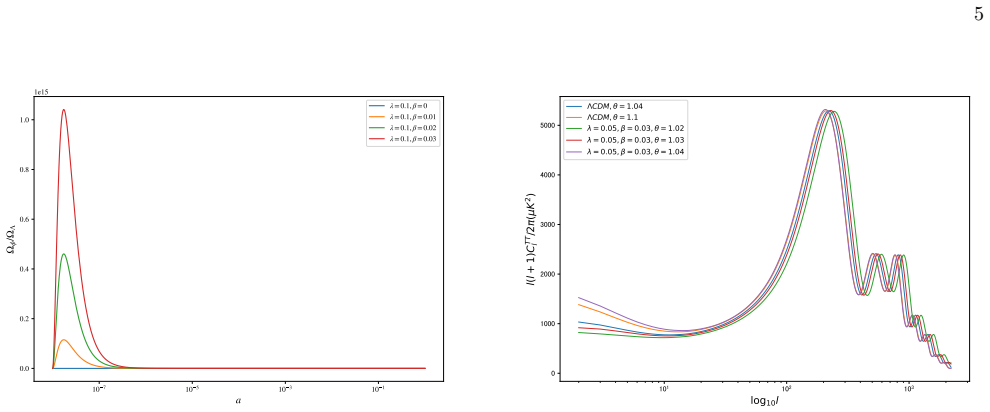
- [Fig. 2] The caption says the curves show Ωϕ relative to ΩΛ 'for different values of λ', but the legend lists λ=0.1 with varying β; please clarify the parameter values and define the y-axis normalization, which currently appears as '/1e15'.
- [Fig. 7 caption] The caption refers to the 'non-interacting quintessence scenario', but the panel presents the interacting model; the caption should be corrected.
- [After Eq. (25)] The version under review contains unreadable tokens (e.g., '/uni00000013/...') between Eq. (25) and Fig. 1; the final PDF must render all equations and figure legends cleanly.
- [References] Several references (e.g., [79]-[85]) are cited only by arXiv identifier; please complete the journal publication information where available.
- [Section II, initial conditions] The relation between the set {Ω_ci h^2, Ω_bi h^2, ρϕ} introduced in Section II and the actual shooting variable is not fully explained; please spell out how ρϕ is adjusted during each iteration and how ρ_c(ai) is initialized in the interacting case.
Circularity Check
No significant circularity: θ* is used as an observed boundary condition, H0 is solved from the model equations, and the MCMC constraints are benchmarked against external CMB/BAO/SN data.
full rationale
The paper sets the scalar-field initial condition by requiring the computed θ* = r_s/D_A (Eq. 17) to match the observed 100θ* = 1.0411 (Section II). This makes θ* an observable input, not a parameter fitted to H0 data and then renamed as a prediction. H0 is not itself fitted; it is determined by solving the coupled background equations subject to that boundary condition, which is the standard way the CMB acoustic scale constrains H0 in a given cosmological model. The result that H0 increases with β follows from the computed decrease of r_s under a fixed θ*, and is conditional on the observed θ* rather than being an identity or a fit to H0 measurements. The MCMC analysis samples θ_MC as a free parameter and uses Planck 2018 CMB, BAO, and Pantheon data, giving the central H0 constraint independent grounding outside the paper's own shooting calculation. The paper's own caveat that the β-perturbation expansion converges only for β < 0.1, and the possible dimensional inconsistency in Eqs. (22) and (24), are technical correctness and validation concerns, not circularity, because the expansion is not assumed to equal the target H0. Self-citations appear only in literature-review contexts and are not load-bearing premises, uniqueness theorems, or ansatz-justifying citations. No circular step can be exhibited in which a quoted equation or claimed result reduces by construction to its own input.
Assumptions & free parameters
free parameters (4)
- lambda (exponential potential slope) =
< 0.4672 at 68% CL (interacting, CMB+BAO+Pantheon)
- beta (dark-sector coupling) =
0.005448 (+0.030, -0.020) at 68% CL (CMB+BAO+Pantheon), consistent with zero
- theta* (angular size of sound horizon) =
1.0411 fixed in the shooting procedure; 100 theta_MC sampled in MCMC with prior [0.5,10]
- initial field velocity phi'_i =
0
assumptions (8)
- domain assumption Homogeneous isotropic flat FLRW universe with general relativity as the theory of gravity
- domain assumption Interaction form Q = beta phi' rho_c between CDM and the quintessence field
- domain assumption Exponential potential V(phi) = V0 exp(-lambda phi)
- ad hoc to paper Weak-coupling perturbative expansion in beta, truncated at second order
- ad hoc to paper Initial field at rest, phi'_i = 0, at a_i = 1e-8
- domain assumption Sound horizon angular scale fixed to the observed value theta* = 1.0411
- standard math Synchronous gauge perturbation equations from Ma and Bertschinger (1995)
- standard math Recombination redshift z* = 1091 from Hu and Sugiyama (1996)
Cite this review
Pith. "Pith review of Solving an Interacting Quintessence Model with a Sound Horizon Initial Condition and its Observational Constraints." pith.science (2026). https://pith.science/paper/2O75H2TD
@misc{pith2026250709258,
  author       = {Pith},
  title        = {Pith review of: Solving an Interacting Quintessence Model with a Sound Horizon Initial Condition and its Observational Constraints},
  year         = {2026},
  howpublished = {\url{https://pith.science/paper/2O75H2TD}},
  note         = {Machine review of arXiv:2507.09258}
}
abstract
Astronomical observations suggest that the current standard $\Lambda$-Cold Dark Matter model in modern cosmology has some discrepancies when fitting the data during the whole expansion history of the universe. To solve the Hubble constant ($H_0$) tension, usually an unknown mechanism is considered that shifts the sound horizon at the decoupling era. On the other hand, dynamical dark energy models are also considered to resolve the problems of the cosmological constant, and the additional degrees of freedom require initial conditions for a solution. In this article we have considered a coupled quintessence dark energy model with a special focus on its early-time behaviour. In our solution the initial conditions are naturally decided by setting the value of the sound horizon at the recombination time, $\theta^*$. We find that during this process, $H_0$ could be derived and its value rises with the coupling strength of the interaction. We also performed the background and cosmic microwave background power spectrum analysis, and find that the existence of the interaction term affects the energy density during a narrow time interval range and shifts the early cosmic microwave background spectrum. We also constrained the parameter space of the underlying scenario using the markov chain monte carlo analysis. We find that the best-fit values of $H_0$ and $S_8$ are improved slightly for the interacting model, but not enough to release the tensions.
Figures


Figures from the paper (3 more)


Reference graph
Works this paper leans on
-
[1]
The lower limit zero fits with the cosmological constant
In both cases, an upper limit on λ can be given only when the Pantheon sample is added to CMB and CMB+BAO. The lower limit zero fits with the cosmological constant. We have 0 < λ <0.4462 at 68% CL (CMB+BAO+Pantheon)for the non- interacting model and 0 < λ < 0.4672 at 68% CL (CMB+BAO+Pantheon) for the interacting model
-
[2]
This is reflected from the anti- correlation between λ and H0 as displayed in Fig
In the non-interacting case, the H0 value decreases with increasing λ. This is reflected from the anti- correlation between λ and H0 as displayed in Fig. 6). However, according to the results as summa- rized in Table II, there is no release on H0 tension for the non-interacting model
-
[3]
In the interacting case, the central value of β is small and positive, which is consistent with the weak coupling assumption. Although we do not find any strong indication of a coupling between CDM and the quintessence, characterized by the coupling function Q = βϕ′ρc, however, based on the existing results, there is no strong indication for ruling out th...
-
[4]
Fund for Improvement of S&T Infrastructure (FIST)
In the interacting case, we find no evidence of any significant release of H0 tension either. However, the central value is enhanced within 68% CL com- pared with the non-interacting case for all the cos- mological probes employed in this work. In summary, we have examined an interacting quintessence with exponential potential with a new cal- 12 culation ...
2019
-
[5]
3 we can clearly see the displacement of the BAO peak positions as we shift the value of θ∗, which is expected and makes it convenient for constraining the model with it
In Fig. 3 we can clearly see the displacement of the BAO peak positions as we shift the value of θ∗, which is expected and makes it convenient for constraining the model with it. In Fig. 4 and Fig. 5 we plot the CMB TT spectra for different values of the coupling param- eter β taking a fixed value of λ = 1 .2. Fig. 4 is for β >0 and Fig. 5 is for β <0. Th...
2018
-
[6]
Di Valentino et al., Astropart
E. Di Valentino et al., Astropart. Phys. 131, 102605 (2021), arXiv:2008.11284 [astro-ph.CO]
arXiv 2021
-
[7]
Weinberg, Rev
S. Weinberg, Rev. Mod. Phys. 61, 1 (1989)
1989
-
[8]
I. Zlatev, L.-M. Wang, and P. J. Steinhardt, Phys. Rev. Lett. 82, 896 (1999), arXiv:astro-ph/9807002
arXiv 1999
Show all 160 references
-
[9]
A. G. Riess et al., Astrophys. J. Lett. 934, L7 (2022), arXiv:2112.04510 [astro-ph.CO]
2022 arXiv
-
[10]
A. G. Riess, S. Casertano, W. Yuan, J. B. Bowers, L. Macri, J. C. Zinn, and D. Scolnic, Astrophys. J. Lett. 908, L6 (2021), arXiv:2012.08534 [astro-ph.CO]
2021 arXiv
-
[11]
Aghanim et al.(Planck), Astron
N. Aghanim et al.(Planck), Astron. Astrophys. 641, A6 (2020), arXiv:1807.06209 [astro-ph.CO]
2020 arXiv
-
[12]
Verde, T
L. Verde, T. Treu, and A. G. Riess, Nature Astron. 3, 891 (2019), arXiv:1907.10625 [astro-ph.CO]
2019 arXiv
-
[13]
Di Valentino et al., Astropart
E. Di Valentino et al., Astropart. Phys. 131, 102604 (2021), arXiv:2008.11285 [astro-ph.CO]
2021 arXiv
-
[14]
T. M. C. Abbott et al.(DES), Phys. Rev. D 105, 023520 (2022), arXiv:2105.13549 [astro-ph.CO]
2022 arXiv
-
[15]
Heymans et al
C. Heymans et al. , Astron. Astrophys. 646, A140 (2021), arXiv:2007.15632 [astro-ph.CO]
2021 arXiv
-
[16]
Loureiro et al
A. Loureiro et al. (KiDS, Euclid), Astron. Astrophys. 665, A56 (2022), arXiv:2110.06947 [astro-ph.CO]
2022 arXiv
- [17]
- [18]
-
[19]
A. G. Riess, Nature Rev. Phys. 2, 10 (2019), arXiv:2001.03624 [astro-ph.CO]
2019 arXiv
-
[20]
Di Valentino, Mon
E. Di Valentino, Mon. Not. Roy. Astron. Soc. 502, 2065 (2021), arXiv:2011.00246 [astro-ph.CO]
2021 arXiv
-
[21]
Di Valentino, O
E. Di Valentino, O. Mena, S. Pan, L. Visinelli, W. Yang, A. Melchiorri, D. F. Mota, A. G. Riess, and J. Silk, Class. Quant. Grav. 38, 153001 (2021), arXiv:2103.01183 [astro-ph.CO]
2021 arXiv
-
[22]
Perivolaropoulos and F
L. Perivolaropoulos and F. Skara, New Astron. Rev. 95, 101659 (2022), arXiv:2105.05208 [astro-ph.CO]
2022 arXiv
-
[23]
Sch¨ oneberg, G
N. Sch¨ oneberg, G. Franco Abell´ an, A. P´ erez S´ anchez, S. J. Witte, V. Poulin, and J. Lesgourgues, Phys. Rept. 984, 1 (2022), arXiv:2107.10291 [astro-ph.CO]
2022 arXiv
-
[24]
M. R. Setare, JCAP 01, 023 (2007), arXiv:hep- th/0701242
2007
-
[25]
Amendola and C
L. Amendola and C. Quercellini, Phys. Rev. D 68, 023514 (2003), arXiv:astro-ph/0303228
2003 arXiv
-
[26]
Guo, R.-G
Z.-K. Guo, R.-G. Cai, and Y.-Z. Zhang, JCAP 05, 002 (2005), arXiv:astro-ph/0412624
2005 arXiv
- [27]
-
[28]
Wang, C.-Y
B. Wang, C.-Y. Lin, and E. Abdalla, Phys. Lett. B 637, 357 (2006), arXiv:hep-th/0509107
2006 arXiv
-
[29]
J. D. Barrow and T. Clifton, Phys. Rev. D 73, 103520 (2006), arXiv:gr-qc/0604063
2006 arXiv
-
[30]
M. B. Gavela, D. Hernandez, L. Lopez Honorez, O. Mena, and S. Rigolin, JCAP 07, 034 (2009), [Er- ratum: JCAP 05, E01 (2010)], arXiv:0901.1611 [astro- ph.CO]
2009 arXiv
-
[31]
C. Feng, B. Wang, Y. Gong, and R.-K. Su, JCAP 09, 005 (2007), arXiv:0706.4033 [astro-ph]
2007 arXiv
-
[32]
C. G. Boehmer, G. Caldera-Cabral, R. Lazkoz, and R. Maartens, Phys. Rev. D 78, 023505 (2008), arXiv:0801.1565 [gr-qc]
2008 arXiv
-
[33]
Olivares, F
G. Olivares, F. Atrio-Barandela, and D. Pavon, Phys. Rev. D 77, 103520 (2008), arXiv:0801.4517 [astro-ph]
2008 arXiv
-
[34]
Valiviita, E
J. Valiviita, E. Majerotto, and R. Maartens, JCAP 07, 020 (2008), arXiv:0804.0232 [astro-ph]
2008 arXiv
-
[35]
Wang and Y
S. Wang and Y. Zhang, Phys. Lett. B 669, 201 (2008), arXiv:0809.3627 [astro-ph]
2008 arXiv
-
[36]
J.-H. He, B. Wang, and E. Abdalla, Phys. Rev. D 84, 123526 (2011), arXiv:1109.1730 [gr-qc]
2011 arXiv
-
[37]
Valiviita, R
J. Valiviita, R. Maartens, and E. Majerotto, Mon. Not. Roy. Astron. Soc. 402, 2355 (2010), arXiv:0907.4987 [astro-ph.CO]
2010 arXiv
-
[38]
Lopez Honorez, B
L. Lopez Honorez, B. A. Reid, O. Mena, L. Verde, and R. Jimenez, JCAP 09, 029 (2010), arXiv:1006.0877 [astro-ph.CO]
2010 arXiv
-
[39]
X. Chen, B. Wang, N. Pan, and Y. Gong, Phys. Lett. B 695, 30 (2011), arXiv:1008.3455 [astro-ph.CO]
2011 arXiv
-
[40]
S. Cao, N. Liang, and Z.-H. Zhu, Mon. Not. Roy. Astron. Soc. 416, 1099 (2011), arXiv:1012.4879 [astro- ph.CO]
2011 arXiv
-
[41]
Clemson, K
T. Clemson, K. Koyama, G.-B. Zhao, R. Maartens, and J. Valiviita, Phys. Rev. D 85, 043007 (2012), arXiv:1109.6234 [astro-ph.CO]
2012 arXiv
- [42]
-
[43]
Harko and F
T. Harko and F. S. N. Lobo, Phys. Rev. D 87, 044018 (2013), arXiv:1210.3617 [gr-qc]
2013 arXiv
- [44]
-
[45]
L. P. Chimento, M. G. Richarte, and I. E. S´ anchez Garc ´ ıa, Phys. Rev. D 88, 087301 (2013), arXiv:1310.5335 [gr-qc]. 13
2013 arXiv
-
[46]
Li and X
Y.-H. Li and X. Zhang, Phys. Rev. D 89, 083009 (2014), arXiv:1312.6328 [astro-ph.CO]
2014 arXiv
-
[47]
Yang and L
W. Yang and L. Xu, Phys. Rev. D 89, 083517 (2014), arXiv:1401.1286 [astro-ph.CO]
2014 arXiv
-
[48]
W. Yang, H. Li, Y. Wu, and J. Lu, JCAP 10, 007 (2016), arXiv:1608.07039 [astro-ph.CO]
2016 arXiv
-
[49]
Yang and L
W. Yang and L. Xu, Phys. Rev. D 90, 083532 (2014), arXiv:1409.5533 [astro-ph.CO]
2014 arXiv
-
[50]
Li, J.-F
Y.-H. Li, J.-F. Zhang, and X. Zhang, Phys. Rev. D 90, 063005 (2014), arXiv:1404.5220 [astro-ph.CO]
2014 arXiv
- [51]
-
[52]
R. S. Goncalves, G. C. Carvalho, and J. S. Alcaniz, Phys. Rev. D 92, 123504 (2015), arXiv:1507.01921 [astro-ph.CO]
2015 arXiv
-
[53]
S. Pan, S. Bhattacharya, and S. Chakraborty, Mon. Not. Roy. Astron. Soc. 452, 3038 (2015), arXiv:1210.0396 [gr-qc]
2015 arXiv
-
[54]
W. Yang, S. Pan, and D. F. Mota, Phys. Rev. D 96, 123508 (2017), arXiv:1709.00006 [astro-ph.CO]
2017 arXiv
-
[55]
R. C. Nunes, S. Pan, and E. N. Saridakis, Phys. Rev. D 94, 023508 (2016), arXiv:1605.01712 [astro-ph.CO]
2016 arXiv
-
[56]
W. Yang, N. Banerjee, and S. Pan, Phys. Rev. D 95, 123527 (2017), [Addendum: Phys.Rev.D 96, 089903 (2017)], arXiv:1705.09278 [astro-ph.CO]
2017 arXiv
-
[57]
Dutta, W
J. Dutta, W. Khyllep, and N. Tamanini, Phys. Rev. D 95, 023515 (2017), arXiv:1701.00744 [gr-qc]
2017 arXiv
-
[58]
Di Valentino, A
E. Di Valentino, A. Melchiorri, and O. Mena, Phys. Rev. D 96, 043503 (2017), arXiv:1704.08342 [astro- ph.CO]
2017 arXiv
-
[59]
Santos, W
L. Santos, W. Zhao, E. G. M. Ferreira, and J. Quintin, Phys. Rev. D 96, 103529 (2017), arXiv:1707.06827 [astro-ph.CO]
2017 arXiv
-
[60]
S. Pan, W. Yang, E. Di Valentino, E. N. Saridakis, and S. Chakraborty, Phys. Rev. D 100, 103520 (2019), arXiv:1907.07540 [astro-ph.CO]
2019 arXiv
-
[61]
W. Yang, S. Pan, and J. D. Barrow, Phys. Rev. D 97, 043529 (2018), arXiv:1706.04953 [astro-ph.CO]
2018 arXiv
-
[62]
W. Yang, L. Xu, H. Li, Y. Wu, and J. Lu, Entropy 19, 327 (2017)
2017
-
[63]
W. Yang, S. Pan, E. Di Valentino, R. C. Nunes, S. Vagnozzi, and D. F. Mota, JCAP 09, 019 (2018), arXiv:1805.08252 [astro-ph.CO]
2018 arXiv
-
[64]
W. Yang, A. Mukherjee, E. Di Valentino, and S. Pan, Phys. Rev. D 98, 123527 (2018), arXiv:1809.06883 [astro-ph.CO]
2018 arXiv
-
[65]
C. Li, X. Ren, M. Khurshudyan, and Y.-F. Cai, Phys. Lett. B 801, 135141 (2020), arXiv:1904.02458 [astro- ph.CO]
2020 arXiv
-
[66]
S. Pan, J. de Haro, W. Yang, and J. Amor´ os, Phys. Rev. D 101, 123506 (2020), arXiv:2001.09885 [gr-qc]
2020 arXiv
-
[67]
Di Valentino, A
E. Di Valentino, A. Melchiorri, O. Mena, and S. Vagnozzi, Phys. Dark Univ. 30, 100666 (2020), arXiv:1908.04281 [astro-ph.CO]
2020 arXiv
-
[68]
Cheng, Y.-Z
G. Cheng, Y.-Z. Ma, F. Wu, J. Zhang, and X. Chen, Phys. Rev. D 102, 043517 (2020), arXiv:1911.04520 [astro-ph.CO]
2020 arXiv
-
[69]
Di Valentino, A
E. Di Valentino, A. Melchiorri, O. Mena, and S. Vagnozzi, Phys. Rev. D 101, 063502 (2020), arXiv:1910.09853 [astro-ph.CO]
2020 arXiv
-
[70]
S. Pan, G. S. Sharov, and W. Yang, Phys. Rev. D 101, 103533 (2020), arXiv:2001.03120 [astro-ph.CO]
2020 arXiv
-
[71]
Di Valentino and O
E. Di Valentino and O. Mena, Mon. Not. Roy. Astron. Soc. 500, L22 (2020), arXiv:2009.12620 [astro-ph.CO]
2020 arXiv
-
[72]
Chatzidakis, A
S. Chatzidakis, A. Giacomini, P. G. L. Leach, G. Leon, A. Paliathanasis, and S. Pan, JHEAp 36, 141 (2022), arXiv:2206.06639 [gr-qc]
2022 arXiv
-
[73]
Di Valentino, A
E. Di Valentino, A. Melchiorri, O. Mena, S. Pan, and W. Yang, Mon. Not. Roy. Astron. Soc.502, L23 (2021), arXiv:2011.00283 [astro-ph.CO]
2021 arXiv
-
[74]
W. Yang, S. Pan, E. Di Valentino, O. Mena, and A. Melchiorri, JCAP 10, 008 (2021), arXiv:2101.03129 [astro-ph.CO]
2021 arXiv
-
[75]
Gariazzo, E
S. Gariazzo, E. Di Valentino, O. Mena, and R. C. Nunes, Phys. Rev. D 106, 023530 (2022), arXiv:2111.03152 [astro-ph.CO]
2022 arXiv
-
[76]
Gao, Z.-W
L.-Y. Gao, Z.-W. Zhao, S.-S. Xue, and X. Zhang, JCAP 07, 005 (2021), arXiv:2101.10714 [astro-ph.CO]
2021 arXiv
-
[77]
R.-Y. Guo, L. Feng, T.-Y. Yao, and X.-Y. Chen, JCAP 12, 036 (2021), arXiv:2110.02536 [gr-qc]
2021 arXiv
- [78]
-
[79]
Y. Zhao, Y. Liu, S. Liao, J. Zhang, X. Liu, and W. Du, Mon. Not. Roy. Astron. Soc. 523, 5962 (2023), arXiv:2212.02050 [astro-ph.CO]
2023 arXiv
- [80]
-
[81]
Hou, J.-Z
W.-T. Hou, J.-Z. Qi, T. Han, J.-F. Zhang, S. Cao, and X. Zhang, JCAP 05, 017 (2023), arXiv:2211.10087 [astro-ph.CO]
2023 arXiv
-
[82]
R. C. Nunes, S. Vagnozzi, S. Kumar, E. Di Valentino, and O. Mena, Phys. Rev. D 105, 123506 (2022), arXiv:2203.08093 [astro-ph.CO]
2022 arXiv
-
[83]
Y. Zhai, W. Giar` e, C. van de Bruck, E. Di Valentino, O. Mena, and R. C. Nunes, JCAP 07, 032 (2023), arXiv:2303.08201 [astro-ph.CO]
2023 arXiv
-
[84]
M. A. Sabogal, E. Silva, R. C. Nunes, S. Kumar, E. Di Valentino, and W. Giar` e, 2408.12403 (2024)
2024 arXiv
-
[85]
Benisty, S
D. Benisty, S. Pan, D. Staicova, E. Di Valentino, and R. C. Nunes, 2403.00056 (2024)
2024 arXiv
- [86]
-
[87]
Giar` e, M
W. Giar` e, M. A. Sabogal, R. C. Nunes, and E. Di Valentino, 2404.15232 (2024)
2024 arXiv
-
[88]
Giar` e, Y
W. Giar` e, Y. Zhai, S. Pan, E. Di Valentino, R. C. Nunes, and C. van de Bruck, Phys. Rev. D 110, 063527 (2024), arXiv:2404.02110 [astro-ph.CO]
2024 arXiv
-
[89]
Halder, S
S. Halder, S. Pan, P. M. S´ a, and T. Saha, Phys. Rev. D 110, 063529 (2024), arXiv:2407.15804 [gr-qc]
2024 arXiv
-
[90]
Huey and B
G. Huey and B. D. Wandelt, Phys. Rev. D 74, 023519 (2006), arXiv:astro-ph/0407196
2006 arXiv
- [91]
-
[92]
Y. L. Bolotin, A. Kostenko, O. A. Lemets, and D. A. Yerokhin, Int. J. Mod. Phys. D 24, 1530007 (2014), arXiv:1310.0085 [astro-ph.CO]
2014 arXiv
-
[93]
B. Wang, E. Abdalla, F. Atrio-Barandela, and D. Pavon, Rept. Prog. Phys. 79, 096901 (2016), arXiv:1603.08299 [astro-ph.CO]
2016 arXiv
-
[94]
B. Wang, E. Abdalla, F. Atrio-Barandela, and D. Pav´ on, 2402.00819 (2024)
2024 arXiv
- [95]
- [96]
-
[97]
del Campo, R
S. del Campo, R. Herrera, and D. Pavon, Phys. Rev. D 78, 021302 (2008), arXiv:0806.2116 [astro-ph]
2008 arXiv
-
[98]
del Campo, R
S. del Campo, R. Herrera, and D. Pavon, JCAP 01, 020 (2009), arXiv:0812.2210 [gr-qc]. 14
2009 arXiv
-
[99]
Wang, Y.-g
B. Wang, Y.-g. Gong, and E. Abdalla, Phys. Lett. B 624, 141 (2005), arXiv:hep-th/0506069
2005 arXiv
-
[100]
H. M. Sadjadi and M. Honardoost, Phys. Lett. B 647, 231 (2007), arXiv:gr-qc/0609076
2007 arXiv
-
[101]
Pan and S
S. Pan and S. Chakraborty, Int. J. Mod. Phys. D 23, 1450092 (2014), arXiv:1410.8281 [gr-qc]
2014 arXiv
-
[102]
Kumar, R
S. Kumar, R. C. Nunes, and S. K. Yadav, Eur. Phys. J. C 79, 576 (2019), arXiv:1903.04865 [astro-ph.CO]
2019 arXiv
-
[103]
W. Yang, S. Pan, O. Mena, and E. Di Valentino, JHEAp 40, 19 (2023), arXiv:2209.14816 [astro-ph.CO]
2023 arXiv
-
[104]
S. Pan, W. Yang, and A. Paliathanasis, Mon. Not. Roy. Astron. Soc. 493, 3114 (2020), arXiv:2002.03408 [astro- ph.CO]
2020 arXiv
-
[105]
W. Yang, O. Mena, S. Pan, and E. Di Valentino, Phys. Rev. D 100, 083509 (2019), arXiv:1906.11697 [astro- ph.CO]
2019 arXiv
-
[106]
Pourtsidou and T
A. Pourtsidou and T. Tram, Phys. Rev. D 94, 043518 (2016), arXiv:1604.04222 [astro-ph.CO]
2016 arXiv
-
[107]
R. An, C. Feng, and B. Wang, JCAP 02, 038 (2018), arXiv:1711.06799 [astro-ph.CO]
2018 arXiv
-
[108]
J. Haro, J. Amor´ os, and S. Pan, Eur. Phys. J. C 80, 404 (2020), arXiv:1908.01516 [gr-qc]
2020 arXiv
-
[109]
Tsujikawa, Class
S. Tsujikawa, Class. Quant. Grav. 30, 214003 (2013), arXiv:1304.1961 [gr-qc]
2013 arXiv
-
[110]
P. J. Steinhardt, L.-M. Wang, and I. Zlatev, Phys. Rev. D 59, 123504 (1999), arXiv:astro-ph/9812313
1999 arXiv
-
[111]
V. V. Kiselev, JCAP 01, 019 (2008), arXiv:gr- qc/0611064
2008
-
[112]
Roy and N
N. Roy and N. Banerjee, Gen. Rel. Grav. 46, 1651 (2014), arXiv:1312.2670 [gr-qc]
2014 arXiv
- [113]
-
[114]
Van De Bruck and J
C. Van De Bruck and J. Mifsud, Phys. Rev. D 97, 023506 (2018), arXiv:1709.04882 [astro-ph.CO]
2018 arXiv
-
[115]
L. A. Ure˜ na L´ opez and N. Roy, Phys. Rev. D 102, 063510 (2020), arXiv:2007.08873 [astro-ph.CO]
2020 arXiv
-
[116]
A. Alho, C. Uggla, and J. Wainwright, Phys. Dark Univ. 44, 101433 (2024), arXiv:2311.16775 [gr-qc]
2024 arXiv
- [117]
-
[118]
van de Bruck, J
C. van de Bruck, J. Mifsud, and J. Morrice, Phys. Rev. D 95, 043513 (2017), arXiv:1609.09855 [astro-ph.CO]
2017 arXiv
-
[119]
Mifsud and C
J. Mifsud and C. Van De Bruck, JCAP 11, 001 (2017), arXiv:1707.07667 [astro-ph.CO]
2017 arXiv
-
[120]
Sakstein and M
J. Sakstein and M. Trodden, Phys. Rev. Lett. 124, 161301 (2020), arXiv:1911.11760 [astro-ph.CO]
2020 arXiv
-
[121]
X.-W. Liu, C. Heneka, and L. Amendola, JCAP 05, 038 (2020), arXiv:1910.02763 [astro-ph.CO]
2020 arXiv
-
[122]
da Fonseca, T
V. da Fonseca, T. Barreiro, and N. J. Nunes, Phys. Dark Univ. 35, 100940 (2022), arXiv:2104.14889 [astro- ph.CO]
2022 arXiv
-
[123]
B. J. Barros, D. Castel˜ ao, V. da Fonseca, T. Barreiro, N. J. Nunes, and I. Tereno, JCAP 01, 013 (2023), arXiv:2209.04468 [astro-ph.CO]
2023 arXiv
-
[124]
E. M. Teixeira, R. Daniel, N. Frusciante, and C. van de Bruck, Phys. Rev. D 108, 084070 (2023), arXiv:2309.06544 [astro-ph.CO]
2023 arXiv
-
[125]
Poulin, T
V. Poulin, T. L. Smith, T. Karwal, and M. Kamionkowski, Phys. Rev. Lett. 122, 221301 (2019), arXiv:1811.04083 [astro-ph.CO]
2019 arXiv
-
[126]
Agrawal, F.-Y
P. Agrawal, F.-Y. Cyr-Racine, D. Pinner, and L. Randall, Phys. Dark Univ. 42, 101347 (2023), arXiv:1904.01016 [astro-ph.CO]
2023 arXiv
-
[127]
Niedermann and M
F. Niedermann and M. S. Sloth, Phys. Rev. D 103, L041303 (2021), arXiv:1910.10739 [astro-ph.CO]
2021 arXiv
-
[128]
Chudaykin, D
A. Chudaykin, D. Gorbunov, and N. Nedelko, Phys. Rev. D 103, 043529 (2021), arXiv:2011.04682 [astro- ph.CO]
2021 arXiv
-
[129]
Niedermann and M
F. Niedermann and M. S. Sloth, Phys. Rev. D 102, 063527 (2020), arXiv:2006.06686 [astro-ph.CO]
2020 arXiv
-
[130]
T. L. Smith, V. Poulin, J. L. Bernal, K. K. Boddy, M. Kamionkowski, and R. Murgia, Phys. Rev. D 103, 123542 (2021), arXiv:2009.10740 [astro-ph.CO]
2021 arXiv
-
[131]
Seto and Y
O. Seto and Y. Toda, Phys. Rev. D 103, 123501 (2021), arXiv:2101.03740 [astro-ph.CO]
2021 arXiv
-
[132]
Jedamzik, L
K. Jedamzik, L. Pogosian, and G.-B. Zhao, Commun. in Phys. 4, 123 (2021), arXiv:2010.04158 [astro-ph.CO]
2021 arXiv
-
[133]
Karwal and M
T. Karwal and M. Kamionkowski, Phys. Rev. D 94, 103523 (2016), arXiv:1608.01309 [astro-ph.CO]
2016 arXiv
-
[134]
Poulin, T
V. Poulin, T. L. Smith, and T. Karwal, Phys. Dark Univ. 42, 101348 (2023), arXiv:2302.09032 [astro- ph.CO]
2023 arXiv
-
[135]
Knox and M
L. Knox and M. Millea, Phys. Rev. D 101, 043533 (2020), arXiv:1908.03663 [astro-ph.CO]
2020 arXiv
-
[136]
G´ omez-Valent, V
A. G´ omez-Valent, V. Pettorino, and L. Amendola, Phys. Rev. D 101, 123513 (2020), arXiv:2004.00610 [astro-ph.CO]
2020 arXiv
-
[137]
Notice that the sign of β and ϕ′ together decides the di- rection of the energy flow
should be considered in dense environments while preserving cosmological-scale interactions. Notice that the sign of β and ϕ′ together decides the di- rection of the energy flow. The coupling becomes strong when ϕ evolves fast, and remains zero at the possible stationary point...
-
[138]
W. L. K. Wu, P. Motloch, W. Hu, and M. Raveri, Phys. Rev. D 102, 023510 (2020), arXiv:2004.10207 [astro- ph.CO]
2020 arXiv
-
[139]
Maziashvili and V
M. Maziashvili and V. Tsintsabadze, Astropart. Phys. 154, 102901 (2024), arXiv:2302.00380 [astro-ph.CO]
2024 arXiv
-
[140]
Ratra and P
B. Ratra and P. J. E. Peebles, Phys. Rev. D 37, 3406 (1988)
1988
-
[141]
Kesden and M
M. Kesden and M. Kamionkowski, Physical Review D 74 (2006), 10.1103/physrevd.74.083007
2006 doi
-
[142]
Khoury and A
J. Khoury and A. Weltman, Physical Review D 69 (2004), 10.1103/physrevd.69.044026
2004 doi
-
[143]
Vainshtein, Physics Letters B 39, 393 (1972)
A. Vainshtein, Physics Letters B 39, 393 (1972)
1972
- [144]
-
[145]
Ma and E
C.-P. Ma and E. Bertschinger, Astrophys. J. 455, 7 (1995), arXiv:astro-ph/9506072
1995 arXiv
-
[146]
Weller and A
J. Weller and A. M. Lewis, Monthly Notices of the Royal Astronomical Society 346, 987–993 (2003)
2003
-
[147]
Aghanim et al.(Planck), Astron
N. Aghanim et al.(Planck), Astron. Astrophys. 641, A5 (2020), arXiv:1907.12875 [astro-ph.CO]
2020 arXiv
-
[148]
Beutler, C
F. Beutler, C. Blake, M. Colless, D. Jones, L. Staveley- Smith, L. Campbell, Q. Parker, W. Saunders, and F. Watson, Mon. Not. Roy. Astron. Soc. 416, 3017 (2011), arXiv:1106.3366 [astro-ph.CO]
2011 arXiv
-
[149]
A. J. Ross, L. Samushia, C. Howlett, W. J. Percival, A. Burden, and M. Manera, Mon. Not. Roy. Astron. Soc. 449, 835 (2015), arXiv:1409.3242 [astro-ph.CO]
2015 arXiv
-
[150]
Alam et al
S. Alam et al. (BOSS), Mon. Not. Roy. Astron. Soc. 470, 2617 (2017), arXiv:1607.03155 [astro-ph.CO]
2017 arXiv
-
[151]
Scolnic et al
D. Scolnic et al. , Astrophys. J. 859, 101 (2018), arXiv:1710.00845 [astro-ph.CO]
2018 arXiv
-
[152]
Lewis, A
A. Lewis, A. Challinor, and A. Lasenby, Astrophys. J. 538, 473 (2000), arXiv:astro-ph/9911177
2000 arXiv
-
[153]
Lewis and S
A. Lewis and S. Bridle, Phys. Rev. D 66, 103511 (2002), arXiv:astro-ph/0205436
2002 arXiv
- [154]
-
[155]
Gelman and D
A. Gelman and D. B. Rubin, Statist. Sci. 7, 457 (1992). 15
1992
-
[156]
Heavens, Y
A. Heavens, Y. Fantaye, E. Sellentin, H. Eggers, Z. Ho- senie, S. Kroon, and A. Mootoovaloo, Phys. Rev. Lett. 119, 101301 (2017), arXiv:1704.03467 [astro-ph.CO]
2017 arXiv
-
[157]
Heavens, Y
A. Heavens, Y. Fantaye, A. Mootoovaloo, H. Eggers, Z. Hosenie, S. Kroon, and E. Sellentin, (2017), arXiv:1704.03472 [stat.CO]
2017 arXiv
-
[158]
S. Pan, E. N. Saridakis, and W. Yang, Physical Review D 98 (2018), 10.1103/physrevd.98.063510
2018 doi
-
[159]
W. Yang, M. Shahalam, B. Pal, S. Pan, and A. Wang, Physical Review D 100 (2019), 10.1103/phys- revd.100.023522
2019 doi
-
[160]
R. E. Kass and A. E. Raftery, J. Am. Statist. Assoc. 90, 773 (1995)
1995
Reviewed August 6, 2026 · model on record in the stance chip above.
Discussion (0). Sign in to comment.