REVIEW 4 major objections 5 minor 41 references
Geometric Generative Modeling with Noise-Conditioned Graph Networks
T0 review · 4 major / 5 minor · reviewed 2026-08-06 · deepseek-v4-flash
Pith's one-line read A graph generative model's architecture should be conditioned on noise level: its Dynamic Message Passing, which widens its reach and coarsens its view as noise rises, beats fixed-architecture GNNs on 3D shapes, cell data, and images.
desk verdict The DMP architecture is a genuinely useful idea with credible strong results, but the motivating theory has a real algebra error that breaks Theorem 3.2; fix the appendix or reframe the constraint. read the letter →
The pith
A machine-rendered reading of the paper's core claim, the machinery that carries it, and where it could break.
The reading
What carries the argument
The object carrying the argument is the noise-conditioned graph network (NCGN): a GNN whose message-passing range and node resolution are scheduled by the noise level $t$, in contrast to the fixed architecture of prior work. Its concrete realization is Dynamic Message Passing (DMP), whose forward pass coarsens the noisy graph to $s_t$ supernodes, builds edges among supernodes with range $r_t$ (e.g. $k$NN), runs the ordinary GNN layers on that coarse graph, and uncoarsens back to the original nodes so the predicted vector field is defined at full resolution. The two knobs come from a predefined scheduler $f$ satisfying a monotonicity constraint — $r' \ge r$ and $s' \le s$ when noise increases — plus boundary conditions. The theoretical motor is Lemma 3.1's exact formula $$ I($x_1^{{(i)}}$, $Y_t^{{(i,r)}}$) = \frac{1}{2}\log\!\left(\frac{2r/\mathrm{SNR}(t) + A}{2r/\mathrm{SNR}(t) + A - $B^{2}$}\right), \quad A = \iint_{D_r(i)} \rho(\$eta^{{(j)}}$,\$eta^{{(k)}}$)\,dj\,dk,\; B = \int_{D_r(i)} \rho(\$eta^{{(i)}}$,\$eta^{{(j)}}$)\,dj, $$ which converts 'how far should a message travel' into a calculus problem whose optimum provably moves outward as the signal-to-noise ratio drops (Theorem 3.2); the resolution conclusion follows because aggregation is itself a form of pooling, so the same radius result justifies coarsening at high noise.
What would settle it
A decisive experiment is a per-noise-level search: train on ModelNet40 or the transcriptomics dataset with the schedule frozen at several fixed noise levels (or sweep range and resolution at each level) and record the Wasserstein distance — if the best range does not grow, or the best resolution does not shrink, monotonically with noise, the design principle behind DMP is refuted. The position-noising justification is checkable even more cheaply: Proposition 3.3's closed form, evaluated at $t=0$, should return the clean squared distance $\gamma^2$, whereas the stated expression returns $2(1+\rho(\gamma))$, so the formula as written fails its own zero-noise boundary condition.
Extended reading notes
Core claim
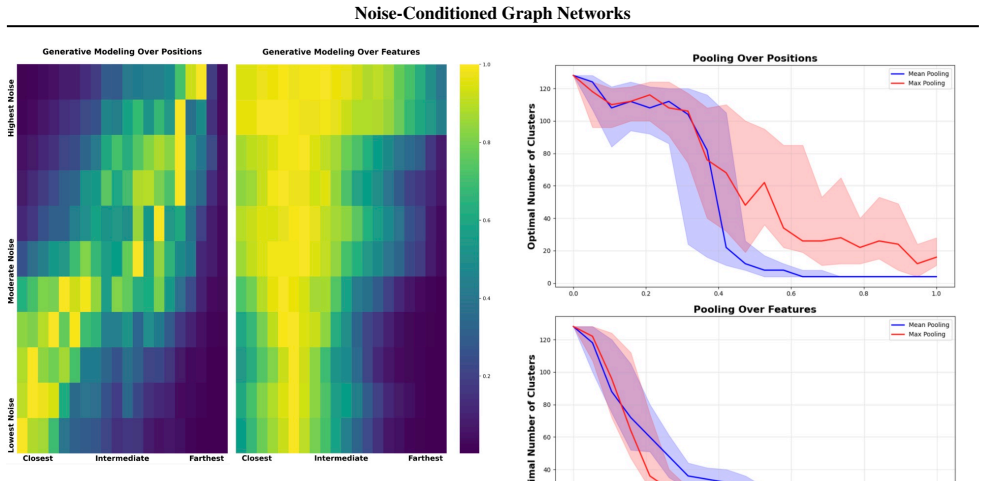
The central claim is that noise level should be an architectural input, not merely a conditioning scalar: the denoising network should be written $v_\theta(G_t, t) = \mathrm{NCGN}_t(G_t)$, with range and resolution changing in $t$, rather than $v_\theta(G_t, t) = \mathrm{GNN}(G_t)$ on a graph structure fixed across the whole process. The supporting argument analyzes a Gaussianized geometric graph in information-theoretic terms. Lemma 3.1 gives the mutual information between a clean node feature and the aggregation of noised features within radius $r$; Theorem 3.2 shows that under the correlation model $\rho(\eta^{(i)},\eta^{(j)}) = 1-(\eta^{(i)}-\eta^{(j)})^2$ the radius maximizing that mutual information strictly increases as the signal-to-noise ratio falls, and Proposition 3.3 argues the same qualitative direction for noised positions. For resolution, the paper demonstrates with Gromov-Wasserstein distances that heavily noised graphs are better preserved by coarse-graining than at full resolution. The concrete instantiation, DMP, coarsens the graph into supernodes, passes messages among them with range $r_t$, and uncoarsens back to the original nodes, using a scheduler $f(t, r_0, r_1, s_0, s_1)$ constrained to be monotone (wider range and fewer supernodes as noise rises) and to hit boundary conditions at $t=0$ and $t=1$; with endpoints chosen so that $r_t s_t = r_1 N$, message passing stays linear-time throughout generation. The paper reports that this single change beats the noise-independent baselines in every tested domain, including an ImageNet FID improvement from 84.051 to 63.983 at equal compute for a modified DiT.
Load-bearing premise
The load-bearing premise is that the simplified Gaussian analysis — which shows the optimal aggregation radius grows as noise increases, proved for a hand-picked correlation function on a continuum of nodes — transfers to real discrete geometric graphs and learned message passing; the paper's evidence for the transfer is the qualitative attention-weight pattern in Section 3.2.
Editorial extensions
If this is right
- Noise-independent flow models leave measurable performance unused: adopting a monotone range-and-resolution schedule is a drop-in change that improved Wasserstein distance on ModelNet40 by 16.15% on average across both GCN and GAT backbones.
- The same exponential schedule transferred across three unrelated domains — 3D shapes, simulated gene-expression graphs, and images — indicating the design rule 'wider and coarser as noise rises' is architecture-agnostic, holding for message-passing GNNs and for transformer-based image diffusion.
- The principle costs nothing in scaling: with boundary endpoints chosen so that $r_t s_t = r_1 N$, DMP keeps linear-time message passing while outperforming quadratic fully connected baselines.
- In image generation, patch size and attention range play the roles of resolution and range, so latent diffusion models can adopt noise-conditioned patching as a free improvement at equal compute.
- Because only monotonicity and boundary conditions are imposed on the scheduler, the theoretical guarantee attaches to the constraint class, not to the particular exponential schedule used in the experiments.
Reading between the lines
- The paper's own layer-count ablation shows DMP degrades like a fully connected network once message-passing layers reach 8 or more; an untested extension is to schedule depth as well as range and resolution — dense communication when noise is high, shallow sparse layers when it is low — which would target the 2-to-4-layer regime where DMP already dominates.
- The scheduler is hand-picked in this paper; the authors flag learnable range and resolution as future work. If monotonicity is the only constraint that matters, a learned monotone scheduler should beat the fixed exponential form by adapting per dataset.
- The central theorem is proved in a continuum idealization with one hand-picked correlation, yet the attention analysis suggests the pattern survives in trained GATs; comparing the radius that maximizes Lemma 3.1's mutual information at each signal-to-noise ratio against the empirically optimal radius found by search would localize where the theory stops being predictive.
- Under the geometric-graph view of images, the ImageNet result predicts that any patch-based latent diffusion model can treat patch size and attention window as noise-conditioned hyperparameters; whether the gain persists at DiT-Large or XL scale, where each patch encodes more learned structure, is a testable next step.
Editorial analysis
A structured set of objections, weighed in public.
Referee Report
Summary. The paper introduces Noise-Conditioned Graph Networks (NCGNs), in which the connectivity radius and node resolution of a GNN used in flow-based generative modeling are scheduled as functions of the noise level. The authors support this design with an information-theoretic analysis of a continuum geometric graph, a qualitative attention-weight analysis, and three sets of experiments: ModelNet40 point-cloud generation, simulated spatiotemporal transcriptomics, and ImageNet 256×256 generation using a modified DiT. They report substantial improvements, including a 16.15% average Wasserstein reduction on ModelNet40 and FID 63.983 versus 84.051 for DiT at equal compute. The central claim is that as noise increases, message passing should reach farther and use coarser nodes.
Significance. If correct, this is a practically valuable and broadly applicable architectural principle: converting existing GNN or transformer generative models to noise-conditioned range/resolution schedules requires minimal code changes and preserves computational complexity. The manuscript is clearly written, releases code, and evaluates across three domains; the ImageNet experiment in particular is an attractive proof of concept. However, the theoretical backbone contains algebraic and kernel-validity errors, and the experimental comparisons lack uncertainty information and are partially inconsistent with the stated design. These issues must be repaired before the central claims can be accepted.
major comments (4)
- [Appendix A.1, Lemma A.1] The denominator in Lemma A.1 is misderived. Substituting the A and B computed in the same lemma into Lemma 3.1 gives A - B^2 = -4r^6/9, so the denominator is 2r/c - 4r^6/9 = r(2/c - 4r^5/9), not the printed 2/c + 4r^6/9. Lemma A.2 and Lemma A.3 differentiate this incorrect expression. With the corrected κ, the monotonicity claim in Theorem 3.2 fails: for c=1 the corrected κ is maximized at the boundary r=1, while for c=0.1 it has an interior maximum near r≈0.8, so lowering the SNR can decrease, not increase, the optimal radius. The monotonicity constraint imposed on the scheduler in Section 4.1 therefore rests on an invalid theorem rather than on a transfer assumption. In addition, ρ(η(i),η(j)) = 1-(η(i)-η(j))^2 is not a valid correlation kernel on [-r,r]: the Gram matrix at positions 0, 0.5, 1 has determinant -1/8, so the Gaussian mutual-information expression in Lemma 3.1 is not well-defined for the claimed range of (r,c).
- [Section 3.1.2 / Appendix A.2, Proposition 3.3] The variance of a difference is computed with the wrong sign. For variance-preserving noise, var(η(i)_t - η(j)_t) = 2(1-t)(1-ρ(γ)), not 2(1-t)+2ρ(γ)(1-t). Consequently the displayed expected squared distance in Proposition 3.3 is incorrect. As written, this proposition does not reliably establish that the distance between nearby nodes grows with the noise level, so it cannot serve as the positional-noising justification for increasing the message-passing radius. The correct formula should be derived and the implications re-evaluated.
- [Tables 1-4] All headline experimental results are reported as single point estimates with no number of seeds, standard deviations, or confidence intervals, so the size and reliability of the claimed 16.15% average improvement and the ImageNet FID gap cannot be assessed. Moreover, Table 3 shows that DMP with GAT is worse than RANDOMKNN on gene imputation (2.575 versus 2.527) and gene knockout (2.397 versus 2.390), and only comparable on several other tasks. This contradicts the abstract's statement that DMP “consistently outperforms” noise-independent architectures; the more guarded wording in Section 5.2 is closer to the data.
- [Appendix B.2, Table 5] The boundary conditions in Table 5 appear to be reversed relative to the design stated in Section 4.1. Section 4.1 specifies at low noise t=1 full resolution and sparse connectivity, and at high noise t=0 coarse resolution and dense connectivity, but Table 5 lists kNN(t=1)=Fully connected, Clusters(t=1)=[√cN], kNN(t=0)=[3√N], and Clusters(t=0)=N. If the experiments actually used this schedule, they do not instantiate DMP as described; if this is a typo, it must be corrected because the boundary conditions are load-bearing for the complexity argument and for reproducibility.
minor comments (5)
- [Figure 2] The axes and the precise family of curves are not labeled; since the figure is based on the erroneous Lemma A.1, it should be regenerated from a corrected expression and preferably with error bars or a quantitative legend.
- [Section 3.2] The attention-weight analysis in Figure 3 averages over the dataset but reports no variation across shapes or noise levels; a few representative curves with variance bands would make the claimed qualitative support more convincing.
- [Appendix B.2, Table 5] The notation [√cN] and [3√N] is ambiguous: it is not stated whether brackets denote rounding, and whether c is the same c as the signal-to-noise ratio in the theoretical section.
- [Section 5.2] The claim that the exponential schedule is used because it “works best” should note that the comparison in Table 2 was run only on ModelNet40 with a diffusion objective; the transfer of this choice to flow-matching on transcriptomics is an assumption rather than an established result.
- [Section 5.3] The statement that DiT-DMP has the same computational complexity as baseline DiT is not fully derived; spelling out the tradeoff between the reduced attention range and the reduced sequence length would make the equivalence transparent.
Circularity Check
No circularity: the derivation is self-contained; the appendix algebra error is a correctness concern, not a circular reduction.
full rationale
The paper's central claims do not reduce to their own inputs by construction. Lemma 3.1 derives a mutual-information formula from stated Gaussian and continuum assumptions on the noising process, and Lemma A.1 evaluates the integrals A and B for a specific, explicitly chosen correlation kernel. Theorem 3.2 and the monotonicity constraint on the DMP scheduler are then consequences of this analytic chain plus the empirical attention and Gromov-Wasserstein analyses in Section 3.2, not of the reported generation results. The DMP scheduler is selected on ModelNet40 and then transferred to other domains; this is model selection on one benchmark, not a fitted parameter being renamed as a prediction, and the reported improvements are not entailed by the scheduler constraint alone. The self-citations to Pao-Huang et al. 2023, Jing et al. 2023, and Qiu et al. 2024 are background or application context and are not load-bearing for any uniqueness claim or architectural choice; no cited result is invoked to forbid alternatives. The paper openly acknowledges that the scheduler is predefined rather than learned, which is an honest limitation rather than a circular step. The principal caveat is a mathematical correctness issue outside the circularity rubric: substituting the paper's own A and B into Lemma 3.1 gives A - B^2 = -4r^6/9, so the denominator in Lemma A.1 should be 2/c - 4r^5/9 rather than 2/c + 4r^6/9, which affects the support for Theorem 3.2. That is an internal algebraic error, not a reduction of the theorem to its assumptions, and the paper does not present this step as an independent empirical prediction. Therefore, no significant circularity is present, and the circularity score is 0.
Assumptions & free parameters
free parameters (3)
- Adaptive schedule function f (exponential) =
exponential interpolation between (r0,s0) and (r1,s1)
- Boundary conditions (r0,r1,s0,s1) per experiment =
Hand-set per dataset, e.g., ModelNet40: r0=c, r1=N, s0=N, s1=floor(sqrt(c*N))
- Voxel clustering grid resolution =
d√s uniform partitions per position dimension
assumptions (5)
- domain assumption Noised positions/features are approximately isotropic Gaussian N(Z_t, diag(σ_t^2))
- ad hoc to paper Nodes form a continuum indexed by R with η(i)=i
- ad hoc to paper Feature correlation is ρ(η(i),η(j)) = 1 - (η(i)-η(j))^2
- domain assumption Message passing can be modeled as summation over a ball of radius r
- domain assumption Variance-preserving noise schedule for positional noising
invented entities (1)
-
Coarse-grained supernodes
Cite this review
Pith. "Pith review of Geometric Generative Modeling with Noise-Conditioned Graph Networks." pith.science (2026). https://pith.science/paper/KHOMGWJR
@misc{pith2026250709391,
  author       = {Pith},
  title        = {Pith review of: Geometric Generative Modeling with Noise-Conditioned Graph Networks},
  year         = {2026},
  howpublished = {\url{https://pith.science/paper/KHOMGWJR}},
  note         = {Machine review of arXiv:2507.09391}
}
abstract
Generative modeling of graphs with spatial structure is essential across many applications from computer graphics to spatial genomics. Recent flow-based generative models have achieved impressive results by gradually adding and then learning to remove noise from these graphs. Existing models, however, use graph neural network architectures that are independent of the noise level, limiting their expressiveness. To address this issue, we introduce \textit{Noise-Conditioned Graph Networks} (NCGNs), a class of graph neural networks that dynamically modify their architecture according to the noise level during generation. Our theoretical and empirical analysis reveals that as noise increases, (1) graphs require information from increasingly distant neighbors and (2) graphs can be effectively represented at lower resolutions. Based on these insights, we develop Dynamic Message Passing (DMP), a specific instantiation of NCGNs that adapts both the range and resolution of message passing to the noise level. DMP consistently outperforms noise-independent architectures on a variety of domains including $3$D point clouds, spatiotemporal transcriptomics, and images. Code is available at https://github.com/peterpaohuang/ncgn.
Figures


Figures from the paper (7 more)


Reference graph
Works this paper leans on
-
[1]
J., Bambrick, J., et al
Abramson, J., Adler, J., Dunger, J., Evans, R., Green, T., Pritzel, A., Ronneberger, O., Willmore, L., Ballard, A. J., Bambrick, J., et al. Accurate structure prediction of biomolecular interactions with alphafold 3. Nature, pp.\ 1--3, 2024
2024
-
[2]
Albergo, M. S., Boffi, N. M., and Vanden-Eijnden, E. Stochastic interpolants: A unifying framework for flows and diffusions. arXiv preprint arXiv:2303.08797, 2023
arXiv 2023
-
[3]
Alon, U. and Yahav, E. On the bottleneck of graph neural networks and its practical implications. In International Conference on Learning Representations, 2021. URL https://openreview.net/forum?id=i80OPhOCVH2
work page 2021
-
[4]
Flow network based generative models for non-iterative diverse candidate generation
Bengio, E., Jain, M., Korablyov, M., Precup, D., and Bengio, Y. Flow network based generative models for non-iterative diverse candidate generation. Advances in Neural Information Processing Systems, 34: 0 27381--27394, 2021
2021
-
[5]
Flexivit: One model for all patch sizes
Beyer, L., Izmailov, P., Kolesnikov, A., Caron, M., Kornblith, S., Zhai, X., Minderer, M., Tschannen, M., Alabdulmohsin, I., and Pavetic, F. Flexivit: One model for all patch sizes. In Proceedings of the IEEE/CVF Conference on Computer Vision and Pattern Recognition, pp.\ 14496--14506, 2023
work page 2023
-
[6]
Bunne, C., Stark, S. G., Gut, G., Del Castillo, J. S., Levesque, M., Lehmann, K.-V., Pelkmans, L., Krause, A., and R \"a tsch, G. Learning single-cell perturbation responses using neural optimal transport. Nature methods, 20 0 (11): 0 1759--1768, 2023
work page 2023
-
[7]
Diffdock: Diffusion steps, twists, and turns for molecular docking
Corso, G., St \"a rk, H., Jing, B., Barzilay, R., and Jaakkola, T. Diffdock: Diffusion steps, twists, and turns for molecular docking. arXiv preprint arXiv:2210.01776, 2022
arXiv 2022
-
[8]
Imagenet: A large-scale hierarchical image database
Deng, J., Dong, W., Socher, R., Li, L.-J., Li, K., and Fei-Fei, L. Imagenet: A large-scale hierarchical image database. In 2009 IEEE conference on computer vision and pattern recognition, pp.\ 248--255. Ieee, 2009
2009
Show all 41 references
-
[9]
and Lenssen, J
Fey, M. and Lenssen, J. E. Fast graph representation learning with pytorch geometric. arXiv preprint arXiv:1903.02428, 2019
1903 arXiv
-
[10]
N., Duvenaud, D., Hern \'a ndez-Lobato, J
G \'o mez-Bombarelli, R., Wei, J. N., Duvenaud, D., Hern \'a ndez-Lobato, J. M., S \'a nchez-Lengeling, B., Sheberla, D., Aguilera-Iparraguirre, J., Hirzel, T. D., Adams, R. P., and Aspuru-Guzik, A. Automatic chemical design using a data-driven continuous representation of mol...
2018
-
[11]
Neighborhood attention transformer
Hassani, A., Walton, S., Li, J., Li, S., and Shi, H. Neighborhood attention transformer. In Proceedings of the IEEE/CVF Conference on Computer Vision and Pattern Recognition, pp.\ 6185--6194, 2023
2023
-
[12]
Denoising diffusion probabilistic models
Ho, J., Jain, A., and Abbeel, P. Denoising diffusion probabilistic models. Advances in neural information processing systems, 33: 0 6840--6851, 2020
2020
-
[13]
Torsional diffusion for molecular conformer generation
Jing, B., Corso, G., Chang, J., Barzilay, R., and Jaakkola, T. Torsional diffusion for molecular conformer generation. Advances in Neural Information Processing Systems, 35: 0 24240--24253, 2022
2022
-
[14]
Eigenfold: Generative protein structure prediction with diffusion models
Jing, B., Erives, E., Pao-Huang, P., Corso, G., Berger, B., and Jaakkola, T. Eigenfold: Generative protein structure prediction with diffusion models. arXiv preprint arXiv:2304.02198, 2023
2023 arXiv
-
[15]
Highly accurate protein structure prediction with alphafold
Jumper, J., Evans, R., Pritzel, A., Green, T., Figurnov, M., Ronneberger, O., Tunyasuvunakool, K., Bates, R., Z \' dek, A., Potapenko, A., et al. Highly accurate protein structure prediction with alphafold. nature, 596 0 (7873): 0 583--589, 2021
2021
-
[16]
Kipf, T. N. and Welling, M. Semi-supervised classification with graph convolutional networks. arXiv preprint arXiv:1609.02907, 2016
2016 arXiv
-
[17]
Neural operator: Graph kernel network for partial differential equations
Li, Z., Kovachki, N., Azizzadenesheli, K., Liu, B., Bhattacharya, K., Stuart, A., and Anandkumar, A. Neural operator: Graph kernel network for partial differential equations. arXiv preprint arXiv:2003.03485, 2020
2003 arXiv
-
[18]
T., Ben-Hamu, H., Nickel, M., and Le, M
Lipman, Y., Chen, R. T., Ben-Hamu, H., Nickel, M., and Le, M. Flow matching for generative modeling. arXiv preprint arXiv:2210.02747, 2022
2022 arXiv
-
[19]
Flow straight and fast: Learning to generate and transfer data with rectified flow
Liu, X., Gong, C., and Liu, Q. Flow straight and fast: Learning to generate and transfer data with rectified flow. arXiv preprint arXiv:2209.03003, 2022
2022 arXiv
-
[20]
Predicting molecular conformation via dynamic graph score matching
Luo, S., Shi, C., Xu, M., and Tang, J. Predicting molecular conformation via dynamic graph score matching. Advances in Neural Information Processing Systems, 34: 0 19784--19795, 2021
2021
-
[21]
Antigen-specific antibody design and optimization with diffusion-based generative models for protein structures
Luo, S., Su, Y., Peng, X., Wang, S., Peng, J., and Ma, J. Antigen-specific antibody design and optimization with diffusion-based generative models for protein structures. Advances in Neural Information Processing Systems, 35: 0 9754--9767, 2022
2022
-
[22]
Gromov--wasserstein distances and the metric approach to object matching
M \'e moli, F. Gromov--wasserstein distances and the metric approach to object matching. Foundations of computational mathematics, 11: 0 417--487, 2011
2011
-
[23]
A., and Battaglia, P
Nash, C., Ganin, Y., Eslami, S. A., and Battaglia, P. Polygen: An autoregressive generative model of 3d meshes. In International conference on machine learning, pp.\ 7220--7229. PMLR, 2020
2020
-
[24]
Action matching: Learning stochastic dynamics from samples
Neklyudov, K., Brekelmans, R., Severo, D., and Makhzani, A. Action matching: Learning stochastic dynamics from samples. In International conference on machine learning, pp.\ 25858--25889. PMLR, 2023
2023
-
[25]
and Suzuki, T
Oono, K. and Suzuki, T. Graph neural networks exponentially lose expressive power for node classification. In International Conference on Learning Representations, 2020. URL https://openreview.net/forum?id=S1ldO2EFPr
2020
-
[26]
Scalable multimer structure prediction using diffusion models
Pao-Huang, P., Jing, B., and Berger, B. Scalable multimer structure prediction using diffusion models. In NeurIPS 2023 AI for Science Workshop, 2023
2023
-
[27]
and Xie, S
Peebles, W. and Xie, S. Scalable diffusion models with transformers. In Proceedings of the IEEE/CVF International Conference on Computer Vision, pp.\ 4195--4205, 2023
2023
-
[28]
stvcr: Reconstructing spatio-temporal dynamics of cell development using optimal transport
Peng, Q., Zhou, P., and Li, T. stvcr: Reconstructing spatio-temporal dynamics of cell development using optimal transport. bioRxiv, pp.\ 2024--06, 2024
2024
-
[29]
D., Weng, C., Hosseinzadeh, S., Yang, D., Pogson, A
Qiu, X., Zhang, Y., Martin-Rufino, J. D., Weng, C., Hosseinzadeh, S., Yang, D., Pogson, A. N., Hein, M. Y., Min, K. H. J., Wang, L., et al. Mapping transcriptomic vector fields of single cells. Cell, 185 0 (4): 0 690--711, 2022
2022
-
[30]
Y., Lu, Y., Yao, J., Jing, Z., Min, K
Qiu, X., Zhu, D. Y., Lu, Y., Yao, J., Jing, Z., Min, K. H., Cheng, M., Pan, H., Zuo, L., King, S., et al. Spatiotemporal modeling of molecular holograms. Cell, 2024
2024
-
[31]
Digit patterning is controlled by a bmp-sox9-wnt turing network modulated by morphogen gradients
Raspopovic, J., Marcon, L., Russo, L., and Sharpe, J. Digit patterning is controlled by a bmp-sox9-wnt turing network modulated by morphogen gradients. Science, 345 0 (6196): 0 566--570, 2014
2014
-
[32]
and Ermon, S
Song, Y. and Ermon, S. Generative modeling by estimating gradients of the data distribution. Advances in neural information processing systems, 32, 2019
2019
-
[33]
Trajectorynet: A dynamic optimal transport network for modeling cellular dynamics
Tong, A., Huang, J., Wolf, G., Van Dijk, D., and Krishnaswamy, S. Trajectorynet: A dynamic optimal transport network for modeling cellular dynamics. In International conference on machine learning, pp.\ 9526--9536. PMLR, 2020
2020
-
[34]
Improving and generalizing flow-based generative models with minibatch optimal transport
Tong, A., Fatras, K., Malkin, N., Huguet, G., Zhang, Y., Rector-Brooks, J., Wolf, G., and Bengio, Y. Improving and generalizing flow-based generative models with minibatch optimal transport. arXiv preprint arXiv:2302.00482, 2023
2023 arXiv
-
[35]
Graph attention networks
Veli c kovi \'c , P., Cucurull, G., Casanova, A., Romero, A., Lio, P., and Bengio, Y. Graph attention networks. arXiv preprint arXiv:1710.10903, 2017
2017 arXiv
-
[36]
L., Juergens, D., Bennett, N
Watson, J. L., Juergens, D., Bennett, N. R., Trippe, B. L., Yim, J., Eisenach, H. E., Ahern, W., Borst, A. J., Ragotte, R. J., Milles, L. F., et al. De novo design of protein structure and function with rfdiffusion. Nature, 620 0 (7976): 0 1089--1100, 2023
2023
-
[37]
Demystifying oversmoothing in attention-based graph neural networks
Wu, X., Ajorlou, A., Wu, Z., and Jadbabaie, A. Demystifying oversmoothing in attention-based graph neural networks. Advances in Neural Information Processing Systems, 36, 2024
2024
-
[38]
3d shapenets: A deep representation for volumetric shapes
Wu, Z., Song, S., Khosla, A., Yu, F., Zhang, L., Tang, X., and Xiao, J. 3d shapenets: A deep representation for volumetric shapes. In Proceedings of the IEEE conference on computer vision and pattern recognition, pp.\ 1912--1920, 2015
1912
-
[39]
Geodiff: A geometric diffusion model for molecular conformation generation
Xu, M., Yu, L., Song, Y., Shi, C., Ermon, S., and Tang, J. Geodiff: A geometric diffusion model for molecular conformation generation. arXiv preprint arXiv:2203.02923, 2022
2022 arXiv
-
[40]
Pointflow: 3d point cloud generation with continuous normalizing flows
Yang, G., Huang, X., Hao, Z., Liu, M.-Y., Belongie, S., and Hariharan, B. Pointflow: 3d point cloud generation with continuous normalizing flows. In Proceedings of the IEEE/CVF international conference on computer vision, pp.\ 4541--4550, 2019
2019
-
[41]
write newline
" write newline "" before.all 'output.state := FUNCTION n.dashify 't := "" t empty not t #1 #1 substring "-" = t #1 #2 substring "--" = not "--" * t #2 global.max substring 't := t #1 #1 substring "-" = "-" * t #2 global.max substring 't := while if t #1 #1 substring * t #2 gl...
Reviewed August 6, 2026 · model on record in the stance chip above.
Discussion (0). Sign in to comment.