REVIEW 3 major objections 3 minor 49 references
Decomposition of multi-qutrit gates generated by Weyl-Heisenberg strings
T0 review · 3 major / 3 minor · reviewed 2026-08-06 · deepseek-v4-flash
Pith's one-line read This paper introduces an algorithm that decomposes exponentials of Weyl-Heisenberg and Gell-Mann strings into single- and two-qutrit gates, and extends the Steiner-Gauss routing method to qutrit architectures.
desk verdict The Weyl Z-string and ternary routing ideas are solid, but the Gell-Mann expansion coefficients are wrong, so the central claim is unsupported as stated. read the letter →
The pith
A machine-rendered reading of the paper's core claim, the machinery that carries it, and where it could break.
The reading
What carries the argument
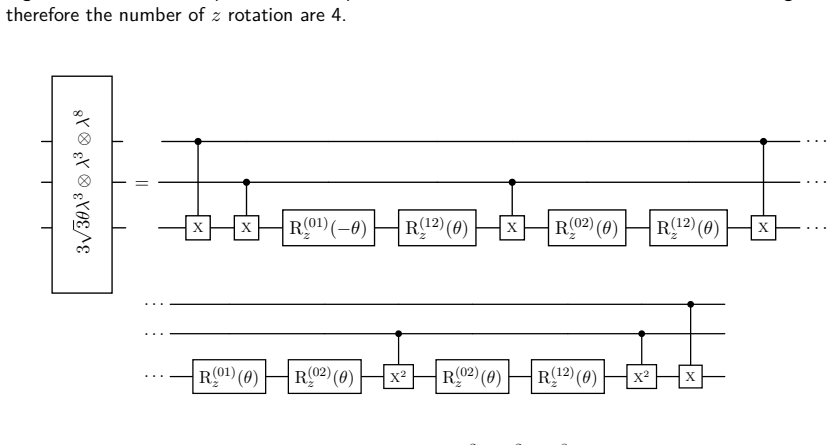
The load-bearing object is the Weyl $Z$-string, $cZ^{s_1}\otimes\cdots\otimes Z^{s_{N-1}}\otimes Z+\mathrm{h.c.}$, a Hermitian combination of tensor products of powers of the qutrit $Z$ gate. The identity that carries the argument is Eq. (16), which expands a diagonal Gell-Mann string into $2^{N-1}$ such Weyl $Z$-strings with closed-form coefficients (Eqs. (17)--(18)); Appendix A proves both this expansion and the per-string circuit. The per-string circuit uses a ladder of $CX$ and $CX^2$ gates that concentrates the parity of the input qutrits onto one target qutrit, a block of $z$-rotations $R_z^{(ij)}$, and the inverse ladder. A Gray-code ordering of the blocks lets consecutive blocks cancel shared $CX$ gates, yielding the quoted gate counts. For routing on restricted topologies, the paper introduces the ternary parity map, a $GF(3)$-linear map that acts as an intermediate representation for circuits made of $CX$, $CX^2$, and $\sigma_x^{(12)}$ gates, and feeds the Steiner-Gauss extraction algorithm.
What would settle it
Expand the right-hand side of Eq. (16) for the worked example $\lambda_8\otimes\lambda_3\otimes\lambda_8$ in the computational basis, using $\lambda_3=-i\omega/\sqrt{3}\,Z+\mathrm{h.c.}$ and $\lambda_8=-\omega/\sqrt{3}\,Z+\mathrm{h.c.}$, and compare all $27$ matrix elements with the left-hand side. The $(0,0,0)$ entry, which must equal $1/3$, is the quickest spot check; any mismatch would show the coefficient formulas do not represent the Gell-Mann string, so the circuit in Fig. 18 implements a different unitary.
Extended reading notes
Core claim
The central claim is a closed-form reduction: every diagonal Gell-Mann string $\lambda_{i_1}\otimes\cdots\otimes\lambda_{i_N}$ with $i_j\in\{3,8\}$ can be written as a weighted sum of $2^{N-1}$ Weyl $Z$-strings $c_k Z^{s_1}\otimes\cdots\otimes Z^{s_{N-1}}\otimes Z+\mathrm{h.c.}$, with coefficients $c_k$ given explicitly by parity and string-position formulas (Eqs. (17)--(18)). Each Weyl $Z$-string exponential is then implemented by an entangling ladder of $CX$/$CX^2$ gates onto one target qutrit, a single-qutrit $z$-rotation block, and the inverse ladder. Ordering the $2^{N-1}$ blocks in Gray-code sequence lets neighboring blocks share $CX$ gates, giving a total $CX$ count of $2^{N-1}+2N-3$ for an $N$-qutrit Gell-Mann string. The same machinery generalizes Pauli-string decomposition to qutrits, and the authors extend the Steiner-Gauss routing algorithm to limited-connectivity qutrit devices by replacing the $GF(2)$ parity map with a ternary parity map over $GF(3)$.
Load-bearing premise
The whole construction rests on the coefficient formulas in Eqs. (17)--(18) being exactly right: they must express every diagonal Gell-Mann string as the stated weighted sum of products of powers of the qutrit $Z$ operator.
Editorial extensions
If this is right
- Trotterized evolution of any Hamiltonian expressed in Gell-Mann or Weyl-Heisenberg terms compiles into $CX$, $CX^2$, and single-qutrit rotations with per-string $CX$ count $2^{N-1}+2N-3$ and at most $2^N$ $z$-rotation gates.
- Qutrit QAOA for graph $k$-coloring with $k=3^n$ uses $\lceil\log_3 k\rceil$ qutrits per node, avoids penalty Hamiltonians for the encoding, and gives circuits shallower than qubit binary encoding, with the advantage growing as $k$ increases.
- Because Gell-Mann and Weyl-Heisenberg matrices form complete operator bases (with identity), any multi-qutrit gate that is diagonal up to single-qutrit rotations can be decomposed by this method.
- The ternary parity map gives a connectivity-aware compilation path for limited-topology qutrit devices, extending the Steiner-Gauss gate-count reductions known for CNOT circuits.
- Using the alternative generators $\tilde{\lambda}_3$ and $\tilde{\lambda}_8$ from Eq. (38) in place of $\lambda_3$ and $\lambda_8$ simplifies the single-qutrit rotation blocks, lowering the rotation count in the compiled circuits.
Reading between the lines
- The same expansion strategy should transfer to qudit systems of prime dimension $d>3$ by using the $d$-dimensional clock operator and a $GF(d)$ parity map; the paper notes this direction but does not carry it out.
- Because the coefficients are closed-form, the decomposition is straightforward to automate: a compiler can precompute the $c_k$ for each string type and emit circuits without solving linear systems.
- The Gray-code block ordering used here could also lower CNOT counts in qubit Pauli-string exponentials, since the qubit construction is a special case of the same commuting-block structure.
- For color counts $k$ that are not powers of three, a ternary encoding with penalty terms would still use fewer qutrits than binary encoding, though the depth comparison has not been worked out in the paper.
Editorial analysis
A structured set of objections, weighed in public.
Referee Report
Summary. The manuscript proposes qutrit analogues of Pauli-string decomposition. Section 3.1 presents an algorithm for decomposing exponentials of Weyl Z-strings of the form c Z^{s1}⊗...⊗Z + h.c. into CX, CX2, and single-qutrit rotations, and then extends the method to exponentials of Gell-Mann strings by expanding a Gell-Mann string as a weighted sum of Weyl Z-strings via Eqs. (16)-(19). Section 3.2 applies the technique to qutrit QAOA for graph k-coloring, and Section 4 generalizes the Steiner-Gauss algorithm to qutrit architectures using a ternary parity map.
Significance. The Weyl Z-string decomposition in Appendix A and the ternary parity map in Section 4 are useful contributions and appear technically sound, and the QAOA resource comparison in Table 2 is potentially interesting. However, the central Gell-Mann expansion coefficients in Eqs. (17)-(18) and in Appendix B are incorrect, so the claimed decomposition of Gell-Mann string exponentials is not established. The contribution is therefore conditional on a corrected derivation of these coefficients.
major comments (3)
- [Section 3.1, Eq. (17)] Equation (17) is inconsistent with Eq. (15). For N=2 with λ8⊗λ8, direct expansion using Eq. (15) gives λ8⊗λ8 = (ω²/3)(Z⊗Z + h.c.) + (1/3)(Z²⊗Z + h.c.), so the coefficient of the Z²⊗Z string is c1 = 1/3. Equation (17) instead yields c1 = ω/3. Substituting the printed coefficients into Eq. (16), the |00⟩ matrix element of the right-hand side is 2Re(c0) + 2Re(c1) = -2/3, whereas ⟨00|λ8⊗λ8|00⟩ = 1/3. Thus the general coefficient formula fails even in the simplest two-qutrit case.
- [Appendix B, Eq. (46)] The coefficients printed for λ8⊗λ3⊗λ8 do not satisfy Eq. (16). A direct expansion using Eq. (15) yields c0 = -i/(3√3), c1 = -(√3+i)/(6√3), c2 = (√3+i)/(6√3), and c3 = (√3-i)/(6√3); the printed values instead produce ⟨000|RHS|000⟩ = 1 rather than ⟨000|λ8⊗λ3⊗λ8|000⟩ = 1/3. The worked example and any circuits depending on these coefficients are therefore incorrect.
- [Section 3.1, Eqs. (16)-(19)] Because the Gell-Mann-to-Weyl expansion is the load-bearing step for the claimed decomposition of Gell-Mann string exponentials, the main algorithmic claim of Section 3.1 is unsupported. The CX-count and rotation-count statements may survive with a corrected coefficient set, but the correctness of the circuits in Figs. 6-8 and the general claim for arbitrary Gell-Mann strings are not established by the present derivation.
minor comments (3)
- [Section 4.4] The final paragraph of Section 4.4 contains an apparent editorial artifact: the text reads "Here's an improved and clearer version of your sentence..." and "Let me know if you'd like it to sound more formal, more technical, or simplified further." This passage must be removed before any resubmission.
- [Eqs. (18)-(19)] The notation s(k)+1/2 in Eq. (18) is never defined; the authors should clarify whether it means adding 1/2 to every entry of the string s(k) or some other operation.
- [Fig. 4 caption and surrounding text] The text refers to "control qubit" and "target qubit" in the context of CX gates on qutrits; these should be "control qutrit" and "target qutrit" throughout.
Circularity Check
No significant circularity: the Gell-Mann-to-Weyl decomposition is derived algebraically from operator identities; self-citations are background only.
full rationale
The central decomposition (Section 3.1) is not circular. Equation (15) gives exact identities lambda8 = -(omega/sqrt(3))Z + h.c. and lambda3 = -i(omega/sqrt(3))Z + h.c., and Eq. (16) is the direct expansion of a tensor product into 2^{N-1} Weyl Z-strings; the coefficients c_k are then obtained constructively in Appendix A by introducing the conjugate generators lambda_tilde_3 and lambda_tilde_8 and computing a_k = i^{n3}/sqrt(3^N)(-1)^{f(i,s(k))}. No quantity in Eqs. (16)-(18), (40)-(46) is fitted to data or to the target unitary; the circuit identities in Eqs. (33)-(37) and Fig. 4 provide a step-by-step decomposition of each Weyl Z-string exponential into CX, CX2 and single-qutrit rotations. The paper's own prior work is cited for background (e.g., refs. [2], [16], [38], [41]) or for qutrit QAOA context ([15], not by the authors), but the decomposition proof does not rely on those citations. The skeptical objection that the printed coefficients in Eqs. (17)-(18) and Eq. (46) fail direct matrix-element checks is a mathematical-correctness concern, not a circularity concern: an incorrect coefficient is not an input that has been relabeled as a prediction. Similarly, the ternary-parity-map extension of Steiner-Gauss in Section 4.3 is an explicit algorithm over GF(3) with worked examples, not a renaming of the qubit result. Hence the derivation chain is self-contained; any flaw would be an algebraic error, not a circular reduction.
Assumptions & free parameters
assumptions (4)
- standard math The identity e^{-iθ U P U†} = U e^{-iθ P} U† for unitary U, used to translate CX conjugation of Weyl Z-strings into a circuit decomposition.
- domain assumption CX, CX2 and single-qutrit rotations are the native gate set for the target qutrit hardware.
- domain assumption The decreasing Steiner tree method requires the connectivity graph to contain a Hamiltonian path.
- ad hoc to paper The expansion coefficients in Eqs. (16)-(19) and Appendix B correctly decompose Gell-Mann strings into Weyl Z-strings.
Cite this review
Pith. "Pith review of Decomposition of multi-qutrit gates generated by Weyl-Heisenberg strings." pith.science (2026). https://pith.science/paper/ISR36W5X
@misc{pith2026250709781,
  author       = {Pith},
  title        = {Pith review of: Decomposition of multi-qutrit gates generated by Weyl-Heisenberg strings},
  year         = {2026},
  howpublished = {\url{https://pith.science/paper/ISR36W5X}},
  note         = {Machine review of arXiv:2507.09781}
}
abstract
Decomposing unitary operations into native gates is an essential step for implementing quantum algorithms. For qubit-based devices, where native gates are typically single- and two-qubit operations, a range of decomposition techniques have been developed. In particular, efficient algorithms exist for decomposing exponentials of Pauli strings while taking hardware topology in account. Motivated by the growing interest in qutrit-based quantum computing, we develop analogous decomposition methods for qutrit systems. Specifically, we introduce an algorithm that decomposes the exponential of an arbitrary tensor product of Weyl-Heisenberg operators (plus their Hermitian conjugation) into single- and two-qutrit gates. We further extend this approach to unitaries generated by Gell-Mann string (i.e., a tensor product of Gell-Mann matrices). Since both Gell-Mann matrices and Weyl-Heisenberg operators form (together with identity) complete operator bases of qutrit operators, we can use this result also to decompose any multi-qutrit gate that is diagonal up to single-qutrit rotations. As a practical application, we use our method to decompose the layers of the quantum approximate optimization algorithm for qutrit-based implementations of the graph k-coloring problem. For values of $k$ well-suited to qutrit architectures (e.g., $k=3$ or in general $k=3^n$), our approach yields significantly shallower circuits compared to qubit-based implementations, an advantage that grows with problem size, while also requiring a smaller total Hilbert space dimension. Finally, we also address the routing challenge in qutrit architectures that arises due to the limited connectivity of the devices. In particular, we generalize the Steiner-Gauss method, originally developed to reduce CNOT counts in qubit circuit, to optimize gate routing in qutrit-based systems.
Figures


Figures from the paper (14 more)




Reference graph
Works this paper leans on
-
[1]
Quantum computing in the nisq era and beyond
John Preskill. “Quantum computing in the nisq era and beyond”. Quantum2, 79 (2018)
2018
-
[2]
Zoltán Zimborás, Bálint Koczor, Zoë Holmes, Elsi-Mari Borrelli, András Gilyén, Hsin- Yuan Huang, Zhenyu Cai, Antonio Acín, Leandro Aolita, Leonardo Banchi, et al. “Mythsaroundquantumcomputationbeforefullfaulttolerance: Whatno-gotheorems rule out and what they don’t” (2025). arXiv:2501.05694
arXiv 2025
-
[3]
Superadiabatic population transfer in a three-level superconducting circuit
Antti Vepsäläinen, Sergey Danilin, and Gheorghe Sorin Paraoanu. “Superadiabatic population transfer in a three-level superconducting circuit”. Science advances5, eaau5999 (2019). 21
work page 2019
-
[4]
Quantum phase estimation with time-frequency qudits in a single photon
Hsuan-Hao Lu, Zixuan Hu, Mohammed Saleh Alshaykh, Alexandria Jeanine Moore, Yuchen Wang, Poolad Imany, Andrew Marc Weiner, and Sabre Kais. “Quantum phase estimation with time-frequency qudits in a single photon”. Adv. Quantum Technol. 3, 1900074 (2019)
work page 2019
-
[5]
Quantum information scrambling on a superconducting qutrit processor
Machiel S Blok, Vinay V Ramasesh, Thomas Schuster, Kevin O’Brien, John-Mark Kreikebaum, Dar Dahlen, Alexis Morvan, Beni Yoshida, Norman Y Yao, and Irfan Siddiqi. “Quantum information scrambling on a superconducting qutrit processor”. Phys. Rev. X11, 021010 (2021)
work page 2021
-
[6]
Qutrit randomized benchmarking
Alexis Morvan, Venkata V. Ramasesh, Martijn S. Blok, John Mark Kreikebaum, Kathleen P. O’Brien, Leo Chen, Brian K. Mitchell, Ritesh K. Naik, Daniel I. San- tiago, and Irfan Siddiqi. “Qutrit randomized benchmarking”. Phys. Rev. Lett.126, 210504 (2021)
work page 2021
-
[7]
High-fidelity qutrit entangling gates for superconducting circuits
Noah Goss, Alexis Morvan, Brian Marinelli, Bradley K. Mitchell, Long B. Nguyen, Ravi K. Naik, Larry Chen, Christian Jünger, John Mark Kreikebaum, David I. San- tiago, Joel J. Wallman, and Irfan Siddiqi. “High-fidelity qutrit entangling gates for superconducting circuits”. Nat. Commun.13, 7481 (2022)
work page 2022
-
[8]
A universal qudit quantum processor with trapped ions
Martin Ringbauer, Michael Meth, Lukas Postler, Roman Stricker, Rainer Blatt, Philipp Schindler, and Thomas Monz. “A universal qudit quantum processor with trapped ions”. Nat. Phys.18, 1053–1057 (2022)
work page 2022
Show all 49 references
-
[9]
A programmable qudit-based quantum processor
Yulin Chi, Jieshan Huang, Zhanchuan Zhang, Jun Mao, Zinan Zhou, Xiaojiong Chen, Chonghao Zhai, Jueming Bao, Tianxiang Dai, Huihong Yuan, et al. “A programmable qudit-based quantum processor”. Nature communications13, 1166 (2022)
2022
-
[10]
Extending the com- putational reach of a superconducting qutrit processor
Noah Goss, Samuele Ferracin, Akel Hashim, Arnaud Carignan-Dugas, John Mark Kreikebaum, Ravi K Naik, David I Santiago, and Irfan Siddiqi. “Extending the com- putational reach of a superconducting qutrit processor”. npj Quantum Information 10, 101 (2024)
2024
-
[11]
Factoring with qutrits: Shor’s algorithm on ternary and metaplectic quantum architectures
Alex Bocharov, Martin Roetteler, and Krysta M. Svore. “Factoring with qutrits: Shor’s algorithm on ternary and metaplectic quantum architectures”. Phys. Rev. A 96, 012306 (2017)
2017
-
[12]
Qudits and high- dimensional quantum computing
Yuchen Wang, Zixuan Hu, Barry C Sanders, and Sabre Kais. “Qudits and high- dimensional quantum computing”. Frontiers in Physics8, 589504 (2020)
2020
-
[13]
Time-efficient implementation of quantum search with qudits
S. S. Ivanov, H. S. Tonchev, and N. V. Vitanov. “Time-efficient implementation of quantum search with qudits”. Phys. Rev. A85, 062321 (2012)
2012
-
[14]
Two-qutrit quantum algorithms on a programmable superconducting processor
Tanay Roy, Ziqian Li, Eliot Kapit, and David I. Schuster. “Two-qutrit quantum algorithms on a programmable superconducting processor”. Phys. Rev. Appl.19, 064024 (2023)
2023
-
[15]
Exploring the potential of qutrits for quantum optimization of graph coloring
Gabriel Bottrill, Mudit Pandey, and Olivia Di Matteo. “Exploring the potential of qutrits for quantum optimization of graph coloring”. In 2023 IEEE International Conference on Quantum Computing and Engineering (QCE). Volume 01, pages 177–
2023
-
[16]
Efficient qudit based scheme for photonic quantum computing
Márton Karácsony, László Oroszlány, and Zoltan Zimboras. “Efficient qudit based scheme for photonic quantum computing”. SciPost Physics Core7, 032 (2024)
2024
-
[17]
Transmon qutrit-based simulation of spin-1 aklt systems
Keerthi Kumaran, Faisal Alam, Norhan Eassa, Kaelyn Ferris, Xiao Xiao, Lukasz Cincio, Nicholas Bronn, and Arnab Banerjee. “Transmon qutrit-based simulation of spin-1 aklt systems” (2024)
2024
-
[18]
Qutrit circuits and algebraic relations: A pathway to efficient spin-1 hamiltonian simulation
Oluwadara Ogunkoya, Joonho Kim, Bo Peng, A Barış Özgüler, and Yuri Alexeev. “Qutrit circuits and algebraic relations: A pathway to efficient spin-1 hamiltonian simulation”. Physical Review A109, 012426 (2024). 22
2024
-
[19]
Realization of efficient quantum gates with a superconducting qubit-qutrit circuit
Thorvald Bækkegaard, Lasse Bjørn Kristensen, Niels Jakob Søe Loft, Chris- tian Kraglund Andersen, Dimitris Petrosyan, and Nikolaj T. Zinner. “Realization of efficient quantum gates with a superconducting qubit-qutrit circuit”. Scientific Re- ports9, 13389 (2019)
2019
-
[20]
Asymptotic improvements to quantum circuits via qutrits
Pranav Gokhale, Jonathan M. Baker, Casey Duckering, Natalie C. Brown, Kenneth R. Brown, and Frederic T. Chong. “Asymptotic improvements to quantum circuits via qutrits”. In Proceedings of the 46th International Symposium on Computer Architec- ture. Page 554–566. ISCA ’19. ACM (2019)
2019
-
[21]
Quantum-classical tradeoffs and multi-controlled quantum gate decompositions in variational algo- rithms
Teague Tomesh, Nicholas Allen, Daniel Dilley, and Zain Saleem. “Quantum-classical tradeoffs and multi-controlled quantum gate decompositions in variational algo- rithms”. Quantum8, 1493 (2024)
2024
-
[22]
Quantum computation and quantum informa- tion: 10th anniversary edition
Michael A Nielsen and Isaac Chuang. “Quantum computation and quantum informa- tion: 10th anniversary edition”. Cambridge University Press. (2010)
2010
-
[23]
A quantum approximate opti- mization algorithm
Edward Farhi, Jeffrey Goldstone, and Sam Gutmann. “A quantum approximate opti- mization algorithm” (2014). arXiv:1411.4028
2014 arXiv
-
[24]
Efficient mapping of quantum circuits to the ibm qx architectures
Alwin Zulehner, Alexandru Paler, and Robert Wille. “Efficient mapping of quantum circuits to the ibm qx architectures”. In Design, Automation and Test in Europe Conference and Exhibition (DATE). Pages 1135–1138. (2018)
2018
-
[25]
Using reinforcement learning to find effi- cient qubit routing policies for deployment in near-term quantum computers
Steven Herbert and Akash Sengupta. “Using reinforcement learning to find effi- cient qubit routing policies for deployment in near-term quantum computers” (2019). arXiv:1812.11619
2019 arXiv
-
[26]
Cnot circuit extraction for topologically-constrained quantum memories
Aleks Kissinger and Arianne Meijer van de Griend. “Cnot circuit extraction for topologically-constrained quantum memories” (2019). arXiv:1904.00633
2019 arXiv
-
[27]
Quantum circuit optimizations for nisq architectures
Beatrice Nash, Vlad Gheorghiu, and Michele Mosca. “Quantum circuit optimizations for nisq architectures”. Quantum Science and Technology5, 025010 (2020)
2020
-
[28]
Symmetries of baryons and mesons
Murray Gell-Mann. “Symmetries of baryons and mesons”. Phys. Rev.125, 1067– 1084 (1962)
1962
-
[29]
Teleporting an unknown quantum state via dual classical and einstein-podolsky-rosen channels
Charles H. Bennett, Gilles Brassard, Claude Crépeau, Richard Jozsa, Asher Peres, and William K. Wootters. “Teleporting an unknown quantum state via dual classical and einstein-podolsky-rosen channels”. Phys. Rev. Lett.70, 1895–1899 (1993)
1993
-
[30]
Bloch vectors for qudits
Reinhold A Bertlmann and Philipp Krammer. “Bloch vectors for qudits”. Journal of Physics A: Mathematical and Theoretical41, 235303 (2008)
2008
-
[31]
Elementary gates for ternary quantum logic cir- cuit
Yao-Min Di and Hai-Rui Wei. “Elementary gates for ternary quantum logic cir- cuit” (2012). arXiv:1105.5485
2012 arXiv
-
[32]
Constructing all qutrit controlled clifford+t gates in clifford+t
Lia Yeh and John van de Wetering. “Constructing all qutrit controlled clifford+t gates in clifford+t”. Page 28–50. Springer International Publishing. (2022)
2022
-
[33]
On swapping the states of two qudits
Colin Wilmott. “On swapping the states of two qudits” (2011). arXiv:1101.4159
2011 arXiv
-
[34]
A swap gate for qudits
Juan Carlos Garcia-Escartin and Pedro Chamorro-Posada. “A swap gate for qudits”. Quantum Inf. Process.12, 3625–3631 (2013)
2013
-
[35]
Phase gadget synthesis for shallow circuits
Alexander Cowtan, Silas Dilkes, Ross Duncan, Will Simmons, and Seyon Sivarajah. “Phase gadget synthesis for shallow circuits”. Electronic Proceedings in Theoretical Computer Science318, 213–228 (2020)
2020
-
[36]
Redefining lexicographical ordering: Optimizing pauli string decompositions for quantum compiling
Qunsheng Huang, David Winderl, Arianne Meijer van de Griend, and Richie Ye- ung. “Redefining lexicographical ordering: Optimizing pauli string decompositions for quantum compiling”. In 2024 IEEE International Conference on Quantum Com- puting and Engineering (QCE). Pages 885–8...
2024 arXiv
-
[37]
Ising formulations of many np problems
Andrew Lucas. “Ising formulations of many np problems”. Frontiers in Physics2, 5 (2014). 23
2014
-
[38]
Quantum optimization for the graph coloring problem with space-efficient embedding
Zsolt Tabi, Kareem H. El-Safty, Zsofia Kallus, Peter Haga, Tamas Kozsik, Adam Glos, and Zoltan Zimboras. “Quantum optimization for the graph coloring problem with space-efficient embedding”. In 2020 IEEE International Conference on Quantum Computing and Engineering (QCE). Volu...
2020
-
[39]
Solvingbooleansatisfiabilityproblemswith the quantum approximate optimization algorithm
SamiBoulebnaneandAshleyMontanaro. “Solvingbooleansatisfiabilityproblemswith the quantum approximate optimization algorithm”. PRX Quantum5, 030348 (2024)
2024
-
[40]
From the quantum approximate optimization algorithm to a quantum alternating operator ansatz
Stuart Hadfield, Zhihui Wang, Bryan O’Gorman, Eleanor G. Rieffel, Davide Ven- turelli, and Rupak Biswas. “From the quantum approximate optimization algorithm to a quantum alternating operator ansatz”. Algorithms12, 34 (2019)
2019
-
[41]
Space-efficient binary opti- mization for variational quantum computing
Adam Glos, Aleksandra Krawiec, and Zoltán Zimborás. “Space-efficient binary opti- mization for variational quantum computing”. npj Quantum Information8, 39 (2022)
2022
-
[42]
Computers and intractability; a guide to the theory of np-completeness
Michael R. Garey and David S. Johnson. “Computers and intractability; a guide to the theory of np-completeness”. W. H. Freeman & Co. USA (1990)
1990
-
[43]
New methods to color the vertices of a graph
Daniel Brélaz. “New methods to color the vertices of a graph”. Commun. ACM22, 251–256 (1979)
1979
-
[44]
A memetic algorithm for graph coloring
Zhipeng Lü and Jin-Kao Hao. “A memetic algorithm for graph coloring”. Eur. J. Oper. Res203, 241–250 (2010)
2010
-
[45]
Quantum approximate optimization algorithm for qudit systems
Yannick Deller, Sebastian Schmitt, Maciej Lewenstein, Steve Lenk, Marika Federer, Fred Jendrzejewski, Philipp Hauke, and Valentin Kasper. “Quantum approximate optimization algorithm for qudit systems”. Phys. Rev. A107, 062410 (2023)
2023
-
[46]
High-dimensional counterdiabatic quantum computing
Diego Tancara and Francisco Albarrán-Arriagada. “High-dimensional counterdiabatic quantum computing” (2024). arXiv:2410.10622
2024 arXiv
-
[47]
t|ket〉: a retargetable compiler for nisq devices
Seyon Sivarajah, Silas Dilkes, Alexander Cowtan, Will Simmons, Alec Edgington, and Ross Duncan. “t|ket〉: a retargetable compiler for nisq devices”. Quantum Sci. Technol. 6, 014003 (2021)
2021
-
[48]
Improved steiner tree approximation in graphs
Gabriel Robins and Alex Zelikovsky. “Improved steiner tree approximation in graphs”. In ACM-SIAM Symposium on Discrete Algorithms. (2000). url:https://api. semanticscholar.org/CorpusID:5269457
2000
-
[49]
Optimal synthesis of linear reversible circuits
Ketan Patel, Igor Markov, and John Hayes. “Optimal synthesis of linear reversible circuits”. Quantum Inf. Comput.8, 282–294 (2004). A Proof for the decomposition of a generic Gell-Mann string We prove how the WeylZ-string defined in Eq.(12)can be decomposed into CX, CX2 and si...
2004
Reviewed August 6, 2026 · model on record in the stance chip above.
Discussion (0). Continue with ORCID to comment.