REVIEW 4 major objections 5 minor 49 references
ReDiSC: A Reparameterized Masked Diffusion Model for Scalable Node Classification with Structured Predictions
T0 review · 4 major / 5 minor · reviewed 2026-08-06 · deepseek-v4-flash
Pith's one-line read ReDiSC learns the joint distribution of node labels with a reparameterized masked diffusion model, runs variational EM with pseudo-labels, and scales to million-node graphs where continuous-domain diffusion baselines run out of memory.
desk verdict Worth refereeing: a genuine discrete diffusion model for node classification with strong empirical results on large graphs, but the O(NDK) complexity claim is not supported by the algorithm as written. read the letter →
The pith
A machine-rendered reading of the paper's core claim, the machinery that carries it, and where it could break.
The reading
What carries the argument
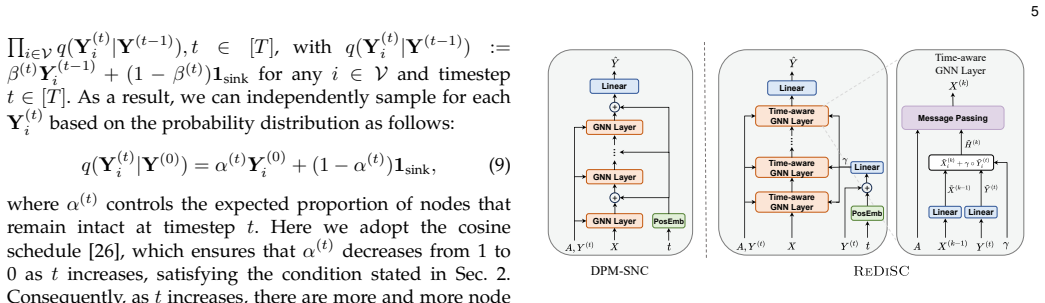
The engine is a reparameterized masked diffusion model (RMDM): the forward process maps each one-hot label to an absorbing "sink" state with probability 1−α(t), and the reverse transition is written with Bernoulli routing variables that either keep a node's denoised label or re-mask it. The denoiser Dθ(Y(t), t, G) is a time-aware GNN that scales the fusion of node features and noisy label embeddings by a timestep-dependent factor γ∈[0,1]^d', and its output is forced to be consistent with already denoised labels. Two sampling-side mechanisms carry the argument: labeled-first inference, which spends the denoising budget on labeled nodes first so that pruning of inconsistent paths happens early and each node is denoised once, and a priority queue that weights pseudo-label samples by validation accuracy during EM training. Together they make the E-step cost comparable to a single GNN forward pass per node and turn the learned model into an ensemble of "GNN+LP" hybrids across mask ratios.
What would settle it
Count the actual number of GNN message-passing operations in Algorithm 2 on ogbn-products with T=40: if the denoiser is executed T times over the full graph, or if measured wall-clock time grows linearly with T after accounting for parallelization, the O(NDK) E-step claim is not supported by the implemented procedure.
Extended reading notes
Core claim
The central claim is that node classification should be treated as estimation of p(Y|G), the joint distribution of node labels, and that a reparameterized masked diffusion model is the right estimator for this joint distribution at scale. ReDiSC uses an absorbing "sink" state as the noise distribution, so the forward process progressively masks node labels, and the reverse process denoises each node exactly once. Training is cast as variational EM: the M-step maximizes an ELBO over pseudo-labels sampled in the E-step, with a priority queue selecting higher-quality pseudo-labels. The paper shows that the M-step objective equals a weighted sum of "GNN+LP" hybrid losses, giving an interpretable connection to label propagation, and argues that the E-step of ReDiSC costs O(NDK) message-passing operations versus O(TNDK) for DPM-SNC, where N is the number of nodes, D the average degree, K the GNN depth, and T the number of diffusion steps. Empirically, ReDiSC outperforms or matches baselines on eight benchmarks and scales to ogbn-products (2.4M nodes), where LGD and DPM-SNC run out of memory.
Load-bearing premise
The linear-time E-step claim rests on the assumption that each node is denoised once through sampled neighborhoods, but the sampling algorithm as written invokes the GNN denoiser on the full graph at every timestep.
Editorial extensions
If this is right
- Structured prediction becomes practical on large graphs: diffusion-based joint label modeling no longer requires T costly backward passes over the full graph, so methods like ReDiSC can be applied where DPM-SNC and LGD run out of memory.
- Because the model is an ensemble of GNN+LP hybrids, its behavior is interpretable through classical label propagation, and insights from LP research can inform how different mask ratios act as propagation strengths.
- Subgraph-level consistency improves substantially: on ogbn-arxiv, ReDiSC raises subgraph accuracy by 47.8% over the GraphSAGE backbone, indicating that jointly modeled labels align entire neighborhoods, not just individual nodes.
- Fewer diffusion steps suffice: ReDiSC remains accurate at T=40 and T=60 on most datasets, so practitioners can trade horizon for speed without the accuracy collapse seen in continuous-domain alternatives.
- The components generalize: the time-aware GNN layer and priority queue each give consistent gains in ablation, and the paper suggests they can benefit other diffusion-based models.
Reading between the lines
- An extension the paper does not pursue is applying the same labeled-first inverse-problem solver to other graph tasks with partially observed discrete targets, such as link prediction or collective classification, where the masked-diffusion view of "fill in missing labels" transfers directly.
- The O(NDK) complexity analysis relies on graph-sampling neighborhoods and their overlap; a direct benchmark counting message-passing operations on a high-degree graph would show whether the linear-in-N bound survives when D is large.
- The priority queue's validation-accuracy score is a heuristic proxy for sample quality; a more principled criterion, such as the model's own confidence or an ELBO estimate, could tighten the variational EM objective and reduce dependence on a validation set.
- On heterophilic graphs the label-correlation signal is weaker, yet ReDiSC still improves over its backbone; this suggests the discrete masked objective itself, rather than homophily assumptions, is doing much of the work, and the same formulation may extend to directed or dynamic graphs.
Editorial analysis
A structured set of objections, weighed in public.
Referee Report
Summary. The paper proposes ReDiSC, a reparameterized masked discrete diffusion model for transductive node classification, trained through a variational expectation-maximization framework. The model treats unlabeled node labels as latent variables, alternates between an E-step that generates pseudo-labels via a labeled-first denoising procedure with a priority queue and an M-step that trains a time-aware GNN denoiser with a masked-diffusion objective, and is evaluated on homophilic, heterophilic, and large-scale graphs. The authors claim that ReDiSC's E-step costs O(NDK) message-passing operations versus O(TNDK) for DPM-SNC, that the M-step objective can be interpreted as an ensemble of GNN+LP hybrids, and that the model matches or exceeds state-of-the-art baselines, including scaling to ogbn-products where DPM-SNC and LGD run out of memory.
Significance. The empirical contribution is potentially significant: if the results hold, ReDiSC is the first discrete-domain diffusion model for structured node classification that scales to ogbn-products, and the reported gains in subgraph-level accuracy over standard GNNs are consistent across several benchmarks. The paper includes standard deviations, ablation studies for each component, a sensitivity analysis over the number of diffusion steps, and a public code link, which are strengths. The connection to GNN+LP hybrids is a useful interpretability result, and the time-aware GNN layer is a simple, potentially reusable architectural idea. However, the formal scaffolding for the two headline theoretical claims is currently not sound: the O(NDK) E-step complexity is not supported by Algorithm 2 as written, and the derivation of Proposition 3 contains an indicator/set mismatch. The variational EM underpinning also contains an incorrect identity in Eq. (7). These gaps do not by themselves invalidate the empirical story, but they prevent the paper from being accepted as-is.
major comments (4)
- [Sec. 3.4, Prop. 2; Algorithm 2] Algorithm 2 executes line 5, Ž́Y(0) ← D_θ(Y(t), t, G), on the full graph for every t = T, ..., 1. A K-layer GNN forward over N nodes costs Θ(NDK) message-passing operations by the paper's own counting, so the algorithm as written costs O(TNDK) per E-step, not O(NDK). The proof of Proposition 2 switches to “iteratively making inference for each node with graph sampling [9]” without specifying that variant in Algorithm 2 or showing that its samples are distributionally equivalent to the full-graph procedure. The notation O(min(TNDK, NDK)) is also redundant since T ≥ 1, and the overlap argument makes NDK an overestimate rather than an upper bound. Please either specify the graph-sampling variant in Algorithm 2 and state its equivalence, or weaken the complexity claim to O(TNDK) and present the empirical memory savings as the scalability evidence.
- [Sec. 3.4, Prop. 3 and Eq. (13)] In Eq. (12), the loss contains the factor (1 − b_i^{(t)}), so only masked nodes (b_i^{(t)} = 0) contribute. Eq. (13) instead defines Vout = {i : b_i^{(t)} = 1}, i.e., the unmasked nodes, and drops the (1 − b_i) factor. With b_i^{(t)} = 1 indicating Y_i^{(t)} = Ž̃Y_i, Vout is exactly the complement of the set that appears in Eq. (12). This reverses the role of Vin/Vout relative to the label-trick objective in Eq. (3) and makes the displayed equality in Eq. (13) false as written. Proposition 3 rests on this rewriting, so it needs to be corrected (Vout should be {i : b_i^{(t)} = 0}) or the derivation revised.
- [Sec. 3.1, Eq. (7)] The displayed identity is not an identity. The standard variational decomposition is log p(YL) = E_q[log p(YL, YU)] − E_q[log q(YU)] + KL(q ‖ p); the second expectation in Eq. (7) uses log p_θ(YU|G, YL) instead of log q(YU). With the term as printed, the first minus second expectation equals log p_θ(YL|G) (an expectation of a constant), so LELBO + KL cannot equal LMLE. Since the variational EM formulation is the foundation of the method, please correct the term or define LELBO consistently.
- [Sec. 3.3.1, labeled-first inference] The labeled-first strategy changes the conditional distribution used at inference relative to the random masking used in training: the expected number of denoised nodes is preserved, but the denoising budget is reallocated to VL in priority. Lemma 1 is invoked to justify this, but that lemma concerns reweighting of q(v_i) in the training objective, not a systematic change in which variables are unmasked at each step. The paper itself states that the required generalization under distribution shift “looks unrealistic” but performs well in practice. This is a load-bearing assumption for the E-step's claim to approximate p_θ(YU|G, YL). Please either provide a formal condition under which Lemma 1 covers labeled-first inference or add a direct empirical test (e.g., compare pseudo-label quality or downstream accuracy against an inference procedure that uses the training masking distribution).
minor comments (5)
- [Tables 6 and 7] The reported Δ values for Computer are inconsistent with the displayed means: Table 6 lists w/ 83.18 and w/o 82.08 with Δ = 0.10 (the difference is 1.10), and Table 7 lists 83.18 and 81.91 with Δ = 0.73 (the difference is 1.27). Please correct the deltas or the means.
- [Sec. 5.1, Results] The text says that with GAT as backbone ReDiSC achieves the best subgraph accuracy on “five out of six datasets,” but Table 1 contains five homophilic datasets and ReDiSC is best on four of them (Cora is a drop). Please correct the count.
- [Algorithm 2, line 4] The instruction “Apply labeled-first strategy to modify v_i^{(t-1)}” is not specified in the pseudocode; please describe the allocation rule (e.g., priority order over VL and the exact reweighting of λ′) so that the procedure is reproducible and the complexity analysis can be checked.
- [Proposition 2 statement] The expression O(min(TNDK, NDK)) is redundant because T ≥ 1 implies the minimum is NDK; if the intention is to contrast with DPM-SNC's O(TNDK), state the bound as O(NDK) with the explicit condition on the graph-sampling implementation.
- [Notation around Eq. (13)] The timestep index of λ′ differs between Eq. (12) (λ'^{(t-1)}_i) and Eq. (13) (λ'^{(t)}); please make the indexing consistent.
Circularity Check
No load-bearing circularity: the core EM derivation and benchmarks are self-contained, with only a minor self-citation and an algebraic re-writing in Prop. 3; the flagged O(NDK) issue is an unsupported complexity claim, not a circular reduction.
full rationale
I walked the claimed derivation chain. The M-step loss (Eq. 12) is defined directly as a reweighted masked cross-entropy sum, and Proposition 3 (Eq. 13) rewrites that same objective as E_t[-lambda'(t) L^{alpha(t)}_{GNN+LP}(theta)] with V_out equal to the unmasked nodes; this is an exact algebraic identity, so the 'ensemble of GNN+LP hybrids' claim is an interpretation of the objective rather than an independent prediction, but it is not load-bearing for the accuracy or scalability conclusions. The pseudo-label loop in Algorithm 1 is the explicit variational-EM procedure, so using E-step samples in the M-step is stated methodology rather than a concealed fit. The priority queue uses validation accuracy only to weight cached pseudo-label samples, which is a mild use of validation labels, not a derivation of test predictions from the validation set. No uniqueness theorem and no load-bearing self-citation is invoked; reference [30], which shares authors, merely supports that variational EM is effective in similar scenarios and is not used to force ReDiSC's design. The Discussion's admitted approximation gaps and transductive focus are acknowledged limitations, not circular steps. The one genuine weakness is Proposition 2: Algorithm 2 line 5 evaluates D_theta(Y(t), t, G) on the full graph at every timestep, which is O(TNDK) message passing, while the proposition claims O(NDK) by appealing to an unspecified 'graph sampling [9]' implementation; this is an unsupported complexity claim and an internal inconsistency, but it is not an instance of circular reasoning because the O(NDK) bound is not equivalent by construction to any fitted parameter or to the algorithm's actual loop. I therefore find no significant circularity; the score of 2 reflects only the minor self-citation and the by-construction rewriting in Prop. 3, not a forced derivation.
Assumptions & free parameters
free parameters (5)
- number of diffusion steps T =
80 (40 on ogbn-products)
- priority queue size S =
100
- priority queue temperature tau =
tuned in {0.01, 0.1, 0.5} or {0.01, 0.25, 0.5} per dataset
- learning rate =
0.001/0.005/0.01 on homophilic; 0.0001/0.0003/0.001 on heterophilic
- weight decay =
0.001/0.005 on homophilic; 0/0.001/0.005 on heterophilic
assumptions (3)
- domain assumption Lemma 1 from RDM [46], the invariance of the training objective up to reweighting under modified routing distributions, remains valid when applied to graph node labels and the labeled-first inference strategy.
- ad hoc to paper The denoiser D_theta generalizes well under the distribution shift between random masking at training and labeled-first masking at inference.
- domain assumption D_theta is sufficiently expressive to behave as if it had separate parameters theta(t) for each timestep t.
Cite this review
Pith. "Pith review of ReDiSC: A Reparameterized Masked Diffusion Model for Scalable Node Classification with Structured Predictions." pith.science (2026). https://pith.science/paper/6DFOQGBF
@misc{pith2026250714484,
  author       = {Pith},
  title        = {Pith review of: ReDiSC: A Reparameterized Masked Diffusion Model for Scalable Node Classification with Structured Predictions},
  year         = {2026},
  howpublished = {\url{https://pith.science/paper/6DFOQGBF}},
  note         = {Machine review of arXiv:2507.14484}
}
read the original abstract
In recent years, graph neural networks (GNN) have achieved unprecedented successes in node classification tasks. Although GNNs inherently encode specific inductive biases (e.g., acting as low-pass or high-pass filters), most existing methods implicitly assume conditional independence among node labels in their optimization objectives. While this assumption is suitable for traditional classification tasks such as image recognition, it contradicts the intuitive observation that node labels in graphs remain correlated, even after conditioning on the graph structure. To make structured predictions for node labels, we propose ReDiSC, namely, Reparameterized masked Diffusion model for Structured node Classification. ReDiSC estimates the joint distribution of node labels using a reparameterized masked diffusion model, which is learned through the variational expectation-maximization (EM) framework. Our theoretical analysis shows the efficiency advantage of ReDiSC in the E-step compared to DPM-SNC, a state-of-the-art model that relies on a manifold-constrained diffusion model in continuous domain. Meanwhile, we explicitly link ReDiSC's M-step objective to popular GNN and label propagation hybrid approaches. Extensive experiments demonstrate that ReDiSC achieves superior or highly competitive performance compared to state-of-the-art GNN, label propagation, and diffusion-based baselines across both homophilic and heterophilic graphs of varying sizes. Notably, ReDiSC scales effectively to large-scale datasets on which previous structured diffusion methods fail due to computational constraints, highlighting its significant practical advantage in structured node classification tasks.
Figures


Reference graph
Works this paper leans on
-
[9]
W. L. Hamilton, R. Ying, and J. Leskovec. Inductive representa- tion learning on large graphs. In Advances in neural information processing systems, volume 30, pages 1024–1034, 2017
work page 2017
- [1]
-
[2]
D. Bo, X. Wang, C. Shi, and H. Shen. Beyond low-frequency information in graph convolutional networks. In Proceedings of the AAAI conference on artificial intelligence, volume 35, pages 3950– 3957, 2021
work page 2021
- [3]
-
[4]
H. Dong, J. Chen, F. Feng, X. He, S. Bi, Z. Ding, and P . Cui. On the equivalence of decoupled graph convolution network and label propagation. In Proceedings of the Web Conference 2021, pages 3651– 3662, 2021
work page 2021
-
[5]
L. Du, X. Shi, Q. Fu, X. Ma, H. Liu, S. Han, and D. Zhang. Gbk-gnn: Gated bi-kernel graph neural networks for modeling both homophily and heterophily. In Proceedings of the ACM Web Conference 2022, pages 1550–1558, 2022
work page 2022
-
[6]
V . P . Dwivedi and X. Bresson. A generalization of transformer networks to graphs. AAAI Workshop on Deep Learning on Graphs: Methods and Applications, 2021
work page 2021
-
[7]
W. Fan, Y. Ma, Q. Li, Y. He, E. Zhao, J. Tang, and D. Yin. Graph neural networks for social recommendation. In The world wide web conference, pages 417–426, 2019
work page 2019
Show all 49 references
-
[8]
C. Gong, D. Tao, W. Liu, L. Liu, and J. Yang. Label propagation via teaching-to-learn and learning-to-teach. IEEE Transactions on Neural Networks and Learning Systems, 28(6):1452–1465, 2017
2017
-
[10]
M. Hang, J. Neville, and B. Ribeiro. A collective learning frame- work to boost gnn expressiveness for node classification. In Inter- national Conference on Machine Learning , pages 4040–4050. PMLR, 2021
2021
-
[11]
Haxholli and M
E. Haxholli and M. Lorenzi. Faster training of diffusion models and improved density estimation via parallel score matching. In NeurIPS 2023 Workshop on Diffusion Models , 2023
2023
-
[12]
J. Ho, A. Jain, and P . Abbeel. Denoising diffusion probabilistic models. Advances in neural information processing systems , 33:6840– 6851, 2020
2020
-
[13]
Hoogeboom, D
E. Hoogeboom, D. Nielsen, P . Jaini, P . Forr ´e, and M. Welling. Argmax flows and multinomial diffusion: Learning categorical distributions. Advances in neural information processing systems , 34:12454–12465, 2021
2021
-
[14]
W. Hu, M. Fey, M. Zitnik, Y. Dong, H. Ren, B. Liu, M. Catasta, and J. Leskovec. Open graph benchmark: Datasets for machine learning on graphs. Advances in neural information processing systems, 33:22118–22133, 2020
2020
-
[15]
Huang, H
Q. Huang, H. He, A. Singh, S.-N. Lim, and A. R. Benson. Com- bining label propagation and simple models out-performs graph neural networks. arXiv preprint arXiv:2010.13993, 2020
2010 arXiv
-
[16]
H. Jang, S. Park, S. Mo, and S. Ahn. Diffusion probabilistic models for structured node classification. Advances in Neural Information Processing Systems, 36:32075–32101, 2023
2023
-
[17]
D. P . Kingma and J. Ba. Adam: A method for stochastic optimiza- tion. arXiv preprint arXiv:1412.6980, 2014
2014 arXiv
-
[18]
T. N. Kipf and M. Welling. Semi-supervised classification with graph convolutional networks. In International Conference on Learn- ing Representations, 2017
2017
-
[19]
Koller and N
D. Koller and N. Friedman. Probabilistic graphical models: principles and techniques. MIT press, 2009
2009
-
[20]
Q. Li, Z. Han, and X.-M. Wu. Deeper insights into graph convolu- tional networks for semi-supervised learning. In Proceedings of the AAAI conference on artificial intelligence, volume 32, 2018
2018
-
[21]
X. Li, R. Zhu, Y. Cheng, C. Shan, S. Luo, D. Li, and W. Qian. Find- ing global homophily in graph neural networks when meeting heterophily. In International Conference on Machine Learning , pages 13242–13256. PMLR, 2022
2022
-
[22]
Y. Liu, J. Lee, M. Park, S. Kim, E. Yang, S. J. Hwang, and Y. Yang. Learning to propagate labels: Transductive propagation network for few-shot learning. arXiv preprint arXiv:1805.10002, 2018
2018 arXiv
-
[23]
J. Ma, W. Tang, J. Zhu, and Q. Mei. A flexible generative framework for graph-based semi-supervised learning. Advances in Neural Information Processing Systems, 32:3276–3285, 2019
2019
-
[24]
S. K. Maurya, X. Liu, and T. Murata. Simplifying approach to node classification in graph neural networks. Journal of Computational Science, 62:101695, 2022
2022
-
[25]
McAuley, C
J. McAuley, C. Targett, Q. Shi, and A. Van Den Hengel. Image- based recommendations on styles and substitutes. In Proceedings of the 38th international ACM SIGIR conference on research and development in information retrieval, pages 43–52, 2015
2015
-
[26]
A. Q. Nichol and P . Dhariwal. Improved denoising diffusion probabilistic models. In International conference on machine learning, pages 8162–8171. PMLR, 2021
2021
-
[27]
Platonov, D
O. Platonov, D. Kuznedelev, M. Diskin, A. Babenko, and L. Prokhorenkova. A critical look at the evaluation of gnns under heterophily: Are we really making progress? InInternational Conference on Learning Representations, 2023
2023
-
[28]
M. Qu, Y. Bengio, and J. Tang. Gmnn: Graph markov neural networks. In International conference on machine learning , pages 5241–5250. PMLR, 2019
2019
-
[29]
M. Qu, H. Cai, and J. Tang. Neural structured prediction for inductive node classification. In International Conference on Learning Representations, 2022
2022
-
[30]
J. Rao, J. Xie, Q. Yuan, D. Liu, Z. Wang, Y. Lu, S. Zheng, and Y. Yang. A variational expectation-maximization framework for balanced multi-scale learning of protein and drug interactions. Nature Communications, 15(1):4476, 2024. 12
2024
-
[31]
Schaul, J
T. Schaul, J. Quan, I. Antonoglou, and D. Silver. Prioritized experience replay. arXiv preprint arXiv:1511.05952, 2015
2015 arXiv
-
[32]
P . Sen, G. Namata, M. Bilgic, L. Getoor, B. Galligher, and T. Eliassi- Rad. Collective classification in network data. AI magazine , 29(3):93–93, 2008
2008
-
[33]
Shchur, M
O. Shchur, M. Mumme, A. Bojchevski, and S. G ¨unnemann. Pitfalls of graph neural network evaluation. arXiv preprint arXiv:1811.05868, 2018
2018 arXiv
-
[34]
Z. Shi, J. Wang, F. Lu, H. Chen, D. Lian, Z. Wang, J. Ye, and F. Wu. Label deconvolution for node representation learning on large- scale attributed graphs against learning bias. IEEE Transactions on Pattern Analysis and Machine Intelligence, 2024
2024
-
[35]
Veliˇckovi´c, G
P . Veliˇckovi´c, G. Cucurull, A. Casanova, A. Romero, P . Li `o, and Y. Bengio. Graph attention networks. In International Conference on Learning Representations, 2018
2018
-
[36]
Vignac, I
C. Vignac, I. Krawczuk, A. Siraudin, B. Wang, V . Cevher, and P . Frossard. Digress: Discrete denoising diffusion for graph gener- ation. In International Conference on Learning Representations, 2023
2023
-
[37]
Wang and J
H. Wang and J. Leskovec. Unifying graph convolutional neural networks and label propagation. arXiv preprint arXiv:2002.06755 , 2020
2002 arXiv
-
[38]
Wang and M
X. Wang and M. Zhang. How powerful are spectral graph neural networks. In International conference on machine learning , pages 23341–23362. PMLR, 2022
2022
-
[39]
Y. Wang, J. Jin, W. Zhang, Y. Yongyi, J. Chen, Q. Gan, Y. Yu, Z. Zhang, Z. Huang, and D. Wipf. Why propagate alone? parallel use of labels and features on graphs. In International Conference on Learning Representations, 2022
2022
-
[40]
Y. Wang, J. Jin, W. Zhang, Y. Yu, Z. Zhang, and D. Wipf. Bag of tricks for node classification with graph neural networks. arXiv preprint arXiv:2103.13355, 2021
2021 arXiv
-
[41]
K. Xu, W. Hu, J. Leskovec, and S. Jegelka. How powerful are graph neural networks? In International Conference on Learning Representations, 2018
2018
-
[42]
K. Xu, C. Li, Y. Tian, T. Sonobe, K.-i. Kawarabayashi, and S. Jegelka. Representation learning on graphs with jumping knowledge networks. In International conference on machine learn- ing, pages 5453–5462. PMLR, 2018
2018
-
[43]
Y. Yang, T. Liu, Y. Wang, J. Zhou, Q. Gan, Z. Wei, Z. Zhang, Z. Huang, and D. Wipf. Graph neural networks inspired by classical iterative algorithms. In International Conference on Machine Learning, pages 11773–11783. PMLR, 2021
2021
-
[44]
Z. Yang, W. Cohen, and R. Salakhudinov. Revisiting semi- supervised learning with graph embeddings. In International conference on machine learning, pages 40–48. PMLR, 2016
2016
-
[45]
C. Ying, T. Cai, S. Luo, S. Zheng, G. Ke, D. He, Y. Shen, and T.-Y. Liu. Do transformers really perform bad for graph representation? arXiv preprint arXiv:2106.05234, 2021
2021 arXiv
-
[46]
Zheng, J
L. Zheng, J. Yuan, L. Yu, and L. Kong. A reparameterized discrete diffusion model for text generation. In First Conference on Language Modeling, 2024
2024
-
[47]
C. Zhou, X. Wang, and M. Zhang. Unifying generation and prediction on graphs with latent graph diffusion. Advances in Neural Information Processing Systems, 37:61963–61999, 2024
2024
-
[48]
D. Zhou, O. Bousquet, T. Lal, J. Weston, and B. Sch¨olkopf. Learning with local and global consistency. Advances in neural information processing systems, 16:321–328, 2003
2003
-
[49]
J. Zhu, Y. Yan, L. Zhao, M. Heimann, L. Akoglu, and D. Koutra. Beyond homophily in graph neural networks: Current limitations and effective designs. Advances in neural information processing systems, 33:7793–7804, 2020
2020
Reviewed August 6, 2026 · model on record in the stance chip above.
Discussion (0). Sign in to comment.