REVIEW 3 major objections 6 minor 57 references
Finite-temperature properties of the Frenkel-Kontorova model: Relation to tribological systems and fluid rheology
T0 review · 3 major / 6 minor · reviewed 2026-08-06 · deepseek-v4-flash
Pith's one-line read In a thermally driven chain of spring-coupled beads, friction at intermediate speeds is set by the energy released in sudden instabilities, not by thermally lowered barriers.
desk verdict A solid simulation study with a good central mechanism, let down mainly by an abstract that claims more than the body measures. read the letter →
The pith
A machine-rendered reading of the paper's core claim, the machinery that carries it, and where it could break.
The reading
What carries the argument
The central object is the discommensuration, or kink—a local region where the chain's natural spacing and the substrate period are out of step, enforced in the periodic chain by the boundary conditions. As the chain is dragged, the potential energy of the whole chain rises until an instability triggers, at which point an atom falls into the next well and the energy drops by $\Delta E_d$; the average of these drops over one substrate period gives the kinetic friction per atom, $f_k = \Delta E_d/b$, and hence the effective viscosity $\eta_{\mathrm{eff}} \approx \Delta E_d/(v b)$. The argument transfers this athermal, quasi-static energy drop to finite temperature and finite velocity by showing that a fast thermal chain's instantaneous energy trace is a delayed, smeared version of the slow athermal one, with the drop size unchanged. This transfer is what lets the paper replace Eyring's thermally reduced barrier with a mechanically determined energy drop.
What would settle it
Simulate a medium-coupled FK chain at a temperature and velocity where thermal activation is still visible, compute the actual dissipated energy per substrate period from the instantaneous potential-energy trace, and compare it with the athermal $\Delta E_d$; if $\eta_{\mathrm{eff}}(v)\, b\, v$ differs from $\Delta E_d$ by more than numerical thermal corrections, the proposed identity fails.
Extended reading notes
Core claim
At medium elastic coupling, a periodically repeated Frenkel-Kontorova chain contains at least one discommensuration, and sliding its center of mass by one substrate period forces atoms through instabilities: an atom passes over a potential maximum and falls into the next minimum, releasing an energy $\Delta E_d$ that the chain then dissipates. The authors show, for chains with $k = 10\,V_0/a^2$ and $k = 15\,V_0/a^2$, that the athermal kinetic friction per atom equals $\Delta E_d/b$, and that the thermally driven chain at intermediate velocity reproduces the same energy drops, delayed and smeared but equal in size. From this they conclude that the effective viscosity obeys $\eta_{\mathrm{eff}} \approx \Delta E_d/(v b)$ per atom in the intermediate regime. Because this mechanism does not involve thermal activation over reduced barriers, a seemingly accurate Eyring fit to the simulated or experimental rheology can arise from different physics; the paper states this explicitly.
Load-bearing premise
The central premise is that the energy drop released per kink advance in a hot, moving chain is the same as the drop measured in a cold, quasi-static center-of-mass drag, and that this equality survives across temperatures and velocities in the intermediate regime.
Editorial extensions
If this is right
- At intermediate velocities, the effective viscosity of a medium-coupled FK chain follows from athermal energy-landscape data alone, without fitting thermal barrier theories.
- The details of damping and thermostat matter less in this regime; Brownian, Langevin, and viscoelastic chains give similar $\eta_{\mathrm{eff}}(v)$, while momentum-conserving damping can produce unstable motion and an effectively negative shear-thinning exponent.
- An Eyring or Carreau–Yasuda fit to viscosity data does not establish the mechanism, because the same curves are reproduced by enforced basin hopping with a different physical cause.
- The same model yields subdiffusion between ballistic and diffusive regimes and a non-Arrhenius to Arrhenius crossover near the specific-heat maximum, connecting tribological sliding to complex-liquid rheology.
- For stiff chains ($k = 100$), the energy drops become tiny, friction becomes Stokes-like at low to intermediate velocity, and the response resembles structural lubricity.
Reading between the lines
- Direct measurements of energy dissipation bursts in interfacial sliding experiments, compared with the integrated drop $\Delta E_d/b$, could test the mechanism outside simulations.
- The reasoning suggests re-examining published Eyring fits for confined liquids: if the fitted activation volume or prefactor is not consistent with independently measured energy barriers, the fit may reflect basin-hopping dissipation rather than thermal activation.
- The open-chain result—a large pop-in energy drop followed by many small drops—implies that boundary effects can dominate friction and that effective barriers measured by dragging a finite chain may overestimate the true thermal nucleation barrier.
- A natural extension is to disordered or multi-harmonic substrate potentials, where the relation $\eta_{\mathrm{eff}} \approx \Delta E_d/(v b)$ could be checked against energy drops computed from the static landscape.
Editorial analysis
A structured set of objections, weighed in public.
Referee Report
Summary. The paper studies the finite-temperature Frenkel-Kontorova (FK) chain as a minimal model for tribological and rheological phenomena. It derives the configurational specific heat of uncoupled particles in a sinusoidal potential, characterizes equilibrium viscosity and sub-diffusive dynamics at medium elastic coupling, and presents rheological data fitted with Eyring and Carreau-Yasuda forms. The central claim is that at medium elastic coupling and intermediate sliding velocities the effective viscosity is set by the energy drops ΔEd caused by shear-induced instabilities, giving ηeff ≈ ΔEd/(v b) per atom, rather than by shear-induced reduction of thermal activation barriers; a stated corollary is that Eyring fits may be coincidental. The claim is supported by quasi-static athermal simulations and constant-force thermal simulations for two stiffnesses, several damping schemes, and periodic as well as open boundary conditions.
Significance. If the central mechanism holds, the paper provides a parameter-free, falsifiable alternative to thermal-activation pictures of shear thinning and a caution against over-interpreting Eyring fits. The analytic specific-heat result, the explicit energy-balance prediction, and the systematic variation of damping schemes, boundary conditions, and stiffnesses are genuine strengths, as is the availability of the simulation code and data on Github. The reader's concern that the microscopic equality is verified only for one direct energy trace is only partly valid: the grey line in Fig. 9 is already a macroscopic, parameter-free test of the equality across a range of velocities and temperatures. However, the microscopic identification of ΔEd with the actual per-instability dissipation at finite temperature and finite velocity remains inferred rather than directly measured, and the 'coincidental Eyring' conclusion is more an interpretive claim than a tested one.
major comments (3)
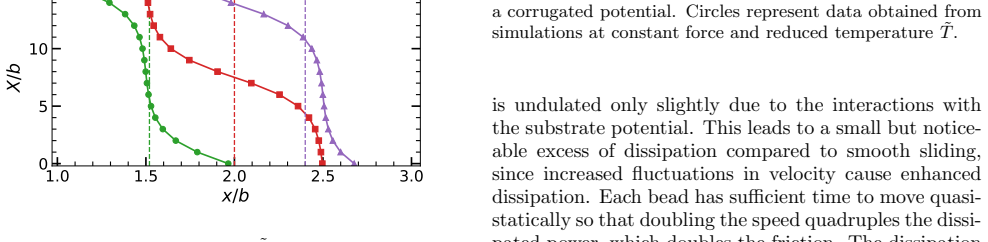
- [Sec. III.B2, Figs. 9 and 11] The parameter-free prediction ηeff ≈ ΔEd/(v b) is tested in Fig. 9 against constant-force viscosity data, and this is a meaningful macroscopic test of the energy balance. However, the microscopic identification of the quasi-static, athermal ΔEd with the per-instability energy dissipation under finite-temperature, constant-force dynamics is inferred rather than directly measured; the only direct energy-trace comparison is Fig. 11 for a single state point (v = 10^-2, kBT = 0.05). I request a quantitative measure of the agreement between the data and the grey line over the claimed intermediate-velocity window (for example, residuals or a stated tolerance), and, if feasible, statistics of energy-drop magnitudes in constant-force thermal trajectories at several (v, T) values, to rule out that the macroscopic agreement results from a compensation between altered drop sizes, kinetic-energy carryover, and other dissipative channels.
- [Sec. III.C and Fig. 14] The paper extends the ΔEd mechanism to the open chain and to alternative damping schemes in qualitative terms, but the supporting evidence is not at the same level as for the periodic k = 10 chain. For the open chain, the hull in Fig. 16 is built from one particular athermal cycle with pop-in and pop-out events, and no finite-temperature dissipated-energy measurement is shown; for the momentum-conserving Langevin thermostat, Fig. 14 shows a strong qualitative deviation from the ΔEd line, terminating at a critical velocity, yet the text states that the overall picture 'confirms this expectation'. Please state more precisely the parameter window in which ηeff ≈ ΔEd/(v b) is expected to hold and where it is expected to fail, and provide direct evidence from at least one open-chain or alternative-damping case.
- [Abstract and Sec. IV] The conclusion that Eyring agreement 'may be purely coincidental' is not directly tested. The paper shows that Eyring and Carreau-Yasuda fits describe the same ηeff(v) data and that the ΔEd prediction also captures part of the data, but it does not test Eyring's distinguishing assumption that shear reduces the free-energy barrier for directed motion. A discriminating test would compare the measured force-velocity relation with the Eyring barrier-reduction prediction, or show that the temperature dependence of the fitted Eyring parameters contradicts the barrier picture while remaining consistent with the ΔEd picture. Without such a test, the 'coincidental' claim should be presented as a possibility or a caution, not as a demonstrated conclusion.
minor comments (6)
- [Abstract] The abstract states a 'cross-over from a non-Arrhenius to an Arrhenius dependence of the diffusion coefficient', but the corresponding results are presented for the equilibrium viscosity (Figs. 3 and 10), not for the diffusion coefficient; please either provide diffusion-coefficient data or rephrase the abstract and conclusions in terms of viscosity.
- [Sec. II.B.1, Eq. (2)] In Eq. (2), the term '2ux' is almost certainly a typo for '2x_n' (or the corresponding bead coordinate); as printed, the term is dimensionally inconsistent.
- [Sec. II.B.1 and Sec. III.B] Minor typos: 'sping stiffness' should be 'spring stiffness', and 'This quantum equals the energy dissipated...' should be 'This quantity equals...'.
- [Sec. III.C] The reference to 'Fig. 19' for the open-chain hull is incorrect; the open-chain effective viscosity is shown in Fig. 16.
- [Fig. 8 caption] The caption says 'RMS displacement dynamics', but Eq. (13) and the plotted quantity are the mean squared displacement; the terminology should be aligned.
- [Fig. 9 caption] There is a typo 'shwon'; in addition, the caption says circles represent constant-force data, but the text states that for T = 0.12 the chains were driven at constant center-of-mass velocity, so the symbol for that case should be identified in the caption.
Circularity Check
No significant circularity: the central ηeff ≈ ΔEd/(v b) estimate uses an independently measured athermal energy drop and is compared, not fitted, to thermal rheology data.
full rationale
The central claim that medium-to-high-velocity friction is dictated by the energy drop ΔEd is not circular. ΔEd is read off from athermal, quasi-static, center-of-mass-constrained simulations at v = 10^-5 and kBT = 0 (Figs. 4 and 5), while the effective viscosity data in Fig. 9 come from constant-force thermal simulations. The grey line ΔEd/(bv) is a comparison curve, not a fit to those viscosity data, so a failure of the comparison would have been visible; the paper even notes that it is only an 'upper bound or even estimate' in part of the velocity range. The intermediate step fk = ΔEd/b is an energy-balance statement for the athermal sliding cycle, and it is separately verified for two stiffness values (k = 10 and k = 15) against the directly measured kinetic friction force. The extension of this quasi-static athermal result to finite temperature and velocity is tested in Fig. 11, where the dissipated energy per event is compared between the slow athermal and fast thermal chains; that is a genuine empirical check rather than an assumption smuggled in by definition. The Eyring and Carreau-Yasuda fits are retrospective descriptions of the simulation data, and the claim that Eyring agreement may be coincidental is an interpretive conclusion, not an input to the derivation. The self-citations (refs. 29, 30, 37) provide background on the Prandtl-model analogy and thermostat implementation; they are not load-bearing for the paper's main energy-drop mechanism. No equation in the paper reduces to its own input by construction, and no fitted parameter is renamed as a prediction. The main weakness noted in the manuscript itself — that the broad applicability of the quasi-static ΔEd is asserted beyond the few directly checked parameter points — is a scientific-support limitation, not circularity.
Assumptions & free parameters
free parameters (3)
- Eyring fit parameters (η0, v0) per temperature =
varies with T; see Figs. 2, 9, 12, 13, 16
- Carreau-Yasuda fit parameters (η0, γ̇0, n, a) per temperature =
varies with T; see Figs. 9, 13, 16
- Kink half-width ζ from fits to configuration data =
0.63 a for k=10
assumptions (4)
- standard math The Langevin equation with damping m/τ and random force satisfying the fluctuation-dissipation relation samples the canonical ensemble at temperature T.
- domain assumption The Grønbech-Jensen thermostat (ref. 36) accurately integrates the Langevin equation for the chosen time steps.
- ad hoc to paper The energy dissipated per kink advance equals the potential-energy drop ΔEd measured in quasi-static athermal sliding, independent of temperature and velocity in the intermediate shear regime.
- domain assumption Discommensurations in the FK chain are dynamically analogous to coordination defects that enable mass transport in liquids.
Cite this review
Pith. "Pith review of Finite-temperature properties of the Frenkel-Kontorova model: Relation to tribological systems and fluid rheology." pith.science (2026). https://pith.science/paper/62TEZKEB
@misc{pith2026250714948,
  author       = {Pith},
  title        = {Pith review of: Finite-temperature properties of the Frenkel-Kontorova model: Relation to tribological systems and fluid rheology},
  year         = {2026},
  howpublished = {\url{https://pith.science/paper/62TEZKEB}},
  note         = {Machine review of arXiv:2507.14948}
}
read the original abstract
The Frenkel-Kontorova model is a simple yet generic framework for the description of tribological phenomena and processes, including dry solid friction and the motion of adsorbed layers. As revealed in this work, it also reproduces qualitatively various features of complex liquids, such as, power-law sub-diffusion between the ballistic and the diffusive regimes as well as a cross-over from a non-Arrhenius to an Arrhenius dependence of the diffusion coefficient near the temperature, where the specific heat assumes its maximum. The study of these and related thermal and kinetic properties highlights several misconceptions prevalent in the literature. Most notably, shear thinning with a shear-thinning exponent close to zero can be the natural consequence from enforced basin hopping: the energy drops caused by shear-induced instabilities dictate the friction-velocity dependence at medium shear rates rather than the way how shear forces reduce the free energy barriers for directed motion. Thus, even if the rheology is described by semi-empirical theories such as the Eyring model, any agreement with experimental data, whether past, present, or future, may be purely coincidental.
Figures


Figures from the paper (13 more)




Reference graph
Works this paper leans on
-
[1]
Here, V0 is of unit energy and q = 2 π/b is the wavenumber of the potential and b the period
Default model The default Frenkel-Kontorova model studied in this work consists of a one-dimensional, linearly harmonic bead-spring chain with nearest-neighbor interactions, 3 which is placed into a single-sinusoidal potential of the form V (x) = V0 cos(qx). Here, V0 is of unit energy and q = 2 π/b is the wavenumber of the potential and b the period. Damp...
-
[2]
Alternative damping schemes In addition to the default model defined in Eq. (2), we also consider two alternative approaches for dissipating energy, which deviate from the standard implementation of instantaneous damping relative to the substrate. In the first approach, damping and thermalization are implemented via Maxwell elements. This corresponds form...
work page 2003
-
[3]
Thermal dynamics of the default model We note that the finite elastic coupling between the beads does not alter the dependence of specific heat on temperature qualitatively compared to the uncoupled case. However, the location of the peak maximum, T ∗, moved to a temperature about 2.5 times higher than for very weak coupling (Fig. 6), although the energy ...
-
[4]
9 shows results for the effective viscosity of the k = 10 V0/a2, N = 16, and a/b = 15/16 chain
Driven dynamics of the default model Fig. 9 shows results for the effective viscosity of the k = 10 V0/a2, N = 16, and a/b = 15/16 chain. The rhe- ological response resembles, as is the case for uncoupled atoms, that of many non-Newtonian liquids: the equilib- rium viscosity η0 increases with decreasing temperature and the effective viscosity can be descr...
-
[5]
This can be said to correspond to a body force
Non-uniform force distribution and constraints Throughout most of this work, the external driving force is distributed uniformly among the beads in the chain. This can be said to correspond to a body force. In reality, external forces do not directly apply to atoms or molecules in a sheared liquid, but indirectly via in- termittent layers. Thus, the exter...
-
[6]
Alternative damping From our analysis conducted so far, shear thinning has been rationalized from the perspective of basin hop- ping. In this view, the rate at which excess kinetic 10 4 10 3 10 2 10 1 100 v 101 102 eff/ 0.12 0.2 0.5 FIG. 13. Effective viscosity of a ˜k = 10 chain with periodic boundary condition and constant velocity applied to alternate ...
-
[7]
J. Frenkel and T. Kontorova. On the theory of plastic deformation and twinning. Physikalische Zeitschrift der Sowjetunion, 13:1–10, 1938
work page 1938
-
[8]
Luis M. Flor ´ ıa and Juan J. Mazo. Dissipative dynamics of the Frenkel-Kontorova model. Advances in Physics , 45(6):505–598, December 1996
work page 1996
Show all 57 references
-
[9]
Braun, Thierry Dauxois, Maxim V
Oleg M. Braun, Thierry Dauxois, Maxim V. Paliy, and Michel Peyrard. Nonlinear mobility of the gen- eralized Frenkel-Kontorova model. Physical Review E , 55(3):3598–3612, March 1997
1997
-
[10]
Driven dynamics of simpli- fied tribological models
A Vanossi and OM Braun. Driven dynamics of simpli- fied tribological models. Journal of Physics: Condensed Matter, 19(30):305017, 2007
2007
-
[11]
Driven Frenkel- Kontorova model
Torsten Strunz and Franz-Josef Elmer. Driven Frenkel- Kontorova model. I. Uniform sliding states and dynam- ical domains of different particle densities. Physical Re- view E , 58(2):1601, 1998
1998
-
[12]
Driven Frenkel- Kontorova model
Torsten Strunz and Franz-Josef Elmer. Driven Frenkel- Kontorova model. II. Chaotic sliding and nonequilibrium melting and freezing. Physical Review E , 58(2):1612, 1998
1998
-
[13]
The size of a dislocation
R Peierls. The size of a dislocation. Proceedings of the Physical Society, 52(1):34–37, January 1940
1940
-
[14]
Dislocations in a simple cubic lat- tice
F R N Nabarro. Dislocations in a simple cubic lat- tice. Proceedings of the Physical Society , 59(2):256–272, March 1947
1947
-
[15]
C. A. Coulomb. Th´ eorie des machines simples.Memoirs de Mathematique et de Physique de l”acadmie Royale , pages 161–342, 1785
-
[16]
M¨ user, Michael Urbakh, and Mark O
Martin H. M¨ user, Michael Urbakh, and Mark O. Rob- bins. Statistical mechanics of static and low-velocity ki- netic friction, January 2003
2003
-
[17]
Benassi, Ming Ma, M
A. Benassi, Ming Ma, M. Urbakh, and A. Vanossi. The breakdown of superlubricity by driving-induced commen- surate dislocations. Scientific Reports , 5(1), November 2015
2015
-
[18]
The effect of temperature and velocity on superlubricity
Joost A van den Ende, Astrid S de Wijn, and Annal- isa Fasolino. The effect of temperature and velocity on superlubricity. Journal of Physics: Condensed Matter , 24(44):445009, October 2012
2012
-
[19]
H M¨ user
M. H M¨ user. Structural lubricity: Role of dimension and symmetry. Europhysics Letters (EPL), 66(1):97–103, April 2004
2004
-
[20]
Brazda, A
T. Brazda, A. Silva, N. Manini, A. Vanossi, R. Guerra, E. Tosatti, and C. Bechinger. Experimental observa- tion of the aubry transition in two-dimensional colloidal monolayers. Physical Review X , 8(1), March 2018
2018
-
[21]
Jesper Norell, Annalisa Fasolino, and Astrid S. de Wijn. Emergent friction in two-dimensional frenkel-kontorova models. Physical Review E , 94(2), August 2016
2016
-
[22]
Relaxation in liquids, polymers and plastic crystals — strong/fragile patterns and problems
C.A Angell. Relaxation in liquids, polymers and plastic crystals — strong/fragile patterns and problems. Journal of Non-Crystalline Solids , 131–133:13–31, June 1991
1991
-
[23]
Viscosity, plasticity, and diffusion as ex- amples of absolute reaction rates
Henry Eyring. Viscosity, plasticity, and diffusion as ex- amples of absolute reaction rates. The Journal of Chem- ical Physics, 4(4):283–291, April 1936
1936
-
[24]
On the commonality between theoretical models for fluid and solid friction, wear and tribochemistry
Hugh Spikes and Wilfred Tysoe. On the commonality between theoretical models for fluid and solid friction, wear and tribochemistry. Tribology Letters, 59(1), June 2015
2015
-
[25]
Pierre J. Carreau. Rheological equations from molecular network theories. Transactions of the Society of Rheology, 16(1):99–127, March 1972
1972
-
[26]
Yasuda, R
K. Yasuda, R. C. Armstrong, and R. E. Cohen. Shear flow properties of concentrated solutions of lin- ear and star branched polystyrenes. Rheologica Acta, 20(2):163–178, March 1981
1981
-
[27]
Vanossi, G.E
A. Vanossi, G.E. Santoro, N. Manini, E. Tosatti, and O.M. Braun. Lubricated friction between in- commensurate substrates. Tribology International , 41(9–10):920–925, September 2008
2008
-
[28]
Rapaport
D.C. Rapaport. Hydrogen bonds in water: Net- work organization and lifetimes. Molecular Physics , 16 50(5):1151–1162, December 1983
1983
-
[29]
K¨ uhne, Matthias Krack, Fawzi R
Thomas D. K¨ uhne, Matthias Krack, Fawzi R. Mohamed, and Michele Parrinello. Efficient and accurate Car- Parrinello-like approach to Born-Oppenheimer molecular dynamics. Physical Review Letters, 98(6), February 2007
2007
-
[30]
Aubry and P.Y
S. Aubry and P.Y. Le Daeron. The discrete Frenkel- Kontorova model and its extensions. Physica D: Nonlin- ear Phenomena, 8(3):381–422, September 1983
1983
-
[31]
The twist map, the extended frenkel- kontorova model and the devil’s staircase
Serge Aubry. The twist map, the extended frenkel- kontorova model and the devil’s staircase. Physica D: Nonlinear Phenomena, 7(1–3):240–258, May 1983
1983
-
[32]
Dynamics of supercooled liquids and the glass transition
U Bengtzelius, W Gotze, and A Sjolander. Dynamics of supercooled liquids and the glass transition. Jour- nal of Physics C: Solid State Physics , 17(33):5915–5934, November 1984
1984
-
[33]
L. Prandtl. Ein Gedankenmodell zur kinetischen Theo- rie der festen K¨ orper.Zeitschrift f¨ ur Angewandte Math- ematik und Mechanik , 8(2):85–106, 1928
1928
-
[34]
Popov and J.A.T
V.L. Popov and J.A.T. Gray. Prandtl-Tomlinson model: History and applications in friction, plasticity, and nan- otechnologies. ZAMM - Journal of Applied Mathematics and Mechanics / Zeitschrift f¨ ur Angewandte Mathematik und Mechanik, 92(9):683–708, July 2012
2012
-
[35]
Martin H. M¨ user. Shear thinning in the Prandtl model and its relation to generalized Newtonian fluids. Lubri- cants, 8(4):38, March 2020
2020
-
[36]
Hongyu Gao and Martin H. M¨ user. On the shear- thinning of alkanes. Tribology Letters, 72(1), December 2023
2023
-
[37]
Manzi, Wilfred T
Sergio J. Manzi, Wilfred T. Tysoe, and Octavio J. Furlong. Temperature dependences in the Tomlin- son/Prandtl model for atomic sliding friction. Tribology Letters, 55(3):363–369, June 2014
2014
-
[38]
Sergio Javier Manzi, Sebastian Eduardo Carrera, Oc- tavio Javier Furlong, Germaine Djuidje Kenmoe, and Wilfred T. Tysoe. Prandtl–Tomlinson-type models for molecular sliding friction. Tribology Letters, 69(4), Octo- ber 2021
2021
-
[39]
Locked-to-running transition in the two-dimensional un- derdamped driven frenkel-kontorova model
OM Braun, MV Paliy, J R¨ oder, and AR Bishop. Locked-to-running transition in the two-dimensional un- derdamped driven frenkel-kontorova model. Physical Re- view E , 63(3):036129, 2001
2001
-
[40]
Atomistic lock- ing and friction
Motohisa Hirano and Kazumasa Shinjo. Atomistic lock- ing and friction. Physical Review B, 41(17):11837–11851, June 1990
1990
-
[41]
Martin H. M¨ user. Frenkel-Kontorova.https://github. com/mueser/Frenkel-Kontorova.git., 2025
2025
-
[42]
Complete set of stochastic Verlet-type thermostats for correct Langevin simulations
Niels Grønbech-Jensen. Complete set of stochastic Verlet-type thermostats for correct Langevin simulations. Molecular Physics, 118(8):e1662506, September 2019
2019
-
[43]
Advanced Langevin thermostats: Properties, extensions to rheology, and a lean momentum-conserving approach
Shubham Agarwal, Sergey V Sukhomlinov, Marc Ho- necker, and Martin H M¨ user. Advanced Langevin thermostats: Properties, extensions to rheology, and a lean momentum-conserving approach. arXiv preprint arXiv:2506.15579, 2025
2025 arXiv
-
[44]
Statistical mechanics of dis- sipative particle dynamics
P Espa˜ nol and P Warren. Statistical mechanics of dis- sipative particle dynamics. Europhysics Letters (EPL) , 30(4):191–196, May 1995
1995
-
[45]
Dissipative particle dynamics: A useful thermostat for equilibrium and nonequilibrium molecular dynamics simulations
Thomas Soddemann, Burkhard D¨ unweg, and Kurt Kre- mer. Dissipative particle dynamics: A useful thermostat for equilibrium and nonequilibrium molecular dynamics simulations. Physical Review E , 68(4), October 2003
2003
-
[46]
Vattulainen, M
I. Vattulainen, M. Karttunen, G. Besold, and J. M. Polson. Integration schemes for dissipative particle dy- namics simulations: From softly interacting systems to- wards hybrid models. The Journal of Chemical Physics , 116(10):3967–3979, March 2002
2002
-
[47]
H. Risken. The Fokker-Planck Equation: Methods of So- lution and Applications , volume 18 of Springer Series in Synergetics. Springer, 2nd edition, 1989
1989
-
[48]
H. A. Kramers. Brownian motion in a field of force and the diffusion model of chemical reactions. Physica, 7(4):284–304, 1940
1940
-
[49]
H¨ anggi, P
P. H¨ anggi, P. Talkner, and M. Borkovec. Reaction-rate theory: Fifty years after Kramers. Reviews of Modern Physics, 62(2):251–341, 1990
1990
-
[50]
Vinay Ambegaokar and B. I. Halperin. Voltage due to thermal noise in the dc Josephson Effect.Physical Review Letters, 22(25):1364–1366, June 1969
1969
-
[51]
The random walk’s guide to anomalous diffusion: a fractional dynamics ap- proach
Ralf Metzler and Joseph Klafter. The random walk’s guide to anomalous diffusion: a fractional dynamics ap- proach. Physics Reports, 339(1):1–77, December 2000
2000
-
[52]
Andersen
Walter Kob and Hans C. Andersen. Testing mode- coupling theory for a supercooled binary lennard-jones mixture i: The van hove correlation function. Physical Review E, 51(5):4626–4641, May 1995
1995
-
[53]
Krajewski and Martin H
Florian R. Krajewski and Martin H. M¨ user. Quan- tum Creep and Quantum-Creep Transitions in 1D Sine- Gordon Chains. Physical Review Letters, 92(3), January 2004
2004
-
[54]
C. A. Angell. Formation of glasses from liquids and biopolymers. Science, 267(5206):1924–1935, March 1995
1924
-
[55]
Selective actuation enabled multifunctional magneto-mechanical metamaterial for programming elas- tic wave propagation
Jay Sim, Shuai Wu, Sarah Hwang, Lu Lu, and Ruike Re- nee Zhao. Selective actuation enabled multifunctional magneto-mechanical metamaterial for programming elas- tic wave propagation. Advanced Functional Materials , 35(16):2422325, 2025
2025
-
[56]
Micro magnetic tweezers for nanomanipulation inside live cells
Anthony HB De Vries, Bea E Krenn, Roel van Driel, and Johannes S Kanger. Micro magnetic tweezers for nanomanipulation inside live cells. Biophysical journal , 88(3):2137–2144, 2005
2005
-
[57]
Char- acterizing intracellular mechanics via optical tweezers- based microrheology
Bart E Vos, Till M Muenker, and Timo Betz. Char- acterizing intracellular mechanics via optical tweezers- based microrheology. Current Opinion in Cell Biology , 88:102374, 2024
2024
Reviewed August 6, 2026 · model on record in the stance chip above.
Discussion (0). Continue with ORCID to comment.