REVIEW 4 major objections 5 minor 28 references
Impact of finite squeezing on near-term quantum computations using GKP qubits
T0 review · 4 major / 5 minor · reviewed 2026-08-06 · deepseek-v4-flash
Pith's one-line read A classical simulation of 108 GKP modes finds that a three-qubit Grover search on the quad-rail lattice beats classical search only above about 10 dB of GKP squeezing.
desk verdict Solid simulation advance with a concrete GKP squeezing target, though the claimed 'fundamental threshold' is only as strong as the one-parameter noise model it assumes. read the letter →
The pith
A machine-rendered reading of the paper's core claim, the machinery that carries it, and where it could break.
The reading
What carries the argument
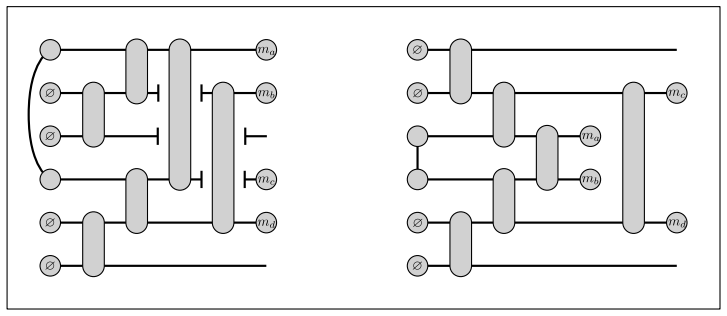
The machinery is the functional matrix product state (FMPS) representation of continuous-variable states, which keeps simulations tractable by truncating singular values and using randomized range finding for approximate SVDs. The circuit model is the quad-rail lattice (QRL), built from qunaught states and Bell pairs entangled by beam splitters, with homodyne measurements implementing Knill-style error-corrected Clifford gates and injected magic Bell pairs implementing $T$ gates. Noise enters through the non-unitary photon dampening operator $e^{-\epsilon \hat N}$, which models finite-energy GKP states, and simulations use fixed domains because the resulting envelopes are spherically symmetric and inherited from the ancillas.
What would settle it
Run the same three-qubit Grover circuit under an alternative noise model, such as a GKP code with asymmetric quadrature envelopes or with added photon loss and finite detection efficiency, and check whether the success probability crosses the classical $13/28$ bound at a squeezing level significantly different from 10 dB. A direct experiment preparing GKP states with measured squeezing near 10 dB and executing one query of a two-solution three-qubit Grover oracle would also settle the claim.
Extended reading notes
Core claim
On the paper's own terms, the central discovery is that the FMPS formalism can simulate QRL computations with 108 physical GKP modes, and that under the photon-dampening noise model a three-qubit Grover's algorithm has a squeezing threshold of approximately 10 dB below which intrinsic finite-energy noise destroys any quantum advantage. The authors show through randomized benchmarking that the average gate error rate follows the analytical estimates of ref. [12] in the intermediate squeezing range, and that logical errors are well described as independent depolarizing noise because logical purity does not decay with circuit depth. They emphasize that this threshold is for systems with no external noise, so it is a fundamental rather than practical bound.
Load-bearing premise
The load-bearing premise is that a real finite-energy GKP state is faithfully represented by applying the photon-dampening operator $e^{-\epsilon \hat N}$ to the ideal state, so that the only noise in the simulated circuits is this intrinsic coherent envelope noise; if physical GKP states have asymmetric or non-Gaussian envelopes, or if photon loss and detection inefficiency are added, the simulated error rates and the 10 dB crossover could shift.
Editorial extensions
If this is right
- At squeezing levels around and above roughly 10.5 dB, the analytical incoherent-noise estimates used for the QRL match the simulated gate error rates.
- A three-qubit Grover search on the QRL succeeds with probability above the classical $13/28$ one-query bound only for GKP squeezing above about 10 dB.
- Logical-level depolarizing noise is a good approximation of the physical error mechanisms across deep circuits.
- The FMPS approach can handle over 100 GKP modes, so larger near-term GKP circuits are classically simulable.
- Since logical purity does not decay with circuit depth, the dominant errors are logical errors from incorrect decoding of gadget syndromes, not degradation of the GKP states themselves.
Reading between the lines
- If the 10 dB threshold persists under other noise models, photonic experiments aiming for algorithmic quantumness would need GKP squeezing near 10 dB before any external loss is added; loss and detection inefficiency would only push the threshold higher.
- The FMPS approach should extend to other bosonic codes and alternative cluster-state geometries, since its cost depends on the tensor-network bond dimension rather than on the specific code or entanglement pattern.
- The proposed deterministic magic Bell state injection for $T$ gates could be tested in existing photonic platforms as a lower-overhead alternative to heralded magic state preparation.
- The agreement between simulated randomized benchmarking and analytical estimates suggests that small-circuit error rates could be used to extrapolate hardware requirements for larger GKP computations.
Editorial analysis
A structured set of objections, weighed in public.
Referee Report
Summary. The manuscript presents an FMPS-based simulation of measurement-based quantum computation with GKP qubits in a quad-rail lattice (QRL), using the photon-dampening approximation e^{-epsilon N} for finite-energy GKP states. It performs randomized benchmarking for squeezing levels between 5 and 15 dB and simulates a three-qubit Grover search that involves 108 physical GKP modes. The central claim is that the Grover success probability exceeds the one-query classical bound 13/28 only above approximately 10 dB of GKP squeezing, which the authors call a fundamental squeezing threshold. The paper also contributes a deterministic magic-state injection scheme for T gates and a Pauli-frame tracking procedure for non-Clifford gates in the QRL.
Significance. If the numerical results are reliable, this is a significant demonstration that an FMPS method can simulate measurement-based CV circuits with more than 100 GKP modes and explicit finite-squeezing noise, going well beyond earlier few-qubit simulations. The agreement between the simulated RB error rates and the analytical estimates of Walshe et al. is a useful cross-check in an intermediate squeezing window, and the release of the simulation code is a practical asset. The significance is however qualified by two issues: the 'fundamental threshold' is computed under a single one-parameter noise model, and the manuscript does not report convergence tests for the FMPS truncation and fixed-domain approximations. The quantitative 10 dB number should therefore be regarded as model- and method-dependent until these points are addressed.
major comments (4)
- [Section 2, Eq. (3), Appendix B.2] The central claim that ~10 dB is a fundamental lower bound rests entirely on the photon-dampening model e^{-epsilon N}. The paper cites ref. [17] for equivalence of approximate GKP models, but it does not show that the equivalence preserves the specific quantities that set the threshold: the gadget-level logical X/Z error rates, the RB error rate in Fig. 3, or the depolarizing estimate in Eq. (8). Appendix B.2 itself notes that spherical phase-space symmetry is a special feature of this model, and the fixed-domain simplification of Appendix B.5 relies on that symmetry. If real finite-squeezed GKP states have asymmetric envelopes, or if loss and detection inefficiency are included, the crossover can move. The authors should either establish the equivalence for the relevant observables or rephrase the claim as a prediction under this model; ideally they should also test at least one alternative envelope, such as individual squeezed teeth with unequal q- and p-widths.
- [Eq. (8), Fig. 7] The analytical curve in Fig. 7 is not an independent check of the numerical simulation. It uses r from the analytical dashed line in Fig. 3 rather than from the numerically estimated RB decay parameters, and the depolarizing survival probability p = 1 - 4r/3 in Eq. (8) is inserted by construction. Thus the agreement between the points and the curve in Fig. 7 validates the depolarizing error-propagation model only under the same noise premise; it does not validate the premise itself. The numerical points are independent, but the caption should state explicitly that the line is based on the analytical error-rate model and is not a fit to the Grover data.
- [Appendices B.1 and B.5] No convergence data are reported for the two main FMPS approximations: the truncated randomized SVD and the fixed quadrature domain. The manuscript states that internal dimensions are 'capped somewhere on the order 64' and that the fixed domain loses no accuracy 'as long as the domain is big enough', but it does not state the domain size or truncation tolerance used, nor does it show that the 10 dB crossover is stable under tightening these parameters. Since the crossover is the main quantitative result, a convergence test, such as repeating the RB and Grover simulations at higher bond dimension and larger domain, is needed.
- [Section 4.2, Fig. 3] The agreement between the numerical RB error rates and the analytical estimates is explicitly reported to fail below 7 dB and above 11 dB. The 10 dB crossover in Fig. 7 lies close to the upper edge of this deviation region, and the text offers only speculative 'interference effects' as an explanation. The authors should quantify the resulting systematic uncertainty in the analytical curve used in Fig. 7, or use the numerical RB rates for the Grover estimate, before claiming a precise threshold.
minor comments (5)
- [Abstract and Section 5.1] The name of the algorithm is misspelled as 'Grovers' in the Abstract and in Section 5.1; it should be 'Grover's algorithm'.
- [Section 2] The sentence 'the most prominent models including this one has previously been shown to be equivalent' has a grammar error and does not specify under which metric or for which quantities the equivalence is claimed; please clarify.
- [Appendix A.3, Eqs. (16)-(17)] The notation T^{dagger_{Xi in P}}_i is confusing and easy to misread; define the conditional exponent explicitly, for example by writing T_i when X_i is not in P and T_i^dagger when X_i is in P.
- [Fig. 2 caption] The caption says 'The two different shades are only used to distinguish data sets' but the shades are not otherwise labeled; a legend or explicit per-curve labels would improve readability.
- [Section 4.2] The statement that logical purity shows no significant decay with circuit depth is not supported by any figure or table; either show the data or soften the claim.
Circularity Check
No circular derivation: the ~10 dB Grover threshold is a simulation output cross-checked against external analytical benchmarks, not a fitted parameter renamed as a prediction.
full rationale
The central numerical claim is produced by FMPS simulations of QRL gadgets under the stated photon-dampening model e^{-epsilon N}. The randomized-benchmarking error rates in Fig. 3 are compared with analytical estimates from Walshe et al. (ref. [12]), an external benchmark. The Grover success estimate in Eq. 8 uses the analytical average error rate, not the fitted RB curve, so no fitted quantity is relabeled as a prediction. The ~10 dB threshold is read off from independently sampled Grover simulation data and then cross-checked against a depolarizing-noise estimate; the estimate is not derived from the threshold. Self-citations to the FMPS framework [9] and to GKP error-correction properties [7] support the simulation platform and decoder assumptions, but those are separately published, code-backed methods, and the cited equivalence of noise models [17] is an external result. None of these citations functions as a uniqueness theorem forcing the 10 dB conclusion. The word 'fundamental' is a scope claim about the chosen noise model, not a circular step: the model dependence is a correctness or external-validity caveat, not an equivalence between the paper's input and output.
Assumptions & free parameters
free parameters (3)
- RB decay parameter p per squeezing level =
not quoted in the preprint
- FMPS bond dimension truncation =
capped at order 64
- Fixed quadrature domain size =
not specified
assumptions (5)
- domain assumption Finite-energy GKP states are modeled by e^{-epsilon N} photon dampening and this is representative of physical GKP states
- domain assumption Knill-type error correction with qunaught states makes logical envelopes inherited from ancilla states and X/Z errors symmetric and independent
- domain assumption The QRL gadget identities for single- and two-mode gates, including the T-gate injection via magic Bell pairs, are correct
- standard math Randomized range finding gives accurate truncated SVDs for FMPS matrices
- standard math The classical one-query search bound for 2 marked items among 8 is 13/28
Cite this review
Pith. "Pith review of Impact of finite squeezing on near-term quantum computations using GKP qubits." pith.science (2026). https://pith.science/paper/2LNUMF3M
@misc{pith2026250715955,
  author       = {Pith},
  title        = {Pith review of: Impact of finite squeezing on near-term quantum computations using GKP qubits},
  year         = {2026},
  howpublished = {\url{https://pith.science/paper/2LNUMF3M}},
  note         = {Machine review of arXiv:2507.15955}
}
read the original abstract
We present the first detailed simulation of a measurement based quantum computation based on Gottesman-Kitaev-Preskill (GKP) qubits within a quad-rail lattice (QRL) cluster state involving over 100 GKP modes. This was enabled by the recently developed functional matrix product states (FMPS) framework, with which we simulate continuous-variable (CV) quantum circuits while explicitly modelling intrinsic coherent error sources due to finite squeezing. We perform simulated randomised benchmarking across squeezing levels between 5 and 15 dB and find strong agreement with analytical estimates for high quality GKP qubits. As a demonstration of practical computation, we simulate a three-qubit Grover's algorithm within the QRL and identify a fundamental squeezing threshold -- approximately 10 dB -- beyond which the algorithm outperforms classical probability bounds.
Figures


Figures from the paper (8 more)




Reference graph
Works this paper leans on
-
[17]
Equivalence of approximate Gottesman-Kitaev-Preskill codes
T. Matsuura et al. “Equivalence of approximate Gottesman-Kitaev-Preskill codes”. en. In: Physical Review A 102.3 (Sept. 2020). arXiv:1910.08301 [quant-ph], p. 032408.doi: 10.1103/PhysRevA.102.032408
arXiv 2020
-
[1]
Fault-Tolerant Measurement-Based Quantum Computing with Continuous-Variable Cluster States
N. C. Menicucci. “Fault-Tolerant Measurement-Based Quantum Computing with Continuous-Variable Cluster States”. en. In: Physical Review Letters 112.12 (Mar. 2014), p. 120504.doi: 10.1103/PhysRevLett.112.120504
-
[2]
Fault-tolerant bosonic quantum error correction with the surface–Gottesman-Kitaev-Preskill code
K. Noh and C. Chamberland. “Fault-tolerant bosonic quantum error correction with the surface–Gottesman-Kitaev-Preskill code”. In:Physical Review A 101.1 (Jan. 2020). Publisher: American Physical Society, p. 012316. doi: 10 . 1103 / PhysRevA . 101 . 012316
work page 2020
-
[3]
Fault-TolerantContinuous-VariableMeasurement-basedQuantum Computation Architecture
M.V.Larsenetal.“Fault-TolerantContinuous-VariableMeasurement-basedQuantum Computation Architecture”. en. In:PRX Quantum 2.3 (Aug. 2021), p. 030325.doi: 10.1103/PRXQuantum.2.030325
-
[4]
Fault-Tolerant Quantum Computation with Static Linear Optics
I. Tzitrin et al. “Fault-Tolerant Quantum Computation with Static Linear Optics”. In: PRX Quantum 2.4 (Dec. 2021). Publisher: American Physical Society, p. 040353.doi: 10.1103/PRXQuantum.2.040353
-
[5]
Low-Overhead Fault-Tolerant Quantum Error Correction with the Surface-GKP Code
K. Noh et al. “Low-Overhead Fault-Tolerant Quantum Error Correction with the Surface-GKP Code”. en. In:PRX Quantum 3.1 (Jan. 2022), p. 010315.doi: 10.1103/ PRXQuantum.3.010315
work page 2022
-
[6]
Integrated photonic source of Gottesman–Kitaev–Preskill qubits
M. V. Larsen et al. “Integrated photonic source of Gottesman–Kitaev–Preskill qubits”. en. In: Nature (June 2025). Publisher: Nature Publishing Group, pp. 1–5.doi: 10. 1038/s41586-025-09044-5
work page 2025
-
[7]
Performance analysis of GKP error correction.arXiv:2505.14775 [quant-ph]
F.K.Marqversenetal. Performance analysis of GKP error correction.arXiv:2505.14775 [quant-ph]. May 2025.doi: 10.48550/arXiv.2505.14775
Show all 28 references
-
[8]
Jafarzadeh et al
M. Jafarzadeh et al. Logical channels in approximate Gottesman-Kitaev-Preskill error correction. arXiv:2504.13383 [quant-ph]. Apr. 2025. doi: 10 . 48550 / arXiv . 2504 . 13383
2025 doi
-
[9]
Functional matrix product state simulation of continuous variable quantum circuits
A.B.Michelsenetal. Functional matrix product state simulation of continuous variable quantum circuits. arXiv:2504.05860 [quant-ph]. Apr. 2025. doi: 10 . 48550 / arXiv . 2504.05860. 9
2025 doi
-
[10]
Strawberry Fields: A Software Platform for Photonic Quantum Computing
N. Killoran et al. “Strawberry Fields: A Software Platform for Photonic Quantum Computing”. en-GB. In:Quantum 3 (Mar. 2019). Publisher: Verein zur Förderung des Open Access Publizierens in den Quantenwissenschaften, p. 129.doi: 10.22331/q- 2019-03-11-129
2019 doi
-
[11]
All-Gaussian Universality and Fault Tolerance with the Gottesman-Kitaev-Preskill Code
B. Q. Baragiola et al. “All-Gaussian Universality and Fault Tolerance with the Gottesman-Kitaev-Preskill Code”. en. In:Physical Review Letters 123.20 (Nov. 2019), p. 200502. doi: 10.1103/PhysRevLett.123.200502
2019 doi
- [12]
-
[13]
Deterministic multi-mode gates on a scalable photonic quantum computing platform
M. V. Larsen et al. “Deterministic multi-mode gates on a scalable photonic quantum computing platform”. en. In: Nature Physics 17.9 (Sept. 2021), pp. 1018–1023.doi: 10.1038/s41567-021-01296-y
2021 doi
-
[14]
Randomized benchmarking of quantum gates
E. Knill et al. “Randomized benchmarking of quantum gates”. In:Physical Review A 77.1 (Jan. 2008). Publisher: American Physical Society, p. 012307.doi: 10 . 1103 / PhysRevA.77.012307
2008
-
[15]
Robust randomized benchmarking of quantum processes
E. Magesan et al. “Robust randomized benchmarking of quantum processes”. In:Phys- ical Review Letters 106.18 (May 2011). arXiv:1009.3639 [quant-ph], p. 180504.doi: 10.1103/PhysRevLett.106.180504
2011 arXiv
-
[16]
Encoding a qubit in an oscillator
D. Gottesman et al. “Encoding a qubit in an oscillator”. In: Physical Review A 64.1 (June 2001). Publisher: American Physical Society, p. 012310.doi: 10 . 1103 / PhysRevA.64.012310
2001
-
[18]
M. H. Shaw et al.Logical Gates and Read-Out of Superconducting Gottesman-Kitaev- Preskill Qubits. en. arXiv:2403.02396 [quant-ph]. Apr. 2024
2024 arXiv
-
[19]
Continuous-variable gate teleportation and bosonic-code error correction
B. W. Walshe et al. “Continuous-variable gate teleportation and bosonic-code error correction”. en. In: Physical Review A 102.6 (Dec. 2020), p. 062411.doi: 10.1103/ PhysRevA.102.062411
2020
-
[20]
Scalable quantum computing in the presence of large detected-error rates
E. Knill. “Scalable quantum computing in the presence of large detected-error rates”. en. In: Physical Review A 71.4 (Apr. 2005), p. 042322.doi: 10.1103/PhysRevA.71. 042322
2005 doi
-
[21]
Progress towards practical qubit computation using approximate Gottesman-Kitaev-Preskill codes
I. Tzitrin et al. “Progress towards practical qubit computation using approximate Gottesman-Kitaev-Preskill codes”. en. In: Physical Review A 101.3 (Mar. 2020), p. 032315. doi: 10.1103/PhysRevA.101.032315
2020 doi
-
[22]
Exact and Approximate Unitary 2-Designs: Constructions and Applications
C. Dankert et al. “Exact and Approximate Unitary 2-Designs: Constructions and Applications”. en. In: Physical Review A 80.1 (July 2009). arXiv:quant-ph/0606161, p. 012304. doi: 10.1103/PhysRevA.80.012304
2009 arXiv
-
[23]
quantum_computations
F.K.Marqversen. quantum_computations. https://github.com/frederik-kofoed- marqversen/quantum_computations. original-date: 2024-08-29. Mar. 2025
2024
-
[24]
Surface codes: Towards practical large-scale quantum computa- tion
A. G. Fowler et al. “Surface codes: Towards practical large-scale quantum computa- tion”. en. In:Physical Review A 86.3 (Sept. 2012), p. 032324.doi: 10.1103/PhysRevA. 86.032324
2012 doi
-
[25]
A fast quantum mechanical algorithm for database search
L. K. Grover. “A fast quantum mechanical algorithm for database search”. en. In: Proceedings of the twenty-eighth annual ACM symposium on Theory of computing - STOC ’96. Philadelphia, Pennsylvania, United States: ACM Press, 1996, pp. 212–219. doi: 10.1145/237814.237866
1996
-
[26]
Complete 3-Qubit Grover search on a programmable quantum com- puter
C. Figgatt et al. “Complete 3-Qubit Grover search on a programmable quantum com- puter”. en. In:Nature Communications 8.1 (Dec. 2017). Number: 1 Publisher: Nature Publishing Group, p. 1918.doi: 10.1038/s41467-017-01904-7. 10
2017 doi
-
[27]
M. A. Nielsen and I. L. Chuang. Quantum Computation and Quantum Information: 10th Anniversary Edition . 1st ed. Cambridge University Press, June 2012.doi: 10. 1017/CBO9780511976667
2012
-
[28]
Halko et al
N. Halko et al. Finding structure with randomness: Probabilistic algorithms for con- structing approximate matrix decompositions . en. arXiv:0909.4061 [math]. Dec. 2010. doi: 10.48550/arXiv.0909.4061. A Universal streamlined quantum computation in the QRL A.1 GKP error decodin...
Reviewed August 6, 2026 · model on record in the stance chip above.
Discussion (0). Continue with ORCID to comment.