REVIEW 4 major objections 7 minor 1 cited by
Further steps towards next generation of covariant energy density functionals
T0 review · 4 major / 7 minor · reviewed 2026-08-06 · deepseek-v4-flash
Pith's one-line read The paper claims that earlier covariant nuclear mass fits carried a hidden systematic error of about 0.8 MeV because they ignored infinite-basis corrections and total electron binding energies, and shows that a corrected fitting protocol…
desk verdict A real methodological step in CEDF fitting, but the headline 0.8 MeV error is an indirect model-difference measure, not a clean attribution. read the letter →
The pith
A machine-rendered reading of the paper's core claim, the machinery that carries it, and where it could break.
The reading
What carries the argument
The load-bearing object is the correction function $\Delta B_{\rm cor}(Z,N) = B_{\rm el}(Z) + \Delta B^F_\infty(Z,N)$ used to generate pseudodata for the fit. $B_{\rm el}(Z)$ is the total energy needed to strip all electrons from an atom with $Z$ protons, converting the experimental table's atomic binding energies into nuclear ones. $\Delta B^F_\infty$ is the difference between the binding energy computed in an infinite fermionic basis and in the truncated $N_F=20$ basis used in practice; since infinite bases are numerically impossible, the paper extrapolates from runs with up to $N_F=40$ (and $N_F=60$ without pairing), benchmarks the extrapolation on test nuclei to better than 15 keV for DD-MEZ and 10 keV for NL5(Z), and iterates the correction inside the anchor-based optimization until it stabilizes below 8 keV. The bosonic sector is handled more directly by using $N_B=40$ full shells instead of the standard $N_B=20$, which brings the bosonic basis error below 10 keV everywhere. This combination turns the fitted parameters into quantities defined against infinite-basis, purely nuclear binding energies.
What would settle it
Run the new functionals on deformed actinide and superheavy nuclei such as 240Pu and 290Lv in fermionic bases of 56 or 60 shells without pairing and with a converged bosonic basis, then compare the resulting binding energies with the extrapolated pseudodata; if the differences cluster systematically above about 100 keV, the extrapolation and the 0.8 MeV error estimate would need revision.
Extended reading notes
Core claim
The central claim is that the accuracy budget of covariant energy density functionals is controlled, at the level of around 0.8 MeV, by three protocol details that are not part of the nuclear interaction: the truncation of the harmonic-oscillator basis in the fermionic and bosonic sectors, and the use of atomic rather than nuclear binding energies as fit targets. To remove them, the paper fits to pseudodata $B_{\rm pseudo}(Z,N) = B_{\rm AME}(Z,N) - [B_{\rm el}(Z) + \Delta B^F_\infty(Z,N)]$, where $B_{\rm el}$ is the total electron binding energy and $\Delta B^F_\infty$ is an extrapolated correction from the truncated fermionic basis to the infinite limit. The correction is redetermined iteratively inside the anchor-based optimization, with convergence judged by the global rms change between rounds falling below 8 keV. On this basis the paper constructs new functionals in all three classes, DD-MEZ, NL5(Z) and PC-Z, and reports the first evaluation of the global calculation error of earlier fits: about 0.77 MeV for DD-MEY, 0.84 MeV for NL5(Y), and more than 1 MeV for the point-coupling class. DD-MEZ improves the rms deviation from 1.802 MeV to 1.601 MeV (1.557 MeV with Wigner energy) while shrinking its own numerical error to roughly 0.025 MeV. The conclusion is that the older fits were not just less convenient but systematically biased, and that convergence to the infinite-basis limit plus the electron correction is a prerequisite for sub-MeV covariant mass tables.
Load-bearing premise
The headline error estimate depends on the extrapolation that turns finite-basis calculations into infinite-basis binding energies being accurate to tens of keV across the whole chart, including the heavy, deformed, and superheavy nuclei where the paper's own basis runs do not fully converge.
Editorial extensions
If this is right
- Previous covariant mass tables based on meson-exchange functionals should be treated as carrying a hidden global error of about 0.8 MeV on top of their reported rms deviations, which changes how their agreement with experiment is interpreted.
- The corrected DD-MEZ functional becomes the best covariant mean-field functional for global binding energies, reaching an rms deviation of 1.557 MeV over 882 even-even nuclei when a Wigner term is included, with a residual numerical error near 0.025 MeV.
- The iterative procedure shows that infinite-basis corrections must be recomputed after each refit: a one-shot correction map can be off by almost 90 keV globally and by up to about 0.4 MeV in heavy nuclei, so static correction tables are not reliable.
- Within the experimentally known region, total electron binding energies can be treated as a function of proton number alone, because their isotopic variation stays below about 1 keV even in superheavy chains.
- For point-coupling functionals, the harmonic-oscillator basis converges too slowly to define infinite-basis corrections in actinides and superheavy nuclei; the new PC-Z fit therefore covers only part of the chart and still carries a global error above 1 MeV.
Reading between the lines
- If the paper is right, a similar audit would be worth doing for non-relativistic mass fits that also rely on truncated harmonic-oscillator bases: part of their reported agreement with experiment may likewise come from absorbing basis and electron-conversion errors into fitted parameters rather than removing them.
- The Y-versus-Z parameter shifts in the paper suggest a testable prediction: the difference between old and new functionals should be concentrated in shell-correction regions, especially around 208Pb and the actinides, where single-particle level ordering most strongly changes binding energies.
- The iterative correction procedure implies that infinite-basis corrections cannot be tabulated once and reused for a different functional; reusing another functional's correction map can introduce errors of a few hundred keV in heavy nuclei.
Editorial analysis
A structured set of objections, weighed in public.
Referee Report
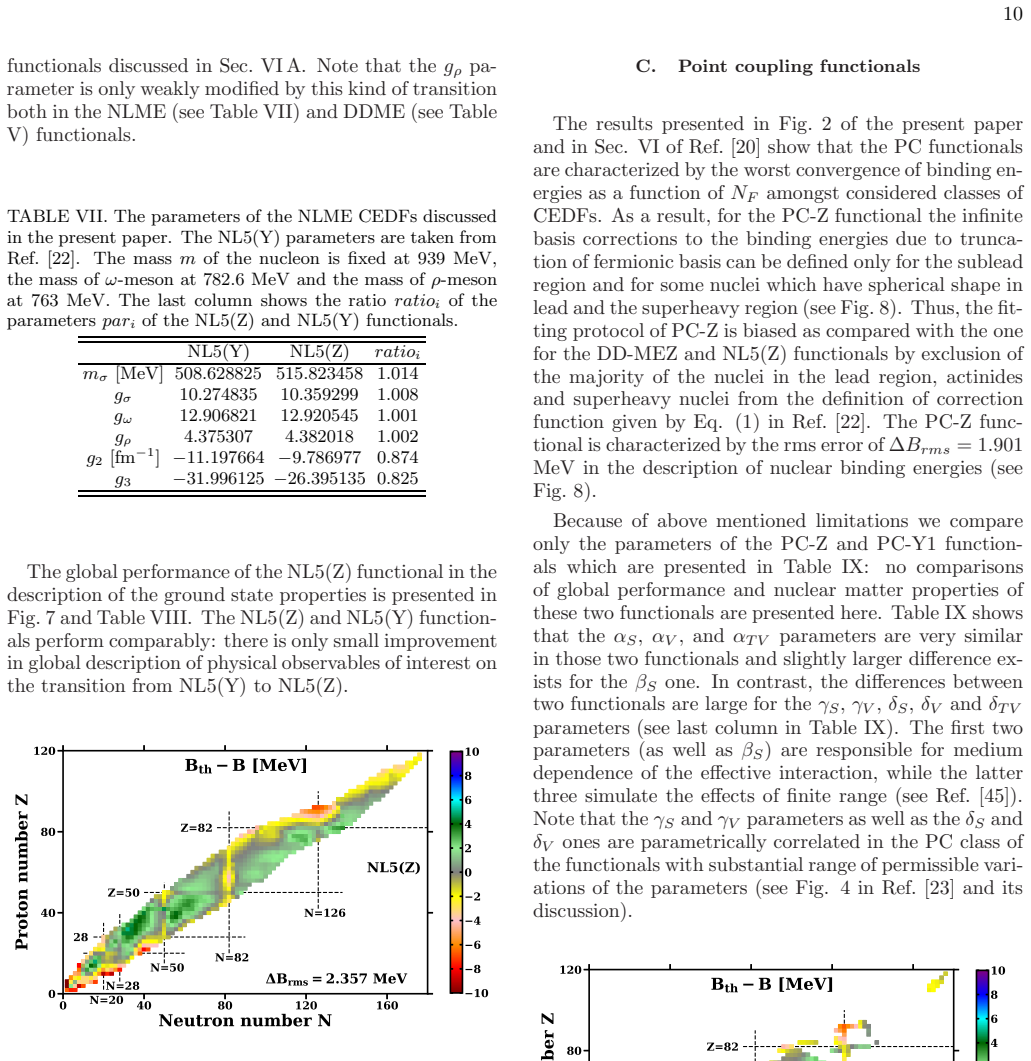
Summary. The paper presents three modifications to the fitting protocol of covariant energy density functionals (CEDFs): (i) inclusion of infinite-basis corrections to binding energies in both fermionic and bosonic sectors, (ii) subtraction of total atomic electron binding energies when converting AME atomic binding energies into nuclear ones, and (iii) use of the full charge-radius formula with spin-orbit terms for anchor nuclei. New functionals DD-MEZ, NL5(Z), and PC-Z are fitted within the anchor-based optimization approach and compared with previous DD-MEY, NL5(Y), and PC-Y fits. The authors report that neglect of the basis corrections and electron binding energies in earlier fits produces a global calculation error δB_negl of about 0.8 MeV for the DDME and NLME classes, and larger than 1.0 MeV for the PC class, while the new Z functionals have δB_negl of about 25–30 keV. The new DD-MEZ functional yields ΔB_rms = 1.601 MeV over 882 even–even nuclei, improving to 1.557 MeV when a Wigner term is added.
Significance. If the central claim is correct, it identifies a hidden systematic error of ~0.8 MeV in previous CDFT mass tables, comparable to the reported rms deviations and thus potentially affecting conclusions drawn from those tables. The paper is also significant for introducing the first chart-wide calculations of infinite-basis corrections in both sectors, for analyzing the neutron-excess dependence of electron binding energies, and for providing new global fits that reach the best mean-field accuracy among CEDFs. The convergence benchmarks (NF = 40/60, NB = 40/120) and the iterative ABOA procedure for defining basis corrections are well documented and could be reused by other groups. The main weakness is that the 0.8 MeV error estimate is derived from a Y-vs-Z functional comparison that does not isolate the three protocol changes, so the causal attribution is not fully established.
major comments (4)
- [Sec. VI E, Eq. (10), Fig. 9] The quantity δB_negl^rms defined in Eq. (10) and displayed in Fig. 9 is computed as rms[B(Y) − B(Z)], i.e., as a difference between two independently optimized functionals. However, the Y and Z fits differ not only in the treatment of basis truncation and electron binding energies but also in the AME evaluation (2016 vs 2020; 853 vs 882 even–even nuclei), in the anchor data values taken from those evaluations, and in the charge-radius expression (full Eq. (1) including spin-orbit terms for Z, first three terms only for Y). The statement in Sec. VI E that the AME update “does not play a principal role” is an assertion with no supporting ablation or sensitivity analysis. Large parameter changes for density-dependent couplings (e.g., c_ω ratio 1.439 in Table V) suggest that the observed 0.8 MeV differences may partly reflect shallow-minimum parameter shifts or data-set changes rather than the physics corrections. To support the central claim, the authors should provide controlled refits that vary one ingredient at a time, or demonstrate that the AME version and charge-radius expression have negligible effect on δB_negl^rms.
- [Abstract, Secs. V, VI C, VI E] The abstract states that the neglect of the new ingredients leads to errors “of the order of 0.8 MeV or higher for the three major classes” of CEDFs. For the DDME and NLME classes, the paper gives δB_negl^rms = 0.77 and 0.84 MeV (Fig. 9(a,b)), though with the attribution caveat above. For the PC class, however, Sec. VI E explicitly states that “at present it is impossible to accurately quantify the δB_negl^rms values,” and Sec. VI C explains that the PC-Z fit is biased by the exclusion of actinides and superheavy nuclei from the correction function because PC functionals do not converge at NF = 40 (Fig. 2). The PC estimate “larger than 1.0 MeV” from Fig. 9(c) is therefore not an accurate quantification and should not be used to support the abstract’s “three major classes” claim. The wording of the abstract and conclusions should be revised to restrict the quantitative 0.8 MeV statement to the DDME and NLME classes, or the authors should provide a reliable PC error estimate that accounts for the biased fitting region.
- [Sec. V, Supplemental Sec. III] The infinite-basis corrections ΔBF∞(Z,N) are defined through the functional being fitted (Eq. (8)) and are updated iteratively in the ABOA rounds. The validation of the extrapolation procedure is performed against NF = 40 results for a “testing set of nuclei scattered more or less equally across experimentally known nuclear landscape,” with claimed global accuracy better than 15 and 10 keV for DD-MEZ and NL5(Z), respectively. These numbers, however, apply only to the selected test nuclei; the procedure is then applied to all 882 nuclei without an explicit chart-wide uncertainty estimate. Because the central error budget for the Y functionals (δB_negl^rms ≈ 0.8 MeV) is much larger than this validation accuracy, this is not the main limitation, but the paper should report how the extrapolation uncertainty propagates into the 28 keV (DD-MEZ) and 23 keV (NL5(Z)) estimates for the Z functionals, and should state more carefully that the 15/10 keV values are validation-set accuracies rather than global uncertainties.
- [Sec. VI E] The same methodological issue that affects δB_negl^rms for binding energies also affects the reported global calculation errors for charge radii and separation energies. The values δ(rch)_negl^rms = 0.010 fm (DD-MEY) and δ(S2n)_negl^rms = 0.387 MeV (DD-MEY) are obtained from the Y–Z differences in the same uncontrolled comparison. Unless the authors provide an ablation separating the contributions of the three protocol changes, these quantities should be described as model-sensitivity measures rather than as well-defined “global calculation errors,” or the analysis should be extended to control the other variables.
minor comments (7)
- [Title, Sec. I] The manuscript text contains “d ensity” in the title and running header; this should be corrected to “density.”
- [Sec. VI E, Eq. (10)] The use of “±” to combine ΔB_rms and δB_negl^rms is not standard; please specify whether the stated uncertainty is one sigma, a quadrature sum, or the rms of the difference itself.
- [Table III] The table classifies existing functionals as atomic or nuclear, but the new Z functionals are not listed; considering they are the main subject of the paper, they should be included or referenced.
- [Sec. IV] The conclusion that the isotopic dependence of Bel is negligible is based on only three chains (Pb, Fm, Og); a sentence on why these are representative would be useful.
- [Fig. 5] The color scales for the two panels are different (max 0.30 vs 1.0 MeV), which makes visual comparison of the magnitude of bosonic corrections between DD-MEZ and NL5(Z) difficult; a common scale would improve clarity.
- [Sec. VI E, footnote 4] This footnote contains a substantial quantitative result (the additional 0.199 MeV contribution for PC-PK1) that is relevant to the main text; consider moving it into the main body.
- [Sec. VII, first bullet] “Eliminate numerical uncertainties” is too strong; the text in Sec. VI E states residual errors of ~25–30 keV for the Z functionals. Rephrase to “substantially reduce.”
Circularity Check
The headline 0.8 MeV error estimate is a defined Y-vs-Z functional difference relabeled as the error from neglected basis/Bel terms; the underlying correction procedure itself is not circular.
-
self definitional
[Sec. VI E, Eq. (10) and Fig. 9]
"δB_negl^rms is the global calculation error due to the truncation of the basis and neglected terms (such as total electron binding energy in the conversion from experimental atomic to nuclear binding energies)... Fig. 9(a) allows to define δB_negl^rms = 0.77 MeV for the DD-MEY functional using the DD-MEZ results as a benchmark."
The claimed global error is not derived from a direct estimate of the neglected terms for the Y functional (e.g., from the same Y parameters evaluated in both truncated and corrected protocols). Instead, Eq. (10) plus Fig. 9 define δB_negl^rms as the rms difference between two separately fitted functionals, B(Y)-B(Z). The Z fit differs from Y not only by the basis truncation and total-electron-binding corrections, but also by the AME evaluation (2016 vs 2020; 853 vs 882 nuclei), the anchor set, and the charge-radius expression (full Eq. (1) for Z). The paper asserts the AME difference 'does not play a principal role' without an ablation or sensitivity analysis.
full rationale
The infinite-basis correction procedure is not circular per se: it is a fixed-point iteration with a stated convergence criterion and it is benchmarked against NF=40 calculations for selected nuclei (better than 15 and 10 keV for DD-MEZ and NL5(Z)). The total electron binding energies from Ref. [67] are independent atomic-physics calculations, not fit to CDFT data, so the self-citation there is not load-bearing. The circular element is localized to Sec. VI E: the quantity called 'global calculation error due to truncation and neglected terms' is operationalized as rms[B(Y)-B(Z)], a difference between two independently refitted functionals that also differ in AME version, anchor nuclei, and charge-radius expression. The paper labels this difference as the error caused specifically by the newly included corrections, without ablating the other protocol changes. The abstract's '0.8 MeV or higher for the three major classes' also overstates support for the PC class, since Sec. VI E explicitly says the PC δB_negl^rms cannot be accurately quantified and the PC fit is biased by excluding actinides and superheavy nuclei from the correction function; this is an internal-consistency issue rather than a circularity. Overall, the central numerical claim partially reduces to a defined model comparison, justifying a partial circularity score, but the paper contains substantial independent numerical content and external benchmarks.
Assumptions & free parameters
free parameters (4)
- DD-MEZ meson-nucleon coupling parameters (m_sigma, g_sigma, g_omega, g_rho, b_sigma, c_sigma, c_omega, a_rho) =
m_sigma=558.606 MeV, g_sigma=10.602, g_omega=12.881, g_rho=3.515, b_sigma=2.668, c_sigma=4.070, c_omega=4.352…
- NL5(Z) parameters (m_sigma, g_sigma, g_omega, g_rho, g2, g3) =
m_sigma=515.823 MeV, g_sigma=10.359, g_omega=12.921, g_rho=4.382, g2=-9.787 fm^-1, g3=-26.395
- PC-Z point-coupling parameters (alpha, beta, gamma, delta) =
See Table IX of the paper (values are correlated; see text)
- Pairing strength scaling f_pi and f_nu =
f_pi=1.877(N+Z)^-0.1072, f_nu=1.208exp(-0.674|N-Z|/(N+Z))
assumptions (6)
- domain assumption The ABOA correction function, built from 882 even-even experimental binding energies, accurately represents the global performance of the trial functional.
- domain assumption Total electron binding energies of Ref. [67] are accurate for all experimentally known isotopes, and their isotopic variation can be neglected.
- domain assumption The basis extrapolation procedure of Sec. VI of Ref. [20] gives infinite fermionic basis corrections accurate to 10-30 keV for all nuclei where it is used.
- domain assumption Mean-field RHB calculations with separable Gogny pairing are an adequate framework for the global binding energy fits.
- domain assumption The charge radius expression Eq. (1), including neutron and spin-orbit terms, is valid for the anchor nuclei.
- domain assumption Differences between the Y and Z functionals are caused only by the new protocol ingredients, so they quantify the global calculation error of the Y-type fits.
Cite this review
Pith. "Pith review of Further steps towards next generation of covariant energy density functionals." pith.science (2026). https://pith.science/paper/C2ZRYR3F
@misc{pith2026250717082,
  author       = {Pith},
  title        = {Pith review of: Further steps towards next generation of covariant energy density functionals},
  year         = {2026},
  howpublished = {\url{https://pith.science/paper/C2ZRYR3F}},
  note         = {Machine review of arXiv:2507.17082}
}
read the original abstract
The present study aims at further development of covariant energy density functionals (CEDFs) towards more accurate description of binding energies across the nuclear chart. For the first time, infinite basis corrections to binding energies in the fermionic and bosonic sectors of the covariant density functional theory have been taken into account in the fitting protocol within the covariant density functional theory. In addition, total electron binding energies have been used in the conversion of atomic binding energies into nuclear ones. Their dependence on neutron excess has been investigated for the first time across the nuclear chart within atomic approach. These factors have been disregarded in previous generation of covariant energy density functionals but their neglect leads to substantial global calculation errors for physical quantities of interest. For example, these errors for binding energies are of the order of 0.8 MeV or higher for the three major classes of covariant energy density functionals.
Figures


Figures from the paper (8 more)




Forward citations
Cited by 1 Pith paper
-
Isotope shift for total electron binding energy of atoms
A systematic relativistic Hartree-Fock calculation produces tabulated field and mass isotope shift coefficients for total electron binding energy of atoms and ions up to Z=120, with a simple power-law interpolation ac...
Reference graph
Works this paper leans on
-
[1]
Mittig, A
W. Mittig, A. L´ epine-Szily, and N. A. Orr, Annu. Rev. Nucl. Sci. 47, 27 (2003)
2003
-
[2]
Erler, N
J. Erler, N. Birge, M. Kortelainen, W. Nazarewicz, E. Olsen, A. M. Perhac, and M. Stoitsov, Nature 486, 509 (2012)
2012
-
[3]
S. E. Agbemava, A. V. Afanasjev, D. Ray, and P. Ring, Phys. Rev. C 89, 054320 (2014)
2014
-
[4]
Dilling, K
J. Dilling, K. Blaum, M. Brodeur, and S. Eliseev, Annu. Rev. Nucl. Sci. 68, 45 (2018)
2018
-
[5]
for the definition of ∆ BF ∞(Z, N) in global calculation since it is substantially less numerically and memory de- manding. At the same time, this procedure reproduces fully convergent NF = 40 results obtained with the DD- MEZ and NL5(Z) CEDFs for a testing set of nuclei scat- tered more or less equally across experimentally known nuclear landscape with gl...
-
[6]
J. J. Cowan, C. Sneden, J. E. Lawler, A. Aprahamian, M. Wiescher, K. Langanke, G. Mart ´ ınez-Pinedo, and F.-K. Thielemann, Rev. Mod. Phys. 93, 015002 (2021)
2021
-
[7]
Chamel and P
N. Chamel and P. Haensel, Living Rev. Relativity 11, 10 (2008)
2008
-
[8]
R. Lau, M. Beard, S. S. Gupta, A. V. Afanasjev, E. F. Brown, A. Deibel, L. R. Gasques, G. W. Hitt, W. R. Hix, 5 In this paper, the Dirac W oods-Saxon basis is used and the nu- merical errors in the calculations of binding energies are s ubstan- tially reduced as compared with those of the global calculat ions presented in Refs. [80, 82, 90] which also emp...
2018
Show all 98 references
-
[9]
Bender, P.-H
M. Bender, P.-H. Heenen, and P.-G. Reinhard, Rev. Mod. Phys. 75, 121 (2003)
2003
-
[10]
Arnould, S
M. Arnould, S. Goriely, and K. Takahashi, Phys. Rep. 450, 97 (2007)
2007
-
[11]
Tondeur, S
F. Tondeur, S. Goriely, J. M. Pearson, and M. Onsi, Phys. Rev. C 62, 024308 (2000)
2000
-
[12]
Samyn, S
M. Samyn, S. Goriely, P.-H. Heenen, J. M. Pearson, and F. Tondeur, Nucl. Phys. A 700, 142 (2002)
2002
-
[13]
Goriely, N
S. Goriely, N. Chamel, and J. M. Pearson, Phys. Rev. C 88, 061302 (2013)
2013
-
[14]
Baldo, L
M. Baldo, L. M. Robledo, P. Schuck, and X. Vi˜ nas, Phys. Rev. C 87, 064305 (2013)
2013
-
[15]
Vretenar, A
D. Vretenar, A. V. Afanasjev, G. A. Lalazissis, and P. Ring, Phys. Rep. 409, 101 (2005)
2005
-
[16]
Kortelainen, T
M. Kortelainen, T. Lesinski, J. Mor´ e, W. Nazarewicz, J. Sarich, N. Schunck, M. V. Stoitsov, and S. Wild, Phys. Rev. C 82, 024313 (2010)
2010
-
[17]
Kortelainen, J
M. Kortelainen, J. McDonnell, W. Nazarewicz, P.-G. Reinhard, J. Sarich, N. Schunck, M. V. Stoitsov, and S. M. Wild, Phys. Rev. C 85, 024304 (2012)
2012
-
[18]
Kortelainen, J
M. Kortelainen, J. McDonnell, W. Nazarewicz, E. Olsen, P.-G. Reinhard, J. Sarich, N. Schunck, S. M. Wild, D. Davesne, J. Erler, and A. Pastore, Phys. Rev. C 89, 054314 (2014)
2014
-
[20]
Note that to our knowl- edge this is the first time when all terms of Eq
for further discussion). Note that to our knowl- edge this is the first time when all terms of Eq. (1) are used in the fitting protocol of CEDFs: early fits carried out by different groups are restricted to the first two terms of this equation since they dominate Eq. (1) 1. In the ...
1904
-
[21]
M¨ oller, A
P. M¨ oller, A. J. Sierk, T. Ichikawa, and H. Sagawa, At. Data and Nucl. Data Tables 109, 1 (2016)
2016
-
[22]
Taninah and A
A. Taninah and A. V. Afanasjev, Phys. Rev. C 107, L041301 (2023)
2023
-
[23]
Taninah, S
A. Taninah, S. E. Agbemava, A. V. Afanasjev, and P. Ring, Phys. Lett. B 800, 135065 (2020)
2020
-
[24]
C. J. Horowitz and J. Piekarewicz, Phys. Rev. C 86, 045503 (2012)
2012
-
[25]
Taninah, B
A. Taninah, B. Osei, A. V. Afanasjev, U. C. Perera, and S. Teeti, Phys. Rev. C 109, 024321 (2024)
2024
-
[26]
Pe˜ na-Arteaga, S
D. Pe˜ na-Arteaga, S. Goriely, and N. Chamel, Eur. Phys. J. A 52, 320 (2016). 15
2016
-
[27]
Naito, T
T. Naito, T. Oishi, H. Sagawa, and Z. Wang, Phys. Rev. C 107, 054307 (2022)
2022
-
[28]
M. Wang, W. J. Huang, F. G. Kondev, G. Audi, and S. Naimi, Chin. Phys. C45, 030003 (2021)
2021
-
[29]
Angeli and K
I. Angeli and K. P. Marinova, At. Data Nucl. Data Tables 99, 69 (2013)
2013
-
[30]
Kurasawa and T
H. Kurasawa and T. Suzuki, Prog. Th. Exp. Phys. 2019, 113D01 (2019)
2019
-
[31]
Reinhard and W
P.-G. Reinhard and W. Nazarewicz, Phys. Rev. C 103, 054310 (2021)
2021
-
[32]
B¨ urvenich, D
T. B¨ urvenich, D. G. Madland, J. A. Maruhn, and P.-G. Reinhard, Phys. Rev. C 65, 044308 (2002)
2002
-
[33]
Y. Tian, Z. Y. Ma, and P. Ring, Phys. Lett. B 676, 44 (2009)
2009
-
[34]
Teeti and A
S. Teeti and A. V. Afanasjev, Phys. Rev. C 103, 034310 (2021)
2021
-
[35]
Boguta and R
J. Boguta and R. Bodmer, Nucl. Phys. A292, 413 (1977)
1977
-
[36]
Typel and H
S. Typel and H. H. Wolter, Nucl. Phys. A656, 331 (1999)
1999
-
[37]
Saˆ ad, J
B. Saˆ ad, J. Mult. Eng. Sc. Tech 3, 5012 (2016)
2016
-
[38]
Lunney, J
D. Lunney, J. M. Pearson, and C. Thibault, Rev. Mod. Phys. 75, 1021 (2003)
2003
-
[39]
Rufa, P.-G
M. Rufa, P.-G. Reinhard, J. A. Maruhn, W. Greiner, and M. R. Strayer, Phys. Rev. C 38, 390 (1988)
1988
-
[40]
Full convergence is reached at N ′ F when ∆ B(N ′ F ) = ∆B(N ′ F + 2) = 0
− B(NF ) as a function of NF for the 170Gd, 240Pu and 290Lv nuclei. Full convergence is reached at N ′ F when ∆ B(N ′ F ) = ∆B(N ′ F + 2) = 0. the consequence of the fact that the expansion in har- monic oscillator basis states convergences very slowly for zero-range forces (s...
-
[41]
Bender, K
M. Bender, K. Rutz, P.-G. Reinhard, and J. A. Maruhn, Eur. Phys. J. A 8, 59 (2000)
2000
-
[42]
Hilaire, J.-F
S. Hilaire, J.-F. Berger, M. Girod, W. Satula, and P. Schuck, Phys. Lett. B 531, 61 (2002)
2002
-
[43]
Roca-Maza, X
X. Roca-Maza, X. Vi˜ nas, M. Centelles, P. Ring, and P. Schuck, Phys. Rev. C 84, 054309 (2011)
2011
-
[44]
W. Long, J. Meng, N. V. Giai, and S.-G. Zhou, Phys. Rev. C 69, 034319 (2004)
2004
-
[45]
G. A. Lalazissis, J. K¨ onig, and P. Ring, Phys. Rev. C 55, 540 (1997)
1997
-
[46]
G. A. Lalazissis, S. Karatzikos, R. Fossion, D. P. Arteaga, A. V. Afanasjev, and P. Ring, Phys. Lett. B671, 36 (2009)
2009
-
[47]
Nikˇ si´ c, D
T. Nikˇ si´ c, D. Vretenar, P. Finelli, and P. Ring, Phys. Rev. C 66, 024306 (2002)
2002
-
[48]
B. A. Nikolaus, T. Hoch, and D. G. Madland, Phys. Rev. C 46, 1757 (1992)
1992
-
[49]
Kumar, S
B. Kumar, S. K. Singh, B. K. Agrawal, and S. K. Patra, Nucl. Phys. A 966, 197 (2017)
2017
-
[50]
P. W. Zhao, Z. P. Li, J. M. Yao, and J. Meng, Phys. Rev. C 82, 054319 (2010)
2010
-
[51]
B. Wei, Q. Zhao, Z.-H. Wang, J. Geng, B.-Y. Sun, Y.-F. Niu, and W.-H. Long, Chin. Phys. C 44, 074107 (2020)
2020
-
[52]
G. A. Lalazissis, T. Nikˇ si´ c, D. Vretenar, and P. Ring, Phys. Rev. C 71, 024312 (2005)
2005
-
[53]
Beiner, H
M. Beiner, H. Flocard, N. van Giai, and P. Quentin, Nucl. Phys. A 238, 29 (1975)
1975
-
[54]
Kl¨ upfel, P.-G
P. Kl¨ upfel, P.-G. Reinhard, T. J. B¨ urvenich, and J. A. Maruhn, Phys. Rev. C 79, 034310 (2009)
2009
-
[55]
B. K. Agrawal, A. Sulaksono, and P.-G. Reinhard, Nucl. Phys. A 882, 1 (2012)
2012
-
[56]
Sharma, Phys
M. Sharma, Phys. Lett. B 666, 140 (2008)
2008
-
[57]
Z. X. Liu, Y. H. Lam, N. Lu, and P. Ring, Phys. Lett. B 842, 137946 (2023)
2023
-
[58]
Gogny, in: G
D. Gogny, in: G. Ripka, M. Porneuf (Eds.), Nuclear Self- Consistent Fields, Proc. Internat. Conf. held at the Cen- ter for Theoretical Physics, Trieste, Italy, 1975, North- Holland, Amsterdam , 333 (1975)
1975
-
[59]
J. F. Berger, M. Girod, and D. Gogny, Nucl. Phys. A428, 23c (1984)
1984
-
[60]
Chabanat, P
E. Chabanat, P. Bonche, P. Haensel, J. Meyer, and R. Schaeffer, Nucl. Phys. A 635, 231 (1998)
1998
-
[61]
Bartel, P
J. Bartel, P. Quentin, M. Brack, C. Guet, and H. B. H ˚ akansson, Nucl. Phys. A635, 231 (1998)
1998
-
[62]
Navarro P´ erez, N
R. Navarro P´ erez, N. Schunck, A. Dyhdalo, R. J. Furn- stahl, and S. K. Bogner, Phys. Rev. C 97, 054304 (2018)
2018
-
[63]
M. Liu, N. Wang, Y. Deng, and X. Wu, Phys. Rev. C 84, 014333 (2011)
2011
-
[64]
N. Wang, M. Liu, X. Wu, and J. Meng, Phys. Lett. B 734, 215 (2014)
2014
-
[65]
M¨ oller, J
P. M¨ oller, J. R. Nix, W. D. Myers, and W. J. Swiatecki, At. Data Nucl. Data Tables 59, 185 (1995)
1995
-
[66]
N. Wang, M. Liu, and X. Wu, Phys. Rev. C 81, 044322 (2010)
2010
-
[67]
Total electron binding energies are different for differ- ent isotopes due to the difference in nuclear charge ra- dius (field shift) and nuclear mass (mass shift)
are carried out in the present paper to cover this gap in our knowledge. Total electron binding energies are different for differ- ent isotopes due to the difference in nuclear charge ra- dius (field shift) and nuclear mass (mass shift). It is well known that for heavy atoms field ...
-
[68]
N. Wang, Z. Liang, M. Liu, and X. Wu, Phys. Rev. C 82, 044304 (2010)
2010
-
[69]
V. V. Flambaum and J. S. M. Ginges, Phys. Rev. A 73, 052115 (2005)
2005
-
[70]
Huang, M
K.-N. Huang, M. Aoyagi, M. H. Chen, B. Crasemann, and H. Mark, At. Data and Nucl. Data Tables 18, 243 (1976)
1976
-
[71]
G. C. Rodrigues, P. Indelicato, J. P. Santos, P. Patt´ e, and F. Parente, Atom. Data Nuc. Data Tables 86, 117 (2004)
2004
-
[72]
V. A. Dzuba, V. V. Flambaum, and A. V. Afanasjev, Phys. Rev. A 110, 052810 (2024)
2024
-
[73]
V. A. Dzuba, V. V. Flambaum, and M. S. Safronova, Phys. Rev. A 73, 022112 (2006)
2006
-
[74]
I. I. Sobelman, Atomic Spectra and Radiative Transitions (Springer-Verlag Heidelberg New York, 1979)
1979
-
[75]
V. A. Dzuba, J. C. Berengut, C. Harabati, and V. V. Flambaum, Phys. Rev. A 95, 012503 (2017)
2017
-
[76]
B. G. C. Lackenby, V. A. Dzuba, and V. V. Flambaum, Phys. Rev. A 98, 022518 (2018)
2018
-
[77]
B. G. C. Lackenby, V. A. Dzuba, and V. V. Flambaum, Phys. Rev. A 99, 042509 (2019)
2019
-
[78]
B. G. C. Lackenby, V. A. Dzuba, and V. V. Flambaum, Phys. Rev. A 101, 012514 (2020)
2020
-
[79]
Goriely, M
S. Goriely, M. Samyn, P.-H. Heenen, J. M. Pearson, and F. Tondeur, Phys. Rev. C 66, 024326 (2002)
2002
-
[80]
Taninah, S
A. Taninah, S. E. Agbemava, and A. V. Afanasjev, Phys. Rev. C 102, 054330 (2020)
2020
-
[81]
S. E. Agbemava, A. V. Afanasjev, T. Nakatsukasa, and P. Ring, Phys. Rev. C 92, 054310 (2015)
2015
-
[82]
S. A. Coon, M. I. Avetian, M. K. G. Kruse, U. van Kolck, P. Maris, and J. P. Vary, Phys. Rev. C 86, 054002 (2012)
2012
-
[83]
M. Wang, G. Audi, F. G. Kondev, W. Huang, S. Naimi, and X. Xu, Chin. Phys. C 41, 030003 (2017)
2017
-
[84]
Dutra, O
M. Dutra, O. Lourenco, S. S. Avancini, B. V. Carlson, A. Delfino, D. P. Menezes, C. Providencia, S. Typel, and J. R. Stone, Phys. Rev. C 90, 055203 (2014)
2014
-
[85]
Y. L. Yang, Y. K. Wang, P. W. Zhao, and Z. P. Li, Phys. Rev. C 104, 054312 (2021)
2021
-
[86]
Y. Fu, H. Mei, J. Xiang, Z. P. Li, J. M. Yao, and J. Meng, Phys. Rev. C 87, 054305 (2013)
2013
-
[87]
K. Q. Lu, Z. X. Li, Z. P. Li, J. M. Yao, and J. Meng, Phys. Rev. C 91, 027304 (2015)
2015
-
[88]
Dutra, O
M. Dutra, O. Lourenco, J. S. S. Martins, A. Delfino, J. R. Stone, and P. D. Stevenson, Phys. Rev. C 85, 035201 (2012). 16
2012
-
[89]
Reinhard and B
P.-G. Reinhard and B. K. Agrawal, Int. Jour. Mod. Phys. E20, 1379 (2011)
2011
-
[90]
Goriely, N
S. Goriely, N. Chamel, and J. M. Pearson, Phys. Rev. C 82, 035804 (2010)
2010
-
[91]
Gonzalez-Boquera, M
C. Gonzalez-Boquera, M. Centelles, X. Vinas, and L. M. Robledo, Phys. Lett. 779, 195 (2018)
2018
-
[92]
G. A. Lalazissis, S. Raman, and P. Ring, At. Data Nucl. Data Table 71, 1 (1999)
1999
-
[93]
L. Geng, H. Toki, and J. Meng, Prog. Theor. Phys. 113, 785 (2005)
2005
-
[94]
S. E. Agbemava, A. V. Afanasjev, and A. Taninah, Phys. Rev. C 99, 014318 (2019). . 17 Supplemental material I. OVER VIEW Supplemental material provides additional information to the manuscript. Field isotopic shifts to total electron binding energies of the atoms of superheavy...
2019
-
[95]
Q. S. Zhang, Z. M. Niu, Z. P. Li, J. M. Yao, and J. Meng, Frontiers of Physics 9, 529 (2014)
2014
-
[96]
Goriely, S
S. Goriely, S. Hilaire, M. Girod, and S. P´ eru, Phys. Rev. Lett. 102, 242501 (2009)
2009
-
[97]
Hilaire and M
S. Hilaire and M. Girod, Eur. Phys. J. 33, 237 (2007)
2007
-
[98]
Zhang, M.-K
K. Zhang, M.-K. Cheoun, Y.-B. Choi, P. S. Chong, J. Dong, Z. Dong, X. Du, L. Geng, E. Ha, X.-T. He, C. Heo, M. C. Ho, E. J. In, S. Kim, Y. Kim, C.-H. Lee, J. Lee, H. Li, Z. Li, T. Luo, J. Meng, M.-H. Munb, Z. Niu, C. Pan, P. Papakonstantinou, X. Shang, C. Shen, G. Shen, W. Sun...
2022
-
[2023]
[22] which allowed global fits of CEDFs at a reasonable computational cost (see Ref
It is only the advent of the anchor based optimiza- tion approach (further ABOA) in Ref. [22] which allowed global fits of CEDFs at a reasonable computational cost (see Ref. [20]). In this approach, the optimization of the parameters of EDFs is carried out for a selected set of...
2025 arXiv
Reviewed August 6, 2026 · model on record in the stance chip above.
Discussion (0). Continue with ORCID to comment.