REVIEW 3 major objections 5 minor 25 references
Alternative threshold function for Bayesian Optimization of Variational Quantum Circuits
T0 review · 3 major / 5 minor · reviewed 2026-08-15 · deepseek-v4-flash
Pith's one-line read A threshold that stays positive when energy stalls reaches lower ground-state energies than EMICoRe on the off-critical 10-qubit Ising model and matches it on harder benchmarks.
desk verdict Small, honest heuristic paper on a new EMICoRe threshold; the idea is plausible but the headline gain is in-sample and lacks error bars, so it needs a revision, not a desk reject. read the letter →
The pith
A machine-rendered reading of the paper's core claim, the machinery that carries it, and where it could break.
The reading
What carries the argument
The load-bearing object is Eq. (1), the PEDT threshold function, together with the Gaussian process posterior-variance bound that justifies its scale. With $\sigma_0$ the GP prior standard deviation and $\delta E = |\mu_{t-T_{\mathrm{Avg}}}-\mu_t|/T_{\mathrm{Avg}}$ the absolute average energy change, Eq. (1) sets the threshold as the smaller of $\delta E$ and the saturating curve $1/(3+e^{-\delta E})$, all scaled by $\sigma_0/2$. The first factor imports the observation that posterior variance never exceeds the prior variance (Appendix B), so the threshold is always on the same order as the system's variance; the second factor keeps early optimization controlled while preventing later thresholds from growing linearly with $\delta E$. The absolute value is what removes the EMICoRe failure mode $\kappa=0$ that the paper identifies in Fig. 4 and in the green points of Fig. 3a. The mechanism carries the argument because every reported improvement is attributed to keeping the Confident Region non-empty when EMICoRe's would vanish.
What would settle it
Run PEDT and EMICoRe on a held-out set of 10-qubit Ising Hamiltonians at several transverse-field values, none of which were used to set $c=3$, and check whether PEDT still ends at a lower average energy. If the advantage disappears outside the benchmark that chose $c$, the central claim is in-sample tuning; if it persists, the threshold is doing genuine work.
Extended reading notes
Core claim
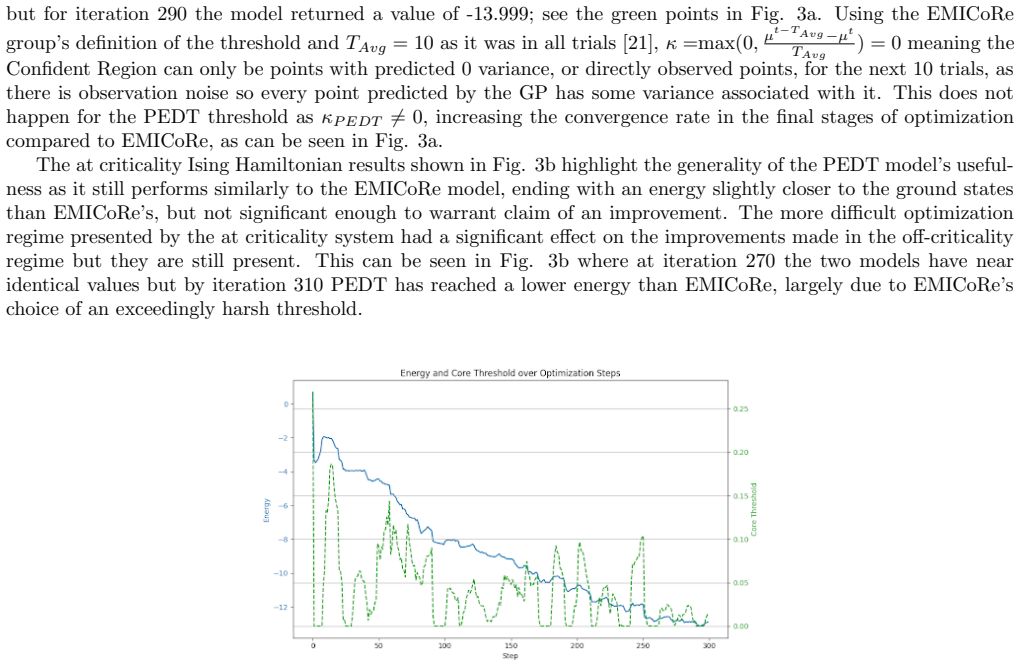
The central claim is that the Confident Region threshold in EMICoRe should depend on the Gaussian process prior variance and on the absolute value of the recent average energy change, not on the signed energy decrease. PEDT sets $\kappa_{\mathrm{PEDT}} = \frac{\sigma_0}{2}\min(\delta E, \frac{1}{3+e^{-\delta E}})$, where $\delta E$ is the absolute average energy change over the last $T_{\mathrm{Avg}}$ iterations. Taking the absolute value keeps the threshold positive during the natural upward fluctuations that make EMICoRe's threshold $\kappa = \max(0, (\mu_{t-T_{\mathrm{Avg}}}-\mu_t)/T_{\mathrm{Avg}})$ equal to zero, and the $\min$ with the logistic-like term keeps the threshold from growing without bound when $\delta E$ is large. The paper argues that the zero-threshold episodes are actively harmful, because they restrict the Confident Region to exactly observed points and slow convergence at the start and end of optimization. On the off-critical 10-qubit Ising model, PEDT's average energy after 310 iterations is closer to the analytic ground state than EMICoRe's; on the critical Ising and Heisenberg models, the two algorithms perform at essentially the same level.
Load-bearing premise
The choice of $c=3$ in the threshold was selected on the same off-critical Ising benchmark that later appears as the reported improvement, so the claimed advantage may be in-sample tuning rather than a general property of PEDT.
Editorial extensions
If this is right
- With PEDT, the Confident Region never fully empties: the threshold remains positive through energy fluctuations, so the exploratory benefit of the region is preserved in late-stage optimization.
- On the off-critical 10-qubit Ising benchmark, the reported average final energy is lower than EMICoRe's, so the threshold choice itself, not the optimizer, is what buys the extra accuracy.
- PEDT matches EMICoRe on the critical Ising and Heisenberg landscapes, implying the modification does not sacrifice performance when local minima are plentiful.
- Because the general PEDT form has six free constants, the same framework can be tuned per system class, which the paper identifies as the next step.
- EMICoRe comparisons that keep the old threshold are, from this paper's view, comparisons against a deliberately fragile choice.
Reading between the lines
- Editorial inference: the reported off-critical advantage should be read warily, because the constant $c=3$ in the denominator $3+e^{-\delta E}$ was selected on the very same off-critical Ising benchmark that later appears as the success case; the gain may be in-sample.
- Editorial inference: the principle of a variance-scaled, always-positive threshold could be dropped into other GP-based acquisition functions, and the six-constant generalization could be optimized per Hamiltonian family to test whether the improvement is structural or just tuned.
- Editorial inference: if the result holds out of sample, the practical effect is that VQE users get a more accurate ground-state estimate for the same number of quantum circuit evaluations, which matters where circuit calls are the expensive resource.
Signed reviews
Editorial analysis
A structured set of objections, weighed in public.
Referee Report
Summary. The paper proposes an alternative threshold function, PEDT (Prior and Energy Dependent Threshold), for the EMICoRe acquisition function used in Bayesian optimization of variational quantum circuits. The proposed threshold, Eq. (1), is κ_PEDT = (σ0/2) · min(δE, 1/(3 + exp(−δE))), where σ0 is the GP prior standard deviation and δE is the absolute average energy change over TAvg iterations. The authors argue that this threshold avoids the κ = 0 events that occur in EMICoRe's threshold and that it better matches the scale of posterior variance. They compare EMICoRe and PEDT on 10-qubit Ising Hamiltonians off and at criticality, and on a 10-qubit Heisenberg Hamiltonian, each run for 310 iterations over 10 independent seeds. The paper reports that PEDT reaches a lower final average energy than EMICoRe on the off-critical Ising system, similar performance at criticality, and practically identical performance on the Heisenberg system. Appendix A justifies the constant c = 3 in the denominator by comparing c = 1, 3, and 5 on the off-critical Ising benchmark, and Appendix B gives a standard bound showing that the posterior variance is bounded by the prior variance.
Significance. If the empirical claims hold, the contribution is a modest but potentially useful heuristic improvement to a specific acquisition function for VQE optimization. The paper is honest in its language, explicitly stating that the criticality and Heisenberg results are not claimed as improvements, and Appendix B correctly reproduces the standard GP variance bound. The proposed threshold is simple, interpretable, and could be of interest to practitioners using EMICoRe. However, the central claim of improvement over EMICoRe rests entirely on a small, in-sample empirical comparison: the key constant c = 3 is selected on the very benchmark used to demonstrate the improvement, and no uncertainty quantification or significance testing is provided for the reported energy differences. As a result, the significance of the result is currently limited, although the proposed framework does offer a plausible direction for further study.
major comments (3)
- [Appendix A / §5, Fig. 3a] The constant c = 3 in Eq. (1) is selected by comparing c = 1, 3, and 5 on the same 10-qubit off-critical Ising Hamiltonian that is later presented as the main success case (Figs. 6–8 in Appendix A, then Fig. 3a in Section 5). This makes the reported improvement over EMICoRe an in-sample comparison: the advantage may be a selection artifact rather than a general property of the PEDT threshold. To support the headline claim, the paper should either evaluate the threshold on a benchmark not used for tuning, use a nested or cross-validation procedure, or demonstrate that the final-energy ordering is insensitive to c across a range of values.
- [§5, Figs. 3a, 3b, 5] The empirical comparison is based on seed-averaged energy curves over only 10 seeds, with no error bars, confidence intervals, or significance tests. The off-critical gap at iteration 310 appears small relative to the fluctuations visible in the trajectories, so it could easily arise from seed noise. The claims of "similar" or "slightly closer" performance for the at-critical Ising and Heisenberg systems are likewise purely qualitative. The authors should report per-seed final energies, the mean and standard deviation (or a confidence interval), and a paired significance test (e.g., a paired t-test or Wilcoxon signed-rank test across seeds) for each benchmark.
- [§5, Fig. 3a and Fig. 4] The mechanism proposed for PEDT's advantage—that EMICoRe's κ = 0 events hinder convergence—is demonstrated with a specific example at iterations 280–290 in Fig. 3a and with a single-seed threshold trace in Fig. 4. Since κ = 0 events are seed-dependent, the causal story needs quantitative support: the authors should report, across all 10 seeds, how often EMICoRe's κ hits zero, when those events occur, and whether their frequency correlates with the average energy gap between the two methods. Without this, the explanation remains anecdotal.
minor comments (5)
- [Eq. (1)] The denominator in Eq. (1) is written inline as 1/(3 + e^{−δE}), but the surrounding text and Fig. 2 refer to f(δE) = 1/(3 + e^{−δE}); please add parentheses consistently and explicitly write the fraction to avoid ambiguity, e.g., κ_PEDT = (σ0/2) · min(δE, 1/(3 + exp(−δE))).
- [Fig. 4 caption] The caption says the run is for 300 iterations, while the main text and other figure captions state 310 iterations; please correct the inconsistency.
- [Fig. 3a caption and text] The caption says "2 points for which κ = 0 between them are shown in green," but the green dotted line also denotes the analytically computed ground state energy; using the same color for both makes the figure confusing. Use distinct markers or colors for these two elements.
- [Section 6] The general form κ_PEDT = (a·σ0) · min(δE, b/(c + d·e^{−f·δE})) introduces constants a through f without naming them as hyperparameters or providing guidance on how they should be chosen in practice; a brief discussion of plausible ranges would be helpful.
- [Throughout] There are several typographical and grammatical issues, such as "VQE's" in the abstract, missing spaces before references, and inconsistent use of "EMICoRe" versus "EMICoRe model"; a careful proofread would improve readability.
Circularity Check
No significant circularity: the PEDT threshold is a new construction from GP prior and energy-history inputs, and the reported energies are genuine simulation outputs.
full rationale
PEDT's threshold κPEDT = (σ0/2)·min(δE, 1/(3+e^{-δE})) is constructed from the GP prior variance and from δE, which is the absolute average change in the GP posterior mean over TAvg iterations. Neither input contains the analytic ground-state energy, the EMICoRe baseline result, or the final energy values plotted in Figs. 3 and 5; therefore the reported energies are genuine outputs of the optimization loop rather than quantities made equal to the threshold by construction. The prior-variance upper bound is justified in Appendix B directly from the GP posterior covariance equation, and the EMICoRe baseline and its κ=max(0,(μ_{t-TAvg}-μ_t)/TAvg) are imported from Nicoli et al.'s external paper and code, not from the present author's own prior work, so no load-bearing self-citation occurs. The only in-sample element is Appendix A, where c=3 is selected by comparing c=1, 3, 5 on the same 10-qubit off-critical Ising benchmark that later demonstrates the improvement; this is a legitimate overfitting and selection risk for the empirical claim, but it is not definitional circularity because the threshold formula does not reduce to the benchmark outcome and no fitted parameter is renamed as an out-of-sample prediction. The paper's own conclusion acknowledges the constants are unoptimized degrees of freedom, further showing the central formula is an ansatz with tunable constants rather than a quantity derived from the target result.
Assumptions & free parameters
free parameters (3)
- scale factor a = 0.5 in kappa_PEDT = (a * sigma0) * min(deltaE, 1/(3 + exp(-deltaE))) =
0.5
- offset constant c = 3 in denominator 3 + exp(-deltaE) =
3
- exponential rate f = 1 and numerator b = 1 in b/(c + d * exp(-f * deltaE)) =
b = 1, f = 1
assumptions (2)
- standard math Posterior GP variance is bounded above by the prior covariance: sigma^2_* <= k(x_*, x_*)
- domain assumption The EMICoRe confident-region acquisition logic remains valid when the threshold kappa is changed to a different deterministic function of the GP and energy history
Cite this review
Pith. "Pith review of Alternative threshold function for Bayesian Optimization of Variational Quantum Circuits." pith.science (2026). https://pith.science/paper/2JJQHJZX
@misc{pith2026250720570,
  author       = {Pith},
  title        = {Pith review of: Alternative threshold function for Bayesian Optimization of Variational Quantum Circuits},
  year         = {2026},
  howpublished = {\url{https://pith.science/paper/2JJQHJZX}},
  note         = {Machine review of arXiv:2507.20570}
}
read the original abstract
In this paper, we propose an expansion of the Expected Maximum Improvement over Confident Regions (EMICoRe) Variational Quantum Eigensolver (VQE) -- a technique advanced by Nicoli et al., which utilizes both quantum and classical components to approximate the ground state of a quantum system -- by introducing an alternative threshold for EMICoRe's Confident Region that depends on both the Gaussian process (GP) prior variance and the model's change in predicted energy over a set number of iterations. This modification is a more lenient threshold for the Confident Region and accounts for natural fluctuations in the predicted energy that EMICoRe punishes by eliminating the exploratory benefits presented by the Confident Region. We test both algorithms with the original EMICoRe model as a baseline and our results suggest improvement over EMICoRe's state-of-the-art results for a common benchmark for VQEs, the Ising Hamiltonian, and similar performance for more complex optimization regimes. We analyze the accuracy in approximated ground state energy and how the threshold evolves during optimization to compare the EMICoRe model with the proposed alternative. After comparison, we discuss the potential optimization of the degrees of freedom present in the new threshold for better performance and a more varied choice of system to be approximated.
Figures


Figures from the paper (5 more)


Reference graph
Works this paper leans on
-
[1]
Physics-Informed Bayesian Optimization of Variational Quantum Circuits
Kim A. Nicoli et al. “Physics-Informed Bayesian Optimization of Variational Quantum Circuits”. In: arXiv preprint arXiv:2406.06150 (2024). url: https://arxiv.org/abs/2406.06150
arXiv 2024
-
[2]
Assessing and Advancing the Potential of Quantum Computing: A NASA Case Study
Eleanor G. Rieffel et al. “Assessing and Advancing the Potential of Quantum Computing: A NASA Case Study”. In: Future Generation Computer Systems 160 (2024), pp. 598–618. doi: 10.1016/j.future.2024.06.012 . url: https://ntrs.nasa.gov/citations/20240014603
arXiv 2024
-
[3]
Quantum Algorithms: A Survey of Applications and End-to-End Complexities
Alexander M. Dalzell et al. “Quantum Algorithms: A Survey of Applications and End-to-End Complexities”. In: arXiv preprint arXiv:2310.03011 (2023). url: https://arxiv.org/abs/2310.03011
arXiv 2023
-
[4]
Understanding Quantum Technologies 2024
Olivier Ezratty. Understanding Quantum Technologies 2024 . https : / / arxiv . org / abs / 2111 . 15352. 7th edition. 2024
work page 2024
-
[5]
Polynomial-Time Algorithms for Prime Factorization and Discrete Logarithms on a Quantum Computer
Peter W. Shor. “Polynomial-Time Algorithms for Prime Factorization and Discrete Logarithms on a Quantum Computer”. In: arXiv preprint quant-ph/9508027 (1995). doi: 10.48550/arXiv.quant- ph/9508027 . url: https://arxiv.org/abs/quant-ph/9508027
-
[6]
Quantum Chemistry in the Age of Quantum Computing
Yudong Cao et al. “Quantum Chemistry in the Age of Quantum Computing”. In: Chemical Reviews 119.19 (2019), pp. 10856–10915. doi: 10.1021/acs.chemrev.8b00803. url: https://pubs.acs.org/doi/10.1021/ acs.chemrev.8b00803
-
[7]
Quantum Computing in the NISQ Era and Beyond
John Preskill. “Quantum Computing in the NISQ Era and Beyond”. In: arXiv preprint arXiv:1801.00862 (2018). doi: 10.22331/q-2018-08-06-79 . url: https://arxiv.org/pdf/1801.00862
arXiv 2018
-
[8]
Quantum entanglement can be a double-edged sword in NISQ computers
Guillermo Gonz´ alez-Garc´ ıa, Rahul Trivedi, and J. Ignacio Cirac. “Quantum entanglement can be a double-edged sword in NISQ computers”. In:Max-Planck-Institute for Quantum Optics Research News (Dec. 2022). Accessed: 2025-06-19. url: https://www.mpq.mpg.de/6798783/12-entanglement-in-nisq-computers
Show all 25 references
-
[9]
Quantum Decoherence
Maximilian Schlosshauer. “Quantum Decoherence”. In: Physics Reports 831 (2019), pp. 1–57. doi: 10.1016/ j.physrep.2019.10.001. arXiv: 1911.06282 [quant-ph]. url: https://arxiv.org/abs/1911.06282
2019 arXiv
-
[10]
Challenges in Scaling-Up the Control Interface of a Quantum Computer
D. J. Reilly. “Challenges in Scaling-Up the Control Interface of a Quantum Computer”. In: arXiv preprint arXiv:1912.05114 (2019). url: https://arxiv.org/pdf/1912.05114
2019 arXiv
-
[11]
Quantum error correction below the surface code threshold
Rajeev Acharya et al. “Quantum error correction below the surface code threshold”. In: Nature 638 (2024), pp. 920–926. doi: 10.1038/s41586-024-08449-y . url: https://www.nature.com/articles/s41586-024- 08449-y
2024 doi
-
[12]
Hybrid Quantum-Classical Algorithms in the Noisy Intermediate- Scale Quantum Era and Beyond
Adam Callison and Nicholas Chancellor. “Hybrid Quantum-Classical Algorithms in the Noisy Intermediate- Scale Quantum Era and Beyond”. In: arXiv preprint arXiv:2207.06850 (2022). url: https://arxiv.org/ abs/2207.06850
2022 arXiv
- [13]
-
[14]
Quantum Computing Lecture Notes, Chapter 5
Christopher Klix. Quantum Computing Lecture Notes, Chapter 5 . School of Physics, William & Mary. https: //cklixx.people.wm.edu/teaching/QC2021/QC-chapter5.pdf. 2021
2021
-
[15]
A Tutorial on Bayesian Optimization
Peter I. Frazier. “A Tutorial on Bayesian Optimization”. In: arXiv preprint arXiv:1807.02811 (2018). url: https://arxiv.org/abs/1807.02811
2018 arXiv
-
[16]
Maximizing acquisition functions for Bayesian optimization
Evgenii Maximov. “Maximizing acquisition functions for Bayesian optimization”. In: arXiv preprint arXiv:1805.10196 (2018). url: https://arxiv.org/abs/1805.10196
2018 arXiv
-
[17]
Carl Edward Rasmussen and Christopher K. I. Williams. Gaussian Processes for Machine Learning. MIT Press,
-
[18]
Sequential Minimal Optimization for Quantum-Classical Hybrid Algorithms
Ken M. Nakanishi, Keisuke Fujii, and Satoshi Todo. “Sequential Minimal Optimization for Quantum-Classical Hybrid Algorithms”. In: Physical Review Research 2.4 (2020), p. 043158. doi: 10.1103/PhysRevResearch.2. 043158. url: https://journals.aps.org/prresearch/abstract/10.1103/P...
2020 doi
-
[19]
Noisy Bayesian optimization for variational quantum eigensolvers
Giovanni Iannelli and Karl Jansen. “Noisy Bayesian optimization for variational quantum eigensolvers”. In: arXiv preprint arXiv:2112.00426 (2021). url: https://arxiv.org/pdf/2112.00426
2021 arXiv
-
[20]
Exact Ising model simulation on a quantum computer
Alba Cervera-Lierta. “Exact Ising model simulation on a quantum computer”. In: Quantum 2 (2018), p. 114. doi: 10.22331/q-2018-12-21-114 . url: https://quantum-journal.org/papers/q-2018-12-21-114/
2018 doi
-
[21]
Nicoli et al
Kim A. Nicoli et al. EMICoRe: Expected Maximum Improvement over Confident Regions . https://github. com/angler-vqe/emicore. GitHub repository. 2023
2023
-
[22]
Hunting for quantum-classical crossover in condensed matter problems
Hsin-Yuan Huang et al. “Hunting for quantum-classical crossover in condensed matter problems”. In: npj Quantum Information 10 (2024), p. 39. doi: 10.1038/s41534- 024- 00839- 4 . url: https://www.nature. com/articles/s41534-024-00839-4 . 7
2024 doi
-
[23]
The energy landscape networks of spin-glasses
Jonathan P.K. Doye and Claire P. Massen. “The energy landscape networks of spin-glasses”. In: arXiv preprint arXiv:0710.5403 (2007). url: https://arxiv.org/abs/0710.5403
2007 arXiv
-
[24]
Mastering the exploration-exploitation trade-off in Bayesian Optimization
Yibo Wang et al. “Mastering the exploration-exploitation trade-off in Bayesian Optimization”. In: arXiv preprint arXiv:2305.08624 (2023). arXiv: 2305.08624 [cs.LG]. url: https://arxiv.org/abs/2305.08624. 8 Appendix A In the appendix we analyze more lenient and strict choices f...
2023 arXiv
-
[2006]
url: http://gaussianprocess.org/gpml/chapters/RW2.pdf
Reviewed August 15, 2026 · model on record in the stance chip above.
Discussion (0). Continue with ORCID to comment.