REVIEW 4 major objections 4 minor 11 references
Piritakua: the atmosphere as a high-energy physics laboratory
T0 review · 4 major / 4 minor · reviewed 2026-08-06 · deepseek-v4-flash
Pith's one-line read Piritakua aims to show that a small rooftop scintillator array can read geophysical and thunderstorm effects in the secondary cosmic-ray rate, with an 8% CME dip as first evidence.
desk verdict Honest, modest commissioning report from a small Mexico City array; the CME rate decrease is plausible but not separated from barometric effects, so it reads as a status update rather than a measurement. read the letter →
The pith
A machine-rendered reading of the paper's core claim, the machinery that carries it, and where it could break.
The reading
What carries the argument
The mechanistic core is the paired particle and environment measurement: plastic scintillator tiles, enlarged from 25 $cm^{2}$ to 400 $cm^{2}$ by wavelength-shifting fibers coupled to silicon photomultipliers (SiPMs), are read out by compact Arduino-based electronics, while an electric-field mill, a magnetometer, a weather station, and an all-sky camera record the surrounding atmospheric state. This synchronization is what lets the authors compare a particle-rate change with the CME's geomagnetic signature and with lightning-triggered field changes. The physics being exploited is the interaction of secondary cosmic rays with atmospheric column density and electric fields: pressure changes alter absorption and lateral spread, and electric fields accelerate or deflect charged secondaries. The two detector subarrays used different thresholds and exposure conditions, so they are kept separate; their agreement is the main cross-check behind the CME attribution.
What would settle it
Run the same May-June 2025 data through a standard barometric correction using the co-located weather station's pressure record, and check whether the roughly 8% dip remains centered on the CME arrival and recovers over a week; if it disappears or tracks a local pressure front instead, the geophysical attribution collapses.
Extended reading notes
Core claim
The central claim, stated by the authors in the summary, is that even though Piritakua is a small-scale experiment, it has observed the effect of a CME in the measured particle rate and hints of the effect of thunderstorm electric fields on secondary particle propagation. The CME signal appears as a maximum rate decrease of about 8% in both detector subarrays, with the local magnetometer trace matching the shape of the reported geomagnetic storm, and a larger nearby observatory saw about 12%. The thunderstorm observation is explicitly a hint: one-second binned rates during the June 11 storm show possible structures that correlate with electric-field variations produced by lightning, but the authors say more data are needed. In its own framing, the paper establishes that the Piritakua array can serve as a sensitive, multi-sensor probe of high-energy atmospheric physics.
Load-bearing premise
The central claim assumes that the observed roughly 8% rate decrease tracks the CME rather than a local weather system, because the paper's shown analysis applies no pressure correction and bins the rate by day.
Editorial extensions
If this is right
- A pressure-corrected version of the CME time series would let the collaboration compare its 8% dip quantitatively with the roughly 12% seen by the larger nearby observatory.
- The planned 16-module array would increase collecting area enough to target minute-long thunderstorm ground enhancements (TGEs) that the current prototype setup can only hint at.
- If the CME signal holds up, small and inexpensive urban scintillator arrays become plausible building blocks for a distributed space-weather and atmospheric-electric-field monitoring network.
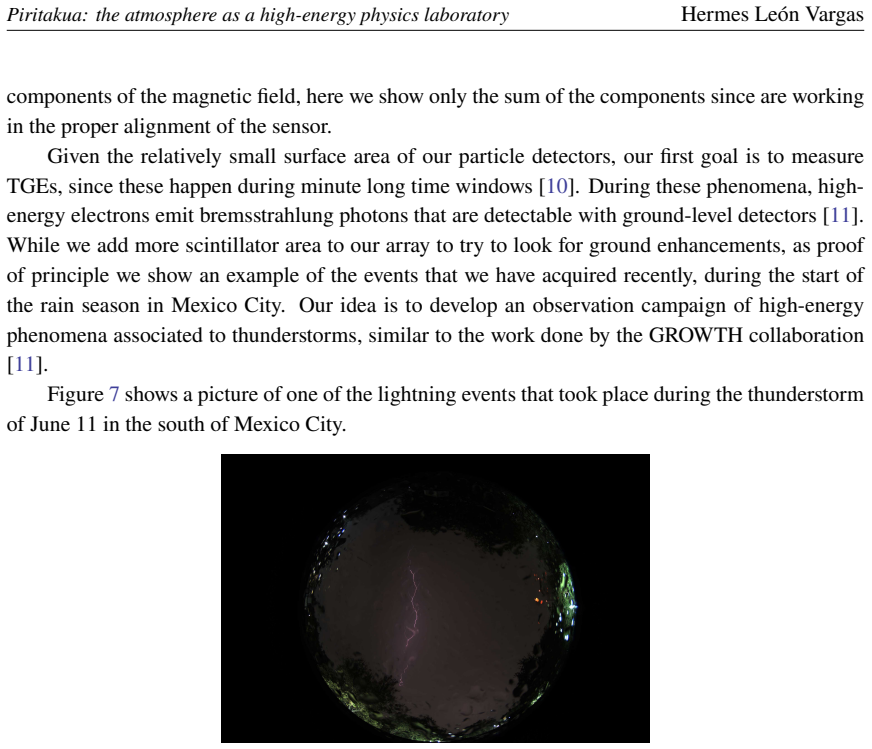
- The co-located electric-field mill, magnetometer, weather station, and all-sky camera make the same detector array a candidate platform for studying gamma-ray glows and related high-energy atmospheric phenomena.
Reading between the lines
- The paper's own caveat about missing pressure corrections suggests a direct test: comparing the daily-binned rate against the co-located weather station's pressure record for May 25 through June 8 would show whether the 8% dip is geophysical or meteorological.
- Because the critical field for relativistic runaway electron avalanches is about 24% smaller at Mexico City's altitude than at sea level, the same array might be a more sensitive site for thunderstorm-electric-field effects than a sea-level detector of equal area.
- The magnetometer gap during the June 11 storm leaves the thunderstorm hint uncheckable against magnetic data; keeping all sensors running through storms would let a future analysis separate electric-field-driven rate changes from purely meteorological ones.
- A similar detector at a site with frequent and intense thunderstorms could test whether the hinted rate structures scale with local electric-field strength or with detector area.
Signed reviews
Editorial analysis
A structured set of objections, weighed in public.
Referee Report
Summary. The paper reports on the status and first results of the Piritakua project, a small array of CosmicWatch plastic scintillators at UNAM in Mexico City (2280 m a.s.l.), operated alongside a weather station, an electric-field mill, a magnetometer, and an all-sky camera. The stated goal is to study transient atmospheric effects on secondary cosmic-ray particles. The main preliminary result is a reported ~8% decrease in the secondary-particle count rate during the late-May/early-June 2025 coronal mass ejection (CME), observed independently in two subarrays (office and rooftop), and compared with a ~12% decrease reported by the Mexico City Cosmic Ray Observatory. The paper also shows a thunderstorm example with electric-field and rate measurements, interpreted only as hints of a possible correlation. The authors acknowledge that pressure corrections are not yet applied and that the lightning-rate correlation requires more data.
Significance. If the CME attribution is correct, the paper demonstrates that a small, low-cost, open-source detector array can resolve geophysical-scale transient variations in secondary cosmic-ray intensity, which would be a useful proof of principle for broader deployments. The simultaneous use of meteorological and electromagnetic sensors is a good design, and the two independent subarrays plus the external comparison are positive features. The manuscript is honestly hedged about the thunderstorm result, and the detector development is described in useful detail. However, the central quantitative claim—the ~8% CME-related decrease—is not yet separated from atmospheric pressure effects, which is the main load-bearing weakness.
major comments (4)
- [Section 4, Figure 5] The attribution of the observed ~8% rate decrease to the CME is not separated from barometric pressure effects. The text explicitly states: 'we are not ready to perform pressure corrections on the data. Instead, we show the data using daily bins.' Daily binning removes the diurnal cycle but not multi-day synoptic pressure trends; at 2280 m a.s.l., pressure changes of a few tens of hPa can alter the secondary muon rate by several percent, comparable to the claimed signal. Please quantify the atmospheric pressure variation over the full period (using the Davis station or external pressure records), overlay the pressure time series on Figure 5, and either perform a pressure correction or demonstrate quantitatively that the rate decrease is not anticorrelated with local pressure. This is necessary to support the central claim in the Summary.
- [Section 4, comparison with Mexico City Cosmic Ray Observatory] The comparison with the Mexico City Cosmic Ray Observatory's ~12% decrease is too underspecified to serve as evidence against a local atmospheric cause. The manuscript gives no information on that instrument's detector type, energy threshold, altitude, pressure-correction procedure, or the exact time window of the quoted decrease. Without those details, the reader cannot tell whether the two measurements probe the same physical quantity or whether a common local weather system could affect both. Please either provide those details, cite a public data release with a documented analysis, or downgrade the comparison to a qualitative consistency check.
- [Section 4, Figure 5] The magnitude of the decrease ('of the order of ~8%') is not defined with respect to a baseline, and no statistical uncertainties are shown on the daily rate points. Please state how the baseline rate was computed (for example, an average over a quiet epoch before the CME), report the statistical error on each rate measurement, and evaluate the significance of the deficit in each subarray separately. As written, the reader cannot judge whether the structure is significant or quantify the confidence of the CME claim.
- [Section 4, Figure 9] The lightning-correlation result is presented only as 'hints' and the text says more data are needed, which is appropriately cautious. However, if the figure is to support even a hint, it should be accompanied by a quantitative measure—for example, a correlation coefficient, a binned significance, or a comparison of rate fluctuations before/after the lightning trigger. As it stands, the claim is purely qualitative, and the lack of error bars on the one-second rates makes the visual impression unreliable. Please either add a simple statistical characterization or explicitly mark the figure as an illustration of data quality rather than evidence.
minor comments (4)
- [References] Several reference entries are incomplete and inconsistent with standard journal citations: [1] gives 'Nature 2024 53–56' without volume/article number; [2] gives 'Physical Review D2025063023' without volume/page; [4] gives 'JINST 2018P03019' without volume; [10] and [11] are missing journal volume/page details. Please check all bibliographic entries against the publisher's final versions.
- [Section 4, Figure 5] The caption says 'The two markers indicate data from two different testing arrays,' but it is not clear which marker corresponds to the office subarray and which to the rooftop subarray. Please identify the subarrays explicitly in the caption or with a legend.
- [Section 2] The sentence 'All of these prototypes have a smaller surface than the design goal size of 20 cm per side' is vague; please state the actual sensitive area of the prototypes used for the CME measurement, since the absolute rate and its sensitivity to pressure depend on the detector size.
- [General] There are several minor grammatical and punctuation issues, including run-on sentences (for example, 'It is interesting to notice that there seem to be hints of structures in the detection rate, that possibly correlate...' should be '...in the detection rate that possibly correlate...') and inconsistent spacing between words in the proceedings format. A careful proofread is recommended.
Circularity Check
No circularity: the paper is an experimental status report with no fitted parameters or derived predictions; the CME observation is compared with an independent external observatory.
full rationale
This paper does not contain a derivation chain of the kind that can be circular. It reports detector construction, data acquisition, and preliminary rate measurements. The central claim—an approximately 8% decrease in secondary-particle rate attributed to the May 2025 CME—is an empirical comparison against the independent Mexico City Cosmic Ray Observatory and against external geomagnetic activity reports; it is not produced by a model, a fitted parameter, or a self-citation. The absence of pressure corrections is a real scientific limitation and a possible confound for the CME attribution, but that is a validity concern, not circularity, because the rate decrease is not constructed from the pressure assumption. The thunderstorm-field 'hints' are explicitly stated to be preliminary and to require more data, so they are not presented as a prediction. Self-references are limited to instrument documentation and standard software, none of which is load-bearing for the claimed physical result. No step in the paper reduces by construction to its own inputs, so the appropriate finding is no significant circularity.
Assumptions & free parameters
assumptions (2)
- domain assumption The scintillator event rate is a faithful proxy for the secondary cosmic-ray particle flux at the site.
- domain assumption The observed rate decrease is caused by the CME rather than by local pressure or temperature changes.
Cite this review
Pith. "Pith review of Piritakua: the atmosphere as a high-energy physics laboratory." pith.science (2026). https://pith.science/paper/KLSP4M54
@misc{pith2026250721373,
  author       = {Pith},
  title        = {Pith review of: Piritakua: the atmosphere as a high-energy physics laboratory},
  year         = {2026},
  howpublished = {\url{https://pith.science/paper/KLSP4M54}},
  note         = {Machine review of arXiv:2507.21373}
}
read the original abstract
The atmosphere provides a large set of experimental conditions on which cosmic-ray induced high-energy hadron interactions can take place. These conditions include: sudden changes in the atmospheric pressure, temperature, and in the local electric and magnetic fields. In this talk we introduce the Piritakua (flash of lightning, in the language of the pre-Columbian Pur\'epecha Empire in Mexico) project, a cosmic-ray detector located at the Instituto de F\'isica of UNAM, in Mexico City at 2280 m. a.s.l. The experiment consists of a small array of scintillator detectors, which use the electronics developed by the CosmicWatch project. The scintillators operate simultaneously with an electric field meter, a magnetometer, a meteorological station, and a hemispheric camera. We propose to use Piritakua to study the modification of the secondary particle production and propagation under sudden variations in the standard atmospheric properties. We present the current status and the first results of the experiment.
Figures


Figures from the paper (2 more)

Reference graph
Works this paper leans on
-
[1]
et al.,Flickering gamma-ray flashes, the missing link between gamma glows and TGFs,Nature 2024 53–56
Østgaard, N., Mezentsev, A., Marisaldi, M. et al.,Flickering gamma-ray flashes, the missing link between gamma glows and TGFs,Nature 2024 53–56
work page 2024
-
[2]
C.Yang,X.X.Zhou,H.H.He,D.H.Huang,X.J.Chen,T.Zhou,andK.J.Guo, Effectofnear- Earth thunderstorm electric fields on the flux of cosmic ray air showers in LHAASO-KM2A, Physical Review D2025063023 [arXiv:2410.07925]
-
[3]
The Physics Behind the CosmicWatch Desktop Muon Detectors
Spencer N. Axani, The Physics Behind the CosmicWatch Desktop Muon Detectors , [arXiv:1908.00146]. 7 Piritakua: the atmosphere as a high-energy physics laboratory Hermes León Vargas
work page Pith review arXiv 1908
- [4]
- [5]
-
[6]
Cumulus MX Development Team, The Cumulus MX weather program , [https://github.com/cumulusmx/CumulusMX]
-
[7]
PythonSoftwareFoundation, Python3: Aninterpreted,interactive,object-orientedprogram- ming language, [https://www.python.org]
-
[8]
Rene Brun and Fons RademakersROOT - An Object Oriented Data Analysis Framework, ProceedingsAIHENP’96Workshop,Lausanne,Sep.1996 Nucl.Inst.&Meth.inPhys.Res.A 1997 389, 81-86
work page 1996
Show all 11 references
-
[9]
Richard et al.,Siril: An Advanced Tool for Astronomical Image Processing, Journal of Open Source Software9 2024 7242
C. Richard et al.,Siril: An Advanced Tool for Astronomical Image Processing, Journal of Open Source Software9 2024 7242
2024
-
[10]
& Cummer, S.A.High-Energy Atmospheric Physics: Terrestrial Gamma-Ray Flashes and Related Phenomena, Space Sci Rev2012 173, 133-196
Dwyer, J.R., Smith, D.M. & Cummer, S.A.High-Energy Atmospheric Physics: Terrestrial Gamma-Ray Flashes and Related Phenomena, Space Sci Rev2012 173, 133-196
-
[11]
Y. Wada, T. Matsumoto, T. Enoto, K. Nakazawa et al.,Catalog of gamma-ray glows during four winter seasons in Japan, Phys. Rev. Res.3 2021043117 [arXiv:2108.01829]. 8
Reviewed August 6, 2026 · model on record in the stance chip above.
Discussion (0). Continue with ORCID to comment.