REVIEW 3 major objections 5 minor 141 references
NIRPS joining HARPS at ESO 3.6 m. On-sky performance and science objectives
T0 review · 3 major / 5 minor · reviewed 2026-08-06 · deepseek-v4-flash
Pith's one-line read A near-infrared spectrograph reaches 77 cm/s radial-velocity precision on Proxima
desk verdict NIRPS first-light paper is a comprehensive and useful instrument characterization, but the 77 cm/s headline is a model-relative residual that overstates what is demonstrated. read the letter →
The pith
A machine-rendered reading of the paper's core claim, the machinery that carries it, and where it could break.
The reading
What carries the argument
The load-bearing components are the adaptive-optics front end and an AO-assisted fibre link that feeds either a 0.4-arcsecond 'high-accuracy' fibre (HA) or a 0.9-arcsecond 'high-efficiency' fibre (HE) with a pupil slicer. The HA fibre is a 29-micron octagonal fibre, while the HE fibre is a 66-micron octagonal fibre feeding a rectangular 33 by 132 micron output; at H-band wavelengths only about 30 modes propagate, so modal noise dominates the precision budget. Fibre stretchers stretching a 20-m section by 6-8 mm at 0.3 Hz plus an AO tip-tilt scanning mode reduce the modal-noise-induced continuum dispersion to about 0.5-0.7 percent, at the cost of a floor of roughly 1.4 m/s and 0.9 m/s in HA and HE modes. A cryogenic white-pupil echelle spectrograph with a 4096 by 4096 H4RG detector and better than 1 mK thermal stability supplies the long-term drift control, while a Fabry-Perot etalon calibrated with uranium-neon lines yields about 17,800 wavelength references across the Y, J, and H bands.
What would settle it
Observe a bright exoplanet-hosting M dwarf with NIRPS alone for several weeks and fit the RVs without imposing an external model; if the residuals remain below about 1 m/s and planet amplitudes match literature values, the precision claim is instrument-level. If residuals are larger or amplitudes differ, the 77 cm/s value is model-dependent. A companion check is a simultaneous HARPS-NIRPS series on one star, looking for an optical-to-NIR RV offset that drifts with telescope position or time.
Extended reading notes
Core claim
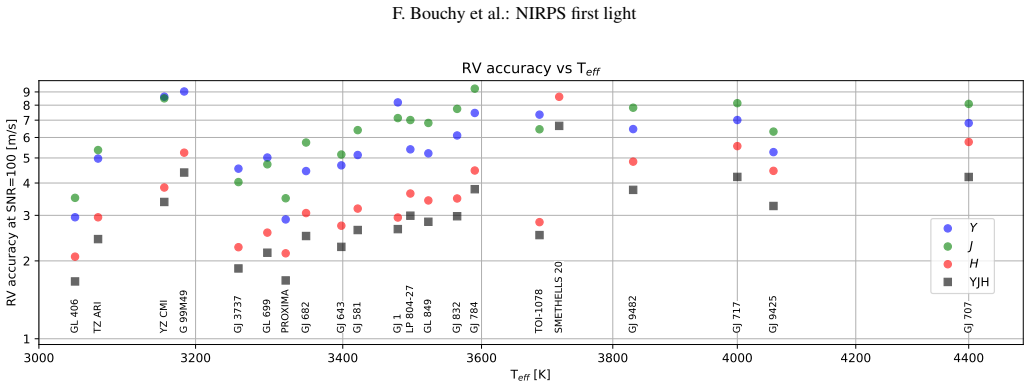
The paper's central claim is that the instrument meets its top-level requirement of 1 m/s radial-velocity precision in the near-infrared: the measured residual RMS against a published Keplerian-plus-activity model of Proxima is 0.77 m/s, the signature of Proxima b is recovered with a semi-amplitude near 1.24 m/s, and the spectrograph's intrinsic drift is only a few cm/s per day with a dispersion of 72 cm/s over five months. The paper also shows that the empirical radial-velocity content of M dwarfs in the Y, J, and H bands is about 1.7 to 2.5 times better than model-based estimates, implying a photon-noise floor near 1.7 m/s at signal-to-noise 100 in H. Additional claims include a peak throughput of 13 percent, successful telluric and OH-line removal, a water detection in a single transit of the hot Saturn WASP-127 b, and the first clear detection of solar p-mode oscillations with a near-infrared spectrograph using the solar feed HELIOS.
Load-bearing premise
The headline 77 cm/s precision assumes that the published ESPRESSO model of Proxima's planets and activity is correct and that NIRPS's wavelength scale and zero point match that model, because only a radial-velocity offset is fitted; if either assumption fails, the residual RMS is not purely NIRPS precision.
Editorial extensions
If this is right
- M dwarf radial-velocity surveys can now be conducted in the near-infrared at the same precision as optical surveys, which is decisive for very red, faint, or active late-M stars.
- Because HARPS and NIRPS observe simultaneously, each epoch can deliver radial velocities from 378 to 1920 nm, letting stellar activity be distinguished from planetary signals by its wavelength dependence.
- The empirical radial-velocity content measurements imply that a 30-minute NIRPS exposure on a slow-rotating M4 dwarf reaches about 1 m/s photon noise at H magnitude 8.2, making small-planet detection around nearby M dwarfs efficient.
- The single-transit water detection on WASP-127 b shows that NIRPS can perform high-resolution atmospheric spectroscopy competitively with longer-established near-infrared instruments.
- The instrument's intrinsic drift is low enough that simultaneous Fabry-Perot reference observations are unnecessary, and OBJ-SKY mode is recommended instead.
Reading between the lines
- If the 77 cm/s Proxima residual survives a fully independent radial-velocity fit, NIRPS would be the first 3.6-m-class near-infrared spectrograph with sub-m/s precision, erasing the practical precision gap between optical and near-infrared work for late M dwarfs.
- The installed but not yet routine laser frequency comb could push the wavelength solution below the current 55 cm/s in HE mode, making the modal-noise floor near S/N 230 the next testable limit on NIRPS radial velocities.
- A direct testable extension is a simultaneous HARPS-plus-NIRPS campaign on a bright RV standard: if the optical-to-near-infrared RV difference drifts with telescope position or time, zero-point systematics are larger than the quoted single-instrument precision.
- The empirical RV content relations for M dwarfs, if adopted by survey planners, would let exposure time be allocated from measured H-band S/N targets rather than model predictions, improving the completeness of small-planet searches.
Editorial analysis
A structured set of objections, weighed in public.
Referee Report
Summary. This paper presents the design, commissioning, and on-sky performance of NIRPS, the AO-assisted near-infrared spectrograph installed at the ESO 3.6-m telescope and operated simultaneously with HARPS. The authors report full YJH coverage from 972.4 to 1919.6 nm, resolving powers of about 90,000 (HA) and 75,000 (HE), a peak throughput of 13%, thermal stability at the millikelvin level, and an RV residual RMS of 0.77 m/s on Proxima relative to the ESPRESSO Keplerian-plus-GP model of Faria et al. (2022). They also characterize modal noise and its mitigation, empirically calibrate the RV photon-noise content of M dwarfs, demonstrate telluric and OH-line corrections, show solar p-mode detection with HELIOS, and present a single-transit water detection in WASP-127b. The paper concludes with the GTO programme and a set of community recommendations for observing modes.
Significance. If the reported performance is confirmed, NIRPS is a rare facility: it is the first AO-assisted, high-resolution, high-stability NIR spectrograph on a 3.6-m-class telescope with sub-m/s-class RV precision, and its simultaneous operation with HARPS provides continuous spectroscopic coverage from 378 nm to 1920 nm. The paper's strengths are its extensive multi-epoch calibration dataset, the explicit benchmarking against the independent ESPRESSO model, the use of two independent pipelines (NIRPS-DRS and APERO) with the LBL algorithm, the empirical RV-content analysis based on on-sky templates, and the HELIOS solar validation that clearly detects solar p-modes in the NIR. These elements make the instrument characterization unusually transparent and reproducible. The main caveat is that the headline 0.77 m/s number is a model-relative residual, not a raw instrument scatter, and its wording in the abstract should be tightened.
major comments (3)
- [Abstract and Section 5.4, Fig. 22] The 0.77 m/s value is the RMS of NIRPS-HE RVs about the ESPRESSO Keplerian-plus-GP model of Faria et al. (2022), with only a constant offset fitted, and the paper itself notes that the residuals are 'not a fit.' This makes 0.77 m/s an upper limit on the intrinsic NIRPS precision rather than a direct measurement: the residual includes the external model's errors, possible differences between optical and NIR activity tracers, and potential NIRPS-ESPRESSO zero-point or wavelength-scale systematics. The abstract's wording 'The RV precision ... is 77 cm/s' therefore overstates what is demonstrated. I recommend rewording to something like 'the residual RMS of NIRPS RVs around the independent ESPRESSO model is 0.77 m/s, consistent with photon noise,' and adding an in-situ validation of sub-m/s precision (for example, a short-timescale repeatability sequence on the HE fibre or an explicit statement that the 55 cm/s wavelength-solution floor is the relevant calibration limit). The figure caption should also state whether the quoted RMS is computed on individual exposures or on nightly binned points.
- [Section 5.1.4 vs. Section 5.4, Fig. 22] There is an internal tension between the modal-noise budget and the Proxima residual. Section 5.1.4 states that the residual modal noise should limit HE-mode RV precision to about 0.9 m/s (and HA to about 1.4 m/s) at the S/N reached for H~8-9 dwarfs in 30 minutes, while Fig. 22 reports a 0.77 m/s residual RMS for Proxima in HE mode. These two numbers cannot both be simple statements of the same precision limit. The paper should explicitly reconcile them, for example by explaining that the Proxima sequence has a different S/N or spectral content, or by stating that the 0.77 m/s value is partly set by the fixed external model rather than by NIRPS noise. This matters because both numbers are used to support the sub-m/s precision claim.
- [Sections 5.1.2 and 7] The current wavelength-solution precision is quoted as 55 cm/s in HE mode and 69 cm/s in HA mode, and Section 7 notes that the laser frequency comb is not yet operational. Since this calibration floor is comparable to both the 0.77 m/s Proxima residual and the 0.9 m/s modal-noise estimate, the paper should state clearly that the demonstrated on-sky precision is at present bounded by the wavelength-solution floor and the modal-noise budget, and should not present 0.77 m/s as the instrument's intrinsic, ultimate precision. This clarification is needed not only in the abstract but also in the conclusions, where 'close to 1 m/s' is the more defensible summary.
minor comments (5)
- [Abstract and Section 5.1.1] The abstract says the spectral range 'continuously covers' 972.4 to 1919.6 nm, but Section 5.1.1 and Table 2 show that echelle orders 104 and 105 (1376.5 to 1397.3 nm) are missing because of OH-doped absorption in the fibre train; please change 'continuously covers' to 'covers' or explicitly note the gap.
- [Section 5.3] The comparison of the empirical RV photon-noise floor with literature predictions should be made apples-to-apples; the quoted factors of 1.7-2.5 mix different S/N conventions, wavelength coverages, telluric masks, and stellar parameters (vsini, metallicity), so the reader cannot tell how much of the improvement is intrinsic to NIRPS and how much follows from different assumptions. A short table listing the assumptions would remove the ambiguity.
- [Section 5.1.2 vs. Section 7] The long-term drift is reported as 4.1 cm/s/day (HA) and 3.4 cm/s/day (HE) in Section 5.1.2, but Section 7 quotes a 'typical drift of 0.1 m/s/day'; this is a factor of 2.5-3 larger and should be harmonized.
- [Section 5.6] The WASP-127b water detection is from a single transit and the reported 4-5 sigma is obtained after optimizing the PCA and telluric-masking parameters; the text already notes the sensitivity to parameters, but the conclusions should state more explicitly that this is a demonstration of capability rather than a confirmed detection.
- [References] Several references still use bracketed placeholders or 'submitted' status (e.g., Allart et al. 2025, Suárez Mascareño et al. 2025, Vaulato et al. 2025, Bazinet et al. 2025); these should be updated to the final journal citations before publication.
Circularity Check
No significant circularity: the headline precision claim is an external benchmark residual, not a fitted prediction.
full rationale
The paper's central quantitative claims are direct measurements benchmarked against external references. The abstract's 77 cm/s RV precision is the RMS residual of NIRPS-HE Proxima RVs about the Faria et al. (2022) ESPRESSO Keplerian-plus-GP model, with only a constant RV offset fit (Sec. 5.4, Fig. 22: 'the residuals of the ESPRESSO model (not a fit) are below the 1 m s−1'). The model parameters are constrained by ESPRESSO data, not by NIRPS RVs, so the residual is not a quantity defined by the paper's own inputs. The throughput measurement (Sec. 5.1.3) divides HR1544 spectra by a CRIRES/CTIO standard-star model, again an external reference. The empirical RV-content curves (Sec. 5.3) are compared with published theoretical predictions (Artigau et al. 2018a, Figueira et al. 2016, Reiners & Zechmeister 2020) rather than being used to generate those predictions. No step derives a 'predicted' quantity from a parameter fitted to that same quantity, and no load-bearing uniqueness theorem is imported from the authors' prior work. Internal citations to design papers (Wildi et al. 2022; Blind et al. 2022; Frensch et al. 2022) document engineering heritage and are not the evidential basis for the measured on-sky performance. The only minor self-referential element is that the Faria et al. (2022) Proxima model has overlapping authorship with the NIRPS consortium, but that does not make the benchmark circular because the model is an independent ESPRESSO-based product and only the offset is adjusted for NIRPS. The 0.77 m/s figure is therefore a legitimate consistency check, though its interpretation as the instrument's intrinsic precision is a correctness consideration, not a circularity one.
Assumptions & free parameters
free parameters (3)
- AO scanning amplitude =
0.1 arcsec (HA), 0.2 arcsec (HE)
- WASP-127b telluric masking and PCA parameters =
Telluric mask 70% transmission, wings to 90%; 4 PCs removed
- Empirical RV photon-noise calibration (Fig. 20) =
1.7 m/s at S/N=100 in H (YJH); 1 m/s at S/N~170 for slow M4; 1 m/s in 30 min for H=8.2
assumptions (3)
- domain assumption The ESPRESSO Keplerian plus activity model of Proxima (Faria et al. 2022) accurately describes Proxima's RVs; residuals of NIRPS RVs relative to it measure NIRPS precision.
- domain assumption The CRIRES/CTIO spectrophotometric model for HR1544 provides accurate absolute flux calibration for the on-sky throughput measurement.
- standard math Poisson statistics and the cross-correlation/line-by-line RV frameworks (Bouchy et al. 2001; Artigau et al. 2022) correctly convert S/N to RV precision for M dwarfs.
Cite this review
Pith. "Pith review of NIRPS joining HARPS at ESO 3.6 m. On-sky performance and science objectives." pith.science (2026). https://pith.science/paper/Q5CKAI6C
@misc{pith2026250721767,
  author       = {Pith},
  title        = {Pith review of: NIRPS joining HARPS at ESO 3.6 m. On-sky performance and science objectives},
  year         = {2026},
  howpublished = {\url{https://pith.science/paper/Q5CKAI6C}},
  note         = {Machine review of arXiv:2507.21767}
}
read the original abstract
The Near-InfraRed Planet Searcher (NIRPS) is a high-resolution, high-stability near-infrared (NIR) spectrograph equipped with an AO system. Installed on the ESO 3.6-m telescope, it was developed to enable radial velocity (RV) measurements of low-mass exoplanets around M dwarfs and to characterise exoplanet atmospheres in the NIR. This paper provides a comprehensive design overview and characterisation of the NIRPS instrument, reporting on its on-sky performance, and presenting its GTO programme. The instrument started its operations on 1 Apr 2023 after intensive on-sky testing phases. The spectral range continuously covers the Y, J, and H bands from 972.4 to 1919.6 nm. The thermal control system maintains 1 mK stability over several months. The NIRPS AO-assisted fibre link improves coupling efficiency and offers a unique high-angular resolution capability with a fibre acceptance of only 0.4 arcsec. A high spectral resolving power of 90 000 and 75 000 is provided in HA and HE modes, respectively. The overall throughput from the top of the atmosphere to the detector peaks at 13 percent. The RV precision, measured on the bright star Proxima with a known exoplanetary system, is 77 cm/s. NIRPS and HARPS can be used simultaneously, offering unprecedented spectral coverage for spectroscopic characterisation and stellar activity mitigation. Modal noise can be aptly mitigated by the implementation of fibre stretchers and AO scanning mode. Initial results confirm that NIRPS opens new possibilities for RV measurements, stellar characterisation, and exoplanet atmosphere studies with high precision and high spectral fidelity. NIRPS demonstrated stable RV precision at the level of 1 m/s over several weeks. The instrument high throughput offers a notable improvement over previous spectrographs, enhancing our ability to detect small exoplanets.
Figures


Figures from the paper (23 more)




Reference graph
Works this paper leans on
-
[1]
G., et al
Adibekyan, V ., Dorn, C., Sousa, S. G., et al. 2021, Science, 374, 330 Al Moulla, K., Dumusque, X., Figueira, P., et al. 2023, A&A, 669, A39 Article number, page 25 of 28 A&A proofs:manuscript no. aa53341-24corr
2021
-
[2]
& Benz, W
Alibert, Y . & Benz, W. 2017, A&A, 598, L5
2017
-
[3]
2025, A&A[700, A7]
Allart, R., Carteret, Y ., Bourrier, V ., et al. 2025, A&A[700, A7]
2025
-
[4]
B., Jaziri, A
Allart, R., Lemée-Joliecoeur, P. B., Jaziri, A. Y ., et al. 2023, A&A, 677, A164
2023
-
[5]
2022, A&A, 666, A196
Allart, R., Lovis, C., Faria, J., et al. 2022, A&A, 666, A196
2022
-
[6]
J., Sánchez-López, A., Snellen, I
Alonso-Floriano, F. J., Sánchez-López, A., Snellen, I. A. G., et al. 2019, A&A, 621, A74 Anglada-Escudé, G., Amado, P. J., Barnes, J., et al. 2016, Nature, 536, 437 Anglada-Escudé, G. & Butler, R. P. 2012, ApJS, 200, 15 Artigau, É., Astudillo-Defru, N., Delfosse, X., et al. 2014, in Society of Photo- Optical Instrumentation Engineers (SPIE) Conference Ser...
2019
-
[7]
F., Bonfils, X., et al
Astudillo-Defru, N., Díaz, R. F., Bonfils, X., et al. 2017, A&A, 605, L11
2017
-
[8]
2025, A&A, 695, A107
Basilicata, M., Giacobbe, P., Brogi, M., et al. 2025, A&A, 695, A107
2025
Show all 141 references
-
[9]
E., Lewis, T., Fortney, J
Batalha, N. E., Lewis, T., Fortney, J. J., et al. 2019, ApJ, 885, L25
2019
-
[10]
2025, A&A[submitted]
Bazinet, L., Allart, R., Benneke, B., et al. 2025, A&A[submitted]
2025
-
[11]
L., Meléndez, J., et al
Bedell, M., Bean, J. L., Meléndez, J., et al. 2018, ApJ, 865, 68
2018
-
[12]
2024, arXiv e-prints, arXiv:2403.03325
Benneke, B., Roy, P.-A., Coulombe, L.-P., et al. 2024, arXiv e-prints, arXiv:2403.03325
2024 arXiv
-
[13]
2019, ApJ, 887, L14
Benneke, B., Wong, I., Piaulet, C., et al. 2019, ApJ, 887, L14
2019
-
[14]
Bensby, T., Feltzing, S., & Oey, M. S. 2014, A&A, 562, A71
2014
-
[15]
L., Lallement, R., Ferron, S., Boonne, C., & Bodichon, R
Bertaux, J. L., Lallement, R., Ferron, S., Boonne, C., & Bodichon, R. 2014, A&A, 564, A46
2014
-
[16]
Birkby, J. L. 2018, arXiv e-prints, arXiv:1806.04617
2018 arXiv
-
[17]
2014, A&A, 569, A111
Blanco-Cuaresma, S., Soubiran, C., Heiter, U., & Jofré, P. 2014, A&A, 569, A111
2014
-
[18]
2022, in Society of Photo-Optical Instrumentation Engineers (SPIE) Conference Series, V ol
Blind, N. 2022, in Society of Photo-Optical Instrumentation Engineers (SPIE) Conference Series, V ol. 12184, Ground-based and Airborne Instrumentation for Astronomy IX, ed. C. J. Evans, J. J. Bryant, & K. Motohara, 121844I
2022
-
[19]
2022, in Society of Photo- Optical Instrumentation Engineers (SPIE) Conference Series, V ol
Blind, N., Conod, U., de Meideros Martins, A., et al. 2022, in Society of Photo- Optical Instrumentation Engineers (SPIE) Conference Series, V ol. 12184, Ground-based and Airborne Instrumentation for Astronomy IX, ed. C. J
2022
-
[20]
2013, A&A, 549, A109
Bonfils, X., Delfosse, X., Udry, S., et al. 2013, A&A, 549, A109
2013
-
[21]
2023, MNRAS, 522, 5062
Boucher, A., Lafreniére, D., Pelletier, S., et al. 2023, MNRAS, 522, 5062
2023
-
[22]
F., Hébrard, G., et al
Bouchy, F., Díaz, R. F., Hébrard, G., et al. 2013, A&A, 549, A49
2013
-
[23]
2001, A&A, 374, 733
Bouchy, F., Pepe, F., & Queloz, D. 2001, A&A, 374, 733
2001
-
[24]
2023, A&A, 669, A63
Bourrier, V ., Attia, O., Mallonn, M., et al. 2023, A&A, 669, A63
2023
-
[25]
2018, A&A, 615, A16
Brogi, M., Giacobbe, P., Guilluy, G., et al. 2018, A&A, 615, A16
2018
-
[26]
2014, A&A, 561, L9
Brucalassi, A., Pasquini, L., Saglia, R., et al. 2014, A&A, 561, L9
2014
-
[27]
2017, ApJ, 850, 93
Brugger, B., Mousis, O., Deleuil, M., & Deschamps, F. 2017, ApJ, 850, 93
2017
-
[28]
2024, Nature Astronomy, 8, 463
Burn, R., Mordasini, C., Mishra, L., et al. 2024, Nature Astronomy, 8, 463
2024
-
[29]
2021, A&A, 656, A72
Burn, R., Schlecker, M., Mordasini, C., et al. 2021, A&A, 656, A72
2021
-
[30]
2022, in Society of Photo-Optical Instru- mentation Engineers (SPIE) Conference Series, V ol
Cabral, A., Wehbé, B., Blind, N., et al. 2022, in Society of Photo-Optical Instru- mentation Engineers (SPIE) Conference Series, V ol. 12184, Ground-based and Airborne Instrumentation for Astronomy IX, ed. C. J. Evans, J. J. Bryant, & K. Motohara, 121844M
2022
-
[31]
2024, ApJ, 960, L3
Cadieux, C., Plotnykov, M., Doyon, R., et al. 2024, ApJ, 960, L3
2024
-
[32]
2023, A&A, 674, A110
Carmona, A., Delfosse, X., Bellotti, S., et al. 2023, A&A, 674, A110
2023
-
[33]
& Bourban, G
Carrier, F. & Bourban, G. 2003, A&A, 406, L23
2003
-
[34]
2019, A&A, 624, A122
Cersullo, F., Coffinet, A., Chazelas, B., Lovis, C., & Pepe, F. 2019, A&A, 624, A122
2019
-
[35]
2017, A&A, 601, A102
Cersullo, F., Wildi, F., Chazelas, B., & Pepe, F. 2017, A&A, 601, A102
2017
-
[36]
A., Lothringer, J., & Blake, G
Chachan, Y ., Knutson, H. A., Lothringer, J., & Blake, G. A. 2023, ApJ, 943, 112
2023
-
[37]
J., Elsworth, Y ., Howe, R., et al
Chaplin, W. J., Elsworth, Y ., Howe, R., et al. 1996, Sol. Phys., 168, 1
1996
-
[38]
2017, European Physical Journal Plus, 132, 364
Claudi, R., Benatti, S., Carleo, I., et al. 2017, European Physical Journal Plus, 132, 364
2017
-
[39]
& Menou, K
Cloutier, R. & Menou, K. 2020, AJ, 159, 211 Collier Cameron, A., Mortier, A., Phillips, D., et al. 2019, MNRAS, 487, 1082
2020
-
[40]
2016, in Society of Photo-Optical In- strumentation Engineers (SPIE) Conference Series, V ol
Conod, U., Blind, N., Wildi, F., & Pepe, F. 2016, in Society of Photo-Optical In- strumentation Engineers (SPIE) Conference Series, V ol. 9909, Adaptive Op- tics Systems V , ed. E. Marchetti, L. M. Close, & J.-P. Véran, 990941
2016
-
[41]
J., Artigau, É., Doyon, R., et al
Cook, N. J., Artigau, É., Doyon, R., et al. 2022, PASP, 134, 114509
2022
-
[42]
I., Donati, J
Cristofari, P. I., Donati, J. F., Masseron, T., et al. 2022, MNRAS, 516, 3802 Delgado Mena, E., Gomes da Silva, J., Faria, J. P., et al. 2023, A&A, 679, A94 Delgado Mena, E., Lovis, C., Santos, N. C., et al. 2018, A&A, 619, A2
2022
-
[43]
2006, in Astronomical Society of the Pacific Conference Series, V ol
Delmotte, N., Dolensky, M., Padovani, P., et al. 2006, in Astronomical Society of the Pacific Conference Series, V ol. 351, Astronomical Data Analysis Software and Systems XV , ed. C. Gabriel, C. Arviset, D. Ponz, & S. Enrique, 690
2006
-
[44]
Demangeon, O. D. S., Zapatero Osorio, M. R., Alibert, Y ., et al. 2021, A&A, 653, A41
2021
-
[45]
F., Kouach, D., Moutou, C., et al
Donati, J. F., Kouach, D., Moutou, C., et al. 2020, MNRAS, 498, 5684
2020
-
[46]
2015, A&A, 577, A83
Dorn, C., Khan, A., Heng, K., et al. 2015, A&A, 577, A83
2015
-
[47]
J., Bristow, P., Smoker, J
Dorn, R. J., Bristow, P., Smoker, J. V ., et al. 2023, A&A, 671, A24
2023
-
[48]
2024, A&A, 684, A117
Dreizler, S., Luque, R., Ribas, I., et al. 2024, A&A, 684, A117
2024
-
[49]
Dressing, C. D. & Charbonneau, D. 2015, ApJ, 807, 45
2015
-
[50]
F., et al
Dumusque, X., Glenday, A., Phillips, D. F., et al. 2015, ApJ, 814, L21
2015
-
[51]
P., Suárez Mascareño, A., Figueira, P., et al
Faria, J. P., Suárez Mascareño, A., Figueira, P., et al. 2022, A&A, 658, A115
2022
-
[52]
Z., Oshagh, M., et al
Figueira, P., Adibekyan, V . Z., Oshagh, M., et al. 2016, A&A, 586, A101
2016
-
[53]
Figueira, P., Pepe, F., Melo, C. H. F., et al. 2010, A&A, 511, A55
2010
-
[54]
M., Nofi, L., et al
Flagg, L., Johns-Krull, C. M., Nofi, L., et al. 2019, ApJ, 878, L37
2019
-
[55]
Frensch, Y . G. C., Bouchy, F., Blind, N., et al. 2022, in Society of Photo-Optical Instrumentation Engineers (SPIE) Conference Series, V ol. 12184, Ground- based and Airborne Instrumentation for Astronomy IX, ed. C. J. Evans, J. J. Bryant, & K. Motohara, 1218451
2022
-
[56]
Fujii, M. S. & Hori, Y . 2019, A&A, 624, A110
2019
-
[57]
J., Petigura, E
Fulton, B. J., Petigura, E. A., Howard, A. W., et al. 2017, AJ, 154, 109
2017
-
[58]
2021, Nature, 592, 205 Gomes da Silva, J., Delgado Mena, E., Santos, N., et al
Giacobbe, P., Brogi, M., Gandhi, S., et al. 2021, Nature, 592, 205 Gomes da Silva, J., Delgado Mena, E., Santos, N., et al. 2025, A&A[in press] González Hernández, J. I., Suárez Mascareño, A., Silva, A. M., et al. 2024, A&A, 690, A79
2021
-
[59]
2010, A&A, 520, A27
Guillot, T. 2010, A&A, 520, A27
2010
-
[60]
2020, A&A, 639, A49
Guilluy, G., Andretta, V ., Borsa, F., et al. 2020, A&A, 639, A49
2020
-
[61]
C., Bonomo, A
Guilluy, G., D’Arpa, M. C., Bonomo, A. S., et al. 2024, A&A, 686, A83
2024
-
[62]
& Schlichting, H
Gupta, A. & Schlichting, H. E. 2020, MNRAS, 493, 792
2020
-
[63]
2024, A&A, 681, A96
Haldemann, J., Dorn, C., Venturini, J., Alibert, Y ., & Benz, W. 2024, A&A, 681, A96
2024
-
[64]
Hekker, S., Snellen, I. A. G., Aerts, C., et al. 2008, A&A, 480, 215
2008
-
[65]
J., Bouchy, F., Cook, N
Hobson, M. J., Bouchy, F., Cook, N. J., et al. 2021, A&A, 648, A48
2021
-
[66]
J., Jofré, E., García, L., Petrucci, R., & Gómez, M
Hobson, M. J., Jofré, E., García, L., Petrucci, R., & Gómez, M. 2018, Rev. Mex- icana Astron. Astrofis., 54, 65
2018
-
[67]
& Madhusudhan, N
Holmberg, M. & Madhusudhan, N. 2024, A&A, 683, L2
2024
-
[68]
2025, ApJ, 978, 154
Jahandar, F., Doyon, R., Artigau, É., et al. 2025, ApJ, 978, 154
2025
-
[69]
2024, ApJ, 966, 56
Jahandar, F., Doyon, R., Artigau, É., et al. 2024, ApJ, 966, 56
2024
-
[70]
& Mordasini, C
Jin, S. & Mordasini, C. 2018, ApJ, 853, 163
2018
-
[71]
A., Aller, K
Johnson, J. A., Aller, K. M., Howard, A. W., & Crepp, J. R. 2010, PASP, 122, 905
2010
-
[72]
K., López-Morales, M., & Zeng, L
Kirk, J., Alam, M. K., López-Morales, M., & Zeng, L. 2020, AJ, 159, 115
2020
-
[73]
B., Schlieder, J
Kostov, V . B., Schlieder, J. E., Barclay, T., et al. 2019, AJ, 158, 32
2019
-
[74]
2024, A&A, 692, A238
Lacedelli, G., Pallé, E., Luque, R., et al. 2024, A&A, 692, A238
2024
-
[75]
Lam, K. W. F., Faedi, F., Brown, D. J. A., et al. 2017, A&A, 599, A3 Leão, I. C., Canto Martins, B. L., Alves, S., et al. 2018, A&A, 620, A139
2017
-
[76]
2023, ApJ, 955, L22
Lim, O., Benneke, B., Doyon, R., et al. 2023, ApJ, 955, L22
2023
-
[77]
2016, A&A, 586, A100 Lo Curto, G., Pepe, F., Avila, G., et al
Lindgren, S., Heiter, U., & Seifahrt, A. 2016, A&A, 586, A100 Lo Curto, G., Pepe, F., Avila, G., et al. 2015, The Messenger, 162, 9
2016
-
[78]
Lopez, E. D. & Rice, K. 2018, MNRAS, 479, 5303
2018
-
[79]
2024, in Society of Photo-Optical Instru- mentation Engineers (SPIE) Conference Series, V ol
Lovis, C., Blind, N., Chazelas, B., et al. 2024, in Society of Photo-Optical Instru- mentation Engineers (SPIE) Conference Series, V ol. 13096, Ground-based and Airborne Instrumentation for Astronomy X, ed. J. J. Bryant, K. Moto- hara, & J. R. D. Vernet, 130961I
2024
-
[80]
& Mayor, M
Lovis, C. & Mayor, M. 2007, A&A, 472, 657
2007
-
[81]
2023, ApJ, 956, L13
Madhusudhan, N., Sarkar, S., Constantinou, S., et al. 2023, ApJ, 956, L13
2023
-
[82]
2024, in Society of Photo-Optical Instrumentation Engineers (SPIE) Conference Series, V ol
Malo, L., Baron, F., Poulin-Girard, A.-S., et al. 2024, in Society of Photo-Optical Instrumentation Engineers (SPIE) Conference Series, V ol. 13096, Ground- based and Airborne Instrumentation for Astronomy X, ed. J. J. Bryant, K. Mo- tohara, & J. R. D. Vernet, 1309646
2024
-
[83]
M., Montes, D., et al
Marfil, E., Tabernero, H. M., Montes, D., et al. 2021, A&A, 656, A162
2021
-
[84]
2024, A&A, 688, A179
Masson, A., Vinatier, S., Bézard, B., et al. 2024, A&A, 688, A179
2024
-
[85]
2009, A&A, 507, 487
Mayor, M., Bonfils, X., Forveille, T., et al. 2009, A&A, 507, 487
2009
-
[86]
2003, The Messenger, 114, 20
Mayor, M., Pepe, F., Queloz, D., et al. 2003, The Messenger, 114, 20
2003
-
[87]
2016, A&A, 589, A75 Mégevand, D., Zerbi, F
Mazeh, T., Holczer, T., & Faigler, S. 2016, A&A, 589, A75 Mégevand, D., Zerbi, F. M., Di Marcantonio, P., et al. 2014, in Society of Photo- Optical Instrumentation Engineers (SPIE) Conference Series, V ol. 9147, Ground-based and Airborne Instrumentation for Astronomy V , ed. S...
2016
-
[88]
J., Dumusque, X., Bourrier, V ., et al
Mercier, S. J., Dumusque, X., Bourrier, V ., et al. 2025, A&A[700, A8]
2025
-
[89]
2024, A&A, 689, A32
Mignon, L., Delfosse, X., Bonfils, X., et al. 2024, A&A, 689, A32
2024
-
[90]
2025, arXiv e-prints, arXiv:2502.06553 Mollière, P., Wardenier, J
Mignon, L., Delfosse, X., Meunier, N., et al. 2025, arXiv e-prints, arXiv:2502.06553 Mollière, P., Wardenier, J. P., van Boekel, R., et al. 2019, A&A, 627, A67
2025 arXiv
-
[91]
M., et al
Montes, D., González-Peinado, R., Tabernero, H. M., et al. 2018, MNRAS, 479, 1332
2018
-
[92]
C., et al
Neves, V ., Bonfils, X., Santos, N. C., et al. 2012, A&A, 538, A25
2012
-
[93]
C., et al
Neves, V ., Bonfils, X., Santos, N. C., et al. 2014, A&A, 568, A121
2014
-
[94]
2015, A&A, 573, A36 Article number, page 26 of 28 F
Niedzielski, A., Villaver, E., Wolszczan, A., et al. 2015, A&A, 573, A36 Article number, page 26 of 28 F. Bouchy et al.: NIRPS first light
2015
-
[95]
2018, Science, 362, 1388
Nortmann, L., Pallé, E., Salz, M., et al. 2018, Science, 362, 1388
2018
-
[96]
K., Kawahara, H., Gibson, N
Nugroho, S. K., Kawahara, H., Gibson, N. P., et al. 2021, ApJ, 910, L9
2021
-
[97]
2018, Optics Express, 26, 34830 Oklopˇci´c, A
Obrzud, E., Rainer, M., Harutyunyan, A., et al. 2018, Optics Express, 26, 34830 Oklopˇci´c, A. & Hirata, C. M. 2018, ApJ, 855, L11
2018
-
[98]
2012, in Society of Photo-Optical In- strumentation Engineers (SPIE) Conference Series, V ol
Oliva, E., Origlia, L., Maiolino, R., et al. 2012, in Society of Photo-Optical In- strumentation Engineers (SPIE) Conference Series, V ol. 8446, Ground-based and Airborne Instrumentation for Astronomy IV , ed. I. S. McLean, S. K. Ram- say, & H. Takami, 84463T Önehag, A., Heite...
2012
-
[99]
F., Dorn, C., Helled, R., et al
Otegi, J. F., Dorn, C., Helled, R., et al. 2020, A&A, 640, A135
2020
-
[100]
2022, A&A, 657, A87
Ottoni, G., Udry, S., Ségransan, D., et al. 2022, A&A, 657, A87
2022
-
[101]
Owen, J. E. & Wu, Y . 2017, ApJ, 847, 29
2017
-
[102]
J., et al
Parc, L., Bouchy, F., Cook, N. J., et al. 2025, A&A[in press]
2025
-
[103]
2024, A&A, 688, A59
Parc, L., Bouchy, F., Venturini, J., Dorn, C., & Helled, R. 2024, A&A, 688, A59
2024
-
[104]
T., Yuk, I.-S., et al
Park, C., Jaffe, D. T., Yuk, I.-S., et al. 2014, in Society of Photo-Optical Instru- mentation Engineers (SPIE) Conference Series, V ol. 9147, Ground-based and Airborne Instrumentation for Astronomy V , ed. S. K. Ramsay, I. S. McLean, & H. Takami, 91471D
2014
-
[105]
M., Bello-García, A., Ordieres-Meré, J., et al
Passegger, V . M., Bello-García, A., Ordieres-Meré, J., et al. 2022, A&A, 658, A194
2022
-
[106]
M., Schweitzer, A., Shulyak, D., et al
Passegger, V . M., Schweitzer, A., Shulyak, D., et al. 2019, A&A, 627, A161
2019
-
[107]
2025, AJ, 169, 10
Pelletier, S., Benneke, B., Chachan, Y ., et al. 2025, AJ, 169, 10
2025
-
[108]
2021, AJ, 162, 73
Pelletier, S., Benneke, B., Darveau-Bernier, A., et al. 2021, AJ, 162, 73
2021
-
[109]
2021, A&A, 645, A96
Pepe, F., Cristiani, S., Rebolo, R., et al. 2021, A&A, 645, A96
2021
-
[110]
2011, A&A, 534, A58
Pepe, F., Lovis, C., Ségransan, D., et al. 2011, A&A, 534, A58
2011
-
[111]
& Valencia, D
Plotnykov, M. & Valencia, D. 2020, MNRAS, 499, 932
2020
-
[112]
J., Caballero, J
Quirrenbach, A., Amado, P. J., Caballero, J. A., et al. 2014, in Society of Photo- Optical Instrumentation Engineers (SPIE) Conference Series, V ol. 9147, Ground-based and Airborne Instrumentation for Astronomy V , ed. S. K. Ram- say, I. S. McLean, & H. Takami, 91471F
2014
-
[113]
2015, A&A, 574, A116
Reffert, S., Bergmann, C., Quirrenbach, A., Trifonov, T., & Künstler, A. 2015, A&A, 574, A116
2015
-
[114]
2019, A&A, 625, A22
Reichert, K., Reffert, S., Stock, S., Trifonov, T., & Quirrenbach, A. 2019, A&A, 625, A22
2019
-
[115]
& Zechmeister, M
Reiners, A. & Zechmeister, M. 2020, ApJS, 247, 11
2020
-
[116]
2020, in Society of Photo-Optical Instru- mentation Engineers (SPIE) Conference Series, V ol
Reshetov, V ., Wevers, I., & Kerley, D. 2020, in Society of Photo-Optical Instru- mentation Engineers (SPIE) Conference Series, V ol. 11447, Society of Photo- Optical Instrumentation Engineers (SPIE) Conference Series, 114473W Reylé, C., Jardine, K., Fouqué, P., et al. 2021, A...
2020
-
[117]
Rodler, F., Kürster, M., & Barnes, J. R. 2013, MNRAS, 432, 1980
2013
-
[118]
S., Harvey, J
Ronan, R. S., Harvey, J. W., & Duvall, T. L., J. 1991, ApJ, 369, 549
1991
-
[119]
J., Fulton, B
Rosenthal, L. J., Fulton, B. J., Hirsch, L. A., et al. 2021, ApJS, 255, 8
2021
-
[120]
2021, A&A, 653, A114
Sabotta, S., Schlecker, M., Chaturvedi, P., et al. 2021, A&A, 653, A114
2021
-
[121]
2023, in Society of Photo-Optical Instrumentation Engineers (SPIE) Conference Series, V ol
Sadlowski, S., Flügel-Paul, T., Wildi, F., et al. 2023, in Society of Photo-Optical Instrumentation Engineers (SPIE) Conference Series, V ol. 12777, Society of Photo-Optical Instrumentation Engineers (SPIE) Conference Series, ed. K. Minoglou, N. Karafolas, & B. Cugny, 127773T
2023
-
[122]
2021, A&A, 649, A147
Sarmento, P., Rojas-Ayala, B., Delgado Mena, E., & Blanco-Cuaresma, S. 2021, A&A, 649, A147
2021
-
[123]
2007, ApJ, 661, 527
Sato, B., Izumiura, H., Toyota, E., et al. 2007, ApJ, 661, 527
2007
-
[124]
2018, in Society of Photo-Optical Instrumentation Engineers (SPIE) Conference Series, V ol
Schipani, P., Campana, S., Claudi, R., et al. 2018, in Society of Photo-Optical Instrumentation Engineers (SPIE) Conference Series, V ol. 10702, Ground- based and Airborne Instrumentation for Astronomy VII, ed. C. J. Evans, L. Simard, & H. Takami, 107020F
2018
-
[125]
V ., Borsa, F., Pino, L., et al
Seidel, J. V ., Borsa, F., Pino, L., et al. 2023, A&A, 673, A125
2023
-
[126]
L., et al
Snellen, I., de Kok, R., Birkby, J. L., et al. 2015, A&A, 576, A59
2015
-
[127]
Snellen, I. A. G., de Kok, R. J., de Mooij, E. J. W., & Albrecht, S. 2010, Nature, 465, 1049
2010
-
[128]
G., Adibekyan, V ., Santos, N
Sousa, S. G., Adibekyan, V ., Santos, N. C., et al. 2019, MNRAS, 485, 3981
2019
-
[129]
G., Santos, N
Sousa, S. G., Santos, N. C., Mayor, M., et al. 2008, A&A, 487, 373
2008
-
[130]
J., Oklopˇci´c, A., & Hillenbrand, L
Spake, J. J., Oklopˇci´c, A., & Hillenbrand, L. A. 2021, AJ, 162, 284 Suárez Mascareño, A., González-Álvarez, E., Zapatero Osorio, M. R., et al. 2023, A&A, 670, A5 Suárez Mascareño, A., Artigau, E., Mignon, L., et al. 2025, A&A[700, A11]
2021
-
[131]
Taylor, B. J. 1984, ApJS, 54, 259
1984
-
[132]
2022, in Society of Photo- Optical Instrumentation Engineers (SPIE) Conference Series, V ol
Thibault, S., Brousseau, D., Poulin-Girard, A.-S., et al. 2022, in Society of Photo- Optical Instrumentation Engineers (SPIE) Conference Series, V ol. 12184, Ground-based and Airborne Instrumentation for Astronomy IX, ed. C. J
2022
-
[133]
Evans, J. J. Bryant, & K. Motohara, 1218454 Vallée, P., Poulin-Girard, A.-S., Reshetov, V ., et al. 2020, in Society of Photo- Optical Instrumentation Engineers (SPIE) Conference Series, V ol. 11451, So- ciety of Photo-Optical Instrumentation Engineers (SPIE) Conference Series...
2020
-
[134]
2025, A&A[700, A9]
Vaulato, V ., Pelletier, S., Ehrenreich, D., et al. 2025, A&A[700, A9]
2025
-
[135]
M., Ronco, M
Venturini, J., Guilera, O. M., Ronco, M. P., & Mordasini, C. 2020, A&A, 644, A174
2020
-
[136]
J., Muirhead, P
Veyette, M. J., Muirhead, P. S., Mann, A. W., et al. 2017, ApJ, 851, 26
2017
-
[137]
2017, in Society of Photo-Optical Instru- mentation Engineers (SPIE) Conference Series, V ol
Wildi, F., Blind, N., Reshetov, V ., et al. 2017, in Society of Photo-Optical Instru- mentation Engineers (SPIE) Conference Series, V ol. 10400, Society of Photo- Optical Instrumentation Engineers (SPIE) Conference Series, ed. S. Shaklan, 1040018
2017
-
[138]
2022, in Society of Photo-Optical Instru- mentation Engineers (SPIE) Conference Series, V ol
Wildi, F., Bouchy, F., Doyon, R., et al. 2022, in Society of Photo-Optical Instru- mentation Engineers (SPIE) Conference Series, V ol. 12184, Ground-based and Airborne Instrumentation for Astronomy IX, ed. C. J. Evans, J. J. Bryant, & K. Motohara, 121841H
2022
-
[139]
2022, A&A, 661, A63
Wolthoff, V ., Reffert, S., Quirrenbach, A., et al. 2022, A&A, 661, A63
2022
-
[140]
C., Kral, Q., & Sinclair, C
Wyatt, M. C., Kral, Q., & Sinclair, C. A. 2020, MNRAS, 491, 782
2020
-
[141]
Zechmeister, M., Dreizler, S., Ribas, I., et al. 2019, A&A, 627, A49 1Observatoire de Genève, Département d’Astronomie, Université de Genève, Chemin Pegasi 51, 1290 Versoix, Switzerland 2Institut Trottier de recherche sur les exoplanètes, Département de
2019
Reviewed August 6, 2026 · model on record in the stance chip above.
Discussion (0). Continue with ORCID to comment.