REVIEW 3 major objections 4 minor 1 cited by
AION-10: Technical Design Report for a 10m Atom Interferometer in Oxford
T0 review · 3 major / 4 minor · reviewed 2026-08-06 · deepseek-v4-flash
Pith's one-line read AION-10's technical design shows a 10-metre strontium atom interferometer can meet its precision targets, clearing the way for construction and for scaling to longer baselines.
desk verdict A genuine engineering TDR with real content, but the abstract's 97% compliance claim is not supported by the body: the stability numbers in Table 5 already miss one lens specification even under the favorable single-input model, and the vacuum section says pumping needs to be increased. read the letter →
The pith
A machine-rendered reading of the paper's core claim, the machinery that carries it, and where it could break.
The reading
What carries the argument
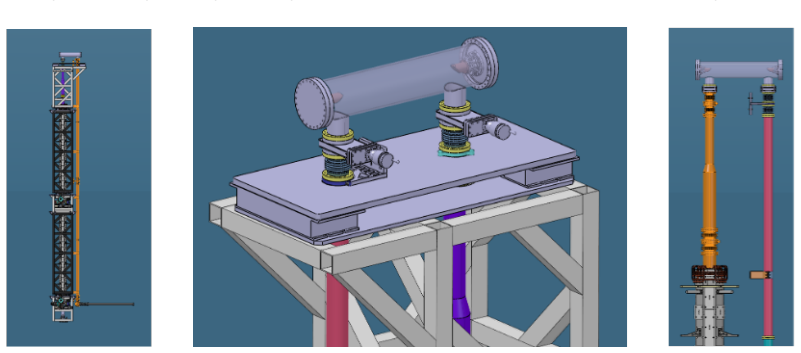
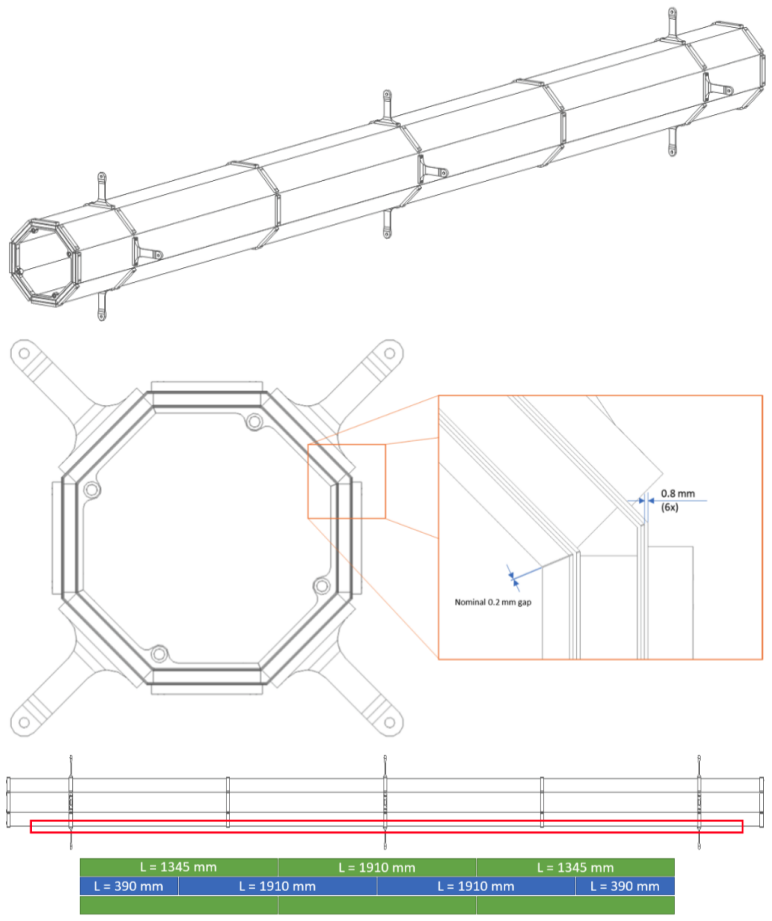
The argument is carried by a linked set of computational models and one experimental data set. The structural model is a hybrid one-dimensional and two-dimensional finite-element tower with welded aluminium box sections, four wall supports and a base, run in single-input mode so the same measured building vibration is applied at every support; it produces the modal frequencies and the RMS/end-to-end lens motions used to judge the stability specification. The magnetic design rests on COMSOL finite-element analysis of a double-layer octagonal mu-metal shield and a five-coil-pair guide field, giving the static shielding factor, field homogeneity, and edge-compensation results. The vacuum design rests on Molflow+ Monte-Carlo simulation with a stainless-steel outgassing rate of $5\times10^{-13}$ mbar litres per second per square centimetre. The phase-shear detection platform, with its piezo-actuated retroreflecting mirror and closed-loop strain-gauge and optical-lever sensing, is the component that turns the tower into an interferometer and sets the 100 nm camera-stability target.
What would settle it
A synchronized multi-point vibration survey of the stairwell during a busy period, processed into relative displacement spectra between the four wall supports and the base, would settle the question: if the support points move relative to each other by amounts comparable to the 33 to 41 nm input in the 0.5 to 50 Hz band, or if the paper's multi-input model then predicts upper-lens motion above the 40 nm displacement specification, the stability conclusion fails.
Extended reading notes
Core claim
The central claim is that AION-10, a pair of vertically stacked 5 m atom interferometers in a 10 m tower using $^{87}$Sr, is technically ready: the tower structure, vacuum vessel, magnetic shielding, and vibration isolation meet the specifications set out in the report. The paper defends this with three linked analysis chains. Modal and response finite-element analysis gives a 24.0 Hz fundamental frequency and predicts telescope-lens displacements of roughly 36 to 45 nm RMS under the 33 to 41 nm input from the measured building spectrum, staying within the tens-of-nanometre pointing specification; a double-layer octagonal mu-metal shield with staggered seams gives a static shielding factor near 1000 and sub-5 mG field homogeneity; and Molflow+ Monte-Carlo vacuum modelling reaches the $10^{-11}$ mbar region with three 300 l/s pumps after an in-situ bakeout. The report states that critical optical components remain within specification 97% of the time under realistic operating conditions. It also notes that the stability numbers come from a single-input vibration model that treats the stairwell as rigid, and that a synchronized multi-input survey has been performed but its data are not yet incorporated.
Load-bearing premise
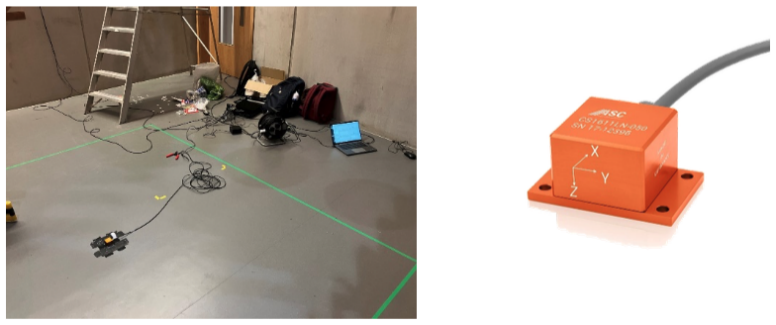
The stability conclusion assumes the 15-metre-deep stairwell moves as a rigid structure, so the same vibration reaches all four wall supports and the base; if the building flexes instead, the simulated lens motions could be larger than reported.
Editorial extensions
If this is right
- If the design is correct, the five module tower can be assembled offsite, craned into the stairwell by a professional lifting contractor, and vacuum-connected in clean boxes, with active isolators installed after the heavy lifting.
- The telescope stability analysis supports proceeding with the full-structure tower rather than decoupling the magnetic shield and vacuum tube, since the lighter 'lite' variant gives only marginal improvement in lens response.
- The double-layer octagonal shield plus correction coils extends the usable interferometry length, so the 10 m baseline retains nearly its full aperture for precision measurement.
- The vacuum analysis justifies an in-situ bakeout and 300 l/s pumping as the route to $10^{-11}$ mbar, with a possible order-of-magnitude improvement from lower-outgassing materials.
- The demonstrated phase-shear platform provides camera positioning and retroreflecting-mirror control at the required nanoradian and nanometre level, enabling the target phase-shear readout.
Reading between the lines
- The 97% within-specification statement assumes the measured building vibration is a stationary random process; if operation coincides with non-stationary activity or rare transients in the stairwell, the duty-cycle figure could be optimistic.
- The paper's planned synchronized multi-point survey is the natural adjudicator: until its data are fed into the multi-input model, the single-input stability numbers should be treated as provisional.
- If the 10 m tower performs as modelled, the modular assembly approach and the combination of passive shielding plus active isolation look transferable to 100 m and kilometre baselines, where rigid-body behaviour is no longer plausible and distributed control becomes the key scaling issue.
- The external optical interferometer network could be used continuously to measure drift of lenses and cameras, converting slow thermal motion from a stability error into a correctable common-mode signal.
Editorial analysis
A structured set of objections, weighed in public.
Referee Report
Summary. The manuscript is a technical design report for AION-10, a 10 m strontium atom interferometer planned for the Beecroft building at Oxford. It describes the tower, telescope, vacuum system, magnetic shielding, and assembly sequence, and reports simulations intended to show that the design meets mechanical, magnetic, and vacuum specifications. The central verification claims are that the design meets all performance requirements and that critical optical components remain within specification 97% of the time under realistic operating conditions. These claims are not supported by the reported analyses: Table 5 shows upper-lens RMS displacements exceeding the 40 nm specification, the 97% statistic does not appear anywhere in the body, the vibration analysis relies on a single-input rigid-stairwell assumption that Section 5.2 explicitly says needs to be replaced by synchronized multi-input data, and Section 7.2 states that the pumping speed 'will need to increase' to meet the agreed specification.
Significance. A detailed technical design report of this kind is potentially significant: it lays out a concrete engineering path for a 10 m atom interferometer, including a modular assembly procedure through a stairwell, an active-isolation platform that can be installed after initial assembly, a double-layer octagonal magnetic shield, and Monte-Carlo vacuum estimates. The use of measured building vibration, ambient magnetic-field, and material outgassing data as forward-model inputs is a strength, as is the tested phase-shear platform hardware. If the stability and vacuum analyses were brought into agreement with the stated requirements, the report would be a useful foundation for the final design review. As written, however, the headline verification claim overreaches the evidence presented.
major comments (3)
- [Sec. 3.5; Sec. 5.1, Table 5] The telescope specification in Sec. 3.5 is a maximal transverse shift of <40 nm for the first lens. Table 5 reports upper-lens RMS displacements of 44.6 nm (X) and 42.0 nm (Y) even under the favorable single-input rigid-tower model. For the zero-mean Gaussian model described in Sec. 5.1, an RMS of 44.6 nm implies the lens is within ±40 nm only about 63% of the time, not 97%; the quoted end-to-end values are ±3σ (6σ) excursions of 267.6 nm and 252.0 nm, roughly 6.7 times the specification. The sentence following Table 5 acknowledges that the displacement RMS for the upper lens is 'around the maximum transverse shift specified,' but no derivation is given that converts the 'worst case' wording or the low amplification factor into a 97% compliance statistic. This discrepancy directly undermines the abstract's 97% claim and the conclusion of satisfactory structural stability.
- [Sec. 5.1 and 5.2] The stability analysis is load-bearing for the design-meets-requirements claim, and it rests on the assumption stated in Sec. 5.1 that 'Applying the same input to multiple support points is in practise equivalent to treating the stairwell as a rigid structure.' Section 5.2 immediately cautions that the 15 m deep stairwell can have notable deformation and that synchronized multi-input data are required to capture this effect. The November 2024 vibration test is described as taking only 45 minutes, with sensors limited by cable length and accessibility, and no multi-input analysis is presented. The reported lens responses are therefore conditional on a rigid-stairwell assumption that the manuscript itself identifies as inadequate; a revised report should either apply the multi-input model or explicitly state that the stability conclusion is a lower-bound estimate pending synchronized measurements.
- [Sec. 7.2; Sec. 8; Abstract] The vacuum analysis does not support the global 'design meets all performance requirements' claim. After reporting that the 300 l/s simulation reaches the 10^-11 mbar range, the text states: 'Although modelling has been done with 300 l/s up to this point, we will need to increase this to meet the agreed specification.' It also notes a factor-of-3 pressure rise near the centre between pumping ports that still requires assessment. Nevertheless, the conclusions summarize the design as satisfactory and the abstract asserts that all requirements are met. Either the pumping configuration, the specification target, or the overall claim must be revised so that the report is internally consistent.
minor comments (4)
- [Table 3] The modal-frequency table jumps from the 4th mode to the 7th mode without listing modes 5 and 6; this appears to be a transcription or formatting error and should be corrected.
- [Sec. 6.1 and Fig. 44] The text states that the magnetic-field noise requirement is met for frequencies above 10^-4 Hz, while the caption of Fig. 44 states above 0.1 mHz; these numbers should be made consistent.
- [Sec. 7.1 and 7.2] Section 7.1 discusses a 2000 l/s NEXTorr D2000-10 pump, while the Molflow+ simulations in Section 7.2 use 75 l/s and 300 l/s pumping speeds; the relationship between these configurations should be explained explicitly.
- [Sec. 8] The 'Plans for Future Work' paragraph appropriately lists a thermal model, updated vibration analyses, and longer synchronized vibration tests as remaining tasks; given the issues in Section 5, these should be framed as prerequisites for the stability verification rather than as optional refinements.
Circularity Check
No circular reasoning: the design analyses are forward models from measured building vibration, magnetic field, and outgassing inputs; the main issues are overstatement and modeling conservatism, not circularity.
full rationale
No circular derivation chain is present in this TDR. The telescope stability analysis takes measured Beecroft building vibration data as input, applies it through an FEA support-tower model, and reports RMS/end-to-end lens responses in Table 5. The magnetic analysis uses COMSOL forward models of mu-metal shields and coil geometries with stated requirements. The vacuum analysis propagates an assumed stainless-steel outgassing rate through Molflow+ Monte-Carlo simulations. None of these steps fits a parameter to the target quantity and then renames that fit as a prediction. The phase-shear platform performance data come from the MAGIS prototype, which is an external engineering test, not a self-citation chain that forces the AION design conclusion. The paper does contain internal inconsistencies and unsupported claims, but they are not circularity: the abstract's '97% of the time' statistic is never derived from Table 5, and Table 5's upper-lens RMS of 44.6 nm in X already exceeds the Section 3.5 40 nm transverse-shift target even under the favorable single-input rigid-stairwell model. Section 7 also states that the 300 l/s pumping configuration 'will need to be increased to meet the agreed specification,' which conflicts with the abstract's claim that all performance requirements are met. Section 5.2 itself acknowledges that the single-input model treats the stairwell as rigid and that synchronized multi-input data are required for a more realistic analysis. These are correctness, completeness, and conservatism risks, not reductions of the claimed results to their own inputs. Accordingly, the circularity score is 0.
Assumptions & free parameters
free parameters (2)
- Guide field coil currents (A1/A2, B1/B2, C1/C2) =
4.6 A, 3.5 A, 3.3 A
- Stainless steel outgassing rate =
5 x 10^-13 mbar l/s/cm^2
assumptions (4)
- domain assumption The Beecroft stairwell moves as a rigid body under vibration; the same input spectrum applies at all tower supports.
- domain assumption The magnetic shield can be modeled as continuous, neglecting holes, flanges, and mounting ports.
- domain assumption Telescope lenses vibrate as rigid bodies rigidly connected to the outer case.
- domain assumption Vacuum pressure can be estimated from a closed volume with virtual pump surfaces and a uniform outgassing rate.
Cite this review
Pith. "Pith review of AION-10: Technical Design Report for a 10m Atom Interferometer in Oxford." pith.science (2026). https://pith.science/paper/LB6FCITG
@misc{pith2026250803491,
  author       = {Pith},
  title        = {Pith review of: AION-10: Technical Design Report for a 10m Atom Interferometer in Oxford},
  year         = {2026},
  howpublished = {\url{https://pith.science/paper/LB6FCITG}},
  note         = {Machine review of arXiv:2508.03491}
}
read the original abstract
This Technical Design Report presents AION-10, a 10-meter atom interferometer to be located at Oxford University using ultracold strontium atoms to make precision measurements of fundamental physics. AION-10 serves as both a prototype for future larger-scale experiments and a versatile scientific instrument capable of conducting its own diverse physics programme. The design features a 10-meter vertical tower housing two atom interferometer sources in an ultra-high vacuum environment. Key engineering challenges include achieving nanometer-level vibrational stability and precise magnetic field control. Solutions include active vibration isolation, specialized magnetic shielding, and a modular assembly approach using professional lifting equipment. Detailed analysis confirms the design meets all performance requirements, with critical optical components remaining within our specifications 97% of the time under realistic operating conditions. Vacuum and vibration measurements in the host building validate that the instrument will achieve the precision needed for quantum sensing applications. This work establishes the technical foundation for scaling atom interferometry to longer baselines while creating a cutting-edge facility for precision measurements that could advance our understanding of fundamental physics.
Figures


Figures from the paper (52 more)






Forward citations
Cited by 1 Pith paper
-
A Long-Baseline Atom Interferometer at CERN LHC Point 4: Implementation Study
A CERN implementation study finds that the PX46 shaft can be modified during the LHC's third long shutdown to host a 100 m atom interferometer alongside HL-LHC operations.
Reference graph
Works this paper leans on
-
[1]
LIGO Scientific, Virgocollaboration, Observation of Gravitational Waves from a Binary Black Hole Merger, Phys. Rev. Lett. 116 (2016) 061102 [ 1602.03837]
arXiv 2016
-
[2]
LIGO Scientific, Virgocollaboration, GW170817: Observation of Gravitational Waves from a Binary Neutron Star Inspiral , Phys. Rev. Lett. 119 (2017) 161101 [ 1710.05832]
arXiv 2017
-
[3]
LISA collaboration, Laser Interferometer Space Antenna, 1702.00786
-
[4]
International Pulsar Timing Arraycollaboration, Comparing Recent Pulsar Timing Array Results on the Nanohertz Stochastic Gravitational-wave Background , Astrophys. J. 966 (2024) 105 [ 2309.00693]
arXiv 2024
-
[5]
O. Buchmueller, J. Ellis and U. Schneider, Large-scale atom interferometry for fundamental physics , Contemp. Phys. 64 (2023) 93 [ 2306.17726]
arXiv 2023
-
[6]
L. Badurina et al., AION: An Atom Interferometer Observatory and Network , Journal of Cosmology and Astroparticle Physics (2020) 011 [ 1911.11755]
arXiv 2020
-
[7]
S. Dimopoulos, P.W. Graham, J.M. Hogan, M.A. Kasevich and S. Rajendran, Gravitational Wave Detection with Atom Interferometry , Phys. Lett. B 678 (2009) 37 [ 0712.1250]
arXiv 2009
-
[8]
P.W. Graham, J.M. Hogan, M.A. Kasevich and S. Rajendran, A New Method for Gravitational Wave Detection with Atomic Sensors , Phys. Rev. Lett. 110 (2013) 171102 [ 1206.0818]
arXiv 2013
Show all 47 references
-
[9]
Graham, J.M
P.W. Graham, J.M. Hogan, M.A. Kasevich and S. Rajendran, Resonant mode for gravitational wave detectors based on atom interferometry , Phys. Rev. D 94 (2016) 104022 [ 1606.01860]. 51
2016 arXiv
-
[10]
Ellis, M
J. Ellis, M. Fairbairn, J. Urrutia and V. Vaskonen, Probing Supermassive Black Hole Seed Scenarios with Gravitational-wave Measurements, Astrophys. J. 964 (2024) 11 [ 2312.02983]
2024 arXiv
-
[11]
Graham, D.E
P.W. Graham, D.E. Kaplan, J. Mardon, S. Rajendran and W.A. Terrano, Dark Matter Direct Detection with Accelerometers, Phys. Rev. D 93 (2016) 075029 [ 1512.06165]
2016 arXiv
-
[12]
Arvanitaki, P.W
A. Arvanitaki, P.W. Graham, J.M. Hogan, S. Rajendran and K. Van Tilburg, Search for light scalar dark matter with atomic gravitational wave detectors , Phys. Rev. D 97 (2018) 075020 [ 1606.04541]
2018 arXiv
-
[13]
Badurina, D
L. Badurina, D. Blas and C. McCabe, Refined ultralight scalar dark matter searches with compact atom gradiometers, Phys. Rev. D 105 (2022) 023006 [ 2109.10965]
2022 arXiv
-
[14]
Biedermann, X
G.W. Biedermann, X. Wu, L. Deslauriers, S. Roy, C. Mahadeswaraswamy and M.A. Kasevich, Testing Gravity with Cold-Atom Interferometers , Phys. Rev. A 91 (2015) 033629 [ 1412.3210]
2015 arXiv
-
[15]
G. Rosi, G. D’Amico, L. Cacciapuoti, F. Sorrentino, M. Prevedelli, M. Zych et al., Quantum test of the equivalence principle for atoms in superpositions of internal energy eigenstates , Nature Commun. 8 (2017) 5529 [ 1704.02296]
2017 arXiv
-
[16]
Asenbaum, C
P. Asenbaum, C. Overstreet, M. Kim, J. Curti and M.A. Kasevich, Atom-Interferometric Test of the Equivalence Principle at the 10−12 Level, Phys. Rev. Lett. 125 (2020) 191101 [ 2005.11624]
2020 arXiv
-
[17]
Burrage, E.J
C. Burrage, E.J. Copeland and E.A. Hinds, Probing Dark Energy with Atom Interferometry , JCAP 03 (2015) 042 [ 1408.1409]
2015 arXiv
-
[18]
Hamilton, M
P. Hamilton, M. Jaffe, P. Haslinger, Q. Simmons, H. M¨ uller and J. Khoury, Atom-interferometry constraints on dark energy , Science 349 (2015) 849 [ 1502.03888]
2015 arXiv
-
[19]
Sabulsky, I
D.O. Sabulsky, I. Dutta, E.A. Hinds, B. Elder, C. Burrage and E.J. Copeland, Experiment to detect dark energy forces using atom interferometry , Phys. Rev. Lett. 123 (2019) 061102 [ 1812.08244]
2019 arXiv
-
[20]
Abdalla et al., Terrestrial Very-Long-Baseline Atom Interferometry: summary of the second workshop , EPJ Quant
A. Abdalla et al., Terrestrial Very-Long-Baseline Atom Interferometry: summary of the second workshop , EPJ Quant. Technol. 12 (2025) 42 [ 2412.14960]
2025 arXiv
-
[21]
Memorandum of Understanding for the Terrestrial Very Long Baseline Atom Interferometer Study
“Memorandum of Understanding for the Terrestrial Very Long Baseline Atom Interferometer Study.” https://indi.to/fshnp
-
[22]
Stray et al., Quantum sensing for gravity cartography , Nature 602 (2022) 590
B. Stray et al., Quantum sensing for gravity cartography , Nature 602 (2022) 590
2022
-
[23]
MAGIS-100 collaboration, Matter-wave Atomic Gradiometer Interferometric Sensor (MAGIS-100) , Quantum Sci. Technol. 6 (2021) 044003 [ 2104.02835]
2021 arXiv
-
[24]
AEDGE collaboration, AEDGE: Atomic Experiment for Dark Matter and Gravity Exploration in Space , EPJ Quant. Technol. 7 (2020) 6 [ 1908.00802]
2020 arXiv
-
[25]
6 (2023) 014409 [2305.20060]
AION collaboration, Centralized design and production of the ultra-high vacuum and laser-stabilization systems for the AION ultra-cold strontium laboratories , A VS Quantum Sci. 6 (2023) 014409 [2305.20060]
2023 arXiv
-
[26]
AION collaboration, A Prototype Atom Interferometer to Detect Dark Matter and Gravitational Waves , 2504.09158
-
[27]
Sugarbaker, S.M
A. Sugarbaker, S.M. Dickerson, J.M. Hogan, D.M.S. Johnson and M.A. Kasevich, Enhanced atom interferometer readout through the application of phase shear , Phys. Rev. Lett. 111 (2013) 113002
2013
-
[28]
M.M. Boyd, T. Zelevinsky, A.D. Ludlow, S. Blatt, T. Zanon-Willette, S.M. Foreman et al., Nuclear spin effects in optical lattice clocks , Physical Review A 76 (2007) 022510
2007
-
[29]
Glick, Z
J. Glick, Z. Chen, T. Deshpande, Y. Wang and T. Kovachy, Coriolis force compensation and laser beam delivery for 100-m baseline atom interferometry , A VS Quantum Science 6 (2024)
2024
-
[30]
Warburton and P
W. Warburton and P. Pianetta, A novel differential pump for synchrotron beamlines tests, models and applications, Nuclear Instruments and Methods in Physics Research Section A: Accelerators, Spectrometers, Detectors and Associated Equipment 291 (1990) 350
1990
-
[31]
THORLABS Hex Adjusters, 6-80 Fine
“THORLABS Hex Adjusters, 6-80 Fine.” https://www.thorlabs.com/newgrouppage9.cfm?objectgroup_id=1204. 52
-
[32]
HERZAN Experts in Environmental Control
“HERZAN Experts in Environmental Control.” https://www.herzan.com/products/active-vibration-control/ avi-series-active-vibration-control-platform/avi-400-series.html
-
[33]
CYCLONE Crane Services
“CYCLONE Crane Services.” https://www.cyclonecranes.co.uk
-
[34]
HILTI HUS3-A 6 concrete screw anchor
“HILTI HUS3-A 6 concrete screw anchor.” https://www.hilti.co.uk/c/CLS_FASTENER_7135/CLS_MECHANICAL_ANCHORS_7135/r6253
-
[35]
UHV Design
“UHV Design.” https://www.uhvdesign.com/products/view-port-shutters/view-port-shutters/
-
[36]
Clickmetal
“Clickmetal.” https://www.clickmetal.co.uk/?srsltid= AfmBOoppYzAGrYumoscSIqS9FkVT7dUeJLU5LbDjWizlZQ_u00YDw7KU
-
[37]
Bosch Rexroth
“Bosch Rexroth.” https://www.boschrexroth.com/en/gb/products/industrial-solutions/ assembly-technology/aluminum-profile-kit/
-
[38]
Lalanne, Mechanical Vibration and Shock Analysis , vol
C. Lalanne, Mechanical Vibration and Shock Analysis , vol. 3, ISTE Ltd and John Wiley & Sons, Inc., 2 ed. (2009), 10.1002/9780470611937
2009 doi
-
[39]
Lutes and S
L.D. Lutes and S. Sarkani, Random Vibrations: Analysis of Structural and Mechanical Systems , Elsevier Inc. (2004)
2004
-
[40]
Lang and P.V
G.F. Lang and P.V. Baren, How well does 3 approximate infinity? understanding ±3σ clipping in random shake tests , Sound & Vibration (2009) 9
2009
-
[41]
COMSOL Multiphysics
“COMSOL Multiphysics.” https://www.comsol.com/comsol-multiphysics
-
[42]
Schlippert, C
D. Schlippert, C. Meiners, J. Rengelink, R. C. Schubert, D. Tell, ´E. Wodey et al., Matter-wave interferometry for inertial sensing and tests of fundamental physics , in CPT and Lorentz Symmetry: Proceedings of the Eighth Meeting on CPT and Lorentz Symmetry , (Singapore), pp. ...
2020
-
[43]
Wodey, D
´E. Wodey, D. Tell, M. Rasel, E. D. Schlippert, R. Baur, U. Kissling et al., A scalable high-performance magnetic shield for very long baseline atom interferometry , Review of Scientific Instruments 91 (2020) 035117
2020
-
[44]
FERROV AC ultra high vacuum technology
“FERROV AC ultra high vacuum technology.” https://www.ferrovac.com/?tool=ProductDescription&product=PUSAESNEXTorrD2000-10
-
[45]
Kersevan and M
R. Kersevan and M. Ady, Recent developments of monte-carlo codes molflow+ and synrad+ , in Proceedings of the 10th International Particle Accelerator Conference (IPAC2019) , (Geneva, Switzerland), pp. 1327–1330, JACoW Publishing, May, 2019, DOI
2019
-
[46]
Calder and G
R. Calder and G. Lewin, Reduction of stainless-steel outgassing in ultra-high vacuum , British Journal of Applied Physics 18 (1967) 1459
1967
-
[47]
J.R. Young, Errors in UHV pressure measurements resulting from leaks , Journal of Vacuum Science and Technology 6 (1969) 428 [https://pubs.aip.org/avs/jvst/article-pdf/6/3/428/11805570/428 1 online.pdf]. 53
1969
Reviewed August 6, 2026 · model on record in the stance chip above.
Discussion (0). Sign in to comment.