REVIEW 4 major objections 4 minor 3 cited by
Mitigating Think-Answer Mismatch in LLM Reasoning Through Noise-Aware Advantage Reweighting
T0 review · 4 major / 4 minor · reviewed 2026-08-05 · deepseek-v4-flash
Pith's one-line read This paper claims that per-group advantage reweighting with a noise-derived weight stabilizes GRPO training and adds 2–3% accuracy on math reasoning benchmarks.
desk verdict S-GRPO's optimality derivation is unsupported, but the empirical reweighting recipe is a plausible heuristic worth a look. read the letter →
The pith
A machine-rendered reading of the paper's core claim, the machinery that carries it, and where it could break.
The reading
What carries the argument
The load-bearing object is the per-group optimal weight $w^\star$, derived from a symmetric label-noise model. Each observed binary reward $r_i$ is assumed to be the latent true reward $r_i^\star$ flipped with probability $p$; the group mean is corrected to $t=(\bar{r}-p)/(1-2p)$, and minimizing $\mathbb{E}[(w a_i - a_i^\star)^2]$ gives $w^\star$ as the correlation between observed and true rewards. This weight carries the argument: it converts each group's observed advantage into a denoised advantage before the clipped policy-gradient update, and its shape (concave in $k$, bounded by $1-2p$, zero below the noise rate) implements the paper's three desired behaviors: noise-adaptive attenuatio
What would settle it
Run a synthetic experiment with known true rewards: draw many $N=8$ groups with a fixed flip rate $p$, compute the paper's $w^\star$ for each group, and separately grid-search the per-group weight that minimizes the actual average of $(w a_i - a_i^\star)^2$. If the empirical optimum diverges from Equation (11) in unbalanced groups, the claimed optimality fails.
Extended reading notes
Core claim
The central discovery is that the damage from a think-answer mismatch is a group-composition effect, not just a label error. In a group with $k$ observed successes out of $N$, a single false positive changes the advantage of the mismatched sample and every other sample, and the total deviation follows a U-shaped curve that peaks precisely when the group is unbalanced. S-GRPO's response is to treat each observed reward as a noisy version of a latent true reward, estimate the true group success rate as $t=(\bar{r}-p)/(1-2p)$, and derive $w^\star = (1-2p)\,t(1-t)\,/\,(\sqrt{\bar{r}(1-\bar{r})+\epsilon}\,\sqrt{t(1-t)+\epsilon})$ as the best reweighting factor in expected squared error. Using $w^
Load-bearing premise
The optimality argument treats the group mean and standard deviation used to standardize rewards as fixed constants, but in actual training these are random quantities determined by the sampled group; if that randomness is accounted for, the closed-form $w^\star$ need not be the true expected-squared-error minimizer.
Editorial extensions
If this is right
- RL fine-tuning of reasoning models can tolerate substantially higher reward mislabel rates without collapsing, reducing the pressure to invest in expensive step-level reward annotations.
- The reweighting adds almost no computational cost and needs no value model, so the robustness gain is available to existing GRPO pipelines as a drop-in change.
- The assumed noise rate $p$ becomes a practical training dial: smaller values give fast early gains, larger values give slower but steadier improvement and smoother entropy decay.
- Because highly imbalanced groups are down-weighted or gated, the surviving training signal is concentrated on groups where the group-relative comparison is most trustworthy.
Reading between the lines
- The same derivation would apply to any group-relative advantage estimator, so the reweighting could be transplanted into other group-relative RL objectives; this is an extension, not a paper claim.
- Since $w^\star$ depends only on observable group statistics and the assumed $p$, a natural next step is to estimate $p$ online from a validation set with known reasoning quality, removing the need to tune it per model.
- The U-shaped deviation analysis points to a complementary design: deliberately balance the composition of sampled response groups rather than only reweighting them after the fact.
Editorial analysis
A structured set of objections, weighed in public.
Referee Report
Summary. The paper studies how reward noise ('think-answer mismatch') affects GRPO, especially in unbalanced response groups, and proposes S-GRPO. The method assumes symmetric label noise at rate p, estimates the true positive rate t from the observed group mean (Eq. 6), and multiplies GRPO advantages by a group-level weight w* derived from a mean-squared-error objective (Eqs. 7-11). The authors claim w* is optimal and that S-GRPO stabilizes RL training, reporting gains of +2.5%, +2.2%, and +2.4% over Dr. GRPO on three models and showing stable learning under 20% synthetic reward noise where GRPO collapses.
Significance. The problem is timely and practical: if the claimed results held, a simple group-level reweighting of GRPO advantages would be a useful contribution. The manuscript ships a code/data link, performs controlled runs for the 1.5B model, and presents a clear motivation with an intuitive failure mode in unbalanced groups. However, the central derivation in Section 3.2 is not valid as written, the noise level p is tuned on the evaluation benchmarks rather than estimated, and several headline comparisons are imported from other papers rather than run under identical settings. These issues affect the paper's main claims of optimality, principled derivation, and controlled empirical advantage.
major comments (4)
- [§3.2, Eqs. (7)-(11)] The central optimality derivation is not valid. The paper defines the 'true' advantage as a_i^*=(r_i^*-t)/sigma_t, with t=(rbar-p)/(1-2p). This is a population-centered quantity, not a group-relative advantage. For a fixed sampled group, the mean of a_i^* is (rbar^*-t)/sigma_t, which is generally nonzero, and the mean square of a_i^* is not 1 unless the group's true mean rbar^* equals t. Hence Eq. (9), L(w)=w^2-2wCov(a_i,a_i^*)+1, and the resulting w^* in Eq. (10) do not follow. If the expectation is instead over groups, the group-dependent denominators sigma_r and sigma_t are random, so they cannot be pulled out to obtain Cov(r_i,r_i^*)/(sigma_r sigma_t). In either reading, Eq. (11) is not established as the minimizer of Eq. (8) for GRPO's group-relative advantage; S-GRPO's reweighting is currently a heuristic.
- [§4.4.3, Table 2, §5] The noise level p is a free hyperparameter selected per model based on evaluation benchmarks. Figure 9 ablates p against final performance on the test benchmarks, and Table 2 fixes p=0.10 for 7B and p=0.15 for 1.5B/3B. Yet Section 5 says the method is 'parameter-free given the noise estimate.' The noise estimate is not estimated from data; selecting p on the evaluation benchmarks makes the main gains partly a result of benchmark-specific tuning and weakens the claim that the method is principled rather than heuristic.
- [Table 1, §4.2] The main comparison against Dr. GRPO is not fully controlled. Only results marked with asterisks were rerun under identical settings. In the 7B and 3B rows, Dr. GRPO numbers are taken from the original paper, so the abstract-level claims '+2.5% on Qwen-Math-7B-Base' and '+2.2% on Llama-3.2-3B-Base' are cross-paper comparisons, not comparisons under identical experimental settings. The only controlled Dr. GRPO comparison is the 1.5B model. Either rerun all baselines under identical settings or restrict the claims to the controlled comparison.
- [§2.3, Figure 3] The synthetic-noise experiment is underdocumented. The text states that standard GRPO 'collapses' at 20% noise while S-GRPO continues to learn, but it does not state which p was used for S-GRPO, how the noise was injected, how many seeds were averaged, or the training setup. Without these details, the central robustness claim cannot be assessed. Please provide the full protocol and, ideally, an ablation of p under noisy conditions.
minor comments (4)
- [Abstract] The baseline is inconsistently written as 'DR. GRPO' in the abstract and 'Dr. GRPO' in the body; unify the notation.
- [§2.2, Eqs. (2)-(4)] The formulas for a_pos and a_neg appear typeset without explicit square roots, making the deviation computation hard to verify. Please provide a clean derivation with explicit notation.
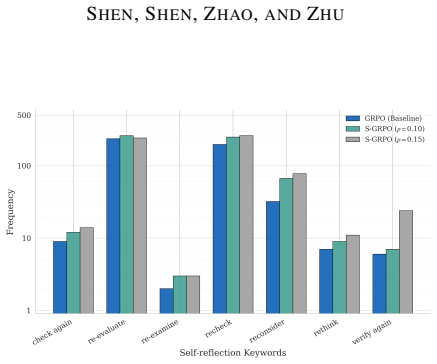
- [§4.4.4] The two qualitative examples are presented as evidence of different learned behaviors, but no frequency or automatic metric is reported. State explicitly that these are anecdotal.
- [Figure 9] The y-axis and training length for the ablation are not fully specified. Clarify what is plotted and how many training steps are used.
Circularity Check
No significant circularity: the optimal-weight derivation is independent of the benchmark results; minor self-citation and p-ablation do not make the derivation circular.
full rationale
The paper's central derivation (Sec. 3.2, Eqs. 5-11) starts from a symmetric label-noise model and an explicit MSE objective, and the closed-form weight w* is obtained by minimizing E[(w a_i - a*_i)^2]. The benchmark gains of Table 1 are not used as inputs to this derivation; no fitted coefficient is renamed as a prediction. The hyperparameter p is selected by ablation on the evaluation benchmarks (Sec. 4.4.3, Fig. 9), which is post-hoc tuning and a possible overfitting concern, but it does not make the reported accuracies a necessary consequence of the fitted value by construction. The only self-citation (Shen et al. 2025, used in Sec. 4.4.2 for 'response length often correlates with reasoning depth') is peripheral and not load-bearing for the main claim. The main weakness is a mathematical gap: Eq. 7 standardizes a*_i with the population mean t, whereas GRPO's advantage is group-relative, and Eq. 9 treats the group statistics as fixed; this is an internal soundness/rigor problem, not a circular reduction of the claimed result to its inputs. Therefore no circular step is identified.
Assumptions & free parameters
free parameters (1)
- noise assumption p =
0.10 for Qwen2.5-Math-7B-Base, 0.15 for Llama-3.2-3B-Base and Qwen2.5-Math-1.5B-Instruct; selected per model via ablatio
assumptions (2)
- domain assumption Reward noise is symmetric: P(r_i != r*_i) = p with fixed p, independent across responses.
- ad hoc to paper Group mean and standard deviation can be treated as constants when computing the covariance between observed and true standardized advantages.
Cite this review
Pith. "Pith review of Mitigating Think-Answer Mismatch in LLM Reasoning Through Noise-Aware Advantage Reweighting." pith.science (2026). https://pith.science/paper/BVKBZQUY
@misc{pith2026250805928,
  author       = {Pith},
  title        = {Pith review of: Mitigating Think-Answer Mismatch in LLM Reasoning Through Noise-Aware Advantage Reweighting},
  year         = {2026},
  howpublished = {\url{https://pith.science/paper/BVKBZQUY}},
  note         = {Machine review of arXiv:2508.05928}
}
read the original abstract
Group-Relative Policy Optimization (GRPO) is a key technique for training large reasoning models, yet it suffers from a critical vulnerability: the \emph{Think-Answer Mismatch}, where noisy reward signals corrupt the learning process. This problem is most severe in unbalanced response groups, paradoxically degrading the signal precisely when it should be most informative. To address this challenge, we propose Stable Group-Relative Policy Optimization (S-GRPO), a principled enhancement that derives optimal, noise-aware advantage weights to stabilize training. Our comprehensive experiments on mathematical reasoning benchmarks demonstrate S-GRPO's effectiveness and robustness. On various models, S-GRPO significantly outperforms DR. GRPO, achieving performance gains of +2.5% on Qwen-Math-7B-Base, +2.2% on Llama-3.2-3B-Base, and +2.4% on Qwen-Math-1.5B-Instruct. Most critically, while standard GRPO fails to learn under 20% synthetic reward noise, S-GRPO maintains stable learning progress. These results highlight S-GRPO's potential for more robust and effective training of large-scale reasoning models. \footnote{Code and data are available at: https://github.com/shenpeijun0212/S-GRPO
Figures


Figures from the paper (6 more)




Forward citations
Cited by 3 Pith papers
-
VIDEOP2R: Video Understanding from Perception to Reasoning
VideoP2R separates perception and reasoning in a process-aware RFT pipeline with a new CoT dataset and PA-GRPO rewards, reaching SOTA on six of seven video benchmarks.
-
Gradient Extrapolation-Based Policy Optimization
GXPO approximates longer local lookahead in GRPO training via gradient extrapolation from two optimizer steps using three backward passes total, improving pass@1 accuracy by 1.65-5.00 points over GRPO and delivering u...
-
DGPO: Beyond Pairwise Preferences with Directional Consistent Groupwise Optimization
DGPO aggregates supervision at the group level with direction-aware multi-candidate comparisons to improve LLM alignment, delivering up to 3.6% average accuracy gains over baselines.
Reference graph
Works this paper leans on
-
[3]
Reinforcement learning for reasoning in small llms: What works and what doesn’t
Quy-Anh Dang and Chris Ngo. Reinforcement learning for reasoning in small llms: What works and what doesn’t. arXiv preprint arXiv:2503.16219,
-
[4]
Deepseek-r1: Incentivizing reasoning capability in llms via reinforcement learning
Daya Guo et al. Deepseek-r1: Incentivizing reasoning capability in llms via reinforcement learning. arXiv preprint arXiv:2501.12948,
-
[5]
Measuring mathematical problem solving with the math dataset
Dan Hendrycks, Collin Burns, Saurav Kadavath, Akul Arora, Steven Basart, Eric Tang, Dawn Song, and Jacob Steinhardt. Measuring mathematical problem solving with the math dataset. arXiv preprint arXiv:2103.03874,
-
[8]
Understanding r1-zero-like training: A critical perspective
Zichen Liu, Changyu Chen, Wenjun Li, Penghui Qi, Tianyu Pang, Chao Du, Wee Sun Lee, and Min Lin. Understanding r1-zero-like training: A critical perspective. arXiv preprint arXiv:2503.20783,
-
[9]
Improve mathematical reasoning in language models by automated process supervision
18 S-GRPO Liangchen Luo, Yinxiao Liu, Rosanne Liu, Samrat Phatale, Meiqi Guo, Harsh Lara, Yunxuan Li, Lei Shu, Yun Zhu, Lei Meng, et al. Improve mathematical reasoning in language models by automated process supervision. arXiv preprint arXiv:2406.06592,
-
[11]
Zettlemoyer, Percy Liang, Emmanuel J
Niklas Muennighoff, Zitong Yang, Weijia Shi, Xiang Lisa Li, Fei-Fei Li, Hanna Hajishirzi, Luke S. Zettlemoyer, Percy Liang, Emmanuel J. Candes, and Tatsunori Hashimoto. s1: Simple test-time scaling. arXiv preprint arXiv:2501.19393,
-
[12]
On symmetric losses for robust policy optimization with noisy preferences
Soichiro Nishimori, Yu-Jie Zhang, Thanawat Lodkaew, and Masashi Sugiyama. On symmetric losses for robust policy optimization with noisy preferences. arXiv preprint arXiv:2505.24709,
-
[13]
Proximal policy optimization algorithms
John Schulman, Filip Wolski, Prafulla Dhariwal, Alec Radford, and Oleg Klimov. Proximal policy optimization algorithms. arXiv preprint arXiv:1707.06347,
Show all 26 references
-
[15]
Deepseekmath: Pushing the limits of mathematical reasoning in open language models
Zhihong Shao, Peiyi Wang, Qihao Zhu, Runxin Xu, Junxiao Song, Xiao Bi, Haowei Zhang, Mingchuan Zhang, YK Li, Y Wu, et al. Deepseekmath: Pushing the limits of mathematical reasoning in open language models. arXiv preprint arXiv:2402.03300,
-
[16]
Long is more important than difficult for training reasoning models
Si Shen, Fei Huang, Zhixiao Zhao, Chang Liu, Tiansheng Zheng, and Danhao Zhu. Long is more important than difficult for training reasoning models. arXiv preprint arXiv:2503.18069,
-
[17]
Prmbench: A fine-grained and challenging benchmark for process-level reward models
Mingyang Song, Zhaochen Su, Xiaoye Qu, Jiawei Zhou, and Yu Cheng. Prmbench: A fine-grained and challenging benchmark for process-level reward models. arXiv preprint arXiv:2501.03124,
-
[18]
Llms cannot find reasoning errors, but can correct them given the error location.arXiv preprint arXiv:2311.08516,
Gladys Tyen, Hassan Mansoor, Victor C ˘arbune, Peter Chen, and Tony Mak. Llms cannot find reasoning errors, but can correct them given the error location.arXiv preprint arXiv:2311.08516,
-
[20]
A minimalist approach to llm reasoning: from rejection sampling to reinforce
Wei Xiong, Jiarui Yao, Yuhui Xu, Bo Pang, Lei Wang, Doyen Sahoo, Junnan Li, Nan Jiang, Tong Zhang, Caiming Xiong, et al. A minimalist approach to llm reasoning: from rejection sampling to reinforce. arXiv preprint arXiv:2504.11343,
-
[21]
Bayesian reward models for llm alignment
19 SHEN , S HEN , Z HAO, AND ZHU Adam X Yang, Maxime Robeyns, Thomas Coste, Zhengyan Shi, Jun Wang, Haitham Bou- Ammar, and Laurence Aitchison. Bayesian reward models for llm alignment. arXiv preprint arXiv:2402.13210,
-
[22]
Are reasoning models more prone to hallucination? arXiv preprint arXiv:2505.23646 ,
Zijun Yao, Yantao Liu, Yanxu Chen, Jianhui Chen, Junfeng Fang, Lei Hou, Juanzi Li, and Tat-Seng Chua. Are reasoning models more prone to hallucination? arXiv preprint arXiv:2505.23646 ,
-
[23]
Dapo: An open-source llm reinforcement learning system at scale
Qiying Yu, Zheng Zhang, Ruofei Zhu, Yufeng Yuan, Xiaochen Zuo, Yu Yue, Weinan Dai, Tiantian Fan, Gaohong Liu, Lingjun Liu, et al. Dapo: An open-source llm reinforcement learning system at scale. arXiv preprint arXiv:2503.14476,
-
[24]
Simplerl- zoo: Investigating and taming zero reinforcement learning for open base models in the wild.arXiv preprint arXiv:2503.18892,
Weihao Zeng, Yuzhen Huang, Qian Liu, Wei Liu, Keqing He, Zejun Ma, and Junxian He. Simplerl- zoo: Investigating and taming zero reinforcement learning for open base models in the wild.arXiv preprint arXiv:2503.18892,
-
[25]
Processbench: Identifying process errors in mathematical rea- soning
Chujie Zheng, Zhenru Zhang, Beichen Zhang, Runji Lin, Keming Lu, Bowen Yu, Dayiheng Liu, Jingren Zhou, and Junyang Lin. Processbench: Identifying process errors in mathematical rea- soning. arXiv preprint arXiv:2412.06559,
-
[26]
Ttrl: Test-time reinforcement learning
Yuxin Zuo, Kaiyan Zhang, Li Sheng, Shang Qu, Ganqu Cui, Xuekai Zhu, Haozhan Li, Yuchen Zhang, Xinwei Long, Ermo Hua, et al. Ttrl: Test-time reinforcement learning. arXiv preprint arXiv:2504.16084,
-
[1988]
Seed-grpo: Semantic entropy enhanced grpo for uncertainty-aware policy optimization
Minghan Chen, Guikun Chen, Wenguan Wang, and Yi Yang. Seed-grpo: Semantic entropy enhanced grpo for uncertainty-aware policy optimization. arXiv preprint arXiv:2505.12346, 2025a. Yanda Chen, Joe Benton, Ansh Radhakrishnan, Jonathan Uesato, Carson Denison, John Schulman, Arushi...
-
[2015]
Beyond the 80/20 rule: High-entropy minority tokens drive effective reinforcement learning for llm reasoning
Shenzhi Wang, Le Yu, Chang Gao, Chujie Zheng, Shixuan Liu, Rui Lu, Kai Dang, Xionghui Chen, Jianxin Yang, Zhenru Zhang, et al. Beyond the 80/20 rule: High-entropy minority tokens drive effective reinforcement learning for llm reasoning. arXiv preprint arXiv:2506.01939,
-
[2017]
Spurious rewards: Rethinking training signals in rlvr
Rulin Shao, Shuyue Stella Li, Rui Xin, Scott Geng, Yiping Wang, Sewoong Oh, Simon Shaolei Du, Nathan Lambert, Sewon Min, Ranjay Krishna, et al. Spurious rewards: Rethinking training signals in rlvr. arXiv preprint arXiv:2506.10947,
-
[2021]
Open-reasoner-zero: An open source approach to scaling up reinforcement learning on the base model
Jingcheng Hu, Yinmin Zhang, Qi Han, Daxin Jiang, Xiangyu Zhang, and Heung-Yeung Shum. Open-reasoner-zero: An open source approach to scaling up reinforcement learning on the base model. arXiv preprint arXiv:2503.24290,
-
[2023]
Step-dpo: Step- wise preference optimization for long-chain reasoning of llms
Xin Lai, Zhuotao Tian, Yukang Chen, Senqiao Yang, Xiangru Peng, and Jiaya Jia. Step-dpo: Step- wise preference optimization for long-chain reasoning of llms. arXiv preprint arXiv:2406.18629,
-
[2024]
Imitate, explore, and self-improve: A reproduction report on slow-thinking reasoning systems
Yingqian Min, Zhipeng Chen, Jinhao Jiang, Jie Chen, Jia Deng, Yiwen Hu, Yiru Tang, Jiapeng Wang, Xiaoxue Cheng, Huatong Song, Wayne Xin Zhao, Zheng Liu, Zhongyuan Wang, and Jiahui Wen. Imitate, explore, and self-improve: A reproduction report on slow-thinking reasoning systems...
-
[2025]
The entropy mechanism of reinforcement learning for reasoning language models
Ganqu Cui, Yuchen Zhang, Jiacheng Chen, Lifan Yuan, Zhi Wang, Yuxin Zuo, Haozhan Li, Yuchen Fan, Huayu Chen, Weize Chen, et al. The entropy mechanism of reinforcement learning for reasoning language models. arXiv preprint arXiv:2505.22617,
Reviewed August 5, 2026 · model on record in the stance chip above.
Discussion (0). Sign in to comment.