REVIEW 3 major objections 5 minor 1 cited by
Choice Outweighs Effort: Facilitating Complementary Knowledge Fusion in Federated Learning via Re-calibration and Merit-discrimination
T0 review · 3 major / 5 minor · reviewed 2026-08-15 · deepseek-v4-flash
Pith's one-line read FedMate claims that re-calibrating prototype aggregation and fusing classifiers class by class lets personalized federated learning balance generalization and local adaptation better than existing methods.
desk verdict Solid incremental PFL contribution with consistent modest gains, but the 'unbiased consensus' mechanism needs a closer look. read the letter →
The pith
A machine-rendered reading of the paper's core claim, the machinery that carries it, and where it could break.
The reading
What carries the argument
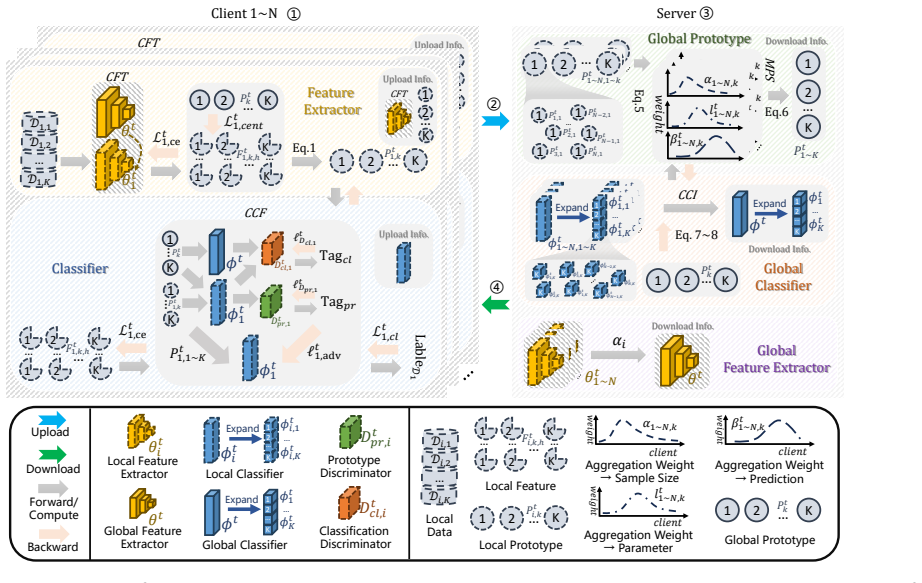
The central mechanism is the MPS aggregation weight $W^{t}_{i,k,\mathrm{final}}$, a convex combination of three normalized signals—sample-size share $\alpha_{i,k}$, centroid-similarity share $l^{t}_{i,k}$ (cosine similarity to the mean of that class's local prototypes), and prediction-based share $\beta^{t}_{i,k}$ (previous global classifier's logit for the prototype)—where the combination coefficients come from a softmax over pairwise Jensen-Shannon divergences between the three views. Around this, three supporting modules carry the argument: CCI aggregates classifier neurons per class by sample size and fine-tunes the global classifier on global prototypes; CCF trains the local classifier with two binary discriminators that play the classifier as generator against global-vs-local prototype outputs; and CFT schedules feature-extractor uploads at rounds set by the parameter-count ratio $q=\mathrm{Par}(\theta_i^t)/\mathrm{Par}(\sum_k P_k^t)$. The machinery's job is to make the global prototype trustworthy enough that it can serve as the supervisory anchor for both extractor and classifier, while keeping clients' local specialization.
What would settle it
Remove the MPS re-calibration from FedMate on the CIFAR-10 s=70 setting, replacing $l^{t}_{i,k}$ and $\beta^{t}_{i,k}$ with uniform weights while keeping everything else identical. If accuracy does not drop materially below the reported 72.19%, the claim that re-calibration yields an unbiased consensus is falsified. A sharper version: construct a one-class, two-client toy where client A's prototype is clean and client B's is corrupted by duplicated noisy samples; MPS's centroid and prediction terms will down-weight A if the centroid is dragged toward B, and measuring the resulting global prototype's distance to the true class mean decides the matter.
Extended reading notes
Core claim
On its own terms, the paper's discovery is that 'unbiased consensus' in heterogeneous federated learning is an aggregation-quality problem, not just a training-intensity problem. The load-bearing idea is multi-view prototype scrutiny (MPS): instead of weighting local prototypes by sample size alone, FedMate combines sample size, cosine similarity of each prototype to the across-client centroid, and the previous global classifier's per-class prediction, then merges the three views through a Jensen-Shannon-divergence softmax that down-weights deviant components. Classifier heads are aggregated per output neuron (category-wise classifier integration) and fine-tuned against the new global prototypes, while clients train classifiers with a dual-adversarial loss that pushes local and global prototype outputs toward each other. In the reported experiments FedMate reaches 72.19% on CIFAR-10 under strong label skew (s=70 versus FedPAC's 71.08%), 77.04% on CIFAR-100 under extreme heterogeneity, and higher Cityscapes mIoU than FedSeg, which the paper reads as evidence that re-calibrated prototypes harmonize generalization and adaptation across tasks.
Load-bearing premise
The quality score that re-calibrates each client prototype assumes both the average of all local prototypes and the previous global classifier's prediction are honest measures of prototype quality, but under heavy label skew early in training both can be badly biased.
Editorial extensions
If this is right
- If the reported gains reproduce, prototype aggregation should stop using sample size alone: MPS-style multi-view weighting becomes a drop-in improvement for any prototype-based federated learning method.
- Per-class classifier aggregation with prototype fine-tuning gives decoupled extractor-classifier methods a way to keep decision boundaries aligned with the feature space, which should reduce the overfitting seen in locally personalized heads.
- The dual-adversarial CCF offers a template for injecting global knowledge into a local classifier without overwriting it, potentially easing catastrophic forgetting in continual or incremental federated learning.
- CFT keeps total communication equivalent to full-model transmission while improving over full transmission on heterogeneous test sets, implying selective extractor exchange can be both cheaper and better.
- The Cityscapes results suggest the prototype re-calibration idea transfers from image classification to dense prediction, so the same server-side machinery may apply to other structured-output tasks.
Reading between the lines
- The prediction-based weight $\beta^{t}_{i,k}$ at round zero (or the first few rounds) is computed from a global classifier that has not yet seen meaningful consensus; a natural extension the paper does not explore is a warm-up phase that relies on sample-size and centroid weights until the classifier stabilizes.
- The paper's title principle—'choice outweighs effort'—implies a testable comparative claim: holding compute fixed, FedMate's gains should come more from re-calibration than from extra local epochs; varying local epochs against weight-calibration sharpness would isolate where the advantage lives.
- The same JS-divergence view-fusion trick used for prototype weights could be applied to other FL aggregation targets, such as normalization statistics, gradient masks, or even client selection probabilities, making the re-calibration idea a general 'weight-of-weights' module.
- Because MPS needs the previous global classifier's per-class logits, it is sensitive to classifier initialization and early-round noise; measuring FedMate's accuracy when the initial classifier is pretrained versus randomly initialized would show how much of the gain depends on a trustworthy starting point.
Signed reviews
Editorial analysis
A structured set of objections, weighed in public.
Referee Report
Summary. The paper proposes FedMate, a personalized federated learning method for label-skew heterogeneity, built on four components: multi-view prototype scrutiny (MPS), which weights local prototypes by sample size, centroid similarity, and previous-global-classifier predictions; category-wise classifier integration (CCI), which aggregates classifier neurons per class and fine-tunes them on global prototypes; complementary classification fusion (CCF), a dual-adversarial client-side objective that aligns local and global prototype/classifier knowledge; and cost-aware feature transmission (CFT), which schedules feature-extractor uploads via a parameter-count ratio. The central empirical claim is that FedMate consistently outperforms prior PFL baselines on several classification datasets and transfers to Cityscapes semantic segmentation, while maintaining communication costs comparable to per-round model uploads.
Significance. If the empirical claims hold, FedMate is a useful integration of prototype recalibration, classifier-level personalization, and selective communication in PFL. The paper has clear strengths: the experimental body is broad, with multiple heterogeneity levels, component ablations, convergence curves, robustness to redundant data, and a segmentation transfer study; a code URL is provided. The main caveats are that the method rests on heuristic quality signals rather than formal guarantees, and two load-bearing details—the communication-equivalence claim and the independence of the tuned hyperparameter cell—need clarification. These issues are fixable within the manuscript's scope and do not by themselves invalidate the overall approach.
major comments (3)
- [§3.4, Eq. (4), Appx. Fig. 2 and Appx. Table 1] The CFT communication-efficiency claim is not well-defined. The multiplier x in the schedule 'rounds that are not multiples of x×q' is never introduced or given a value, and the wording appears backwards: skipping multiples of a large interval would upload the feature extractor in almost every round, not reduce communication. No derivation supports the stated equivalence to per-round model uploading. Taking the setting literally, if classifiers and prototypes are uploaded every round and the extractor is uploaded every xq rounds, the average per-round cost is C+P+F/(xq), which equals C+F only under an unstated condition on x and q; the equality does not follow from Eq. (4). The communication-cost table in the appendix is qualitative (transmission type only) and therefore does not verify the equivalence. This blocks the paper's central 'cost-aware feature transmission' claim, and the section needs a precise schedule definition, a derivation, and reported byte-level or parameter-count costs.
- [§3.5–3.6, Eqs. (5)–(8)] The 'unbiased consensus' claim rests on a feedback loop that is not empirically isolated. In Eq. (5), the prediction-based weight β is computed from the previous global classifier, but in Eq. (7) that same global classifier is aggregated by per-class sample-size weighting only, with no merit-based recalibration. Under the label-skew setting the paper targets, the global classifier can remain majority-dominated at every round rather than only early in training. Eq. (8) then fine-tunes this classifier on global prototypes that were themselves constructed using β from the same biased classifier, so a systematically biased classifier can persistently downweight rare-but-informative local prototypes. This is a structural correctness risk, not a tuning detail. I would ask for a targeted experiment that isolates the failure mode, for example comparing MPS against sample-size-only prototype aggregation in a setting where a minority client holds a rare class with high-quality features, together with per-class prototype-aggregation error or per-class accuracy. The ablations in Table 1 and Appx. Table 4 do not currently separate this effect.
- [Appx.2, Tables 2 and 3 vs. Table 1] The reported CINIC-10 (s=70) result is partly a fitted result, not an independent prediction. The hyperparameter analysis in the appendix selects λe=0.8 and λc=0.6 by tuning on CINIC-10 with s=70, and Table 1 reports FedMate's accuracy on exactly that setting using those values. The text should either mark this cell as a tuning-set result, report a nested validation split, or add an independent heterogeneity level/dataset to demonstrate that the chosen constants transfer. The other datasets provide independent grounding, so the overall claim is not destroyed, but the current presentation overstates the strength of one cell.
minor comments (5)
- [Abstract and §4.1] The abstract says 'five datasets,' but §4.1 lists six datasets (CIFAR-10, CINIC-10, Animal-10, EMNIST, CIFAR-100, Cityscapes); the count should be reconciled.
- [Eq. (7)] As written, Eq. (7) has i on the right-hand side but not on the left-hand side; it should be φ_t^k = Σ_{i∈B_k} α_{i,k} φ_{i,t}^k, as the surrounding text describes.
- [§3.5 and Fig. 2 caption] The caption refers to 'relative entropy-based scoring,' while the method text defines the weighting via Jensen-Shannon divergences; please use consistent terminology.
- [Appx. Table 4 and Table 1] For the same reported settings, the appendix and main text give slightly different values (e.g., CIFAR-10 s=70: 72.19 vs. 72.10; CINIC-10 s=70 Backbone: 34.73 vs. 33.95); the authors should explain whether these are different seeds or correct the inconsistency.
- [Table 3] The segmentation results report only three individual clients with no variance or multiple-run statistics; for a scalability claim, an aggregate mean and standard deviation across clients or runs would be more informative.
Circularity Check
Minor fitted-cell issue on CINIC-10 s=70; no derivation-level circularity.
-
fitted input called prediction
[Appendix 2, Hyperparameter analysis; main results Tab. 1, CINIC-10 s=70 column.]
"We systematically evaluate our approach on the CINIC-10 dataset (s = 70) with uniform test distribution. Tabs. 2 and 3 demonstrate that extreme values in either direction–excessive or insufficient reliance on global knowledge–respectively cause overfitting or underfitting. The optimal balance emerges at λe = 0.8 and λc = 0.6."
The hyperparameters λe and λc are selected by test accuracy on CINIC-10 with s=70, and the same setting is then reported in Tab. 1 (Ours: 50.24) as part of the evidence that FedMate outperforms state-of-the-art methods. That table cell is the selected optimum of a search on its own test set rather than an independent prediction. The remaining datasets and settings use the same constants and are not tuned on, so the central generalization claim retains independent grounding beyond this one fitted cell.
full rationale
No equation in FedMate reduces a predicted quantity to an input by construction. The MPS centroid-similarity weight in Eq. (5) is self-referential in the sense that it measures agreement with the mean of the very prototypes being aggregated, but it is a proposed weighting heuristic, not a derived prediction, and the final global prototype remains a genuine function of the local prototypes and the previous global classifier. The beta feedback loop across rounds (biased classifier -> beta -> global prototype -> fine-tuning) is an iterative algorithmic concern, not a static derivation-level circularity, and the paper offers no theorem whose conclusion is its premise. The cited prior works by the same authors (e.g., FedCAC [36], FedDecomp [37]) are related-work context and are not load-bearing for the FedMate mechanism; there is no imported uniqueness theorem. The only concrete circularity-adjacent step is the hyperparameter selection on the CINIC-10 s=70 test set, which makes that one table cell a fitted result. Because the other datasets and heterogeneity scenarios are evaluated with the same fixed constants and against external baselines, the core claim is not forced by definition or by self-citation.
Assumptions & free parameters
free parameters (4)
- lambda_e =
0.8
- lambda_c =
0.6
- x (CFT schedule multiplier) =
not reported
- eta (classifier fine-tuning LR) =
not reported
assumptions (4)
- domain assumption Global prototypes as per-class mean embeddings are informative and stable enough to serve as aggregation anchors and local training regularizers (Eq. 1).
- domain assumption The previous global classifier's logit scores and the centroid-similarity measure are reliable quality signals for local prototypes (Eq. 5).
- ad hoc to paper The parameter-count ratio q is a valid proxy for information content, and scheduling uploads on x*q gives equivalent communication cost (Eq. 4).
- domain assumption Dual adversarial training with two binary discriminators provides stable and useful gradients for the local classifier.
invented entities (2)
-
Prototype discriminator D_pr,i
-
Classification discriminator D_cl,i
Cite this review
Pith. "Pith review of Choice Outweighs Effort: Facilitating Complementary Knowledge Fusion in Federated Learning via Re-calibration and Merit-discrimination." pith.science (2026). https://pith.science/paper/QG4UHHRO
@misc{pith2026250817954,
  author       = {Pith},
  title        = {Pith review of: Choice Outweighs Effort: Facilitating Complementary Knowledge Fusion in Federated Learning via Re-calibration and Merit-discrimination},
  year         = {2026},
  howpublished = {\url{https://pith.science/paper/QG4UHHRO}},
  note         = {Machine review of arXiv:2508.17954}
}
read the original abstract
Cross-client data heterogeneity in federated learning induces biases that impede unbiased consensus condensation and the complementary fusion of generalization- and personalization-oriented knowledge. While existing approaches mitigate heterogeneity through model decoupling and representation center loss, they often rely on static and restricted metrics to evaluate local knowledge and adopt global alignment too rigidly, leading to consensus distortion and diminished model adaptability. To address these limitations, we propose FedMate, a method that implements bilateral optimization: On the server side, we construct a dynamic global prototype, with aggregation weights calibrated by holistic integration of sample size, current parameters, and future prediction; a category-wise classifier is then fine-tuned using this prototype to preserve global consistency. On the client side, we introduce complementary classification fusion to enable merit-based discrimination training and incorporate cost-aware feature transmission to balance model performance and communication efficiency. Experiments on five datasets of varying complexity demonstrate that FedMate outperforms state-of-the-art methods in harmonizing generalization and adaptation. Additionally, semantic segmentation experiments on autonomous driving datasets validate the method's real-world scalability.
Figures


Figures from the paper (8 more)


Forward citations
Cited by 1 Pith paper
-
Beam Geometry and Input Dimensionality: Impact on Sparse-Sampling Artifact Correction for Clinical CT with U-Nets
On 22 clinical CT volumes with simulated sparse sampling, the 2D axial-slice U-Net scored best on MSE and SSIM for parallel, fan, and cone beam geometries, beating tri-planar 2.5D patches and 64x64x64 3D blocks.
Reference graph
Works this paper leans on
-
[1]
M. G. Arivazhagan, V . Aggarwal, A. K. Singh, and S. Choud- hary. Federated learning with personalization layers. arXiv preprint arXiv:1912.00818, 2019
arXiv 1912
- [2]
-
[3]
Z. Charles, G. Teston, L. Dery, K. Rush, N. Fallen, Z. Garrett, A. Szlam, and A. Douillard. Communication-efficient language model training scales reliably and robustly: Scaling laws for diloco. arXiv preprint arXiv:2503.09799, 2025
arXiv 2025
-
[4]
H. Chen and W. Chao. On bridging generic and personalized feder- ated learning for image classification. In International Conference on Learning Representations, 2022
work page 2022
- [5]
- [6]
-
[7]
L. Collins, H. Hassani, A. Mokhtari, and S. Shakkottai. Exploiting shared representations for personalized federated learning. In Inter- national Conference on Machine Learning , pages 2089–2099. PMLR, 2021
work page 2021
-
[8]
M. Cordts, M. Omran, S. Ramos, T. Rehfeld, M. Enzweiler, R. Benen- son, U. Franke, S. Roth, and B. Schiele. The cityscapes dataset for semantic urban scene understanding. In Proceedings of the IEEE/CVF Conference on Computer Vision and Pattern Recognition , pages 3213– 3223, 2016
work page 2016
Show all 43 references
-
[9]
A. Corrado. Animals-10 dataset, 2018. URL https://www.kaggle.com/ datasets/alessiocorrado99/animals10
2018
-
[10]
L. N. Darlow, E. J. Crowley, A. Antoniou, and A. J. Storkey. Cinic-10 is not imagenet or cifar-10. arXiv preprint arXiv:1810.03505, 2018
2018 arXiv
-
[11]
D. Deng, X. Wu, T. Zhang, X. Tang, H. Du, J. Kang, J. Liu, and D. Niy- ato. Fedasa: A personalized federated learning with adaptive model aggregation for heterogeneous mobile edge computing. IEEE Transac- tions on Mobile Computing , 2024
2024
-
[12]
Y . Deng, M. M. Kamani, and M. Mahdavi. Adaptive personalized fed- erated learning. arXiv preprint arXiv:2003.13461, 2020
2003 arXiv
-
[13]
Florea, M
C. Florea, M. Badea, L. Florea, A. Racoviteanu, and C. V ertan. Margin- mix: Semi-supervised learning for face expression recognition. In Eu- ropean Conference on Computer Vision, pages 1–17, 2020
2020
-
[14]
Huang, L
Y . Huang, L. Chu, Z. Zhou, L. Wang, J. Liu, J. Pei, and Y . Zhang. Per- sonalized cross-silo federated learning on non-iid data. In Proceed- ings of the AAAI Conference on Artificial Intelligence , volume 35, pages 7865–7873, 2021
2021
-
[15]
S. P . Karimireddy, S. Kale, M. Mohri, S. Reddi, S. Stich, and A. T. Suresh. Scaffold: Stochastic controlled averaging for federated learn- ing. In International Conference on Machine Learning , pages 5132–
-
[16]
Krizhevsky, G
A. Krizhevsky, G. Hinton, et al. Learning multiple layers of features from tiny images. 2009
2009
-
[17]
Li and J
D. Li and J. Wang. Fedmd: Heterogenous federated learning via model distillation. arXiv preprint arXiv:1910.03581, 2019
1910 arXiv
-
[18]
Q. Li, B. He, and D. Song. Model-contrastive federated learning. In Proceedings of the IEEE/CVF Conference on Computer Vision and Pat- tern Recognition, pages 10713–10722, 2021
2021
-
[19]
T. Li, A. K. Sahu, M. Zaheer, M. Sanjabi, A. Talwalkar, and V . Smith. Federated optimization in heterogeneous networks. Proceedings of Ma- chine Learning and Systems , 2:429–450, 2020
2020
-
[20]
T. Li, S. Hu, A. Beirami, and V . Smith. Ditto: Fair and robust feder- ated learning through personalization. In International Conference on Machine Learning, pages 6357–6368. PMLR, 2021
2021
-
[21]
Liang, Z
H. Liang, Z. Zhan, W. Liu, X. Zhang, C. W. Tan, and X. Chen. Fe- dReMa: Improving personalized federated learning via leveraging the most relevant clients. In European Conference on Artificial Intelligence , pages 2090–2097, 2024
2024
-
[22]
P . P . Liang, T. Liu, L. Ziyin, N. B. Allen, R. P . Auerbach, D. Brent, R. Salakhutdinov, and L.-P . Morency. Think locally, act globally: Fed- erated learning with local and global representations. arXiv preprint arXiv:2001.01523, 2020
2001 arXiv
-
[23]
Liang, G
W. Liang, G. A. Tadesse, D. Ho, L. Fei-Fei, M. Zaharia, C. Zhang, and J. Zou. Advances, challenges and opportunities in creating data for trustworthy ai. Nature Machine Intelligence, 4(8):669–677, 2022
2022
-
[24]
Y . Liu, Y . Tian, Y . Zhao, H. Y u, L. Xie, Y . Wang, Q. Y e, J. Jiao, and Y . Liu. Vmamba: Visual state space model. Advances in Neural Infor- mation Processing Systems, 37:103031–103063, 2024
2024
-
[25]
McMahan, E
B. McMahan, E. Moore, D. Ramage, S. Hampson, and B. A. y Arcas. Communication-efficient learning of deep networks from decentralized data. In Artificial Intelligence and Statistics , pages 1273–1282. PMLR, 2017
2017
-
[26]
J. Miao, Z. Y ang, L. Fan, and Y . Y ang. Fedseg: Class-heterogeneous federated learning for semantic segmentation. In Proceedings of the IEEE/CVF Conference on Computer Vision and Pattern Recognition , pages 8042–8052, 2023
2023
-
[27]
X. Mu, Y . Shen, K. Cheng, X. Geng, J. Fu, T. Zhang, and Z. Zhang. Fed- proc: Prototypical contrastive federated learning on non-iid data. Future Generation Computer Systems, 143:93–104, 2023
2023
-
[28]
J. Oh, S. Kim, and S.-Y . Y un. FedBABU: Toward enhanced representa- tion for federated image classification. In International Conference on Learning Representations, 2022
2022
-
[29]
Pillutla, K
K. Pillutla, K. Malik, A.-R. Mohamed, M. Rabbat, M. Sanjabi, and L. Xiao. Federated learning with partial model personalization. In International Conference on Machine Learning , pages 17716–17758. PMLR, 2022
2022
-
[30]
P . Qi, D. Chiaro, and F. Piccialli. Small models, big impact: A review on the power of lightweight federated learning. Future Generation Com- puter Systems, page 107484, 2024
2024
-
[31]
Y . Tan, G. Long, L. Liu, T. Zhou, Q. Lu, J. Jiang, and C. Zhang. Fed- proto: Federated prototype learning across heterogeneous clients. In Proceedings of the AAAI Conference on Artificial Intelligence , vol- ume 36, pages 8432–8440, 2022
2022
-
[32]
Y . Tan, G. Long, J. Ma, L. Liu, T. Zhou, and J. Jiang. Federated learning from pre-trained models: A contrastive learning approach. Advances in Neural Information Processing Systems, 35:19332–19344, 2022
2022
-
[33]
L. Wang, X. Zhang, H. Su, and J. Zhu. A comprehensive survey of continual learning: Theory, method and application. IEEE Transactions on Pattern Analysis and Machine Intelligence , 2024
2024
-
[34]
Y . Wen, K. Zhang, Z. Li, and Y . Qiao. A discriminative feature learn- ing approach for deep face recognition. In European Conference on Computer Vision, pages 499–515, 2016
2016
-
[35]
C. Wu, F. Wu, L. Lyu, Y . Huang, and X. Xie. Communication-efficient federated learning via knowledge distillation. Nature Communications, 13(1):2032, 2022
2022
-
[36]
X. Wu, X. Liu, J. Niu, G. Zhu, and S. Tang. Bold but cautious: Un- locking the potential of personalized federated learning through cau- tiously aggressive collaboration. In Proceedings of the IEEE/CVF In- ternational Conference on Computer Vision, pages 19375–19384, 2023
2023
-
[37]
X. Wu, X. Liu, J. Niu, H. Wang, S. Tang, G. Zhu, and H. Su. De- coupling general and personalized knowledge in federated learning via additive and low-rank decomposition. In Proceedings of the 32nd ACM International Conference on Multimedia , pages 7172–7181, 2024
2024
-
[38]
J. Xu, X. Tong, and S.-L. Huang. Personalized Federated Learning with Feature Alignment and Classifier Collaboration. In International Con- ference on Learning Representations, 2023
2023
-
[39]
M. Y e, X. Fang, B. Du, P . C. Y uen, and D. Tao. Heterogeneous feder- ated learning: State-of-the-art and research challenges. ACM Comput- ing Surveys, 56(3):1–44, 2023
2023
-
[40]
Q. Y u, Y . Liu, Y . Wang, K. Xu, and J. Liu. Multimodal Federated Learn- ing via Contrastive Representation Ensemble. In International Confer- ence on Learning Representations , 2023
2023
-
[41]
Zhang, Y
C. Zhang, Y . Xie, H. Bai, B. Y u, W. Li, and Y . Gao. A survey on feder- ated learning. Knowledge-Based Systems, 216:106775, 2021
2021
-
[42]
Zhang, Y
J. Zhang, Y . Hua, H. Wang, T. Song, Z. Xue, R. Ma, J. Cao, and H. Guan. Gpfl: Simultaneously learning global and personalized fea- ture information for personalized federated learning. In Proceedings of the IEEE/CVF International Conference on Computer Vision , pages 5041–5051, 2023
2023
-
[43]
T. Zhou, J. Zhang, and D. H. Tsang. Fedfa: Federated learning with feature anchors to align features and classifiers for heterogeneous data. IEEE Transactions on Mobile Computing , 23(6):6731–6742, 2023. Appendix 1 Algorithm Details This section provides the pseudocode for FedM...
2023
Reviewed August 15, 2026 · model on record in the stance chip above.
Discussion (0). Continue with ORCID to comment.