REVIEW 5 major objections 7 minor 45 references
Improving Long-term Autoregressive Spatiotemporal Predictions: A Proof of Concept with Fluid Dynamics
T0 review · 5 major / 7 minor · reviewed 2026-08-15 · deepseek-v4-flash
Pith's one-line read The paper's central claim is that training on a stochastic mixture of ground-truth and model-generated states can replace multi-step backpropagation for long-term forecasting, improving accuracy at constant GPU memory.
desk verdict SPF is a plausible low-memory alternative to backprop-through-time for neural surrogates, but the paper's own Algorithm 1 contradicts its central constant-memory claim. read the letter →
The pith
A machine-rendered reading of the paper's core claim, the machinery that carries it, and where it could break.
The reading
What carries the argument
The load-bearing object is the supplementary dataset Dδ of model-generated latent states, refreshed every NUI epochs, together with the stochastic acquisition rule It~Bernoulli(p) that decides whether the input for the one-step loss comes from ground truth or from Dδ. The target is always the ground-truth next state, and a coefficient α down-weights the supplementary samples. Because the δ-step composition fδ is evaluated only to generate data between epochs, the training loop stays one-step-ahead and memory use does not grow with δ.
What would settle it
Train SPF, then record both the states in the supplementary dataset and the states the final model visits during long held-out rollouts, and compute a distributional distance between the two sets in latent space. If SPF still improves long-horizon accuracy when that distance is large, the stated correction mechanism is not the one doing the work; if long-horizon error tracks that distance, the premise is load-bearing.
Extended reading notes
Core claim
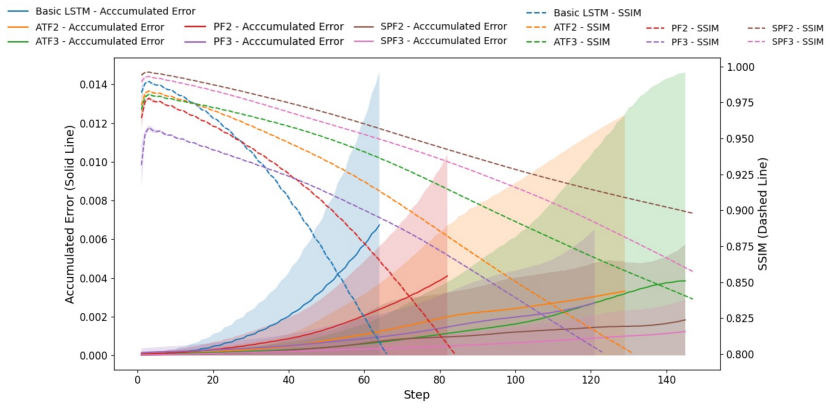
SPF's central claim is that multi-step learning can be achieved without multi-step backpropagation by training on a mixture of ground-truth and self-generated states. The paper defines a supplementary dataset Dδ built by applying the composed predictor fδ to ground-truth inputs, then samples each training input from D1 or Dδ according to a Bernoulli draw with probability p, always targeting the true next state, and weights supplementary samples by α. Multi-step predictions are precomputed between epochs, so no unrolled sequence occupies GPU memory during gradient computation. Experiments on Burgers' equation and the shallow water system report that SPF outperforms the base LSTM, ATF, and PF on accumulated error and SSIM over long horizons, preserves short-term accuracy, remains robust under noisy and sparse data, and keeps RAM at 689 MB independent of depth δ.
Load-bearing premise
The load-bearing premise is that the model's own earlier predictions, generated by unrolling from ground-truth states and stored in the supplementary dataset, resemble the states the model will actually meet during long test-time rollouts, so that a one-step loss on those predicted states teaches it to reduce compounding errors.
Editorial extensions
If this is right
- On both the Burgers' equation and shallow water benchmarks, SPF lowers accumulated error and raises SSIM over long horizons relative to the base LSTM, ATF, and PF.
- GPU memory stays at 689 MB for depths δ=2 and δ=3 in the shallow water test, while ATF and PF memory grows with depth, making SPF's cost independent of rollout depth.
- SPF preserves short-term one-step accuracy because ground-truth samples remain in the stochastic mix, and it maintains higher SSIM than ATF/PF under noisy inputs.
- SPF remains the strongest method when training data is reduced to 50%, 30%, 10%, and 5% of the full set, and it can be combined with an energy-regularization term to reduce accumulated error further.
Reading between the lines
- An untested extension is to anneal the sampling probability p from mostly ground-truth early in training to mostly predicted states later, turning SPF into a curriculum that may reduce sensitivity to the fixed hyperparameter values the paper reports.
- Because memory does not scale with δ, SPF could in principle train very deep rollouts for transformer-based latent surrogates where ATF and PF storage becomes prohibitive; a chaotic test problem would show whether the claimed balance extends beyond the two smooth benchmarks.
- The supplementary dataset is a form of experience replay, so prioritizing predicted states with the largest deviation from ground truth could target exactly the rollouts that diverge, a variant not explored in the paper.
Signed reviews
Editorial analysis
A structured set of objections, weighed in public.
Referee Report
Summary. The paper introduces Stochastic PushForward (SPF), a training framework for long-term autoregressive forecasting that combines one-step-ahead training with a stochastically sampled mixture of ground-truth and model-predicted inputs. SPF builds a supplementary dataset by unrolling a frozen copy of the surrogate model for δ steps from ground-truth states, refreshes it periodically, and trains a one-step surrogate using a Bernoulli acquisition rule with a weighting coefficient α. Multi-step predictions are precomputed between epochs, so gradients are never backpropagated through an unrolled sequence. The framework is evaluated on 2D Burgers' equation and a shallow-water benchmark using a CAE-LSTM architecture, with comparisons against a basic LSTM, autoregressive training (ATF), and PushForward (PF), plus additional experiments on data scarcity, time-step extrapolation, noisy inputs, energy consistency, a physics-constrained variant, hyperparameter sensitivity, and GPU memory usage. The paper claims higher long-term accuracy and lower memory than autoregressive approaches.
Significance. If validated, SPF fills a practical niche: it obtains multi-step robustness without backpropagating through multiple unrolled steps, while preserving short-term accuracy because the training loss remains one-step. The paper's strengths are that it provides a concrete algorithm, a public code repository, a range of diagnostic experiments (limited data, extrapolation, noisy inputs, physics-constrained variant), and a direct comparison with ATF and PF on the shallow-water benchmark. The central mechanism is plausible and the shallow-water results are encouraging. However, the current manuscript does not yet fully support the headline claims: the Burgers benchmark lacks the ATF/PF comparison, the SSIM truncation hides part of the rollout behavior, and the unbounded append rule in Algorithm 1 conflicts with the stable-memory claim. These issues are fixable within the paper's scope.
major comments (5)
- [Algorithm 1, Section 3.4] In Algorithm 1, the supplementary-dataset update is implemented as 'Dδ ← Dδ ∪ {~ηt+δ}' inside the 'if (epoch mod NUI) == 0' branch, with the comment 'Append predicted sequence to Dδ.' This is an appending operation, not a replacement or reset. Because the model changes between updates, successive updates add new predicted states that are not duplicates, so |Dδ| grows without bound as training proceeds. This directly contradicts the claim in §5.7 that SPF maintains constant RAM usage of 689 MB independent of δ, since an unbounded Dδ increases CPU-side storage and, depending on the data-transfer strategy, per-epoch data-transfer and training cost. It also preserves stale predictions from earlier checkpoints in the training mix, weakening the paper's mechanism that Dδ represents the current model's rollout states. The pseudocode must either be corrected to a replace/refresh operation (matching the memory claims) or the memory and training-cost analysis must account for the accumulated supplementary dataset. This is load-bearing because both the headline efficiency claim and the accuracy mechanism depend on the actual update rule.
- [Section 4 (Burgers' equation)] The Burgers' equation experiments compare only the basic one-step LSTM with SPF2/SPF3; neither ATF nor PF is evaluated on this test case. The paper's claims in the abstract and introduction that SPF outperforms 'autoregressive approaches' are therefore only directly supported by the shallow-water experiments. The Burgers results should either include ATF/PF baselines with the same depth settings, or the claims should be restricted to the shallow-water benchmark.
- [Section 5.2.1, Fig. 9] The text states that 'if SSIM falls below 0.8, the subsequent data points are not plotted, as the results below the threshold are deemed non-informative.' This truncation can hide large accumulated errors: for models whose SSIM drops below threshold early, such as the basic LSTM, the plotted accumulated-error curve stops, and the visual comparison ends at the truncation point rather than at the full horizon. The reported metric comparisons are therefore incomplete. Please report full-length curves or, at minimum, state the truncation explicitly in every affected figure and provide the step at which each model crosses the threshold.
- [Section 5 (experimental setup)] No random seeds, number of independent runs, or error bars are reported for any experiment. The claim in §5.2.1 that 'SPF models demonstrate less error and uncertainty' appears to refer to standard deviations, but the corresponding curves are not shown with error bands, and the number of seeds is not given. In addition, key training hyperparameters (LSTM architecture, optimizer settings, learning rate, batch size, Ninit, Nepoch, NUI, and the chosen p and α for each reported result) are not stated in the main text. The repository link is helpful, but the paper should include the numerical settings needed to reproduce Tables 1–3 and Figures 6–16 without inferring them from code.
- [Table 3 and Section 5.7] The memory comparison is ambiguous. Table 3 is headed 'RAM Usage,' but §5.7 states that 'Both ATF and SPF initially store all data on the CPU and transfer it to the GPU only for training.' It is not clear whether the reported numbers are GPU memory, CPU RAM, or total memory, nor whether the supplementary dataset Dδ storage is included in the SPF figures. Since the central efficiency claim is that SPF keeps memory 'stable regardless of δ,' the measurement procedure must be stated precisely. If the reported 689 MB excludes the CPU-side Dδ storage, Table 3 understates the true memory footprint when Dδ is accumulated as in Algorithm 1.
minor comments (7)
- [Section 2] The word 'recrusive' should be 'recursive.'
- [Section 3.1] The phrase 'singe-step-ahead prediction' should be 'single-step-ahead prediction.'
- [Eq. (13)] Since I_t is Bernoulli, the expression 'ηI_t = I_t·η^{D1}_t + (1−I_t)·η^{Dδ}_t' is a selection between two states rather than a convex combination; presenting it as a conditional selection would be clearer.
- [Section 5.2.2, Fig. 10] The statement that 'the performance of PF models deteriorates as δ increases' is not connected to the quantitative results in Fig. 9, where PF3 does not uniformly underperform PF2; please clarify or qualify this claim.
- [Section 5.4] The phrase 'To access whether the model meets this criterion' should be 'To assess whether the model meets this criterion.'
- [Algorithm 1] The notation 'length(D)' is not explicitly defined; since the dimensionality of D depends on whether Dδ is reset or appended, the algorithm should define it precisely.
- [Tables 1–2] It should be stated whether the reported MSE and SSIM values are from a single run or averaged over multiple seeds.
Circularity Check
No significant circularity: the SPF training objective always compares against ground-truth targets and the accuracy claims are tested on external benchmark data.
full rationale
SPF's derivation is self-contained rather than circular. In Eq. (15) the training loss is ||f(η^I_t) − η_{t+1}||^2_2, and by Eq. (13) the target η_{t+1} is always the ground-truth state from D1 even when the input η^I_t is drawn from the supplementary dataset Dδ. Thus model-generated states are used only as inputs, never as validation targets, so the claimed long-term accuracy is not assumed through the back door. The reported performance comparisons (Sections 4 and 5) are measured on held-out simulations, unseen initial conditions, and extrapolation timesteps 351–450, against external baselines (basic LSTM, ATF, PF); no fitted parameter is relabeled as a prediction. The self-citations ([20], [28], [37]) are background or methodological references and are not load-bearing; no uniqueness theorem or ansatz is imported from the authors' prior work. One concern in the manuscript is algorithmic rather than circular: Algorithm 1 executes 'Dδ ← Dδ ∪ {~η_{t+δ}}' and comments 'Append predicted sequence to Dδ', so the CPU-side supplementary dataset grows without an explicit replacement bound; this bears on the memory/staleness claims, but it does not make any equation equivalent to its own input. Under the stated rubric, no circular step can be exhibited, so the appropriate score is 0.
Assumptions & free parameters
free parameters (4)
- Bernoulli probability p =
0.5 for best MSE and SSIM in §5.6 (also tested 0.25, 0.75)
- Supplementary loss weight α =
1.0 (best MSE) or 0.75 (best SSIM) in §5.6
- Rollout depth δ =
2 and 3 in experiments
- Physics constraint weight λ_PC =
1
assumptions (4)
- domain assumption The convolutional autoencoder latent representation preserves the dynamical information needed for multi-step prediction
- ad hoc to paper Training on a mixture of ground-truth and self-generated inputs is stable and does not cause feedback-loop bias amplification
- domain assumption The numerical simulations (finite difference for Burgers, finite difference plus Euler for shallow water) provide reliable ground truth
- domain assumption Hyperparameters of the ATF and PF baselines were chosen fairly and comparably
Cite this review
Pith. "Pith review of Improving Long-term Autoregressive Spatiotemporal Predictions: A Proof of Concept with Fluid Dynamics." pith.science (2026). https://pith.science/paper/WPJSC2YP
@misc{pith2026250818565,
  author       = {Pith},
  title        = {Pith review of: Improving Long-term Autoregressive Spatiotemporal Predictions: A Proof of Concept with Fluid Dynamics},
  year         = {2026},
  howpublished = {\url{https://pith.science/paper/WPJSC2YP}},
  note         = {Machine review of arXiv:2508.18565}
}
read the original abstract
Data-driven methods are emerging as efficient alternatives to traditional numerical forecasting, offering fast inference and lower computational cost. Yet, for complex systems, long-term accuracy often deteriorates due to error accumulation, and autoregressive training (though effective) demands large GPU memory and may sacrifice short-term performance. We propose the Stochastic PushForward (SPF) framework, which retains one-step-ahead training while enabling multi-step learning. SPF builds a supplementary dataset from model predictions and combines it with ground truth via a stochastic acquisition strategy, balancing short- and long-term performance while reducing overfitting. Multi-step predictions are precomputed between epochs, keeping memory usage stable without storing full unrolled sequences. Experiments on the Burgers' equation and the Shallow Water benchmark show that SPF achieves higher long-term accuracy than autoregressive methods while lowering memory requirements, making it promising for resource-limited and complex simulations.
Figures


Figures from the paper (13 more)




Reference graph
Works this paper leans on
-
[34]
P. R. Vlachas, P. Koumoutsakos, Learning from predictions: fusing training and autoregressive inference for long-term spatiotemporal forecasts, arXiv preprint arXiv:2302.11101 (2023)
work page Pith review arXiv 2023
-
[1]
N. Tabatabaei, R. Vinuesa, R. Örlü, P. Schlatter, Techniques for turbulence tripping of bound- ary layers in rans simulations, Flow, Turbulence and Combustion 108 (2022) 661–682
work page 2022
-
[2]
P. J. Olver, et al., Introduction to partial differential equations, volume 1, Springer, 2014
work page 2014
-
[3]
V. Casulli, Semi-implicit finite difference methods for the two-dimensional shallow water equations, Journal of Computational Physics 86 (1990) 56–74
work page 1990
-
[4]
A. Kurganov, D. Levy, Central-upwind schemes for the saint-venant system, ESAIM: Mathe- matical Modelling and Numerical Analysis 36 (2002) 397–425
work page 2002
-
[5]
F. Alcrudo, P. Garcia-Navarro, A high-resolution godunov-type scheme in finite volumes for the 2d shallow-water equations, International Journal for Numerical Methods in Fluids 16 (1993) 489–505
work page 1993
-
[6]
D. S. Bale, R. J. Leveque, S. Mitran, J. A. Rossmanith, A wave propagation method for conservation laws and balance laws with spatially varying flux functions, SIAM Journal on Scientific Computing 24 (2003) 955–978
work page 2003
-
[7]
Y.-H. Qian, D. d’Humières, P. Lallemand, Lattice bgk models for navier-stokes equation, Europhysics letters 17 (1992) 479
work page 1992
Show all 45 references
-
[8]
X. Shan, H. Chen, Lattice boltzmann model for simulating flows with multiple phases and components, Physical review E 47 (1993) 1815
1993
-
[9]
Babanezhad, A
M. Babanezhad, A. Taghvaie Nakhjiri, M. Rezakazemi, A. Marjani, S. Shirazian, Functional input and membership characteristics in the accuracy of machine learning approach for esti- mation of multiphase flow, Scientific Reports 10 (2020) 17793
2020
-
[10]
Lagha, G
M. Lagha, G. Dufour, Body force modeling of the fan stage of a windmilling turbofan, Journal of Turbomachinery (2021) 1–13
2021
-
[11]
W. Zuo, Q. Chen, Real-time or faster-than-real-time simulation of airflow in buildings, Indoor air 19 (2009) 33
2009
-
[12]
Fresca, A
S. Fresca, A. Manzoni, Real-time simulation of parameter-dependent fluid flows through deep learning-based reduced order models, Fluids 6 (2021) 259
2021
-
[13]
Drakoulas, T
G. Drakoulas, T. Gortsas, G. Bourantas, V. Burganos, D. Polyzos, Fastsvd-ml–rom: A reduced-order modeling framework based on machine learning for real-time applications, Com- puter Methods in Applied Mechanics and Engineering 414 (2023) 116155
2023
-
[14]
J. L. Elman, Finding structure in time, Cognitive science 14 (1990) 179–211
1990
-
[15]
C. Yu, F. Wang, Z. Shao, T. Sun, L. Wu, Y. Xu, Dsformer: A double sampling transformer for multivariate time series long-term prediction, in: Proceedings of the 32nd ACM international conference on information and knowledge management, 2023, pp. 3062–3072
2023
-
[16]
Young, J
J. Young, J. Chen, F. Huang, J. Peng, Dateformer: Time-modeling transformer for longer-term series forecasting, arXiv preprint arXiv:2207.05397 (2022). 32
2022 arXiv
-
[17]
P.Lara-Benítez, M.Carranza-García, J.C.Riquelme, Anexperimentalreviewondeeplearning architectures for time series forecasting, International journal of neural systems 31 (2021) 2130001
2021
-
[18]
J. Chen, E. Gildin, J. Killough, Multi-step embed to control: A novel deep learning-based approach for surrogate modelling in reservoir simulation, arXiv preprint arXiv:2409.09920 (2024)
2024 arXiv
-
[19]
Trehan, K
S. Trehan, K. T. Carlberg, L. J. Durlofsky, Error modeling for surrogates of dynamical systems usingmachinelearning, InternationalJournalforNumericalMethodsinEngineering112(2017) 1801–1827
2017
-
[20]
Cheng, Y
S. Cheng, Y. Zhuang, L. Kahouadji, C. Liu, J. Chen, O. K. Matar, R. Arcucci, Multi-domain encoder–decoder neural networks for latent data assimilation in dynamical systems, Computer Methods in Applied Mechanics and Engineering 430 (2024) 117201
2024
-
[21]
Fukami, K
K. Fukami, K. Fukagata, K. Taira, Machine-learning-based spatio-temporal super resolution reconstruction of turbulent flows, Journal of Fluid Mechanics 909 (2021) A9
2021
-
[22]
Hasegawa, K
K. Hasegawa, K. Fukami, T. Murata, K. Fukagata, Machine-learning-based reduced-order modeling for unsteady flows around bluff bodies of various shapes, Theoretical and Computa- tional Fluid Dynamics 34 (2020) 367–383
2020
-
[23]
Maulik, B
R. Maulik, B. Lusch, P. Balaprakash, Reduced-order modeling of advection-dominated systems with recurrent neural networks and convolutional autoencoders, Physics of Fluids 33 (2021)
2021
-
[24]
Raissi, P
M. Raissi, P. Perdikaris, G. E. Karniadakis, Physics-informed neural networks: A deep learning framework for solving forward and inverse problems involving nonlinear partial differential equations, Journal of Computational physics 378 (2019) 686–707
2019
-
[25]
G. E. Karniadakis, I. G. Kevrekidis, L. Lu, P. Perdikaris, S. Wang, L. Yang, Physics-informed machine learning, Nature Reviews Physics 3 (2021) 422–440
2021
-
[26]
H. Wang, H. Zhou, S. Cheng, Dynamical system prediction from sparse observations using deep neural networks with voronoi tessellation and physics constraint, Computer Methods in Applied Mechanics and Engineering 432 (2024) 117339
2024
-
[27]
S. Xiao, J. Bai, H. Jeong, L. Alzubaidi, Y. Gu, A meshless runge-kutta-based physics-informed neural network framework for structural vibration analysis, Engineering Analysis with Bound- ary Elements 170 (2025) 106054
2025
-
[28]
H. Zhou, S. Cheng, R. Arcucci, Multi-fidelity physics constrained neural networks for dynam- ical systems, Computer Methods in Applied Mechanics and Engineering 420 (2024) 116758
2024
-
[29]
S.H.Rudy, S.L.Brunton, J.L.Proctor, J.N.Kutz, Data-drivendiscoveryofpartialdifferential equations, Science advances 3 (2017) e1602614
2017
-
[30]
Raissi, Deep hidden physics models: Deep learning of nonlinear partial differential equa- tions, Journal of Machine Learning Research 19 (2018) 1–24
M. Raissi, Deep hidden physics models: Deep learning of nonlinear partial differential equa- tions, Journal of Machine Learning Research 19 (2018) 1–24. 33
2018
-
[31]
De Bézenac, A
E. De Bézenac, A. Pajot, P. Gallinari, Deep learning for physical processes: Incorporating prior scientific knowledge, Journal of Statistical Mechanics: Theory and Experiment 2019 (2019) 124009
2019
-
[32]
Chattopadhyay, P
A. Chattopadhyay, P. Hassanzadeh, D. Subramanian, Data-driven predictions of a multiscale lorenz96 chaoticsystemusing machine-learningmethods: reservoircomputing, artificialneural network, and long short-term memory network, Nonlinear Processes in Geophysics 27 (2020) 373–389
2020
-
[33]
Bielitz, D
T. Bielitz, D. Bestle, Identification of dynamic systems assisted by an autoregressive recurrent model, PAMM 23 (2023) e202300086
2023
-
[35]
T. Wu, T. Maruyama, Q. Zhao, G. Wetzstein, J. Leskovec, Learning controllable adaptive simulation for multi-resolution physics, arXiv preprint arXiv:2305.01122 (2023)
2023 arXiv
-
[36]
Brandstetter, D
J. Brandstetter, D. Worrall, M. Welling, Message passing neural pde solvers, arXiv preprint arXiv:2202.03376 (2022)
2022 arXiv
-
[37]
Cheng, M
S. Cheng, M. Bocquet, W. Ding, T. S. Finn, R. Fu, J. Fu, Y. Guo, E. Johnson, S. Li, C. Liu, et al., Machine learning for modelling unstructured grid data in computational physics: a review, Information Fusion (2025) 103255
2025
-
[38]
G. E. Hinton, R. R. Salakhutdinov, Reducing the dimensionality of data with neural networks, science 313 (2006) 504–507
2006
-
[39]
D. E. Rumelhart, G. E. Hinton, R. J. Williams, Learning representations by back-propagating errors, nature 323 (1986) 533–536
1986
-
[40]
Graves, A
A. Graves, A. Graves, Long short-term memory, Supervised sequence labelling with recurrent neural networks (2012) 37–45
2012
-
[41]
Vaswani, Attention is all you need, Advances in Neural Information Processing Systems (2017)
A. Vaswani, Attention is all you need, Advances in Neural Information Processing Systems (2017)
2017
-
[42]
R. F. Engle, Autoregressive conditional heteroscedasticity with estimates of the variance of united kingdom inflation, Econometrica: Journal of the econometric society (1982) 987–1007
1982
-
[43]
Q. Meng, M. Xiao, S. Yan, Y. Wang, Z. Lin, Z.-Q. Luo, Towards memory-and time-efficient backpropagation for training spiking neural networks, in: Proceedings of the IEEE/CVF International Conference on Computer Vision, 2023, pp. 6166–6176
2023
-
[44]
Pascanu, On the difficulty of training recurrent neural networks, arXiv preprint arXiv:1211.5063 (2013)
R. Pascanu, On the difficulty of training recurrent neural networks, arXiv preprint arXiv:1211.5063 (2013)
2013 arXiv
-
[45]
Hochreiter, J
S. Hochreiter, J. Schmidhuber, Long short-term memory, Neural computation 9 (1997) 1735– 1780. 34
1997
Reviewed August 15, 2026 · model on record in the stance chip above.
Discussion (0). Continue with ORCID to comment.