REVIEW 3 major objections 6 minor 1 cited by
Aerosol dynamics on hot exoplanets: the role of radiation pressure
T0 review · 3 major / 6 minor · reviewed 2026-08-05 · deepseek-v4-flash
Pith's one-line read Starlight exerts up to 30 times the acceleration of gravity on sub-micron haze particles in hot exoplanet atmospheres, and this extra push makes the particles smaller and more dilute, steepening optical transmission slopes and strengthening
desk verdict Radiation pressure on aerosols is a genuinely new physical idea for hot exoplanet atmospheres, and the core force-balance argument is sound; the quantitative scalings and spectral predictions are real but rest on a simplified coagulation model, so the paper deserves a serious referee but also a clear sensitivity discussion. read the letter →
The pith
A machine-rendered reading of the paper's core claim, the machinery that carries it, and where it could break.
The reading
What carries the argument
The load-bearing mechanism is the radiation-pressure-to-gravity ratio β_p (Equation 2), which parametrises the extra downward acceleration on an aerosol particle. The argument then runs through the growth-settling equilibrium: the terminal settling velocity (Equation 8, Epstein drag with acceleration (1+β_p)g) and the coagulation timescale (Equation 9, ballistic Brownian collisions with perfect sticking) are equated, giving the particle size and mass concentration scalings (Equations 10–11). This equilibrium determines everything downstream: the aerosol opacity profile, the photospheric pressure, and finally the transmission spectrum. The 2D equatorial-band model (Section 3.3) carries this m
What would settle it
Observe a sample of hot gas giants with homogeneous transmission spectra and measure the normalised 1.4 μm water amplitude and optical slope as a function of β_p; if planets with high β_p do not show larger water amplitudes and steeper slopes after accounting for scale height, the radiation-pressure mechanism is not the controlling factor. Alternatively, a laboratory measurement showing that soot/tholin aggregates bounce or fragment at the relevant collision speeds would falsify the perfect-sticking growth-settling equilibrium that the size scalings depend on.
Extended reading notes
Core claim
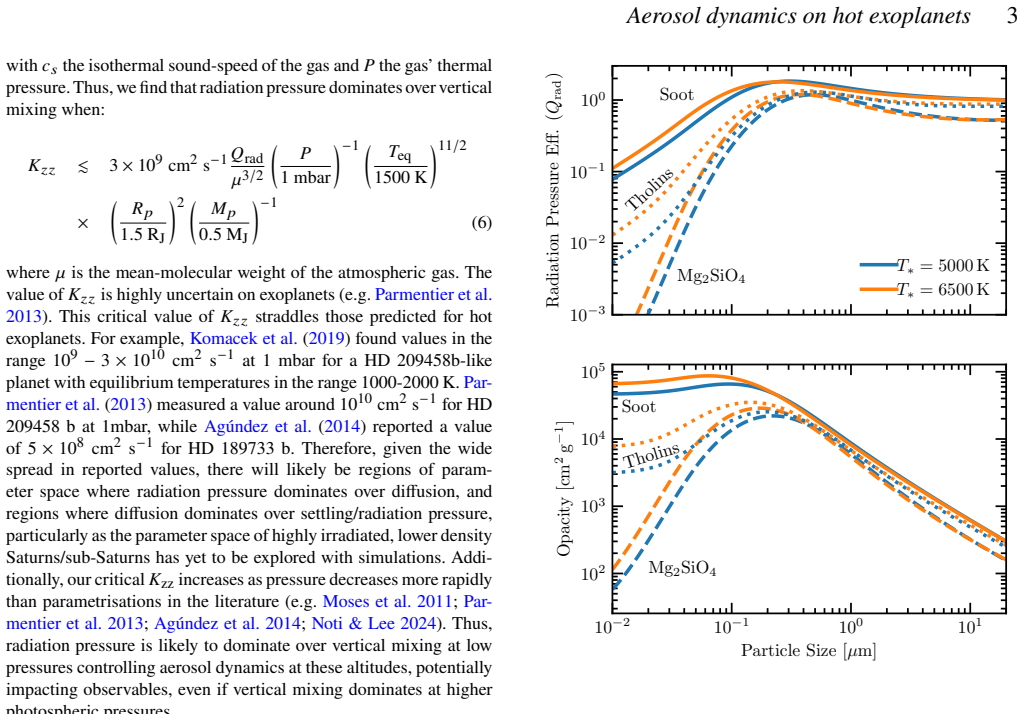
The paper's central claim is that the ratio of radiative acceleration to planetary gravity, β_p, is typically larger than one for ~0.1–1 micron aerosols on highly irradiated giant planets, often reaching values of 10–30 (Equation 3, Figure 2). Because radiation pressure acts in the stellar direction, it adds to gravity in the settling of haze particles, raising their terminal velocity. Equating the coagulation timescale (Equation 9, assuming perfect sticking) with the settling timescale (Equation 8) gives the growth-settling equilibrium: particle size a ∝ (1+β_p)^(-2/9) and mass concentration X_p ∝ (1+β_p)^(-5/9) (Equations 10–11). Thus radiation pressure makes particles smaller and the aero
Load-bearing premise
The predictions rest on a growth-settling equilibrium in which every collision sticks and the aerosol population is described by a single representative size; if sticking is inefficient, fragmentation occurs, or the size distribution is broad, the scalings and spectral signatures would change.
Editorial extensions
If this is right
- Microphysical models that omit radiation pressure will overestimate haze particle sizes and mass concentrations on highly irradiated planets, biasing retrievals of molecular abundances and cloud properties.
- The paper predicts a population-level correlation: among hot gas giants, the normalised 1.4 μm water feature amplitude should increase with β_p (roughly with equilibrium temperature and inverse surface gravity), helping explain the scatter in measured feature amplitudes.
- Morning and evening terminator spectra should differ systematically: the evening terminator is hazier, while the morning terminator has a steeper optical slope that can become super-Rayleigh under strong radiation pressure.
- Radiation pressure can drive an outward flow of aerosols; for soot-like hazes the mass-loss rate is about 1.6% of the production rate, enough to deplete the upper-atmosphere haze precursor reservoir over the planet's lifetime unless replenished.
- Radiation pressure narrows the haze production rates that produce high albedos, which could account for the lack of strong correlations between observed exoplanet albedos and standard planetary and stellar parameters.
Reading between the lines
- The paper's scalings suggest a direct observational test: a sample of hot giant planets with well-determined masses, radii and temperatures should show normalised water-feature amplitudes increasing with β_p even after controlling for scale-height effects; current observations of separate morning/evening terminator spectra could check the predicted asymmetry direction.
- If the same acceleration applies to condensate clouds, as the paper speculates, radiation pressure would shrink cloud particles too, potentially explaining super-Rayleigh optical slopes without invoking extremely strong vertical mixing.
- The perfect-sticking, single-size growth-settling equilibrium is the load-bearing premise; if laboratory studies of soot/tholin aggregates find low sticking efficiencies or fragmentation, the size scaling with β_p weakens and the spectral predictions would need revision.
- The radiative feedback loop described in Section 6.1 (smaller particles → lower opacity → hotter atmosphere → longer settling time → larger particles) could create bistable or time-variable haze states, which would appear as transit-depth variations across epochs.
Editorial analysis
A structured set of objections, weighed in public.
Referee Report
Summary. This paper proposes that stellar radiation pressure exerts a force on aerosol particles in hot exoplanet atmospheres that is often comparable to or larger than planetary gravity, with beta_p up to ~10-30 for low-gravity, highly irradiated planets. Assuming hazes with a monodisperse size and a growth-settling equilibrium, the authors derive analytic scalings in which radiation pressure reduces particle size and mass concentration; they then simulate haze dynamics in a 2D equatorial band with a single representative particle size, compute transmission spectra, and predict steeper optical slopes and larger near-IR molecular feature amplitudes at higher radiation pressure. They also discuss albedo effects, morning/evening terminator asymmetries, aerosol mass loss, and population-level correlations.
Significance. If the central scalings survive closer scrutiny, radiation pressure would be a genuinely new physical process for aerosol evolution on hot exoplanets, with direct consequences for the interpretation of HST and JWST transmission spectra and albedo measurements. The paper's analytic derivation is clean and does not fit observational data; the Mie opacities are computed from published laboratory optical constants; the simulation code is publicly available; and the main predictions (beta_p-driven steepening of optical slopes and stronger molecular features) are, in principle, testable with current observations. The paper is also appropriately cautious about implicit correlations between radiation pressure strength and other planetary/stellar parameters.
major comments (3)
- [Section 3.1, Eqs. (8)-(11)] The analytic growth-settling equilibrium treats collisions as driven only by Brownian relative motion of equal-mass particles. This assumption is not justified at the pressures and sizes of interest. For the HAT-P-65 b analogue at P*=1 microbar with beta_p=10, Eq. (8) gives settling velocities of about 6e3 cm/s for 0.1 micron grains and 1.3e4 cm/s for 0.2 micron grains, so differential settling between different-sized grains is about 6e3 cm/s, while v_BM in Eq. (9) is about 20 cm/s. Since v_BM scales as a^{-3/2} and v_set as (1+beta_p) a / rho_gas, the hierarchy worsens for larger grains and lower gas densities. Radiation pressure multiplies differential settling velocities by (1+beta_p), so the scalings in Eqs. (10)-(11), and their use in Section 5, are not demonstrated for a realistic size distribution. Please provide a quantitative validity condition for the Brownian-only regime, or g
- [Section 3.3-3.4, Eq. (36)] The numerical model evolves a single representative particle size per cell, yet the growth time is stated to come from Ormel & Min (2019), including differential particle drift. With only one size per cell it is unclear how the differential-drift relative velocity is evaluated; if it is evaluated between identical sizes it vanishes, and the model cannot capture the radiation-pressure-amplified differential-settling channel highlighted above. The separate treatment of freshly injected 10^-3 micron seeds (sweep-up vs. self-coagulation) addresses only the injection step, not the subsequent growth of the resident population. Please specify the assumed size distribution or effective relative velocity used in the Ormel & Min formula, and test the sensitivity of the size/concentration profiles (Figures 9, 11-12) and transmission spectra (Figures 14-16) to the single-size approximation. This is
- [Section 3.1, Eq. (9) and Section 6.1] The collision model assumes perfect sticking ('all collisions result in growth') and no fragmentation. Radiation pressure can produce collision velocities of order km/s at the low pressures considered, where sticking efficiencies are plausibly below unity and fragmentation or erosion may become important. This could alter the growth-settling equilibrium and the predicted size scalings. The manuscript does not discuss this channel, even though it is directly relevant to the claim that the qualitative result is robust. At minimum, the authors should state the expected collision velocities and justify the perfect-sticking assumption for the parameter range simulated.
minor comments (6)
- [Eq. (3)] The prefactor of 5 assumes F* = 4 sigma Teq^4 (full isotropic re-radiation) and zero albedo. State this explicitly when introducing Teq.
- [Figure 9 caption] The caption refers to a 'HATP-67 b analogue' while the text uses HAT-P-65 b. Please correct the typo.
- [Section 2.1] The text says 'HAT-P-67 b having the largest value', while the square point in Figure 2 is HAT-P-65 b. Harmonize the notation.
- [Eq. (40)] Please provide the fitted values of the eight alpha coefficients or a pointer to where they can be obtained; the functional form alone is not sufficient for reproduction.
- [Section 3.2] Define the Rayleigh index b more precisely: Qpr is proportional to (a/lambda*)^{1+b} in the small-particle limit, and state the particle size range over which this approximation is used.
- [Section 5.1] Specify how tau_pro is computed (wavelength band, gas and particle opacity) and how the production shut-off exp(-tau_pro) is normalized relative to Eq. (39).
Circularity Check
No significant circularity: radiation-pressure accelerations are from Mie theory, size/concentration scalings are closed-form equilibrium solutions, and spectral trends are model outputs, not fitted quantities.
full rationale
The paper's load-bearing chain is: (1) compute Qrad and opacity from optical constants via Mie theory (Section 2.1); (2) evaluate beta_p for observed planets (Eqs. 2-3, Fig. 2); (3) derive growth-settling equilibrium sizes and concentrations by equating settling time (Eq. 8, with 1+beta_p in the acceleration) to the Brownian collision time (Eq. 9), yielding Eqs. 10-11; (4) evolve a representative particle size in 2D simulations and ray-trace transmission spectra (Sections 3.3-5). None of these steps fits a parameter to the quantity it later 'predicts': the Mie-derived opacities are inputs, not regressions to the spectral slopes or feature amplitudes; Eqs. 10-11 follow algebraically from stated timescale equalities; the 1.4-micron feature amplitudes in Fig. 17 are computed from the simulated atmospheres, not used to set constants. Self-citations (e.g., Owen & Wu 2013, Owen 2020, Rogers & Owen 2021) appear only in background or discussion contexts (photoevaporation, sub-Neptune radii) and are not load-bearing for the aerosol equilibrium or spectral predictions. The acknowledged limitations in Section 6.1 (monodisperse representative size, perfect-sticking coagulation, omitted differential-settling coagulation and fractal growth) are modeling uncertainties that could change quantitative scalings, but they do not make the derivation circular. The analytic limit beta_p = 0 reproduces the known no-radiation-pressure scalings (Eqs. 17-18), confirming the formalism is a generalization rather than a renaming. Therefore no step reduces by construction to its own inputs.
Assumptions & free parameters
free parameters (7)
- Haze production rate Sigma_dot_p =
varied 10^-16 to 10^-10 g cm^-2 s^-1
- Eddy diffusion coefficient K =
varied 10^5 to 10^10 cm^2 s^-1
- Initial particle size =
10^-3 micron
- Peak production pressure P* and width sigma* =
P* = 1 microbar, sigma* = 0.5
- Zonal wind profile parameters =
v_peak = 1 km/s, P0 = 0.09 bar, sigma_lp = 1.5, sigma_hp = 0.7
- Eight alpha coefficients in Eq. 40 =
fitted to Mie-calculated opacities
- Internal density rho_in =
1 g cm^-3
assumptions (8)
- domain assumption Epstein drag law applies (Knudsen number >> 1) for aerosol particles in the upper atmosphere.
- domain assumption Terminal velocity / short friction time approximation for settling.
- ad hoc to paper Globally isothermal atmosphere in hydrostatic equilibrium.
- domain assumption Plane-parallel incident stellar irradiation with no diffuse scattered/thermal radiation pressure.
- ad hoc to paper Haze production parameterized as a log-normal in pressure, with production shut off on the night side.
- ad hoc to paper Single representative particle size (no full size distribution).
- domain assumption All collisions result in growth (sticking efficiency unity).
- ad hoc to paper 2D equatorial band is representative of the 3D terminator; terminator distributions assumed symmetric in latitude.
Cite this review
Pith. "Pith review of Aerosol dynamics on hot exoplanets: the role of radiation pressure." pith.science (2026). https://pith.science/paper/DP7OSBES
@misc{pith2026250820175,
  author       = {Pith},
  title        = {Pith review of: Aerosol dynamics on hot exoplanets: the role of radiation pressure},
  year         = {2026},
  howpublished = {\url{https://pith.science/paper/DP7OSBES}},
  note         = {Machine review of arXiv:2508.20175}
}
read the original abstract
Aerosols appear to be ubiquitous in exoplanetary atmospheres. However because our understanding of the physical processes that govern aerosols is incomplete, their presence makes the measurement of atmospheric properties, such as molecular abundance ratios, difficult. We show that aerosol particles in highly-irradiated exoplanets experience an additional acceleration due to stellar radiation pressure. The strength of this radiative acceleration often exceeds the planet's gravity and can approach values of ~10-20x gravity's for low-density planets (typically sub-Saturns) hosting ~0.1--1 micron aerosols. Since these highly irradiated, low-density planets are often the best targets for atmospheric characterisation with current instrumentation, radiation pressure is likely an important process when considering aerosol dynamics. We find that radiation pressure accelerates hazes produced by photochemistry at high altitudes to faster terminal velocities, causing them to grow more slowly. Hence, the particles are smaller and have lower mass concentrations in the presence of radiation pressure. By simulating haze-like aerosols in a 2D equatorial band model, we show that radiation pressure steepens optical slopes in transmission spectra, resulting in less muted molecular features in the Near-IR and gives rise to a correlation between the strength of radiation pressure and the molecular feature amplitude. Furthermore, the interaction of zonal winds and radiation pressure impacts both the optical slopes and amplitudes on the individual morning and evening terminators.
Figures


Figures from the paper (13 more)


Forward citations
Cited by 1 Pith paper
-
Flow-Driven Limb-Asymmetry of Haze Distribution Part I: An Analytical Framework for Predicting the Size Distribution of Photochemical Hazes Across the Two Limbs of hot-Jupiters
A new dimensionless ratio, ΨHALD, predicts the maximum haze particle radius that can reach a hot Jupiter's morning limb, and matches 3D climate simulations to within a factor of a few.
Reference graph
Works this paper leans on
-
[1]
write newline
" write newline "" before.all 'output.state := FUNCTION fin.entry write newline FUNCTION new.block output.state before.all = 'skip after.block 'output.state := if FUNCTION new.sentence output.state after.block = 'skip output.state before.all = 'skip after.sentence 'output.state := if if FUNCTION not #0 #1 if FUNCTION and 'skip pop #0 if FUNCTION or pop #1...
-
[2]
Adams D., Gao P., de Pater I., Morley C. V., 2019, @doi [ ] 10.3847/1538-4357/ab074c , https://ui.adsabs.harvard.edu/abs/2019ApJ...874...61A 874, 61
-
[3]
Adams D. J., Kataria T., Batalha N. E., Gao P., Knutson H. A., 2022, @doi [ ] 10.3847/1538-4357/ac3d32 , https://ui.adsabs.harvard.edu/abs/2022ApJ...926..157A 926, 157
-
[4]
Ag \'u ndez M., Parmentier V., Venot O., Hersant F., Selsis F., 2014, @doi [ ] 10.1051/0004-6361/201322895 , https://ui.adsabs.harvard.edu/abs/2014A&A...564A..73A 564, A73
-
[5]
Anderson T. A., Liu H., Kuper L., Totoni E., Vitek J., Shpeisman T., 2017, in M\" u ller P., ed., Leibniz International Proceedings in Informatics (LIPIcs) Vol. 74, 31st European Conference on Object-Oriented Programming (ECOOP 2017). Schloss Dagstuhl -- Leibniz-Zentrum f \"u r Informatik, Dagstuhl, Germany, pp 4:1--4:29, @doi 10.4230/LIPIcs.ECOOP.2017.4 ...
-
[6]
Barman T. S., Hauschildt P. H., Allard F., 2001, @doi [ ] 10.1086/321610 , https://ui.adsabs.harvard.edu/abs/2001ApJ...556..885B 556, 885
doi:10.1086/321610 2001
-
[7]
Barstow J. K., 2020, @doi [ ] 10.1093/mnras/staa2219 , https://ui.adsabs.harvard.edu/abs/2020MNRAS.497.4183B 497, 4183
-
[8]
Barstow J. K., Aigrain S., Irwin P. G. J., Hackler T., Fletcher L. N., Lee J. M., Gibson N. P., 2014, @doi [ ] 10.1088/0004-637X/786/2/154 , https://ui.adsabs.harvard.edu/abs/2014ApJ...786..154B 786, 154
Show all 110 references
-
[9]
K., Aigrain S., Irwin P
Barstow J. K., Aigrain S., Irwin P. G. J., Sing D. K., 2017, @doi [ ] 10.3847/1538-4357/834/1/50 , https://ui.adsabs.harvard.edu/abs/2017ApJ...834...50B 834, 50
2017 doi
-
[10]
Benneke B., et al., 2019, @doi [Nature Astronomy] 10.1038/s41550-019-0800-5 , https://ui.adsabs.harvard.edu/abs/2019NatAs...3..813B 3, 813
2019 doi
-
[11]
Birnstiel T., et al., 2018, @doi [ ] 10.3847/2041-8213/aaf743 , https://ui.adsabs.harvard.edu/abs/2018ApJ...869L..45B 869, L45
2018 doi
-
[12]
F., Huffman D
Bohren C. F., Huffman D. R., 1998, Absorption and Scattering of Light by Small Particles
1998
-
[13]
A., Lamy P
Burns J. A., Lamy P. L., Soter S., 1979, @doi [ ] 10.1016/0019-1035(79)90050-2 , https://ui.adsabs.harvard.edu/abs/1979Icar...40....1B 40, 1
1979 doi
-
[14]
Burrows A., et al., 1997, @doi [ ] 10.1086/305002 , https://ui.adsabs.harvard.edu/abs/1997ApJ...491..856B 491, 856
1997 doi
-
[15]
Chandrasekhar S., 1960, Radiative transfer
1960
-
[16]
M., Noyes R
Charbonneau D., Brown T. M., Noyes R. W., Gilliland R. L., 2002, @doi [ ] 10.1086/338770 , https://ui.adsabs.harvard.edu/abs/2002ApJ...568..377C 568, 377
2002 doi
-
[17]
L., et al., 2021, @doi [ ] 10.1051/0004-6361/202038350 , https://ui.adsabs.harvard.edu/abs/2021A&A...646A..21C 646, A21
Chubb K. L., et al., 2021, @doi [ ] 10.1051/0004-6361/202038350 , https://ui.adsabs.harvard.edu/abs/2021A&A...646A..21C 646, A21
2021 doi
-
[18]
Deming D., et al., 2013, @doi [ ] 10.1088/0004-637X/774/2/95 , https://ui.adsabs.harvard.edu/abs/2013ApJ...774...95D 774, 95
2013 doi
-
[19]
H., Yu X., Ohno K., Zhang X., Fortney J
Dymont A. H., Yu X., Ohno K., Zhang X., Fortney J. J., Thorngren D., Dickinson C., 2022, @doi [ ] 10.3847/1538-4357/ac7f40 , https://ui.adsabs.harvard.edu/abs/2022ApJ...937...90D 937, 90
2022 doi
-
[20]
Espinoza N., et al., 2019, @doi [ ] 10.1093/mnras/sty2691 , https://ui.adsabs.harvard.edu/abs/2019MNRAS.482.2065E 482, 2065
2019 doi
-
[21]
Cycle 2, ID
Espinoza N., et al., 2023, Hot Jupiter Atmospheric Forecast: are mornings cloudier than evenings in other worlds? , JWST Proposal. Cycle 2, ID. \#3969
2023
- [22]
-
[23]
D., et al., 2023, @doi [ ] 10.1038/s41586-022-05674-1 , https://ui.adsabs.harvard.edu/abs/2023Natur.614..670F 614, 670
Feinstein A. D., et al., 2023, @doi [ ] 10.1038/s41586-022-05674-1 , https://ui.adsabs.harvard.edu/abs/2023Natur.614..670F 614, 670
2023 doi
-
[24]
J., 2005, @doi [ ] 10.1111/j.1365-2966.2005.09587.x , https://ui.adsabs.harvard.edu/abs/2005MNRAS.364..649F 364, 649
Fortney J. J., 2005, @doi [ ] 10.1111/j.1365-2966.2005.09587.x , https://ui.adsabs.harvard.edu/abs/2005MNRAS.364..649F 364, 649
2005
-
[25]
Fraine J., et al., 2014, @doi [ ] 10.1038/nature13785 , https://ui.adsabs.harvard.edu/abs/2014Natur.513..526F 513, 526
2014 doi
-
[26]
S., Lustig-Yaeger J., Fortney J
Freedman R. S., Lustig-Yaeger J., Fortney J. J., Lupu R. E., Marley M. S., Lodders K., 2014, @doi [ ] 10.1088/0067-0049/214/2/25 , https://ui.adsabs.harvard.edu/abs/2014ApJS..214...25F 214, 25
2014 doi
-
[27]
Fu G., Deming D., Knutson H., Madhusudhan N., Mandell A., Fraine J., 2017, @doi [ ] 10.3847/2041-8213/aa8e40 , https://ui.adsabs.harvard.edu/abs/2017ApJ...847L..22F 847, L22
2017 doi
-
[28]
Gao P., Zhang X., 2020, @doi [ ] 10.3847/1538-4357/ab6a9b , https://ui.adsabs.harvard.edu/abs/2020ApJ...890...93G 890, 93
2020 doi
-
[29]
S., Ackerman A
Gao P., Marley M. S., Ackerman A. S., 2018, @doi [ ] 10.3847/1538-4357/aab0a1 , https://ui.adsabs.harvard.edu/abs/2018ApJ...855...86G 855, 86
2018 doi
-
[30]
Gao P., et al., 2020, @doi [Nature Astronomy] 10.1038/s41550-020-1114-3 , https://ui.adsabs.harvard.edu/abs/2020NatAs...4..951G 4, 951
2020 doi
-
[31]
R., Moran S
Gao P., Wakeford H. R., Moran S. E., Parmentier V., 2021, @doi [Journal of Geophysical Research (Planets)] 10.1029/2020JE006655 , https://ui.adsabs.harvard.edu/abs/2021JGRE..12606655G 126, e06655
2021 doi
-
[32]
Grant D., et al., 2023, @doi [ ] 10.3847/2041-8213/acfc3b10.3847/2041-8213/acfdab , https://ui.adsabs.harvard.edu/abs/2023ApJ...956L..32G 956, L32
2023 doi
-
[33]
Guillot T., 2010, @doi [ ] 10.1051/0004-6361/200913396 , https://ui.adsabs.harvard.edu/abs/2010A&A...520A..27G 520, A27
2010 doi
-
[34]
B., Lunine J
Guillot T., Burrows A., Hubbard W. B., Lunine J. I., Saumon D., 1996, @doi [ ] 10.1086/309935 , https://ui.adsabs.harvard.edu/abs/1996ApJ...459L..35G 459, L35
1996 doi
-
[35]
D., et al., 2016, @doi [ ] 10.3847/0004-6256/152/6/182 , https://ui.adsabs.harvard.edu/abs/2016AJ....152..182H 152, 182
Hartman J. D., et al., 2016, @doi [ ] 10.3847/0004-6256/152/6/182 , https://ui.adsabs.harvard.edu/abs/2016AJ....152..182H 152, 182
2016 doi
-
[36]
Helling C., 2019, @doi [Annual Review of Earth and Planetary Sciences] 10.1146/annurev-earth-053018-060401 , https://ui.adsabs.harvard.edu/abs/2019AREPS..47..583H 47, 583
2019 doi
-
[37]
H., 2008, @doi [ ] 10.1086/533462 , https://ui.adsabs.harvard.edu/abs/2008ApJ...675L.105H 675, L105
Helling C., Dehn M., Woitke P., Hauschildt P. H., 2008, @doi [ ] 10.1086/533462 , https://ui.adsabs.harvard.edu/abs/2008ApJ...675L.105H 675, L105
2008 doi
-
[38]
Heng K., Demory B.-O., 2013, @doi [ ] 10.1088/0004-637X/777/2/100 , https://ui.adsabs.harvard.edu/abs/2013ApJ...777..100H 777, 100
2013 doi
-
[39]
J., 2011, @doi [ ] 10.1111/j.1365-2966.2011.18315.x , https://ui.adsabs.harvard.edu/abs/2011MNRAS.413.2380H 413, 2380
Heng K., Menou K., Phillipps P. J., 2011, @doi [ ] 10.1111/j.1365-2966.2011.18315.x , https://ui.adsabs.harvard.edu/abs/2011MNRAS.413.2380H 413, 2380
2011
-
[40]
M., Kitzmann D., 2021, @doi [Nature Astronomy] 10.1038/s41550-021-01444-7 , https://ui.adsabs.harvard.edu/abs/2021NatAs...5.1001H 5, 1001
Heng K., Morris B. M., Kitzmann D., 2021, @doi [Nature Astronomy] 10.1038/s41550-021-01444-7 , https://ui.adsabs.harvard.edu/abs/2021NatAs...5.1001H 5, 1001
2021 doi
-
[41]
M., 2016, The Planetary Society, Clouds and haze and dust, oh my!, https://www.planetary.org/articles/0324-clouds-and-haze-and-dust-oh-my
H\"orst S. M., 2016, The Planetary Society, Clouds and haze and dust, oh my!, https://www.planetary.org/articles/0324-clouds-and-haze-and-dust-oh-my
2016
-
[42]
M., Tolbert M
H \"o rst S. M., Tolbert M. A., 2013, @doi [ ] 10.1088/2041-8205/770/1/L10 , https://ui.adsabs.harvard.edu/abs/2013ApJ...770L..10H 770, L10
2013 doi
-
[43]
M., et al., 2018, @doi [Nature Astronomy] 10.1038/s41550-018-0397-0 , https://ui.adsabs.harvard.edu/abs/2018NatAs...2..303H 2, 303
H \"o rst S. M., et al., 2018, @doi [Nature Astronomy] 10.1038/s41550-018-0397-0 , https://ui.adsabs.harvard.edu/abs/2018NatAs...2..303H 2, 303
2018 doi
-
[44]
J \"a ger C., Dorschner J., Mutschke H., Posch T., Henning T., 2003, @doi [ ] 10.1051/0004-6361:20030916 , https://ui.adsabs.harvard.edu/abs/2003A&A...408..193J 408, 193
2003 doi
-
[45]
Jontof-Hutter D., et al., 2016, @doi [ ] 10.3847/0004-637X/820/1/39 , https://ui.adsabs.harvard.edu/abs/2016ApJ...820...39J 820, 39
2016 doi
-
[46]
G., Helling C., 2017, @doi [ ] 10.1051/0004-6361/201629977 , https://ui.adsabs.harvard.edu/abs/2017A&A...608A..70J 608, A70
Juncher D., J rgensen U. G., Helling C., 2017, @doi [ ] 10.1051/0004-6361/201629977 , https://ui.adsabs.harvard.edu/abs/2017A&A...608A..70J 608, A70
2017 doi
-
[47]
Kawashima Y., Ikoma M., 2019, @doi [ ] 10.3847/1538-4357/ab1b1d , https://ui.adsabs.harvard.edu/abs/2019ApJ...877..109K 877, 109
2019 doi
-
[48]
Kempton E. M. R., Bean J. L., Parmentier V., 2017, @doi [ ] 10.3847/2041-8213/aa84ac , https://ui.adsabs.harvard.edu/abs/2017ApJ...845L..20K 845, L20
2017 doi
-
[49]
Kempton E. M. R., et al., 2018, @doi [ ] 10.1088/1538-3873/aadf6f , https://ui.adsabs.harvard.edu/abs/2018PASP..130k4401K 130, 114401
2018 doi
-
[50]
Kempton E. M. R., et al., 2023, @doi [ ] 10.1038/s41586-023-06159-5 , https://ui.adsabs.harvard.edu/abs/2023Natur.620...67K 620, 67
2023 doi
-
[51]
N., Sagan C., Arakawa E
Khare B. N., Sagan C., Arakawa E. T., Suits F., Callcott T. A., Williams M. W., 1984, @doi [ ] 10.1016/0019-1035(84)90142-8 , https://ui.adsabs.harvard.edu/abs/1984Icar...60..127K 60, 127
1984 doi
- [52]
-
[53]
D., Showman A
Komacek T. D., Showman A. P., Parmentier V., 2019, @doi [ ] 10.3847/1538-4357/ab338b , https://ui.adsabs.harvard.edu/abs/2019ApJ...881..152K 881, 152
2019 doi
-
[54]
J., Belmonte J
Kreidberg L., 2018, in Deeg H. J., Belmonte J. A., eds, , Handbook of Exoplanets. p. 100, @doi 10.1007/978-3-319-55333-7_100
2018 doi
-
[55]
Kreidberg L., et al., 2014, @doi [ ] 10.1038/nature12888 , https://ui.adsabs.harvard.edu/abs/2014Natur.505...69K 505, 69
2014 doi
-
[56]
K., Pitrou A., Seibert S., 2015, in Proceedings of the Second Workshop on the LLVM Compiler Infrastructure in HPC
Lam S. K., Pitrou A., Seibert S., 2015, in Proceedings of the Second Workshop on the LLVM Compiler Infrastructure in HPC. LLVM '15. Association for Computing Machinery, New York, NY, USA, @doi 10.1145/2833157.2833162 , https://doi.org/10.1145/2833157.2833162
2015
-
[57]
Lavvas P., Koskinen T., 2017, @doi [ ] 10.3847/1538-4357/aa88ce , https://ui.adsabs.harvard.edu/abs/2017ApJ...847...32L 847, 32
2017 doi
-
[58]
Lavvas P., Sander M., Kraft M., Imanaka H., 2011, @doi [ ] 10.1088/0004-637X/728/2/80 , https://ui.adsabs.harvard.edu/abs/2011ApJ...728...80L 728, 80
2011 doi
-
[59]
Lecavelier Des Etangs A., Pont F., Vidal-Madjar A., Sing D., 2008, @doi [ ] 10.1051/0004-6361:200809388 , https://ui.adsabs.harvard.edu/abs/2008A&A...481L..83L 481, L83
2008 doi
-
[60]
Lee E., Helling C., Dobbs-Dixon I., Juncher D., 2015, @doi [ ] 10.1051/0004-6361/201525982 , https://ui.adsabs.harvard.edu/abs/2015A&A...580A..12L 580, A12
2015 doi
-
[61]
R., Knutson H., Wolf A
Line M. R., Knutson H., Wolf A. S., Yung Y. L., 2014, @doi [ ] 10.1088/0004-637X/783/2/70 , https://ui.adsabs.harvard.edu/abs/2014ApJ...783...70L 783, 70
2014 doi
-
[62]
Lueber A., Novais A., Fisher C., Heng K., 2024, @doi [ ] 10.1051/0004-6361/202348802 , https://ui.adsabs.harvard.edu/abs/2024A&A...687A.110L 687, A110
2024 doi
-
[63]
Madhusudhan N., Sarkar S., Constantinou S., Holmberg M., Piette A. A. A., Moses J. I., 2023, @doi [ ] 10.3847/2041-8213/acf577 , https://ui.adsabs.harvard.edu/abs/2023ApJ...956L..13M 956, L13
2023 doi
-
[64]
P., van Boekel R., Henning T., Molaverdikhani K., Snellen I
Molli \`e re P., Wardenier J. P., van Boekel R., Henning T., Molaverdikhani K., Snellen I. A. G., 2019, @doi [ ] 10.1051/0004-6361/201935470 , https://ui.adsabs.harvard.edu/abs/2019A&A...627A..67M 627, A67
2019 doi
-
[65]
V., Fortney J
Morley C. V., Fortney J. J., Kempton E. M. R., Marley M. S., Visscher C., Zahnle K., 2013, @doi [ ] 10.1088/0004-637X/775/1/33 , https://ui.adsabs.harvard.edu/abs/2013ApJ...775...33M 775, 33
2013 doi
-
[66]
I., et al., 2011, @doi [ ] 10.1088/0004-637X/737/1/15 , https://ui.adsabs.harvard.edu/abs/2011ApJ...737...15M 737, 15
Moses J. I., et al., 2011, @doi [ ] 10.1088/0004-637X/737/1/15 , https://ui.adsabs.harvard.edu/abs/2011ApJ...737...15M 737, 15
2011 doi
-
[67]
M., et al., 2025, @doi [ ] 10.3847/1538-3881/addf38 , https://ui.adsabs.harvard.edu/abs/2025AJ....170...61M 170, 61
Murphy M. M., et al., 2025, @doi [ ] 10.3847/1538-3881/addf38 , https://ui.adsabs.harvard.edu/abs/2025AJ....170...61M 170, 61
2025 doi
-
[68]
K., Gibson N
Nikolov N., Sing D. K., Gibson N. P., Fortney J. J., Evans T. M., Barstow J. K., Kataria T., Wilson P. A., 2016, @doi [ ] 10.3847/0004-637X/832/2/191 , https://ui.adsabs.harvard.edu/abs/2016ApJ...832..191N 832, 191
2016 doi
-
[69]
A., Lee E
Noti P. A., Lee E. K. H., 2024, @doi [ ] 10.1051/0004-6361/202451823 , https://ui.adsabs.harvard.edu/abs/2024A&A...691A.139N 691, A139
2024 doi
-
[70]
Ohno K., Kawashima Y., 2020, @doi [ ] 10.3847/2041-8213/ab93d7 , https://ui.adsabs.harvard.edu/abs/2020ApJ...895L..47O 895, L47
2020 doi
-
[71]
Ohno K., Okuzumi S., 2017, @doi [ ] 10.3847/1538-4357/835/2/261 , https://ui.adsabs.harvard.edu/abs/2017ApJ...835..261O 835, 261
2017 doi
-
[72]
W., Min M., 2019, @doi [ ] 10.1051/0004-6361/201833678 , https://ui.adsabs.harvard.edu/abs/2019A&A...622A.121O 622, A121
Ormel C. W., Min M., 2019, @doi [ ] 10.1051/0004-6361/201833678 , https://ui.adsabs.harvard.edu/abs/2019A&A...622A.121O 622, A121
2019 doi
-
[73]
E., 2020, @doi [ ] 10.1093/mnras/staa2784 , https://ui.adsabs.harvard.edu/abs/2020MNRAS.498.5030O 498, 5030
Owen J. E., 2020, @doi [ ] 10.1093/mnras/staa2784 , https://ui.adsabs.harvard.edu/abs/2020MNRAS.498.5030O 498, 5030
2020 doi
-
[74]
E., Kollmeier J
Owen J. E., Kollmeier J. A., 2019, @doi [ ] 10.1093/mnras/stz1591 , https://ui.adsabs.harvard.edu/abs/2019MNRAS.487.3702O 487, 3702
2019 doi
-
[75]
E., Wu Y., 2013, @doi [ ] 10.1088/0004-637X/775/2/105 , https://ui.adsabs.harvard.edu/abs/2013ApJ...775..105O 775, 105
Owen J. E., Wu Y., 2013, @doi [ ] 10.1088/0004-637X/775/2/105 , https://ui.adsabs.harvard.edu/abs/2013ApJ...775..105O 775, 105
2013 doi
-
[76]
P., Lian Y., 2013, @doi [ ] 10.1051/0004-6361/201321132 , https://ui.adsabs.harvard.edu/abs/2013A&A...558A..91P 558, A91
Parmentier V., Showman A. P., Lian Y., 2013, @doi [ ] 10.1051/0004-6361/201321132 , https://ui.adsabs.harvard.edu/abs/2013A&A...558A..91P 558, A91
2013 doi
-
[77]
J., Showman A
Parmentier V., Fortney J. J., Showman A. P., Morley C., Marley M. S., 2016, @doi [ ] 10.3847/0004-637X/828/1/22 , https://ui.adsabs.harvard.edu/abs/2016ApJ...828...22P 828, 22
2016 doi
- [78]
-
[79]
Pinhas A., Madhusudhan N., 2017, @doi [ ] 10.1093/mnras/stx1849 , https://ui.adsabs.harvard.edu/abs/2017MNRAS.471.4355P 471, 4355
2017 doi
-
[80]
Pinhas A., Madhusudhan N., Gandhi S., MacDonald R., 2019, @doi [ ] 10.1093/mnras/sty2544 , https://ui.adsabs.harvard.edu/abs/2019MNRAS.482.1485P 482, 1485
2019 doi
-
[81]
L., Kyuberis A
Polyansky O. L., Kyuberis A. A., Zobov N. F., Tennyson J., Yurchenko S. N., Lodi L., 2018, @doi [ ] 10.1093/mnras/sty1877 , https://ui.adsabs.harvard.edu/abs/2018MNRAS.480.2597P 480, 2597
2018 doi
-
[82]
Powell D., Zhang X., Gao P., Parmentier V., 2018, @doi [ ] 10.3847/1538-4357/aac215 , https://ui.adsabs.harvard.edu/abs/2018ApJ...860...18P 860, 18
2018 doi
-
[83]
Richard C., et al., 2012, @doi [ ] 10.1016/j.jqsrt.2011.11.004 , https://ui.adsabs.harvard.edu/abs/2012JQSRT.113.1276R 113, 1276
2012 doi
-
[84]
G., Owen J
Rogers J. G., Owen J. E., 2021, @doi [ ] 10.1093/mnras/stab529 , https://ui.adsabs.harvard.edu/abs/2021MNRAS.503.1526R 503, 1526
2021 doi
-
[85]
T., Kempton E
Roman M. T., Kempton E. M. R., Rauscher E., Harada C. K., Bean J. L., Stevenson K. B., 2021, @doi [ ] 10.3847/1538-4357/abd549 , https://ui.adsabs.harvard.edu/abs/2021ApJ...908..101R 908, 101
2021 doi
-
[86]
P., Juhasz A., Booth R
Rosotti G. P., Juhasz A., Booth R. A., Clarke C. J., 2016, @doi [ ] 10.1093/mnras/stw691 , https://ui.adsabs.harvard.edu/abs/2016MNRAS.459.2790R 459, 2790
2016 doi
-
[87]
B., 1978, @doi [ ] 10.1016/0019-1035(78)90072-6 , https://ui.adsabs.harvard.edu/abs/1978Icar...36....1R 36, 1
Rossow W. B., 1978, @doi [ ] 10.1016/0019-1035(78)90072-6 , https://ui.adsabs.harvard.edu/abs/1978Icar...36....1R 36, 1
1978 doi
-
[88]
S., et al., 2010, @doi [ ] 10.1016/j.jqsrt.2010.05.001 , https://ui.adsabs.harvard.edu/abs/2010JQSRT.111.2139R 111, 2139
Rothman L. S., et al., 2010, @doi [ ] 10.1016/j.jqsrt.2010.05.001 , https://ui.adsabs.harvard.edu/abs/2010JQSRT.111.2139R 111, 2139
2010 doi
-
[89]
D., 2000, @doi [ ] 10.1086/309088 , https://ui.adsabs.harvard.edu/abs/2000ApJ...537..916S 537, 916
Seager S., Sasselov D. D., 2000, @doi [ ] 10.1086/309088 , https://ui.adsabs.harvard.edu/abs/2000ApJ...537..916S 537, 916
2000 doi
-
[90]
A., Sasselov D
Seager S., Whitney B. A., Sasselov D. D., 2000, @doi [ ] 10.1086/309292 , https://ui.adsabs.harvard.edu/abs/2000ApJ...540..504S 540, 504
2000 doi
-
[91]
P., Guillot T., 2002, @doi [ ] 10.1051/0004-6361:20020101 , https://ui.adsabs.harvard.edu/abs/2002A&A...385..166S 385, 166
Showman A. P., Guillot T., 2002, @doi [ ] 10.1051/0004-6361:20020101 , https://ui.adsabs.harvard.edu/abs/2002A&A...385..166S 385, 166
2002 doi
-
[92]
K., et al., 2013, @doi [ ] 10.1093/mnras/stt1782 , https://ui.adsabs.harvard.edu/abs/2013MNRAS.436.2956S 436, 2956
Sing D. K., et al., 2013, @doi [ ] 10.1093/mnras/stt1782 , https://ui.adsabs.harvard.edu/abs/2013MNRAS.436.2956S 436, 2956
2013 doi
-
[93]
K., et al., 2016, @doi [ ] 10.1038/nature16068 , https://ui.adsabs.harvard.edu/abs/2016Natur.529...59S 529, 59
Sing D. K., et al., 2016, @doi [ ] 10.1038/nature16068 , https://ui.adsabs.harvard.edu/abs/2016Natur.529...59S 529, 59
2016 doi
-
[94]
M., 2001, @doi [Aerosol Science Technology] 10.1080/02786820117868 , https://ui.adsabs.harvard.edu/abs/2001AerST..35..648S 35, 648
Sorensen C. M., 2001, @doi [Aerosol Science Technology] 10.1080/02786820117868 , https://ui.adsabs.harvard.edu/abs/2001AerST..35..648S 35, 648
2001 doi
-
[95]
M., Norman M
Stone J. M., Norman M. L., 1992, @doi [ ] 10.1086/191680 , https://ui.adsabs.harvard.edu/abs/1992ApJS...80..753S 80, 753
1992 doi
-
[96]
Takeuchi T., Lin D. N. C., 2003, @doi [ ] 10.1086/376496 , https://ui.adsabs.harvard.edu/abs/2003ApJ...593..524T 593, 524
2003 doi
-
[97]
D., 2019, @doi [ ] 10.3847/1538-4357/ab4a76 , https://ui.adsabs.harvard.edu/abs/2019ApJ...886...26T 886, 26
Tan X., Komacek T. D., 2019, @doi [ ] 10.3847/1538-4357/ab4a76 , https://ui.adsabs.harvard.edu/abs/2019ApJ...886...26T 886, 26
2019 doi
-
[98]
P., 2017, @doi [ ] 10.3847/1538-4357/835/2/186 , https://ui.adsabs.harvard.edu/abs/2017ApJ...835..186T 835, 186
Tan X., Showman A. P., 2017, @doi [ ] 10.3847/1538-4357/835/2/186 , https://ui.adsabs.harvard.edu/abs/2017ApJ...835..186T 835, 186
2017 doi
-
[99]
P., Fortney J
Thorngren D. P., Fortney J. J., Murray-Clay R. A., Lopez E. D., 2016, @doi [ ] 10.3847/0004-637X/831/1/64 , https://ui.adsabs.harvard.edu/abs/2016ApJ...831...64T 831, 64
2016 doi
-
[100]
Tsai S.-M., et al., 2024, @doi [ ] 10.3847/1538-4357/ad1600 , https://ui.adsabs.harvard.edu/abs/2024ApJ...963...41T 963, 41
2024 doi
-
[101]
Tsiaras A., et al., 2018, @doi [ ] 10.3847/1538-3881/aaaf75 , https://ui.adsabs.harvard.edu/abs/2018AJ....155..156T 155, 156
2018 doi
-
[102]
E., Marley M
Vahidinia S., Moran S. E., Marley M. S., Cuzzi J. N., 2024, @doi [ ] 10.1088/1538-3873/ad6cf2 , https://ui.adsabs.harvard.edu/abs/2024PASP..136h4404V 136, 084404
2024 doi
-
[103]
R., Sing D
Wakeford H. R., Sing D. K., 2015, @doi [ ] 10.1051/0004-6361/201424207 , https://ui.adsabs.harvard.edu/abs/2015A&A...573A.122W 573, A122
2015 doi
-
[104]
R., et al., 2017, @doi [ ] 10.3847/2041-8213/835/1/L12 , https://ui.adsabs.harvard.edu/abs/2017ApJ...835L..12W 835, L12
Wakeford H. R., et al., 2017, @doi [ ] 10.3847/2041-8213/835/1/L12 , https://ui.adsabs.harvard.edu/abs/2017ApJ...835L..12W 835, L12
2017 doi
-
[105]
C., Draine B
Weingartner J. C., Draine B. T., 2001, @doi [ ] 10.1086/320963 , https://ui.adsabs.harvard.edu/abs/2001ApJ...553..581W 553, 581
2001 doi
-
[106]
F., Hubeny I., Spiegelman F., Leininger T., 2019, @doi [ ] 10.3847/2041-8213/ab5a89 , https://ui.adsabs.harvard.edu/abs/2019ApJ...887L..20W 887, L20
Welbanks L., Madhusudhan N., Allard N. F., Hubeny I., Spiegelman F., Leininger T., 2019, @doi [ ] 10.3847/2041-8213/ab5a89 , https://ui.adsabs.harvard.edu/abs/2019ApJ...887L..20W 887, L20
2019 doi
-
[107]
Wilck M., Mann I., 1996, @doi [ ] 10.1016/0032-0633(95)00151-4 , https://ui.adsabs.harvard.edu/abs/1996P&SS...44..493W 44, 493
1996 doi
-
[108]
Yu X., et al., 2021, @doi [Nature Astronomy] 10.1038/s41550-021-01375-3 , https://ui.adsabs.harvard.edu/abs/2021NatAs...5..822Y 5, 822
2021 doi
-
[109]
N., Amundsen D
Yurchenko S. N., Amundsen D. S., Tennyson J., Waldmann I. P., 2017, @doi [ ] 10.1051/0004-6361/201731026 , https://ui.adsabs.harvard.edu/abs/2017A&A...605A..95Y 605, A95
2017 doi
-
[110]
P., 2018, @doi [ ] 10.3847/1538-4357/aada7c , https://ui.adsabs.harvard.edu/abs/2018ApJ...866....2Z 866, 2
Zhang X., Showman A. P., 2018, @doi [ ] 10.3847/1538-4357/aada7c , https://ui.adsabs.harvard.edu/abs/2018ApJ...866....2Z 866, 2
2018 doi
Reviewed August 5, 2026 · model on record in the stance chip above.
Discussion (0). Continue with ORCID to comment.