REVIEW 4 major objections 4 minor 49 references
Two-particle number and transverse momentum balance function with event-topology in pp collisions at $\sqrt{s}=13$ TeV
T0 review · 4 major / 4 minor · reviewed 2026-08-05 · deepseek-v4-flash
Pith's one-line read By sorting proton-proton collisions by transverse spherocity—jet-like versus isotropic—this paper shows that charge-balance function widths narrow with multiplicity, more strongly in jet-like events, while momentum balance correlations stay
desk verdict Useful first MC look at balance functions vs spherocity in pp, but the EPOS core on/off comparison does not isolate radial flow, and uncertainty bars are missing. read the letter →
The pith
A machine-rendered reading of the paper's core claim, the machinery that carries it, and where it could break.
The reading
What carries the argument
The analysis is carried by three ingredients: the charge balance function B(Δη,Δϕ), which measures how close opposite-sign charge-balancing pairs sit in relative pseudorapidity and azimuthal angle; the charge-dependent transverse momentum correlator P2^CD, which measures covariance of transverse momentum deviations for unlike-sign pairs; and transverse spherocity S0, an event-shape variable between 0 (pencil-like, jet-dominated) and 1 (isotropic). The isolating device is the EPOS-LHC core on/off toggle: with the hydrodynamic core on, a dense core expands and generates radial flow; with the core off, the same event generator hadronizes without collective expansion, providing the counterfactua
What would settle it
Run EPOS-LHC with the core enabled but with the collective radial-flow velocity set to zero while keeping hadronization identical; if the Δϕ width still narrows with multiplicity, the narrowing is not caused by flow. On the data side, if high-multiplicity isotropic pp events measured at the LHC Run 3 show widths that track the no-core curve rather than the core curve, the flow-localization claim would be contradicted.
Extended reading notes
Core claim
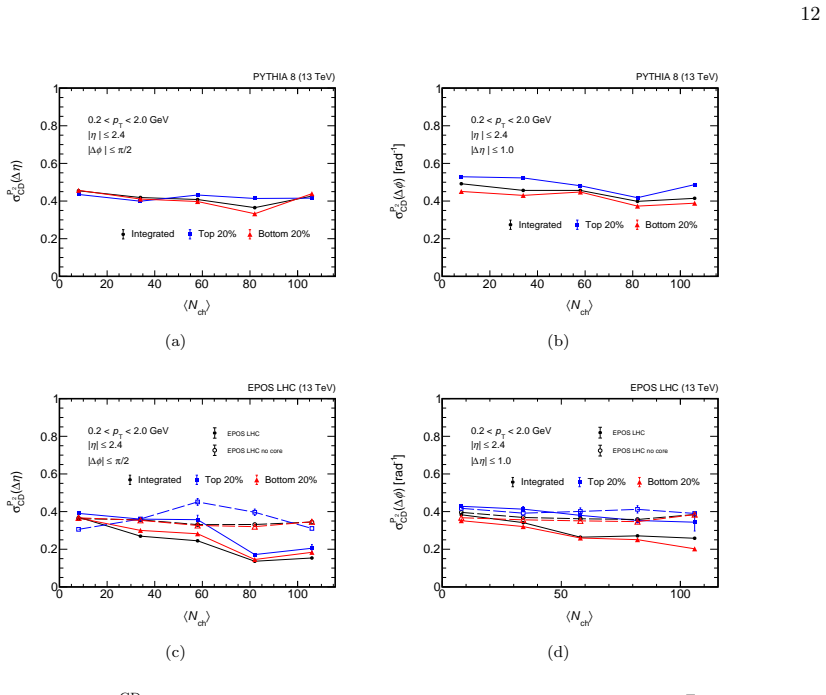
The paper's central claim is that the charge-dependent number balance function B(Δη,Δϕ) and the charge-dependent transverse momentum correlator P2^CD, when binned in transverse spherocity classes and charged-particle multiplicity, separate two regimes of charge balancing in pp collisions. The widths of B in both Δη and Δϕ decrease systematically with multiplicity, with the decrease most pronounced in low-spherocity (jet-like) events; isotropic high-spherocity events show wider balance functions. The momentum correlator P2^CD, however, shows a nearly flat multiplicity dependence. The paper's decisive comparison is EPOS-LHC with its hydrodynamic core enabled versus disabled: the core-enabled v
Load-bearing premise
The load-bearing premise is that turning the EPOS-LHC hydrodynamic core off removes radial flow without changing anything else, such as hadronization, the core-corona partition, or which events fall into which spherocity class.
Editorial extensions
If this is right
- Multiplicity narrowing of B(Δη) and B(Δϕ) can be read as localization of charge-balancing pairs in denser events.
- Jet-like low-spherocity events give the narrowest widths, so local charge conservation within jet fragmentation dominates that event class.
- Isotropic high-spherocity events give broader widths, pointing to soft multi-parton interactions and color-reconnection effects rather than hard jets.
- Switching off the EPOS-LHC hydrodynamic core removes most of the multiplicity dependence in Δϕ widths, indicating that radial flow is the quantitative driver of azimuthal localization in the model.
- The nearly flat P2^CD widths imply momentum correlations are less sensitive to flow than number correlations, so the two observables probe different aspects of charge conservation.
Reading between the lines
- Applying this spherocity-binned balance-function analysis to LHC Run 3 pp data would directly test whether measured widths track the core-on or core-off EPOS-LHC curve.
- Because the core on/off toggle changes the whole hadronization environment, a model variant that removes only the collective velocity field would isolate radial flow more cleanly and is a natural follow-up calculation.
- The near-flat P2^CD widths hint that momentum balancing is dominated by short-range jet and resonance correlations; removing resonance decays from the analysis may expose a weaker but cleaner flow signal in momentum space.
Editorial analysis
A structured set of objections, weighed in public.
Referee Report
Summary. This paper presents a generator-level study of charge-dependent two-particle number balance functions B and transverse-momentum balance functions P_2^CD in pp collisions at sqrt(s)=13 TeV, as a function of charged-particle multiplicity and transverse spherocity. Using PYTHIA8 and EPOS-LHC (both with and without the hydrodynamic core), the authors report narrowing of B widths in Delta eta and Delta phi with increasing multiplicity, wider B in isotropic (high-spherocity) events than in jet-like (low-spherocity) events, and a weaker multiplicity dependence for the P_2^CD widths. The main interpretive claim is that comparing EPOS-LHC with its hydrodynamic core enabled versus disabled provides a quantitative handle on radial-flow-induced localization of charge-balancing pairs.
Significance. If the central claims are supported, this would be the first differential application of balance functions to event-topology classes in small systems and could provide a useful generator-level benchmark for LHC Run 3 measurements. The analysis uses standard definitions (Eqs. 1-10), large MC samples, and a controlled model comparison that is, in principle, informative about how different hadronization/collectivity mechanisms affect charge correlations. The main added value is the spherocity classification, which sharpens the sensitivity to jet-like versus isotropic event populations. However, the paper's interpretive strength is currently limited by the lack of uncertainties on all plotted quantities and by an overreach in the claim that the EPOS core on/off comparison isolates radial flow.
major comments (4)
- [Abstract; Sec. III; Sec. IV.C, Figs. 9-10] The statement in Sec. III that the core on/off comparison 'explicitly isolates radial flow contributions' is not supported. Disabling the core in EPOS-LHC also changes the hadronization mechanism (statistical/microcanonical hadronization of the core versus string fragmentation), the core-corona partition, and the event selection. Figure 1 shows that the spherocity distributions differ between the core-on and core-off configurations, so the top/bottom 20% spherocity classes select different event populations. String fragmentation itself enforces local charge conservation and produces resonance decays, both of which directly shape B and P_2^CD widths. The differences in Figs. 9 and 10 cannot therefore be uniquely attributed to radial flow. Please either provide a control that varies radial-flow strength while keeping the core-corona decomposition and hadronization fixed, or soften the inte
- [Figs. 3-10; Sec. IV.C] No statistical or systematic uncertainties are shown on any correlation function or width. The conclusions rest on comparisons of widths across multiplicity and spherocity classes (e.g., 'nearly flat' vs. 'clear narrowing' in Fig. 10). Without propagated MC statistical errors and at least a discussion of systematic choices (spherocity percentile, pT range, width integration range, generator tune), the quantitative statements are not fully testable. The 500M events make random errors small, but they are not zero, and the significance of the core on/off differences is not quantified.
- [Sec. II; Fig. 9 and Fig. 10 captions] The width extraction ranges are stated inconsistently. The text says the P_2^CD widths are estimated in the region |Delta eta, Delta phi| <=1.0, but the Fig. 10 captions use the same projection cuts as for B (|Delta phi|<=pi/2 for sigma(Delta eta), |Delta eta|<=1.0 for sigma(Delta phi)). In addition, the Delta eta integration range for sigma(Delta eta) is not explicitly stated in the captions; the text says |Delta eta|<=3.0 for B. Since the widths are the quantitative outputs of the paper, these ranges must be unambiguous and consistent.
- [Abstract; Sec. IV.C, Fig. 10] The abstract's claim that 'for the momentum correlations, a nearly flat dependence is observed with Nch' is inconsistent with the body. In Sec. IV.C the P_2^CD widths are described as showing a 'mild decrease' for PYTHIA8 and, for EPOS-LHC with the core enabled, 'clear narrowing at high multiplicities' (Fig. 10c,d). Please reconcile the abstract with the shown trends, or qualify the claim as e.g. 'weaker multiplicity dependence than B.'
minor comments (4)
- [Sec. V] Typo: 'summerizes' should be 'summarizes'.
- [Figure captions 3-8] The phrase 'are take in' should be 'are taken in', and the inconsistent 'right panel'/'right column' wording should be unified.
- [Sec. II / references] Reference [38] is cited for 'multiplicity classes', but the listed ref ([38], CMS arXiv:2410.04578) is about azimuthal anisotropy correlations and appears unrelated. Please replace with an appropriate multiplicity-class reference.
- [Sec. III] The statement '500M MC events' should specify whether this total is per generator and per core configuration; the sample sizes affect the statistical assessment.
Circularity Check
No significant circularity: the balance functions are direct generator outputs, not fitted to the target observables, and the core on/off comparison is a controlled model variation.
full rationale
This is a Monte Carlo model-comparison study, not a derivation in which an output is constructed from the input it claims to predict. The number and momentum balance functions B and P2^CD are computed directly from final-state particles via the standard definitions in Eqs. (1)-(10); no parameter is fitted to the widths or shapes that are later reported. The EPOS-LHC core-on vs core-off comparison is a controlled model variation: the paper states that the difference 'explicitly isolates radial flow contributions,' but even if this assertion is physically oversimplified (because the toggle also changes hadronization and event selection), that is a validity concern about model interpretation, not a circular reduction of the result to its input. The only self-citation is Ref. [30], an author's earlier spherocity paper, but it is used only to define the spherocity variable and the Nch >= 5 requirement, and it is corroborated by independent ALICE references [31,32,48,49]. Thus the central claims remain independent of any self-citation chain, and no prediction is equivalent to its input by construction.
Assumptions & free parameters
assumptions (5)
- domain assumption Event generators (PYTHIA8 with CP5 tune, EPOS-LHC) reproduce the relevant features of pp collisions
- domain assumption Transverse spherocity separates jet-like and isotropic events
- standard math Local charge conservation implies opposite-charge pairs are produced locally
- standard math Mixed-event normalization corrects pair acceptance
- standard math RMS width over stated ranges measures the separation scale of balancing pairs
Cite this review
Pith. "Pith review of Two-particle number and transverse momentum balance function with event-topology in pp collisions at $\sqrt{s}=13$ TeV." pith.science (2026). https://pith.science/paper/YZJTRORR
@misc{pith2026250820198,
  author       = {Pith},
  title        = {Pith review of: Two-particle number and transverse momentum balance function with event-topology in pp collisions at $\sqrts=13$ TeV},
  year         = {2026},
  howpublished = {\url{https://pith.science/paper/YZJTRORR}},
  note         = {Machine review of arXiv:2508.20198}
}
abstract
The first study of charge-dependent two-particle differential number ($B$) and momentum balance functions ($P_{2}^{CD}$) with respect to an event shape variable, transverse spherocity, is reported. Results are presented from PYTHIA8 and EPOS-LHC model calculations in proton-proton (pp) collisions at $\sqrt{s} = 13$ TeV. To distinguish between back-to-back jet-like topologies and isotropic events, low and high transverse spherocity values are chosen. The correlation functions are measured as a function of averaged charged-particle multiplicity ($\langle N_{ch}\rangle$) in relative pseudorapidity ($\Delta\eta$) and relative azimuthal angle ($\Delta\phi$) with $|\eta| < 2.4$ and $0.2 < p_{T} < 2.0$ GeV. A narrowing of the balance function width is observed in $\Delta\eta$ and $\Delta\phi$ from low- to high-multiplicity collisions. Wider balance functions are found in isotropic events as compared to jet-like events. However, for the momentum correlations, a nearly flat dependence is observed with $\langle N_{ch}\rangle$. This study investigates charge conservation mechanisms and their correlations for events classified with jet-like and isotropic topologies. To isolate medium-driven effects, we compare EPOS-LHC with its hydrodynamic core enabled and disabled and observed narrowing patterns in $B$ and $P_{2}^{CD}$ as a quantitative handle on radial-flow-induced localization of charge-balancing pairs.
Figures


Figures from the paper (7 more)


Reference graph
Works this paper leans on
-
[1]
Overview of high-density QCD studies with the CMS experiment at the LHC
CMS Collaboration, A. Hayrapetyan et al., “Overview of high-density QCD studies with the CMS experiment at the LHC”, Phys. Rept. 1115 (2025) 219–367, arXiv:2405.10785 [nucl-ex]
arXiv 2025
-
[2]
The ALICE experiment: a journey through QCD
ALICE Collaboration, S. Acharya et al., “The ALICE experiment: a journey through QCD”, Eur. Phys. J. C84 (2024) 813, arXiv:2211.04384 [nucl-ex]
arXiv 2024
-
[3]
PHENIX Collaboration, K. Adcox et al., “Formation of dense partonic matter in relativistic nucleus-nucleus collisions at RHIC: Experimental evaluation by the PHENIX collaboration”, Nucl. Phys. A757 (2005) 184–283, arXiv:nucl-ex/0410003
arXiv 2005
-
[4]
ST ARCollaboration, J. Adams et al., “Experimental and theoretical challenges in the search for the quark gluon plasma: The STAR Collaboration’s critical assessment of the evidence from RHIC collisions”, Nucl. Phys. A 757 (2005) 102–183, arXiv:nucl-ex/0501009
arXiv 2005
-
[5]
The PHOBOS perspective on discoveries at RHIC
PHOBOS Collaboration, B. B. Back et al., “The PHOBOS perspective on discoveries at RHIC”, Nucl. Phys. A757 (2005) 28–101, arXiv:nucl-ex/0410022
arXiv 2005
-
[6]
Quark gluon plasma and color glass condensate at RHIC? The Perspective from the BRAHMS experiment
BRAHMS Collaboration, I. Arsene et al., “Quark gluon plasma and color glass condensate at RHIC? The Perspective from the BRAHMS experiment”, Nucl. Phys. A757 (2005) 1–27, arXiv:nucl-ex/0410020
arXiv 2005
-
[7]
ALICE Collaboration, S. Acharya et al., “General balance functions of identified charged hadron pairs of ( π,K,p) in Pb–Pb collisions at sNN= 2.76 TeV”, Phys. Lett. B833 (2022) 137338, arXiv:2110.06566 [nucl-ex]
arXiv 2022
-
[8]
CMS Collaboration, A. Tumasyan et al., “Multiplicity and transverse momentum dependence of charge-balance functions in pPb and PbPb collisions at LHC energies”, JHEP 08 (2024) 148, arXiv:2307.11185 [nucl-ex]
work page Pith review arXiv 2024
Show all 49 references
-
[9]
Observation and studies of jet quenching in PbPb collisions at nucleon-nucleon center-of-mass energy = 2.76 TeV
CMS Collaboration, S. Chatrchyan et al., “Observation and studies of jet quenching in PbPb collisions at nucleon-nucleon center-of-mass energy = 2.76 TeV”, Phys. Rev. C 84 (2011) 024906, arXiv:1102.1957 [nucl-ex]
2011 arXiv
-
[10]
Multi-differential pattern of low-mass e+e− excess from √sN N=2.4 GeV Au+Au collisions with HADES
HADES Collaboration, S. Harabasz, “Multi-differential pattern of low-mass e+e− excess from √sN N=2.4 GeV Au+Au collisions with HADES”, Nucl. Phys. A982 (2019) 771
2019
-
[11]
Measurements of jet quenching with semi-inclusive hadron+jet distributions in Au+Au collisions at √sN N= 200 GeV
ST ARCollaboration, L. Adamczyk et al., “Measurements of jet quenching with semi-inclusive hadron+jet distributions in Au+Au collisions at √sN N= 200 GeV”, Phys. Rev. C 96 (2017) 024905, arXiv:1702.01108 [nucl-ex]
2017 arXiv
-
[12]
On the origin of the ’Ridge’ phenomenon induced by jets in heavy ion collisions
E. V. Shuryak, “On the origin of the ’Ridge’ phenomenon induced by jets in heavy ion collisions”, Phys. Rev. C76 (2007) 047901, arXiv:0706.3531 [nucl-th]
2007 arXiv
-
[13]
Emergence of Long-Range Angular Correlations in Low-Multiplicity Proton-Proton Collisions
ALICE Collaboration, S. Acharya et al., “Emergence of Long-Range Angular Correlations in Low-Multiplicity Proton-Proton Collisions”, Phys. Rev. Lett.132 (2024) 172302, arXiv:2311.14357 [nucl-ex]
2024 arXiv
-
[14]
Enhanced production of multi-strange hadrons in high-multiplicity proton-proton collisions
ALICE Collaboration, J. Adam et al., “Enhanced production of multi-strange hadrons in high-multiplicity proton-proton collisions”, Nature Phys. 13 (2017) 535–539, arXiv:1606.07424 [nucl-ex]
2017 arXiv
-
[15]
Novel observables for exploring QCD collective evolution and quantum entanglement within individual jets
A. Baty, P. Gardner, and W. Li, “Novel observables for exploring QCD collective evolution and quantum entanglement within individual jets”, Phys. Rev. C107 (2023) 064908, arXiv:2104.11735 [hep-ph]
2023 arXiv
-
[17]
Observation of Enhanced Long-Range Elliptic Anisotropies Inside High-Multiplicity Jets in pp Collisions at s=13 TeV
CMS Collaboration, A. Hayrapetyan et al., “Observation of Enhanced Long-Range Elliptic Anisotropies Inside High-Multiplicity Jets in pp Collisions at s=13 TeV”, Phys. Rev. Lett.133 (2024) 142301, arXiv:2312.17103 [hep-ex]
2024 arXiv
-
[18]
Measurement of long-range near-side two-particle angular correlations in pp collisions at √s =13 TeV
CMS Collaboration, V. Khachatryan et al., “Measurement of long-range near-side two-particle angular correlations in pp collisions at √s =13 TeV”, Phys. Rev. Lett.116 (2016) 172302, arXiv:1510.03068 [nucl-ex]
2016 arXiv
-
[19]
Investigating late-stage particle production in pp collisions with balance functions
A. Manea, C. Pruneau, D. C. Brandibur, A. Danu, A. F. Dobrin, V. Gonzalez, and S. Basu, “Investigating late-stage particle production in pp collisions with balance functions”, Eur. Phys. J. C85 (2025) 323, arXiv:2411.11207 [hep-ph]
2025
-
[20]
General Charge Balance Functions, A Tool for Studying the Chemical Evolution of the Quark-Gluon Plasma
S. Pratt, “General Charge Balance Functions, A Tool for Studying the Chemical Evolution of the Quark-Gluon Plasma”, Phys. Rev. C85 (2012) 014904, arXiv:1109.3647 [nucl-th]
2012 arXiv
-
[21]
Elliptic flow splittings in the Polyakov–Nambu–Jona-Lasinio transport model
W.-H. Zhou, H. Liu, F. Li, Y.-F. Sun, J. Xu, and C. M. Ko, “Elliptic flow splittings in the Polyakov–Nambu–Jona-Lasinio transport model”, Phys. Rev. C104 (2021) 044901, 14 arXiv:2105.09518 [nucl-th]
2021 arXiv
-
[22]
Two particle differential transverse momentum and number density correlations in p-Pb and Pb-Pb at the LHC
ALICE Collaboration, S. Acharya et al., “Two particle differential transverse momentum and number density correlations in p-Pb and Pb-Pb at the LHC”, Phys. Rev. C100 (2019) 044903, arXiv:1805.04422 [nucl-ex]
2019 arXiv
-
[23]
Measurements of differential two-particle number and transverse momentum correlation functions in pp collisions at √s = 13 TeV
ALICE Collaboration, S. Acharya et al., “Measurements of differential two-particle number and transverse momentum correlation functions in pp collisions at √s = 13 TeV”, Eur. Phys. J. C85 (2025) 866, arXiv:2411.07059 [nucl-ex]
2025
-
[24]
Charm balance function in relativistic heavy-ion collisions
T. Parida, P. Bozek, and S. Chatterjee, “Charm balance function in relativistic heavy-ion collisions”, Phys. Rev. C109 (2024) 014903, arXiv:2308.14446 [nucl-th]
2024 arXiv
-
[25]
Longitudinal scaling property of the charge balance function in Au + Au collisions at 200 GeV
ST ARCollaboration, B. I. Abelev et al., “Longitudinal scaling property of the charge balance function in Au + Au collisions at 200 GeV”, Phys. Lett. B690 (2010) 239, arXiv:1002.1641 [nucl-ex]
2010 arXiv
-
[26]
Boost invariance and multiplicity dependence of the charge balance functionin π+p and K +p collisions at √s = 22-GeV/c
EHS, NA22Collaboration, M. R. Atayan et al., “Boost invariance and multiplicity dependence of the charge balance functionin π+p and K +p collisions at √s = 22-GeV/c”, Phys. Lett. B637 (2006) 39, arXiv:hep-ex/0506027
2006 arXiv
-
[27]
Heavy ion collisions: Correlations and Fluctuations in particle production
S. A. Voloshin, “Heavy ion collisions: Correlations and Fluctuations in particle production”, J. Phys.: Conf. Ser.50 (2006) 111, arXiv:nucl-ex/0505003 [nucl-ex]
2006 arXiv
-
[28]
Balance of baryon number in the quark coalescence model
A. Bialas and J. Rafelski, “Balance of baryon number in the quark coalescence model”, Phys. Lett. B 633 (2006) 488–491, arXiv:hep-ph/0508084
2006 arXiv
-
[29]
Balance functions in coalescence model
A. Bialas, “Balance functions in coalescence model”, Phys. Lett. B579 (2004) 31–38, arXiv:hep-ph/0308245
2004 arXiv
-
[30]
Event shape engineering and multiplicity dependent study of identified particle production in proton + proton collisions at √s = 13 TeV using PYTHIA8
A. Khuntia, S. Tripathy, A. Bisht, and R. Sahoo, “Event shape engineering and multiplicity dependent study of identified particle production in proton + proton collisions at √s = 13 TeV using PYTHIA8”, J. Phys. G48 (2021) 035102, arXiv:1811.04213 [hep-ph]
2021 arXiv
-
[33]
A comprehensive guide to the physics and usage of PYTHIA 8.3
C. Bierlich et al., “A comprehensive guide to the physics and usage of PYTHIA 8.3”, SciPost Phys. Codeb. 2022 (2022) 8, arXiv:2203.11601 [hep-ph]
2022 arXiv
-
[36]
Role of baryon number conservation in measurements of fluctuations
C. A. Pruneau, “Role of baryon number conservation in measurements of fluctuations”, Phys. Rev. C100 (2019) 034905, arXiv:1903.04591 [nucl-th]
2019 arXiv
-
[37]
EPOS LHC: Test of collective hadronization with data measured at the CERN Large Hadron Collider
T. Pierog, I. Karpenko, J. M. Katzy, E. Yatsenko, and K. Werner, “EPOS LHC: Test of collective hadronization with data measured at the CERN Large Hadron Collider”, Phys. Rev. C 92 (2015) 034906, arXiv:1306.0121 [hep-ph]
2015 arXiv
-
[38]
Correlations between azimuthal anisotropy and mean transverse momentum in pp, pPb, and peripheral PbPb collisions
CMS Collaboration, A. Tumasyan et al., “Correlations between azimuthal anisotropy and mean transverse momentum in pp, pPb, and peripheral PbPb collisions”, arXiv:2410.04578 [nucl-ex]
-
[39]
Balance Functions from Au+Au, d+Au, and p + p Collisions at √sN N= 200 GeV
ST ARCollaboration, M. M. Aggarwal et al., “Balance Functions from Au+Au, d+Au, and p + p Collisions at √sN N= 200 GeV”, Phys. Rev. C 82 (2010) 024905, arXiv:1005.2307 [nucl-ex]
2010 arXiv
-
[40]
Observation of long-range, near-side angular correlations in proton-proton collisions at the LHC
CMS Collaboration, V. Khachatryan et al., “Observation of long-range, near-side angular correlations in proton-proton collisions at the LHC”, JHEP 09 (2010) 091, arXiv:1009.4122 [hep-ex]
2010 arXiv
-
[41]
Long-range and short-range dihadron angular correlations in central PbPb collisions at a nucleon-nucleon center of mass energy of 2.76 TeV
CMS Collaboration, S. Chatrchyan et al., “Long-range and short-range dihadron angular correlations in central PbPb collisions at a nucleon-nucleon center of mass energy of 2.76 TeV”, JHEP 07 (2011) 076, arXiv:1105.2438 [nucl-ex]
2011 arXiv
-
[42]
Two-particle azimuthal correlations in γp interactions using pPb collisions at sNN=8.16TeV
CMS Collaboration, A. Tumasyan et al., “Two-particle azimuthal correlations in γp interactions using pPb collisions at sNN=8.16TeV”, Phys. Lett. B844 (2023) 137905, arXiv:2204.13486 [nucl-ex]
2023 arXiv
-
[43]
Elliptic flow of charm and strange hadrons in high-multiplicity pPb collisions at √sNN = 8.16 TeV
CMS Collaboration, A. M. Sirunyan et al., “Elliptic flow of charm and strange hadrons in high-multiplicity pPb collisions at √sNN = 8.16 TeV”, Phys. Rev. Lett.121 (2018) 082301, arXiv:1804.09767 [hep-ex]
2018 arXiv
-
[44]
Simulation studies of R2(∆ η,∆φ) and P2(∆η,∆φ) correlation functions in pp collisions with the PYTHIA and HER WIG models
B. Sahoo, B. K. Nandi, P. Pujahari, S. Basu, and C. Pruneau, “Simulation studies of R2(∆ η,∆φ) and P2(∆η,∆φ) correlation functions in pp collisions with the PYTHIA and HER WIG models”, Phys. Rev. C100 (2019) 024909, arXiv:1810.09747 [nucl-ex]
2019 arXiv
-
[45]
Differential two-particle number and momentum 15 correlations with the AMPT, UrQMD, and EPOS models in Pb-Pb collisions at sNN=2.76 TeV
S. Basu, V. Gonzalez, J. Pan, A. Knospe, A. Marin, C. Markert, and C. Pruneau, “Differential two-particle number and momentum 15 correlations with the AMPT, UrQMD, and EPOS models in Pb-Pb collisions at sNN=2.76 TeV”, Phys. Rev. C104 (2021) 064902, arXiv:2001.07167 [nucl-ex]
2021 arXiv
-
[46]
Femtoscopy in Relativistic Heavy Ion Collisions and its Relation to Bulk Properties of QCD Matter
S. Pratt and J. Vredevoogd, “Femtoscopy in Relativistic Heavy Ion Collisions and its Relation to Bulk Properties of QCD Matter”, Phys. Rev. C 78 (2008) 054906, arXiv:0809.0516 [nucl-th]. [Erratum: Phys.Rev.C 79, 069901 (2009)]
2008 arXiv
-
[47]
Correlation between Photons in two Coherent Beams of Light
R. H. Brown and R. Q. Twiss, “Correlation between Photons in two Coherent Beams of Light”, Nature 177 (1956) 27–29
1956
-
[48]
Charged-particle production as a function of multiplicity and transverse spherocity in pp collisions at √s = 5.02 and 13 TeV
ALICE Collaboration, S. Acharya et al., “Charged-particle production as a function of multiplicity and transverse spherocity in pp collisions at √s = 5.02 and 13 TeV”, Eur. Phys. J. C 79 (2019) 857, arXiv:1905.07208 [nucl-ex]
2019 arXiv
-
[49]
Light-flavor particle production in high-multiplicity pp collisions at √s= 13 TeV as a function of transverse spherocity
ALICE Collaboration, S. Acharya et al., “Light-flavor particle production in high-multiplicity pp collisions at √s= 13 TeV as a function of transverse spherocity”, JHEP 05 (2024) 184, arXiv:2310.10236 [hep-ex]
2024 arXiv
-
[50]
Production of pions, kaons, and protons as a function of the relative transverse activity classifier in pp collisions at √s = 13 TeV
ALICE Collaboration, S. Acharya et al., “Production of pions, kaons, and protons as a function of the relative transverse activity classifier in pp collisions at √s = 13 TeV”, JHEP 06 (2023) 027, arXiv:2301.10120 [nucl-ex]
2023 arXiv
-
[51]
Color Reconnection and Flowlike Patterns in pp Collisions
A. Ortiz Velasquez, P. Christiansen, E. Cuautle Flores, I. Maldonado Cervantes, and G. Pai´ c, “Color Reconnection and Flowlike Patterns in pp Collisions”, Phys. Rev. Lett.111 (2013) 042001, arXiv:1303.6326 [hep-ph]
2013 arXiv
-
[52]
Multiparton interactions in pp collisions from machine learning-based regression
A. Ortiz, A. Paz, J. D. Romo, S. Tripathy, E. A. Zepeda, and I. Bautista, “Multiparton interactions in pp collisions from machine learning-based regression”, Phys. Rev. D102 (2020) 076014, arXiv:2004.03800 [hep-ph]
2020 arXiv
-
[53]
Core-corona procedure and microcanonical hadronization to understand strangeness enhancement in proton-proton and heavy ion collisions in the EPOS4 framework
K. Werner, “Core-corona procedure and microcanonical hadronization to understand strangeness enhancement in proton-proton and heavy ion collisions in the EPOS4 framework”, Phys. Rev. C109 (2024) 014910, arXiv:2306.10277 [hep-ph]
2024 arXiv
-
[54]
Baryon correlations in Pythia
L. L¨ onnblad and H. Shah, “Baryon correlations in Pythia”, Eur. Phys. J. C83 (2023) 1105, arXiv:2309.01557 [hep-ph]
2023 arXiv
Reviewed August 5, 2026 · model on record in the stance chip above.
Discussion (0). Sign in to comment.