REVIEW 2 major objections 5 minor 121 references
Atmospheric composition and circulation of the ultra-hot Jupiter WASP-121b with joint NIRPS, HARPS and CRIRES+ transit spectroscopy
T0 review · 2 major / 5 minor · reviewed 2026-08-05 · deepseek-v4-flash
Pith's one-line read WASP-121b's atmosphere is near-solar in composition and only weakly braked by drag.
desk verdict A careful, honest multi-instrument characterization of WASP-121b whose headline ΔKp circulation claim would be stronger with an injection/recovery test, and which has a minor internal inconsistency—still deserves a serious referee. read the letter →
The pith
A machine-rendered reading of the paper's core claim, the machinery that carries it, and where it could break.
The reading
What carries the argument
The load-bearing object is the velocity offset ΔKp = Kp(retrieved) − Kp(orbital), computed by comparing a cross-correlation and free-retrieval analysis of the planet's spectral lines with a Keplerian fit to 1261 radial velocities and five TESS sectors. The retrieval models absorption from H2O, CO, OH, Fe, V, TiO, H−, and electrons, fitting abundances together with temperature, Kp, systemic velocity, and rotational broadening, while reporting abundance ratios as the robust chemical outputs. The drag interpretation rests on a ladder of 3D circulation models — drag-free, weak-drag, and strong-drag regimes, parameterized by a drag timescale representing how long an air parcel takes to lose a sub
What would settle it
Measure WASP-121's stellar mass independently to about 1 percent precision and recompute ΔKp; if the offset becomes consistent with zero or with the strong-drag global circulation model prediction, the circulation claim fails. A direct check would be phase-resolved Doppler mapping of Fe, V, and CO lines during transit to track the wind velocity field and compare it with the GCM-predicted day-to-night flow.
Extended reading notes
Core claim
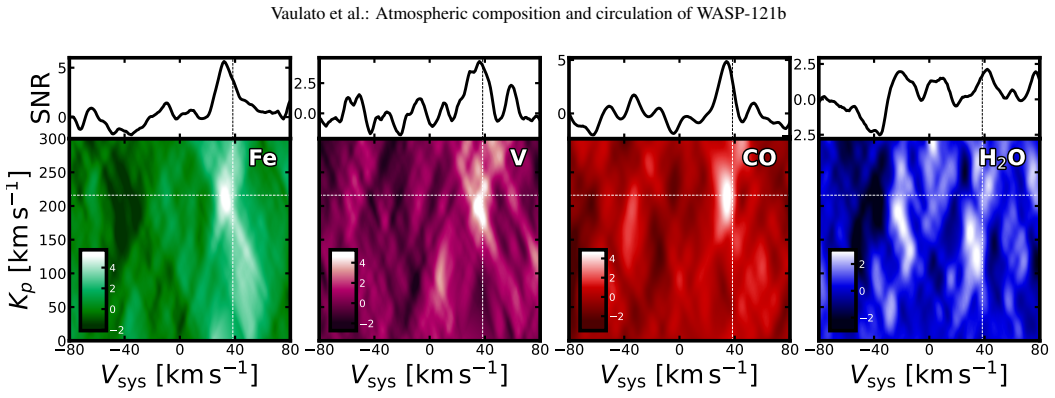
On the paper's own terms, the core discovery is that WASP-121b's atmosphere, seen in transmission, is simultaneously near-solar in its volatile/refractory ratios and dynamically unbraked. Cross-correlation detects Fe, CO, and V with signal-to-noise ratios of 5.8, 5.0, and 4.7; a free retrieval on the combined datasets yields log(H2O/CO) = -1.23 (+1.00/-0.97), log(CO/Fe) = 1.04 (+0.80/-1.32), log(V/Fe) = -3.56 (+0.66/-1.11), and log(H−/Fe) = -3.98 (+0.81/-1.14), all consistent with 1× solar equilibrium chemistry at 10^-4 to 10^-3 bar; the slightly sub-solar H2O/CO is attributed to thermal dissociation into OH and O. The retrieval gives Kp = 202.99 (+2.84/-2.92) km/s, while a global fit to rad
Load-bearing premise
The measured offset is calibrated by converting the star's wobble into the planet's orbital speed using an adopted stellar mass of 1.38 ± 0.02 solar masses; if that external mass is wrong by more than a few percent, the non-zero offset and the weak-drag versus drag-free interpretation shift appreciably.
Editorial extensions
If this is right
- If the non-zero offset is real, strong atmospheric drag is excluded for WASP-121b's probed layers, and Doppler shifts of transit lines can measure how efficiently ultra-hot Jupiter atmospheres brake their winds.
- The retrieved abundance ratios imply that the 10^-4 to 10^-3 bar atmosphere is close to solar equilibrium, with no strong alteration from rainout, photochemistry, or deep vertical mixing.
- Water is present but partially dissociated and masked by the H− continuum, so near-infrared non-detections of H2O in ultra-hot Jupiters should not be read as absence.
- The improved orbital solution, with stellar reflex motion Kb = 167.97 +5.78/-6.98 m/s, tightens all future atmospheric studies that depend on the ephemeris and the velocity scale.
- The method — joint optical and near-infrared high-resolution transits with simultaneous photometry and radial velocities — can be repeated on other ultra-hot Jupiters to measure drag and composition together.
- Inference — An independent stellar mass at roughly 1 percent precision would sharpen ΔKp enough to separate weak-drag from drag-free predictions; currently that separation is blurred by the adopted stellar mass.
- Inference — The consistently blueshifted Fe, V, and CO signals suggest that phase-resolved transit spectroscopy could map wind speed as a function of pressure, giving a vertical profile of the drag timescale.
- Inference — The H−/Fe degeneracy between extra hydride opacity and iron depletion via condensation might be broken by adding dayside emission spectra to the same retrieval; the present data leave that ambiguity open.
Editorial analysis
A structured set of objections, weighed in public.
Referee Report
Summary. This manuscript presents a joint analysis of high-resolution transit spectroscopy of the ultra-hot Jupiter WASP-121b obtained with HARPS, NIRPS, and CRIRES+, together with TESS and EulerCam photometry and a large radial-velocity dataset. The authors detect Fe, CO, and V via cross-correlation, run a free chemical retrieval with the SCARLET model, and update the system's orbital parameters. The headline result is a non-zero offset between the retrieved planetary velocity semi-amplitude and the orbital value, ΔKp = -15 ± 3 km/s (for Mstar = 1.38 ± 0.02 Msun), which they interpret as atmospheric circulation consistent with drag-free or weak-drag 3D GCM predictions. The retrieved abundance ratios are reported to be broadly consistent with a solar-composition chemical-equilibrium atmosphere at ~1e-4 to 1e-3 bar.
Significance. If correct, the paper adds a valuable multi-instrument, multi-wavelength data set for a benchmark ultra-hot Jupiter and uses the largest RV sample to date for WASP-121b. The explicit treatment of stellar-mass sensitivity in Table 6 and Figure 10, the use of a free retrieval with uniform abundance priors rather than equilibrium-chemistry priors, and the comparison with multiple GCM drag regimes are strengths. The ΔKp measurement is a potentially important dynamical constraint. However, the central dynamical interpretation currently lacks an end-to-end validation of the retrieval on simulated 3D GCM spectra, which is necessary to support the claim that the measured offset is a circulation signature rather than a model-mismatch artifact.
major comments (2)
- [§5.3, Fig. 10, Table 5] The central claim that ΔKp = -15 ± 3 km/s is a genuine circulation offset and rules out strong drag is not supported by an injection/recovery calibration. The retrieval is a 1D, isothermal, well-mixed SCARLET model in which all 3D dynamical effects are absorbed into a single free rotational-broadening FWHM (Table 5, §4.2). The GCM predictions are shown as vertical lines in Fig. 10, but the paper does not demonstrate that passing a synthetic GCM spectrum with a known input Kp through this exact retrieval returns the input Kp plus the GCM's true ΔKp, without bias from line-shape, continuum, or broadening degeneracies. Without this test, the observed offset could be partly a model-mismatch artifact. Please add such an injection/recovery test, or substantively weaken the strong-drag exclusion claim.
- [§5.2, Table 5, Fig. 7] The chemical conclusions rest on retrieval outputs that are not validated by injection tests. In particular, H2O is constrained to log10(H2O) = -6.52+0.49/-0.68 despite a non-detection in the CCF analysis (SNR ≲ 2, Fig. 7), and the paper itself notes the constraint arises because the retrieval 'prefers to add water.' Given that the same retrieval also collapses 3D effects into a single broadening parameter, the reported abundance ratios (e.g., log(H2O/CO) = -1.23 ± 1.00) may be subject to unquantified biases. An injection/recovery demonstration for the abundances would substantially strengthen the solar-composition conclusion. If such tests are not feasible, the composition claims should be framed as more tentative.
minor comments (5)
- [§5.2] Typo: 'forth panel' should be 'fourth panel.'
- [§6 vs §5.2/Table 5] The retrieved temperature is reported as 2828+691/-238 K in Table 5 but as 2861+396/-418 K in the Conclusions. Please harmonize.
- [Throughout] The typesetting introduces spaces in 'W ASP-121b' throughout; this should be corrected to 'WASP-121b.'
- [Fig. 10] The vertical GCM predictions are shown without uncertainties or a precise definition of how each GCM's ΔKp was computed from the simulated spectra. Since the observational ΔKp is a single retrieval value, please specify the species, pressure weighting, and mapping used for the model lines.
- [§4.2] The prior on Kp is given as U(156, 276) km/s. A brief justification of this range, especially its lower bound relative to the expected ~218 km/s, would help readers assess prior influence on the retrieved value.
Circularity Check
No significant circularity: ΔKp and the solar-composition comparison rest on independent measurements and external models; self-citations are corroborative, not load-bearing.
full rationale
The paper's central claims do not reduce to their inputs by construction. The atmospheric retrieval fits abundances and Kp as free parameters with uniform priors (U(-12,0) for abundances, U(156,276) km/s for Kp), so the retrieved Kp = 202.99+2.84/-2.92 km/s is not derived from the orbital Kp. The orbital Kp = 218.42 +/- 1.06 km/s is computed independently from the RV semi-amplitude Kb via Torres et al. (2010) Eq. 1 with an assumed stellar mass. The circulation offset ΔKp is therefore a difference of two independent measurements, not a fitted parameter renamed as a prediction. The solar-composition conclusion is a posterior comparison of retrieved abundance ratios against FastChem equilibrium models (Kitzmann et al. 2024); the retrieval does not enforce equilibrium chemistry, and the 1x solar assumption appears only in the cross-correlation template, not in the abundance fit. The GCM comparison uses published simulations (Parmentier et al. 2018; Tan et al. 2024; Wardenier et al. 2023/2024) as external benchmarks; although some authors overlap with the present paper, no uniqueness theorem or unverified ansatz is imported as the load-bearing argument. The paper explicitly flags the stellar-mass dependence of ΔKp (Section 5.3, Table 6, Figure 10) and the use of a single rotational-broadening parameter to absorb 3D effects (Section 5.3); the absence of an explicit GCM-injection/recovery test is a validation gap relevant to interpretation, not evidence that the outputs equal the inputs by definition. Minor self-citations (e.g., Vaulato et al. 2025 for the retrieval prescription; Wardenier et al. 2024/2025 for the ΔKp framework) are present but not load-bearing, so the circularity score is low.
Assumptions & free parameters
free parameters (15)
- Fe volume mixing ratio (log10) =
-6.33 (+0.99/-0.40)
- V volume mixing ratio (log10) =
-9.89 (+0.52/-0.53)
- H- volume mixing ratio (log10) =
-10.31 (+0.71/-0.60)
- electron density (log10) =
-6.08 (+3.22/-3.67), unconstrained
- H2O volume mixing ratio (log10) =
-6.52 (+0.49/-0.68)
- CO volume mixing ratio (log10) =
-5.29 (+0.69/-0.87)
- TiO volume mixing ratio (log10) =
-11.18 (+0.66/-0.41)
- OH volume mixing ratio (log10) =
-8.22 (+1.24/-2.52)
- Atmospheric temperature T =
2828 (+691/-238) K; Conclusion states 2861 (+396/-418) K
- Retrieved planet velocity semi-amplitude Kp =
202.99 (+2.84/-2.92) km/s
- Retrieved systemic velocity Vsys =
31.96 (+0.71/-0.69) km/s
- Rotational broadening FWHM =
6.20 (+1.40/-1.67) km/s
- Stellar reflex motion Kb =
167.97 (+5.78/-6.98) m/s
- Per-instrument RV offsets, jitters, GP sigma/rho hyperparameters =
Numerous values in Table 4
- Number of PCA components removed =
5
assumptions (8)
- domain assumption Isothermal, cloud-free, well-mixed (constant-with-altitude) atmosphere in the SCARLET forward models
- domain assumption H- bound-free and free-free opacity sets the continuum, parametrized by fitted H- and electron abundances
- domain assumption Accuracy of the adopted line lists (VALD atoms; Polyansky 2018 H2O; Rothman 2010 CO/OH; McKemmish 2019 TiO)
- domain assumption FastChem equilibrium models and solar abundances (Asplund et al. 2021) are the correct reference frame for judging the retrieved ratios
- domain assumption Stellar mass Mstar = 1.38 ± 0.02 Msun from Borsa et al. (2021), with e = 0, converts reflex motion to orbital Kp via Torres et al. (2010) Eq. 1
- domain assumption Atmospheric 3D dynamics are representable by one Gaussian rotational-broadening parameter in an isothermal retrieval
- domain assumption Doppler-shadow masking (10 km/s window around +35 km/s) fully removes stellar contamination in HARPS data
- domain assumption Matern 3/2 Gaussian processes initialized from FWHM indicators adequately detrend stellar activity in the RVs
Cite this review
Pith. "Pith review of Atmospheric composition and circulation of the ultra-hot Jupiter WASP-121b with joint NIRPS, HARPS and CRIRES+ transit spectroscopy." pith.science (2026). https://pith.science/paper/7KVJQ536
@misc{pith2026250900151,
  author       = {Pith},
  title        = {Pith review of: Atmospheric composition and circulation of the ultra-hot Jupiter WASP-121b with joint NIRPS, HARPS and CRIRES+ transit spectroscopy},
  year         = {2026},
  howpublished = {\url{https://pith.science/paper/7KVJQ536}},
  note         = {Machine review of arXiv:2509.00151}
}
abstract
Ultra-hot Jupiters like WASP-121b provide unique laboratories for studying atmospheric chemistry and dynamics under extreme irradiation. Constraining their composition and circulation is key to tracing planet formation pathways. We present a comprehensive characterisation of WASP-121b using high-resolution transit spectroscopy from HARPS, NIRPS, and CRIRES+ across nine transits, complemented by five TESS sectors, two EulerCam light curves simultaneous with HARPS/NIRPS, and an extensive RV dataset refining orbital parameters. Cross-correlation detects Fe, CO, and V with SNRs of 5.8, 5.0, and 4.7, respectively. Retrieval analysis constrains H$_2$O to $-6.52^{+0.49}_{-0.68}$ dex, though its signal might be muted by the H$^-$ continuum. We measure volatile/refractory ratios, key to uncover planetary chemistry, evolution, and formation. Retrieved values align with solar composition in chemical equilibrium, suggesting minimal disequilibrium chemistry at the probed pressures (around $10^{-4}$-$10^{-3}$ bar). We update WASP-121b's orbital parameters analysing its largest RV dataset to date. Comparing orbital velocities from RVs and atmospheric retrieval reveals a non-zero circulation offset, $\mathrm{\Delta K}_{\mathrm{p}} = -15 \pm 3 \ \mathrm{km}\mathrm{s}^{-1}$ (assuming $\mathrm{M}_{\star} = 1.38 \pm 0.02 \ \mathrm{M}_{\odot}$), consistent with drag-free or weak-drag 3D GCM predictions, though sensitive to stellar mass. These results provide new constraints on WASP-121b's thermal structure, dynamics, and chemistry, underscoring the power of multi-instrument and multi-wavelength high-resolution spectroscopy to probe exoplanet atmospheres.
Figures


Figures from the paper (7 more)




Reference graph
Works this paper leans on
-
[1]
, " * write output.state after.block = add.period write newline
ENTRY address archiveprefix author booktitle chapter edition editor howpublished institution eprint journal key month note number organization pages publisher school series title type volume year label extra.label sort.label short.list INTEGERS output.state before.all mid.sentence after.sentence after.block FUNCTION init.state.consts #0 'before.all := #1 ...
-
[2]
write newline
" write newline "" before.all 'output.state := FUNCTION n.dashify 't := "" t empty not t #1 #1 substring "-" = t #1 #2 substring "--" = not "--" * t #2 global.max substring 't := t #1 #1 substring "-" = "-" * t #2 global.max substring 't := while if t #1 #1 substring * t #2 global.max substring 't := if while FUNCTION word.in bbl.in " " * FUNCTION format....
-
[3]
Anderson, D. R., Temple, L. Y., Nielsen, L. D., et al. 2018, arXiv:1809.04897 [astro-ph], arXiv: 1809.04897
arXiv 2018
-
[4]
R., et al
Arcangeli, J., Désert, J.-M., Line, M. R., et al. 2018, ApJ Letters, 855, L30
2018
-
[5]
2019, A&A, 625, A136, publisher: EDP Sciences
Arcangeli, J., Désert, J.-M., Parmentier, V., et al. 2019, A&A, 625, A136, publisher: EDP Sciences
2019
-
[6]
M., & Grevesse, N
Asplund, M., Amarsi, A. M., & Grevesse, N. 2021, A&A, 653, A141
2021
-
[7]
2025, arXiv e-prints, arXiv:2508.06626
Bazinet , L., Allart , R., Benneke , B., et al. 2025, arXiv e-prints, arXiv:2508.06626
arXiv 2025
-
[8]
Bazinet, L., Pelletier, S., Benneke, B., Salinas, R., & Mace, G. N. 2024, The Astronomical Journal, 167, 206
2024
Show all 121 references
-
[9]
Bell, K. L. & Berrington, K. A. 1987, Journal of Physics B: Atomic and Molecular Physics, 20, 801
1987
-
[10]
Bell, T. J. & Cowan, N. B. 2018, ApJ, 857, L20
2018
- [11]
-
[12]
2019, Exoplanet instrumentation in the 2020s: Canada 's pathway towards searching for life on potentially Earth -like exoplanets, Tech
Benneke, B., Cowan, N., Rowe, J., et al. 2019, Exoplanet instrumentation in the 2020s: Canada 's pathway towards searching for life on potentially Earth -like exoplanets, Tech. rep., Zenodo
2019
-
[13]
& Seager, S
Benneke, B. & Seager, S. 2012, ApJ, 753, 100
2012
-
[14]
& Seager, S
Benneke, B. & Seager, S. 2013, ApJ, 778, 153
2013
-
[15]
L., Kok, D., J, R., et al
Birkby, J. L., Kok, D., J, R., et al. 2013, MNRAS: Letters, 436, L35
2013
-
[16]
2021, A&A, 645, A24
Borsa, F., Allart, R., Casasayas-Barris, N., et al. 2021, A&A, 645, A24
2021
-
[17]
2002, A&A, 390, 779
Borysow, A. 2002, A&A, 390, 779
2002
-
[18]
Bouchy , F., Doyon , R., & Francesco , P. 2025
2025
-
[19]
2020, A&A, 635, A205
Bourrier, V., Ehrenreich, D., Lendl, M., et al. 2020, A&A, 635, A205
2020
-
[20]
2005, Astronomische Nachrichten, 326, 134
Broeg , C., Fern \'a ndez , M., & Neuh \"a user , R. 2005, Astronomische Nachrichten, 326, 134
2005
-
[21]
& Line, M
Brogi, M. & Line, M. R. 2019, The Astronomical Journal, 157, 114
2019
-
[22]
Brogi, M., Snellen, I. A. G., de Kok, R. J., et al. 2012, Nature, 486, 502
2012
-
[23]
S., Line , M
Burningham , B., Marley , M. S., Line , M. R., et al. 2017, , 470, 1177
2017
-
[24]
2022, , 664, A121
Casasayas-Barris , N., Borsa , F., Palle , E., et al. 2022, , 664, A121
2022
-
[25]
A., Lothringer, J., & Blake, G
Chachan, Y., Knutson, H. A., Lothringer, J., & Blake, G. A. 2023, ApJ, 943, 112
2023
-
[26]
Chakraborty , H., Lendl , M., Akinsanmi , B., Petit dit de la Roche , D. J. M., & Deline , A. 2024, , 685, A173
2024
-
[27]
2010, , 407, 507
Collier Cameron , A., Guenther , E., Smalley , B., et al. 2010, , 407, 507
2010
-
[28]
M., Skrutskie , M
Cutri , R. M., Skrutskie , M. F., van Dyk , S., et al. 2003, VizieR Online Data Catalog: 2MASS All-Sky Catalog of Point Sources (Cutri+ 2003) , VizieR On-line Data Catalog: II/246. Originally published in: University of Massachusetts and Infrared Processing and Analysis Center...
2003
-
[29]
2000, in Society of Photo-Optical Instrumentation Engineers (SPIE) Conference Series, Vol
Dekker , H., D'Odorico , S., Kaufer , A., Delabre , B., & Kotzlowski , H. 2000, in Society of Photo-Optical Instrumentation Engineers (SPIE) Conference Series, Vol. 4008, Optical and IR Telescope Instrumentation and Detectors, ed. M. Iye & A. F. Moorwood , 534--545
2000
-
[30]
2016, MNRAS, 458, 4025
Delrez, L., Santerne, A., Almenara, J.-M., et al. 2016, MNRAS, 458, 4025
2016
-
[31]
J., Bristow, P., Smoker, J
Dorn, R. J., Bristow, P., Smoker, J. V., et al. 2023, A&A, 671, A24, publisher: EDP Sciences
2023
-
[32]
2020, Nature, 580, 597
Ehrenreich, D., Lovis, C., Allart, R., et al. 2020, Nature, 580, 597
2020
-
[33]
2019, , 490, 2262
Espinoza , N., Kossakowski , D., & Brahm , R. 2019, , 490, 2262
2019
-
[34]
M., Sing, D
Evans, T. M., Sing, D. K., Wakeford, H. R., et al. 2016, ApJ, 822, L4
2016
-
[35]
M., Sing , D
Evans-Soma , T. M., Sing , D. K., Barstow , J. K., et al. 2025, Nature Astronomy [ [arXiv] 2506.01771 ]
2025 arXiv
-
[36]
J., Oliva, E., et al
Follert, R., Dorn, R. J., Oliva, E., et al. 2014, in Ground-based and Airborne Instrumentation for Astronomy V , Vol. 9147 (International Society for Optics and Photonics), 914719
2014
-
[37]
2017, , 154, 220
Foreman-Mackey , D., Agol , E., Ambikasaran , S., & Angus , R. 2017, , 154, 220
2017
-
[38]
W., Lang, D., & Goodman, J
Foreman-Mackey, D., Hogg, D. W., Lang, D., & Goodman, J. 2013, Publications of the Astronomical Society of the Pacific, 125, 306
2013
-
[39]
G., et al
Fossati, L., Shulyak, D., Sreejith, A. G., et al. 2020, A&A, 643, A131
2020
-
[40]
J., Petigura , E
Fulton , B. J., Petigura , E. A., Blunt , S., & Sinukoff , E. 2018, , 130, 044504
2018
-
[41]
2023, The Astronomical Journal, 165, 242
Gandhi, S., Kesseli, A., Zhang, Y., et al. 2023, The Astronomical Journal, 165, 242
2023
-
[42]
2023, , 165, 242
Gandhi , S., Kesseli , A., Zhang , Y., et al. 2023, , 165, 242
2023
-
[43]
M., Barstow , J
Gapp , C., Evans-Soma , T. M., Barstow , J. K., et al. 2025, , 169, 341
2025
-
[44]
J., Timmermans , M., Pozuelos , F
Garcia , L. J., Timmermans , M., Pozuelos , F. J., et al. 2022, , 509, 4817
2022
-
[45]
S., Stassun, K
Gaudi, B. S., Stassun, K. G., Collins, K. A., et al. 2017, Nature, 546, 514
2017
-
[46]
P., Merritt, S., Nugroho, S
Gibson, N. P., Merritt, S., Nugroho, S. K., et al. 2020, MNRAS, 493, 2215
2020
-
[47]
P., Nugroho, S
Gibson, N. P., Nugroho, S. K., Lothringer, J., Maguire, C., & Sing, D. K. 2022, MNRAS, 512, 4618
2022
-
[48]
Gray, D. F. 2021, The Observation and Analysis of Stellar Photospheres (4th ed.), cambridge: Cambridge University Press
2021
-
[49]
Grimm, S. L. & Heng, K. 2015, ApJ, 808, 182
2015
-
[50]
L., Malik, M., Kitzmann, D., et al
Grimm, S. L., Malik, M., Kitzmann, D., et al. 2021, ApJ Supplement Series, 253, 30
2021
-
[51]
R., Cameron, A
Hellier, C., Anderson, D. R., Cameron, A. C., et al. 2009, Nature, 460, 1098
2009
-
[52]
2021, A&A, 649, A44
Helling, C., Lewis, D., Samra, D., et al. 2021, A&A, 649, A44
2021
-
[53]
J., Bouchy , F., Lavie , B., et al
Hobson , M. J., Bouchy , F., Lavie , B., et al. 2024, , 688, A216
2024
-
[54]
J., Cabot, S
Hoeijmakers, H. J., Cabot, S. H. C., Zhao, L., et al. 2020 a , A&A, 641, A120
2020
-
[55]
J., Ehrenreich, D., Heng, K., et al
Hoeijmakers, H. J., Ehrenreich, D., Heng, K., et al. 2018, Nature, 560, 453
2018
-
[56]
J., Ehrenreich, D., Kitzmann, D., et al
Hoeijmakers, H. J., Ehrenreich, D., Kitzmann, D., et al. 2019, A&A, 627, A165
2019
-
[57]
J., Kitzmann, D., Morris, B
Hoeijmakers, H. J., Kitzmann, D., Morris, B. M., et al. 2024, A&A, 685, A139
2024
-
[58]
J., Seidel, J
Hoeijmakers, H. J., Seidel, J. V., Pino, L., et al. 2020 b , A&A, 641, A123
2020
-
[59]
V., et al
H g , E., Fabricius , C., Makarov , V. V., et al. 2000, , 355, L27
2000
-
[60]
M., Twicken , J
Jenkins , J. M., Twicken , J. D., McCauliff , S., et al. 2016, in Society of Photo-Optical Instrumentation Engineers (SPIE) Conference Series, Vol. 9913, Software and Cyberinfrastructure for Astronomy IV, ed. G. Chiozzi & J. C. Guzman , 99133E
2016
-
[61]
John, T. L. 1988, Astronomy and Astrophysics, 193, 189
1988
-
[62]
G., Lendl , M., Cubillos , P
Juvan , I. G., Lendl , M., Cubillos , P. E., et al. 2018, , 610, A15
2018
-
[63]
Kipping , D. M. 2013, , 435, 2152
2013
-
[64]
B., et al
Kitzmann, D., Heng, K., Rimmer, P. B., et al. 2018, ApJ, 863, 183
2018
-
[65]
W., & Patzer, A
Kitzmann, D., Stock, J. W., & Patzer, A. B. C. 2024, MNRAS, 527, 7263
2024
-
[66]
2015, , 127, 1161
Kreidberg , L. 2015, , 127, 1161
2015
-
[67]
R., Collier-Cameron , A., et al
Lendl , M., Anderson , D. R., Collier-Cameron , A., et al. 2012, , 544, A72
2012
-
[68]
E., Hagelberg , J., et al
Lendl , M., Cubillos , P. E., Hagelberg , J., et al. 2017, , 606, A18
2017
-
[69]
E., Rothman, L
Li, G., Gordon, I. E., Rothman, L. S., et al. 2015, ApJ Supplement Series, 216, 15
2015
-
[70]
D., Barman, T., & Koskinen, T
Lothringer, J. D., Barman, T., & Koskinen, T. 2018, ApJ, 866, 27
2018
-
[71]
D., Rustamkulov, Z., Sing, D
Lothringer, J. D., Rustamkulov, Z., Sing, D. K., et al. 2021, ApJ, 914, 12
2021
-
[72]
B., Rodriguez, J
Lund, M. B., Rodriguez, J. E., Zhou, G., et al. 2017, The Astronomical Journal, 154, 194
2017
-
[73]
2012, ApJ, 758, 36
Madhusudhan, N. 2012, ApJ, 758, 36
2012
-
[74]
P., Nugroho, S
Maguire, C., Gibson, N. P., Nugroho, S. K., et al. 2023, MNRAS, 519, 1030
2023
-
[75]
K., Masseron, T., Hoeijmakers, H
McKemmish, L. K., Masseron, T., Hoeijmakers, H. J., et al. 2019, MNRAS, 488, 2836
2019
-
[76]
R., Gibson , N
Merritt , S. R., Gibson , N. P., Nugroho , S. K., et al. 2021, , 506, 3853
2021
-
[77]
T., Yuk, I.-S., et al
Park, C., Jaffe, D. T., Yuk, I.-S., et al. 2014, in Ground-based and Airborne Instrumentation for Astronomy V , Vol. 9147 (SPIE), 510--521
2014
-
[78]
R., Bean, J
Parmentier, V., Line, M. R., Bean, J. L., et al. 2018, A&A, 617, A110
2018
-
[79]
Patel, J. A. & Espinoza, N. 2022, The Astronomical Journal, 163, 228
2022
-
[80]
2023, Nature, 619, 491
Pelletier, S., Benneke, B., Ali-Dib, M., et al. 2023, Nature, 619, 491
2023
-
[81]
2024, The Astronomical Journal, 169, 10
Pelletier, S., Benneke, B., Chachan, Y., et al. 2024, The Astronomical Journal, 169, 10
2024
-
[82]
2021, The Astronomical Journal, 162, 73
Pelletier, S., Benneke, B., Darveau-Bernier, A., et al. 2021, The Astronomical Journal, 162, 73
2021
-
[83]
2021, A&A, 645, A96
Pepe, F., Cristiani, S., Rebolo, R., et al. 2021, A&A, 645, A96
2021
-
[84]
2000, in Optical and IR Telescope Instrumentation and Detectors , Vol
Pepe, F., Mayor, M., Delabre, B., et al. 2000, in Optical and IR Telescope Instrumentation and Detectors , Vol. 4008 (SPIE), 582--592
2000
-
[85]
L., Kyuberis, A
Polyansky, O. L., Kyuberis, A. A., Zobov, N. F., et al. 2018, MNRAS, 480, 2597
2018
-
[86]
J., Kitzmann, D., et al
Prinoth, B., Hoeijmakers, H. J., Kitzmann, D., et al. 2022, Nature Astronomy, 6, 449
2022
-
[87]
J., Pelletier, S., et al
Prinoth, B., Hoeijmakers, H. J., Pelletier, S., et al. 2023, A&A, 678, A182
2023
-
[88]
V., Hoeijmakers , H
Prinoth , B., Seidel , J. V., Hoeijmakers , H. J., et al. 2025, , 694, A284
2025
-
[89]
P., Nugroho , S
Ramkumar , S., Gibson , N. P., Nugroho , S. K., Fortune , M., & Maguire , C. 2025, , 695, A110
2025
-
[90]
S., Gordon, I
Rothman, L. S., Gordon, I. E., Barber, R. J., et al. 2010, Journal of Quantitative Spectroscopy and Radiative Transfer, 111, 2139
2010
-
[91]
L., et al
Ryabchikova, T., Piskunov, N., Kurucz, R. L., et al. 2015, Physica Scripta, 90, 054005
2015
-
[92]
Saha, M. N. 1920, The London, Edinburgh, and Dublin Philosophical Magazine and Journal of Science, 40, 472, publisher: Taylor & Francis \_eprint: https://doi.org/10.1080/14786441008636148
1920 doi
-
[93]
C., Cristo, E., Demangeon, O., et al
Santos, N. C., Cristo, E., Demangeon, O., et al. 2020, arXiv:2011.03746 [astro-ph], arXiv: 2011.03746
2020 arXiv
-
[94]
B., Kempton, E
Savel, A. B., Kempton, E. M.-R., Rauscher, E., et al. 2023, ApJ, 944, 99, publisher: The American Astronomical Society
2023
-
[95]
V., Borsa, F., Pino, L., et al
Seidel, J. V., Borsa, F., Pino, L., et al. 2023, A&A, 673, A125
2023
-
[96]
V., Ehrenreich, D., Allart, R., et al
Seidel, J. V., Ehrenreich, D., Allart, R., et al. 2021, A&A, 653, A73
2021
-
[97]
V., Ehrenreich, D., Pino, L., et al
Seidel, J. V., Ehrenreich, D., Pino, L., et al. 2020 a , A&A, 633, A86
2020
-
[98]
V., Ehrenreich, D., Wyttenbach, A., et al
Seidel, J. V., Ehrenreich, D., Wyttenbach, A., et al. 2019, A&A, 623, A166
2019
-
[99]
V., Lendl, M., Bourrier, V., et al
Seidel, J. V., Lendl, M., Bourrier, V., et al. 2020 b , A&A, 643, A45
2020
-
[100]
V., Prinoth , B., Pino , L., et al
Seidel , J. V., Prinoth , B., Pino , L., et al. 2025, , 639, 902
2025
-
[101]
A., Demangeon, O
Silva, T. A., Demangeon, O. D. S., Santos, N. C., et al. 2022, A&A, 666, L10, publisher: EDP Sciences
2022
-
[102]
K., Evans-Soma, T
Sing, D. K., Evans-Soma, T. M., Rustamkulov, Z., et al. 2024, The Astronomical Journal, 168, 231
2024
-
[103]
K., Fortney, J
Sing, D. K., Fortney, J. J., Nikolov, N., et al. 2016, Nature, 529, 59
2016
-
[104]
K., Lavvas, P., Ballester, G
Sing, D. K., Lavvas, P., Ballester, G. E., et al. 2019, The Astronomical Journal, 158, 91
2019
-
[105]
C., Stumpe , M
Smith , J. C., Stumpe , M. C., Van Cleve , J. E., et al. 2012, , 124, 1000
2012
-
[106]
Smith, P. C. B., Sanchez, J. A., Line, M. R., et al. 2024, The Astronomical Journal, 168, 293
2024
-
[107]
Snellen, I. A. G., Kok, R. J. d., Mooij, E. J. W. d., & Albrecht, S. 2010, Nature, 465, 1049
2010
-
[108]
Speagle , J. S. 2020, , 493, 3132
2020
-
[109]
W., Kitzmann, D., & Patzer, A
Stock, J. W., Kitzmann, D., & Patzer, A. B. C. 2022, MNRAS, 517, 4070
2022
-
[110]
W., Kitzmann, D., Patzer, A
Stock, J. W., Kitzmann, D., Patzer, A. B. C., & Sedlmayr, E. 2018, MNRAS, 479, 865
2018
-
[111]
C., Smith , J
Stumpe , M. C., Smith , J. C., Catanzarite , J. H., et al. 2014, , 126, 100
2014
-
[112]
C., Smith , J
Stumpe , M. C., Smith , J. C., Van Cleve , J. E., et al. 2012, , 124, 985
2012
-
[113]
& Komacek, T
Tan, X. & Komacek, T. D. 2019, ApJ, 886, 26
2019
-
[114]
D., Batalha, N
Tan, X., Komacek, T. D., Batalha, N. E., et al. 2024, MNRAS, 528, 1016
2024
-
[115]
2010, , 18, 67
Torres , G., Andersen , J., & Gim \'e nez , A. 2010, , 18, 67
2010
-
[116]
2025, , 700, A9
Vaulato , V., Pelletier , S., Ehrenreich , D., et al. 2025, , 700, A9
2025
-
[117]
P., Parmentier , V., Lee , E
Wardenier , J. P., Parmentier , V., Lee , E. K. H., & Line , M. R. 2025, arXiv e-prints, arXiv:2502.01606
2025 arXiv
-
[118]
P., Parmentier, V., Lee, E
Wardenier, J. P., Parmentier, V., Lee, E. K. H., Line, M. R., & Gharib-Nezhad, E. 2021, MNRAS, 506, 1258
2021
-
[119]
P., Parmentier, V., Line, M
Wardenier, J. P., Parmentier, V., Line, M. R., & Lee, E. K. H. 2023, MNRAS, 525, 4942
2023
-
[120]
P., Parmentier, V., Line, M
Wardenier, J. P., Parmentier, V., Line, M. R., et al. 2024, Publications of the Astronomical Society of the Pacific, 136, 084403
2024
-
[121]
G., Hellier, C., Almenara, J.-M., et al
West, R. G., Hellier, C., Almenara, J.-M., et al. 2016, A&A, 585, A126
2016
Reviewed August 5, 2026 · model on record in the stance chip above.
Discussion (0). Continue with ORCID to comment.