REVIEW 3 major objections 5 minor 71 references
A Critical Point on the Hairy Black Hole Phase Boundary in the Improved Holographic Einstein-Maxwell-Dilaton Theory
T0 review · 3 major / 5 minor · reviewed 2026-08-05 · deepseek-v4-flash
Pith's one-line read In the improved holographic Einstein–Maxwell–Dilaton model, the phase boundary between the two hairy black hole types is a first-order line plus a third-order line, meeting at (765.51, 86.54) MeV.
desk verdict A credible numerical study of two hairy black hole branches, but the claimed third-order transition and critical point rest on a sign error and an unspecified free energy normalization. read the letter →
The pith
A machine-rendered reading of the paper's core claim, the machinery that carries it, and where it could break.
The reading
What carries the argument
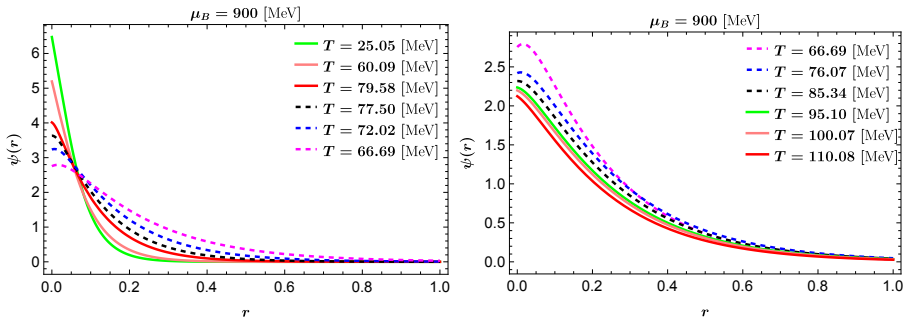
The sign of the near-horizon expansion coefficient ψ₁ʰ in Eq. (21) decides whether the scalar hair decays monotonically (Type I) or first grows near the horizon (Type II); its vanishing marks the boundary between the two hairy phases. Thermodynamically, the transition order is read from the free energy F(T) at fixed μ_B through dF = s dT and the Ehrenfest classification: a finite jump in entropy gives the first-order line, while a finite discontinuity in ∂²s/∂T² gives the third-order line. The U-shaped boundary curve's turning point is where the two branches meet.
What would settle it
Compute the free energy from an explicit holographic on-shell action, or fix the integration constant in dF = s dT by a stated normalization, and re-examine the upper phase boundary; if the discontinuity in the second temperature derivative of the entropy density vanishes or shifts away from (765.51, 86.54) MeV, the claimed third-order line and the critical point are artifacts of the unspecified free-energy construction.
Extended reading notes
Core claim
The paper reports two distinct hairy black hole solutions in the improved holographic EMD model. Type-I hairy black holes are governed by the scalar potential, with a scalar profile that decays monotonically away from the horizon; Type-II solutions are governed by the nonminimal coupling to the U(1) gauge field, with a scalar profile that first grows near the horizon and then decays. In the (μ_B, T) plane the boundary between the two phases forms a U-shaped curve. The lower segment coincides with the first-order transition previously identified in holographic QCD models; the upper segment, analyzed through the Gibbs free energy and its temperature derivatives, shows a finite discontinuity on
Load-bearing premise
The classification assumes the free energy density is uniquely determined by its temperature differential dF = s dT at fixed chemical potential, but the paper does not specify how the integration constant is fixed.
Editorial extensions
If this is right
- For any μ_B above 765.51 MeV, raising the temperature first crosses a sharp first-order transition and then a mild third-order transition on the same phase boundary.
- The upper third-order line is subtle: free energy, entropy, and ∂s/∂T are continuous, so this transition would be missed by conventional holographic thermodynamic probes.
- The gravitational origin of the two phases is tied to the competition between V′(ψ) and f′(ψ) in the near-horizon expansion, giving a bulk criterion for which boundary phase dominates.
- Because the critical point coincides with the turning point of the phase boundary, the endpoint can be read directly from the geometry of the boundary curve rather than from a separate thermodynamic calculation.
- Targeted modifications of the scalar potential and gauge coupling should allow deliberate engineering of the phase diagram's first-order line and third-order endpoint.
Reading between the lines
- Because the free-energy normalization is left unspecified, the classification of the upper branch as third-order is only as strong as that choice; an explicit on-shell action could confirm or move the line.
- The same black-hole-physics analysis should apply to other lattice-calibrated EMD models; the coincidence of the critical point with the turning point may be a generic feature of the calibrated parameter set, not a structural necessity.
- A practical way to search for this weak transition in other holographic models is to look at the nonmonotonicity of the scalar hair near the horizon (the Type II barrier) rather than at boundary free-energy kinks.
- Tuning f(ψ) and V(ψ) should move the critical point along the boundary; this suggests a design rule for engineering phase diagrams with a desired first-order line length and a third-order endpoint.
Editorial analysis
A structured set of objections, weighed in public.
Referee Report
Summary. The manuscript studies the improved holographic Einstein-Maxwell-Dilaton model calibrated to lattice QCD at zero baryon chemical potential (Refs. [54,55]) and classifies static hairy black hole solutions by the sign of the near-horizon scalar derivative psi1_h in Eq. (21). It maps a U-shaped phase boundary in the (mu_B,T) plane between Type-I and Type-II hairy phases. The paper claims that the lower branch of this boundary is a first-order phase transition line consistent with earlier work, the upper branch is a subtle third-order line, and the two branches meet at a critical point (mu_B^crit,T^crit)=(765.51,86.54) MeV that coincides with the turning point of the boundary curve.
Significance. The systematic numerical scan and the gravitational classification of two distinct hairy black hole solutions are useful contributions, and the consistency of the first-order segment with previous EMD results is a valuable cross-check. If the claimed third-order line and critical point were firmly established, they would be a nontrivial addition to holographic black hole thermodynamics and could inform model building. However, the thermodynamic derivation on which these new claims rest is incomplete, so the central novelty is not currently supported.
major comments (3)
- [Sec. IV.B, Eq. (37)] The free energy whose derivatives define the transition order is never properly constructed. With F = -P in Eq. (36), the Gibbs-Duhem relation dP = s dT + rho dmu gives dF = -s dT at fixed mu, not +s dT as printed. If the F(T) curves in Fig. 6 were generated by integrating Eq. (37) literally, they are not the grand potential. Moreover, the differential fixes F only up to a mu-dependent integration constant; the paper does not specify this constant, a reference normalization, or the holographically renormalized on-shell action. Since the first-order transition temperatures are obtained from equality of F branches and the third-order classification requires continuity of F and s across branches, both are sensitive to this unspecified construction. Thus the first-order line, the third-order line, and the critical point (765.51,86.54) MeV are not derived by the text as it stands.
- [Sec. IV.B, Figs. 8-9] The third-order claim rests on resolving a 'subtle' discontinuity in the second temperature derivative of the entropy density. No error bars, radial grid convergence tests, or derivative-stencil details are provided. The plotted curves in Fig. 9 appear noisy, e.g. the mu_B=900 panel shows d^2s/dT^2 jumping from about -50 to +50 over roughly 1 MeV, and the mu_B=950 panel shows sharp spikes. Without a convergence study or a quantitative estimate of the jump and its uncertainty, a finite discontinuity cannot be distinguished from numerical noise. Please provide such evidence.
- [Sec. III.B, Eq. (21) and Sec. IV.A, Fig. 5] The phase boundary is defined geometrically by the vanishing of the near-horizon coefficient psi1_h, and the U-shaped curve in Fig. 5 is then identified as the thermodynamic phase boundary. However, in equilibrium the coexistence curve should be determined by equality of the relevant thermodynamic potentials, not by the sign of a near-horizon expansion coefficient. The lower branch is checked against previous first-order results, but the upper branch has no independent thermodynamic determination. This reinforces the need for a properly defined, normalized free energy before the phase diagram can be accepted.
minor comments (5)
- [Eq. (16)] The notation A'_t(r) is used, but no A_t field is defined in the ansatz; the gauge field is denoted phi(r). Please clarify or correct the typo.
- [Eqs. (22)-(24)] The notation beta_+-prime is confusing; define explicitly that the prime denotes differentiation with respect to psi0_h, and write the derivatives as partial derivatives for clarity.
- [Sec. III.A] The integration is started at r_start=10^-8 and truncated at r_end=10, but no convergence test with respect to these cutoffs is reported. A brief check (e.g. varying r_end by a factor of two) would strengthen the numerical claims.
- [Fig. 1, left panel] The horizontal axis label 'Phi_cutoff_1 / Phi_max_1' is ambiguous; please spell out the ratio and explain how the cutoff value was chosen.
- [Sec. IV] In the introductory sentence, 'thorough Gibbs conditions' should be 'through Gibbs conditions.'
Circularity Check
The claimed coincidence between the critical point and the turning point of the phase boundary is built into the construction; the rest of the model-to-phase-diagram derivation is independent.
-
self definitional
[Section IV A, Fig. 5 text; with Section III B definition of phase boundary via Eq. (21)]
"These two transition branches converge at a critical point (µcrit B , Tcrit) = (765.51, 86.54)MeV, which exactly corresponds to the turning point of the boundary curve."
The two transition branches are not independent thermodynamic objects. The paper assigns the lower/right intersection points of the T–ψ0h curves to the first-order line ('the right intersection points (black dots) in Fig. 3 correspond to first-order phase transitions') and the upper/left intersection points to the other boundary ('the left intersection points (gray dots), which are associated with the upper bifurcation of the phase boundary'). These are the two segments of the same U-shaped boundary, so their meeting point is by definition the boundary curve's turning point. The free-energy analysis labels the branches first/third order but cannot move their junction; no independent computation (e.g., vanishing latent heat) is used to fix the endpoint. Thus 'converge at a critical point ..
full rationale
The model parameters are taken from Refs. [54,55], which calibrated to lattice QCD at µB=0, not to the critical point or third-order line claimed here, so the central numerical output is not a fit to its own target. The two hairy solutions, the U-shaped boundary, and the first-order/third-order classification are computed from the bulk equations and the thermodynamic observables, and Ref. [62] is used as methodological precedent rather than as the sole justification for the improved-model result; hence self-citation is not load-bearing. The main definitional circularity is the 'critical point = turning point' claim: once the first-order and third-order lines are identified with the lower and upper branches of the same U-shaped phase boundary, their junction is the turning point by construction. I do not score the sign error in Eq. (37) or the unspecified integration constant in F as circularity — they are correctness/underdetermination risks — though they do mean the thermodynamic-order determination is less secured than the text suggests. The paper itself flags the third-order signal as 'remarkably smooth and subtle', a resolution concern rather than a circularity.
Assumptions & free parameters
free parameters (5)
- Coupling function parameters c1, c2, c3, c4 =
-0.27, 0.4, 1.7, 100
- Potential parameters v1, v2, v3, v4 =
0.63, 0.65, -0.05, 0.003
- Five-dimensional Newton constant kappa_5^2 =
8*pi*0.46
- Energy scale Lambda_psi =
1058.83 MeV
- Sampling cutoff Phi_1^cutoff =
around mu_B = 1200 MeV
assumptions (5)
- domain assumption AdS/CFT dictionary maps bulk black hole thermodynamics to boundary QCD-like quantities (T, s, mu_B, rho_B).
- domain assumption The improved EMD action (1)-(3) with the parameter values from [55] adequately captures the QCD phase structure of interest.
- domain assumption The static, translationally invariant ansatz (7)-(9) with gauge B=0 contains all relevant black hole solutions.
- domain assumption Numerical shooting from the horizon with r_start=1e-8 and r_end=10 produces converged solutions and valid asymptotic extractions.
- standard math The free energy relation F = -P and dF = s dT at fixed mu_B, Eq. (37), is sufficient to construct phase coexistence and Ehrenfest transition order.
Cite this review
Pith. "Pith review of A Critical Point on the Hairy Black Hole Phase Boundary in the Improved Holographic Einstein-Maxwell-Dilaton Theory." pith.science (2026). https://pith.science/paper/CGN63L3C
@misc{pith2026250903947,
  author       = {Pith},
  title        = {Pith review of: A Critical Point on the Hairy Black Hole Phase Boundary in the Improved Holographic Einstein-Maxwell-Dilaton Theory},
  year         = {2026},
  howpublished = {\url{https://pith.science/paper/CGN63L3C}},
  note         = {Machine review of arXiv:2509.03947}
}
abstract
In this work, we investigate the hairy black hole solutions and their dual phase diagram in the improved holographic Einstein-Maxwell-Dilaton (EMD) model.From the gravitational perspective, the rich phase structures observed in the dual boundary field theory originate from the intricate interplay between the scalar field formalism and the Maxwell field coupling mechanism. Two distinct types of hairy black hole solutions are found in this framework. Type-I hairy black holes are predominantly governed by scalar potential dynamics, whereas Type-II solutions emerge through nonminimal coupling to the $U(1)$ gauge field. We map out the phase distribution in the $(\mu_B,T)$ parameter plane and delineate the boundary separating these two hairy phases. The phase diagram exhibits a first-order phase transition line consistent with previous findings, accompanied by a subtle third-order phase transition line that terminates at a critical point positioned at the turning point of the entire phase boundary curve. Our results complement existing research on holographic EMD theory by offering a comprehensive characterization of phase distributions, transition boundaries, and their gravitational sector interpretations. These insights will enable more effective engineering of specific phase structures for simulating strongly coupled systems through targeted modifications to the EMD model.
Figures


Figures from the paper (6 more)


Reference graph
Works this paper leans on
-
[62]
H. Guo, X.-M. Kuang and W.-L. Qian, The underlying black hole phase transitions in an Einstein-Maxwell-dilaton model with a holographic critical point, 2410.05065
- [1]
- [2]
-
[3]
A. Lovato et al., Long Range Plan: Dense matter theory for heavy-ion collisions and neutron stars, 2211.02224
-
[4]
Fu, QCD at finite temperature and density within the fRG approach: an overview, Commun
W.-j. Fu, QCD at finite temperature and density within the fRG approach: an overview, Commun. Theor. Phys. 74 (2022) 097304, [2205.00468]
arXiv 2022
-
[5]
J. N. Guenther, Overview of the QCD phase diagram: Recent progress from the lattice, Eur. Phys. J. A 57 (2021) 136, [2010.15503]
arXiv 2021
-
[6]
L. Du, A. Sorensen and M. Stephanov, The QCD phase diagram and Beam Energy Scan physics: A theory overview, Int. J. Mod. Phys. E 33 (2024) 2430008, [2402.10183]
arXiv 2024
-
[7]
X. Luo, S. Shi, N. Xu and Y . Zhang, A Study of the Properties of the QCD Phase Diagram in High-Energy Nuclear Collisions, Particles 3 (2020) 278–307, [2004.00789]
work page Pith review arXiv 2020
Show all 71 references
-
[8]
J. R. Espinosa, T. Konstandin, J. M. No and G. Servant, Energy Budget of Cosmological First-order Phase Transitions, JCAP 06 (2010) 028, [1004.4187]
2010 arXiv
-
[9]
Boeckel and J
T. Boeckel and J. Scha ffner-Bielich, A little inflation at the cosmological QCD phase transition, 21 Phys. Rev. D 85 (2012) 103506, [1105.0832]
2012 arXiv
-
[10]
Caprini et al., Science with the space-based interferometer eLISA
C. Caprini et al., Science with the space-based interferometer eLISA. II: Gravitational waves from cosmological phase transitions, JCAP 04 (2016) 001, [1512.06239]
2016 arXiv
-
[11]
Pasechnik, M
R. Pasechnik, M. Reichert, F. Sannino and Z.-W. Wang, Gravitational waves from composite dark sectors, JHEP 02 (2024) 159, [2309.16755]
2024 arXiv
-
[12]
J. Liu, L. Bian, R.-G. Cai, Z.-K. Guo and S.-J. Wang, Primordial black hole production during first-order phase transitions, Phys. Rev. D 105 (2022) L021303, [2106.05637]
2022 arXiv
-
[13]
Shao and M
J. Shao and M. Huang, Gravitational waves and primordial black holes from chirality imbalanced QCD first-order phase transition with P and CP violation, Phys. Rev. D 107 (2023) 043011, [2209.13809]
2023 arXiv
-
[14]
M. A. Stephanov, K. Rajagopal and E. V . Shuryak,Signatures of the tricritical point in QCD, Phys. Rev. Lett. 81 (1998) 4816–4819, [hep-ph/9806219]
1998 arXiv
-
[15]
Adamczyk et al., Bulk Properties of the Medium Produced in Relativistic Heavy-Ion Collisions from the Beam Energy Scan Program, Phys
STAR collaboration, L. Adamczyk et al., Bulk Properties of the Medium Produced in Relativistic Heavy-Ion Collisions from the Beam Energy Scan Program, Phys. Rev. C 96 (2017) 044904, [1701.07065]
2017 arXiv
-
[16]
Senger, Exploring terra incognita in the phase diagram of strongly interacting matter—experiments at FAIR and NICA, Phys
P. Senger, Exploring terra incognita in the phase diagram of strongly interacting matter—experiments at FAIR and NICA, Phys. Scripta 97 (2022) 064003, [2204.01056]
2022 arXiv
-
[17]
Aoki et al., Extension of the J-PARC Hadron Experimental Facility: Third White Paper, 2110.04462
K. Aoki et al., Extension of the J-PARC Hadron Experimental Facility: Third White Paper, 2110.04462
-
[18]
C. R. Allton, S. Ejiri, S. J. Hands, O. Kaczmarek, F. Karsch, E. Laermann et al., The QCD thermal phase transition in the presence of a small chemical potential, Phys. Rev. D 66 (2002) 074507, [hep-lat/0204010]
2002 arXiv
-
[19]
C. R. Allton, M. Doring, S. Ejiri, S. J. Hands, O. Kaczmarek, F. Karsch et al., Thermodynamics of two flavor QCD to sixth order in quark chemical potential, Phys. Rev. D 71 (2005) 054508, [hep-lat/0501030]
2005 arXiv
-
[20]
Bazavov et al., The QCD Equation of State toO(µ6 B) from Lattice QCD, Phys
A. Bazavov et al., The QCD Equation of State toO(µ6 B) from Lattice QCD, Phys. Rev. D 95 (2017) 054504, [1701.04325]
2017 arXiv
-
[21]
Borsányi, Z
S. Borsányi, Z. Fodor, J. N. Guenther, R. Kara, S. D. Katz, P. Parotto et al., Lattice QCD equation of state at finite chemical potential from an alternative expansion scheme, Phys. Rev. Lett. 126 (2021) 232001, [2102.06660]
2021 arXiv
-
[22]
C. D. Roberts and A. G. Williams, Dyson-Schwinger equations and their application to hadronic 22 physics, Prog. Part. Nucl. Phys. 33 (1994) 477–575, [hep-ph/9403224]
1994 arXiv
-
[23]
S.-x. Qin, L. Chang, H. Chen, Y .-x. Liu and C. D. Roberts, Phase diagram and critical endpoint for strongly-interacting quarks, Phys. Rev. Lett. 106 (2011) 172301, [1011.2876]
2011 arXiv
-
[24]
Shi, Y .-L
C. Shi, Y .-L. Wang, Y . Jiang, Z.-F. Cui and H.-S. Zong,Locate QCD Critical End Point in a Continuum Model Study, JHEP 07 (2014) 014, [1403.3797]
2014 arXiv
-
[25]
Gao and Y .-x
F. Gao and Y .-x. Liu,QCD phase transitions via a refined truncation of Dyson-Schwinger equations, Phys. Rev. D 94 (2016) 076009, [1607.01675]
2016 arXiv
-
[26]
A. M. Halasz, A. D. Jackson, R. E. Shrock, M. A. Stephanov and J. J. M. Verbaarschot, On the phase diagram of QCD, Phys. Rev. D 58 (1998) 096007, [hep-ph/9804290]
1998 arXiv
-
[27]
Hatsuda and T
T. Hatsuda and T. Kunihiro, QCD phenomenology based on a chiral effective Lagrangian, Phys. Rept. 247 (1994) 221–367, [hep-ph/9401310]
1994 arXiv
-
[28]
T. M. Schwarz, S. P. Klevansky and G. Papp, The Phase diagram and bulk thermodynamical quantities in the NJL model at finite temperature and density, Phys. Rev. C 60 (1999) 055205, [nucl-th/9903048]
1999 arXiv
-
[29]
de Forcrand, Simulating QCD at finite density, PoS LA T2009(2009) 010, [1005.0539]
P. de Forcrand, Simulating QCD at finite density, PoS LA T2009(2009) 010, [1005.0539]
2009 arXiv
-
[30]
H.-T. Ding, F. Karsch and S. Mukherjee, Thermodynamics of strong-interaction matter from Lattice QCD, Int. J. Mod. Phys. E 24 (2015) 1530007, [1504.05274]
2015 arXiv
-
[31]
J. M. Maldacena, The Large N limit of superconformal field theories and supergravity, Adv. Theor. Math. Phys. 2 (1998) 231–252, [hep-th/9711200]
1998 arXiv
-
[32]
S. S. Gubser, I. R. Klebanov and A. M. Polyakov, Gauge theory correlators from noncritical string theory, Phys. Lett. B 428 (1998) 105–114, [hep-th/9802109]
1998 arXiv
-
[33]
Witten, Anti de Sitter space and holography, Adv
E. Witten, Anti de Sitter space and holography, Adv. Theor. Math. Phys.2 (1998) 253–291, [hep-th/9802150]
1998 arXiv
-
[34]
Kovtun, D
P. Kovtun, D. T. Son and A. O. Starinets, Holography and hydrodynamics: Diffusion on stretched horizons, JHEP 10 (2003) 064, [hep-th/0309213]
2003 arXiv
-
[35]
Buchel and J
A. Buchel and J. T. Liu, Universality of the shear viscosity in supergravity, Phys. Rev. Lett. 93 (2004) 090602, [hep-th/0311175]
2004 arXiv
-
[36]
X.-H. Ge, Y . Matsuo, F.-W. Shu, S.-J. Sin and T. Tsukioka,Viscosity Bound, Causality Violation and Instability with Stringy Correction and Charge, JHEP 10 (2008) 009, [0808.2354]
2008 arXiv
-
[37]
S. A. Hartnoll, Lectures on holographic methods for condensed matter physics, Class. Quant. Grav. 26 (2009) 224002, [0903.3246]. 23
2009 arXiv
-
[38]
C. P. Herzog, Lectures on Holographic Superfluidity and Superconductivity, J. Phys. A 42 (2009) 343001, [0904.1975]
2009 arXiv
-
[39]
R.-G. Cai, L. Li, L.-F. Li and R.-Q. Yang, Introduction to Holographic Superconductor Models, Sci. China Phys. Mech. Astron. 58 (2015) 060401, [1502.00437]
2015 arXiv
-
[40]
Erdmenger, N
J. Erdmenger, N. Evans, I. Kirsch and E. Threlfall, Mesons in Gauge/Gravity Duals - A Review, Eur. Phys. J. A 35 (2008) 81–133, [0711.4467]
2008 arXiv
-
[41]
Casalderrey-Solana, H
J. Casalderrey-Solana, H. Liu, D. Mateos, K. Rajagopal and U. Achim Wiedemann, Gauge/String Duality, Hot QCD and Heavy Ion Collisions. Cambridge University Press, 2014, 10.1017/9781009403504
2014 doi
-
[42]
S. J. Brodsky, G. F. de Teramond, H. G. Dosch and J. Erlich, Light-Front Holographic QCD and Emerging Confinement, Phys. Rept. 584 (2015) 1–105, [1407.8131]
2015 arXiv
-
[43]
Brambilla et al., QCD and Strongly Coupled Gauge Theories: Challenges and Perspectives, Eur
N. Brambilla et al., QCD and Strongly Coupled Gauge Theories: Challenges and Perspectives, Eur. Phys. J. C 74 (2014) 2981, [1404.3723]
2014 arXiv
-
[44]
DeWolfe, S
O. DeWolfe, S. S. Gubser and C. Rosen, A holographic critical point, Phys. Rev. D 83 (2011) 086005, [1012.1864]
2011 arXiv
-
[45]
DeWolfe, S
O. DeWolfe, S. S. Gubser and C. Rosen, Dynamic critical phenomena at a holographic critical point, Phys. Rev. D 84 (2011) 126014, [1108.2029]
2011 arXiv
-
[46]
J. Zhou, X. Chen, Y .-Q. Zhao and J. Ping, Thermodynamics of heavy quarkonium in a magnetic field background, Phys. Rev. D 102 (2020) 086020, [2006.09062]
2020 arXiv
-
[47]
Rougemont, R
R. Rougemont, R. Critelli, J. Noronha-Hostler, J. Noronha and C. Ratti, Dynamical versus equilibrium properties of the QCD phase transition: A holographic perspective, Phys. Rev. D 96 (2017) 014032, [1704.05558]
2017 arXiv
-
[48]
Grefa, M
J. Grefa, M. Hippert, J. Noronha, J. Noronha-Hostler, I. Portillo, C. Ratti et al., Transport coefficients of the quark-gluon plasma at the critical point and across the first-order line, Phys. Rev. D 106 (2022) 034024, [2203.00139]
2022 arXiv
-
[49]
Rougemont, A
R. Rougemont, A. Ficnar, S. Finazzo and J. Noronha, Energy loss, equilibration, and thermodynamics of a baryon rich strongly coupled quark-gluon plasma, JHEP 04 (2016) 102, [1507.06556]
2016 arXiv
-
[50]
Z. Li, D. Li and M. Huang, Signals of critical end point from jet quenching and quark energy loss in holographic QCD, 2504.04147
-
[51]
He, S.-Y
S. He, S.-Y . Wu, Y . Yang and P.-H. Yuan,Phase Structure in a Dynamical Soft-Wall Holographic 24 QCD Model, JHEP 04 (2013) 093, [1301.0385]
2013 arXiv
-
[52]
Yang and P.-H
Y . Yang and P.-H. Yuan,A Refined Holographic QCD Model and QCD Phase Structure, JHEP 11 (2014) 149, [1406.1865]
2014 arXiv
-
[53]
Knaute, R
J. Knaute, R. Yaresko and B. Kämpfer, Holographic QCD phase diagram with critical point from Einstein–Maxwell-dilaton dynamics, Phys. Lett. B 778 (2018) 419–425, [1702.06731]
2018 arXiv
-
[54]
Critelli, J
R. Critelli, J. Noronha, J. Noronha-Hostler, I. Portillo, C. Ratti and R. Rougemont, Critical point in the phase diagram of primordial quark-gluon matter from black hole physics, Phys. Rev. D 96 (2017) 096026, [1706.00455]
2017 arXiv
-
[55]
Grefa, J
J. Grefa, J. Noronha, J. Noronha-Hostler, I. Portillo, C. Ratti and R. Rougemont, Hot and dense quark-gluon plasma thermodynamics from holographic black holes, Phys. Rev. D 104 (2021) 034002, [2102.12042]
2021 arXiv
-
[56]
R.-G. Cai, S. He, L. Li and Y .-X. Wang,Probing QCD critical point and induced gravitational wave by black hole physics, Phys. Rev. D 106 (2022) L121902, [2201.02004]
2022 arXiv
-
[57]
Z. Li, J. Liang, S. He and L. Li, Holographic study of higher-order baryon number susceptibilities at finite temperature and density, Phys. Rev. D 108 (2023) 046008, [2305.13874]
2023 arXiv
-
[58]
Rougemont, J
R. Rougemont, J. Grefa, M. Hippert, J. Noronha, J. Noronha-Hostler, I. Portillo et al., Hot QCD phase diagram from holographic Einstein–Maxwell–Dilaton models, Prog. Part. Nucl. Phys. 135 (2024) 104093, [2307.03885]
2024 arXiv
-
[59]
S. S. Gubser, Breaking an Abelian gauge symmetry near a black hole horizon, Phys. Rev. D 78 (2008) 065034, [0801.2977]
2008 arXiv
-
[60]
S. A. Hartnoll, C. P. Herzog and G. T. Horowitz, Holographic Superconductors, JHEP 12 (2008) 015, [0810.1563]
2008 arXiv
-
[61]
S. A. Hartnoll, C. P. Herzog and G. T. Horowitz, Building a Holographic Superconductor, Phys. Rev. Lett. 101 (2008) 031601, [0803.3295]
2008 arXiv
-
[63]
P. G. S. Fernandes, C. A. R. Herdeiro, A. M. Pombo, E. Radu and N. Sanchis-Gual, Spontaneous Scalarisation of Charged Black Holes: Coupling Dependence and Dynamical Features, Class. Quant. Grav. 36 (2019) 134002, [1902.05079]
2019 arXiv
-
[64]
C. A. R. Herdeiro, E. Radu, N. Sanchis-Gual and J. A. Font, Spontaneous Scalarization of Charged Black Holes, Phys. Rev. Lett. 121 (2018) 101102, [1806.05190]. 25
2018 arXiv
-
[65]
Hertog and K
T. Hertog and K. Maeda, Black holes with scalar hair and asymptotics in N = 8 supergravity, JHEP 07 (2004) 051, [hep-th/0404261]
2004 arXiv
-
[66]
Li, R.-G
H.-F. Li, R.-G. Cai and H.-Q. Zhang, Analytical Studies on Holographic Superconductors in Gauss-Bonnet Gravity, JHEP 04 (2011) 028, [1103.2833]
2011 arXiv
-
[67]
H. Guo, S. Kiorpelidi, X.-M. Kuang, E. Papantonopoulos, B. Wang and J.-P. Wu, Spontaneous holographic scalarization of black holes in Einstein-scalar-Gauss-Bonnet theories, Phys. Rev. D 102 (2020) 084029, [2006.10659]
2020 arXiv
-
[68]
Guo, W.-L
H. Guo, W.-L. Qian and B. Wang, Phase structure of holographic superconductors in an Einstein-scalar-Gauss-Bonnet theory with spontaneous scalarization, Phys. Rev. D 109 (2024) 124038, [2401.09846]
2024 arXiv
-
[69]
Brihaye, B
Y . Brihaye, B. Hartmann, N. P. Aprile and J. Urrestilla,Scalarization of asymptotically anti–de Sitter black holes with applications to holographic phase transitions, Phys. Rev. D 101 (2020) 124016, [1911.01950]
2020 arXiv
-
[70]
Kanti, N
P. Kanti, N. E. Mavromatos, J. Rizos, K. Tamvakis and E. Winstanley,Dilatonic black holes in higher curvature string gravity, Phys. Rev. D 54 (1996) 5049–5058, [hep-th/9511071]
1996 arXiv
-
[71]
Torii, H
T. Torii, H. Yajima and K.-i. Maeda, Dilatonic black holes with Gauss-Bonnet term, Phys. Rev. D 55 (1997) 739–753, [gr-qc/9606034]. 26
1997 arXiv
Reviewed August 5, 2026 · model on record in the stance chip above.
Discussion (0). Sign in to comment.