REVIEW 2 major objections 6 minor 1 cited by
Experimental Review of the Quarkonium Physics at the LHC
T0 review · 2 major / 6 minor · reviewed 2026-08-15 · deepseek-v4-flash
Pith's one-line read This review argues that LHC quarkonium measurements now test QCD production precisely, reveal sequential bottomonium melting, and establish toponium and all-charm tetraquarks.
desk verdict A current and well-referenced review of LHC quarkonium physics, but Section 2.1.3 overstates the t-tbar threshold excess as a confirmed toponium bound state; worth publishing after that section is rewritten. read the letter →
The pith
A machine-rendered reading of the paper's core claim, the machinery that carries it, and where it could break.
The reading
What carries the argument
The machinery is the heavy quarkonium system itself: a non-relativistic bound state of a heavy quark and its antiquark, whose small velocity justifies effective field theories and whose binding is controlled by the QCD Coulomb potential. Within that system, the theoretical engine is non-relativistic QCD (NRQCD), an effective field theory that factorizes short-distance production from universal non-perturbative matrix elements. The argument runs through a small set of observables: differential production cross-sections $d^2\sigma/(dp_T\,dy)$, polarization parameters $\lambda_\theta$ extracted from dilepton angular distributions, nuclear modification factors $R_{AA}$ and $R_{p\mathrm{Pb}}$ that isolate medium and cold-nuclear-matter effects, and invariant-mass spectra of di- and tri-quarkonium final states used to locate resonances. These observables carry the review's claims because each one is a measurement that a specific QCD mechanism must reproduce.
What would settle it
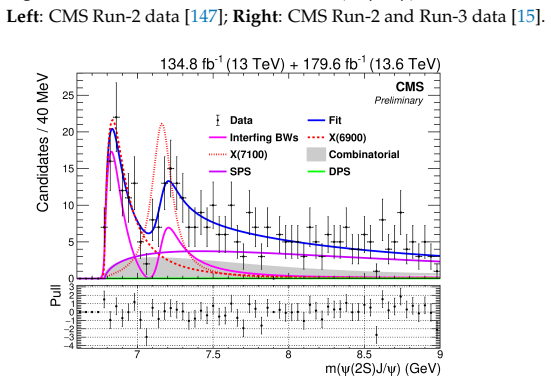
A reader could settle the toponium claim by re-analyzing the $m(t\bar{t})$ distribution with an alternative, threshold-resummed description of the non-resonant $t\bar{t}$ background: if the excess disappears without a bound-state component, or if a spin-parity measurement excludes the $1S_0$ pseudoscalar assignment, the quasi-bound-state interpretation fails. Separately, the all-charm tetraquark family could be tested by confirming the spin-parity $J^{PC}=2^{++}$ assignment and checking whether the $X(6600)$ and $X(7100)$ states survive in an analysis with different interference assumptions.
Extended reading notes
Core claim
On the paper's own terms, the central discovery is that quarkonium observables at the LHC now discriminate among QCD production mechanisms and expose new states. Production cross-sections and polarization parameters of $J/\psi$, $\psi(2S)$, and $\Upsilon(nS)$ states match no single existing model, but they are precise enough to sharpen non-relativistic QCD extractions. In heavy-ion collisions, the measured nuclear modification factors $R_{AA}$ show a clear hierarchy $\Upsilon(1S) > \Upsilon(2S) > \Upsilon(3S)$, which the review presents as sequential melting of bound states in a deconfined medium. The review also reports a $t\bar{t}$ invariant-mass excess near threshold, interpreted as the $1S_0$ pseudoscalar quasi-bound state predicted by the QCD Coulomb potential, with consistent cross-sections from the two observations, and a family of all-charm tetraquarks $X(6600)$, $X(6900)$, $X(7100)$ seen in $J/\psi J/\psi$ and $J/\psi\psi(2S)$ spectra with consistent masses.
Load-bearing premise
The review's boldest claim assumes that the excess of top-quark-pair events near the production threshold is really a new bound state, and not an artifact of imperfect background modeling or of the particular angular assumptions used to separate signal from background.
Editorial extensions
If this is right
- If the toponium interpretation holds, the $t\bar{t}$ threshold excess becomes the first observed QCD Coulomb bound state, and Run-3 measurements of its mass, width, and spin-parity would constrain the top Yukawa coupling and test NRQCD in a new regime.
- The measured $R_{AA}$ hierarchy for $\Upsilon$ states, if correct, supports sequential melting as a quark-gluon-plasma signature and motivates similar measurements in smaller collision systems such as oxygen-oxygen and neon-neon.
- The consistent masses of $X(6600)$, $X(6900)$, and $X(7100)$ across experiments would establish an all-charm tetraquark family and constrain its internal configuration through the measured $J^{PC}=2^{++}$ quantum numbers.
- The first observation of triple $J/\psi$ production with a small effective cross-section would open triple-parton-scattering dynamics to quantitative study.
- The precision of production cross-sections and polarization data would place tighter constraints on NRQCD long-distance matrix elements and motivate higher-order theoretical calculations.
Reading between the lines
- If the toponium quasi-bound state is confirmed, the same threshold-enhancement technique could be applied to other heavy-flavor pairs, such as bottomonium pairs, where the Coulomb attraction is weaker but still potentially resolvable with future data.
- The systematic tension in effective cross-section values between quarkonium and jet or electroweak final states, noted in the review, suggests that the effective cross-section may not be universal; a dedicated measurement of double $J/\psi$ production in the central rapidity region would help resolve it.
- The review's observation that resonant contributions are not subtracted in di-quarkonium cross-section measurements implies that future $J/\psi$-pair cross-sections should be re-evaluated with the all-charm tetraquark resonances included, which could shift the extracted single- versus double-parton-scattering fractions.
- If the sequential melting pattern holds across collision systems, the planned oxygen-oxygen and neon-neon runs would provide a crucial interpolation between $pp$ and PbPb and test whether suppression scales with system size rather than energy density alone.
Signed reviews
Editorial analysis
A structured set of objections, weighed in public.
Referee Report
Summary. This manuscript is a review article summarizing recent heavy-quarkonium measurements at the LHC across pp, pPb, and PbPb collisions, based on Run-2 and early Run-3 data from ALICE, ATLAS, CMS, and LHCb. The paper covers prompt and non-prompt charmonium and bottomonium production cross-sections, polarization measurements, quarkonium suppression in heavy-ion collisions, cold nuclear matter effects in pPb collisions, multiplicity dependence, ultraperipheral collisions, and multi-quarkonium production including di- and tri-J/psi final states and searches for fully charmed tetraquarks. A distinct section (2.1.3) discusses the recent ttbar threshold excess and interprets it as evidence for a toponium quasi-bound state. The abstract and summary elevate this to a definitive observation and also describe the multi-quarkonium resonances as a discovered family of all-charm tetraquarks.
Significance. If the interpretations were accepted without qualification, the review would be a valuable and unusually candid snapshot of LHC quarkonium physics: it is largely faithful to the cited experimental papers, it explicitly acknowledges limitations (forward-only fiducial coverage for J/psi J/psi, missing resonant contributions in the J/psi J/psi cross-section, and the theoretical uncertainty in SPS/DPS separation), and it compiles a broad set of recent results in one place. The paper performs no derivations, so concerns about circular fitted-parameter predictions do not arise; the single self-citation (Hu et al., ref. [60]) is peripheral to the central content. The main significance risk is that the most novel claims—the 'first observation' of a ttbar quasi-bound-state and the 'discovery' of a family of all-charm tetraquarks—are stated more strongly than the primary experimental papers support, and these claims are load-bearing for the abstract and the summary.
major comments (2)
- [Section 2.1.3 and Abstract] The review states that CMS and ATLAS announced 'the first observation of the t-tbar quasi-bound-state' and quotes production cross-sections sigma(pp -> eta_ttbar) in Eq. (2). The cited primary papers (refs. [3,4]) report an 'excess' and a 'cross-section enhancement' near the t-tbar threshold; the identification of that excess with a Coulombic 1S_0^[1] toponium state is a theoretical interpretation layered on the measured m(ttbar) distribution, not a directly established quantum state. The fitted cross-sections are conditional on the simulated eta_ttbar signal template, so the quoted numbers are not model-independent measurements. The review itself concedes in the same section that 'the simulation near the top pair production threshold remains challenging, necessitating additional theoretical calculations and experimental verification.' Because the abstract and Section 5 both present the observation as established, and because the subsequent statements about Sommerfeld-effect verification, top-Yukawa constraints, and maximal-entanglement sources all depend on this attribution, the language should be tempered to 'evidence for' or 'consistent with' a quasi-bound-state, with the model-dependence of the cross-section extraction stated explicitly.
- [Section 4.2, Table 2] The text claims that the observed resonances in the J/psi J/psi and J/psi psi(2S) channels 'represent the first experimental discovery of a family of all-charm tetraquarks T_cccc'. This overstates the evidence: in Table 2, the X(7100) significance is 3.0 sigma (ATLAS, J/psi psi(2S)) and 4.0 sigma (CMS, J/psi psi(2S)), and the X(6900) significance in the ATLAS J/psi psi(2S) channel is 4.3 sigma, all below the conventional 5-sigma discovery threshold. Furthermore, the CMS paper cited for the family (ref. [15]) is titled 'Observation of a family of all-charm tetraquark candidates', and the CMS spin-parity determination (ref. [149]) is derived under specific interference assumptions. The review should distinguish resonances established at 5 sigma or above from candidates and should carry the 'candidates' qualifier into the summary and abstract.
minor comments (6)
- [Section 2.1.1] The paragraph beginning 'In pp collisions at sqrt(s)=13 TeV and 13.6 TeV, ALICE measured the inclusive cross-section ratio sigma_psi(2S)/sigma_J/psi ...' is duplicated verbatim immediately after Figure 11; one copy should be removed.
- [Section 4.3] The word 'sparation' in the sentence describing the SPS/DPS/TPS separation should be 'separation'.
- [Section 5] The phrase 'coor screening' should read 'color screening'.
- [Figure 22 caption] The caption describes the 'Right' panel before the 'Left' panel, which is inconsistent with the usual ordering and with the figure layout; please harmonize the order.
- [References] Reference [106] is cited for the LHCb pPb 8.16 TeV quarkonium measurements, but the listed reference is a conference proceedings contribution; the primary LHCb paper should be cited instead.
- [Section 4.1.1] The sentence 'The estimation of sigma_eff using the result of LHCb at 7 TeV can be difficult [146]' is unclear and should be rephrased to state what difficulty is being referred to.
Circularity Check
No significant circularity: the review compiles external LHC measurements; the only self-citation is a peripheral prior CMS bottomonium review, and no fitted parameter is dressed as a prediction in the review itself.
full rationale
This manuscript is a data-review article rather than a derivation: its equations (1), (3), (5), (8), (10), and (11) are standard definitions or measurement unfoldings, not first-principles predictions. The central content—quarkonium cross-sections, polarizations, R_AA/R_pA, effective cross-sections, and tetraquark masses—is compiled from ALICE, ATLAS, CMS, and LHCb results with external benchmark comparisons, so there is no fitted parameter that is later renamed as a prediction in the review itself. The only self-citation is ref. [60] (Hu et al., a previous CMS bottomonium review), which is used as a supporting reference for a section summarizing external measurements and is not load-bearing for any conclusion. Section 2.1.3 does go beyond the CMS/ATLAS 'excess'/'enhancement' language by calling the result 'the first observation of the t¯t quasi-bound-state,' and the quoted cross-sections are extracted by fitting a simulated η_t¯t template; this is an interpretive/correctness concern about the strength of the claim, not a circularity in the review's own derivation chain, and the review itself concedes threshold modeling remains challenging. Score 2 reflects only the presence of a non-load-bearing self-citation; no circular step is identified.
Assumptions & free parameters
assumptions (3)
- domain assumption The cited ALICE, ATLAS, CMS, and LHCb measurements are correctly reported, with quoted uncertainties and acceptance corrections.
- domain assumption NRQCD, color-singlet, color-octet, and color-evaporation models are appropriate frameworks for interpreting quarkonium production and polarization.
- domain assumption The ttbar invariant-mass excess near threshold is a quasi-bound toponium state rather than a background or resummation artifact.
Cite this review
Pith. "Pith review of Experimental Review of the Quarkonium Physics at the LHC." pith.science (2026). https://pith.science/paper/VH6D6LDV
@misc{pith2026250910330,
  author       = {Pith},
  title        = {Pith review of: Experimental Review of the Quarkonium Physics at the LHC},
  year         = {2026},
  howpublished = {\url{https://pith.science/paper/VH6D6LDV}},
  note         = {Machine review of arXiv:2509.10330}
}
abstract
We review recent heavy quarkonium measurements in $pp$, $p\mathrm{Pb}$, and $\mathrm{PbPb}$ collisions at the LHC by the ALICE, ATLAS, CMS, and LHCb collaborations using Run 2 and early Run 3 data. Production studies include present differential cross sections and polarization measurements of charmonium and bottomonium, providing precise tests of QCD theoretical calculations and unveiling symmetry relations among spin and orbital configurations. Notably, a $t\bar{t}$ quasi bound state has been observed at the LHC recently. Suppression analyses quantify the sequential melting of bottomonium states in $\mathrm{PbPb}$ collisions, serving as a probe of the deconfined quark gluon plasma. Cold nuclear matter effects are constrained through comparisons of quarkonium yields in $p\mathrm{Pb}$ and $pp$ collisions. Furthermore, multi quarkonium investigations observe di and tri quarkonium production processes and resonances, exploring multi parton interactions and the symmetry structure underlying exotic hadron states.
Figures


Figures from the paper (47 more)




Forward citations
Cited by 1 Pith paper
-
Measurement of the $\Upsilon$(1S), $\Upsilon$(2S), and $\Upsilon$(3S) differential cross sections in pp collisions at $\sqrt{s}$ = 13.6 TeV
First CMS measurement of Υ(1S), Υ(2S), and Υ(3S) differential cross sections at √s=13.6 TeV, extending the pT reach from 100 to 200 GeV.
Reference graph
Works this paper leans on
-
[60]
Review of bottomonium measurements from CMS.Int
Hu, Z.; Leonardo, N.T.; Liu, T.; Haytmyradov, M. Review of bottomonium measurements from CMS.Int. J. Mod. Phys. A2017,32, 1730015. https://doi.org/10.1142/S0217751X17300150
-
[1]
Rigorous QCD analysis of inclusive annihilation and production of heavy quarkonium.Phys
Bodwin, G.T.; Braaten, E.; Lepage, G.P . Rigorous QCD analysis of inclusive annihilation and production of heavy quarkonium.Phys. Rev. D1995,51, 1125–1171. Erratum inPhys. Rev. D1997,55, 5853. https://doi.org/10.1103/PhysRevD.51.1125
-
[15]
Observation of a family of all-charm tetraquark candidates at the LHC.Sci
CMS Collaboration. Observation of a family of all-charm tetraquark candidates at the LHC.Sci. Adv.2025, submitted
2025
-
[149]
Determination of the spin and parity of all-charm tetraquarks.arXiv2025, arXiv:2506.07944
CMS Collaboration. Determination of the spin and parity of all-charm tetraquarks.arXiv2025, arXiv:2506.07944
-
[2]
Top quark physics at the LHC.J
Bernreuther, W. Top quark physics at the LHC.J. Phys. G2008,35, 083001. https://doi.org/10.1088/0954-3 899/35/8/083001
-
[3]
CMS Collaboration. Observation of a pseudoscalar excess at the top quark pair production threshold.arXiv 2025,arXiv:2503.22382
arXiv 2025
-
[4]
Observation of a Cross-Section Enhancement near the t¯t Production Threshold in√s =13 TeVppCollisions with the ATLAS Detector; CERN: Geneva, Switzerland, 2025
ATLAS Collaboration. Observation of a Cross-Section Enhancement near the t¯t Production Threshold in√s =13 TeVppCollisions with the ATLAS Detector; CERN: Geneva, Switzerland, 2025
2025
-
[5]
Spin symmetry predictions for heavy quarkonia alignment.Phys
Cho, P .L.; Wise, M.B. Spin symmetry predictions for heavy quarkonia alignment.Phys. Lett. B1995, 346, 129–133. https://doi.org/10.1016/0370-2693(94)01658-Y
Show all 162 references
-
[6]
NLO production and decay of quarkonium
Petrelli, A.; Cacciari, M.; Greco, M.; Maltoni, F.; Mangano, M.L. NLO production and decay of quarkonium. Nucl. Phys. B1998,514, 245–309. https://doi.org/10.1016/S0550-3213(97)00801-8
-
[7]
Producing heavy quark flavors in hadronic collisions: A test of quantum chromodynamics
Fritzsch, H. Producing heavy quark flavors in hadronic collisions: A test of quantum chromodynamics. Phys. Lett. B1977,67, 217–221. https://doi.org/10.1016/0370-2693(77)90108-3
-
[8]
Quantitative tests of color evaporation: Charmonium production.Phys
Amundson, J.F.; Eboli, O.J.P .; Gregores, E.M.; Halzen, F. Quantitative tests of color evaporation: Charmonium production.Phys. Rev. D1996,53, 2686–2693. https://doi.org/10.1016/S0370-2693(96)01417-7
-
[9]
J/ψ suppression by quark-gluon plasma formation.Phys
Matsui, T.; Satz, H. J/ψ suppression by quark-gluon plasma formation.Phys. Lett. B1986,178, 416–422. https://doi.org/10.1016/0370-2693(86)91404-8
-
[10]
Brambilla, N.; Eidelman, S.; Heltsley, B.K.; Vogt, R.; Bodwin, G.T.; Eichten, E.; Frawley, A.D.; Meyer, A.B.; Mitchell, R.E.; Papadimitriou, V .; Heavy quarkonium: Progress, puzzles, and opportunities.Eur. Phys. J. C 2011,71, 1534. https://doi.org/10.1140/epjc/s10052-010-1534-9
2011 doi
-
[11]
Test of lepton universality in Υ(1S) decays at BABAR.Phys
BABAR Collaboration. Test of lepton universality in Υ(1S) decays at BABAR.Phys. Rev. Lett.2010, 104, 191801. https://doi.org/10.1103/PhysRevLett.104.191801
2010 doi
-
[12]
Dark Sectors and New, Light, Weakly-Coupled Particles.arXiv2013, arXiv:1311.0029
Essig, R.; Jaros, J.A.; Wester, W.; Hansson Adrian, P .; Andreas, S.; Averett, T.; Baker, O.; Batell, B.; Battaglieri, M.; Beacham, J. Dark Sectors and New, Light, Weakly-Coupled Particles.arXiv2013, arXiv:1311.0029
-
[13]
A Search for Invisible Decays of the Υ(1S).Phys
BABAR Collaboration. A Search for Invisible Decays of the Υ(1S).Phys. Rev. Lett.2009,103, 251801. https://doi.org/10.1103/PhysRevLett.103.251801
2009 doi
-
[14]
Observation of structure in the J/ψ -pair mass spectrum.Sci
LHCb Collaboration. Observation of structure in the J/ψ -pair mass spectrum.Sci. Bull.2020,65, 1983–1993. https://doi.org/10.1016/j.scib.2020.08.032
2020 doi
-
[16]
Observation of X(6900) and evidence of X(7100) in the psi(2S)Jpsi to 4mu mass spectrum in pp collisions at CMS.Sci
CMS Collaboration. Observation of X(6900) and evidence of X(7100) in the psi(2S)Jpsi to 4mu mass spectrum in pp collisions at CMS.Sci. Adv.2025,submitted
2025
-
[17]
Observation of an Excess of Dicharmonium Events in the Four-Muon Final State with the ATLAS Detector.Phys
ATLAS Collaboration. Observation of an Excess of Dicharmonium Events in the Four-Muon Final State with the ATLAS Detector.Phys. Rev. Lett.2023,131, 151902. https://doi.org/10.1103/PhysRevLett.131.151902
2023 doi
-
[18]
Measurement of the Υ(1S) pair production cross section and search for resonances decaying to Υ(1S)µ+µ− in proton-proton collisions at √s= 13 TeV.Phys
CMS Collaboration. Measurement of the Υ(1S) pair production cross section and search for resonances decaying to Υ(1S)µ+µ− in proton-proton collisions at √s= 13 TeV.Phys. Lett. B2020,808, 135578. https://doi.org/10.1016/j.physletb.2020.135578
-
[19]
Experimental Observation of a Heavy Particle J.Phys
Aubert, J.J.; Becker, U.; Biggs, P .J.; Burger, J.; Chen, M.; Everhart, G.; Goldhagen, P .; Leong, J.; McCorriston, T.; Rhoades, T.G.; et al. Experimental Observation of a Heavy Particle J.Phys. Rev. Lett.1974,33, 1404–1406. https://doi.org/10.1103/PhysRevLett.33.1404
1974 doi
-
[20]
Discovery of a Narrow Resonance in e+e− Annihilation.Phys
Augustin, J.E.; Boyarski, A.M.; Breidenbach, M.; Bulos, F.; Dakin, J.T.; Feldman, G.J.; Fischer, G.E.; Fryberger, D.; Hanson, G.; Jean-Marie, B.; et al. Discovery of a Narrow Resonance in e+e− Annihilation.Phys. Rev. Lett. 1974,33, 1406–1408. https://doi.org/10.1103/PhysRevLet...
1974 doi
-
[21]
J.; Jean-Marie, B.; Sadoulet, B.; Vannucci, F.; Abrams, G
Feldman, G. J.; Jean-Marie, B.; Sadoulet, B.; Vannucci, F.; Abrams, G. S.; Boyarski, A. M.; Breidenbach, M.; Bulos, F.; Chinowsky, W.; Friedberg, C. E.; et al. ψ(3684) Radiative decays to high-mass states.Phys. Rev. Lett.1975,35, 821–824. https://doi.org/10.1103/PhysRevLett.35.821
1975 doi
-
[22]
Inclusive gamma-Ray Spectra from psi (3095) and psi-prime (3684).Phys
Biddick, C.J.; Burnett, T.H.; Masek, G.E.; Miller, E.S.; Smith, J.G.; Stronski, J.P .; Sullivan, M.K.; Vernon, W.; Badtke, D.H.; Barnett, B.A. Inclusive gamma-Ray Spectra from psi (3095) and psi-prime (3684).Phys. Rev. Lett.1977,38, 1324. https://doi.org/10.1103/PhysRevLett.38.1324
1977 doi
-
[23]
Observation of an Intermediate State in psi-prime (3684) Radiative Cascade Decay.Phys
Tanenbaum, W.M.; Whitaker, J.S.; Abrams, G.S.; Boyarski, A.M.; Breidenbach, M.; Chinowsky, W.; DeVoe, R.G.; Feldman, G.J.; Fryberger, D.; Goldhaber, G. Observation of an Intermediate State in psi-prime (3684) Radiative Cascade Decay.Phys. Rev. Lett.1975,35, 1323. https://doi.o...
1975 doi
-
[24]
Radiative Decays of psi (3095) and psi-prime (3684).Phys
Whitaker, J.S.; Tanenbaum, W.M.; Abrams, G.S.; Alam, M.S.; Boyarski, A.M.; Breidenbach, M.; Chinowsky, W.; DeVoe, R.G.; Feldman, G.J.; Friedberg, C.E. Radiative Decays of psi (3095) and psi-prime (3684).Phys. Rev. Lett.1976,37, 1596. https://doi.org/10.1103/PhysRevLett.37.1596
1976 doi
-
[25]
Charmonium: Comparison with experiment
Eichten, E.; Gottfried, K.; Kinoshita, T.; Lane, K.D.; Yan, T.M. Charmonium: Comparison with experiment. Phys. Rev. D1978,17, 3090–3117. https://doi.org/10.1103/PhysRevD.21.203
-
[26]
A.; Gobbi, B.; Lüke, D.; Barbaro-Galtieri, A.; Dorfan, J
Rapidis, P . A.; Gobbi, B.; Lüke, D.; Barbaro-Galtieri, A.; Dorfan, J. M.; Ely, R.; Feldman, G. J.; Feller, J. M.; Fong, A.; Hanson, G.; et al. Observation of a Resonance in e+ e- Annihilation Just Above Charm Threshold. Phys. Rev. Lett.1977,39, 526. Erratum inPhys. Rev. Lett....
1977 doi
-
[27]
Total Cross-section for Hadron Production by e+e− Annihilation at Center-of-mass Energies Between 3.6-GeV and 5.2-GeV.Phys
DASP Collaboration. Total Cross-section for Hadron Production by e+e− Annihilation at Center-of-mass Energies Between 3.6-GeV and 5.2-GeV.Phys. Lett. B1978,76, 361. https://doi.org/10.1016/0370-2693(78)9 0807-9
-
[28]
S.; Boyarski, A
Siegrist, J.; Abrams, G. S.; Boyarski, A. M.; Breidenbach, M.; Bulos, F.; Chinowsky, W.; Feldman, G. J.; Friedberg, C. E.; Fryberger, D.; Goldhaber, G.; Hanson, G.; Hartill, D. L.; Jaros, J.; Jean-Marie, B.; et al. Observation of a Resonance at 4.4-GeV and Additional Structure...
1976 doi
-
[29]
Review of Particle Physics.Prog
Navas, S.; Amsler, C.; Gutsche, T.; Hanhart, C.; Hernández-Rey, J.J.; Lourenço, C.; Masoni, A.; Mikhasenko, M.; Mitchell, R.E.; Patrignani, C. Review of Particle Physics.Prog. Theor. Exp. Phys.2024,2024, 083C01. https://doi.org/10.1103/PhysRevD.110.030001
2024 doi
-
[30]
Observation of a Dimuon Resonance at 9.5 GeV in 400-GeV Proton–Nucleus Collisions.Phys
Herb, S.W.; Hom, D.C.; Lederman, L.M.; Sens, J.; Snyder, H. Observation of a Dimuon Resonance at 9.5 GeV in 400-GeV Proton–Nucleus Collisions.Phys. Rev. Lett.1977,39, 252–255. https://doi.org/10.1103/ PhysRevLett.39.252
1977
-
[31]
Observation of Three Upsilon States.Phys
Andrews, D.; Berkelman, K.; Billing, M.; Cabenda, R.; Cassel, D.G.; DeWire, J.W.; Ehrlich, R.; Ferguson, T.; Gentile, T.; Gibbard, B.G. Observation of Three Upsilon States.Phys. Rev. Lett.1980,44, 1108–1111. https://doi.org/10.1103/PhysRevLett.44.1108
1980 doi
-
[32]
Observation of Radiative Decays of the Υ(2S).Phys
Haas, A.L.; Kirby, H.; Wiedemann, C.; Weissenberg, P .; Brandelik, R.; Schubert, K.; Söhngen, G.; Unterdorfer, G.; Wegener, D.; Wenzel, K.D. Observation of Radiative Decays of the Υ(2S).Phys. Rev. Lett.1984, 52, 799–802. https://doi.org/10.1103/PhysRevLett.52.799
1984 doi
-
[33]
Observation of a Fourth Upsilon State in e+e− Annihilations.Phys
CUSB Collaboration. Observation of a Fourth Upsilon State in e+e− Annihilations.Phys. Rev. Lett.1980, 45, 219–222. https://doi.org/10.1103/PhysRevLett.45.219
1980 doi
-
[34]
Observation of New Structure in thee+e− Cross Section Above theΥ(4S).Phys
Besson, D.; Green, J.; Namjoshi, R.; Sannes, F.; Skubic, P .; Snyder, A.; Stone, R.; Chen, A.; Goldberg, M.; Horwitz, N.; Jawahery, A.; Lipari, P .; et al. Observation of New Structure in thee+e− Cross Section Above theΥ(4S).Phys. Rev. Lett.1985,54, 381–385. https://doi.org/10...
1985 doi
-
[35]
The Physics of theB Factories.Eur
Bevan, A.J.; Golob, B.; Mannel, T.; Prell, S.; Yabsley, B.D.; Aihara, H.; Anulli, A.; Browder, T.E.; Camilleri, L.; Charpentier, P .; et al. The Physics of theB Factories.Eur. Phys. J. C2014,74, 3026. https://doi.org/10.1140/ epjc/s10052-014-3026-9
-
[36]
The CMS experiment at the CERN LHC.J
CMS Collaboration. The CMS experiment at the CERN LHC.J. Instrum.2008,3, S08004. https://doi.org/10 .1088/1748-0221/3/08/S08004
2008
-
[37]
The ATLAS Experiment at the CERN Large Hadron Collider.J
ATLAS Collaboration. The ATLAS Experiment at the CERN Large Hadron Collider.J. Instrum.2008, 3, S08003. https://doi.org/10.1088/1748-0221/3/08/S08003
2008 doi
-
[38]
The LHCb Detector at the LHC.J
LHCb Collaboration. The LHCb Detector at the LHC.J. Instrum.2008,3, S08005. https://doi.org/10.1088/ 1748-0221/3/08/S08005
2008
-
[39]
The ALICE experiment at the CERN LHC.J
ALICE Collaboration. The ALICE experiment at the CERN LHC.J. Instrum.2008,3, S08002. https: //doi.org/10.1088/1748-0221/3/08/S08002
2008 doi
-
[40]
CMS Collaboration.Dimuon Spectrum 2016; Technical Report; CERN: Geneva, Switzerland, 2016
2016
-
[41]
Technical Report; Charles University: Prague, Czech Republic, 2021
Reznicek, P .ATLAS Measurements of CP-Violation and Rare Decays Processes with Beauty Mesons. Technical Report; Charles University: Prague, Czech Republic, 2021
2021
-
[42]
LHCb Collaboration.Search for Dark Photons Produced in 13 T eV pp Collisions;Phys. Rev. Lett.2018, 120, 061801–061812. https://doi.org/10.1103/PhysRevLett.120.061801
2018 doi
-
[43]
Proceedings of Direct photon measurement in small systems and thermal radiation from QGP with ALICE, Hard Probes conference 2024.arXiv2025, arXiv:2505.03669
ALICE Collaboration. Proceedings of Direct photon measurement in small systems and thermal radiation from QGP with ALICE, Hard Probes conference 2024.arXiv2025, arXiv:2505.03669
2024 arXiv
-
[44]
Precision luminosity measurement in proton–proton collisions at√s= 13 TeV in 2015 and 2016 at CMS.Eur
CMS Collaboration. Precision luminosity measurement in proton–proton collisions at√s= 13 TeV in 2015 and 2016 at CMS.Eur. Phys. J. C2021,81, 800. https://doi.org/10.1140/epjc/s10052-021-09538-2. 41 of 45
2015 doi
-
[45]
CMS Collaboration.Luminosity Measurement in Proton–Proton Collisions at √s= 13.6T eV in 2022 at CMS; Technical Report CMS-PAS-LUM-22-001, CMS Physics Analysis Summary; CERN: Geneva, Switzerland, 2024
2022
-
[46]
Υ Production and Polarization in pp Collisions at√s = 1.8 TeV.Phys
CDF Collaboration. Υ Production and Polarization in pp Collisions at√s = 1.8 TeV.Phys. Rev. Lett.2002, 88, 161802. https://doi.org/10.1103/PhysRevLett.88.161802
2002 doi
-
[47]
Polarization of J/ψ and ψ(2S) mesons produced in p ¯p collisions at√s= 1.96 TeV .Phys
CDF Collaboration. Polarization of J/ψ and ψ(2S) mesons produced in p ¯p collisions at√s= 1.96 TeV .Phys. Rev. Lett.2007,99, 132001. https://doi.org/10.1103/PhysRevLett.99.132001
2007 doi
-
[48]
Production of Υ(1S) Mesons from χb Decays in pp Collisions at√s == 1.8 TeV.Phys
CDF Collaboration. Production of Υ(1S) Mesons from χb Decays in pp Collisions at√s == 1.8 TeV.Phys. Rev. Lett.2000,84, 2094–2099. https://doi.org/10.1103/PhysRevLett.84.2094
2000 doi
-
[49]
Prompt and non-prompt J/ψ production in pp collisions at√s= 7 TeV .Eur
CMS Collaboration. Prompt and non-prompt J/ψ production in pp collisions at√s= 7 TeV .Eur. Phys. J. C 2011,71, 1575. https://doi.org/10.1140/epjc/s10052-011-1575-8
2011 doi
-
[50]
Measurement of the differential cross-sections of prompt and non-prompt production of J/ψ and ψ(2S) in pp collisions at√s = 7 TeV with the ATLAS detector.Nucl
ATLAS Collaboration. Measurement of the differential cross-sections of prompt and non-prompt production of J/ψ and ψ(2S) in pp collisions at√s = 7 TeV with the ATLAS detector.Nucl. Phys. B2011,850, 387–444. https://doi.org/10.1140/epjc/s10052-016-4050-8
-
[51]
Measurement of J/ψ production in pp collisions at√s= 7 TeV .Eur
LHCb Collaboration. Measurement of J/ψ production in pp collisions at√s= 7 TeV .Eur. Phys. J. C2011, 71, 1645. https://doi.org/10.1140/epjc/s10052-011-1645-y
-
[52]
Measurement of quarkonium production cross sections in pp collisions at√s= 13 TeV
CMS Collaboration. Measurement of quarkonium production cross sections in pp collisions at√s= 13 TeV . Phys. Lett. B2018,780, 251–272. https://doi.org/10.1016/j.physletb.2018.02.033
2018 doi
-
[53]
Measurement of the production cross-section of J/ψ and ψ(2S) mesons in pp collisions at√s= 13 TeV with the ATLAS detector.Eur
ATLAS Collaboration. Measurement of the production cross-section of J/ψ and ψ(2S) mesons in pp collisions at√s= 13 TeV with the ATLAS detector.Eur. Phys. J. C2024,84, 169. https://doi.org/10.1140/ epjc/s10052-024-12439-9
-
[54]
Measurement of forward J/ψ production cross-section in pp collisions at√s= 13 TeV
LHCb Collaboration. Measurement of forward J/ψ production cross-section in pp collisions at√s= 13 TeV . J. High Energy Phys.2015,10, 172. https://doi.org/10.1007/JHEP10(2015)172
2015 doi
-
[55]
Multiplicity dependence of inclusive J/ψ production at midrapidity in pp collisions at√s=13 TeV .Phys
ALICE Collaboration. Multiplicity dependence of inclusive J/ψ production at midrapidity in pp collisions at√s=13 TeV .Phys. Lett. B2020,810, 135758. https://doi.org/10.1016/j.physletb.2020.135758
2020
-
[56]
Central exclusive production of J/ψ and ψ(2S) mesons in pp collisions at√s= 13 TeV
LHCb Collaboration. Central exclusive production of J/ψ and ψ(2S) mesons in pp collisions at√s= 13 TeV . J. High Energy Phys.2018,10, 167. https://doi.org/10.1007/JHEP10(2018)167
2018 doi
-
[57]
Quarkonia as probes of initial and final states in small systems with ALICE.EPJ Web Conf.2024,274, 09007
ALICE Collaboration. Quarkonia as probes of initial and final states in small systems with ALICE.EPJ Web Conf.2024,274, 09007. https://doi.org/10.1051/epjconf/202429609007
2024
-
[58]
Reconciling J/ψ Production at HERA, RHIC, Tevatron, and LHC with Nonrelativistic QCD Factorization at Next-to-Leading Order.Phys
Butenschön, M.; Kniehl, B.A. Reconciling J/ψ Production at HERA, RHIC, Tevatron, and LHC with Nonrelativistic QCD Factorization at Next-to-Leading Order.Phys. Rev. Lett.2011,106, 022003. https: //doi.org/10.1103/PhysRevLett.106.022003
2011 doi
-
[59]
Production and polarization of promptJ/ψ in the improved color evaporation model using the kT-factorization approach.Phys
Cheung, V .; Vogt, R. Production and polarization of promptJ/ψ in the improved color evaporation model using the kT-factorization approach.Phys. Rev. D2018,98, 114029. https://doi.org/10.1103/PhysRevD.98.1 14029
-
[61]
Inclusive quarkonium production in pp collisions at√s= 5.02 TeV .Eur
ALICE Collaboration. Inclusive quarkonium production in pp collisions at√s= 5.02 TeV .Eur. Phys. J. C 2023,83, 61. https://doi.org/10.1140/epjc/s10052-022-10896-8
2023 doi
-
[62]
Measurement of the multiplicity dependence of Υ production ratios in pp collisions at√s=13 TeV .J
LHCb Collaboration. Measurement of the multiplicity dependence of Υ production ratios in pp collisions at√s=13 TeV .J. High Energy Phys.2025,05, 011. https://doi.org/10.1007/JHEP05(2025)011
2025 doi
-
[63]
Production and polarization of promptΥ(nS) in the improved color evaporation model using the kT-factorization approach.Phys
Cheung, V .; Vogt, R. Production and polarization of promptΥ(nS) in the improved color evaporation model using the kT-factorization approach.Phys. Rev. D2019,99, 034007. https://doi.org/10.1103/PhysRevD.99.0 34007
-
[64]
ThepT spectrum in heavy-flavour hadroproduction.JHEP1998,9805, 007
Cacciari, M.; Greco, M.; Nason, P . ThepT spectrum in heavy-flavour hadroproduction.JHEP1998,9805, 007. https://doi.org/10.1088/1126-6708/1998/05/007
1998 doi
-
[65]
Signatures of toponium formation in LHC run 2 data.Phys
Fuks, B.; Hagiwara, K.; Ma, K.; Zheng, Y.J. Signatures of toponium formation in LHC run 2 data.Phys. Rev. D2021,104, 034023. https://doi.org/10.1103/PhysRevD.104.034023
-
[66]
Differential cross section measurements for the production of top quark pairs and of additional jets using dilepton events from pp collisions at√s = 13 TeV.J
CMS Collaboration. Differential cross section measurements for the production of top quark pairs and of additional jets using dilepton events from pp collisions at√s = 13 TeV.J. High Energy Phys.2025,02, 064. https://doi.org/10.1007/JHEP02(2025)064
2025 doi
-
[67]
Measurement of the t¯t production cross-section and lepton differential distributions in eµ dilepton events from pp collisions at√s= 13 TeV with the ATLAS detector.Eur
ATLAS Collaboration. Measurement of the t¯t production cross-section and lepton differential distributions in eµ dilepton events from pp collisions at√s= 13 TeV with the ATLAS detector.Eur. Phys. J. C2020, 80, 528. https://doi.org/10.1140/epjc/s10052-020-7907-9. 42 of 45
-
[68]
Inclusive and differential cross-sections for dilepton tt production measured in√s = 13 TeV pp collisions with the ATLAS detector.J
ATLAS Collaboration. Inclusive and differential cross-sections for dilepton tt production measured in√s = 13 TeV pp collisions with the ATLAS detector.J. High Energy Phys.2023,07, 141. https://doi.org/10.1007/ JHEP07(2023)141
2023
-
[69]
On the Threshold Behavior of Heavy Top Production.Z
Fadin, V .S.; Khoze, V .A.; Sjostrand, T. On the Threshold Behavior of Heavy Top Production.Z. Phys. C1990, 48, 613–622. https://doi.org/10.1007/BF01614696
-
[70]
Top-quark pair production near threshold at LHC
Kiyo, Y.; Kuhn, J.H.; Moch, S.; Steinhauser, M.; Uwer, P . Top-quark pair production near threshold at LHC. Eur. Phys. J. C2009,60, 375–386. https://doi.org/10.1140/epjc/s10052-009-0892-7
-
[71]
Measurement of the top quark Yukawa coupling from t¯t kinematic distributions in the dilepton final state in proton-proton collisions at √s= 13 TeV.Phys
CMS Collaboration. Measurement of the top quark Yukawa coupling from t¯t kinematic distributions in the dilepton final state in proton-proton collisions at √s= 13 TeV.Phys. Rev. D2020,102, 092013. https://doi.org/10.1103/PhysRevD.102.092013
-
[72]
Entanglement and quantum tomography with top quarks at the LHC.Eur
Afik, Y.; de Nova, J.R.M. Entanglement and quantum tomography with top quarks at the LHC.Eur. Phys. J. Plus2021,136, 907. https://doi.org/10.1140/epjp/s13360-021-01902-1
-
[73]
Observation of quantum entanglement with top quarks at the ATLAS detector
ATLAS Collaboration. Observation of quantum entanglement with top quarks at the ATLAS detector. Nature2024,633, 542–547. https://doi.org/10.1038/s41586-024-07824-z
-
[74]
Observation of quantum entanglement in top quark pair production in proton–proton collisions at√s=13 TeV.Rept
CMS Collaboration. Observation of quantum entanglement in top quark pair production in proton–proton collisions at√s=13 TeV.Rept. Prog. Phys.2024,87, 117801. https://doi.org/10.1088/1361-6633/ad7e4d
2024 doi
-
[75]
Observation of the top quark.Phys
D0 Collaboration. Observation of the top quark.Phys. Rev. Lett.1995,74, 2632–2637. https://doi.org/10.1 103/PhysRevLett.74.2632
1995
-
[76]
Measurement of the prompt J/ψ and ψ(2S) polarizations in pp collisions at√s= 7 TeV
CMS Collaboration. Measurement of the prompt J/ψ and ψ(2S) polarizations in pp collisions at√s= 7 TeV. Phys. Lett. B2013,727, 381–402. https://doi.org/10.1016/j.physletb.2013.10.055
2013 doi
-
[77]
Measurement of the Υ(1S), Υ(2S), and Υ(3S) polarizations in pp collisions at√s = 7 TeV.Phys
CMS Collaboration. Measurement of the Υ(1S), Υ(2S), and Υ(3S) polarizations in pp collisions at√s = 7 TeV.Phys. Rev. Lett.2013,110, 081802. https://doi.org/10.1103/PhysRevLett.110.081802
2013 doi
-
[78]
Measurement of J/ψ polarization in pp collisions at√s = 7 TeV.Eur
LHCb Collaboration. Measurement of J/ψ polarization in pp collisions at√s = 7 TeV.Eur. Phys. J. C2013, 73, 2631. https://doi.org/10.1140/epjc/s10052-013-2631-3
-
[79]
Measurement of ψ(2S) polarisation in pp collisions at√s = 7 TeV.Eur
LHCb Collaboration. Measurement of ψ(2S) polarisation in pp collisions at√s = 7 TeV.Eur. Phys. J. C2014, 74, 2872. https://doi.org/10.1140/epjc/s10052-014-2872-9
-
[80]
J/ψ polarization in pp collisions at√s = 7 TeV.Phys
ALICE Collaboration. J/ψ polarization in pp collisions at√s = 7 TeV.Phys. Rev. Lett.2012,108, 082001. https://doi.org/10.1103/PhysRevLett.108.082001
2012 doi
-
[81]
Effective Field Theories for Heavy Quarkonium.Rev
Brambilla, N.; Pineda, A.; Soto, J.; Vairo, A. Effective Field Theories for Heavy Quarkonium.Rev. Mod. Phys. 2005,77, 1423–1496. https://doi.org/10.1103/RevModPhys.77.1423
2005 doi
-
[82]
Towards the Experimental Clarification of Quarkonium Polarization.Eur
Faccioli, P .; Lourenço, C.; Seixas, J.; Wohri, H.K. Towards the Experimental Clarification of Quarkonium Polarization.Eur. Phys. J. C2010,69, 657–673. https://doi.org/10.1140/epjc/s10052-010-1420-5
-
[83]
Quarkonium Polarization in the NRQCD Factorization Framework.Int
Braaten, E. Quarkonium Polarization in the NRQCD Factorization Framework.Int. J. Mod. Phys. A1997, 12, 3941–3950. https://doi.org/10.1142/S0217751X97002097
-
[84]
Next-to-leading-order tests of nonrelativistic-QCD factorization with J/ψ yield and polarization.Mod
Butenschoen.; Mathias.; Kniehl.; A., B. Next-to-leading-order tests of nonrelativistic-QCD factorization with J/ψ yield and polarization.Mod. Phys. Lett. A2013,28, 1350027. https://doi.org/10.1142/S0217732313500 272
-
[85]
Measurement of the polarizations of prompt and non-prompt J/ψ and ψ(2S) mesons produced in pp collisions at√s= 13 TeV .Phys
CMS Collaboration. Measurement of the polarizations of prompt and non-prompt J/ψ and ψ(2S) mesons produced in pp collisions at√s= 13 TeV .Phys. Lett. B2024,858, 139044. https://doi.org/10.1016/j.physletb. 2024.139044
2024
-
[86]
On the polarization of the non-prompt contribution to inclusiveJ/ψ production in ppcollisions.J
Faccioli, P .; Lourenço, C. On the polarization of the non-prompt contribution to inclusiveJ/ψ production in ppcollisions.J. High Energy Phys.2022,10, 005. https://doi.org/10.1007/JHEP10(2022)010
2022 doi
-
[87]
PolarizedJ/ψ production from B mesons at the Fermilab Tevatron.Phys
Krey, V .; Balaji, K.R.S. PolarizedJ/ψ production from B mesons at the Fermilab Tevatron.Phys. Rev. D2003, 67, 054011. https://doi.org/10.1103/PhysRevD.67.054011
-
[88]
Measurement of quarkonium polarization in Pb–Pb collisions at the LHC with ALICE
ALICE Collaboration. Measurement of quarkonium polarization in Pb–Pb collisions at the LHC with ALICE. In Proceedings of the Hard Probes 2020, Austin, TX, USA, 1–6 June 2020
2020
-
[89]
J/ ψ Production vs Centrality, Transverse Momentum, and Rapidity in Au+Au Collisions at√sNN = 200 GeV .Phys
PHENIX Collaboration. J/ ψ Production vs Centrality, Transverse Momentum, and Rapidity in Au+Au Collisions at√sNN = 200 GeV .Phys. Rev. Lett.2007,98, 232301. https://doi.org/10.1103/PhysRevLett.98.2 32301
2007 doi
-
[90]
Observation of Sequential Upsilon Suppression in PbPb Collisions.Phys
CMS Collaboration. Observation of Sequential Upsilon Suppression in PbPb Collisions.Phys. Rev. Lett.2012, 109, 222301. https://doi.org/10.1103/PhysRevLett.109.222301
2012 doi
-
[91]
Suppression of Upsilon(1S), Upsilon(2S), and Upsilon(3S) quarkonium states in PbPb collisions at√sNN = 2.76 TeV .Phys
CMS Collaboration. Suppression of Upsilon(1S), Upsilon(2S), and Upsilon(3S) quarkonium states in PbPb collisions at√sNN = 2.76 TeV .Phys. Lett. B2017,770, 357–379. https://doi.org/10.1016/j.physletb.2017.04. 031. 43 of 45
2017 doi
-
[92]
Production of Υ(nS) mesons in Pb+Pb and pp collisions at√sNN = 5.02 TeV .Phys
ATLAS Collaboration. Production of Υ(nS) mesons in Pb+Pb and pp collisions at√sNN = 5.02 TeV .Phys. Rev. C2023,107, 054912. https://doi.org/10.1103/PhysRevC.107.054912
-
[93]
Υ production and nuclear modification at forward rapidity in Pb–Pb collisions at√sNN =5.02 TeV .J
ALICE Collaboration. Υ production and nuclear modification at forward rapidity in Pb–Pb collisions at√sNN =5.02 TeV .J. High Energy Phys.2021,11, 194. https://doi.org/10.1016/j.physletb.2021.136579
2021
-
[94]
Color Screening and Regeneration of Bottomonia in High-Energy Heavy-Ion Collisions.Phys
Du, X.; He, M.; Rapp, R. Color Screening and Regeneration of Bottomonia in High-Energy Heavy-Ion Collisions.Phys. Rev. C2017,96, 054901. https://doi.org/10.1103/PhysRevC.96.054901
-
[95]
Bottomonium production in heavy-ion collisions using quantum trajectories: Differential observables and momentum anisotropy.Phys
Brambilla, N.; Escobedo, M.A.; Strickland, M.; Vairo, A.; Vander Griend, P .; Weber, J.H. Bottomonium production in heavy-ion collisions using quantum trajectories: Differential observables and momentum anisotropy.Phys. Rev. D2021,104, 094049. https://doi.org/10.1103/PhysRevD....
-
[96]
Decoding the phase structure of QCD via particle production at high energy.Nature2018,561, 321–330
Andronic, A.; Braun-Munzinger, P .; Redlich, K.; Stachel, J. Decoding the phase structure of QCD via particle production at high energy.Nature2018,561, 321–330. https://doi.org/10.1038/s41586-018-0491-6
-
[97]
Predictions for bottomonia suppression in 5.023 TeV Pb–Pb collisions.Universe 2016,2, 16
Krouppa, B.; Strickland, M. Predictions for bottomonia suppression in 5.023 TeV Pb–Pb collisions.Universe 2016,2, 16. https://doi.org/10.3390/universe2030016
2016 doi
-
[98]
Cold Nuclear Matter Effects on J/ψ and Υ Production at the LHC.Phys
Vogt, R. Cold Nuclear Matter Effects on J/ψ and Υ Production at the LHC.Phys. Rev. C2010,81, 044903. https://doi.org/10.1103/PhysRevC.81.044903
-
[99]
J/ψ suppression in p–A collisions from parton energy loss in cold QCD matter.Phys
Arleo, F.; Peigné, S. J/ψ suppression in p–A collisions from parton energy loss in cold QCD matter.Phys. Rev. Lett.2012,109, 122301. https://doi.org/10.1103/PhysRevLett.109.122301
2012 doi
-
[100]
Is bottomonium suppression in proton-nucleus and nucleus-nucleus collisions at LHC energies due to the same effects?J
Ferreiro, E.G.; Lansberg, J.P . Is bottomonium suppression in proton-nucleus and nucleus-nucleus collisions at LHC energies due to the same effects?J. High Energy Phys.2018,10, 094. https://doi.org/10.1007/JHEP1 0(2018)094
2018 doi
-
[101]
Measurement of prompt and nonprompt J/ψ production in pp and pPb collisions at√sNN =5.02 TeV .Eur
CMS Collaboration. Measurement of prompt and nonprompt J/ψ production in pp and pPb collisions at√sNN =5.02 TeV .Eur. Phys. J. C2017,77, 269. https://doi.org/10.1140/epjc/s10052-017-4828-3
-
[102]
Nuclear modification of Υ states in pPb collisions at√sNN = 5.02 TeV.Phys
CMS Collaboration. Nuclear modification of Υ states in pPb collisions at√sNN = 5.02 TeV.Phys. Lett. B 2022,835, 137397. https://doi.org/10.1016/j.physletb.2022.137397
2022
-
[103]
Measurement of nuclear modification factors of Υ(1S), Υ(2S), and Υ(3S) mesons in PbPb collisions at√sNN = 5.02 TeV.Phys
CMS Collaboration. Measurement of nuclear modification factors of Υ(1S), Υ(2S), and Υ(3S) mesons in PbPb collisions at√sNN = 5.02 TeV.Phys. Lett. B2019,790, 270–293. https://doi.org/10.1016/j.physletb.20 19.01.006
-
[104]
Measurement of quarkonium production in proton–lead and proton–proton collisions at√s= 5.02 TeV with the ATLAS detector.Eur
ATLAS Collaboration. Measurement of quarkonium production in proton–lead and proton–proton collisions at√s= 5.02 TeV with the ATLAS detector.Eur. Phys. J. C2018,78, 171. https://doi.org/10.1140/epjc/s100 52-018-5624-4
-
[105]
Inclusive, prompt and non-prompt J/ψ production at midrapidity in p–Pb collisions at√sNN =5.02 TeV .J
ALICE Collaboration. Inclusive, prompt and non-prompt J/ψ production at midrapidity in p–Pb collisions at√sNN =5.02 TeV .J. High Energy Phys.2022,06, 011. https://doi.org/10.1007/JHEP06(2022)011
2022 doi
-
[106]
Quarkonia production in pPb collisions
Boente Garcia, O.; et al. Quarkonia production in pPb collisions. In Proceedings of the Hard Probes 2020, Austin, TX, USA, 1–6 June 2020
2020
-
[107]
Observation of the charged-particle multiplicity dependence of σψ(2S)/σJ/ψ in pPb collisions at√sNN = 8.16 TeV.arXiv2025,arXiv:2503.02139
CMS Collaboration. Observation of the charged-particle multiplicity dependence of σψ(2S)/σJ/ψ in pPb collisions at√sNN = 8.16 TeV.arXiv2025,arXiv:2503.02139
-
[108]
Multiplicity dependence of σψ(2S)/σJ/ψ in pp collisions at√s = 13 TeV.J
LHCb Collaboration. Multiplicity dependence of σψ(2S)/σJ/ψ in pp collisions at√s = 13 TeV.J. High Energy Phys.2024,5, 243. https://doi.org/10.1007/JHEP05(2024)243
2024 doi
-
[109]
Centrality dependence of ψ(2S) suppression in pPb collisions at√sNN = 5.02 TeV.J
ALICE Collaboration. Centrality dependence of ψ(2S) suppression in pPb collisions at√sNN = 5.02 TeV.J. High Energy Phys.2016,6, 50. https://doi.org/10.1007/JHEP06(2016)050
2016 doi
-
[110]
Excited charmonium suppression in proton–nucleus collisions as a consequence of comovers
Ferreiro, E.G. Excited charmonium suppression in proton–nucleus collisions as a consequence of comovers. Phys. Lett. B2015,749, 98–103. https://doi.org/10.1016/j.physletb.2015.07.066
2015 doi
-
[111]
Multiplicity dependent inclusive J/ψ production at forward rapidity in pp collisions at√s= 13 TeV.arXiv2025, arXiv:2504.00686
ALICE Collaboration. Multiplicity dependent inclusive J/ψ production at forward rapidity in pp collisions at√s= 13 TeV.arXiv2025, arXiv:2504.00686
-
[112]
A comprehensive guide to the physics and usage of PYTHIA 8.3.SciPost Phys
Bierlich, C.; Chakraborty, S.; Desai, N.; Gellersen, L.; Helenius, I.; Ilten, P .; Lönnblad, L.; Mrenna, S.; Prestel, S.; Preuss, C.T.; et al. A comprehensive guide to the physics and usage of PYTHIA 8.3.SciPost Phys. Codeb. 2022,2022, 8. https://doi.org/10.21468/SciPostPhysCodeb.8
2022 doi
-
[113]
Heavy flavor as a probe of hot QCD matter produced in proton-proton collisions.Phys
Zhao, J.; Aichelin, J.; Gossiaux, P .B.; Werner, K. Heavy flavor as a probe of hot QCD matter produced in proton-proton collisions.Phys. Rev. D2024,109, 054011. https://doi.org/10.1103/PhysRevD.109.054011
-
[114]
Multiplicity dependence of quarkonia production in the CGC approach
Levin, E.; Schmidt, I.; Siddikov, M. Multiplicity dependence of quarkonia production in the CGC approach. Eur. Phys. J. C2020,80, 560. https://doi.org/10.1140/epjc/s10052-020-8086-4
-
[115]
Multiplicity Dependence of Quarkonium Production.Universe2024,10, 59
Conesa del Valle, Z. Multiplicity Dependence of Quarkonium Production.Universe2024,10, 59. https: //doi.org/10.3390/universe10020059
-
[116]
Coherent J/ψ photoproduction in ultra-peripheral PbPb collisions at√sNN = 2.76 TeV with the CMS experiment.Phys
CMS Collaboration. Coherent J/ψ photoproduction in ultra-peripheral PbPb collisions at√sNN = 2.76 TeV with the CMS experiment.Phys. Lett. B2017,772, 489. https://doi.org/10.1016/j.physletb.2017.07.001. 44 of 45
2017 doi
-
[117]
Study of coherent J/ψ production in lead–lead collisions at√sNN = 5TeV.J
LHCb Collaboration. Study of coherent J/ψ production in lead–lead collisions at√sNN = 5TeV.J. High Energy Phys.2022,7, 117. https://doi.org/10.1007/JHEP07(2022)117
2022 doi
-
[118]
Charmonium and e+e− pair photoproduction at mid-rapidity in ultra-peripheral Pb-Pb collisions at√sNN = 2.76 TeV.Eur
ALICE Collaboration. Charmonium and e+e− pair photoproduction at mid-rapidity in ultra-peripheral Pb-Pb collisions at√sNN = 2.76 TeV.Eur. Phys. J. C2013,73, 2617. https://doi.org/10.1140/epjc/s10052-0 13-2617-1
-
[119]
Coherent J/ψ photoproduction in ultra-peripheral Pb-Pb collisions at√sNN = 2.76 TeV.Phys
ALICE Collaboration. Coherent J/ψ photoproduction in ultra-peripheral Pb-Pb collisions at√sNN = 2.76 TeV.Phys. Lett. B2013,718, 1273–1283. https://doi.org/10.1016/j.physletb.2012.11.059
2012 doi
-
[120]
Coherent photoproduction of vector mesons in ultraperipheral heavy ion collisions: Update for run 2 at the CERN Large Hadron Collider.Phys
Guzey, V .; Kryshen, E.; Zhalov, M. Coherent photoproduction of vector mesons in ultraperipheral heavy ion collisions: Update for run 2 at the CERN Large Hadron Collider.Phys. Rev. C2016,93, 055206. https://doi.org/10.1103/PhysRevC.93.055206
-
[121]
Gon, V .P .; Machado, M.V .T. Vector meson production in coherent hadronic interactions: Update on predic- tions for energies available at the BNL Relativistic Heavy Ion Collider and the CERN Large Hadron Collider. Phys. Rev. C2011,84, 011902. https://doi.org/10.1103/PhysRevC....
-
[122]
Color dipole predictions for the exclusive vector meson photoproduction in pp, pPb, and PbPb collisions at run 2 LHC energies.Phys
Gon, V .P .; Machado, M.V .T.; Moreira, B.D.; Navarra, F.S.; Santos, G.S.d. Color dipole predictions for the exclusive vector meson photoproduction in pp, pPb, and PbPb collisions at run 2 LHC energies.Phys. Rev. D2017,96, 094027. https://doi.org/10.1103/PhysRevD.96.094027
-
[123]
Coherent and incoherent J/ψ photonuclear production in an energy- dependent hot-spot model.Phys
Cepila, J.; Contreras, J.G.; Krelina, M. Coherent and incoherent J/ψ photonuclear production in an energy- dependent hot-spot model.Phys. Rev. C2018,97, 024901. https://doi.org/10.1103/PhysRevC.97.024901
-
[124]
Probing subnucleon scale fluctuations in ultraperipheral heavy ion collisions
Mantysaari, H.; Schenke, B. Probing subnucleon scale fluctuations in ultraperipheral heavy ion collisions. Phys. Lett. B2017,772, 832–838. https://doi.org/10.1016/j.physletb.2017.07.063
2017 doi
-
[125]
First Measurement of the|t| Dependence of Incoherent J/ψ Photonuclear Production
ALICE Collaboration. First Measurement of the|t| Dependence of Incoherent J/ψ Photonuclear Production. Phys. Rev. Lett.2024,132, 162302. https://doi.org/10.1103/PhysRevLett.132.162302
2024 doi
-
[126]
Exclusive and dissociative J/ψ photoproduction, and exclusive dimuon production, in p-Pb collisions at√sNN = 8.16 TeV.Phys
ALICE Collaboration. Exclusive and dissociative J/ψ photoproduction, and exclusive dimuon production, in p-Pb collisions at√sNN = 8.16 TeV.Phys. Rev. D2023,108, 112004. https://doi.org/10.1103/PhysRevD. 108.112004
-
[127]
STARlight: A Monte Carlo simulation program for ultra-peripheral collisions of relativistic ions.Comput
Klein, S.R.; Nystrand, J.; Seger, J.; Gorbunov, Y.; Butterworth, J. STARlight: A Monte Carlo simulation program for ultra-peripheral collisions of relativistic ions.Comput. Phys. Commun.2017,212, 258–268. https://doi.org/10.1016/j.cpc.2016.10.016
2017 doi
-
[128]
Exclusive vector meson production in relativistic heavy ion collisions.Phys
Klein, S.R.; Nystrand, J. Exclusive vector meson production in relativistic heavy ion collisions.Phys. Rev. C 1999,60, 014903. https://doi.org/10.1103/PhysRevC.60.014903
1999 doi
-
[129]
A new approach to modelling elastic and inelastic photon-initiated production at the LHC: SuperChic 4.Eur
Harland-Lang, L.A.; Tasevsky, M.; Khoze, V .A.; Ryskin, M.G. A new approach to modelling elastic and inelastic photon-initiated production at the LHC: SuperChic 4.Eur. Phys. J. C2020,80, 925. https: //doi.org/10.1140/epjc/s10052-020-08455-0
-
[130]
Double, triple, and n-parton scatterings in high-energy proton and nuclear collisions.Adv
d’Enterria, D.; Snigirev, A. Double, triple, and n-parton scatterings in high-energy proton and nuclear collisions.Adv. Ser. Direct. High Energy Phys.2018,29, 159–187. https://doi.org/10.1142/9789813227767_00 09
2018 doi
-
[131]
Unraveling hadron structure with generalized parton distributions.Phys
Belitsky, A.V .; Radyushkin, A.V . Unraveling hadron structure with generalized parton distributions.Phys. Rep.2005,418, 1–387. https://doi.org/10.1016/j.physrep.2005.06.002
2005 doi
-
[132]
Tuning PYTHIA 8.1: The Monash 2013 Tune.Eur
Skands, P .; Carrazza, S.; Rojo, J. Tuning PYTHIA 8.1: The Monash 2013 Tune.Eur. Phys. J. C2014,74, 3024. https://doi.org/10.1140/epjc/s10052-014-3024-y
2013 doi
-
[133]
MadGraph/MadEvent v4: The New Web Generation.J
Alwall, J.; Demin, P .; de Visscher, S.; Frederix, R.; Herquet, M.; Maltoni, F.; Plehn, T.; Rainwater, D.L.; Stelzer, T. MadGraph/MadEvent v4: The New Web Generation.J. High Energy Phys.2007,9, 28. https: //doi.org/10.1088/1126-6708/2007/09/028
2007 doi
-
[134]
The XYZ states revisited.Int
Yuan, C.Z. The XYZ states revisited.Int. J. Mod. Phys. A2018,33, 1830018. https://doi.org/10.1142/S02177 51X18300181
-
[135]
Heavy-flavored tetraquark states with the QQ ¯Q ¯Q configuration
Wu, J.; Liu, Y.R.; Chen, K.; Liu, X.; Zhu, S.L. Heavy-flavored tetraquark states with the QQ ¯Q ¯Q configuration. Phys. Rev. D2018,97, 094015. https://doi.org/10.1103/PhysRevD.97.094015
-
[136]
Spectrum of the fully-heavy tetraquark state QQQ′Q′
Wang, G.J.; Meng, L.; Zhu, S.L. Spectrum of the fully-heavy tetraquark state QQQ′Q′. In Proceedings of the 18th International Conference on Hadron Spectroscopy and Structure, Trieste, Italy, 16–18 November 2020; pp. 308–312. https://doi.org/10.1142/9789811219313_0051
2020 doi
-
[137]
Bottomoniumlike states in proton collisions: Fragmentation and resummation
Celiberto, F.G.; Gatto, G. Bottomoniumlike states in proton collisions: Fragmentation and resummation. Phys. Rev. D2025,111, 034037. https://doi.org/10.1103/PhysRevD.111.034037
-
[138]
Measurement of Prompt J/ψ Pair Production in pp Collisions at√s = 7 TeV.J
CMS Collaboration. Measurement of Prompt J/ψ Pair Production in pp Collisions at√s = 7 TeV.J. High Energy Phys.2014,9, 94. https://doi.org/10.1007/JHEP09(2014)094. 45 of 45
2014 doi
-
[139]
Observation of J/ψ pair production in pp collisions at√s = 7 TeV.Phys
LHCb Collaboration. Observation of J/ψ pair production in pp collisions at√s = 7 TeV.Phys. Lett. B2012, 707, 52–59. https://doi.org/10.1016/j.physletb.2011.12.015
2011 doi
-
[140]
Measurement of the prompt J/ψ pair production cross-section in pp collisions at√s= 8 TeV with the ATLAS detector.Eur
ATLAS Collaboration. Measurement of the prompt J/ψ pair production cross-section in pp collisions at√s= 8 TeV with the ATLAS detector.Eur. Phys. J. C2017,77, 76. https://doi.org/10.1140/epjc/s10052-017-4644-9
-
[141]
Measurement of J/ψ-pair production in pp collisions at√s = 13 TeV and study of gluon transverse-momentum dependent PDFs.J
LHCb Collaboration. Measurement of J/ψ-pair production in pp collisions at√s = 13 TeV and study of gluon transverse-momentum dependent PDFs.J. High Energy Phys.2024,3, 88. https://doi.org/10.1007/ JHEP03(2024)088
2024
-
[142]
Measurement of inclusive J/ ψ pair production cross section in pp collisions at s=13 TeV.Phys
ALICE Collaboration. Measurement of inclusive J/ ψ pair production cross section in pp collisions at s=13 TeV.Phys. Rev. C2023,108, 045203. https://doi.org/10.1103/PhysRevC.108.045203
-
[143]
Associated production of prompt J/ψ and Υ mesons in pp collisions at√s = 13 TeV.J
LHCb Collaboration. Associated production of prompt J/ψ and Υ mesons in pp collisions at√s = 13 TeV.J. High Energy Phys.2023,8, 93. https://doi.org/10.1007/JHEP08(2023)093
2023 doi
-
[144]
SPlot: A Statistical tool to unfold data distributions.Nucl
Pivk, M.; Le Diberder, F.R. SPlot: A Statistical tool to unfold data distributions.Nucl. Instruments Methods A 2005,555, 356–369, [physics/0402083]. https://doi.org/10.1016/j.nima.2005.08.106
2005 arXiv
-
[145]
New Observables in Inclusive Production of Quarkonia.Phys
Lansberg, J.P . New Observables in Inclusive Production of Quarkonia.Phys. Rep.2020,889, 1–106. https://doi.org/10.1016/j.physrep.2020.08.007
2020 doi
-
[146]
J/ψ -pair production at large momenta: Indications for double parton scatterings and large α5s contributions.Phys
Lansberg, J.P .; Shao, H.S. J/ψ -pair production at large momenta: Indications for double parton scatterings and large α5s contributions.Phys. Lett. B2015,751, 479–486. https://doi.org/10.1016/j.physletb.2015.10.083
2015 doi
-
[147]
New Structures in the J/ψJ/ψ Mass Spectrum in Proton-Proton Collisions at√s= 13 TeV.Phys
CMS Collaboration. New Structures in the J/ψJ/ψ Mass Spectrum in Proton-Proton Collisions at√s= 13 TeV.Phys. Rev. Lett.2024,132, 111901. https://doi.org/10.1103/PhysRevLett.132.111901
2024 doi
-
[148]
Observation of double J/ ψ meson production in pPb collisions at sNN=8.16 TeV.Phys
CMS Collaboration. Observation of double J/ ψ meson production in pPb collisions at sNN=8.16 TeV.Phys. Rev. D2024,110, 092002. https://doi.org/10.1103/PhysRevD.110.092002
-
[150]
Benchmark calculations of fully heavy compact and molecular tetraquark states.Phys
Wu, W.L.; Chen, Y.K.; Meng, L.; Zhu, S.L. Benchmark calculations of fully heavy compact and molecular tetraquark states.Phys. Rev. D2024,109, 054034. https://doi.org/10.1103/PhysRevD.109.054034
-
[151]
Tetra- and Penta-Quark Structures in the Constituent Quark Model.Symmetry 2020,12, 1869
Yang, G.; Ping, J.; Segovia, J. Tetra- and Penta-Quark Structures in the Constituent Quark Model.Symmetry 2020,12, 1869. https://doi.org/10.3390/sym12111869
2020 doi
-
[152]
Fully-heavy tetraquark spectra and production at hadron colliders.Nucl
Zhu, R. Fully-heavy tetraquark spectra and production at hadron colliders.Nucl. Phys. B2021,966, 115393. https://doi.org/10.1016/j.nuclphysb.2021.115393
2021
-
[153]
Coupled-Channel Interpretation of the LHCb Double-J/ψ Spectrum and Hints of a New State Near the J/ψJ/ψ Threshold.Phys
Dong, X.K.; Baru, V .; Guo, F.K.; Hanhart, C.; Nefediev, A. Coupled-Channel Interpretation of the LHCb Double-J/ψ Spectrum and Hints of a New State Near the J/ψJ/ψ Threshold.Phys. Rev. Lett.2021, 126, 132001. https://doi.org/10.1103/PhysRevLett.126.132001
2021 doi
-
[154]
Hadronic molecules.Rev
Guo, F.K.; Hanhart, C.; Meißner, U.G.; Wang, Q.; Zhao, Q.; Zou, B.S. Hadronic molecules.Rev. Mod. Phys. 2018,90, 015004. https://doi.org/10.1103/RevModPhys.90.015004
2018 doi
-
[155]
Four-charm-quark matter from the CMS collaboration as a witness of the development of high- precision Hadron spectroscopy.Sci
Liu, X. Four-charm-quark matter from the CMS collaboration as a witness of the development of high- precision Hadron spectroscopy.Sci. Bull.2024,69, 2802–2803. https://doi.org/10.1016/j.scib.2024.07.033
2024 doi
-
[156]
Experimental Road to a Charming Family of Tetraquarks
Zhu, F.; Bauer, G.; .; Yi, K. Experimental Road to a Charming Family of Tetraquarks . . . and Beyond.Chin. Phys. Lett.2024,41, 111201. https://doi.org/10.1088/0256-307X/41/11/111201
2024 doi
-
[157]
HELAC-Onia: An automatic matrix element generator for heavy quarkonium physics.Comput
Shao, H.S. HELAC-Onia: An automatic matrix element generator for heavy quarkonium physics.Comput. Phys. Commun.2013,184, 2562–2570. https://doi.org/10.1016/j.cpc.2013.05.023
2013 doi
-
[158]
HELAC-Onia 2.0: An upgraded matrix-element and event generator for heavy quarkonium physics.Comput
Shao, H.S. HELAC-Onia 2.0: An upgraded matrix-element and event generator for heavy quarkonium physics.Comput. Phys. Commun.2016,198, 238–259. https://doi.org/10.1016/j.cpc.2015.09.011
2016 doi
-
[159]
Triple Prompt J/ψ Hadroproduction as a Hard Probe of Multiple-Parton Scatterings
Shao, H.S.; Zhang, Y.J. Triple Prompt J/ψ Hadroproduction as a Hard Probe of Multiple-Parton Scatterings. Phys. Rev. Lett.2019,122, 192002. https://doi.org/10.1103/PhysRevLett.122.192002
2019 doi
-
[160]
Triple parton scatterings in high-energy proton-proton collisions.Phys
d’Enterria, D.; Snigirev, A.M. Triple parton scatterings in high-energy proton-proton collisions.Phys. Rev. Lett.2017,118, 122001. https://doi.org/10.1103/PhysRevLett.118.122001
2017 doi
-
[161]
Observation of triple J/ ψ meson production in proton-proton collisions.Nat
CMS Collaboration. Observation of triple J/ ψ meson production in proton-proton collisions.Nat. Phys. 2023,19, 338–350. https://doi.org/10.1038/s41567-022-01838-y
2023 doi
-
[162]
Complete study of hadroproduction of a Υ meson associated with a prompt J/ψ
Shao, H.S.; Zhang, Y.J. Complete study of hadroproduction of a Υ meson associated with a prompt J/ψ. Phys. Rev. Lett.2016,117, 062001. https://doi.org/10.1103/PhysRevLett.117.062001
2016 doi
Reviewed August 15, 2026 · model on record in the stance chip above.
Discussion (0). Continue with ORCID to comment.