REVIEW 4 major objections 5 minor 1 cited by
Relaxation and Its Effects on Electronic Structure in Twisted Systems: An Analytical Perspective
T0 review · 4 major / 5 minor · reviewed 2026-08-04 · deepseek-v4-flash
Pith's one-line read An analytical theory of lattice relaxation in twisted bilayers derives closed-form displacement fields and a phase-factor expansion that maps relaxation into the Hamiltonian, shifting the topological transition in twisted MoTe2 from 1.8 to
desk verdict A genuinely new expansion tool for relaxation in twisted bilayers, but the headline tMoTe2 numbers rest on undisclosed adjustable parameters, so treat the quantitative claims as illustrative until sensitivity analysis appears. read the letter →
The pith
A machine-rendered reading of the paper's core claim, the machinery that carries it, and where it could break.
The reading
What carries the argument
The phase-factor expansion (Eqs. 13–18): relaxation enters the continuum Hamiltonian as e^{iQ·u∥}, and the paper expands this exponential as a series over moiré reciprocal lattice vectors, producing n-th order hopping corrections with amplitude γ_ij = (κ∥/2θ²) (Q_i/|G_j|)·Ĝ_j. Together with the closed-form relaxation fields u∥ ~ (κ∥/θ²)Σ sin(g·r)G/|G|² and u⊥ ~ (κ⊥/θ²)Σ cos(g·r)/|G|², this maps atomic relaxation onto momentum-space hoppings whose strength depends on direction, distance, and twist angle. Convergence requires θ > sqrt(κ∥/2).
What would settle it
Measure the in-plane displacement field in twisted MoTe2 at 3° using electron diffraction or scanning probe and compare its amplitude and profile with Eq. (5) for the paper's κ∥; alternatively, compute the many-body gap at ν=2/3 with a κ∥ value at the edge of the 'generally accepted' range and check if the FCI gap survives. If a 2× change in κ∥ destroys the 3° transition or the FCI, the claim that the framework quantitatively reproduces DFT is parameter-fitting rather than prediction.
Extended reading notes
Core claim
The paper's central claim is that all relevant relaxation physics in twisted hexagonal bilayers can be captured analytically. The displacement fields satisfy Poisson-like equations whose closed-form solutions have amplitude scaling as κ/θ². The in-plane relaxation effect on electrons is a phase factor e^{iQ·u} on each moiré hopping term, and the paper's key step is expanding this phase factor in powers of γ_ij, where each term becomes an additional reciprocal-space hopping at shifted momentum. Truncating at n=2 captures the full relaxation effect: it shifts the topological transition of tMoTe2 from 1.8° to 3°, stabilizes a fractional Chern insulator at ν=2/3, and reproduces the flat-band evo
Load-bearing premise
The quantitative results (3° transition, FCI, TBG flat bands) rest on the chosen values of the material constants κ∥ and κ⊥, which the authors treat as adjustable and do not list with sensitivity analysis; since relaxation amplitudes scale as κ∥/θ², a factor-of-two change in κ∥ could move the transition by about a degree.
Editorial extensions
If this is right
- For tMoTe2, the rigid-model transition at 1.8° is an artifact; relaxation shifts it to ~3°, resolving the discrepancy with DFT and experiments.
- At θ=3° and hole filling ν=2/3, relaxation produces three degenerate ground states with many-body Chern numbers (1,1,0), i.e., a fractional Chern insulator.
- For TBG near the magic angle (1.05°), relaxation lifts the rigid degeneracy and produces nearly flat bands; out-of-plane relaxation has a stronger effect due to graphene's low out-of-plane stiffness.
- The framework provides a computational speedup of over four orders of magnitude relative to DFT-based parameterization, enabling parameter-space scans.
- The analytic relaxation fields and expansion are general for hexagonal Bravais lattice twisted systems; only the elastic energy and binding energy forms need modification for other materials.
Reading between the lines
- If κ∥ is fixed by an independent measurement rather than treated as adjustable, the framework's predictive power can be tested directly; a factor-of-two change in κ∥ would shift the topological transition by roughly a degree, so the stated 3° agreement currently depends on the parameter choice.
- The same phase-factor expansion could be applied to other relaxation-induced phenomena, such as strain-induced pseudo-magnetic fields or phonon renormalization, where the series coefficients would directly quantify the relaxation contribution.
- The paper's analytic relaxation fields may help design moiré devices by predicting how material stiffness and binding strength tune the flat-band width and topology without running DFT.
- The numerical iterative solution (Eq. 7) for small angles suggests a possible non-perturbative extension: summing the phase-factor series to all orders or resumming it could extend the framework below θ† and possibly capture the strong-coupling regime where the analytical solution's assumptions break.
Editorial analysis
A structured set of objections, weighed in public.
Referee Report
Summary. The paper develops an analytical framework for lattice relaxation in twisted bilayers. Starting from continuum elastic theory, it derives closed-form in-plane and out-of-plane displacement fields with θ^{-2} scaling, and then treats the relaxation-induced phase factor e^{iQ·u} by a series expansion in γ_ij ∝ κ∥/θ², thereby mapping relaxation onto additional moiré hoppings. The framework is applied to tMoTe2: in the rigid model the topological transition occurs near 1.8°, while including relaxation to second order shifts it to ~3°, which the authors claim matches DFT; at 3° and hole filling ν=2/3, exact diagonalization on a 27-site cluster yields a fractional Chern insulator. For TBG at 1.05°, the authors report that relaxation flattens the bands. The central quantitative control parameter is the in-plane relaxation coefficient κ∥, which is treated as adjustable in the Supplementary Material.
Significance. If the results hold, the framework is a valuable analytical alternative to DFT-based parameterization, offering mechanistic transparency and a claimed four-order-of-magnitude speedup. The algebra from the Euler-Lagrange equations to Eqs. (5), (13)-(18) is internally consistent, and the in-plane relaxation solution is cross-checked against independent prior work (Refs. 38-39), which is a genuine strength. However, the headline quantitative claims in tMoTe2 depend on adjustable material parameters whose exact values are not disclosed and for which no sensitivity analysis is provided. The paper also acknowledges that the DFT transition point in tMoTe2 is itself disputed, so the benchmark is not sharp. The analytical machinery and the qualitative physical picture are convincing, but the specific quantitative agreements—the 3° transition, the FCI, and the TBG flat-band evolution—remain to be placed on firmer footing.
major comments (4)
- [SM Sec. III and Eq. (12)] The central quantitative prediction is controlled by adjustable parameters whose values are not disclosed. The SM states that κ∥ and κ⊥ are 'treated as adjustable parameters' and gives only order-of-magnitude numbers, with no statement of the values used for Figs. 2-3 and no sensitivity analysis. Because γ_ij ∝ κ∥/θ² (Eq. 12), all relaxation-induced hoppings scale linearly with κ∥; at θ=3°, γmax≈κ∥/(5.5×10^-3), so a factor-of-two change in κ∥ corresponds to a factor-of-two change in the relaxation perturbation. The claimed shift of the topological transition from 1.8° to 3° is therefore not a parameter-free consequence of the framework. Please report the exact κ∥, κ⊥, and θ* values used and provide a sensitivity scan over the accepted range, showing the Chern transition angle as a function of κ∥.
- [Conclusion, final paragraph] The authors acknowledge that 'discrepancies among previously reported DFT results regarding the phase transition point in tMoTe2 suggest possible additional factors.' This undermines the abstract's claim that the 3° transition 'accurately captures' the DFT result. Which DFT benchmark is being matched? If different DFT calculations disagree by roughly a degree, the reported agreement is not a sharp test of the theory. Please specify the benchmark and add uncertainty bars or a comparison set; otherwise the term 'accurately captured' is an overclaim.
- [SM Sec. IV D and Fig. 2(d)] The many-body FCI result is not reproducible. The interaction is V(q)=2πe²/εq, but ε is never specified; the 27-site cluster is described, but no momentum truncation or finite-size extrapolation is discussed. Since the existence of a many-body gap at ν=2/3 is a central claim, provide ε and demonstrate that the FCI persists for a range of screening and cluster geometries.
- [Fig. 2(b) and SM Fig. 5(b)] The statement that convergence is achieved at n=2 is unsupported. No n=1 vs n=2 comparison is shown; the SM caption even describes the n=2 calculation as 'first-order.' Provide the Chern evolution with truncation order, and if possible the residual change between n=1 and n=2 for the transition angle. This is important because the expansion in Eq. (13) is the central technical tool.
minor comments (5)
- [SM Fig. 5(b) vs main Fig. 2(b)] The SM caption says 'first-order' while the main text says n=2 includes first and second order. Please harmonize.
- [Eq. (13)] The n=0 term is written as '1' inside a sum over j1...jn; specify that for n=0 the sum is the identity, and clarify the symmetrization implicit in the n! denominator.
- [Eq. (5)] The regularization max{θ,θ*}^2 is introduced ad hoc. The SM defines θ* in Eq. (52) but no numerical θ* values for tMoTe2 or TBG are reported; add representative values.
- [Introduction/Conclusion] The claimed 'computational speedup of >10^4 times' is not supported by a timing comparison; state the basis for this number.
- [Supplementary Material] Minor typographical issues: 'inclueds', 'lam´e constants', inconsistent notation for κ∥ units. Also, no data/code availability statement is included.
Circularity Check
No significant circularity: the relaxation solution and phase-factor expansion are derived from elastic theory and independent Hamiltonian inputs, not from the predicted transition.
full rationale
The paper's derivation chain is self-contained at the level that matters for circularity. The in-plane relaxation displacement (Eq. 5) is obtained from Euler-Lagrange equations and an elastic energy functional, with the result explicitly cross-checked against independent prior work (Refs. 38–39). The electronic Hamiltonian inputs come from an external, non-self-cited continuum model (Ref. 48, Wu et al.), and the phase-factor expansion (Eqs. 12–18) is a mathematical Taylor expansion of exp(iQ·u) using that derived displacement. No step in the derivation defines a target quantity in terms of itself or fits a parameter to the headline transition point. The main caveat is in SM Sec. III: κ∥ and κ⊥ are 'treated as adjustable parameters' with only order-of-magnitude values given and no sensitivity analysis, so the quantitative 3° transition depends on this choice; this is a robustness/parameter-identification limitation, not circularity. The Conclusion also acknowledges that DFT transition points for tMoTe2 are disputed, which weakens the benchmark but does not make the framework's prediction equivalent to its inputs. The self-citations present (e.g., Ref. 24 in the DFT-consistency list, Ref. 29 in the general references) are not load-bearing: the central argument does not reduce to those citations. Therefore no specific circular step can be exhibited, and the appropriate finding is no significant circularity.
Assumptions & free parameters
free parameters (4)
- κ∥ (in-plane relaxation strength ratio 4V_B ε/μ) =
≈5×10⁻⁴ (TMDs), ≈10⁻⁴ (graphene); exact per-figure values not disclosed
- κ⊥ (out-of-plane relaxation coefficient 2V_B ε/(ζα)) =
≈10⁻⁴ Å⁻¹ (graphene and TMDs); exact per-figure values not disclosed
- regularization angle θ* in max{θ,θ*}^2 patch =
stated as typically below 1 degree; exact values not pinned
- dielectric constant ε in many-body V(q)=2πe²/εq =
not stated
assumptions (9)
- domain assumption 2D hexagonal elastic energy functional (Eq. 2) with Lamé constants and zero-trace incompressibility condition
- domain assumption Interlayer binding energy LB = V1(d_z) + Σ 2V_B V0(d_z) cos(G_j·δ) with exponential V1/V0 forms (Eq. 3; SM Eqs. 20-24)
- domain assumption Local stacking approximation δ(r) = d(θ) + u_∥(r) with G_j·d(θ) = g_j·r
- standard math u_+(r) ≡ 0 via Liouville's theorem on bounded harmonic functions
- ad hoc to paper Small-angle approximation |g_j| = θ|G_j| and neglect of the G_j·u_∥ self-coupling in the sine arguments
- ad hoc to paper Decoupling of in-plane from out-of-plane relaxation: exp(-(d_z - c0)/α) ≈ 1
- ad hoc to paper Truncation of e^{iQ·u} at n=2 with convergence criterion κ∥/(2θ²) < 1 (Eqs. 13 and 19)
- domain assumption Rigid continuum model parameters adopted from Wu et al. (Ref. 48)
- domain assumption Two-center Slater-Koster interlayer hopping with d_z(δ) given by SM Eq. (66)
Cite this review
Pith. "Pith review of Relaxation and Its Effects on Electronic Structure in Twisted Systems: An Analytical Perspective." pith.science (2026). https://pith.science/paper/6M2UANDO
@misc{pith2026250913114,
  author       = {Pith},
  title        = {Pith review of: Relaxation and Its Effects on Electronic Structure in Twisted Systems: An Analytical Perspective},
  year         = {2026},
  howpublished = {\url{https://pith.science/paper/6M2UANDO}},
  note         = {Machine review of arXiv:2509.13114}
}
abstract
Lattice relaxation profoundly reshapes electronic structures in twisted materials. Prevailing treatments, however, typically rely on large-scale density functional theory (DFT), which is computationally costly and mechanistically opaque. Here, we develop a unified analytical framework to overcome these limitations. From continuum elastic theory, we derive closed-form solutions for both in-plane and out-of-plane relaxation fields. We further introduce an analytical phase factor expansion theory that maps relaxation into the electronic Hamiltonian. By applying this framework, the relaxation-mediated single-particle and many-body topological phase transitions in twisted MoTe$_{2}$ is accurately captured, and the evolution of flat bands in magic-angle graphene is quantitatively reproduced. Our work transforms the research of moir\'e relaxation from black-box numerical fitting to an analytical paradigm, offering fundamental insights, exceptional efficiency, and general applicability to a wide range of twisted materials.
Figures


Figures from the paper (10 more)


Forward citations
Cited by 1 Pith paper
-
MoireStudio: A Universal Twisted Electronic Structure Calculation Package
MoireStudio is a Python package that finds commensurate moiré angles, builds tight-binding and k·p Hamiltonians, and includes Fourier-based relaxation for twisted 2D materials.
Reference graph
Works this paper leans on
-
[1]
We therefore focus on uuu−
yields uuu+(rrr) = 0, meaning uuu(t) and uuu(b) are equal in magnitude but opposite in di- rection in the 2D whole space [ 35]. We therefore focus on uuu−. After detailed derivation, we obtain the following equations [ 35], ∆uuu− ∥ = − ∑ j∈{1,3,5} κ∥ sin(gggj · rrr)GGGj, ∆uuu− ⊥ = − ∑ j∈{1,3,5} κ⊥ cos(gggj · rrr)ˆeeez, (4) where ∆ = ∂2 ∂x2 + ∂2 ∂y 2 + ∂2 ...
-
[2]
and Eq. ( 3). Current limitations include: Failure of analytic solu- tions and series expansions at extremely small angles (θ < θ ∗ and θ†) due to emergent strong relaxation self- coupling effects, necessitating the development of non- perturbative theories for extremely small twist angles. Moreover, the discrepancies among previously reported DFT results ...
-
[3]
Y. Cao, V. Fatemi, S. Fang, K. Watanabe, T. Taniguchi, E. Kaxiras, and P. Jarillo-Herrero, Unconventional super- conductivity in magic-angle graphene superlattices, Na- ture 556, 43 (2018)
2018
-
[4]
Y. Cao, V. Fatemi, A. Demir, S. Fang, S. L. Tomarken, J. Y. Luo, J. D. Sanchez-Yamagishi, K. Watanabe, T. Taniguchi, E. Kaxiras, R. C. Ashoori, and P. Jarillo- Herrero, Correlated insulator behaviour at half-filling in magic-angle graphene superlattices, Nature 556, 80 (2018)
2018
-
[5]
Serlin, C
M. Serlin, C. L. Tschirhart, H. Polshyn, Y. Zhang, J. Zhu, K. Watanabe, T. Taniguchi, L. Balents, and A. F. Young, Intrinsic quantized anomalous Hall effect in a moir´ e het- erostructure, Science 367, 900 (2020) . 6
2020
-
[6]
J. Cai, E. Anderson, C. Wang, X. Zhang, X. Liu, W. Holtzmann, Y. Zhang, F. Fan, T. Taniguchi, K. Watanabe, Y. Ran, T. Cao, L. Fu, D. Xiao, W. Yao, and X. Xu, Signatures of fractional quantum anomalous Hall states in twisted MoTe2, Nature 622, 63 (2023)
2023
-
[7]
Yankowitz, S
M. Yankowitz, S. Chen, H. Polshyn, Y. Zhang, K. Watan- abe, T. Taniguchi, D. Graf, A. F. Young, and C. R. Dean, Tuning superconductivity in twisted bilayer graphene, Science 363, 1059 (2019)
2019
-
[8]
X. Lu, P. Stepanov, W. Yang, M. Xie, M. A. Aamir, I. Das, C. Urgell, K. Watanabe, T. Taniguchi, G. Zhang, A. Bachtold, A. H. MacDonald, and D. K. Efetov, Su- perconductors, orbital magnets and correlated states in magic-angle bilayer graphene, Nature 574, 653 (2019)
2019
Show all 107 references
-
[9]
Y. Guo, J. Pack, J. Swann, L. Holtzman, M. Cothrine, K. Watanabe, T. Taniguchi, D. G. Mandrus, K. Barmak, J. Hone, A. J. Millis, A. Pasupathy, and C. R. Dean, Superconductivity in 5.0 ◦ twisted bilayer WSe2, Nature 637, 839 (2025)
2025
-
[11]
F. Xu, Z. Sun, T. Jia, C. Liu, C. Xu, C. Li, Y. Gu, K. Watanabe, T. Taniguchi, B. Tong, J. Jia, Z. Shi, S. Jiang, Y. Zhang, X. Liu, and T. Li, Observation of Integer and Fractional Quantum Anomalous Hall Effects in Twisted Bilayer MoTe 2, Phys. Rev. X 13, 031037 (2023)
2023
-
[12]
Z. Lu, T. Han, Y. Yao, A. P. Reddy, J. Yang, J. Seo, K. Watanabe, T. Taniguchi, L. Fu, and L. Ju, Fractional quantum anomalous Hall effect in multilayer graphene, Nature 626, 759 (2024)
2024
-
[13]
Z. Hao, A. M. Zimmerman, P. Ledwith, E. Khalaf, D. H. Najafabadi, K. Watanabe, T. Taniguchi, A. Vishwanath, and P. Kim, Electric field–tunable superconductivity in alternating-twist magic-angle trilayer graphene, Science 371, 1133 (2021)
2021
-
[14]
K. Kang, B. Shen, Y. Qiu, Y. Zeng, Z. Xia, K. Watan- abe, T. Taniguchi, J. Shan, and K. F. Mak, Evidence of the fractional quantum spin Hall effect in moir´ e MoTe2, Nature 628, 522 (2024)
2024
-
[15]
The Princess and the Pea
M. Yamamoto, O. Pierre-Louis, J. Huang, M. S. Fuhrer, T. L. Einstein, and W. G. Cullen, “The Princess and the Pea” at the Nanoscale: Wrinkling and Delamination of Graphene on Nanoparticles, Phys. Rev. X 2, 041018 (2012)
2012
-
[16]
E. C. Regan, D. Wang, C. Jin, M. I. Bakti Utama, B. Gao, X. Wei, S. Zhao, W. Zhao, Z. Zhang, K. Yu- migeta, M. Blei, J. D. Carlstr¨ om, K. Watanabe, T. Taniguchi, S. Tongay, M. Crommie, A. Zettl, and F. Wang, Mott and generalized Wigner crystal states in WSe2/WS2 moir´ e super...
2020
-
[17]
J. Xie, Z. Huo, X. Lu, Z. Feng, Z. Zhang, W. Wang, Q. Yang, K. Watanabe, T. Taniguchi, K. Liu, Z. Song, X. C. Xie, J. Liu, and X. Lu, Tunable Fractional Chern Insulators in Rhombohedral Graphene Superlat- tices, arXiv:2405.16944 (2025)
2025 arXiv
-
[18]
gggt and gggb denote the recip- rocal lattice points of the top layer and the bottom layer, re- spectively
at n=1 order. gggt and gggb denote the recip- rocal lattice points of the top layer and the bottom layer, re- spectively. (e) Effect of out-of-plane relaxation on electroni c structures via modified coupling coefficients, exemplified in TBG by the induced sublattice-dependent coeffic...
-
[19]
C. R. Woods, L. Britnell, A. Eckmann, R. S. Ma, J. C. Lu, H. M. Guo, X. Lin, G. L. Yu, Y. Cao, R. V. Gor- bachev, A. V. Kretinin, J. Park, L. A. Ponomarenko, M. I. Katsnelson, Y. N. Gornostyrev, K. Watanabe, T. Taniguchi, C. Casiraghi, H.-J. Gao, A. K. Geim, and K. S. Novoselo...
2014
-
[20]
J. Jung, A. M. DaSilva, A. H. MacDonald, and S. Adam, Origin of band gaps in graphene on hexagonal boron ni- tride, Nat Commun 6, 6308 (2015)
2015
-
[21]
San-Jose, A
P. San-Jose, A. Guti´ errez-Rubio, M. Sturla, and F. Guinea, Electronic structure of spontaneously strained graphene on hexagonal boron nitride, Phys. Rev. B 90, 115152 (2014)
2014
-
[22]
Koshino, N
M. Koshino, N. F. Q. Yuan, T. Koretsune, M. Ochi, K. Kuroki, and L. Fu, Maximally Localized Wannier Or- bitals and the Extended Hubbard Model for Twisted Bi- layer Graphene, Phys. Rev. X 8, 031087 (2018)
2018
-
[23]
Koshino and N
M. Koshino and N. N. T. Nam, Effective continuum model for relaxed twisted bilayer graphene and moir´ e electron-phonon interaction, Phys. Rev. B 101, 195425 (2020)
2020
-
[24]
N. N. T. Nam and M. Koshino, Lattice relaxation and en- ergy band modulation in twisted bilayer graphene, Phys. Rev. B 96, 075311 (2017)
2017
-
[25]
N. Mao, C. Xu, J. Li, T. Bao, P. Liu, Y. Xu, C. Felser, L. Fu, and Y. Zhang, Transfer learning relaxation, elec- tronic structure and continuum model for twisted bilayer MoTe2, Commun. Phys. 7, 262 (2024)
2024
-
[26]
Wang, X.-W
C. Wang, X.-W. Zhang, X. Liu, Y. He, X. Xu, Y. Ran, T. Cao, and D. Xiao, Fractional Chern Insulator in Twisted Bilayer MoTe2, Phys. Rev. Lett. 132, 036501 (2024)
2024
-
[27]
J. Yu, J. Herzog-Arbeitman, M. Wang, O. Vafek, B. A. Bernevig, and N. Regnault, Fractional Chern insulators versus nonmagnetic states in twisted bilayer MoTe 2, Phys. Rev. B 109, 045147 (2024)
2024
-
[28]
Zhang, C
X.-W. Zhang, C. Wang, X. Liu, Y. Fan, T. Cao, and D. Xiao, Polarization-driven band topology evolution in twisted MoTe2 and WSe2, Nat. Commun. 15, 4223 (2024)
2024
-
[29]
J. Liu, J. Liu, and X. Dai, The pseudo-Landau-level rep- resentation of twisted bilayer graphene: Band topology and the implications on the correlated insulating phase, Phys. Rev. B 99, 155415 (2019)
2019
-
[30]
Tarnopolsky, A
G. Tarnopolsky, A. J. Kruchkov, and A. Vishwanath, Ori- gin of Magic Angles in Twisted Bilayer Graphene, Phys. Rev. Lett. 122, 106405 (2019)
2019
-
[31]
Xie and J
B. Xie and J. Liu, Lattice distortions, moir´ e phonons, and relaxed electronic band structures in magic-angle twisted bilayer graphene, Phys. Rev. B 108, 094115 (2023)
2023
-
[32]
J. Yu, S. Qian, and C.-C. Liu, General electronic struc- ture calculation method for twisted systems, Phys. Rev. B 111, 075434 (2025)
2025
-
[33]
Morales-Dur´ an, N
N. Morales-Dur´ an, N. Wei, J. Shi, and A. H. MacDon- ald, Magic Angles and Fractional Chern Insulators in Twisted Homobilayer Transition Metal Dichalcogenides, Phys. Rev. Lett. 132, 096602 (2024)
2024
-
[34]
A. P. Reddy, F. Alsallom, Y. Zhang, T. Devakul, and L. Fu, Fractional quantum anomalous Hall states in twisted bilayer MoTe 2 and WSe 2, Phys. Rev. B 108, 085117 (2023)
2023
-
[35]
Y. Jia, J. Yu, J. Liu, J. Herzog-Arbeitman, Z. Qi, H. Pi, N. Regnault, H. Weng, B. A. Bernevig, and Q. Wu, Moir´ e fractional Chern insulators. I. First-principles calcula- 7 tions and continuum models of twisted bilayer MoTe2, Phys. Rev. B 109, 205121 (2024)
2024
-
[36]
C. Xu, J. Li, Y. Xu, Z. Bi, and Y. Zhang, Maximally lo- calized Wannier functions, interaction models, and frac- tional quantum anomalous Hall effect in twisted bilayer MoTe2, Proc. Natl. Acad. Sci. U.S.A. 121, e2316749121 (2024)
2024
-
[38]
See Supplemental Material for more detailed information on (I) Derivation of the relaxation equations, (II) Analyt- ical solutions of the relaxation equations, (III) Numeri- cally exact solutions of the relaxation equations, (IV) Im- pact of relaxation on electronic structure,...
-
[39]
I. V. Lebedeva, A. A. Knizhnik, A. M. Popov, Y. E. Lo- zovik, and B. V. Potapkin, Interlayer interaction and rel- ative vibrations of bilayer graphene, Phys. Chem. Chem. Phys. 13, 5687 (2011)
2011
-
[40]
G. S. Verhoeven, M. Dienwiebel, and J. W. M. Frenken, Model calculations of superlubricity of graphite, Phys. Rev. B 70, 165418 (2004)
2004
-
[41]
M. M. A. Ezzi, G. N. Pallewela, C. De Beule, E. J. Mele, and S. Adam, Analytical Model for Atomic Relaxation in Twisted Moir´ e Materials, Phys. Rev. Lett. 133, 266201 (2024)
2024
-
[42]
Ceferino and F
A. Ceferino and F. Guinea, Pseudomagnetic fields in fully relaxed twisted bilayer and trilayer graphene, 2D Mater. 11, 035015 (2024)
2024
-
[44]
Shabani, D
S. Shabani, D. Halbertal, W. Wu, M. Chen, S. Liu, J. Hone, W. Yao, D. N. Basov, X. Zhu, and A. N. Pasu- pathy, Deep moir´ e potentials in twisted transition metal dichalcogenide bilayers, Nat. Phys. 17, 720 (2021)
2021
-
[45]
X. Liu, R. Peng, Z. Sun, and J. Liu, Moir´ e Phonons in Magic-Angle Twisted Bilayer Graphene, Nano Lett. 22, 7791 (2022)
2022
-
[47]
Cantele, D
G. Cantele, D. Alf` e, F. Conte, V. Cataudella, D. Ninno, and P. Lucignano, Structural relaxation and low-energy properties of twisted bilayer graphene, Phys. Rev. Re- search 2, 043127 (2020)
2020
-
[48]
J. M. B. Lopes dos Santos, N. M. R. Peres, and A. H. Castro Neto, Graphene Bilayer with a Twist: Electronic Structure, Phys. Rev. Lett. 99, 256802 (2007)
2007
-
[49]
Bistritzer and A
R. Bistritzer and A. H. MacDonald, Moir´ e bands in twisted double-layer graphene, Proc. Natl. Acad. Sci. U.S.A. 108, 12233 (2011)
2011
-
[50]
J. Jung, A. Raoux, Z. Qiao, and A. H. MacDonald, Ab initio theory of moir´ e superlattice bands in layered two- dimensional materials, Phys. Rev. B 89, 205414 (2014)
2014
-
[51]
F. Wu, T. Lovorn, E. Tutuc, I. Martin, and A. H. MacDonald, Topological Insulators in Twisted Transition Metal Dichalcogenide Homobilayers, Phys. Rev. Lett. 122, 086402 (2019)
2019
-
[52]
Moon and M
P. Moon and M. Koshino, Optical Absorption in Twisted Bilayer Graphene, Phys. Rev. B 87, 205404 (2013)
2013
-
[53]
S. Lisi, X. Lu, T. Benschop, T. A. de Jong, P. Stepanov, J. R. Duran, F. Margot, I. Cucchi, E. Cappelli, A. Hunter, A. Tamai, V. Kandyba, A. Giampietri, A. Barinov, J. Jobst, V. Stalman, M. Leeuwenhoek, K. Watanabe, T. Taniguchi, L. Rademaker, S. J. van der Molen, M. P. Allan,...
2021
-
[54]
Lucignano, D
P. Lucignano, D. Alf` e, V. Cataudella, D. Ninno, and G. Cantele, Crucial role of atomic corrugation on the flat bands and energy gaps of twisted bilayer graphene at the magic angle, Phys. Rev. B 99, 195419 (2019)
2019
-
[55]
N. P. Kazmierczak, M. Van Winkle, C. Ophus, K. C. Bustillo, S. Carr, H. G. Brown, J. Ciston, T. Taniguchi, K. Watanabe, and D. K. Bediako, Strain fields in twisted bilayer graphene, Nat. Mater. 20, 956 (2021)
2021
-
[56]
V. V. Enaldiev, V. Z´ olyomi, C. Yelgel, S. J. Magorrian, and V. I. Fal’ko, Stacking Domains and Dislocation Net- works in Marginally Twisted Bilayers of Transition Metal Dichalcogenides, Phys. Rev. Lett. 124, 206101 (2020)
2020
-
[57]
Igui˜ niz, R
N. Igui˜ niz, R. Frisenda, R. Bratschitsch, and A. Castellanos-Gomez, Revisiting the Buckling Metrol- ogy Method to Determine the Young’s Modulus of 2D Materials, Advanced Materials 31, 1807150 (2019)
2019
-
[58]
Androulidakis, K
C. Androulidakis, K. Zhang, M. Robertson, and S. Taw- fick, Tailoring the mechanical properties of 2D materials and heterostructures, 2D Mater. 5, 032005 (2018)
2018
-
[59]
San-Jose, A
P. San-Jose, A. Guti´ errez-Rubio, M. Sturla, and F. Guinea, Spontaneous strains and gap in graphene on boron nitride, Phys. Rev. B 90, 075428 (2014)
2014
-
[60]
A. M. Popov, I. V. Lebedeva, A. A. Knizhnik, Y. E. Lozovik, and B. V. Potapkin, Commensurate- incommensurate phase transition in bilayer graphene, Phys. Rev. B 84, 045404 (2011)
2011
-
[61]
K. V. Zakharchenko, M. I. Katsnelson, and A. Fasolino, Finite Temperature Lattice Properties of Graphene be- yond the Quasiharmonic Approximation, Phys. Rev. Lett. 102, 046808 (2009)
2009
-
[62]
V. B. Shenoy, C. D. Reddy, A. Ramasubramaniam, and Y. W. Zhang, Edge-Stress-Induced Warping of Graphene Sheets and Nanoribbons, Phys. Rev. Lett. 101, 245501 (2008)
2008
-
[63]
Y. Wei, B. Wang, J. Wu, R. Yang, and M. L. Dunn, Bend- ing Rigidity and Gaussian Bending Stiffness of Single- Layered Graphene, Nano Lett. 13, 26 (2013)
2013
-
[64]
Hajgat´ o, S
B. Hajgat´ o, S. G¨ uryel, Y. Dauphin, J.-M. Blairon, H. E. Miltner, G. Van Lier, F. De Proft, and P. Geerlings, Out-of-plane shear and out-of plane Young’s modulus of double-layer graphene, Chemical Physics Letters 564, 37 (2013)
2013
-
[66]
Teklu, N
A. Teklu, N. Kern, N. Kuthirummal, J. Tidwell, M. Rabe, Y. Gong, W. Zhang, and L. Balicas, Experi- mental Analysis of the Elastic Moduli of Atomically Thin Transition Metal Dichalcogenides, J. Phys. Chem. C 128, 20333 (2024)
2024
-
[67]
Fasolino, J
A. Fasolino, J. H. Los, and M. I. Katsnelson, Intrinsic ripples in graphene, Nature Mater 6, 858 (2007)
2007
-
[68]
Angeli and A
M. Angeli and A. H. MacDonald, Γ valley transition metal dichalcogenide moir´ e bands,Proc. Natl. Acad. Sci. U.S.A. 118, e2021826118 (2021)
2021
-
[69]
Sheng, Z.-C
D. Sheng, Z.-C. Gu, K. Sun, and L. Sheng, Fractional quantum Hall effect in the absence of Landau levels, Nat 8 Commun 2, 389 (2011)
2011
-
[70]
Q. Niu, D. J. Thouless, and Y.-S. Wu, Quantized Hall conductance as a topological invariant, Phys. Rev. B 31, 3372 (1985)
1985
-
[71]
Regnault and B
N. Regnault and B. A. Bernevig, Fractional Chern Insu- lator, Phys. Rev. X 1, 021014 (2011)
2011
-
[72]
Relaxation and Its Effects on Electronic St ructure in Twisted Systems: An Analytical Perspective
T. Fukui, Y. Hatsugai, and H. Suzuki, Chern Numbers in Discretized Brillouin Zone: Efficient Method of Com- puting (Spin) Hall Conductances, J. Phys. Soc. Jpn. 74, 1674 (2005) . Supplementary Material for “Relaxation and Its Effects on Electronic St ructure in Twisted Systems: An...
2005
-
[73]
Interlayer Coupling 11
-
[74]
Effect of In-plane Relaxation 13 C
Intralayer Potential 12 B. Effect of In-plane Relaxation 13 C. Range of Validity 16 D. Many-Body Calculation Details 16 E. Results 17 References 18 ∗ ccliu@bit.edu.cn 2 I. DERIV A TION OF THE RELAXA TION EQUA TIONS In this section, we derive the relaxation equations for twisted...
-
[75]
Assume the bottom layer is fixed while the top layer undergoes displacement
Interlayer Coupling Taking a hexagonal system as an example, consider an untwisted bilayer s tructure. Assume the bottom layer is fixed while the top layer undergoes displacement. Starting from th e Wannier functions |RRRt X,i⟩, |RRRb X,i⟩ for an orbital X within the monolayer,...
-
[76]
for not-too-small ( θ > θ ∗) angles and transform it via the local stacking approximation, d− z (δδδ) = d0 + 1 [max(θ, θ∗)]2 2VBϵ ζα 1 |GGGi|2 ∑ i∈{1,3,5} cos(GGGi · δδδ). (66) It should be noted that above, we have used the relation GGGi ·δδδ = gggi ·rrr, which means the influ...
-
[77]
(77) 13 For (RRRi′i = 0, X′ = X), this is the on-site energy; otherwise, it represents hopping
Intralayer Potential Similarly, consider the intralayer part Hamiltonian ⟨RRRl X ′,i′ |H|RRRl X,i⟩ = hl X ′X (RRRi′i; δδδ, d− z (δδδ)). (77) 13 For (RRRi′i = 0, X′ = X), this is the on-site energy; otherwise, it represents hopping. P eriodicity requires hl X ′X (RRRi′i; δδδ + ...
-
[78]
and intralayer potential Eq. ( 85) become TX ′X (rrr) = ∑ i∈{0,2,3} ωX ′X exp [iGGGi · τττ X ′X ] exp [iGGGi · δδδ] exp [iKKK η · δδδ] = ∑ i∈{0,2,3} ωX ′X exp [iGGGi · τττ X ′X ] exp [i(gggi + qqqη) · rrr] exp [ i(GGGi + KKK η) · uuu− ∥ ] , (87) 14 V l X ′X (rrr) = 6∑ i=1 νl,i...
-
[79]
L. D. Landau and E. M. Lifshitz, Theory of Elasticity , 3rd ed., Course of Theoretical Physics, Vol. 7 (Butterworth- Heinemann, Oxford, 1986)
1986
-
[80]
Angeli and A
M. Angeli and A. H. MacDonald, Γ valley transition metal dic halcogenide moir´ e bands,Proc. Natl. Acad. Sci. U.S.A. 118, e2021826118 (2021)
2021
-
[81]
M. M. A. Ezzi, G. N. Pallewela, C. De Beule, E. J. Mele, and S. Adam, Analytical Model for Atomic Relaxation in Twisted Moir´ e Materials,Phys. Rev. Lett. 133, 266201 (2024)
2024
-
[82]
Ceferino and F
A. Ceferino and F. Guinea, Pseudomagnetic fields in fully rela xed twisted bilayer and trilayer graphene, 2D Mater. 11, 035015 (2024)
2024
-
[83]
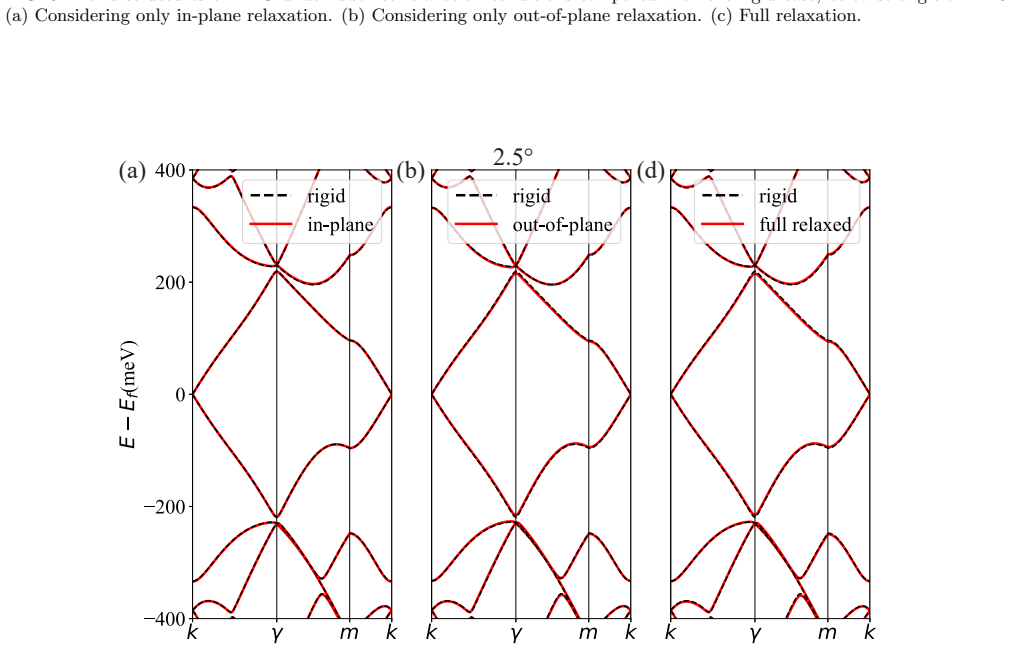
N. P. Kazmierczak, M. Van Winkle, C. Ophus, K. C. Bustillo, S. Carr, H. G. Brown, J. Ciston, T. Taniguchi, K. Watanabe, 19 (a) (b) (d) 0.95° FIG. 7. Band structures of TBG under distinct relaxation condit ions compared with the rigid case, at twist angle θ = 0 .95◦. (a) Consid...
2021
-
[84]
I. V. Lebedeva, A. A. Knizhnik, A. M. Popov, Y. E. Lozovik, and B. V. Potapkin, Interlayer interaction and relative vibrations of bilayer graphene, Phys. Chem. Chem. Phys. 13, 5687 (2011)
2011
-
[85]
G. S. Verhoeven, M. Dienwiebel, and J. W. M. Frenken, Model ca lculations of superlubricity of graphite, Phys. Rev. B 70, 165418 (2004)
2004
-
[86]
Uchida, S
K. Uchida, S. Furuya, J.-I. Iwata, and A. Oshiyama, Atomic corrugation and electron localization due to Moir´ e patterns in twisted bilayer graphenes, Phys. Rev. B 90, 155451 (2014)
2014
-
[87]
Shabani, D
S. Shabani, D. Halbertal, W. Wu, M. Chen, S. Liu, J. Hone, W. Y ao, D. N. Basov, X. Zhu, and A. N. Pasupathy, Deep moir´ e potentials in twisted transition metal dichalcogeni de bilayers, Nat. Phys. 17, 720 (2021)
2021
-
[88]
X. Liu, R. Peng, Z. Sun, and J. Liu, Moir´ e Phonons in Magi c-Angle Twisted Bilayer Graphene, Nano Lett. 22, 7791 (2022)
2022
-
[89]
J. Liu, Z. Fang, H. Weng, and Q. Wu, DPmoire: A tool for constru cting accurate machine learning force fields in moir´ e systems, arXiv:2412.19333 (2024)
2024
-
[90]
San-Jose, A
P. San-Jose, A. Guti´ errez-Rubio, M. Sturla, and F. Guinea , Spontaneous strains and gap in graphene on boron nitride, Phys. Rev. B 90, 075428 (2014)
2014
-
[91]
A. M. Popov, I. V. Lebedeva, A. A. Knizhnik, Y. E. Lozovik , and B. V. Potapkin, Commensurate-incommensurate phase transition in bilayer graphene, Phys. Rev. B 84, 045404 (2011)
2011
-
[92]
J. Jung, A. M. DaSilva, A. H. MacDonald, and S. Adam, Origin o f band gaps in graphene on hexagonal boron nitride, Nat Commun 6, 6308 (2015)
2015
-
[93]
K. V. Zakharchenko, M. I. Katsnelson, and A. Fasolino, Fi nite Temperature Lattice Properties of Graphene beyond the Quasiharmonic Approximation, Phys. Rev. Lett. 102, 046808 (2009)
2009
-
[94]
N. N. T. Nam and M. Koshino, Lattice relaxation and energy b and modulation in twisted bilayer graphene, Phys. Rev. B 96, 075311 (2017)
2017
-
[95]
V. V. Enaldiev, V. Z´ olyomi, C. Yelgel, S. J. Magorrian, an d V. I. Fal’ko, Stacking Domains and Dislocation Networks in Marginally Twisted Bilayers of Transition Metal Dichalcogenid es, Phys. Rev. Lett. 124, 206101 (2020)
2020
-
[96]
Igui˜ niz, R
N. Igui˜ niz, R. Frisenda, R. Bratschitsch, and A. Castell anos-Gomez, Revisiting the Buckling Metrology Method to Dete r- mine the Young’s Modulus of 2D Materials, Advanced Materials 31, 1807150 (2019)
2019
-
[97]
Androulidakis, K
C. Androulidakis, K. Zhang, M. Robertson, and S. Tawfick, T ailoring the mechanical properties of 2D materials and heterostructures, 2D Mater. 5, 032005 (2018)
2018
-
[98]
V. B. Shenoy, C. D. Reddy, A. Ramasubramaniam, and Y. W. Zha ng, Edge-Stress-Induced Warping of Graphene Sheets and Nanoribbons, Phys. Rev. Lett. 101, 245501 (2008)
2008
-
[99]
Y. Wei, B. Wang, J. Wu, R. Yang, and M. L. Dunn, Bending Rigi dity and Gaussian Bending Stiffness of Single-Layered Graphene, Nano Lett. 13, 26 (2013)
2013
-
[100]
Hajgat´ o, S
B. Hajgat´ o, S. G¨ uryel, Y. Dauphin, J.-M. Blairon, H. E. Miltner, G. Van Lier, F. De Proft, and P. Geerlings, Out-of-plane shear and out-of plane Young’s modulus of double-layer graph ene, Chemical Physics Letters 564, 37 (2013)
2013
-
[101]
Calis, N
M. Calis, N. Boddeti, and J. Scott Bunch, Blister test to measure the out-of-plane shear modulus of few-layer graphene, Nanoscale 17, 2235 (2025)
2025
-
[102]
Teklu, N
A. Teklu, N. Kern, N. Kuthirummal, J. Tidwell, M. Rabe, Y. G ong, W. Zhang, and L. Balicas, Experimental Analysis of the Elastic Moduli of Atomically Thin Transition Metal Dicha lcogenides, J. Phys. Chem. C 128, 20333 (2024)
2024
-
[103]
Fasolino, J
A. Fasolino, J. H. Los, and M. I. Katsnelson, Intrinsic rip ples in graphene, Nature Mater 6, 858 (2007)
2007
-
[104]
F. Wu, T. Lovorn, E. Tutuc, I. Martin, and A. H. MacDonald, Top ological Insulators in Twisted Transition Metal Dichalco- genide Homobilayers, Phys. Rev. Lett. 122, 086402 (2019)
2019
-
[105]
J. Cai, E. Anderson, C. Wang, X. Zhang, X. Liu, W. Holtzman n, Y. Zhang, F. Fan, T. Taniguchi, K. Watanabe, Y. Ran, T. Cao, L. Fu, D. Xiao, W. Yao, and X. Xu, Signatures of fractional q uantum anomalous Hall states in twisted MoTe2, Nature 622, 63 (2023)
2023
-
[106]
Y. Zeng, Z. Xia, K. Kang, J. Zhu, P. Kn¨ uppel, C. Vaswani, K. Watanabe, T. Taniguchi, K. F. Mak, and J. Shan, Thermodynamic evidence of fractional Chern insulator in moir´ e MoTe2, Nature 622, 69 (2023)
2023
-
[107]
F. Xu, Z. Sun, T. Jia, C. Liu, C. Xu, C. Li, Y. Gu, K. Watanab e, T. Taniguchi, B. Tong, J. Jia, Z. Shi, S. Jiang, Y. Zhang, X. Liu, and T. Li, Observation of Integer and Fractional Quantu m Anomalous Hall Effects in Twisted Bilayer MoTe 2, Phys. Rev. X 13, 031037 (2023)
2023
-
[108]
Regnault and B
N. Regnault and B. A. Bernevig, Fractional Chern Insulator, Phys. Rev. X 1, 021014 (2011)
2011
-
[109]
Sheng, Z.-C
D. Sheng, Z.-C. Gu, K. Sun, and L. Sheng, Fractional quantu m Hall effect in the absence of Landau levels, Nat Commun 2, 389 (2011)
2011
-
[110]
Q. Niu, D. J. Thouless, and Y.-S. Wu, Quantized Hall condu ctance as a topological invariant, Phys. Rev. B 31, 3372 (1985)
1985
-
[111]
Fukui, Y
T. Fukui, Y. Hatsugai, and H. Suzuki, Chern Numbers in Discre tized Brillouin Zone: Efficient Method of Computing (Spin) Hall Conductances, J. Phys. Soc. Jpn. 74, 1674 (2005)
2005
-
[112]
Cantele, D
G. Cantele, D. Alf` e, F. Conte, V. Cataudella, D. Ninno, an d P. Lucignano, Structural relaxation and low-energy properties of twisted bilayer graphene, Phys. Rev. Research 2, 043127 (2020)
2020
Reviewed August 4, 2026 · model on record in the stance chip above.
Discussion (0). Continue with ORCID to comment.