REVIEW 3 major objections 4 minor 34 references
Alleviating Cosmological Tensions with the Hadrosymmetric Twin Higgs
T0 review · 3 major / 4 minor · reviewed 2026-08-04 · deepseek-v4-flash
Pith's one-line read The Hadrosymmetric Twin Higgs model, a particle-physics fix for the hierarchy problem, cuts the Hubble tension from over 4σ to about 2.5σ and resolves the S8 clustering discrepancy, all without adding new relativistic species.
The pith
A machine-rendered reading of the paper's core claim, the machinery that carries it, and where it could break.
The reading
What carries the argument
The load-bearing object is the effective decaying dark matter (DDM) description of the twin pion sector. The background and perturbation equations let the twin-pion density ρ_DDM decay at a rate γ_DDM into visible photons, which add to the photon background and modify the photon perturbation hierarchy. The two new parameters, Ω_DDM (energy density) and γ_DDM (decay rate), are given flat priors and fitted to the data. The physical picture is that the neutral twin pion, a pseudo-Nambu-Goldstone boson, must decay to SM photons through an off-shell π0 before BBN, providing a prompt injection of photons that affects the recombination-era photon distribution and the matter power spectrum.
What would settle it
Compute the twin-pion relic abundance and decay width directly from the HTH Lagrangian, with a specified twin-pion mass and portal coupling, and check whether the predicted Ω_DDM and γ_DDM fall inside the posterior contours reported here; if the predicted values lie outside, the cosmological tension-alleviation would not be a genuine prediction of HTH. A complementary check is to measure CMB spectral distortions or BBN light-element abundances to bound the photon injection epoch and rate, comparing with the fitted γ_DDM.
Extended reading notes
Core claim
The central claim is that the HTH twin sector, although composed entirely of massive hadrons and containing no new light species, can simultaneously ease the Hubble and clustering tensions. In the model, twin neutral pions decay into SM photons, acting as a decaying dark matter fluid; this injection of radiation changes the CMB damping tail and the growth of structure. Using CMB temperature and polarization data plus a local Hubble measurement, the paper finds the tension drops from >4σ to ~2.5σ, and the S8 parameter is consistent with weak-lensing estimates once the local H0 prior is included. The paper emphasizes that this happens with ΔNeff ≃ 0, which distinguishes it from scenarios that
Load-bearing premise
The load-bearing assumption is that all twin-hadron physics can be compressed into a single decaying dark matter fluid with only two free parameters (Ω_DDM and γ_DDM), whose values are freely fitted rather than derived from the twin-pion mass, abundance, and decay width in the HTH model; if the actual twin hadron physics gives different values, the constraints say nothing about HTH.
Editorial extensions
If this is right
- If the HTH scenario is correct, a naturalness-motivated completion of the Standard Model can be consistent with the tight ΔNeff bound and still move H0 and S8 toward their locally measured values.
- The fit that includes the local H0 measurement forces the model to higher H0 and lower σ8, effectively removing the S8 tension without adding dark radiation.
- The fitted DDM parameters imply a specific, testable density and decay rate for the twin-pion fluid that future CMB and large-scale-structure data will constrain more tightly.
- The model predicts small shifts in the baryon density, cold dark matter density, and spectral index relative to ΛCDM, offering a distinct signature that could be separated from other early-universe solutions.
Reading between the lines
- The decisive check the paper leaves undone is a direct derivation of the twin-pion relic abundance, mass, and decay width from the HTH Lagrangian; if the real twin hadron dynamics produce different values, the fitted constraints might not apply to HTH at all.
- The mechanism is fairly generic: any hidden sector with short-lived massive states decaying to photons will shift H0 and S8 in a similar direction, so the result hints that the easing of tensions may not be unique to the HTH construction.
- The appendix's variant with light twin leptons removes the Hubble tension entirely through the standard sound-horizon reduction, which highlights that the minimal HTH's partial success works through late-time photon injection rather than early-time geometry.
Editorial analysis
A structured set of objections, weighed in public.
Referee Report
Summary. The paper claims that the Hadrosymmetric Twin Higgs (HTH) model, implemented as an effective decaying dark matter (DDM) fluid that decays into visible photons, can alleviate the Hubble and σ8 tensions. The authors implement Eqs. (2)–(3) in CLASS, run MontePython MCMC chains against Planck 2018 CMB data and optionally the SH0ES H0 measurement, and report that the Hubble tension drops from >4σ to ~2.5σ while σ8 is also reduced. An appendix considers an extension with light twin leptons (HTH+ΔNtwin) that fully resolves H0. The central mechanism is that twin neutral pions act as DDM with decay rate γDDM, injecting photons into the visible sector.
Significance. If the claimed reductions were real, the paper would be significant: it would show that a naturally motivated twin-sector model with ΔNeff≈0 can nevertheless produce early-time cosmological effects and partially reconcile CMB and local H0 measurements. The use of standard public Boltzmann and MCMC codes and the reported convergence checks are also positive features. However, as analyzed below, the best-fit DDM parameters are numerically negligible and inconsistent with the HTH pion lifetime, so the reported tension relief is not attributable to the HTH mechanism. The significance of the paper as it stands is therefore primarily as a cautionary example of posterior widening in models with new ineffective parameters.
major comments (3)
- [Sec. III, Eqs. (2)–(3), Table I] The best-fit DDM parameters make the source terms negligible. With ΩDDM=0.48×10^-5 and γDDM=1.68×10^-8 km s^-1 Mpc^-1, γDDM/H0≈2.5×10^-10. At recombination a≈9×10^-4 and ρDDM/ργ≈10^-4, so the photon perturbation coupling aγDDMρDDM/ργ in Eq. (3) is of order 10^-17; the background source in Eq. (2) is equally tiny. The fitted model is therefore numerically indistinguishable from ΛCDM. The claimed tension reduction cannot be produced by these terms and is instead an artifact of adding two poorly constrained parameters, as the paper itself acknowledges when it states that the HTH contours are broader due to the additional free parameters.
- [Sec. II vs Sec. III and Table I] The effective DDM fluid is inconsistent with the HTH microphysics described in the paper. Section II requires the neutral twin pion to decay before BBN, τπ'0<1 s. The fitted decay rate γDDM=1.68×10^-8 km s^-1 Mpc^-1≈5.4×10^-28 s^-1 corresponds to a decay time ≈6×10^19 yr, many orders of magnitude longer than the age of the universe. Conversely, a pion that decays before BBN has no late-time density to source the photon equations. Moreover, the twin-pion relic abundance, mass, and decay width are never derived from the HTH Lagrangian; the DDM fluid is simply assumed. Thus the fitted constraints do not test the HTH model.
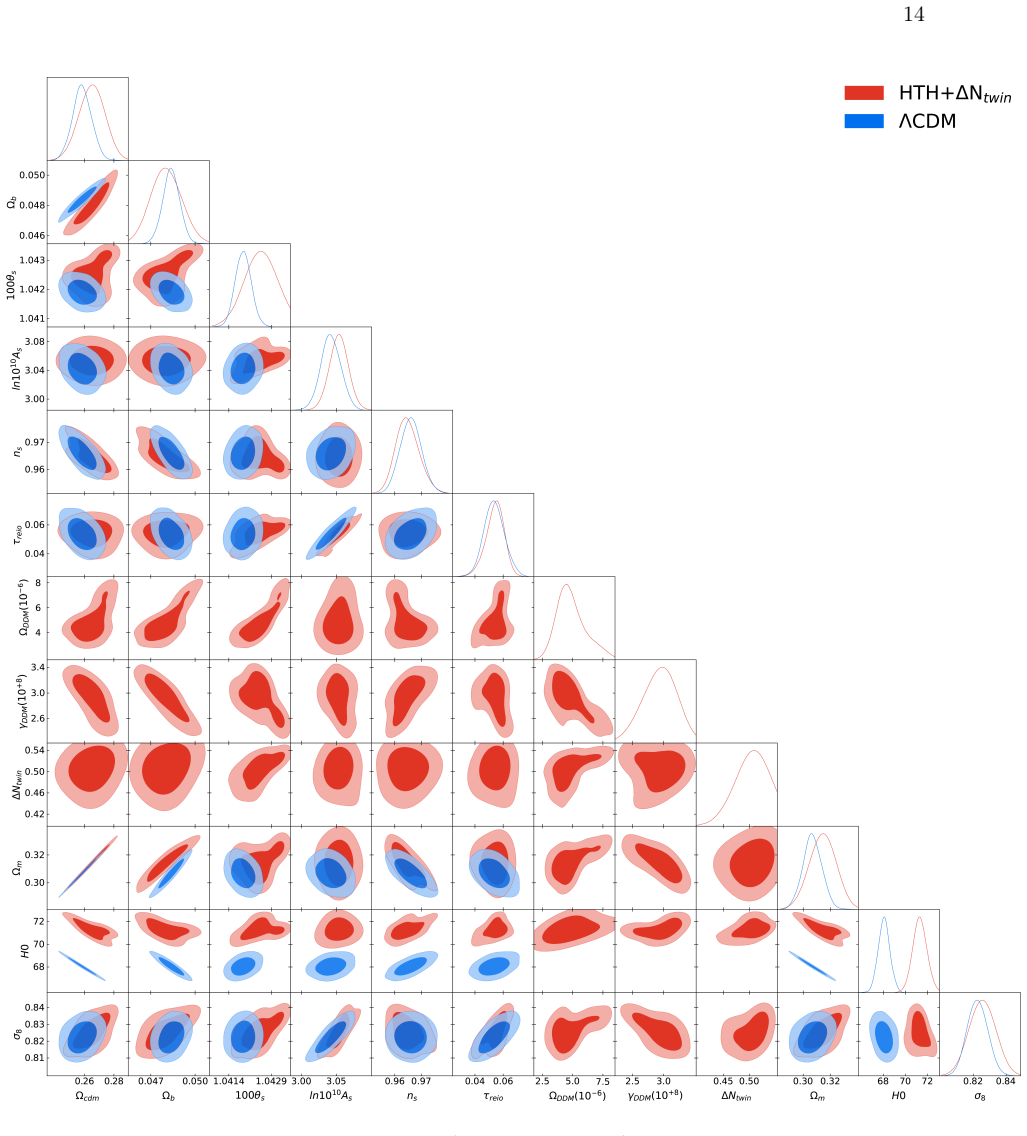
- [Sec. III, Table I and abstract] The claimed reduction of the Hubble tension is not supported by the central values. CMB-only H0 changes from 68.1±0.5 km/s/Mpc in ΛCDM to 68.3±1.0 km/s/Mpc in HTH, and the 95% interval widens from ±1.1 to ±2.6. The central shift is only 0.2 km/s/Mpc, while the error bars double. The reduction from '>4σ to about 2.5σ' therefore reflects prior-volume broadening rather than a physical preference for higher H0. A robust tension metric and a demonstration that the DDM source terms, not the priors, drive the change are required before the abstract's claim can be accepted.
minor comments (4)
- [Eq. (3)] The definitions below Eq. (3) refer to n_e as the 'number density of twin electrons' and σ_T as the Thomson cross-section 'for the twin sector', but the equations describe visible photon perturbations. These should be the visible-sector electron density and Thomson cross-section.
- [References] References [18] and [36] are identical Planck 2018 papers; consolidate to avoid duplication.
- [Figures and table] The notation for asymmetric credible intervals in Table I is difficult to parse (e.g., the HTH* and HTH+ΔNtwin rows). Also, the captions of Figs. 2 and 5 do not clearly state which contours correspond to which dataset combinations; please make the legend and caption consistent.
- [Appendix A] In Appendix A, ΔNtwin is a free parameter fitted to ΔNtwin=0.499, but the paper does not specify a freeze-out mechanism or derive the light-lepton abundance from the HTH model. As written, this extension is an essentially standard extra-radiation model rather than a prediction of HTH.
Circularity Check
No significant circularity: H0 and σ8 are fit outputs, not inputs, and self-citations are not load-bearing.
full rationale
Central derivation is self-contained: the model parameters ΩDDM and γDDM are free inputs with flat priors, while the reported values of H0, σ8, S8, and the tension statistics are posterior outputs of the MCMC rather than quantities defined in terms of those parameters. The effective DDM description is explicitly presented as a phenomenological modeling choice ('we model the twin-sector states ... as an effective decaying dark matter (DDM) component ... without relying on the detailed microphysics of the dark hadron spectrum'), so no HTH-specific prediction is being disguised as derived from the Lagrangian. The paper itself acknowledges the mechanism of tension reduction ('The HTH contours are broader due to the additional free parameters'), which is a posterior-broadening effect rather than a hidden identity. Self-citations (Refs [21,25,26,27]) appear only in the thematic literature list and are not load-bearing; the numerical work relies on public CLASS and MontePython codes and compares HTH against ΛCDM on the same Planck/SH0ES data, making the central comparison self-contained. The ΔN_twin appendix is an explicitly separate extension whose effect is the standard sound-horizon mechanism; it is fit-dependent and not presented as an independent prediction. The skeptical concern that the best-fit DDM parameters are dynamically negligible is a substantive validity issue, not a circular-reasoning issue.
Assumptions & free parameters
free parameters (3)
- ΩDDM =
0.48e-5 (Table I: 10^-5 Ωddm = 0.48)
- γDDM =
1.68e-8 km/s/Mpc
- ΔN_twin (appendix model HTH+ΔNtwin) =
0.499 ± 0.031
assumptions (5)
- ad hoc to paper Twin pions can be represented by a decaying-dark-matter fluid with decay rate γDDM producing visible photons (Eqs. 2-3).
- domain assumption The minimal HTH twin sector has ΔNeff = 0 and contains no light leptons or twin photons.
- domain assumption The neutral twin pion decays to SM photons before BBN via a UV twin-SM portal (π'0 → π0* → SM).
- ad hoc to paper Flat priors ΩDDM ∈ [0,0.1] and γDDM ∈ [0,2×10^3] km/s/Mpc span the cosmologically relevant parameter space.
- standard math The CLASS Boltzmann equations and MontePython MCMC sampling are correct.
Cite this review
Pith. "Pith review of Alleviating Cosmological Tensions with the Hadrosymmetric Twin Higgs." pith.science (2026). https://pith.science/paper/FZJBGMOC
@misc{pith2026251000852,
  author       = {Pith},
  title        = {Pith review of: Alleviating Cosmological Tensions with the Hadrosymmetric Twin Higgs},
  year         = {2026},
  howpublished = {\url{https://pith.science/paper/FZJBGMOC}},
  note         = {Machine review of arXiv:2510.00852}
}
abstract
The Hadrosymmetric Twin Higgs (HTH) model provides a natural solution to the little hierarchy problem by incorporating all three generations of quarks in a twin sector. Unlike other Twin Higgs scenarios, such as the Mirror Twin Higgs (MTH), the HTH framework avoids introducing additional light states or radiation and thus remains consistent with stringent bounds on the effective number of relativistic species, $\Delta N_{\rm eff}$. Its particle content and interactions also make it difficult to probe at colliders, highlighting the importance of cosmological tests. In this work, we study the cosmological implications of the HTH model, focusing on the persistent tensions in the Hubble constant ($H_0$) and the matter clustering amplitude ($\sigma_8$). Implementing the HTH sector in a Boltzmann code and confronting it with cosmic microwave background (CMB) data and local $H_0$ measurements, we find that HTH scenario partially reduces the Hubble tension from more than $4\sigma$ to about $2.5\sigma$, while also alleviating the $\sigma_8$ discrepancy. These results demonstrate that the HTH framework not only addresses naturalness in particle physics but also offers a viable route to mitigating current cosmological tensions, thereby strengthening the link between fundamental theory and precision cosmology.
Figures


Figures from the paper (3 more)


Reference graph
Works this paper leans on
-
[1]
Z. Chacko, H.-S. Goh, and R. Harnik,The Twin Higgs: Natural electroweak breaking from mirror symmetry, Phys. Rev. Lett.96(2006) 231802, [hep-ph/0506256]
arXiv 2006
-
[2]
Z. Chacko, H.-S. Goh, and R. Harnik,A Twin Higgs model from left-right symmetry,JHEP01(2006) 108, [hep-ph/0512088]. 13 Figure 4:Likelihood distributions for the HTH+∆N twin (red) model andΛCDM (blue) scenario. The addition of ultra-relativistic species clearly alleviates the Hubble tension. 65 70 75 H0 0.7 0.8 0.9 S8 Figure 5:Preferred ranges ofS 8 =σ 8 p...
arXiv 2006
- [3]
-
[4]
N. Craig and K. Howe,Doubling down on naturalness with a supersymmetric twin Higgs,JHEP03 (2014) 140, [1312.1341]. 15
arXiv 2014
-
[5]
A. Falkowski, S. Pokorski, and M. Schmaltz,Twin SUSY,Phys. Rev. D74(2006) 035003, [hep-ph/0604066]
arXiv 2006
-
[6]
P. Batra and Z. Chacko,A Composite Twin Higgs Model,Phys. Rev. D79(2009) 095012, [0811.0394]
arXiv 2009
-
[7]
R. Barbieri, D. Greco, R. Rattazzi, and A. Wulzer,The Composite Twin Higgs scenario,JHEP08 (2015) 161, [1501.07803]
arXiv 2015
-
[8]
M. Low, A. Tesi, and L.-T. Wang,Twin Higgs mechanism and a composite Higgs boson,Phys. Rev. D 91(2015) 095012, [1501.07890]
arXiv 2015
Show all 34 references
-
[9]
Burdman, Z
G. Burdman, Z. Chacko, R. Harnik, L. de Lima, and C. B. Verhaaren,Colorless Top Partners, a 125 GeV Higgs, and the Limits on Naturalness,Phys. Rev. D91(2015), no. 5 055007, [1411.3310]
2015 arXiv
-
[10]
Craig, S
N. Craig, S. Knapen, and P. Longhi,The Orbifold Higgs,JHEP03(2015) 106, [1411.7393]
2015 arXiv
-
[11]
Craig, S
N. Craig, S. Knapen, and P. Longhi,Neutral Naturalness from Orbifold Higgs Models,Phys. Rev. Lett.114(2015), no. 6 061803, [1410.6808]
2015 arXiv
-
[12]
Craig, A
N. Craig, A. Katz, M. Strassler, and R. Sundrum,Naturalness in the Dark at the LHC,JHEP07 (2015) 105, [1501.05310]
2015 arXiv
-
[13]
Craig, S
N. Craig, S. Knapen, P. Longhi, and M. Strassler,The Vector-like Twin Higgs,JHEP07(2016) 002, [1601.07181]
2016 arXiv
-
[14]
Freytsis, S
M. Freytsis, S. Knapen, D. J. Robinson, and Y. Tsai,Gamma-rays from Dark Showers with Twin Higgs Models,JHEP05(2016) 018, [1601.07556]
2016 arXiv
-
[15]
Schwaller, D
P. Schwaller, D. Stolarski, and A. Weiler,Emerging Jets,JHEP05(2015) 059, [1502.05409]
2015 arXiv
-
[16]
Cohen, M
T. Cohen, M. Lisanti, and H. K. Lou,Semivisible Jets: Dark Matter Undercover at the LHC,Phys. Rev. Lett.115(2015), no. 17 171804, [1503.00009]
2015 arXiv
-
[17]
A. G. Riesset. al.,Large Magellanic Cloud Cepheid Standards Provide a 1% Foundation for the Determination of the Hubble Constant and Stronger Evidence for Physics BeyondΛCDM,Astrophys. J.876(2019), no. 1 85, [1903.07603]. [18]PlanckCollaboration, N. Aghanim et. al.,Planck 2018...
2019 arXiv
-
[19]
Heymans et
C. Heymans et. al.,KiDS-1000 Cosmology: Multi-probe weak gravitational lensing and spectroscopic galaxy clustering constraints,Astron. Astrophys.646(2021) A140, [2007.15632]. [20]DESCollaboration, T. M. C. Abbott et. al.,Dark Energy Survey Year 3 Results: Cosmological Constrai...
2021 arXiv
-
[21]
Banihashemi, N
A. Banihashemi, N. Khosravi, and A. H. Shirazi,Ginzburg-Landau Theory of Dark Energy: A Framework to Study Both Temporal and Spatial Cosmological Tensions Simultaneously,Phys. Rev. D 99(2019), no. 8 083509, [1810.11007]
2019 arXiv
-
[22]
Vagnozzi,Consistency tests ofΛCDM from the early integrated Sachs-Wolfe effect: Implications for early-time new physics and the Hubble tension,Phys
S. Vagnozzi,Consistency tests ofΛCDM from the early integrated Sachs-Wolfe effect: Implications for early-time new physics and the Hubble tension,Phys. Rev. D104(2021), no. 6 063524, [2105.10425]. 16
2021 arXiv
-
[23]
M. A. Buen-Abad, G. Marques-Tavares, and M. Schmaltz,Non-Abelian dark matter and dark radiation, Phys. Rev. D92(2015), no. 2 023531, [1505.03542]
2015 arXiv
-
[24]
Bagherian, M
H. Bagherian, M. Joseph, M. Schmaltz, and E. N. Sivarajan,Confronting interacting radiation models for the Hubble tension with Lyman-αdata,Phys. Rev. D111(2025), no. 4 043513, [2405.17554]
2025 arXiv
-
[25]
Davari and N
Z. Davari and N. Khosravi,Can decaying dark matter scenarios alleviate both H0 andσ8 tensions?, Mon. Not. Roy.Astron. Soc.516(2022), no. 3 4373–4382, [2203.09439]
2022 arXiv
- [26]
-
[27]
Ashoorioon and Z
A. Ashoorioon and Z. Davari,Dark Matter Cosmology with Varying Viscosity: A Possible Resolution to the S8 Tension, Astrophys. J.959(2023), no. 2 120, [2303.06627]
2023 arXiv
-
[28]
Kamionkowski and A
M. Kamionkowski and A. G. Riess,The Hubble Tension and Early Dark Energy,Ann. Rev. Nucl. Part. Sci.73(2023) 153–180, [2211.04492]
2023 arXiv
-
[29]
Poulin, T
V. Poulin, T. L. Smith, and T. Karwal,The Ups and Downs of Early Dark Energy solutions to the Hubble tension: A review of models, hints and constraints circa 2023,Phys. Dark Univ.42(2023) 101348, [2302.09032]
2023 arXiv
-
[30]
Jedamzik and L
K. Jedamzik and L. Pogosian,Relieving the Hubble tension with primordial magnetic fields,Phys. Rev. Lett.125(2020), no. 18 181302, [2004.09487]. [31]CosmoV erse NetworkCollaboration, E. Di Valentino et. al.,The CosmoVerse White Paper: Addressing observational tensions in cosmo...
2020 arXiv
-
[32]
Bansal, J
S. Bansal, J. H. Kim, C. Kolda, M. Low, and Y. Tsai,Mirror twin Higgs cosmology: constraints and a possible resolution to the H0 and S8 tensions, JHEP05(2022) 050, [2110.04317]
2022 arXiv
-
[33]
Lesgourgues and T
J. Lesgourgues and T. Tram,The Cosmic Linear Anisotropy Solving System (CLASS) IV: efficient implementation of non-cold relics,JCAP09(2011) 032, [1104.2935]
2011 arXiv
-
[34]
Audren, J
B. Audren, J. Lesgourgues, K. Benabed, and S. Prunet,Conservative Constraints on Early Cosmology: an illustration of the Monte Python cosmological parameter inference code,JCAP02 (2013) 001, [1210.7183]
2013 arXiv
-
[35]
Brinckmann and J
T. Brinckmann and J. Lesgourgues,MontePython 3: boosted MCMC sampler and other features, Phys. Dark Univ.24(2019) 100260, [1804.07261]. [36]PlanckCollaboration, N. Aghanim et. al.,Planck 2018 results. VI. Cosmological parameters,Astron. Astrophys.641(2020) A6, [1807.06209]
2019 arXiv
-
[37]
A. G. Riesset. al.,A Comprehensive Measurement of the Local Value of the Hubble Constant with 1 km s−1Mpc −1 Uncertainty from the Hubble Space Telescope and the SH0ES Team,Astrophys. J. Lett.934(2022), no. 1 L7, [2112.04510]
2022 arXiv
-
[38]
Hildebrandt et
H. Hildebrandt et. al.,KiDS+VIKING-450: Cosmic shear tomography with optical and infrared data, Astron. Astrophys.633(2020) A69, [1812.06076]
2020 arXiv
Reviewed August 4, 2026 · model on record in the stance chip above.
Discussion (0). Sign in to comment.