REVIEW 3 major objections 4 minor 69 references
This paper argues that an equivalence-principle violation can be isolated as a specific 1/K dipole in the squeezed bispectrum, and that a practical quadratic estimator—not a full bispectrum analysis—can extract this signal with precision co
Reviewed by Pith at T0; open to challenge. T0 means a machine referee read the full paper against a public rubric. the ladder, T0–T4 →
T0 review · deepseek-v4-flash
2026-08-04 09:40 UTC pith:UWY4KSOY
load-bearing objection Solid methods paper on a quadratic-estimator EP test; the headline constraint is a degenerate product, but the paper is honest about it and the response decomposition is a useful contribution. the 3 major comments →
Density reconstruction from biased tracers: Testing the equivalence principle through consistency relations
The pith
A machine-rendered reading of the paper's core claim, the machinery that carries it, and where it could break.
Core claim
The central discovery is that a violation of the weak equivalence principle between two galaxy populations A and B produces a specific linear response in the local cross-power spectrum: f_S^(-)(k, K-k) = 2 P_L(k)[K·k/K^2 + O((K/k)^0)]. This anti-symmetric shift is the only one of the six gravitational response types (growth, shift, and tidal, each with symmetric and anti-symmetric parts) that the EP forces to vanish in standard gravity. The paper shows that a sub-optimal quadratic estimator built from this response—the displacement estimator—reconstructs the long-wavelength modes in a manner analogous to CMB lensing reconstruction, and that its cross-correlation with galaxies carries the 1/K
What carries the argument
The key object is the anti-symmetric shift response f_S^(-), which carries the dipole K·k/K^2 in the squeezed limit. In standard galaxy bias this response is switched off by the equivalence principle (C^S_[AB] = 0), so any non-zero amplitude is a smoking-gun signature of EP violation. The paper's quadratic estimator (the displacement estimator) uses a template f_D = 2 P_L(k) K·k/K^2, Wiener-filtering one tracer and inverse-variance-filtering the other, then multiplying with the dipole kernel and normalizing to recover the long mode. The effective bias b_D(K) of the reconstructed field then becomes flat on large scales only when the anti-symmetric shift is active, separating the EP signal fro
Load-bearing premise
The forecast constrains the product of the EP-violation amplitude and the anti-symmetric bias combination C^S_[AB]; the paper's promise of a precision test hinges on these EP-violating bias parameters being known, fitted, or modelled, since marginalizing over them washes out the constraints on the bare amplitude.
What would settle it
Run an N-body simulation with two species of tracer particles that couple differently to a fifth force. Measure the conditional response of their cross-power spectrum to a long-wavelength mode; the extracted 1/K dipole coefficient should equal 2 epsilon C^S_[AB] P_L(k) at leading order. If the quadratic estimator's cross-spectrum does not reproduce this amplitude to within the forecast errors, the response-based mapping between the estimator and the bispectrum envelope is incorrect.
If this is right
- If the central claim is correct, current and near-term galaxy surveys can run an equivalence-principle test through quadratic estimators rather than full bispectrum estimation, avoiding the difficult covariance and systematics steps of bispectrum analyses.
- The method provides a scale-dependent null test: a flat, scale-invariant contribution to the estimator cross-spectrum on large scales is the fingerprint of EP violation, and its absence with known bias parameters would tighten bounds on the product of the violation amplitude and the anti-symmetric bias combination.
- Including mildly nonlinear reconstruction scales (k_max,rec about 0.15 h/Mpc) yields sensitivity comparable to a direct bispectrum forecast with the same survey configuration, so the squeezed-limit information is largely captured by the quadratic approach.
- Because only the long-wavelength mode must be linear, the test inherits the usual robustness of consistency relations to nonlinear evolution, baryonic physics, and redshift-space distortions on small scales.
- The degeneracy with the unknown bias parameters b_epsilon,S_A and b_epsilon,S_B means that a detected anti-symmetric shift alone does not by itself pin down the bare EP-violation amplitude; a model for those biases is required to turn the product into a constraint on epsilon.
Where Pith is reading between the lines
- A testable extension would apply the same displacement estimator to tomographic bins of a single photometric survey, using redshift-split subsamples as the two tracers; this could enlarge the lever arm on the anti-symmetric bias combination C^S_[AB] without new instruments.
- The paper leaves the primordial-non-Gaussianity (PNG) contamination question open. A joint estimator that fits the 1/K^2 PNG monopole alongside the 1/K EP dipole, possibly with bias-hardening, could convert the null test into a two-parameter separation and is a natural next step.
- Tracer selection matters: the product C^S_[AB] = (b_epsilon,S_A b_1B - b_epsilon,S_B b_1A)/2 is maximized when the two populations have very different linear bias, so halo-split or colour-split samples within one survey offer a cheap way to increase signal-to-noise.
- The estimator is sub-optimal but separable and fast, so combining it with growth-type estimators in a joint Fisher analysis appears the most promising route to control the standard bias parameters b_2 and b_s2 while isolating the anti-symmetric shift.
Editorial analysis
A structured set of objections, weighed in public.
Referee Report
Summary. The paper develops a linear-response framework for the squeezed bispectrum of two biased tracers, decomposing the response into symmetric and antisymmetric growth, shift, and tidal parts. Its central theoretical result is that the equivalence principle (EP) requires the antisymmetric shift coefficient C^S_[AB] to vanish (Eq. 17), so an EP violation produces a characteristic 1/K dipole in the response f^{(-)}_S (Eq. 21). The authors construct a sub-optimal quadratic estimator (Eq. 27) based on this displacement response, test it on AbacusSummit mocks, and run Fisher forecasts for a DESI-like survey. The headline result is a forecasted uncertainty σ(ϵ × C^S_[AB]) ≃ 6 × 10^{-3} after marginalizing over standard bias parameters (Fig. 4), which they argue is competitive with direct bispectrum forecasts. However, the paper itself states that without knowledge of the EP-violating bias parameters b_{ϵ,S_X}, strong constraints on ϵ alone are not possible (Sec. V), and Appendix G demonstrates that marginalizing over the relative density bias b_r washes out constraints on ϵ. The theoretical derivation is clean, but the paper's presentation of the product constraint as an 'EP test' is not fully supported.
Significance. If the response decomposition and estimator framework are correct, this is a useful contribution: it gives a practical quadratic-estimator route to squeezed-bispectrum information, provides a clear symmetry-based identification of the EP-violating 1/K pole, includes public code, and validates the estimator on simulations. The scale separation in the response basis (G±, S±, T±) is a genuine handle, and the comparison with direct bispectrum forecasts is plausible for the product ϵ × C^S_[AB]. However, the main sensitivity is on a degenerate product of new physics and tracer-dependent bias, not on ϵ itself. As the paper acknowledges, this degeneracy is analogous to the b_φ × f_NL problem in PNG studies, and it is not resolved by the present forecasts. The paper's practical claim that surveys like DESI can already run an EP test is therefore not yet established; it requires either external priors on b_{ϵ,S_X} or a multi-tracer calibration strategy.
major comments (3)
- [Abstract; §IV, Fig. 4; §V; App. G, Figs. 12–14] The headline constraint is σ(ϵ × C^S_[AB]) ≃ 6 × 10^{-3}, but C^S_[AB] = (b_{ϵ,S_A}b_{1B} − b_{ϵ,S_B}b_{1A})/2 contains the EP-violating bias parameters b_{ϵ,S_X}, which are effectively unknown. Section V states 'without knowledge of b_{ϵ,S_X} strong constraints on ϵ will not be possible,' and Appendix G shows that under the Bottaro et al. model, marginalizing over the relative density bias b_r degrades σ_ϵ by about an order of magnitude (Figs. 12–14). The abstract and conclusions nevertheless present the result as a constraint on 'the overall amplitude of EP violation.' This is a load-bearing mismatch: the forecast constrains a degenerate product, not ϵ. The paper should either make the marginalized-ϵ forecast with an explicit b_ϵ prior the main result, or carefully limit the claim to detection of a nonzero product, which would still be an EP-violation signature but not a measurement of
- [§IV, Fig. 4; comparison with Refs. [55,56]] The grey band in Fig. 4 is taken from the Planck+DESI BAO constraint of Ref. [55] on ϵ, while the vertical axis is σ(ϵ × C^S_[AB]). The comparison is valid only under the assumptions C^S_[AB] ≃ 1 and that the fraction of interacting dark matter is of order unity. These are model assumptions external to the Fisher forecast and are not clearly stated in the figure or the surrounding text. Without this caveat, the claim that the QE is 'competitive' with direct bispectrum constraints conflates the product with the model-dependent parameter ϵ. Please state the assumption explicitly on the figure and in the comparison, and, if possible, show how the forecast changes when C^S_[AB] is allowed to vary within a plausible range.
- [§III.B, §IV; Eq. (33); Table II] The main forecast treats ϵ × C^S_[AB] as an independent parameter while marginalizing over b_{1X}, b_{2X}, b_{s2X}. However, in a generic EP-violating model the same ϵ also enters the anti-symmetric growth and tidal coefficients C^G_[AB] and C^T_[AB] (Table II). Appendix G shows that including these other responses can lead to partial cancellations in the estimator bias and to different marginalized constraints. The main forecast should state explicitly which anti-symmetric coefficients are held fixed, and justify why the S− term can be isolated without degeneracy with G− and T−. As it stands, the reader cannot tell whether the reported 6×10^{-3} is robust to plausible values of the other EP-violating bias coefficients.
minor comments (4)
- [Abstract; §VI] The abstract says 'constraints on the overall amplitude of EP violation,' but the paper constrains ϵ×C^S_[AB]. Please use consistent terminology, e.g. 'amplitude of the antisymmetric shift response' or 'product ϵ×C^S_[AB]' throughout.
- [Eq. (F6)] There appears to be a typographical error in Eq. (F6): 'N_{XD,shot}(KZ' should presumably read 'N_{XD,shot}(K)'. Please check the equation formatting.
- [Fig. 2 and Appendix D.4] The simulation validation is useful, but it is performed on standard ΛCDM simulations with no EP-violating signal. It validates the estimator implementation and the bias model, but not the ability to detect the 1/K dipole. The text should state more clearly that the simulation test is a null test only.
- [§IV.B] The redshift-binned Fisher analysis assumes independent redshift bins and ignores redshift-space distortions and photometric errors. These are listed as future work in §VI, but the reader should be reminded in §IV that the forecast is idealized in these respects.
Circularity Check
No circular reduction: Eq. (21) is a squeezed-limit SPT calculation and the QE forecast is a matched-filter Fisher calculation. The ϵ×C^S_[AB] degeneracy is an acknowledged limitation, not a circular step; score 2 reflects only a minor, non-load-bearing self-citation.
full rationale
The central theoretical step, Eq. (21), is obtained by taking the squeezed limit of the anti-symmetric shift kernel f^(−)_S from second-order SPT (Eqs. 14–15 and Appendix C), not by assuming the forecast target. The EP condition C^S_[AB]=0 follows from b_1A b_1B − b_1B b_1A = 0 in the standard bias expansion (Eq. 19); the nonzero case is explicitly parameterized from the Bottaro et al. relative-density model rather than presented as an independent derivation. The estimator (Eq. 27) is a matched filter to the pole of Eq. (21), and the forecast is a Fisher calculation for the amplitude of that template with Gaussian covariances and literature shot noise; no fitted subset is relabeled as a prediction. The paper itself flags the true limitation: 'Unfortunately, we do not know the EP-violating bias parameters b_ϵ,SA and b_ϵ,SB. We will instead constrain the combination ϵ×C^S_[AB] as a single quantity' (Sec. IV C), and 'without knowledge of b_ϵ,SX strong constraints on ϵ will not be possible' (Sec. V), with App. G showing marginalization over b_r washes out ϵ constraints. This is a bias-parameter degeneracy analogous to b_ϕ×f_NL, i.e. a correctness/interpretation risk, not a circular construction. Self-citations to [45] for QE noise formulas are re-derived in Appendices D/F and checked against AbacusSummit, so they are not load-bearing; per the scoring rubric this supports a low score, not a circularity finding.
Axiom & Free-Parameter Ledger
free parameters (4)
- relative density bias b_r (fiducial value 1) =
1 (assumed, following Schmidt 2016, Ref. [87])
- Linear bias ratio b_1B = 0.8 b_1A =
0.8 b_1A(z)
- Tracer number-density split (n_A = n_bar/3, n_B = n_bar/4) =
n_A = n_bar/3, n_B = n_bar/4
- Scale cuts k_min,rec = 0.051, k_max,rec = 0.15 h/Mpc and K_max = 0.05 h/Mpc =
0.051 / 0.15 / 0.05 h Mpc^-1
axioms (5)
- domain assumption Standard perturbation theory with Einstein-de Sitter kernels (17/21 growth, 2/7 tidal, shift coefficient exactly 1) applies to the second-order matter density.
- domain assumption Galaxy bias is local and quadratic: delta_X = b_1X delta_m + b_2X delta_m^2 + b_s2X s^2.
- domain assumption Initial conditions are Gaussian and adiabatic; local-type PNG is treated as separable.
- domain assumption Long modes are in the linear regime and the linear response truncation holds.
- ad hoc to paper The Bottaro et al. fifth-force model: scale-independent relations delta_r^(1) = (5/3) epsilon delta_m^(1), theta_r^(1)/( - H f_r) = delta_r^(1).
read the original abstract
Consistency relations of large-scale structure offer a unique and powerful test of the weak equivalence principle (EP) on cosmological scales. If the EP is violated, different tracers will undergo different accelerations in response to a uniform gravitational field, and this loss of universality manifests as a dipole with a characteristic $1/K$ scale dependence in the squeezed limit of the bispectrum. In this work we show that such a violation can be identified with a particular anti-symmetric modulation in the local cross-power spectrum of distinct tracers. Based on this observation, we propose to test the EP using quadratic estimators as a more practical alternative to the conventional approach of directly estimating the bispectrum. We apply our quadratic estimator to a DESI-like survey and forecast constraints on the overall amplitude of EP violation. Including mildly nonlinear scales in our reconstruction ($k_\mathrm{max}\simeq0.15\, h\,\mathrm{Mpc}^{-1}$), we find that our estimator is competitive with the more exhaustive direct bispectrum approach. This shows that surveys like DESI can already benefit from the quadratic estimator approach.
Figures




Reference graph
Works this paper leans on
-
[1]
Consider the fully-evolved nonlinear matter fluctuationδ m =δ m[δ0] =δ m[δS, δL]
Linear response at leading order Using the long–short split, we now give a calculation of the tree-level linear response functionf(k 1,k 2). Consider the fully-evolved nonlinear matter fluctuationδ m =δ m[δ0] =δ m[δS, δL]. The two-point function for this non-Gaussian field is⟨δ m(k1)δm(k2)⟩δL , where the scales are chosen so thatk 1, k2 >Λ≫K. Note that al...
-
[2]
(B3) that the mode couplingF S is affected by second-order gravitational evolution butnotby any galaxy bias operator (besides trivially linear bias)
EP-violating response The previous calculation showed in Eq. (B3) that the mode couplingF S is affected by second-order gravitational evolution butnotby any galaxy bias operator (besides trivially linear bias). We will now assume a more general galaxy bias model which involve shift operators typically forbidden by the EP. The basic assumption here is that...
-
[3]
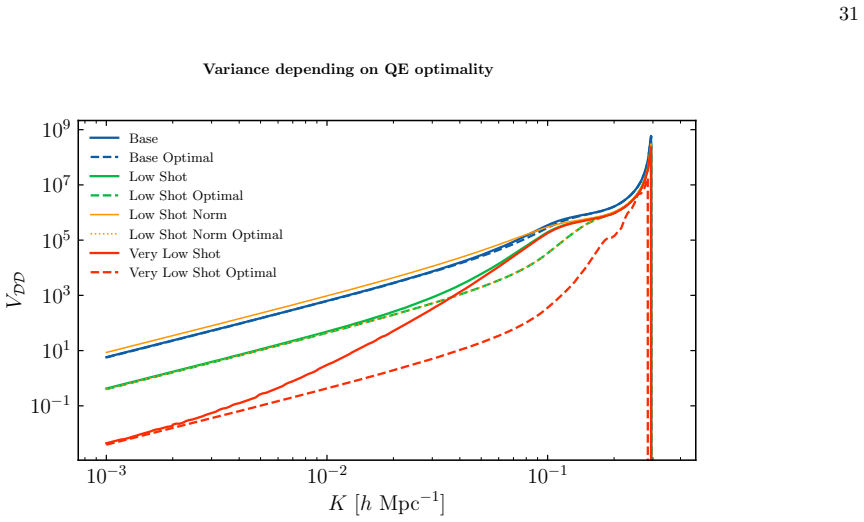
Properties of the sub-optimal quadratic estimator Reconstruction noise from Gaussian fluctuations.Using Eq. (D5), the variance of our estimator coming from disconnected Gaussian fluctuations is 10 V AB αβ (K) = Z k wα AB(k,K−k) h wβ AB(k,K−k)P AA tot (k)P BB tot (K−k) +w β AB(K−k,k)P AB cross(k)P AB cross(K−k) i =N AB αα (K)N AB ββ (K) Z k fα(k,K−k) 4P AA...
-
[4]
Cosmological Simulation Requirements
Application to simulations We apply our estimator to cosmological simulations. We do not aim for a rigorous analysis, rather show how we can get reasonable predictions for the QE with simple tools. We use four simulations from theAbacusSummitsuite of cosmologicalN-body simulations, run with the high- accuracyAbacuscode [58]. The simulations cover a 2h −1G...
-
[5]
The numerical results, cross+auto (green) and cross (orange), are in excellent agreement even for high number densities
V arying number densities Figure 16 shows the dependence of constraints on number density ¯n, assuming ¯n A = 1/3¯nand ¯nB = 1/4¯n. The numerical results, cross+auto (green) and cross (orange), are in excellent agreement even for high number densities. This is because the displacement estimator is still very noisy, even in low shot-noise regimes. For comp...
-
[6]
We take as our starting point Eq
Information comparison with a simple bispectrum estimator Here we make a quick comparison between the information content in cross-correlations, and that in a simple bispectrum estimator. We take as our starting point Eq. (F7) and continue our calculations from there. Using Eq. (32), the derivative with respect toϵis ∂ϵPXD (K) =b 1X ∂ϵbD(K)PL(K) =b 1X PL(...
-
[57]
For this we need only go up to second order in standard perturbation theory (SPT)
Standard response In this appendix we calculate the leading-order responsef AB, beginning from the definition (7). For this we need only go up to second order in standard perturbation theory (SPT). The tracer overdensity isδ X (k)≃δ (1) X (k)+δ (2) X (k), where δ(1) X (k) =b 1X δ(1) m (k), δ (2) X (k) = Z q F2X (q,k−q)δ (1) m (q)δ (1) m (k−q).(B1) Hereδ (...
-
[59]
To do this, we first require an unbiased cross-correlation of the reconstructed field with the desired field to get the large-scale signal of interest (e.g
Optimal quadratic estimator Given tracersAandB, a general quadratic estimator of the long mode based from theαresponse is bhα AB(K) = Z k wα AB(k,K−k)δ A(k)δB(K−k),(D1) where we assume some general weightingw α AB(k,K−k) which we will fix below. To do this, we first require an unbiased cross-correlation of the reconstructed field with the desired field to...
-
[60]
A sub-optimal quadratic estimator The weighting (D6) is not separable, hence not well suited for fast evaluation with Fourier transforms, unlike for typical quadratic estimators. We thus define the weights in the caseA=Bandf α symmetric under exchange of its arguments (as it is for the usual G +,S +,T + gravitational kernels): wα AA(k,K−k) =N AA αα (K) f ...
-
[63]
For an observableO, the Fisher information per 35 modeKis given in general by (e.g
Fisher matrix formalism The Fisher matrix provides an estimator of the inverse covariance of the maximum likelihood estimate under the assumption of Gaussianity around the peak of the likelihood [109]. For an observableO, the Fisher information per 35 modeKis given in general by (e.g. Refs. [109–111]) ˜Fmn(K) = Z q1 · · · Z qn−1 ∂O ∂θm Cov−1(O) ∂O ∂θn (F1...
-
[64]
For all retained parameters, we impose flat priors
Simplified Setup We construct various Fisher matricesF ab using the power spectra listed in Table III. For all retained parameters, we impose flat priors. Our parameter set includes the standard bias parameters{b 1X , b2X , bs2X }forX∈ {A, B}, but 38 excludes theϵ-related bias parameters{b ϵ,GX , bϵ,SX , bϵ,T X}, which are poorly constrained due to limite...
-
[65]
That is, we consider a scenario where EP violation leads tob ϵ,SX ̸= 0, butb ϵ,GX = 0 andb ϵ,TX = 0 (changes to the shift only)
Constraints from the anti-symmetric shift response As a first study of the estimator’s performance, we forecastϵconstraints expected solely from the shiftS(both symmetric and anti-symmetric). That is, we consider a scenario where EP violation leads tob ϵ,SX ̸= 0, butb ϵ,GX = 0 andb ϵ,TX = 0 (changes to the shift only). We will find that the constraints ar...
-
[66]
F. Bernardeau, S. Colombi, E. Gaztanaga, and R. Scoccimarro, Large scale structure of the universe and cosmological perturbation theory, Phys. Rept.367, 1 (2002), arXiv:astro-ph/0112551
Pith/arXiv arXiv 2002
-
[67]
V. Desjacques, D. Jeong, and F. Schmidt, Large-Scale Galaxy Bias, Phys. Rept.733, 1 (2018), arXiv:1611.09787 [astro- ph.CO]
Pith/arXiv arXiv 2018
-
[68]
F. R. Bouchet, R. Juszkiewicz, S. Colombi, and R. Pellat, Weakly Nonlinear Gravitational Instability for Arbitrary Omega, Astrophys. J. Lett.394, L5 (1992)
1992
-
[69]
T. Fujita and Z. Vlah, Perturbative description of biased tracers using consistency relations of LSS, JCAP10, 059, arXiv:2003.10114 [astro-ph.CO]
Pith/arXiv arXiv 2003
-
[70]
R. Takahashi, Third Order Density Perturbation and One-loop Power Spectrum in a Dark Energy Dominated Universe, Prog. Theor. Phys.120, 549 (2008), arXiv:0806.1437 [astro-ph]
Pith/arXiv arXiv 2008
-
[71]
M. Crisostomi, M. Lewandowski, and F. Vernizzi, Consistency relations for large-scale structure in modified gravity and the matter bispectrum, Phys. Rev. D101, 123501 (2020), arXiv:1909.07366 [astro-ph.CO]
Pith/arXiv arXiv 2020
-
[72]
D. Jeong and M. Kamionkowski, Clustering Fossils from the Early Universe, Phys. Rev. Lett.108, 251301 (2012), arXiv:1203.0302 [astro-ph.CO]
Pith/arXiv arXiv 2012
-
[73]
S. M. Carroll, S. Mantry, M. J. Ramsey-Musolf, and C. W. Stubbs, Dark-matter-induced violation of the weak equivalence principle, Physical Review Letters103, 10.1103/physrevlett.103.011301 (2009)
-
[74]
K. Akitsu, M. Takada, and Y. Li, Large-scale tidal effect on redshift-space power spectrum in a finite-volume survey, Phys. Rev. D95, 083522 (2017), arXiv:1611.04723 [astro-ph.CO]
Pith/arXiv arXiv 2017
-
[75]
Y. Li, M. Schmittfull, and U. Seljak, Galaxy power-spectrum responses and redshift-space super-sample effect, JCAP02, 022, arXiv:1711.00018 [astro-ph.CO]
-
[76]
M. Bucher, C. S. Carvalho, K. Moodley, and M. Remazeilles, CMB Lensing Reconstruction in Real Space, Phys. Rev. D 85, 043016 (2012), arXiv:1004.3285 [astro-ph.CO]
Pith/arXiv arXiv 2012
-
[77]
H. Prince, K. Moodley, J. Ridl, and M. Bucher, Real space lensing reconstruction using cosmic microwave background polarization, JCAP01, 034, arXiv:1709.02227 [astro-ph.CO]
-
[78]
E. Schaan and S. Ferraro, Foreground-Immune Cosmic Microwave Background Lensing with Shear-Only Reconstruction, Phys. Rev. Lett.122, 181301 (2019), arXiv:1804.06403 [astro-ph.CO]
Pith/arXiv arXiv 2019
-
[79]
J. Carron and A. Lewis, Spherical bispectrum expansion and quadratic estimators, JCAP07, 067, arXiv:2404.16797 [astro-ph.CO]
-
[80]
N. A. Maksimova, L. H. Garrison, D. J. Eisenstein, B. Hadzhiyska, S. Bose, and T. P. Satterthwaite, Abacussummit: 20 a massive set of high-accuracy, high-resolution n-body simulations, Monthly Notices of the Royal Astronomical Society 508, 4017 (2021), https://academic.oup.com/mnras/article-pdf/508/3/4017/40811763/stab2484.pdf
2021
-
[81]
L. A. Rizzo, D. F. Mota, and P. Valageas, Consistency relations for large-scale structures: Applications for the integrated Sachs-Wolfe effect and the kinematic Sunyaev-Zeldovich effect, Astron. Astrophys.606, A128 (2017), arXiv:1701.04049 [astro-ph.CO]
Pith/arXiv arXiv 2017
-
[82]
D. Green, Y. Guo, J. Han, and B. Wallisch, Light fields during inflation from BOSS and future galaxy surveys, JCAP 05, 090, arXiv:2311.04882 [astro-ph.CO]
-
[83]
T. Lazeyras, C. Wagner, T. Baldauf, and F. Schmidt, Precision measurement of the local bias of dark matter halos, JCAP 02, 018, arXiv:1511.01096 [astro-ph.CO]
-
[84]
M. M. Abidi and T. Baldauf, Cubic halo bias in eulerian and lagrangian space, Journal of Cosmology and Astroparticle Physics2018(07), 029–029
-
[85]
A. Barreira, Can we actually constrain f N Lusing the scale-dependent bias effect? An illustration of the impact of galaxy bias uncertainties using the BOSS DR12 galaxy power spectrum, JCAP11, 013, arXiv:2205.05673 [astro-ph.CO]
-
[86]
W. R. Coulton, F. Villaescusa-Navarro, D. Jamieson, M. Baldi, G. Jung, D. Karagiannis, M. Liguori, L. Verde, and B. D. Wandelt, Quijote-PNG: The Information Content of the Halo Power Spectrum and Bispectrum, Astrophys. J.943, 178 (2023), arXiv:2206.15450 [astro-ph.CO]
Pith/arXiv arXiv 2023
-
[87]
F. Schmidt, Effect of relative velocity and density perturbations between baryons and dark matter on the clustering of galaxies, Phys. Rev. D94, 063508 (2016), arXiv:1602.09059 [astro-ph.CO]
Pith/arXiv arXiv 2016
-
[88]
S.-F. Chen, E. Castorina, and M. White, Biased Tracers of Two Fluids in the Lagrangian Picture, JCAP06, 006, arXiv:1903.00437 [astro-ph.CO]
Pith/arXiv arXiv 1903
-
[89]
Barreira, G
A. Barreira, G. Cabass, D. Nelson, and F. Schmidt, Baryon-cdm isocurvature galaxy bias with illustristng, Journal of Cosmology and Astroparticle Physics2020(02), 005–005
-
[90]
H. Khoraminezhad, T. Lazeyras, R. E. Angulo, O. Hahn, and M. Viela, Quantifying the impact of baryon-CDM pertur- bations on halo clustering and baryon fraction, JCAP03, 023, arXiv:2011.01037 [astro-ph.CO]
Pith/arXiv arXiv 2011
- [91]
-
[92]
D. Baumann and D. Green, The power of locality: primordial non-Gaussianity at the map level, JCAP08(08), 061, arXiv:2112.14645 [astro-ph.CO]
-
[93]
Namikawa, D
T. Namikawa, D. Hanson, and R. Takahashi, Bias-hardened cmb lensing, Monthly Notices of the Royal Astronomical Society431, 609–620 (2013)
2013
-
[94]
D. J. Schlegelet al., Astro2020 APC White Paper: The MegaMapper: a z>2 Spectroscopic Instrument for the Study of Inflation and Dark Energy, Bull. Am. Astron. Soc.51, 229 (2019), arXiv:1907.11171 [astro-ph.IM]
Pith/arXiv arXiv 2019
-
[95]
A. Slosaret al.(PUMA), Packed Ultra-wideband Mapping Array (PUMA): A Radio Telescope for Cosmology and Transients, Bull. Am. Astron. Soc.51, 53 (2019), arXiv:1907.12559 [astro-ph.IM]
Pith/arXiv arXiv 2019
-
[96]
S. M. Carroll, S. Leichenauer, and J. Pollack, Consistent effective theory of long-wavelength cosmological perturbations, Phys. Rev. D90, 023518 (2014), arXiv:1310.2920 [hep-th]
Pith/arXiv arXiv 2014
-
[97]
H.-M. Zhu, U.-L. Pen, Y. Yu, X. Er, and X. Chen, Cosmic tidal reconstruction, Physical Review D93, 10.1103/phys- revd.93.103504 (2016)
doi:10.1103/phys- 2016
-
[98]
A. S. Maniyar, Y. Ali-Ha ¨ ımoud, J. Carron, A. Lewis, and M. S. Madhavacheril, Quadratic estimators for cmb weak lensing, Physical Review D103, 10.1103/physrevd.103.083524 (2021)
-
[99]
O. Darwishet al., The Atacama Cosmology Telescope: A CMB lensing mass map over 2100 square degrees of sky and its cross-correlation with BOSS-CMASS galaxies, Mon. Not. Roy. Astron. Soc.500, 2250 (2020), arXiv:2004.01139 [astro-ph.CO]
Pith/arXiv arXiv 2020
-
[100]
Jeong, Ph.D
D. Jeong, Ph.D. thesis, University of Texas (2010)
2010
-
[101]
K. C. Chan and L. Blot, Assessment of the information content of the power spectrum and bispectrum, Physical Review D96, 10.1103/physrevd.96.023528 (2017)
-
[102]
D. Ginzburg, V. Desjacques, and K. C. Chan, Shot noise and biased tracers: A new look at the halo model, Physical Review D96, 10.1103/physrevd.96.083528 (2017)
-
[103]
Hadzhiyska, L
B. Hadzhiyska, L. H. Garrison, D. Eisenstein, and S. Bose, The halo light-cone catalogues of abacussummit, Monthly Notices of the Royal Astronomical Society509, 2194 (2021), https://academic.oup.com/mnras/article- pdf/509/2/2194/41192331/stab3066.pdf
2021
-
[104]
P. Virtanenet al., SciPy 1.0–Fundamental Algorithms for Scientific Computing in Python, Nature Meth.17, 261 (2020), arXiv:1907.10121 [cs.MS]
Pith/arXiv arXiv 2020
-
[105]
Kokron, S.-F
N. Kokron, S.-F. Chen, M. White, J. DeRose, and M. Maus, Accurate predictions from small boxes: variance suppression via the zel’dovich approximation, Journal of Cosmology and Astroparticle Physics2022(09), 059
-
[106]
DeRose, S.-F
J. DeRose, S.-F. Chen, N. Kokron, and M. White, Precision redshift-space galaxy power spectra using zel’dovich control variates, Journal of Cosmology and Astroparticle Physics2023(02), 008
-
[107]
Hadzhiyskaet al., Mitigating the noise of DESI mocks using analytic control variates, Open J
B. Hadzhiyskaet al., Mitigating the noise of DESI mocks using analytic control variates, Open J. Astrophys.6, 2308.12343 (2023), arXiv:2308.12343 [astro-ph.CO]
Pith/arXiv arXiv 2023
-
[108]
N. Hand, Y. Feng, F. Beutler, Y. Li, C. Modi, U. Seljak, and Z. Slepian, nbodykit: an open-source, massively parallel toolkit for large-scale structure, Astron. J.156, 160 (2018), arXiv:1712.05834 [astro-ph.IM]
Pith/arXiv arXiv 2018
-
[109]
Dodelson and F
S. Dodelson and F. Schmidt,Modern Cosmology(Academic Press, 2020)
2020
-
[110]
Tegmark, A
M. Tegmark, A. N. Taylor, and A. F. Heavens, Karhunen-loeve eigenvalue problems in cosmology: How should we tackle large data sets?, The Astrophysical Journal480, 22–35 (1997)
1997
-
[111]
Heavens, Statistical techniques in cosmology (2010), arXiv:0906.0664 [astro-ph.CO]
A. Heavens, Statistical techniques in cosmology (2010), arXiv:0906.0664 [astro-ph.CO]. 21
Pith/arXiv arXiv 2010
-
[112]
Meureret al., Sympy: symbolic computing in python, PeerJ Computer Science3, e103 (2017)
A. Meureret al., Sympy: symbolic computing in python, PeerJ Computer Science3, e103 (2017)
2017
-
[113]
Bradbury, R
J. Bradbury, R. Frostig, P. Hawkins, M. J. Johnson, C. Leary, D. Maclaurin, G. Necula, A. Paszke, J. VanderPlas, S. Wanderman-Milne, and Q. Zhang, JAX: composable transformations of Python+NumPy programs (2018)
2018
-
[114]
P. G´ omez, H. Hem Toftevaag, and G. Meoni, torchquad: Numerical Integration in Arbitrary Dimensions with PyTorch, Journal of Open Source Software64, 10.21105/joss.03439 (2021)
-
[115]
Seljak, Extracting primordial non-gaussianity without cosmic variance, Phys
U. Seljak, Extracting primordial non-gaussianity without cosmic variance, Phys. Rev. Lett.102, 021302 (2009)
2009
-
[116]
McDonald and U
P. McDonald and U. Seljak, How to evade the sample variance limit on measurements of redshift-space distortions, Journal of Cosmology and Astroparticle Physics2009(10), 007–007
-
[117]
G. S. Farren, B. D. Sherwin, B. Bolliet, T. Namikawa, S. Ferraro, and A. Krolewski, Detection of the CMB lensing – galaxy bispectrum, (2023), arXiv:2311.04213 [astro-ph.CO]
Pith/arXiv arXiv 2023
-
[118]
Babich, Optimal estimation of non-Gaussianity, Phys
D. Babich, Optimal estimation of non-Gaussianity, Phys. Rev. D72, 043003 (2005), arXiv:astro-ph/0503375
Pith/arXiv arXiv 2005
-
[119]
J. R. Fergusson, D. M. Regan, and E. P. S. Shellard, Rapid separable analysis of higher order correlators in large-scale structure, Physical Review D86, 10.1103/physrevd.86.063511 (2012)
-
[120]
D. M. Regan, M. M. Schmittfull, E. P. S. Shellard, and J. R. Fergusson, Universal non-gaussian initial conditions for n-body simulations, Physical Review D86, 10.1103/physrevd.86.123524 (2012). Appendix A: Conditional averages and linear response In this appendix we clarify the meaning of⟨· · · ⟩δL by defining it explicitly in terms of the probability dis...
-
[121]
In particular, in the fifth force model of Ref
Constraints from other signatures A violation of the EP can also lead to an enhanced growth of structure. In particular, in the fifth force model of Ref. [31], it was shown that even for a single tracer competitive constraints onϵcan be obtained through an enhanced linear growth factor (specifically, Ref. [31] considers a model with a large fraction of se...
-
[122]
We clearly see how biases are well constrained when including this (compare blue vs red)
Marginalized constraints Figure 15 shows marginalized vs unmarginalized constraints on bias parameters depending on whether we include (red) or do not include (blue) the nonlinear growth estimator G +. We clearly see how biases are well constrained when including this (compare blue vs red). Roughly speaking, the growth estimator is taking a squared (filte...
discussion (0)
Sign in with ORCID, Apple, or X to comment. Anyone can read and Pith papers without signing in.