REVIEW 3 major objections 5 minor 2 cited by
ParaToric 1.0: Continuous-time quantum Monte Carlo for the toric code in a parallel field
T0 review · 3 major / 5 minor · reviewed 2026-08-04 · deepseek-v4-flash
Pith's one-line read ParaToric is a continuous-time quantum Monte Carlo package for the toric code in parallel X and Z fields, extended with two new updates that keep sampling ergodic at high temperature and zero off-diagonal field.
desk verdict Well-built, well-documented CT-QMC code for the toric code; the new global-flip updates are the load-bearing novelty and they lack the detailed-balance/ergodicity documentation that the journal should require. read the letter →
The pith
A machine-rendered reading of the paper's core claim, the machinery that carries it, and where it could break.
The reading
What carries the argument
The central object is the continuous-time quantum Monte Carlo representation of the extended toric-code partition function, in which worldlines in imaginary time are generated by off-diagonal spin flips. On top of the original five update types, ParaToric adds two full-imaginary-time-axis updates: one flips a single bond's spin for the entire imaginary-time interval, the other flips all spins on a plaquette (in the X-basis) or a star (in the Z-basis) for the entire interval. These updates move the spin at the boundary τ=0=β, which is otherwise frozen in high-temperature and zero-off-diagonal-field regimes, thereby restoring connectivity of the sampled configuration space. Their stated cost i
What would settle it
On a small (e.g., 4×4) square lattice at h=0, λ=0, and high temperature, run a chain from a staggered initial configuration and check whether the spin at τ=0 ever flips. Then compare the acceptance ratio reported for the full-axis update with the exact Metropolis ratio obtained by enumerating the diagonal-energy change for each possible configuration; a mismatch, or a chain that remains stuck in one τ=0 sector, would falsify the ergodicity claim.
Extended reading notes
Core claim
ParaToric implements the original continuous-time quantum Monte Carlo algorithm for the toric code in parallel X and Z fields and extends it with two updates that flip an entire bond's spin, or an entire plaquette's (or star's) spin, along the full imaginary-time axis. These updates are introduced to cure a specific ergodicity failure: at high temperature and at zero off-diagonal field, the spin at the periodic boundary (0=β) cannot be flipped, so the original update set cannot move between certain sectors. The paper asserts that the new updates make the Markov chain ergodic in those regimes, cost little because they only change the cached total diagonal energy, and also shorten autocorrelat
Load-bearing premise
The load-bearing premise is that the two full-imaginary-time-axis flip updates satisfy detailed balance and connect all configurations that the original updates cannot reach; the paper asserts this but does not derive the acceptance probabilities or prove ergodicity.
Editorial extensions
If this is right
- Users can simulate the perturbed toric code on square, triangular, honeycomb, and cubic lattices with periodic or open boundaries at finite temperature.
- The new updates extend the reach of the algorithm to high temperatures and to h=0 or λ=0, regimes that were previously problematic or inaccessible for ergodic sampling.
- Snapshot output in both X and Z bases lets the package generate training and benchmarking data for lattice-gauge-theory simulators, cold-atom quantum simulators, and error-correction studies.
- The reported near-independence of runtime from β means very low temperatures can be reached with only logarithmic search overhead.
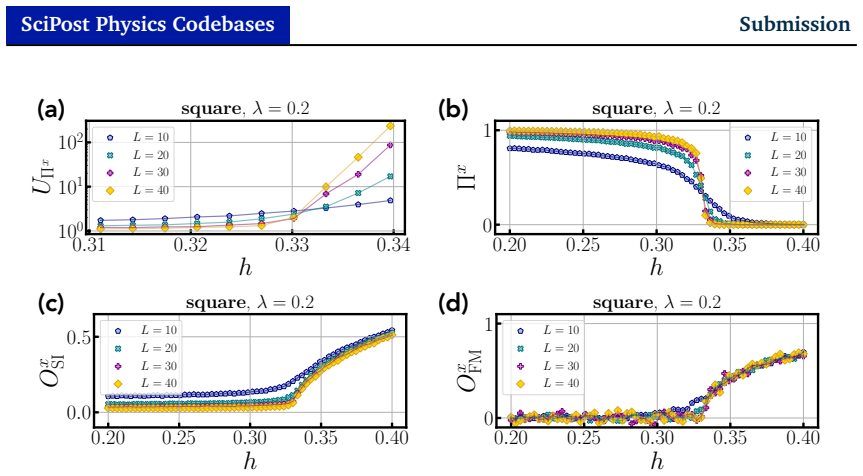
- Reproducing the known h_c≈0.33 boundary validates the implementation on a global phase-transition observable, not just local quantities.
Reading between the lines
- Because the full-axis updates only involve diagonal energy, the same construction should transfer to other sign-problem-free stabilizer-plus-field models—e.g., generalized Ising gauge theories with longer-range diagonal couplings—provided the new update set is checked for balance.
- The percolation and Fredenhagen-Marcu observables need only equal-time snapshots, so the snapshot output could be used directly to train neural-network state classifiers or to benchmark tensor-network results.
- The zero-field regime is exactly where the topological phase is most stable, so if the new updates are truly ergodic there, ParaToric could probe ground-state physics at large L without the usual restriction to finite off-diagonal fields.
- A natural next step would be to measure the off-diagonal Fredenhagen-Marcu string operators and Rényi entropies, which the paper lists as requiring major code changes; the current package's clean interface makes such extensions a concrete test of its design.
Editorial analysis
A structured set of objections, weighed in public.
Referee Report
Summary. The manuscript presents ParaToric, a C++/Python software package for continuous-time quantum Monte Carlo (CT-QMC) simulations of the toric code in a parallel field. It implements the Wu–Deng–Prokof'ev algorithm on square, triangular, honeycomb, and cubic lattices with open or periodic boundaries, and it introduces two new updates that flip a spin on the entire imaginary-time axis on one bond or on a plaquette/star. The paper documents the API, installation, observables, diagnostics, and benchmarks, including a reproduction of the known topological transition at h_c(λ=0.2)≈0.33. The central claimed novelty is that the two global-flip updates restore ergodicity at high temperatures and zero off-diagonal field, but this claim is asserted without a detailed-balance proof or a numerical test in the target regime.
Significance. If the algorithmic extension is correct, ParaToric would be a useful, interoperable finite-temperature solver for the extended toric code, with attractive features: multi-language bindings, snapshot export to GraphML, autocorrelation diagnostics, and bootstrap error analysis. The phase-transition benchmark is a genuinely nontrivial validation: no parameter is fitted, and the reported h_c is consistent with independent literature [5]. Credit is also due for the explicit thermalization and autocorrelation guidance, which is often missing in codebase papers. However, the only advertised algorithmic novelty — the two full-axis flip updates — is not supported by any derivation or by a benchmark in the regime they are designed for. Since the abstract and conclusion rest on this extension, the paper currently cannot be accepted as a validated codebase publication.
major comments (3)
- [§4.1, Monte Carlo Updates] The two new full-axis flip updates are described only verbally. There is no statement of the proposal distribution, no Metropolis acceptance-ratio derivation, and no proof that the combined seven-update set satisfies detailed balance or connects all spin sectors. The statement that 'the spin at imaginary time 0=β cannot be flipped' is an ergodicity assertion, not a proof. This matters because the abstract and conclusion claim that these updates 'enable ergodicity at large temperatures and at zero off-diagonal field.' The paper's own §4.3.9 advises benchmarking new features, but no benchmark in the target regime is provided. Please add a derivation (including the change in the total integrated diagonal energy and the proposal probabilities) and a numerical validation against exact diagonalization or a sector-connectivity check in the high-temperature/zero-field regime.
- [§4.4.4, Topological phase transition] This benchmark does not exercise the regime the new updates target. It uses T=1/L (low temperature) and λ=0.2 (finite off-diagonal field), where the original five Wu–Deng–Prokof'ev updates are expected to be ergodic. A clean reproduction of h_c(λ=0.2)≈0.33 therefore does not support the claim that the global-axis flips restore ergodicity at high temperature or zero off-diagonal field. Add benchmarks at small β and at h=0 or λ=0, with acceptance ratios and autocorrelation times, and compare against exact diagonalization or high-temperature series for small systems.
- [Code availability] The manuscript text does not provide a repository URL, version tag, or DOI for the ParaToric source code. For a codebase submission, reproducibility of the benchmarks and inspection of the update implementation are central. Please add a clear Code Availability statement and, if possible, provide reviewer instructions for reproducing the benchmark figures with a fixed seed.
minor comments (5)
- [§4.2.3, Error bars] The text says 'the only parameter that the user can change is the number of bootstrap resamples N_between_steps.' The parameter name should be N_resamples, not N_between_steps.
- [§4.3.6, Choosing N_between_samples] The sentence 'The optimal choice for N_samples is the integrated autocorrelation time' appears to be a typo; presumably the optimal thinning interval N_between_samples should be compared with τ_int.
- [§2.2 / Abstract] The abstract mentions 'smooth open boundaries' while the body only lists 'open' boundaries. Please align the terminology.
- [§4.1] The phrase 'spin at imaginary time 0=β' is confusing; it should read 'τ=0, which is identified with τ=β by periodicity.'
- [§4.4.3, Run-time] The runtime benchmark uses a single run per system size and notes non-identical laptop conditions. This is acceptable as an indicative benchmark, but it would be clearer to label the table as a single-run timing estimate rather than a robust performance measurement.
Circularity Check
No significant circularity: benchmark anchored to independent literature h_c; no output is defined in terms of the target result.
full rationale
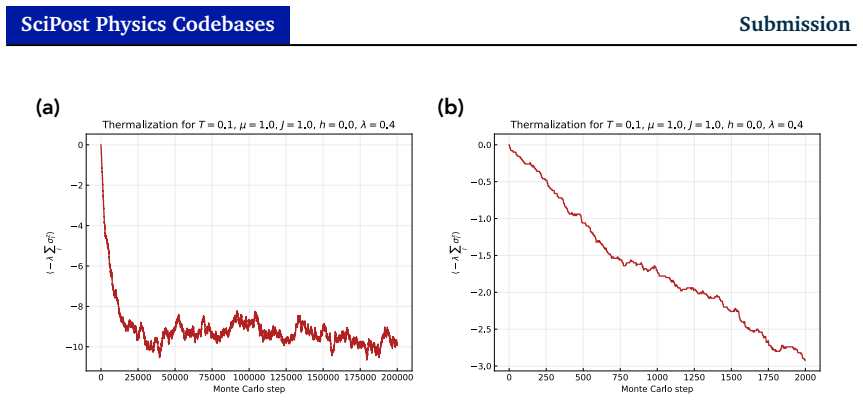
I walked the claimed derivation chain. The paper's central validation is the reproduction of the known topological phase boundary h_c(lambda=0.2)≈0.33 in §4.4.4, with observables measured by the implemented CT-QMC code. That critical value is cited to the independent Wu-Deng-Prokof'ev reference [5] as well as to the authors' own [9], and no parameter in ParaToric is fitted to h_c; the simulation outputs are not constructed from or defined in terms of h_c. The new all-imaginary-time-axis flip updates in §4.1 are claimed to restore ergodicity at high temperature and zero off-diagonal field, but the paper gives no detailed-balance proof, acceptance-ratio derivation, or ergodicity argument, and the §4.4.4 benchmark at T=1/L with lambda=0.2 does not exercise that regime. However, an unsupported or unvalidated algorithmic claim is a correctness/evidence gap, not circularity: the ergodicity assertion is not equivalent by construction to the results it is meant to enable. The paper itself advises in §4.3.9 that added features should be benchmarked against analytical results or other methods. Self-citations [9-11] supply order-parameter definitions and prior context, but the key benchmark value is independently anchored by [5], so the self-citations are not load-bearing in the sense of making the validation reduce to the paper's own prior output. Thus no circular step can be exhibited, and the appropriate finding is no significant circularity.
Assumptions & free parameters
assumptions (4)
- domain assumption The parallel-field toric code Hamiltonian is sign-problem-free for J,λ>0 in the σ^x-basis and μ,h>0 in the σ^z-basis.
- standard math Detailed balance and ergodicity of the seven updates imply convergence to the Gibbs state.
- ad hoc to paper The two new full-axis flip updates preserve detailed balance and connect previously disconnected sectors.
- domain assumption The literature value h_c(λ=0.2)≈0.33 from refs [5,9] is accurate enough to serve as a benchmark.
Cite this review
Pith. "Pith review of ParaToric 1.0: Continuous-time quantum Monte Carlo for the toric code in a parallel field." pith.science (2026). https://pith.science/paper/JMHABN3Q
@misc{pith2026251014781,
  author       = {Pith},
  title        = {Pith review of: ParaToric 1.0: Continuous-time quantum Monte Carlo for the toric code in a parallel field},
  year         = {2026},
  howpublished = {\url{https://pith.science/paper/JMHABN3Q}},
  note         = {Machine review of arXiv:2510.14781}
}
abstract
We introduce ParaToric, a C++ package for simulating the toric code in a parallel field (i.e., $X$- and $Z$-fields) at finite temperature. We implement and extend the continuous-time quantum Monte Carlo algorithm of Wu, Deng, and Prokof'ev on the square, triangular, honeycomb, and cubic lattices with either periodic or smooth open boundaries. The package is expandable to arbitrary lattice geometries and custom observables diagonal in either the $X$- or $Z$-basis. ParaToric also supports snapshot extraction in both bases, making it ideal for generating training/benchmarking data for other methods, such as lattice gauge theories, cold atom or other quantum simulators, quantum spin liquids, artificial intelligence, and quantum error correction. The software provides bindings to C/C++ and Python, and is thus almost universally integrable into other software projects.
Figures

Forward citations
Cited by 2 Pith papers
-
Quantized topological invariant of symmetry-projected Gibbs states
Symmetry projection converts the thermally trivial 3D cluster model into a system with SPT, projected-paramagnetic, and disordered phases, distinguished by a quantized membrane invariant taking values -1, +1, and 0.
-
Distinct finite-temperature phase diagrams of non-invertible Kennedy--Tasaki duals
In three dimensions, a cluster-model interpolation and its non-invertible Kennedy–Tasaki dual have inequivalent finite-T phase diagrams over a finite window of the interpolation, proven exactly at s=0 and mapped by QMC.
Reference graph
Works this paper leans on
-
[5]
F. Wu, Y. Deng and N. Prokof'ev, Phase diagram of the toric code model in a parallel magnetic field, Phys. Rev. B 85, 195104 (2012), doi:10.1103/PhysRevB.85.195104
-
[1]
A. Kitaev, Fault-tolerant quantum computation by anyons, Annals of Physics 303(1), 2 (2003), doi:https://doi.org/10.1016/S0003-4916(02)00018-0
-
[2]
E. Dennis, A. Kitaev, A. Landahl and J. Preskill, Topological quantum memory, Journal of Mathematical Physics 43(9), 4452 (2002), doi:10.1063/1.1499754, https://pubs.aip.org/aip/jmp/article-pdf/43/9/4452/19183135/4452_1_online.pdf
-
[3]
A. G. Fowler, M. Mariantoni, J. M. Martinis and A. N. Cleland, Surface codes: Towards practical large-scale quantum computation, Phys. Rev. A 86, 032324 (2012), doi:10.1103/PhysRevA.86.032324
-
[4]
J. B. Kogut, An introduction to lattice gauge theory and spin systems, Rev. Mod. Phys. 51, 659 (1979), doi:10.1103/RevModPhys.51.659
-
[6]
K. Fredenhagen and M. Marcu, Charged states in z2 gauge theories, Communications in Mathematical Physics 92(1), 81 (1983), doi:10.1007/BF01206315
-
[7]
K. Fredenhagen and M. Marcu, Confinement criterion for qcd with dynamical quarks, Phys. Rev. Lett. 56, 223 (1986), doi:10.1103/PhysRevLett.56.223
-
[8]
K. Fredenhagen and M. Marcu, Dual interpretation of order parameters for lattice gauge theories with matter fields, Nuclear Physics B - Proceedings Supplements 4, 352 (1988), doi:https://doi.org/10.1016/0920-5632(88)90124-7
Show all 18 references
-
[9]
S. M. Linsel, A. Bohrdt, L. Homeier, L. Pollet and F. Grusdt, Percolation as a confinement order parameter in z2 lattice gauge theories, Phys. Rev. B 110, L241101 (2024), doi:10.1103/PhysRevB.110.L241101
2024 doi
-
[10]
D\"unnweber, S
G. D\"unnweber, S. M. Linsel, A. Bohrdt and F. Grusdt, Percolation renormalization group analysis of confinement in z2 lattice gauge theories, Phys. Rev. B 111, 024314 (2025), doi:10.1103/PhysRevB.111.024314
2025 doi
-
[11]
S. M. Linsel, L. Pollet and F. Grusdt, Independent e- and m-anyon confinement in the parallel field toric code on non-square lattices, doi:10.48550/arXiv.2504.03512 (2025)
2025 doi
-
[12]
Matsumoto and T
M. Matsumoto and T. Nishimura, Mersenne twister: a 623-dimensionally equidistributed uniform pseudo-random number generator, ACM Trans. Model. Comput. Simul. 8, 3 (1998)
1998
-
[13]
Wolff, Critical slowing down, Nuclear Physics B - Proceedings Supplements 17, 93 (1990), doi:https://doi.org/10.1016/0920-5632(90)90224-I
U. Wolff, Critical slowing down, Nuclear Physics B - Proceedings Supplements 17, 93 (1990), doi:https://doi.org/10.1016/0920-5632(90)90224-I
1990 doi
-
[14]
D. N. Politis and J. P. Romano, The stationary bootstrap, Journal of the American Statistical Association 89(428), 1303 (1994), doi:10.1080/01621459.1994.10476870
1994
-
[15]
D. N. Politis and H. White, Automatic block-length selection for the dependent bootstrap, Econometric Reviews 23(1), 53 (2004), doi:10.1081/ETC-120028836
2004 doi
-
[16]
Patton, D
A. Patton, D. N. Politis and H. White, Correction to ``automatic block-length selection for the dependent bootstrap'' by d. politis and h. white, Econometric Reviews 28(4), 372 (2009), doi:10.1080/07474930802459016
2009 doi
-
[17]
, " * write output.state after.block =
ENTRY address archive author booktitle chapter doi edition editor eid eprint howpublished institution isbn journal key month note number organization pages publisher school series title type url volume year label INTEGERS output.state before.all mid.sentence after.sentence aft...
-
[18]
write newline
" write newline "" before.all 'output.state := FUNCTION n.dashify 't := "" t empty not t #1 #1 substring "-" = t #1 #2 substring "--" = not "--" * t #2 global.max substring 't := t #1 #1 substring "-" = "-" * t #2 global.max substring 't := while if t #1 #1 substring * t #2 gl...
Reviewed August 4, 2026 · model on record in the stance chip above.
Discussion (0). Continue with ORCID to comment.