REVIEW 3 major objections 6 minor 59 references
Consistent Zero-Shot Imitation with Contrastive Goal Inference
T0 review · 3 major / 6 minor · reviewed 2026-08-04 · deepseek-v4-flash
Pith's one-line read Zero-shot imitation reduces to goal inference: a self-supervised agent infers the demonstrator's goal from one trajectory and commands a contrastive goal-conditioned policy, and this procedure is proven consistent.
desk verdict CIRL's consistency theorem doesn't apply to the GoalKDE-based algorithm that was actually run, though the FB counterexample is a genuine contribution. read the letter →
The pith
A machine-rendered reading of the paper's core claim, the machinery that carries it, and where it could break.
The reading
What carries the argument
The key machinery is Lemma 1, an identity that converts MaxEnt IRL into a variational goal-inference objective. The forward KL between expert and model trajectory distributions decomposes via the KL chain rule; because the same goal prior appears in both joints, the objective becomes a variational posterior-matching problem. The crucial trick is that trajectories are sampled from the MaxEnt policy (g∼p(g), τ∼p*(τ|g)), so the intractable partition function Z_g is accounted for implicitly in the sample distribution. This is coupled with two supporting components: a mean-field variational family (Corollary 1) that contains the true posterior for finite trajectories, and GoalKDE, an automatic go
What would settle it
On a locomotion task, train CIRL with GoalKDE exploration but evaluate on expert trajectories whose true goals lie in a region GoalKDE rarely visited during training (e.g., a far corner of the arena). Plot the MAP-inferred goal against the true goal across many demonstrations: if the consistency claim holds for the algorithm as run, the inferred goals should be unbiased; any systematic bias toward the visited low-density region — and a corresponding drop in imitation score relative to oracle goal sampling — would refute the claim as applied.
Extended reading notes
Core claim
The paper's central claim is an equivalence (Lemma 1): under MaxEnt IRL with goal-conditioned rewards, minimizing the forward KL between expert and model trajectory distributions (with a shared goal prior) is equivalent to maximizing a variational goal-inference objective — min_θ E_{p(g)} D_KL(p_E(τ|g)∥p*(τ|g)) ⟹ max_ξ E_{g∼p(g),τ∼p*(τ|g)} log q_ξ(g|τ). The partition function encoding the relative difficulty of reaching goals is never computed; it is implicitly captured by sampling trajectories from the MaxEnt policy. The paper further proves (Corollary 1) that a mean-field variational posterior is without loss of generality for finite trajectories, and gives a counterexample (Lemma 2) showi
Load-bearing premise
The consistency proof assumes the goal distribution used during pretraining is the same as the expert's goal prior and that the learned MaxEnt policy is optimal; in practice GoalKDE explores low-density states rather than sampling from the test-time goal prior, so the theorem does not apply to the algorithm as run — a gap the authors attribute for most of the performance loss.
Editorial extensions
If this is right
- Agents can be pretrained for imitation entirely through self-supervised interaction — no rewards, no demonstrations, no human preference data — and then imitate a single expert trajectory at test time.
- Because goal inference accounts for the relative difficulty of reaching states, an infrequently visited but intended state is correctly identified as the goal, something occupancy-based IRL methods provably fail to do.
- By enlarging the goal space (e.g., adding velocity to position), the same framework can imitate reward-maximizing policies that are not explicitly goal-reaching, as demonstrated on standard benchmark tasks.
- Mean-field goal inference, which predicts the goal independently from each state-action pair, is both computationally cheaper and, when the true posterior is mean-field, exactly as expressive as full-trajectory encoders.
- The proven failure of Forward-Backward representations (Lemma 2) is a caution: using occupancy measures directly as rewards is fundamentally inadequate for zero-shot imitation.
Reading between the lines
- The consistency theorem requires the goal prior used in pretraining to equal the expert's goal prior. The deployed algorithm uses GoalKDE, which samples low-density states rather than drawing from p(g); the authors acknowledge in Appendix D that most of the measured performance gap stems from this distribution shift. The theoretical guarantee therefore does not directly cover the algorithm as run.
- If GoalKDE were replaced by a method that samples goals from the true test-time prior, the imitation score should approach the oracle baseline whenever the variational goal-inference model is well calibrated; the gap observed between GoalKDE and oracle sampling is thus a measurable violation of the theorem's assumptions.
- The variational sampling trick in Lemma 1 may extend beyond goal-reaching rewards to any reward family parameterized by a low-dimensional latent variable, though the mean-field corollary would not survive without the goal structure.
- Lemma 2's counterexample generalizes to a broader lesson for IRL: any method that treats state visitation frequency as a proxy for reward will misread policies that spend time in easy-to-reach rather than rewarding states.
Editorial analysis
A structured set of objections, weighed in public.
Referee Report
Summary. The paper proposes CIRL, a self-supervised pretraining method for zero-shot imitation. CIRL trains a goal-conditioned maximum-entropy policy with contrastive RL, proposes training goals via a KDE-based low-density sampler (GoalKDE), and learns an amortized variational posterior q_xi(g|tau) over goals from trajectories. At test time, given a single demonstration, it infers a goal and commands the learned goal-conditioned policy. The paper claims a consistency guarantee (Lemma 1) that MaxEnt IRL over goal-conditioned rewards is equivalent to maximizing L_Info = E_{g~p(g), tau~p^*(tau|g)} log q_xi(g|tau), and reports experiments on JaxGCRL and URLB showing improved imitation scores over FB and 1-NN baselines.
Significance. The conceptual goal—reducing multi-task IRL to goal inference while accounting for the partition function—is appealing, and the paper ships reproducible code and conducts informative ablations. However, the central theoretical contribution is not established as stated. The proof of Lemma 1 effectively assumes the learned policy trajectory distribution equals the expert's, and the implemented GoalKDE goal sampler violates the common-prior assumption of the theorem. The paper therefore does not currently deliver a consistency guarantee for the algorithm that is actually evaluated. The empirical results may still be of interest, but the main novelty is the claimed consistency, and that claim is unsupported.
major comments (3)
- [Section 4.3 / Lemma 1 / Appendix A.1] The proof never bridges the IRL objective and the L_Info objective. After writing min_theta E_p(g) D_KL(p_E(tau|g) || p^*(tau|g)), the proof switches to FA VI over p^*(tau,g) and shows that max_xi E_{p^*(g,tau)} log q_xi(g|tau) makes q_xi match p^*(g|tau). But matching the posterior of the learned policy is not the same as matching the expert posterior p_E(g|tau). The two coincide only if p^*(tau|g) = p_E(tau|g), which is assumed nowhere in the lemma and is not guaranteed by optimality of the learned policy unless the expert is itself the MaxEnt-optimal policy for the same entropy coefficient. Under that assumption the result is almost tautological: q is trained on samples from p^*(g,tau) and hence recovers p^*(g|tau) by definition. This does not constitute a consistency proof for IRL.
- [Algorithm 1 line 5 / Section 4.4 / Appendix D] The theorem requires goals to be drawn from p(g), the same prior used at test time ('When the same prior p(g) is used'). GoalKDE instead selects g = argmin_g KDE(D), a deterministic, policy-dependent low-density proposal mu(g). Consequently the variational objective trains q on p_mu(g|tau) proportional to mu(g) p^*(tau|g), not the expert posterior under p(g). Recomputing the KL decomposition with mu leaves an uncancelled E[log(p(g)/mu(g))] term, so maximizing L_Info is not equivalent to MaxEnt IRL under the test-time prior. The authors' own Appendix D statement—'most of the performance gap is likely due to distribution shift between goals explored by GoalKDE and those commanded at test time'—concedes this distribution shift. Thus Lemma 1 does not apply to CIRL as implemented.
- [Section 4.2 / Corollary 1] The claim that the mean-field family 'without loss of generality' contains the true posterior is asserted without proof. The true posterior p^*(g|tau) is proportional to p(g) exp(sum_t r_g(s_t,a_t) - log Z_g); the goal-dependent factors p(g) and Z_g are global and do not factor over time. No argument shows they can be absorbed into per-timestep Gaussian conditionals q_xi(g|s_t,a_t), and the Gaussian MLP class is not closed under arbitrary such reparameterizations. This is not merely technical, because the corollary is used to justify the goal-inference architecture. The empirical superiority of mean field over full-trajectory inference in Figure 5 can stand on its own, but the corollary should be proved with appropriate capacity assumptions or removed.
minor comments (6)
- [Equation (4)] The symbol '=⇒' is ambiguous. The paper should state whether Lemma 1 claims an equivalence, an implication, or a reduction, and in which direction. There is also a missing closing parenthesis in the KL expression.
- [Section 4.2] The sentence 'By additionally noting that the g we infer should have high mutual information with tau, we simplify...' is misleading. The simplification from D_KL(p^*(g|tau) || q_xi(g|tau)) to E log q_xi(g|tau) is just the forward KL objective with respect to xi; the mutual-information remark is unnecessary.
- [Appendix A.1] In the chain-rule step, the notation 'E_{p(g)}[D_KL(p_E(tau,g) || p^*(tau,g))]' is not correct; the joint KL is D_KL(p_E(tau,g) || p^*(tau,g)) after defining the joints with the same prior. Also, the roles of theta and g are not consistently distinguished: the IRL objective is written as min_theta, but the goal-conditioned family is indexed by g.
- [Section 5 / Appendix C] The expert is trained with CRL under oracle goal sampling, while CIRL is trained with GoalKDE. The paper should clarify whether the expert satisfies the MaxEnt optimality assumption of Lemma 1; the reported entropy coefficient alpha = 1e-5 is very small, so the expert is close to deterministic and may not be the soft-Boltzmann policy used in the theory.
- [Appendix D / Figure 8] The admission that 'most of the performance gap is likely due to distribution shift between goals explored by GoalKDE and those commanded at test time' directly conflicts with the consistency claim in the main text. This is currently relegated to the appendix; it should be discussed in the main text where Lemma 1 is presented.
- [Appendix A.2 / Lemma 2] The FB inconsistency counterexample assumes the backward representation can be the one-hot occupancy vector. For learned FB representations this equality is not guaranteed, so the lemma is illustrative rather than a rigorous refutation of FB as a family. It is not central to CIRL, but the paper should temper the wording.
Circularity Check
No significant circularity; consistency theorem is a conditional reduction and the GoalKDE mismatch is a validity limitation, not a circular step.
full rationale
The central derivation (Appendix A.1, Lemma 1) is a mathematical reduction: under the stated assumptions (expert is a MaxEnt goal-optimizer and the same goal prior p(g) is used in data collection and modeling), the MaxEnt IRL objective equals a joint KL that decomposes into a trajectory term and a posterior term, and the posterior term is optimized by maximizing E_{g∼p(g),τ∼p^*(τ|g)} log q_ξ(g|τ). This is a standard consistency statement conditional on correct model specification, not a prediction equivalent to its input by construction. The paper does not fit q to expert goals and then rename the fit as a prediction; q is trained on trajectories from the learned policy, and the empirical evaluations include experts trained with CRL as well as PPO on URLB, providing external checkpoints. The main caveat is that the implemented GoalKDE sampler (Algorithm 1, line 5: g = argmin_g KDE(D)) does not sample from p(g), so the theorem's prior-cancellation condition is not met by the algorithm as run; the authors acknowledge this in Appendix D ('most of the performance gap is likely due to distribution shift between goals explored by GoalKDE and those commanded at test time'). This is a gap between theorem and implementation, not a circular reduction. Self-citations to Eysenbach et al. (2022) and Myers et al. (2024) supply the underlying contrastive RL machinery and are externally published, code-reproduced methods; they are not invoked as a uniqueness theorem or to forbid alternatives.
Assumptions & free parameters
free parameters (2)
- MaxEnt entropy regularization weight α =
1e-5
- GoalKDE kernel bandwidth =
unspecified
assumptions (5)
- domain assumption Many tasks can be summarized by a single goal state; reward depends only on reaching that state
- domain assumption The expert follows the same MaxEnt goal-conditioned policy as the learned model, and the learned policy is trained to optimality so p*(τ|g)=p_E(τ|g)
- domain assumption The goal prior p(g) used during pretraining matches the expert's goal prior
- ad hoc to paper The mean-field variational family contains the true posterior (Corollary 1)
- standard math Forward amortized variational inference (Ambrogioni et al. 2019) is valid and its sampling distribution k(τ) can be chosen as p*(τ)
Cite this review
Pith. "Pith review of Consistent Zero-Shot Imitation with Contrastive Goal Inference." pith.science (2026). https://pith.science/paper/364SNZSI
@misc{pith2026251017059,
  author       = {Pith},
  title        = {Pith review of: Consistent Zero-Shot Imitation with Contrastive Goal Inference},
  year         = {2026},
  howpublished = {\url{https://pith.science/paper/364SNZSI}},
  note         = {Machine review of arXiv:2510.17059}
}
read the original abstract
Zero-shot imitation learning requires an agent to reproduce expert behavior from a single demonstration without additional environment interaction or gradient updates at test time. We introduce Contrastive Inverse Reinforcement Learning (CIRL), a self-supervised framework for pre-training zero-shot imitation agents. Our methods rests on a key observation that many useful tasks can be summarized by a single goal state. We can thus convert the multi-task inverse RL problem into a more tractable goal-inference problem, and utilize state-of-the-art goal-conditioned RL methods to recover a policy that reaches the goal. During pre-training, CIRL jointly employs three components to learn without any rewards or demonstrations: (1) a variant of contrastive RL designed to learn maximum-entropy goal-conditioned policies, (2) an automatic goal proposal mechanism (GoalKDE) that drives exploration, and (3) a mean-field variational model that performs amortized goal inference from trajectories. We prove that this procedure consistently recovers the demonstrator's intent by accounting for the relative difficulty of reaching different states and show how structurally similar prior work may otherwise fail to infer the correct reward. Experiments on goal-conditioned and standard reward-maximizing control tasks show that CIRL outperforms prior zero-shot imitation methods, supporting the expressiveness of goals as a compact summary of behavior.
Figures

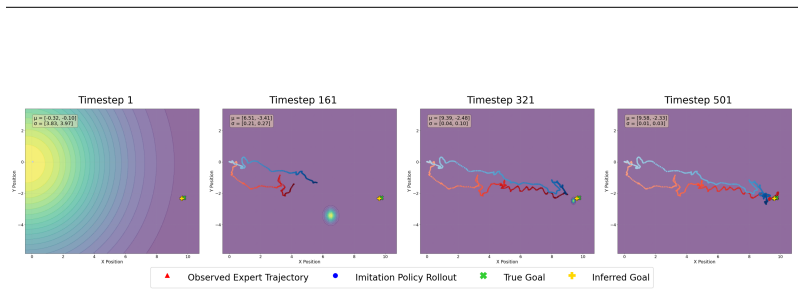

Figures from the paper (5 more)


Reference graph
Works this paper leans on
-
[1]
u c l\" u , Julia Berezutskaya, Eva van den Borne, Ya g mur G\
Luca Ambrogioni, Umut G\" u c l\" u , Julia Berezutskaya, Eva van den Borne, Ya g mur G\" u c l\" u t\" u rk, Max Hinne, Eric Maris, and Marcel van Gerven. Forward amortized inference for likelihood-free variational marginalization. In Kamalika Chaudhuri and Masashi Sugiyama (eds.), Proceedings of the Twenty-Second International Conference on Artificial I...
2019
-
[2]
Concrete problems in ai safety
Dario Amodei, Chris Olah, Jacob Steinhardt, Paul Francis Christiano, John Schulman, and Dandelion Man \'e . Concrete problems in ai safety. ArXiv, abs/1606.06565, 2016. URL https://api.semanticscholar.org/CorpusID:10242377
arXiv 2016
-
[3]
Hindsight experience replay
Marcin Andrychowicz, Filip Wolski, Alex Ray, Jonas Schneider, Rachel Fong, Peter Welinder, Bob McGrew, Josh Tobin, OpenAI Pieter Abbeel, and Wojciech Zaremba. Hindsight experience replay. In I. Guyon, U. Von Luxburg, S. Bengio, H. Wallach, R. Fergus, S. Vishwanathan, and R. Garnett (eds.), Advances in Neural Information Processing Systems, volume 30. Curr...
2017
-
[4]
End to end learning for self-driving cars
Mariusz Bojarski, Davide Del Testa, Daniel Dworakowski, Bernhard Firner, Beat Flepp, Prasoon Goyal, Lawrence D Jackel, Mathew Monfort, Urs Muller, Jiakai Zhang, Xin Zhang, Jake Zhao, and Karol Zieba. End to end learning for self-driving cars. arXiv [cs.CV], April 2016
2016
-
[5]
Hudson, Ehsan Adeli, Russ Altman, Simran Arora, Sydney von Arx, Michael S
Rishi Bommasani, Drew A. Hudson, Ehsan Adeli, Russ Altman, Simran Arora, Sydney von Arx, Michael S. Bernstein, Jeannette Bohg, Antoine Bosselut, Emma Brunskill, Erik Brynjolfsson, S. Buch, Dallas Card, Rodrigo Castellon, Niladri S. Chatterji, Annie S. Chen, Kathleen A. Creel, Jared Davis, Dora Demszky, Chris Donahue, Moussa Doumbouya, Esin Durmus, Stefano...
2021
-
[6]
Goodman, Elizabeth Spelke, and Laura Schulz
Elizabeth Bonawitz, Patrick Shafto, Hyowon Gweon, Noah D. Goodman, Elizabeth Spelke, and Laura Schulz. The double-edged sword of pedagogy: Instruction limits spontaneous exploration and discovery. Cognition, 120 0 (3): 0 322--330, 2011. ISSN 0010-0277. doi:https://doi.org/10.1016/j.cognition.2010.10.001. URL https://www.sciencedirect.com/science/article/p...
-
[7]
Accelerating Goal-Conditioned RL Algorithms and Research
Micha Bortkiewicz, W adek Pa ucki, Vivek Myers, Tadeusz Dziarmaga, Tomasz Arczewski, ukasz Kuci\' n ski, and Benjamin Eysenbach. Accelerating Goal-Conditioned RL Algorithms and Research . In International Conference on Learning Representations , 2025. URL https://arxiv.org/pdf/2408.11052
arXiv 2025
-
[8]
JAX : composable transformations of P ython+ N um P y programs, 2018
James Bradbury, Roy Frostig, Peter Hawkins, Matthew James Johnson, Chris Leary, Dougal Maclaurin, George Necula, Adam Paszke, Jake Vander P las, Skye Wanderman- M ilne, and Qiao Zhang. JAX : composable transformations of P ython+ N um P y programs, 2018. URL http://github.com/jax-ml/jax
2018
Show all 59 references
-
[9]
Openai gym
Greg Brockman, Vicki Cheung, Ludwig Pettersson, Jonas Schneider, John Schulman, Jie Tang, and Wojciech Zaremba. Openai gym. ArXiv, abs/1606.01540, 2016. URL https://api.semanticscholar.org/CorpusID:16099293
2016 arXiv
-
[10]
Explore, discover and learn: Unsupervised discovery of state-covering skills
Victor Campos, Alexander Trott, Caiming Xiong, Richard Socher, Xavier Giro-I-Nieto, and Jordi Torres. Explore, discover and learn: Unsupervised discovery of state-covering skills. In Hal Daumé III and Aarti Singh (eds.), Proceedings of the 37th International Conference on Mach...
2020
-
[11]
Multi-task hierarchical adversarial inverse reinforcement learning
Jiayu Chen, Dipesh Tamboli, Tian Lan, and Vaneet Aggarwal. Multi-task hierarchical adversarial inverse reinforcement learning. In Proceedings of the 40th International Conference on Machine Learning, ICML'23. JMLR.org, 2023
2023
-
[12]
Diffusion policy: Visuomotor policy learning via action diffusion
Cheng Chi, Siyuan Feng, Yilun Du, Zhenjia Xu, Eric Cousineau, Benjamin Burchfiel, and Shuran Song. Diffusion policy: Visuomotor policy learning via action diffusion. In Proceedings of Robotics: Science and Systems (RSS), 2023
2023
-
[13]
Diffusion policy: Visuomotor policy learning via action diffusion
Cheng Chi, Zhenjia Xu, Siyuan Feng, Eric Cousineau, Yilun Du, Benjamin Burchfiel, Russ Tedrake, and Shuran Song. Diffusion policy: Visuomotor policy learning via action diffusion. The International Journal of Robotics Research, 2024
2024
-
[14]
Dragan, Kenton C.T
Anca D. Dragan, Kenton C.T. Lee, and Siddhartha S. Srinivasa. Legibility and predictability of robot motion. In Proceedings of the 8th ACM/IEEE International Conference on Human-Robot Interaction, HRI '13, pp.\ 301–308. IEEE Press, 2013. ISBN 9781467330558
2013
-
[15]
Rewriting history with inverse rl: hindsight inference for policy improvement
Benjamin Eysenbach, Xinyang Geng, Sergey Levine, and Ruslan Salakhutdinov. Rewriting history with inverse rl: hindsight inference for policy improvement. In Proceedings of the 34th International Conference on Neural Information Processing Systems, NIPS '20, Red Hook, NY, USA, ...
2020
-
[16]
Contrastive learning as goal-conditioned reinforcement learning
Benjamin Eysenbach, Tianjun Zhang, Sergey Levine, and Ruslan Salakhutdinov. Contrastive learning as goal-conditioned reinforcement learning. In Proceedings of the 36th International Conference on Neural Information Processing Systems, NIPS '22, Red Hook, NY, USA, 2022. Curran ...
2022
-
[17]
Chelsea Finn, Sergey Levine, and P. Abbeel. Guided cost learning: Deep inverse optimal control via policy optimization. In International Conference on Machine Learning, 2016. URL https://api.semanticscholar.org/CorpusID:8121626
2016
-
[18]
One-shot visual imitation learning via meta-learning
Chelsea Finn, Tianhe Yu, Tianhao Zhang, Pieter Abbeel, and Sergey Levine. One-shot visual imitation learning via meta-learning. In Sergey Levine, Vincent Vanhoucke, and Ken Goldberg (eds.), Proceedings of the 1st Annual Conference on Robot Learning, volume 78 of Proceedings of...
2017
-
[19]
Automatic goal generation for reinforcement learning agents
Carlos Florensa, David Held, Xinyang Geng, and Pieter Abbeel. Automatic goal generation for reinforcement learning agents. In Jennifer Dy and Andreas Krause (eds.), Proceedings of the 35th International Conference on Machine Learning, volume 80 of Proceedings of Machine Learni...
2018
-
[20]
Brax -- a differentiable physics engine for large scale rigid body simulation
C Daniel Freeman, Erik Frey, Anton Raichuk, Sertan Girgin, Igor Mordatch, and Olivier Bachem. Brax -- a differentiable physics engine for large scale rigid body simulation. arXiv [cs.RO], June 2021
2021
-
[21]
Learning robust rewards with adverserial inverse reinforcement learning
Justin Fu, Katie Luo, and Sergey Levine. Learning robust rewards with adverserial inverse reinforcement learning. In 6th International Conference on Learning Representations, ICLR 2018, Vancouver, BC, Canada, April 30 - May 3, 2018, Conference Track Proceedings . OpenReview.ne...
2018
-
[22]
Childhood as a solution to explore–exploit tensions
Alison Gopnik. Childhood as a solution to explore–exploit tensions. Philosophical Transactions of the Royal Society B: Biological Sciences, 375 0 (1803): 0 20190502, 2020. doi:10.1098/rstb.2019.0502. URL https://royalsocietypublishing.org/doi/abs/10.1098/rstb.2019.0502
2020
-
[23]
From exploration to instruction: Children learn from exploration and tailor their demonstrations to observers’ goals and competence
Hyowon Gweon and Laura Schulz. From exploration to instruction: Children learn from exploration and tailor their demonstrations to observers’ goals and competence. Child Development, 90 0 (1): 0 e148--e164, 2019. doi:https://doi.org/10.1111/cdev.13059. URL https://srcd.onlinel...
2019 doi
-
[24]
Soft actor-critic: Off-policy maximum entropy deep reinforcement learning with a stochastic actor
Tuomas Haarnoja, Aurick Zhou, Pieter Abbeel, and Sergey Levine. Soft actor-critic: Off-policy maximum entropy deep reinforcement learning with a stochastic actor. In International conference on machine learning, pp.\ 1861--1870. Pmlr, 2018
2018
-
[25]
Generative adversarial imitation learning
Jonathan Ho and Stefano Ermon. Generative adversarial imitation learning. In Proceedings of the 30th International Conference on Neural Information Processing Systems, NIPS'16, pp.\ 4572–4580, Red Hook, NY, USA, 2016. Curran Associates Inc. ISBN 9781510838819
2016
-
[26]
BC -z: Zero-shot task generalization with robotic imitation learning
Eric Jang, Alex Irpan, Mohi Khansari, Daniel Kappler, Frederik Ebert, Corey Lynch, Sergey Levine, and Chelsea Finn. BC -z: Zero-shot task generalization with robotic imitation learning. In 5th Annual Conference on Robot Learning, 2021. URL https://openreview.net/forum?id=8kbp23tSGYv
2021
-
[27]
Learning to achieve goals
Leslie Pack Kaelbling. Learning to achieve goals. In International Joint Conference on Artificial Intelligence, 1993. URL https://api.semanticscholar.org/CorpusID:5538688
1993
-
[28]
Variational curriculum reinforcement learning for unsupervised discovery of skills
Seongun Kim, Kyowoon Lee, and Jaesik Choi. Variational curriculum reinforcement learning for unsupervised discovery of skills. In Proceedings of the 40th International Conference on Machine Learning, ICML'23. JMLR.org, 2023
2023
-
[29]
Urlb: Unsupervised reinforcement learning benchmark
Misha Laskin, Denis Yarats, Hao Liu, Kimin Lee, Albert Zhan, Kevin Lu, Catherine Cang, Lerrel Pinto, and Pieter Abbeel. Urlb: Unsupervised reinforcement learning benchmark. In J. Vanschoren and S. Yeung (eds.), Proceedings of the Neural Information Processing Systems Track on ...
2021
-
[30]
Learning Temporal Distances : Contrastive Successor Features Can Provide a Metric Structure for Decision-Making
Vivek Myers, Chongyi Zheng, Anca Dragan, Sergey Levine, and Benjamin Eysenbach. Learning Temporal Distances : Contrastive Successor Features Can Provide a Metric Structure for Decision-Making . In International Conference on Machine Learning , 2024. URL https://proceedings.mlr...
2024
-
[31]
Visual reinforcement learning with imagined goals
Ashvin V Nair, Vitchyr Pong, Murtaza Dalal, Shikhar Bahl, Steven Lin, and Sergey Levine. Visual reinforcement learning with imagined goals. In S. Bengio, H. Wallach, H. Larochelle, K. Grauman, N. Cesa-Bianchi, and R. Garnett (eds.), Advances in Neural Information Processing Sy...
2018
-
[32]
Ng and Stuart J
Andrew Y. Ng and Stuart J. Russell. Algorithms for inverse reinforcement learning. In Proceedings of the Seventeenth International Conference on Machine Learning, ICML '00, pp.\ 663–670, San Francisco, CA, USA, 2000. Morgan Kaufmann Publishers Inc. ISBN 1558607072
2000
-
[33]
Octo: An open-source generalist robot policy
Octo Model Team , Dibya Ghosh, Homer Walke, Karl Pertsch, Kevin Black, Oier Mees, Sudeep Dasari, Joey Hejna, Charles Xu, Jianlan Luo, Tobias Kreiman, You Liang Tan, Pannag Sanketi, Quan Vuong, Ted Xiao, Dorsa Sadigh, Chelsea Finn, and Sergey Levine. Octo: An open-source genera...
2024
-
[34]
Representation Learning with Contrastive Predictive Coding
Aaron van den Oord, Yazhe Li, and Oriol Vinyals. Representation Learning with Contrastive Predictive Coding . arXiv:1807.03748 [cs, stat], July 2018. URL http://arxiv.org/abs/1807.03748. arXiv: 1807.03748
2018 arXiv
-
[35]
Asymmetric self-play for automatic goal discovery in robotic manipulation
OpenAI OpenAI, Matthias Plappert, Raul Sampedro, Tao Xu, Ilge Akkaya, Vineet Kosaraju, Peter Welinder, Ruben D'Sa, Arthur Petron, Henrique Pond \'e de Oliveira Pinto, Alex Paino, Hyeonwoo Noh, Lilian Weng, Qiming Yuan, Casey Chu, and Wojciech Zaremba. Asymmetric self-play for ...
2021 arXiv
-
[36]
Efros, and Trevor Darrell
Deepak Pathak, Parsa Mahmoudieh, Guanghao Luo, Pulkit Agrawal, Dian Chen, Fred Shentu, Evan Shelhamer, Jitendra Malik, Alexei A. Efros, and Trevor Darrell. Zero-shot visual imitation. In 2018 IEEE/CVF Conference on Computer Vision and Pattern Recognition Workshops (CVPRW), pp....
2018
-
[37]
Fast imitation via behavior foundation models
Matteo Pirotta, Andrea Tirinzoni, Ahmed Touati, Alessandro Lazaric, and Yann Ollivier. Fast imitation via behavior foundation models. In B. Kim, Y. Yue, S. Chaudhuri, K. Fragkiadaki, M. Khan, and Y. Sun (eds.), International Conference on Representation Learning, volume 2024, ...
2024
-
[38]
Maximum entropy gain exploration for long horizon multi-goal reinforcement learning
Silviu Pitis, Harris Chan, Stephen Zhao, Bradly Stadie, and Jimmy Ba. Maximum entropy gain exploration for long horizon multi-goal reinforcement learning. In Proceedings of the 37th International Conference on Machine Learning, ICML'20. JMLR.org, 2020
2020
-
[39]
Mars, and Sabine Hunnius
Francesco Poli, Marlene Meyer, Rogier B. Mars, and Sabine Hunnius. Exploration in 4-year-old children is guided by learning progress and novelty. Child Development, 96 0 (1): 0 192--202, 2025. doi:https://doi.org/10.1111/cdev.14158. URL https://srcd.onlinelibrary.wiley.com/doi...
2025 doi
-
[40]
Pomerleau
Dean A. Pomerleau. Alvinn: an autonomous land vehicle in a neural network. In Proceedings of the 2nd International Conference on Neural Information Processing Systems, NIPS'88, pp.\ 305–313, Cambridge, MA, USA, 1988. MIT Press
1988
-
[41]
Pong, Murtaza Dalal, Steven Lin, Ashvin Nair, Shikhar Bahl, and Sergey Levine
Vitchyr H. Pong, Murtaza Dalal, Steven Lin, Ashvin Nair, Shikhar Bahl, and Sergey Levine. Skew-fit: state-covering self-supervised reinforcement learning. In Proceedings of the 37th International Conference on Machine Learning, ICML'20. JMLR.org, 2020
2020
-
[42]
A generalist agent
Scott Reed, Konrad Zolna, Emilio Parisotto, Sergio Gomez Colmenarejo, Alexander Novikov, Gabriel Barth-Maron, Mai Gimenez, Yury Sulsky, Jackie Kay, Jost Tobias Springenberg, Tom Eccles, Jake Bruce, Ali Razavi, Ashley Edwards, Nicolas Heess, Yutian Chen, Raia Hadsell, Oriol Vin...
2022
-
[43]
A reduction of imitation learning and structured prediction to no-regret online learning
Stephane Ross, Geoffrey Gordon, and Drew Bagnell. A reduction of imitation learning and structured prediction to no-regret online learning. In Geoffrey Gordon, David Dunson, and Miroslav Dudík (eds.), Proceedings of the Fourteenth International Conference on Artificial Intelli...
2011
-
[44]
Universal value function approximators
Tom Schaul, Daniel Horgan, Karol Gregor, and David Silver. Universal value function approximators. In Francis Bach and David Blei (eds.), Proceedings of the 32nd International Conference on Machine Learning, volume 37 of Proceedings of Machine Learning Research, pp.\ 1312--132...
2015
-
[45]
Smile: Scalable meta inverse reinforcement learning through context-conditional policies
Seyed Kamyar Seyed Ghasemipour, Shixiang (Shane) Gu, and Richard Zemel. Smile: Scalable meta inverse reinforcement learning through context-conditional policies. In H. Wallach, H. Larochelle, A. Beygelzimer, F. d Alch\' e -Buc, E. Fox, and R. Garnett (eds.), Advances in Neural...
2019
-
[46]
Mastering the game of go with deep neural networks and tree search
David Silver, Aja Huang, Chris J Maddison, Arthur Guez, Laurent Sifre, George van den Driessche, Julian Schrittwieser, Ioannis Antonoglou, Veda Panneershelvam, Marc Lanctot, Sander Dieleman, Dominik Grewe, John Nham, Nal Kalchbrenner, Ilya Sutskever, Timothy Lillicrap, Madelei...
2016
-
[47]
Stahl and Lisa Feigenson
Aimee E. Stahl and Lisa Feigenson. Observing the unexpected enhances infants’ learning and exploration. Science, 348 0 (6230): 0 91--94, 2015. doi:10.1126/science.aaa3799. URL https://www.science.org/doi/abs/10.1126/science.aaa3799
2015 doi
-
[48]
Learning one representation to optimize all rewards
Ahmed Touati and Yann Ollivier. Learning one representation to optimize all rewards. In Proceedings of the 35th International Conference on Neural Information Processing Systems, NIPS '21, Red Hook, NY, USA, 2021. Curran Associates Inc. ISBN 9781713845393
2021
-
[49]
Optimal goal-reaching reinforcement learning via quasimetric learning
Tongzhou Wang, Antonio Torralba, Phillip Isola, and Amy Zhang. Optimal goal-reaching reinforcement learning via quasimetric learning. In International Conference on Machine Learning. PMLR, 2023
2023
-
[50]
Unsupervised control through non-parametric discriminative rewards
David Warde-Farley, Tom Van de Wiele, Tejas Kulkarni, Catalin Ionescu, Steven Hansen, and Volodymyr Mnih. Unsupervised control through non-parametric discriminative rewards. arXiv [cs.LG], November 2018
2018
-
[51]
Outracing champion gran turismo drivers with deep reinforcement learning
Peter R Wurman, Samuel Barrett, Kenta Kawamoto, James MacGlashan, Kaushik Subramanian, Thomas J Walsh, Roberto Capobianco, Alisa Devlic, Franziska Eckert, Florian Fuchs, Leilani Gilpin, Piyush Khandelwal, Varun Kompella, Haochih Lin, Patrick MacAlpine, Declan Oller, Takuma Sen...
2022
-
[52]
Meta-inverse reinforcement learning with probabilistic context variables
Lantao Yu, Tianhe Yu, Chelsea Finn, and Stefano Ermon. Meta-inverse reinforcement learning with probabilistic context variables. In H. Wallach, H. Larochelle, A. Beygelzimer, F. d Alch\' e -Buc, E. Fox, and R. Garnett (eds.), Advances in Neural Information Processing Systems, ...
2019
-
[53]
One-shot imitation from observing humans via domain-adaptive meta-learning
Tianhe Yu, Chelsea Finn, Annie Xie, Sudeep Dasari, Tianhao Zhang, Pieter Abbeel, and Sergey Levine. One-shot imitation from observing humans via domain-adaptive meta-learning. arXiv [cs.LG], February 2018
2018
-
[54]
Maximum entropy inverse reinforcement learning
Brian D Ziebart, Andrew L Maas, J Bagnell, and A Dey. Maximum entropy inverse reinforcement learning. National Conference on Artificial Intelligence, pp.\ 1433--1438, July 2008
2008
-
[55]
Brown, and Anca D
Matthew Zurek, Andreea Bobu, Daniel S. Brown, and Anca D. Dragan. Situational confidence assistance for lifelong shared autonomy. In 2021 IEEE International Conference on Robotics and Automation (ICRA), pp.\ 2783–2789. IEEE Press, 2021. doi:10.1109/ICRA48506.2021.9561839. URL ...
2021
-
[56]
write newline
" write newline "" before.all 'output.state := FUNCTION n.dashify 't := "" t empty not t #1 #1 substring "-" = t #1 #2 substring "--" = not "--" * t #2 global.max substring 't := t #1 #1 substring "-" = "-" * t #2 global.max substring 't := while if t #1 #1 substring * t #2 gl...
-
[57]
@esa (Ref
\@ifxundefined[1] #1\@undefined \@firstoftwo \@secondoftwo \@ifnum[1] #1 \@firstoftwo \@secondoftwo \@ifx[1] #1 \@firstoftwo \@secondoftwo [2] @ #1 \@temptokena #2 #1 @ \@temptokena \@ifclassloaded agu2001 natbib The agu2001 class already includes natbib coding, so you should ...
-
[58]
\@lbibitem[] @bibitem@first@sw\@secondoftwo \@lbibitem[#1]#2 \@extra@b@citeb \@ifundefined br@#2\@extra@b@citeb \@namedef br@#2 \@nameuse br@#2\@extra@b@citeb \@ifundefined b@#2\@extra@b@citeb @num @parse #2 @tmp #1 NAT@b@open@#2 NAT@b@shut@#2 \@ifnum @merge>\@ne @bibitem@firs...
-
[59]
@open @close @open @close and [1] URL: #1 \@ifundefined chapter * \@mkboth \@ifxundefined @sectionbib * \@mkboth * \@mkboth\@gobbletwo \@ifclassloaded amsart * \@ifclassloaded amsbook * \@ifxundefined @heading @heading NAT@ctr thebibliography [1] @ \@biblabel @NAT@ctr \@bibset...
Reviewed August 4, 2026 · model on record in the stance chip above.
Discussion (0). Continue with ORCID to comment.