REVIEW 3 major objections 6 minor 1 cited by
The paper claims that a single dimensionless combination, α²|Q|, decides whether Regularized Maxwell black holes exhibit first-order coexistence or second-order criticality, with the threshold at α²|Q| = 1.
Reviewed by Pith at T0; open to challenge. T0 means a machine referee read the full paper against a public rubric. the ladder, T0–T4 →
T0 review · deepseek-v4-flash
2026-08-04 08:20 UTC pith:WJGRST4V
load-bearing objection The paper's central α²|Q| = 1 classifier is built on a mass formula that fails the horizon condition; substituting Eq. (10) into Eq. (2) gives f(r_h) = −α²|Q|, so the threshold should be 1/2. the 3 major comments →
Topological Signatures and Geometrothermodynamics of Critical Phenomena in Regularized Maxwell Black Holes
The pith
A machine-rendered reading of the paper's core claim, the machinery that carries it, and where it could break.
Core claim
The paper claims that the Duan off-shell free-energy vector field φ = (∂F/∂S, −cotΘ cscΘ) has a small-radius expansion whose leading coefficient is φ_S(0+) = ½(1 − α²|Q|). From this single coefficient the authors read the entire thermodynamic topology: for α²|Q| < 1 the small black hole emerges on a rising branch of τ(r_h) = 1/T(r_h), so the heat capacity is negative and the winding number is −1, and the phase structure is first-order SBH/LBH coexistence; for α²|Q| > 1 the small black hole emerges on a falling branch, winding +1, and the defect curve generically develops an intermediate branch plus vertical tangencies dτ/dr_h = 0 where the heat capacity diverges and defect pairs are created
What carries the argument
The load-bearing object is the small-radius expansion of the Duan vector field, Eq. (52): φ_S(0+) = ½(1 − α²|Q|). It converts the nonlinear RegMax coupling α and charge Q into a single dimensionless control parameter. The Duan construction assigns each zero of φ — each equilibrium black hole at τ = 1/T — an integer winding number w = +1 (locally stable, heat capacity C > 0, falling τ(r_h)) or w = −1 (locally unstable, C < 0, rising τ(r_h)); vertical tangencies dτ/dr_h = 0 are where C diverges and second-order criticality occurs. The Ruppeiner metric, the temperature-scaled Hessian of the mass, is the companion object: its scalar curvature R_Rup encodes the sign of the dominant microscopic in
Load-bearing premise
The load-bearing premise is that the sign of the leading small-radius coefficient φ_S(0+) = ½(1 − α²|Q|) — Eq. (52) — determines the global shape of the defect curve τ(r_h), so that the entire three-regime classification follows from this one term; the paper verifies this only at two representative parameter points and does not prove that the intermediate branch and vertical tangencies appear for every α²|Q| > 1 or that a genuine second-order point exists exactly at α²|Q| = 1
What would settle it
Scan the defect curve τ(r_h) for a fine grid of α at fixed Q = 1, P = 0.1, crossing α²|Q| = 1 (e.g., α = 0.9, 1.0, 1.1). If for any α²|Q| > 1 the curve lacks an intermediate branch or a vertical tangency with dτ/dr_h = 0 and diverging heat capacity — or if at α²|Q| = 1 no tangency/divergence occurs — then the sign of the small-radius coefficient alone does not control the topology and the central claim fails.
If this is right
- For α²|Q| < 1 the SBH branch is always born unstable (w = −1), so no intermediate branch exists; the only phase competition is first-order SBH/LBH coexistence.
- For α²|Q| > 1 the SBH branch is stable (w = +1) and the defect curve has an SBH–IBH–LBH structure; the vertical tangencies mean the heat capacity diverges at two points, so the system can undergo continuous second-order critical transitions.
- At α²|Q| = 1 the small-radius coefficient vanishes and J_0 = T/C → 0, so C → ∞; this is a marginal point where topological defect pairs can be created or annihilated.
- The Ruppeiner curvature is predominantly positive in the subcritical regime (repulsive microstructure) and becomes negative at small radii in the critical/supercritical regimes (attractive microstructure), connecting regime change to microscopic interaction sign.
- Because larger α pushes the NEC/WEC threshold r_NEC = (√2−1)√|Q|/α inward, a horizon at r_h > r_NEC sits in an energy-condition-violating region; the regime that admits second-order criticality is the same regime that violates classical energy conditions at the horizon.
Where Pith is reading between the lines
- Editorial inference: the paper checks the claimed topology at only two representative points (α = 2 and α = 0.2, with Q = 1, P = 0.1). A numerical scan through α²|Q| = 1 would test whether the intermediate branch appears exactly when the small-radius coefficient changes sign or at some different value.
- Editorial inference: the same α²|Q| classifier should generalize to other nonlinear electrodynamics black holes whose off-shell free energy admits the same small-radius expansion structure; if a similar theory failed to show the three-regime pattern, the mechanism would not be generic.
- Editorial inference: if the second-order critical points exist, they should leave signatures in the temperature-dependence of thermodynamic response functions (specific heat, isothermal compressibility) near the tangencies, and possibly in quasinormal-mode or shadow observables for astrophysical black holes; the dimensionless threshold gives a concrete target for constraining α.
- Editorial inference: the claimed correlation between EC violation and enriched topology is novel enough that it deserves a direct test — constructing a RegMax solution with α²|Q| > 1 but arranging the outer horizon to lie below r_NEC should still show the intermediate branch if the topology is truly driven by α²|Q| alone.
Editorial analysis
A structured set of objections, weighed in public.
Referee Report
Summary. The manuscript studies charged AdS black holes in Regularized Maxwell (RegMax) gravity, combining Duan's topological current method with Ruppeiner thermodynamic geometry. Starting from the RegMax lapse function and a mass function M(r_h) taken from the literature, the authors construct an off-shell free energy, define the Duan vector field, and compute defect curves τ(r_h). Their central claim is that the dimensionless combination α²|Q| is a sharp analytic classifier: for α²|Q| < 1 the small-black-hole branch is unstable (winding w = −1) and the system exhibits first-order SBH/LBH coexistence; for α²|Q| > 1 the SBH branch is stable (w = +1), an intermediate branch appears, and vertical tangencies in τ(r_h) produce second-order critical behaviour; at α²|Q| = 1 the system is marginal with C → ∞. The paper also derives energy-condition radii (r_NEC, r_WEC) and the Ruppeiner curvature, reporting sign changes that are interpreted as a transition between attractive and repulsive microstructures. The analysis is supplemented by numerical plots for representative parameter values.
Significance. If the central classification were correct, the paper would supply a clean, analytic link between the RegMax coupling, energy-condition violations, and topologically richer phase structure. The closed-form energy-condition radii in Eqs. (25) and (28), the explicit off-shell free energy, and the Ruppeiner curvature are useful and transparent; no fitted parameters hide the results. However, the central classifier rests on a mass function that does not satisfy the horizon condition f(r_h)=0. This is a load-bearing algebraic inconsistency: the off-shell free energy, the Duan vector, the defect curve, and the Ruppeiner curvature are not those of the spacetime described by the lapse function (2). Correcting the mass term shifts the apparent threshold from α²|Q| = 1 to α²|Q| = 1/2. The qualitative framework (subcritical/supercritical regimes) may survive after this correction, but all quantitative statements, figures, and the claimed critical value would need to be reworked. Because the present version's main quantitative claim is not established, the paper in its current form is not publishable without substantial revision.
major comments (3)
- [§II.A, Eq. (10) and §III, Eqs. (42), (45), (52)–(54)] The mass formula Eq. (10) is algebraically inconsistent with the lapse function Eq. (2). Substituting Eq. (10) into f(r_h)=0 leaves f(r_h) = −α²|Q| identically; all r-dependent terms cancel. Thus the off-shell free energy (42), the Duan vector (45), the defect curve (53), and the Ruppeiner curvature (61) are not those of the RegMax-AdS spacetime (1)–(2). The small-r coefficient in Eq. (52), (1−α²|Q|)/2, is an artifact of the incorrect −3α²r_h|Q| term. Solving f(r_h)=0 gives a mass whose small-r expansion has linear coefficient (1−2α²|Q|)/2, shifting the claimed critical threshold from α²|Q|=1 to α²|Q|=1/2. This invalidates the central classifier and all regime assignments built on it.
- [§III, Eqs. (35), (45)–(48)] The vector field is defined in Eq. (35) as φ = (∂F/∂S, −cotΘcscΘ), but Eq. (45) is not ∂F/∂S. Since S = πr_h², ∂F/∂S = (1/(2πr_h)) ∂F/∂r_h, whereas the right-hand side of Eq. (45) equals ∂F/∂r_h as verified by direct differentiation of Eq. (42). Consequently the small-r limit in Eq. (52) is ∂F/∂r_h at 0+, not φ_S(0+), and the identities J0 = ∂_S φ_S = ∂_S T = T/C in Eqs. (47)–(48) do not follow from the displayed definitions. An r_h-based Duan field is legitimate and preserves winding numbers, but the coordinate choice must be made consistently and the Jacobian/winding-number dictionary must be derived for that coordinate.
- [§III, after Eq. (52); Figs. 6–7] The global phase classification is inferred from the sign of the leading small-r coefficient in Eq. (52), but this is verified only for two representative parameter points (α=2 and α=0.2 with Q=1, P=0.1). The existence of an intermediate branch and vertical tangencies for all α²|Q|>1 (or α²|Q|>1/2 after correcting Eq. (10)) is an extrapolation. An exact analysis of the number of extrema of τ(r_h) or a systematic parameter scan across the critical threshold is required to establish that the leading coefficient alone determines the full defect-curve topology.
minor comments (6)
- [Notation (throughout)] The symbol Q is used both for the charge and its absolute value; in Sec. IV the statement “without loss of generality Q > 0” conflicts with the |Q| notation used elsewhere. Please define conventions once and use them consistently.
- [Eq. (2)] The second equality with the infinite series does not reproduce the explicit −2α²|Q| term; clarify the relation between the closed form and the series expansion.
- [Typos] There are numerous typographical errors, e.g., “RegMAx” (Sec. II.E), “geothermodynamic” (Sec. II intro), and “Reissner-Nordstrm” (missing umlaut). A careful proofread is needed.
- [Figs. 6(c), 7(c)] The winding-number contours are difficult to read; please enlarge the plots and label the contours C1, C2, C3 more clearly.
- [Ref. [26]] Reference [26] is cited only as an arXiv preprint; update to the published version if available.
- [Eq. (60)] The scalar-curvature formula for a 2D metric with g22 = 0 is non-standard; provide a brief derivation or reference for the expression used.
Circularity Check
No significant circularity: the α²|Q| classifier is an explicit analytic consequence of the stated mass function, not a fitted or self-referential input.
full rationale
The central derivation is self-contained: the mass formula M(rh) (Eq. 10, inherited from the external RegMax solution [49]) is substituted into the off-shell free energy F = M − S/τ (Eqs. 34 and 42), giving the vector component φS (Eq. 45) and its small-radius expansion φS(0+) = ½(1 − α²|Q|) (Eq. 52). The threshold α²|Q| = 1 is obtained by setting this leading coefficient to zero, not by fitting to the subsequent numerical examples. The topological stability dictionary C > 0 ↔ w = +1 follows from the standard Jacobian identity J0 = ∂SφS = T/C (Eqs. 47–51), which is cited to Duan and Wei–Liu and then applied, not assumed as a prediction. The Ruppeiner curvature is computed from the same mass function through Eqs. (58)–(61). Self-citations (e.g., refs. [13, 25, 69]) appear as contextual applications of the same thermodynamic-topology and geometrothermodynamic tools and are not load-bearing for the main claim. The skeptic's algebraic concern about whether Eq. (10) actually solves f(rh)=0 is a correctness or consistency issue, not a circularity: even if the coefficient in Eq. (52) were wrong, the derivation would still be an independent consequence of the stated inputs rather than a reduction of the conclusion to the premise. The extrapolation from the small-r expansion to the full phase structure (IBH branch, vertical tangencies) is an inferential gap, but it is not circular. Overall, no step reduces by construction to its own output; the score of 1 reflects only the presence of minor, non-load-bearing self-citations.
Axiom & Free-Parameter Ledger
axioms (5)
- domain assumption RegMax-AdS solution and its first law/Smarr relation from [49] are correct.
- standard math Duan's topological current: zeros of φ correspond to thermodynamic critical points with winding numbers.
- domain assumption Ruppeiner metric in the (S,P) canonical ensemble with g22 = 0 (since M is linear in P).
- ad hoc to paper Small-r asymptotic expansion ln(1 + √Q/(αr)) ≈ ln(√Q/(αr)) is sufficient to classify global phase structure.
- domain assumption The sign of Ruppeiner curvature indicates attractive/repulsive microscopic interactions.
read the original abstract
We study the thermodynamic topology and microscopic interaction properties of charged black holes in RegMax gravity, focusing on the role of the coupling parameter $\alpha$. Using the Duan topological current method together with Ruppeiner geometry, we show that $\alpha$ controls a sharp change in phase structure. Above a certain critical threshold, we find that the Duan defect curve develops an intermediate branch and vertical tangency points, producing continuous (second-order) critical behaviour. Furthermore, the Ruppeiner curvature becomes negative at very small horizon radii before turning positive and progressively vanishing at larger radii. By contrast, below the critical value of the coupling, the intermediate black hole phase disappears, and the system shows a simpler small/large first-order/coexistence behaviour driven by free-energy competition. In this regime, the Ruppeiner curvature remains predominantly positive. Overall, increasing $\alpha$ enriches the thermodynamic topology (allowing for second-order criticality) while simultaneously reducing the domain in which classical energy conditions (ECs) are satisfied, thus linking exotic thermodynamic behaviour to more severe violations of standard energy conditions.
Figures



Forward citations
Cited by 1 Pith paper
-
Topology of black hole thermodynamics: A brief review
Topological numbers categorize black hole systems into universality classes based on thermodynamic behavior, with calculations for critical points and phase transitions.
Reference graph
Works this paper leans on
-
[1]
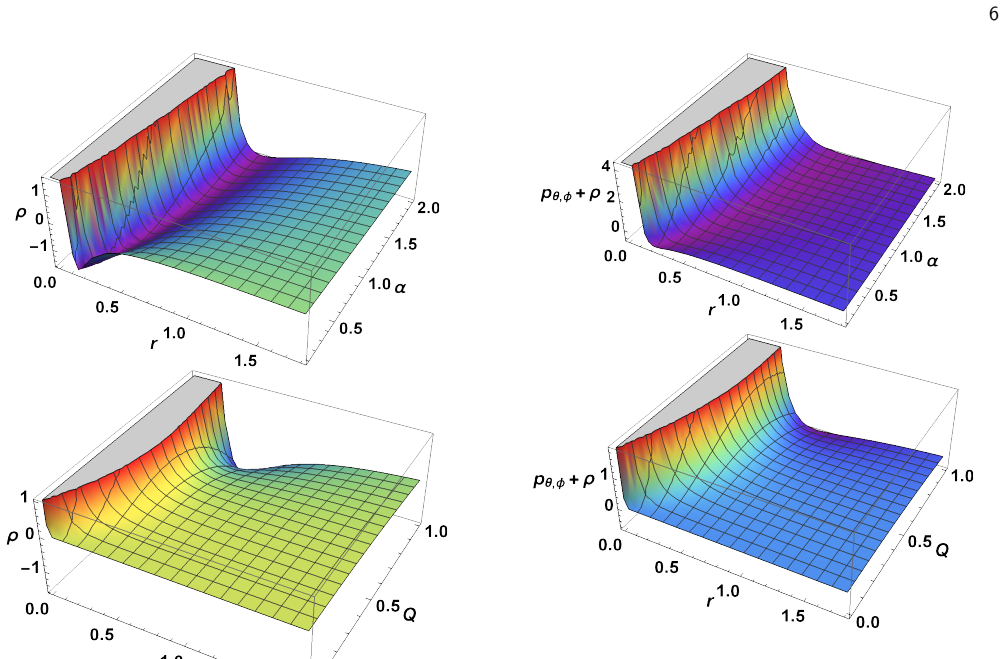
For α = 2the NEC is satisfied only for extremely small radii r <0.2071(see Fig. 3). For all phys- ically interesting horizon radii (the outer hori- zon typically rh ≳O (1)in our examples), the NEC is violated. This indicates that large α en- hances violations of standard energy conditions at macroscopic scales. The effect stems from the stronger α–depende...
2071
-
[2]
For α = 0.2the NEC holds up to r≈ 2.07, so a wide domain of horizon radii satisfies both the NEC and WEC combinations (see Figs. 2-3). In this regime the system is closer to a standard physically sensible matter profile. This again matches the simpler phase structure obtained for smallα. • The strong energy condition (SEC) asserts that Tµν tµtν ⩾ 1/2 Tµνt...
-
[3]
As r→ 0+ the −ρ term dominates (since ρ∼ + α2|Q| r2 ), so −ρ + 2Pθ → −∞, and the SEC is always violated arbitrarily close to the singularity
-
[4]
The logarithmic term enters −ρ + 2Pθ with a negative coefficient ∝ −α4, so larger α system- atically makes the SEC harder to satisfy at inter- mediate or large radii (see Fig. 4). Therefore, SEC violations are generic near the core and tend to persist or expand for supercritical couplings. Broadly speaking, a simple analytic estimate showed that the radia...
-
[5]
Black holes and entropy,
Jacob D. Bekenstein, “Black holes and entropy,” Phys. Rev. D7, 2333–2346 (1973)
1973
-
[6]
Particle Creation by Black Holes,
S. W. Hawking, “Particle Creation by Black Holes,” Com- mun. Math. Phys.43, 199–220 (1975), [Erratum: Com- mun.Math.Phys. 46, 206 (1976)]
1975
-
[7]
P-V criticality of charged AdS black holes,
David Kubiznak and Robert B. Mann, “P-V criticality of charged AdS black holes,” JHEP07, 033 (2012), arXiv:1205.0559 [hep-th]
Pith/arXiv arXiv 2012
-
[8]
Impact of barrow entropy on geometrothermodynamics of specific black holes,
Shamaila Rani, Abdul Jawad, and Mazhar Hussain, “Impact of barrow entropy on geometrothermodynamics of specific black holes,” Eur. Phys. J. C83, 710 (2023)
2023
-
[9]
Tsallis entropy inspires geometric thermo- dynamics of specific black hole,
Shamaila Rani, Abdul Jawad, Hooman Moradpour, and Aqsa Tanveer, “Tsallis entropy inspires geometric thermo- dynamics of specific black hole,” Eur. Phys. J. C82, 713 (2022)
2022
-
[10]
Black hole geometrother- modynamics and critical phenomena: A look from tsallis entropy-based perspective,
G. G. Luciano and A. Sheykhi, “Black hole geometrother- modynamics and critical phenomena: A look from tsallis entropy-based perspective,” Phys. Dark Univ.42, 101319 (2023). 16
2023
-
[12]
P–v criticalities, phase transitions and geometrothermodynamics of charged ads black holes from kaniadakis statistics,
G. G. Luciano and E. Saridakis, “P–v criticalities, phase transitions and geometrothermodynamics of charged ads black holes from kaniadakis statistics,” JHEP12, 114 (2023)
2023
-
[13]
Thermodynamics of black holes with R´ enyi entropy from classical gravity,
Ratchaphat Nakarachinda, Chatchai Promsiri, Lunchakorn Tannukij, and Pitayuth Wongjun, “Thermodynamics of black holes with R´ enyi entropy from classical gravity,” Nucl. Phys. B1011, 116796 (2025), arXiv:2211.05989 [gr-qc]
Pith/arXiv arXiv 2025
-
[14]
Generalized uncertainty principle and black hole thermody- namics,
Sunandan Gangopadhyay, Abhijit Dutta, and Anirban Saha, “Generalized uncertainty principle and black hole thermody- namics,” Gen. Rel. Grav.46, 1661 (2014), arXiv:1307.7045 [gr-qc]
Pith/arXiv arXiv 2014
-
[15]
S. Hassanabadi, J. Kˇ r ´ ıˇ z, W. S. Chung, B. C. L¨ utf¨ uo˘ glu, E. Maghsoodi, and H. Hassanabadi, “Thermodynamics of the Schwarzschild and Reissner–Nordstr¨ om black holes under higher-order generalized uncertainty principle,” Eur. Phys. J. Plus136, 918 (2021), arXiv:2110.01363 [gr-qc]
Pith/arXiv arXiv 2021
-
[16]
Thermo- dynamics of a black hole based on a generalized uncertainty principle,
Wontae Kim, Edwin J. Son, and Myungseok Yoon, “Thermo- dynamics of a black hole based on a generalized uncertainty principle,” JHEP01, 035 (2008), arXiv:0711.0786 [gr-qc]
Pith/arXiv arXiv 2008
-
[17]
Y. Sekhmani, G. G. Luciano, S. N. Gashti, and A. Baruah, “Infrared Extended Uncertainty Principle corrections and quintessence-induced topology of Reiss- ner–Nordstr¨ om AdS black holes,” Annals Phys.481, 170187 (2025), arXiv:2508.14953 [gr-qc]
Pith/arXiv arXiv 2025
-
[18]
Holography, thermodynamics and fluctuations of charged AdS black holes,
Andrew Chamblin, Roberto Emparan, Clifford V. Johnson, and Robert C. Myers, “Holography, thermodynamics and fluctuations of charged AdS black holes,” Phys. Rev. D60, 104026 (1999), arXiv:hep-th/9904197
Pith/arXiv arXiv 1999
-
[19]
Thermodynamics of Kerr-Newman-AdS black holes and conformal field theories,
Marco M. Caldarelli, Guido Cognola, and Dietmar Klemm, “Thermodynamics of Kerr-Newman-AdS black holes and conformal field theories,” Class. Quant. Grav.17, 399–420 (2000), arXiv:hep-th/9908022
Pith/arXiv arXiv 2000
-
[20]
Thermodynamical Aspects of Grav- ity: New insights,
T. Padmanabhan, “Thermodynamical Aspects of Grav- ity: New insights,” Rept. Prog. Phys.73, 046901 (2010), arXiv:0911.5004 [gr-qc]
Pith/arXiv arXiv 2010
-
[21]
First law of thermody- namics and Friedmann equations of Friedmann-Robertson- Walker universe,
Rong-Gen Cai and Sang Pyo Kim, “First law of thermody- namics and Friedmann equations of Friedmann-Robertson- Walker universe,” JHEP02, 050 (2005), arXiv:hep- th/0501055
arXiv 2005
-
[22]
The thermodynamics of black holes,
Robert M. Wald, “The thermodynamics of black holes,” Living Rev. Rel.4, 6 (2001), arXiv:gr-qc/9912119
Pith/arXiv arXiv 2001
-
[23]
Black hole chemistry: thermodynamics with Lambda,
David Kubiznak, Robert B. Mann, and Mae Teo, “Black hole chemistry: thermodynamics with Lambda,” Class. Quant. Grav.34, 063001 (2017), arXiv:1608.06147 [hep-th]
Pith/arXiv arXiv 2017
-
[24]
Pressure and volume in the first law of black hole thermodynamics,
Brian P. Dolan, “Pressure and volume in the first law of black hole thermodynamics,” Class. Quant. Grav.28, 235017 (2011), arXiv:1106.6260 [gr-qc]
Pith/arXiv arXiv 2011
-
[25]
Black Hole Enthalpy and an Entropy Inequality for the Thermodynamic Volume,
M. Cvetic, G. W. Gibbons, D. Kubiznak, and C. N. Pope, “Black Hole Enthalpy and an Entropy Inequality for the Thermodynamic Volume,” Phys. Rev. D84, 024037 (2011), arXiv:1012.2888 [hep-th]
Pith/arXiv arXiv 2011
-
[26]
Sharmila Gunasekaran, Robert B. Mann, and David Kubiz- nak, “Extended phase space thermodynamics for charged and rotating black holes and Born-Infeld vacuum polarization,” JHEP11, 110 (2012), arXiv:1208.6251 [hep-th]
Pith/arXiv arXiv 2012
-
[27]
Unified first law of black hole dynamics and relativistic thermodynamics,
Sean A. Hayward, “Unified first law of black hole dynamics and relativistic thermodynamics,” Class. Quant. Grav.15, 3147–3162 (1998), arXiv:gr-qc/9710089
Pith/arXiv arXiv 1998
-
[28]
Black hole thermodynamics from logotropic fluids,
Salvatore Capozziello, Rocco D’Agostino, Alessio Lap- poni, and Orlando Luongo, “Black hole thermodynamics from logotropic fluids,” Eur. Phys. J. C83, 175 (2023), arXiv:2210.02431 [gr-qc]
Pith/arXiv arXiv 2023
-
[29]
S. Ghaffari and G. G. Luciano, “Black hole thermodynam- ics in Harada’s inspired theory of gravity: stability, phase structure and geometrothermodynamics,” Eur. Phys. J. C 85, 785 (2025), arXiv:2505.06560 [gr-qc]
Pith/arXiv arXiv 2025
-
[30]
The topological quantization and the branch process of the (k-1)-dimensional topological defects
Yi-shi Duan, Ying Jiang, and Guo-hong Yang, “The Topological quantization and the branch pro- cess of the (k-1)-dimensional topological defects,” arXiv (1998), https://doi.org/10.48550/arXiv.hep-th/9810111, hep-th/9810111
work page internal anchor Pith review Pith/arXiv arXiv doi:10.48550/arxiv.hep-th/9810111 1998
-
[33]
Saeed Noori Gashti, ˙Izzet Sakallı, and Behnam Pourhassan, “Thermodynamic topology, photon spheres, and evidence for weak gravity conjecture in charged black holes with perfect fluid within Rastall theory,” Phys. Lett. B869, 139862 (2025), arXiv:2410.14492 [hep-th]
Pith/arXiv arXiv 2025
-
[34]
Van der Waals black holes: Universality, quantum corrections, and topolog- ical classifications,
Ankit Anand and Saeed Noori Gashti, “Van der Waals black holes: Universality, quantum corrections, and topolog- ical classifications,” Phys. Dark Univ.49, 102018 (2025), arXiv:2507.21663 [gr-qc]
Pith/arXiv arXiv 2025
-
[35]
Ther- modynamic curvature and topological insights of Hayward black holes with string fluids,
Ankit Anand, Saeed Noori Gashti, and Aditya Singh, “Ther- modynamic curvature and topological insights of Hayward black holes with string fluids,” Phys. Dark Univ.49, 101994 (2025), arXiv:2506.23736 [gr-qc]
Pith/arXiv arXiv 2025
-
[36]
Mohammad Ali S. Afshar, Mohammad Reza Alipour, Saeed Noori Gashti, and Jafar Sadeghi, “A Deep Dive into classi- cal and Topological CFT Thermodynamics in Lifshitz and Hyperscaling Violating Black Holes,” Fortsch. Phys.2025, e70030 (2025), arXiv:2505.15314 [hep-th]
arXiv 2025
-
[37]
Universality relation and thermodynamic topology with three-parameter entropy model,
Ankit Anand and Saeed Noori Gashti, “Universality relation and thermodynamic topology with three-parameter entropy model,” Phys. Dark Univ.48, 101916 (2025)
2025
-
[38]
Metric geometry of equilibrium thermodynam- ics,
F. Weinhold, “Metric geometry of equilibrium thermodynam- ics,” J. Chem. Phys.63, 2479 (1975)
1975
-
[39]
Thermodynamics: A riemannian geometric model,
G. Ruppeiner, “Thermodynamics: A riemannian geometric model,” Phys. Rev. A20, 1608 (1979)
1979
-
[40]
Riemannian geometry in thermodynamic fluctuation theory,
G. Ruppeiner, “Riemannian geometry in thermodynamic fluctuation theory,” Rev. Mod. Phys.67, 605 (1995)
1995
-
[41]
Critical phenomena and thermodynamic geometry of charged Gauss-Bonnet AdS black holes,
Shao-Wen Wei and Yu-Xiao Liu, “Critical phenomena and thermodynamic geometry of charged Gauss-Bonnet AdS black holes,” Phys. Rev. D87, 044014 (2013), arXiv:1209.1707 [gr-qc]
Pith/arXiv arXiv 2013
-
[42]
Jia-Lin Zhang, Rong-Gen Cai, and Hongwei Yu, “Phase transition and thermodynamical geometry for Schwarzschild AdS black hole in AdS 5 ×S 5 spacetime,” JHEP02, 143 (2015), arXiv:1409.5305 [hep-th]
Pith/arXiv arXiv 2015
-
[43]
S. H. Hendi, S. Panahiyan, and B. Eslam Panah, “P–V criticality and geometrical thermodynamics of black holes with Born–Infeld type nonlinear electrodynamics,” Int. J. Mod. Phys. D25, 1650010 (2015), arXiv:1410.0352 [gr-qc]
Pith/arXiv arXiv 2015
-
[44]
Phase transition and thermodynamic geometry of Einstein- Maxwell-dilaton black holes,
S. H. Hendi, A. Sheykhi, S. Panahiyan, and B. Eslam Panah, “Phase transition and thermodynamic geometry of Einstein- Maxwell-dilaton black holes,” Phys. Rev. D92, 064028 (2015), arXiv:1509.08593 [hep-th]. 17
Pith/arXiv arXiv 2015
-
[45]
Jia-Lin Zhang, Rong-Gen Cai, and Hongwei Yu, “Phase tran- sition and thermodynamical geometry of Reissner-Nordstr¨ om- AdS black holes in extended phase space,” Phys. Rev. D91, 044028 (2015), arXiv:1502.01428 [hep-th]
Pith/arXiv arXiv 2015
-
[46]
B. Eslam Panah, “Effects of energy dependent spacetime on geometrical thermodynamics and heat engine of black holes: gravity’s rainbow,” Phys. Lett. B787, 45–55 (2018), arXiv:1805.03014 [hep-th]
Pith/arXiv arXiv 2018
-
[47]
Thermo- dynamic geometry for charged Gauss-Bonnet black holes in AdS spacetimes,
Aritra Ghosh and Chandrasekhar Bhamidipati, “Thermo- dynamic geometry for charged Gauss-Bonnet black holes in AdS spacetimes,” Phys. Rev. D101, 046005 (2020), arXiv:1911.06280 [gr-qc]
Pith/arXiv arXiv 2020
-
[48]
Thermodynamic geometry of the novel 4-D Gauss–Bonnet AdS black hole,
Seyed Ali Hosseini Mansoori, “Thermodynamic geometry of the novel 4-D Gauss–Bonnet AdS black hole,” Phys. Dark Univ.31, 100776 (2021), arXiv:2003.13382 [gr-qc]
Pith/arXiv arXiv 2021
-
[49]
Foundations of the new field theory,
M. Born and L. Infeld, “Foundations of the new field theory,” Proc. Roy. Soc. Lond. A144, 425–451 (1934)
1934
-
[50]
Nonlinear Electrody- namics from Quantized Strings,
E. S. Fradkin and Arkady A. Tseytlin, “Nonlinear Electrody- namics from Quantized Strings,” Phys. Lett. B163, 123–130 (1985)
1985
-
[51]
Dirac-Born-Infeld Action from Dirichlet Sigma Model,
R. G. Leigh, “Dirac-Born-Infeld Action from Dirichlet Sigma Model,” Mod. Phys. Lett. A4, 2767 (1989)
1989
-
[52]
Regular black hole in general relativity coupled to nonlinear electrodynam- ics,
Eloy Ayon-Beato and Alberto Garcia, “Regular black hole in general relativity coupled to nonlinear electrodynam- ics,” Phys. Rev. Lett.80, 5056–5059 (1998), arXiv:gr- qc/9911046
arXiv 1998
-
[53]
Solutions and basic properties of regular- ized Maxwell theory,
Tom´ aˇ s Hale, David Kubizˇ n´ ak, Otakar Sv ´ ıtek, and Tayebeh Tahamtan, “Solutions and basic properties of regular- ized Maxwell theory,” Phys. Rev. D107, 124031 (2023), arXiv:2303.16928 [gr-qc]
Pith/arXiv arXiv 2023
-
[54]
Compatibility of nonlinear electrodynamics models with Robinson-Trautman geometry,
T. Tahamtan, “Compatibility of nonlinear electrodynamics models with Robinson-Trautman geometry,” Phys. Rev. D 103, 064052 (2021), arXiv:2010.01689 [gr-qc]
Pith/arXiv arXiv 2021
-
[55]
Robinson–Trautman solution with nonlinear electrodynamics,
T. Tahamtan and O. Sv ´ ıtek, “Robinson–Trautman solution with nonlinear electrodynamics,” Eur. Phys. J. C76, 335 (2016), arXiv:1510.01183 [gr-qc]
Pith/arXiv arXiv 2016
-
[56]
Slowly rotating black holes in nonlinear electrodynamics,
David Kubiznak, Tayebeh Tahamtan, and Otakar Svitek, “Slowly rotating black holes in nonlinear electrodynamics,” Phys. Rev. D105, 104064 (2022), arXiv:2203.01919 [gr-qc]
Pith/arXiv arXiv 2022
-
[57]
Enthalpy and the Mechanics of AdS Black Holes,
David Kastor, Sourya Ray, and Jennie Traschen, “Enthalpy and the Mechanics of AdS Black Holes,” Class. Quant. Grav. 26, 195011 (2009), arXiv:0904.2765 [hep-th]
Pith/arXiv arXiv 2009
-
[58]
Energy conditions of non-singular black hole spacetimes in conformal gravity,
Bobir Toshmatov, Cosimo Bambi, Bobomurat Ahmedov, Ahmadjon Abdujabbarov, and Zdenˇ ek Stuchl ´ ık, “Energy conditions of non-singular black hole spacetimes in conformal gravity,” Eur. Phys. J. C77, 542 (2017), arXiv:1702.06855 [gr-qc]
Pith/arXiv arXiv 2017
-
[59]
Black Hole Solutions as Topological Thermodynamic Defects,
Shao-Wen Wei, Yu-Xiao Liu, and Robert B. Mann, “Black Hole Solutions as Topological Thermodynamic Defects,” Phys. Rev. Lett.129, 191101 (2022), arXiv:2208.01932 [gr-qc]
Pith/arXiv arXiv 2022
-
[60]
Black hole thermodynamics and the Euclidean Einstein action,
James W. York, Jr., “Black hole thermodynamics and the Euclidean Einstein action,” Phys. Rev. D33, 2092–2099 (1986)
2092
-
[61]
Topology of black hole thermodynamics,
Shao-Wen Wei and Yu-Xiao Liu, “Topology of black hole thermodynamics,” Phys. Rev. D105, 104003 (2022), arXiv:2112.01706 [gr-qc]
Pith/arXiv arXiv 2022
-
[62]
Thermodynamic curvature of the btz black hole,
R. G. Cai and J. H. Cho, “Thermodynamic curvature of the btz black hole,” Phys. Rev. D60, 067502 (1999)
1999
-
[63]
S. W. Wei and Y. X. Liu, “Insight into the micro- scopic structure of an ads black hole from a thermody- namical phase transition,” Phys. Rev. Lett.115, 111302 (2015), erratum: Phys. Rev. Lett. 116, 169903 (2016), doi:10.1103/PhysRevLett.116.169903
-
[64]
Repulsive interac- tions and universal properties of charged anti–de sitter black hole microstructures,
S. W. Wei, Y. X. Liu, and R. B. Mann, “Repulsive interac- tions and universal properties of charged anti–de sitter black hole microstructures,” Phys. Rev. Lett.123, 071103 (2019)
2019
-
[65]
Microstruc- ture and continuous phase transition of a reissner–nordstrm– ads black hole,
X. Y. Guo, H. F. Li, L. C. Zhang, and R. Zhao, “Microstruc- ture and continuous phase transition of a reissner–nordstrm– ads black hole,” Phys. Rev. D100, 064036 (2019)
2019
-
[66]
Ruppeiner thermody- namic geometry for the schwarzschild–ads black hole,
Z. M. Xu, B. Wu, and W. L. Yang, “Ruppeiner thermody- namic geometry for the schwarzschild–ads black hole,” Phys. Rev. D101, 024018 (2020)
2020
-
[67]
Thermodynamic geometry and interacting microstructures of btz black holes,
A. Ghosh and C. Bhamidipati, “Thermodynamic geometry and interacting microstructures of btz black holes,” Phys. Rev. D101, 106007 (2020)
2020
-
[68]
Diagnosis inspired by the thermodynamic geometry for different thermodynamic schemes of the charged btz black hole,
Z. M. Xu, B. Wu, and W. L. Yang, “Diagnosis inspired by the thermodynamic geometry for different thermodynamic schemes of the charged btz black hole,” Eur. Phys. J. C80, 997 (2020)
2020
-
[69]
Emer- gent phase, thermodynamic geometry, and criticality of charged black holes from r´ enyi statistics,
E. Hirunsirisawat, R. Nakarachinda, and C. Promsiri, “Emer- gent phase, thermodynamic geometry, and criticality of charged black holes from r´ enyi statistics,” Phys. Rev. D 105, 124049 (2022)
2022
-
[70]
Thermodynamic schemes of charged btz-like black holes in arbitrary dimensions,
A. Dehghani, B. Pourhassan, S. Zarepour, and E. N. Sari- dakis, “Thermodynamic schemes of charged btz-like black holes in arbitrary dimensions,” Phys. Rev. D108, 024006 (2023)
2023
-
[71]
Wave-packet dynamics in monolayer graphene with periodic scattering po- tentials,
M. M. Suleimanov, M. U. Nosirov, H. T. Yusupov, A. Chaves, G. R. Berdiyorov, and Kh. Yu. Rakhimov, “Wave-packet dynamics in monolayer graphene with periodic scattering po- tentials,” Physica B Condensed Matter714, 417484 (2025), arXiv:2411.02896 [cond-mat.mes-hall]
Pith/arXiv arXiv 2025
-
[72]
Nonextensive entropies impact onto thermodynamics and phase structure of kerr–newman black holes,
S. Ghaffari, G. G. Luciano, and A. Sheykhi, “Nonextensive entropies impact onto thermodynamics and phase structure of kerr–newman black holes,” Phys. Dark Univ.44, 101447 (2024)
2024
-
[73]
Topological ads black holes surrounded by chaplygin dark fluid: From stability to geometrothermodynamic analysis,
Y. Sekhmani, G. G. Luciano, J. Rayimbaev, M. K. Jasim, A. Al-Badawi, and S. K. Maurya, “Topological ads black holes surrounded by chaplygin dark fluid: From stability to geometrothermodynamic analysis,” Phys. Dark Univ.46, 101567 (2024)
2024
-
[74]
Geometrothermodynamics,
H. Quevedo, “Geometrothermodynamics,” J. Math. Phys. 48, 013506 (2007)
2007
-
[75]
Geometrothermodynamics of black holes,
H. Quevedo, “Geometrothermodynamics of black holes,” Gen. Rel. Grav.40, 971–984 (2008), arXiv:0704.3102 [gr- qc]
Pith/arXiv arXiv 2008
-
[76]
Gravitational lensing and shadows of dilatonic black holes in dilaton-massive gravity,
Shahid Chaudhary, Talha Anwar, Farruh Atamurotov, Ali M. Mubaraki, and M. M. Alam, “Gravitational lensing and shadows of dilatonic black holes in dilaton-massive gravity,” Nucl. Phys. B1018, 117075 (2025)
2025
-
[77]
Testing regular black holes in the framework of asymptoti- cally safe gravity using particle dynamics, QPOs, and shadow constraints,
G. Mustafa, Asalkhon Alimova, Farruh Atamurotov, Awad A. Ibraheem, Phongpichit Channuie, and Gunel Bahaddinova, “Testing regular black holes in the framework of asymptoti- cally safe gravity using particle dynamics, QPOs, and shadow constraints,” Eur. Phys. J. C85, 741 (2025)
2025
-
[78]
Particles acceleration by Bocharova–Bronnikov–Melnikov–Bekenstein black hole,
Bobur Turimov, Sulton Usanov, and Yokub- jon Khamroev, “Particles acceleration by Bocharova–Bronnikov–Melnikov–Bekenstein black hole,” Phys. Dark Univ.48, 101876 (2025), arXiv:2502.11185 [gr-qc]
Pith/arXiv arXiv 2025
-
[79]
Tidal forces in Bocharova–Bronnikov–Melnikov–Bekenstein spacetime,
Bobur Turimov, Sunnatillo Urinov, Islomkhon Mardiev, Sul- ton Usanov, Musabek Akylbayev, and Rabiga Kenzhebekova, “Tidal forces in Bocharova–Bronnikov–Melnikov–Bekenstein spacetime,” (2025), 10.1007/s40065-025-00573-5
-
[80]
Charged Zipoy–Voorhees metric in string theory,
Odil Yunusov, Bobur Turimov, Yokubjon Khamroev, Sul- ton Usanov, Farkhodjon Turaev, and Markhabo Kuliyeva, “Charged Zipoy–Voorhees metric in string theory,” Annals 18 Phys.481, 170151 (2025)
2025
discussion (0)
Sign in with ORCID, Apple, or X to comment. Anyone can read and Pith papers without signing in.