REVIEW 4 major objections 7 minor 38 references
Calculation of Particle Pair Correlation Functions with Classical Trajectory Approximation
T0 review · 4 major / 7 minor · reviewed 2026-08-04 · deepseek-v4-flash
Pith's one-line read A classical-trajectory Monte Carlo model reproduces measured pair correlations and shows source size, not temperature, controls the signal.
desk verdict A plausible classical-trajectory femtoscopy tool whose source-size extraction needs stronger validation before I'd trust the quoted numbers. read the letter →
The pith
A machine-rendered reading of the paper's core claim, the machinery that carries it, and where it could break.
The reading
What carries the argument
The central object is CTA-I, a classical-trajectory Monte Carlo model that generates correlated particle pairs from a thermal Gaussian source and evolves them in the self-consistent mean field of the residual nucleus plus the pair's mutual Coulomb interaction. The mechanism that carries the argument is a set of constraint equations derived from Liouville's theorem: requiring a Boltzmann momentum distribution and a Gaussian spatial source to form a stationary phase-space distribution forces the mean field to be harmonic, with gradient V = (k_BT / sigma_R^2) r. The model then fixes its Coulomb-plus-Woods-Saxon-plus-surface potential by matching that harmonic condition through second order at r
What would settle it
Take CTA-I's initial Gaussian phase-space distribution and evolve it in the full mean field with no emission for thousands of fm/c; if the projected spatial distribution widens or becomes non-Gaussian on the simulation timescale, the second-order matching is insufficient and the model's sigma_R is not a clean observable. A cheaper check: compare CTA-I correlation functions for the same reaction against a quantum transport simulation that treats the same mean field and three-body dynamics exactly; agreement within the authors' parameter range would support the classical approximation, while dis
Extended reading notes
Core claim
The paper develops a classical-trajectory approximation model, CTA-I, in which the emitting source is a thermalized, Gaussian-distributed fireball characterized by temperature k_BT and size sigma_R, and the residual nucleus is represented by a mean field built from a Gaussian charge distribution, a Woods-Saxon volume term, and a Woods-Saxon surface term. Requiring the mean field to satisfy the stationary Liouville condition at the origin forces it to behave like a harmonic oscillator, and the potential parameters are fixed by matching the harmonic condition through second order. Correlated pairs are then evolved classically under the source field plus their mutual Coulomb interaction until t
Load-bearing premise
The sampled Gaussian emission source is treated as stationary under a mean field that matches the harmonic condition only through second order at the origin; if higher-order or long-range parts of the field distort the sampled phase space significantly, the extracted source size would be biased.
Editorial extensions
If this is right
- If the model's match to data is taken at face value, the source-size parameter sigma_R can be extracted from measured IMF-IMF and LCP-LCP correlation functions by direct comparison with CTA-I.
- The near-flat dependence on k_BT means correlation-function fits do not need a precisely known temperature; temperature can be fixed by the singles energy spectra without feeding uncertainty into the size extraction.
- The model puts the three-body final-state interaction (pair plus recoiling source) on a classical footing, which is important for IMF pairs where Coulomb repulsion from the source is strong and two-body-only treatments are inadequate.
- Because the model reproduces t-t and 3He-3He correlations with different suggested source sizes, it points to a way to probe isospin-dependent emission once higher-statistics data are available.
Reading between the lines
- Extrapolating from the paper's sensitivity scans, one could invert the procedure: instead of fixing sigma_R and scanning to match a single dataset, fit several reactions with a global calibration and ask whether the extracted sigma_R tracks the system size or momentum transfer—that would test whether sigma_R is a true physical source radius.
- The model deliberately leaves out quantum statistics and resonance channels; the authors note s-wave proton-proton resonances are not treatable classically. Adding a hybrid quantum correction for light pairs would test whether the classical approximation limits the agreement with data.
- The harmonic matching at r=0 is the load-bearing approximation; a stress test would be to build a version retaining higher-order terms in the mean-field expansion and see how much sigma_R shifts. A noticeable shift would mean the extracted sizes are model-dependent.
- The near-independence of temperature suggests a simple experimental protocol: measure the energy spectrum to fix T, then fit only sigma_R, making femtoscopy in the Fermi domain as routine as HBT radius extraction at higher energies.
Editorial analysis
A structured set of objections, weighed in public.
Referee Report
Summary. The manuscript presents CTA-I, a classical-trajectory Monte Carlo model for two-particle femtoscopic correlation functions. It assumes a thermal Boltzmann momentum distribution and a Gaussian spatial source, and constructs a mean field V_c+V_v+V_s whose curvature at r=0 is matched to the harmonic condition κ=k_BT/σ_R² derived from Liouville's theorem. The model then propagates particle pairs in this potential plus the pair Coulomb interaction, and compares the computed C(q) with measured B-B, t-t, and 3He-3He correlation functions. The authors report that C(q) is insensitive to the temperature T and sensitive to the Gaussian source size σ_R, and they extract σ_R ≈ 8 fm (B-B) and 4–6 fm (t-t, 3He-3He) from the data.
Significance. The Liouville derivation is transparent and internally correct, and the idea of treating the source mean field and the pair final-state interaction on the same footing is a genuine step beyond CRAB and LL approaches, which neglect the source potential. The model is simple and could become a practical tool for femtoscopy in the Fermi-energy domain if validated. However, the central extraction claim is not yet established: σ_R is entangled with the mean-field parameters, the harmonic truncation of the potential is unvalidated, and the data comparison is qualitative. With additional control runs, quantitative fits, and a benchmark against an independent code, the approach could become a useful complement to MENEKA.
major comments (4)
- [Sec. II.A–II.B, Eqs. (7)–(13) and (23)–(25)] The phase-space distribution (3) with Gaussian f_x is stationary under Liouville only if ∇V=(k_BT/σ_R²)r, i.e., V is exactly harmonic. The model instead constructs V_MF=V_c+V_v+V_s and fixes its parameters by imposing this condition only at harmonic order at r=0. At larger r, V_MF flattens and becomes Coulomb-like, so the initial Gaussian is not a stationary solution. During the long propagation (t_max=12000 fm/c), the sampled distribution will evolve, and the effective source at freeze-out need not equal the input σ_R. No numerical test is provided (e.g., an exact harmonic-potential run, monitoring σ(t), or comparison with an independent code). This is load-bearing for the claim that C(q) constrains the Gaussian source size.
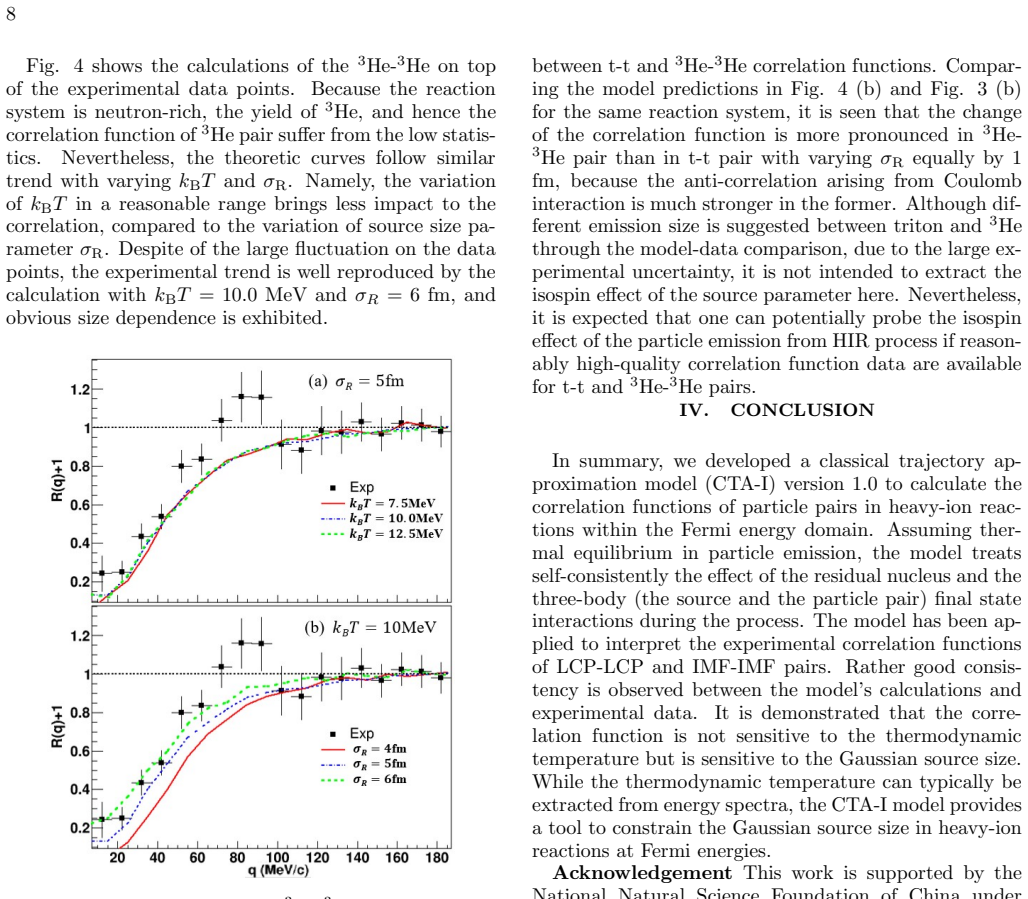
- [Sec. III, Figs. 2–4] The parameter σ_R enters both the initial Gaussian width and the mean-field through κ=k_BT/σ_R² (Eq. 13), σ_c=γ_c σ_R and d=γ_d σ_R (Eqs. 26–27). Therefore the reported sensitivity of C(q) to σ_R is not a pure source-size effect; changing σ_R also changes the depth, range, and curvature of the mean field. A control run varying σ_R at fixed κ (compensating T) or varying κ at fixed σ_R is necessary to support the Sec. IV conclusion. As it stands, the model cannot separate 'source size' from 'mean-field geometry'.
- [Sec. III.A–III.B and Sec. IV] The comparison with experimental data is qualitative: there is no χ², no confidence band, and no uncertainty on the extracted parameters. The parameter set P in Eq. (45) contains five free parameters, and three of them (γ_c, γ_d, U_0) are not systematically explored; for the B-B case (Fig. 2) their values are not even stated. The extracted σ_R values (8 fm for IMF, 4–6 fm for LCP) therefore have no stated precision and may not be unique. A quantitative fit with error treatment is required before claiming extraction of source sizes.
- [Sec. II.C and Sec. IV] The model treats the residual source as a fixed external potential; the source has no recoil or internal dynamics. The description 'three-body final state interactions' (Sec. IV) is therefore inaccurate—the calculation is two particles moving in a static mean field. Since MENEKA (Ref. [28]) explicitly includes source recoil and the paper cites that as a motivation, the neglect of recoil should be justified or tested, particularly for heavy IMFs where Coulomb recoil can be non-negligible.
minor comments (7)
- [Sec. III.A, Fig. 2 caption] The caption is incomplete: 'for the reactions MeV/u' is missing the beam energy and system. Please correct.
- [Sec. III.A] The B-B calculation parameters (γ_c, γ_d, U_0) are not given; only the t-t case lists γ_c=5, γ_d=0.3, U_0=0. Provide all parameter sets in a table for reproducibility.
- [Eq. (43)] Define R_LMT more carefully. The expression as written is a charge/mass conservation relation, not a definition of linear momentum transfer. Also, m_u in Eq. (44) is not defined; specify the average nucleon mass.
- [Sec. II.B] The relation β=e^{-r_0/d} is introduced, but r_0 is not part of the final parameter set. State explicitly that r_0 is determined by β and d, or give its value.
- [Throughout] Correct typos and standard nomenclature: 'Wood-Saxon' should be 'Woods-Saxon'; 'one can refers to' in the Introduction; 'Schr¨odinger' spacing; similar issues elsewhere.
- [Eq. (40)] Clarify whether q is the relative momentum in the pair rest frame and whether p_1,p_2 are the final-state momenta after all interactions. This is important for reproducibility.
- [Sec. III.A] The statement that the small peak around q≈300 MeV/c is 'unlikely to have real physical correspondence' is unsupported; either justify or remove it.
Circularity Check
No significant circularity; the model is an independent numerical construction, though the second-order harmonic matching is an unvalidated physical assumption.
full rationale
The derivation chain is not circular. The Gaussian source width sigma_R is defined by the sampled initial spatial distribution (Eq. 8), and the mean-field curvature is fixed to k_BT/sigma_R^2 by the stationarity condition (Eqs. 10, 13, 25). Varying sigma_R therefore changes both the initial source and (through Eq. 25) the mean-field curvature, but this is a consistency condition, not a restatement of the correlation function. The reported sensitivity of C(q) to sigma_R and insensitivity to k_BT is obtained from explicit numerical scans (Figs. 2-4), and the T-insensitivity in particular is not encoded in the construction; it is an emergent outcome of the ratio definition in Eq. (41). Fitting sigma_R to the experimental correlation functions is ordinary parameter extraction, not a fitted quantity renamed as a prediction. The self-citations (refs. 13, 14, 21, 26, 29, 33-38) are to experimental data, apparatus, or earlier data analyses and are not load-bearing in the model's derivation. No uniqueness theorem is invoked. The main weakness is physical rather than circular: Eq. (7) with a Gaussian f_x is exact only for a purely harmonic potential, while the model uses a Coulomb + Woods-Saxon + surface field matched only to second order at r=0 (Eqs. 19-25); the paper does not quantify the resulting phase-space drift. That is an unvalidated modeling assumption and a correctness risk, but it does not make the derivation equivalent to its inputs. Hence score 0.
Assumptions & free parameters
free parameters (5)
- k_B T (source temperature) =
15 MeV (B-B), 7.5 MeV (t-t), 10.0 MeV (3He-3He)
- sigma_R (Gaussian source size) =
8 fm (B-B), 4 fm (t-t), 6 fm (3He-3He)
- U0 (potential depth) =
0 MeV in the t-t example; unspecified for B-B and 3He-3He
- gamma_c (charge-to-source width ratio) =
5 in the t-t example
- gamma_d (surface-diffusion ratio) =
0.3 in the t-t example
assumptions (4)
- domain assumption The emission source is in thermal equilibrium, with a Boltzmann momentum distribution and a factorized Gaussian spatial distribution.
- domain assumption Emitted pairs propagate classically, and quantum statistics and s-wave resonances are neglected.
- ad hoc to paper The mean field can be represented by Coulomb + Woods-Saxon volume + derivative surface terms, and the harmonic equilibrium condition need only be matched to second order at r=0.
- domain assumption Pair final-state interaction is limited to the mutual Coulomb potential; nuclear pair interactions are neglected.
Cite this review
Pith. "Pith review of Calculation of Particle Pair Correlation Functions with Classical Trajectory Approximation." pith.science (2026). https://pith.science/paper/HLV4H4OC
@misc{pith2026251023030,
  author       = {Pith},
  title        = {Pith review of: Calculation of Particle Pair Correlation Functions with Classical Trajectory Approximation},
  year         = {2026},
  howpublished = {\url{https://pith.science/paper/HLV4H4OC}},
  note         = {Machine review of arXiv:2510.23030}
}
read the original abstract
Femtoscopic interferometry is a powerful tool for probing the spatio-temporal evolution of emission sources in heavy-ion collisions. A major challenge in the field is formulating a self-consistent description of the source function, final-state interactions between the particle pair, and interactions inherent to the source itself. To address this, we have developed a novel Monte Carlo model for calculating two-particle correlation functions in a classical trajectory approximation (CTA-I). The model incorporates self-consistently the emission source of thermal equilibrium and three-body final state interactions. Application of the model shows satisfactory fit to experimental data, revealing that the correlation function is highly sensitive to the source's spatio-temporal extent. In contrast, the temperature parameter governing the emitted particles' energy spectra has a negligible influence. Our approach offers the potential to extract the spatio-temporal information from the emission source, thereby advancing the applicability of femtoscopic interferometry in the Fermi energy domain.
Figures


Figures from the paper (1 more)
Reference graph
Works this paper leans on
-
[28]
Elmaani, N
A. Elmaani, N. N. Ajitanand, T. Ethvignot, and J. M. Alexander, Nuclear Instruments and Methods A313, 401 (1992)
1992
-
[1]
Colonna, Progress in Particle and Nuclear Physics 113, 103775 (2020)
M. Colonna, Progress in Particle and Nuclear Physics 113, 103775 (2020)
2020
-
[2]
Ciampi, S
C. Ciampi, S. Mallik, F. Gulminelli, D. Gruyer, J. Frank- land, N. Le Neindre, R. Bougault, A. Chbihi, L. Baldesi, S. Barlini, B. Borderie, A. Camaiani, G. Casini, I. Dekhissi, J. Due˜ nas, Q. Fable, F. Gramegna, M. Henri, B. Hong, S. Kim, A. Kordyasz, T. Kozik, I. Lombardo, O. Lopez, T. Marchi, S. Nam, J. Park, M. Pˆ arlog, G. Pasquali, S. Piantelli, G. ...
2025
-
[3]
Zhang, J
Y. Zhang, J. Tian, W. Cheng, F. Guan, Y. Huang, H. Li, L. L¨ u, R. Wang, Y. Wang, Q. Wu, H. Yi, Z. Zhang, Y. Zhao, L. Duan, R. Hu, M. Huang, G. Jin, S. Jin, C. Lu, J. Ma, P. Ma, J. Wang, H. Yang, Y. Yang, J. Zhang, Y. Zhang, Y. Zhang, C. Ma, C. Qiao, M. B. Tsang, and Z. Xiao, Phys. Rev. C95, 041602 (2017)
2017
-
[4]
T. R. Q. BROWN, R. HANBURY, Nature177, 27 (1956)
1956
-
[5]
Hanbury Brown and R
R. Hanbury Brown and R. Q. Twiss, Nature178, 1046 (1956)
1956
-
[6]
M. A. Lisa, S. Pratt, R. Soltz, and U. Wiedemann, Ann. Rev. Nucl. Part. Sci.55, 357 (2005), arXiv:nucl- ex/0505014
arXiv 2005
-
[7]
M. A. Lisa and S. Pratt, Femtoscopically Probing the Freeze-out Configuration in Heavy Ion Collisions, in Relativistic Heavy Ion Physics, edited by R. Stock 9 (2010) arXiv:0811.1352 [nucl-ex]
arXiv 2010
Show all 38 references
-
[8]
Gyulassy, S
M. Gyulassy, S. K. Kauffmann, and L. W. Wilson, Phys. Rev. C20, 2267 (1979)
1979
-
[9]
Bauer, C.-K
W. Bauer, C.-K. Gelbke, and S. Pratt, Annual Review of Nuclear and Particle Science42, 77 – 100 (1992)
1992
-
[10]
Gelbke, Progress in Particle and Nuclear Physics42, 91 – 97 (1999)
C. Gelbke, Progress in Particle and Nuclear Physics42, 91 – 97 (1999)
1999
-
[11]
Kotte, J
R. Kotte, J. Alard, A. Andronic, V. Barret, Z. Basrak, N. Bastid, M. Benabderrahmane, R. ˇCaplar, E. Cordier, P. Crochet, P. Dupieux, M. Dˇ zelalija, Z. Fodor, I. ˇGaspariˇ c, A. Gobbi, Y. Grishkin, O. Hartmann, N. Herrmann, K. Hildenbrand, B. Hong, J. Kecskemeti, Y. Kim, M. K...
2005
-
[12]
Adam et al
J. Adam et al. (ALICE Collaboration), Phys. Rev. C93, 024905 (2016)
2016
-
[13]
Pengcheng Li, Manzi Nan, Haojie Zhang, Junhuai Xu, Xilong Xiang, Yijie Wang, Yongjia Wang, Gaochan Yong, Tadaaki Isobe, Zhigang Xiao, Qingfeng Li, Physics Letters B , accepted, (2025), arXiv:2510.12226 [nucl-ph]
2025
-
[14]
Haojie Zhang, Junhuai Xu, Pengcheng Li, Zhi Qin, Dawei Si, Yijie Wang, Yongjia Wang, Qingfeng Li, and Zhigang Xiao, arXiv , 2510.20554v1 (2025), arXiv:2510.20554v1 [nucl-ex]
2025
-
[15]
S. E. Koonin, Physics Letters B70, 43 (1977)
1977
-
[16]
Anchishkin, U
D. Anchishkin, U. Heinz, and P. Renk, Phys. Rev. C57, 1428 (1998)
1998
-
[17]
D. Si, S. Xiao, Z. Qin, Y. Qin, J. Xu, B. Tian, B. Zhang, H. Zhang, R. Zou, D. Guo, Y. Wang, X. Wei, Y. Hao, Z. Wang, T. Zhuo, C. Ma, Y. Yang, X. Wei, H. Yang, P. Ma, L. Duan, F. Duan, K. Wang, J. Ma, S. Xu, Z. Bai, G. Yang, Y. Yang, and Z. Xiao, Phys. Rev. Lett.134, 222301 (2025)
2025
-
[18]
Adamczyk et al
L. Adamczyk et al. (STAR), Nature527, 345 (2015), arXiv:1507.07158 [nucl-ex]
2015 arXiv
-
[19]
Verde, A
G. Verde, A. Chbihi, R. Ghetti, and J. Helgesson, Eur. Phys. J. A30, 81 (2006), arXiv:nucl-ex/0609043
2006 arXiv
-
[20]
Jing-Bo, H
Z. Jing-Bo, H. Lei, Z. Wei-Ning, L. Xin-Hua, X. Nu, and L. Yi-Ming, Chinese Physics Letters18, 1568 (2001)
2001
-
[21]
Wang et al., Phys
Y. Wang et al., Phys. Lett. B825, 136856 (2022), arXiv:2112.02210 [nucl-ex]
2022 arXiv
-
[22]
Wang and Z
Y. Wang and Z. Xiao, Nuovo Cim. C48, 37 (2024)
2024
-
[23]
Ghetti et al., Phys
R. Ghetti et al., Phys. Rev. Lett.91, 092701 (2003)
2003
-
[24]
Lednicky and V
R. Lednicky and V. L. Lyuboshits, Yad. Fiz.35, 1316 (1981)
1981
-
[25]
Adam et al
J. Adam et al. (STAR), Phys. Lett. B790, 490 (2019), arXiv:1808.02511 [hep-ex]
2019 arXiv
-
[26]
J. Xu, Z. Qin, R. Zou, D. Si, S. Xiao, B. Tian, Y. Wang, and Z. Xiao, Chin. Phys. Lett.42, 031401 (2025), arXiv:2411.08718 [nucl-th]
2025 arXiv
-
[27]
Anchishkin, Y
D. Anchishkin, Y. Anchishkin, and U. Heinz, PoS CFRNC2006, 025 (2006), arXiv:nucl-th/0611088
2006 arXiv
-
[29]
Z. Xiao, R. Hu, H. Wu, G. Jin, Z. Li, L. Duan, H. Wang, B. Zhang, S. Wang, Z. Wei, H. Xu, Y. Zhu, S. Li, F. Fu, X. Yuan, and Z. Feng, Physics Letters B639, 436 (2006)
2006
-
[30]
Y. D. Kim, R. T. de Souza, C. K. Gelbke, W. G. Gong, and S. Pratt, Phys. Rev. C45, 387 (1992)
1992
-
[31]
Le Fevre et al
A. Le Fevre et al. (INDRA, ALADIN), Phys. Lett. B 659, 807 (2008), arXiv:0711.1470 [nucl-ex]
2008 arXiv
-
[32]
Y. D. Kim, R. T. de Souza, D. R. Bowman, N. Carlin, C. K. Gelbke, W. G. Gong, W. G. Lynch, L. Phair, M. B. Tsang, F. Zhu, and S. Pratt, Phys. Rev. Lett.67, 14 (1991)
1991
-
[33]
F. Guan, X. Diao, Y. Wang, Y. Qin, Z. Qin, Q. Wu, D. Guo, X. Wei, H. Yang, P. Ma, R. Hu, L. Duan, W. Liu, W. Su, C.-W. Ma, Y. Hou, and Z. Xiao, Nuclear Instru- ments and Methods A1011, 165592 (2021)
2021
-
[34]
Wang, F.-H
Y.-J. Wang, F.-H. Guan, X.-Y. Diao, Q.-H. Wu, X.-L. Wei, H.-R. Yang, P. Ma, Z. Qin, Y.-H. Qin, D. Guo, R.- J. Hu, L.-M. Duan, and Z.-G. Xiao, Nucl. Sci. Tech.32, 4 (2021)
2021
-
[35]
Wei, Y.-H
X.-B. Wei, Y.-H. Qin, S. Xiao, D.-W. Si, D. Guo, Z. Qin, F.-H. Guan, X.-Y. Diao, B.-Y. Zhang, B.-T. Tian, J.-H. Xu, T.-R. Zhuo, Y.-B. Hao, Z.-X. Wang, S.-T. Wang, C.- W. Ma, Y.-J. Wang, and Z.-G. Xiao, Nucl. Sci. Tech.36, 132 (2025)
2025
-
[36]
F. Guan, Y. Wang, X. Diao, Y. Qin, Z. Qin, D. Guo, Q. Wu, D. Si, S. Xiao, B. Zhang, Y. Zhang, X. Zhao, and Z. Xiao, Nuclear Instruments and Methods A1029, 166461 (2022)
2022
-
[37]
Y. Wang, F. Guan, X. Diao, M. Wan, Y. Qin, Z. Qin, Q. Wu, D. Guo, D. Si, S. Xiao, B. Zhang, Y. Zhang, B. Tian, X. Wei, H. Yang, P. Ma, R. Hu, L. Duan, F. Duan, Q. Hu, J. Ma, S. Xu, Z. Bai, Y. Yang, J. Wang, W. Liu, W. Su, X. Wei, C.-W. Ma, X. Li, H. Wang, F. Wang, Y. Zhang, M....
2023
-
[38]
Y.-J. Wang, S. Xiao, M.-T. Wan, X.-Y. Diao, Y.-H. Qin, Z. Qin, D. Guo, D.-W. Si, B.-Y. Zhang, B.-T. Tian, J.- H. Xu, F.-H. Guan, Q.-H. Wu, X.-L. Wei, H.-R. Yang, P. Ma, R.-J. Hu, L.-M. Duan, F.-F. Duan, J.-B. Ma, S.-W. Xu, Q. Hu, Z. Bai, Y.-Y. Yang, J.-S. Wang, W.- B. Liu, W.-...
2025
Reviewed August 4, 2026 · model on record in the stance chip above.
Discussion (0). Continue with ORCID to comment.