REVIEW 4 major objections 6 minor 66 references
Probing the existence of a new charged vector boson decaying into heavy neutral leptons using ultra-peripheral heavy ion collisions at ATLAS
T0 review · 4 major / 6 minor · reviewed 2026-08-15 · deepseek-v4-flash
Pith's one-line read The paper claims that ATLAS, using ultra-peripheral lead-ion collisions, can directly test a new charged vector boson and heavy neutral lepton in the 5–100 GeV mass range, excluding three mass scenarios at 95% C.L.
desk verdict Interesting proposal with a real physics gap: the missing tau+tau- background undercuts the headline sensitivity, but the UPC channel idea is worth pursuing. read the letter →
The pith
A machine-rendered reading of the paper's core claim, the machinery that carries it, and where it could break.
The reading
What carries the argument
The load-bearing object is the Vector Scotogenic Model's charged vector boson doublet $V_\mu=(V^\pm_\mu,V^0_\mu)^T$ and its interaction $\mathcal{L}=-\sum_{i=e,\mu,\tau}\beta_i \bar{L}_i\gamma^\mu \tilde V_\mu N_L + \mathrm{h.c.}$, with $\beta_2=0.5$ adopted in the scans; this couples the new boson to SM leptons and the heavy neutral lepton. The search machinery is the ultra-peripheral photon-fusion environment, where two quasi-real photons from lead nuclei fuse into $V^+V^-$ (signal) or $W^+W^-$ (background), together with a random-search cut optimizer that maximizes a significance defined in Eq. (6) over six muon observables: $p_T(\mu^\pm)$, missing transverse energy, dimuon invariant mass, $\Delta R$, acoplanarity, and $\cos\theta$. These cuts exploit the back-to-back, angularly separated muons produced by light $V$ decays, while the $W$-pair background is angularly unstructured.
What would settle it
Generate the same signal and background with a detector-level simulation that adds exclusive $\gamma\gamma\to \tau^+\tau^-\to \mu^+\mu^- +$ neutrinos and fake or mismeasured missing energy, then apply the optimized cuts of Table II; if the expected background at $L_{\rm int}=3.48$ nb$^{-1}$ is above about one event in the (30, 20), (30, 10), or (20, 10) GeV signal regions, the claimed 95% exclusions fail. In data, applying the same Table II cuts to the existing ATLAS Pb-Pb UPC sample would directly count the excess and settle whether the 5$\sigma$ discovery claim holds.
Extended reading notes
Core claim
The central claim is that the exclusive two-photon process $\mathrm{Pb}+\mathrm{Pb}\to \mathrm{Pb}^{(*)} + \mathrm{Pb}^{(*)} + \mu^+\mu^- + \not E_T$ carries a usable signal for a charged vector boson $V^\pm$ decaying into a heavy neutral lepton $N_L$, with the main irreducible background coming from $\gamma\gamma\to W^+W^-\to \mu^+\mu^-\nu\bar{\nu}$ vector-boson fusion. Using $L_{\rm int}=3.48$ nb$^{-1}$ of lead-ion UPC data, the paper claims ATLAS can exclude the mass scenarios $(M_{V^\pm},M_{N_L})=(30,20)$, $(30,10)$, and $(20,10)$ GeV at 95% C.L. and reach 5$\sigma$ for $(20,10)$ GeV. It further claims that at the HL-LHC with proton-proton ultra-peripheral collisions and 150 fb$^{-1}$, the exclusion extends to $100< M_{V^\pm}<200$ GeV and $5< M_{N_L}<200$ GeV, with 5$\sigma$ discovery possible for most scenarios.
Load-bearing premise
The analysis assumes the dimuon-plus-MET sample after the basic cuts contains only the $\gamma\gamma\to W^+W^-$ background and that the cuts optimized on the same Monte Carlo sample describe real detector data; if either assumption fails by even a few events, the claimed 95% exclusions and 5$\sigma$ discovery do not survive.
Editorial extensions
If this is right
- If the (30, 20), (30, 10), and (20, 10) GeV scenarios are absent in the current 3.48 nb$^{-1}$ Pb-Pb UPC sample, ATLAS would already exclude a part of the Vector Scotogenic Model parameter space that no other experiment has directly tested.
- A 5$\sigma$ excess in the (20, 10) GeV channel would be direct evidence of a new charged vector boson and a heavy neutral lepton produced through photon fusion, without the QCD background that obscures conventional proton-proton searches.
- If the Pb-Pb search comes back empty, the HL-LHC proton-proton UPC program with 150 fb$^{-1}$ would extend the exclusion to 100–200 GeV for $M_{V^\pm}$ and up to 200 GeV for $M_{N_L}$, covering most of the remaining low-mass window.
- The same six-observable cut sets could be published as a reusable analysis recipe for light charged resonances decaying to dileptons plus missing energy.
- The mass hierarchy matters: the analysis shows the smallest scenarios, especially (20, 10) GeV, give the strongest signal, so future searches should prioritize low $V^\pm$ masses with significantly lighter heavy neutral leptons.
Reading between the lines
- The quoted significances are computed on the same Monte Carlo samples used by the random-search cut optimizer; a blinded, independent validation sample would be the natural next check before claiming discovery power.
- The background model includes only $\gamma\gamma\to W^+W^-$; adding exclusive $\gamma\gamma\to \tau^+\tau^-$ with leptonic tau decays, or detector-level fake missing energy, would likely raise the background above the roughly one-event level and shrink the excluded region.
- The same dimuon-plus-MET selection is a reusable template: any model producing a charged resonance that decays to a muon plus an invisible or long-lived fermion could be constrained by reinterpreting these cut sets.
- The clean separation between signal and background in acoplanarity and $\Delta R$ suggests that a shape-based or machine-learned discriminant on these observables could outperform the box cuts and extend the reach beyond the specific mass points quoted.
Signed reviews
Editorial analysis
A structured set of objections, weighed in public.
Referee Report
Summary. The paper proposes a search for charged vector bosons V± of the Vector Scotogenic Model decaying into heavy neutral leptons N_L, using the dimuon+MET final state in ultra-peripheral Pb-Pb collisions at ATLAS (L_int = 3.48 nb^-1) and in pp UPCs at the HL-LHC. Signal and a γγ→W+W- background are generated with MadGraph using the chff photon flux, and a random search over 2×10^5 cut combinations on six observables is used to maximize a significance formula. The authors claim 95% C.L. exclusion of the mass scenarios (30,20), (30,10), and (20,10) GeV and a 5σ discovery for (20,10) GeV at current Pb-Pb luminosity, with broader coverage at the HL-LHC. The central quantitative claims rest on the background model, the optimized cuts, and the statistical interpretation of Eq. (6).
Significance. If the sensitivity projections are correct, the paper would open a low-mass window for charged-vector-boson and HNL searches that complements LEP-II, and the use of UPCs to suppress QCD backgrounds is a timely and interesting idea. The authors provide a concrete FeynRules/MadGraph implementation of the VSM and consider angular observables that are well suited to exclusive photon-induced events. However, the reported exclusions and discovery reach depend on a background estimate that contains only γγ→W+W-, on an uncalibrated optimization over many cut combinations, and on an unspecified exclusion criterion. These issues must be resolved before the quantitative claims can be accepted; the qualitative idea, namely that UPCs may probe light charged vectors in this final state, remains worth pursuing.
major comments (4)
- [Section IV A, Fig. 2(a), Tables II and III] The background estimate for the dimuon+MET final state includes only γγ→W+W-→μ+μ-νν (Fig. 2a). In Pb-Pb UPCs at √s_NN = 5.02 TeV, γγ→τ+τ- has a much larger cross-section at the low invariant masses relevant here, and with BR(τ→μνν) ≈ 17.4% per tau it yields the same μ+μ- + 4ν signature. This process is not generated, not included in the 2×10^5 cut optimization, and not reflected in the N_B ≈ 1 values of Tables II and III. Because the 95% C.L. exclusions and the 5σ claim for (20,10) GeV follow from inserting those N_B values into Eq. (6), the central sensitivity result is not established until this irreducible background, along with other sources such as γγ→μ+μ- with mismeasured MET and the 'background arising from the intricate structure of lead nuclei' acknowledged at the end of Section IV, is quantified with a realistic systematic uncertainty.
- [Section IV B, Eq. (6), Tables II and III] The significance is evaluated after selecting the best of 2×10^5 random cut combinations on the same simulated samples. The N_S and N_B entries in Tables II and III are therefore maxima over a large search, and the quoted significances do not include a trials factor or a separation between optimization and evaluation samples. With N_B ≈ 1–6 and N_S ≈ 8–57, the probability of an upward fluctuation over 2×10^5 trials is non-negligible. The analysis should either fix the cuts a priori, use a validation sample for the final significances, or report a global significance that accounts for the scan.
- [Section IV B, Fig. 7, Section V B, Fig. 13] The paper uses one significance formula (Eq. 6) for both the discovery and exclusion statements, but a 95% C.L. exclusion of a signal hypothesis is not equivalent to a signal significance threshold. The statistical criterion behind the exclusion contours in Figs. 7 and 13 is never stated, and no CL_s or profile-likelihood construction is provided. Please specify the limit-setting procedure, including how the systematic ε_sys^B is treated as a nuisance parameter and what threshold defines 'exclude at 95% C.L.'.
- [Section IV A, Tables II and III] The analysis applies a flat muon detection efficiency of 0.8 and does not include muon momentum resolution, trigger efficiency, MET resolution, or acceptance effects beyond |η|<2.4. The background counts N_B ≈ 1 are at the level where detector-level smearing and efficiency losses can change the outcome by factors of order unity. A detector-level or smeared analysis is needed before the projected exclusions and 5σ reach can be taken at face value.
minor comments (6)
- [Abstract, Sections IV and V] The mass ranges quoted in the abstract are inconsistent with the body: the abstract says 5 GeV < M < 105 GeV while Section IV B restricts the Pb-Pb analysis to 5–50 GeV, and the abstract's 100–350 GeV range for the HL-LHC disagrees with Section V's 100 GeV < M_V± < 200 GeV.
- [Tables II and III] The column headers are ambiguous; entries such as cosθ = 0.034±0.96 and ΔR = 1.55±1.40 are not clearly defined as cut windows, fitted values, or cut bounds, and the pT μ and |E_T|miss cut values should be explicitly labeled as lower bounds.
- [Section IV B] The random search algorithm is described only qualitatively; please provide the number of search iterations, the sampling distributions over the six observables, and the exact cost function so that the quoted efficiencies and cut values are reproducible.
- [Footnote 3 and general text] There are numerous typos, including 'archive' for 'achieve', 'liminosity' for 'luminosity', 'exceded' for 'exceeded', and the title's 'A TLAS' spacing; a careful proofread is needed.
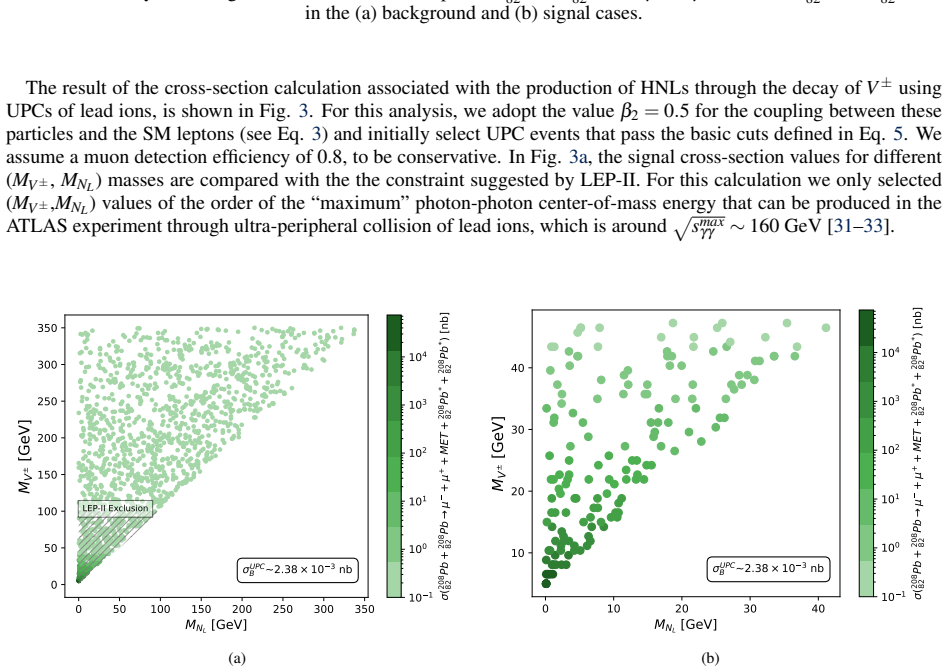
- [Fig. 3 and Section IV A] The text says only mass values near the maximum γγ energy of about 160 GeV were selected, yet Fig. 3 displays masses up to 350 GeV; please clarify the selection criterion and the role of masses above 160 GeV.
- [References] The LEP-II exclusion argument cites the PDG review [62]; a direct citation to the LEP W-pair cross-section measurements would let the reader verify the claimed M_W' < 105 GeV constraint.
Circularity Check
No significant circularity: the ATLAS/HL-LHC sensitivity projections are conditional Monte Carlo estimates using stated model inputs and an external SM background.
full rationale
The paper's derivation chain is a Monte Carlo sensitivity projection, not a derivation of the BSM signal from data. The signal is defined by the VSM Lagrangian (Eqs. 2-3) with stated input parameters (beta_2 = 0.5; k1,2, alpha2,3 and lambda2,3,4 from ref. [51], a paper overlapping with the authors). These are assumptions, not outputs fitted to the claimed exclusion or discovery: no equation reduces the predicted significance (Eq. 6) to a fitted parameter. The background is an external SM benchmark (gamma-gamma -> W+W- -> mu+mu- + neutrinos, Fig. 2a), and the LEP-II comparison rests on an independent PDG constraint. The random-search cut optimization over the same Monte Carlo sample is an in-sample selection issue that can bias the quoted significance, but it is an overfitting/trial-factor concern rather than a circular reduction: the quoted N_S and N_B are generated counts after cuts, not parameters re-expressed as predictions. The model parameters and mass scenarios are scanned inputs, so the paper's claims are conditional projections; the admitted omission of other SM backgrounds (e.g., from lead-nucleus structure) is a completeness/correctness risk, not a circularity. No step was found where Eq. X equals Eq. Y by construction or where a fitted parameter is renamed as a prediction.
Assumptions & free parameters
free parameters (5)
- beta_2 =
0.5
- VSM parameters k1, k2, alpha_2,3, lambda_2,3,4 =
fixed to values of ref [51]
- background systematic epsilon_sys^B =
0.1
- muon detection efficiency =
0.8
- optimized selection cuts per mass scenario =
Tables II and III
assumptions (5)
- domain assumption The Vector Scotogenic Model Lagrangian (Eq. 2) with the HNL interaction (Eq. 3) describes the production and decay of V± and N_L.
- domain assumption The UPC photon flux is described by the chff distribution of ref [67] for coherent photon emission.
- domain assumption The only relevant background in the dimuon+MET final state is SM gamma-gamma -> W+W- -> mu+mu- + neutrinos.
- domain assumption Heavy neutral leptons N_L are stable on detector scales and escape, contributing only to missing transverse energy.
- domain assumption The selected VSM parameter region (masses 5-200 GeV, beta_2=0.5) is not already excluded by other experiments beyond the LEP-II indirect limit.
Cite this review
Pith. "Pith review of Probing the existence of a new charged vector boson decaying into heavy neutral leptons using ultra-peripheral heavy ion collisions at ATLAS." pith.science (2026). https://pith.science/paper/SJ7SR2OD
@misc{pith2026251024499,
  author       = {Pith},
  title        = {Pith review of: Probing the existence of a new charged vector boson decaying into heavy neutral leptons using ultra-peripheral heavy ion collisions at ATLAS},
  year         = {2026},
  howpublished = {\url{https://pith.science/paper/SJ7SR2OD}},
  note         = {Machine review of arXiv:2510.24499}
}
abstract
In this paper we explore the potential of Ultra-peripheral Collisions at the LHC to investigate new physics, focusing on the production of new charged vector bosons ${V}^{\pm}$ that decay into heavy neutral leptons $N_{L}$ in the context of the Vector Scotogenic Model. We show that the ATLAS experiment, searching for dilepton+met final states via UPCs of lead ions, can directly probe the existence of new charged vector bosons in the 5 GeV $<M_{V^{\pm}}, M_{N_L}<$ 105 GeV mass range. Our analysis identifies regions in the parameter space where the signal can be distinguished from the background with high statistical significance. Within this mass range, ATLAS can exclude at 95\% C.L. specific (${M}_{{V}^{\pm}}$, ${M}_{{N}_{L}}$) mass scenarios such as (30 GeV, 20 GeV), (30 GeV, 10 GeV) and (20 GeV, 10 GeV). In a discovery scenario, ATLAS could reach a significance of 5$\sigma$ for (20 GeV, 10 GeV). In addition, we show that HL-LHC with proton-proton UPCs could explore higher mass ranges, specifically 100 GeV $< M_{V^{\pm}}, M_{N_L}<$ 350 GeV. We find that the HL-LHC can exclude this mass range with 95\% C.L., covering a larger parameter space than previous SUSY searches, and most scenarios can achieve a discovery significance of 5$\sigma$.
Figures


Figures from the paper (10 more)


Reference graph
Works this paper leans on
-
[1]
G. Bertone, D. Hooper, and J. Silk, Phys. Rept.405, 279 (2005), arXiv:hep-ph/0404175
arXiv 2005
-
[2]
M. S. Boucenna, R. A. Lineros, and J. W. F. Valle, Front. in Phys.1, 34 (2013), arXiv:1204.2576 [hep-ph]
work page Pith review arXiv 2013
-
[3]
Y . Mambrini, S. Profumo, and F. S. Queiroz, Phys. Lett. B760, 807 (2016), arXiv:1508.06635 [hep-ph]
arXiv 2016
-
[4]
Hambye, PoSIDM2010, 098 (2011), arXiv:1012.4587 [hep-ph]
T. Hambye, PoSIDM2010, 098 (2011), arXiv:1012.4587 [hep-ph]
arXiv 2011
-
[5]
Affleck and M
I. Affleck and M. Dine, Nucl. Phys. B249, 361 (1985)
1985
-
[6]
A. D. Sakharov, Pisma Zh. Eksp. Teor. Fiz.5, 32 (1967)
1967
-
[7]
M. Yoshimura, Phys. Rev. Lett.41, 281 (1978), [Erratum: Phys.Rev.Lett. 42, 746 (1979)]. 17 0 25 50 75 100 125 150 175 200 MNL [GeV] 10 1 100 101 102 103 Luminosity [fb 1] HL-LHC expected luminosity with pp-UPC 100 120 140 160 180 200 MV± [GeV] (a) 0 25 50 75 100 125 150 175 200 MNL [GeV] 100 101 102 103 Luminosity [fb 1] HL-LHC expected luminosity with pp...
work page 1978
-
[8]
Dimopoulos and L
S. Dimopoulos and L. Susskind, Phys. Rev. D18, 4500 (1978)
1978
Show all 66 references
-
[9]
J. R. Ellis, M. K. Gaillard, and D. V . Nanopoulos, Phys. Lett. B80, 360 (1979), [Erratum: Phys.Lett.B 82, 464 (1979)]
1979
-
[10]
R. N. Mohapatra and G. Senjanovi ´c, Phys. Rev. Lett.44, 912 (1980)
1980
-
[11]
R. N. Mohapatra and J. W. F. Valle, Phys. Rev. D34, 1642 (1986)
1986
- [12]
-
[13]
Ding and S
G.-J. Ding and S. F. King, Rept. Prog. Phys.87, 084201 (2024), arXiv:2311.09282 [hep-ph]
2024 arXiv
-
[14]
S. O. Bilson-Thompson, F. Markopoulou, and L. Smolin, Class. Quant. Grav.24, 3975 (2007), arXiv:hep-th/0603022
2007 arXiv
-
[15]
A. H. Chamseddine, R. L. Arnowitt, and P. Nath, Phys. Rev. Lett.49, 970 (1982)
1982
-
[16]
H. M. Lee, J. Korean Phys. Soc.78, 985 (2021), arXiv:1907.12409 [hep-ph]
2021 arXiv
-
[17]
Halkiadakis, G
E. Halkiadakis, G. Redlinger, and D. Shih, Ann. Rev. Nucl. Part. Sci.64, 319 (2014), arXiv:1411.1427 [hep-ex]
2014 arXiv
-
[18]
Aad et al
G. Aad et al. (ATLAS), JINST3, S08003 (2008)
2008
-
[19]
Chatrchyan et al
S. Chatrchyan et al. (CMS), JINST3, S08004 (2008)
2008
- [20]
-
[21]
Chatrchyan et al
S. Chatrchyan et al. (CMS), Phys. Lett. B716, 30 (2012), arXiv:1207.7235 [hep-ex]
2012 arXiv
-
[22]
Chatrchyan et al
S. Chatrchyan et al. (CMS), JHEP01, 052 (2012), arXiv:1111.5536 [hep-ex]
2012 arXiv
-
[23]
Aaboud et al
M. Aaboud et al. (ATLAS), Nature Phys.13, 852 (2017), arXiv:1702.01625 [hep-ex]
2017 arXiv
-
[24]
Aad et al
G. Aad et al. (ATLAS), Phys. Rev. C104, 024906 (2021), arXiv:2011.12211 [nucl-ex]
2021 arXiv
-
[26]
C. A. Bertulani, S. R. Klein, and J. Nystrand, Ann. Rev. Nucl. Part. Sci.55, 271 (2005), arXiv:nucl-ex/0502005
2005 arXiv
-
[27]
C. A. Bertulani, J. Phys. Conf. Ser.2619, 012003 (2023), arXiv:2304.12475 [hep-ph]
2023 arXiv
-
[28]
Bruce, T
R. Bruce, T. Argyropoulos, H. Bartosik, R. De Maria, N. Fuster Martinez, M. A. Jebramcik, J. Jowett, N. Mounet, S. Redaelli, G. Rumolo, M. Schaumann, and H. Timko, HL-LHC operational scenarios for Pb-Pb and p-Pb operation, Tech. Rep. (CERN, Geneva, 2020)
2020
-
[29]
de Favereau de Jeneret, V
J. de Favereau de Jeneret, V . Lemaitre, Y . Liu, S. Ovyn, T. Pierzchala, K. Piotrzkowski, X. Rouby, N. Schul, and M. Van- der Donckt, (2009), arXiv:0908.2020 [hep-ph]
2009 arXiv
-
[30]
Klasen, Nucl
M. Klasen, Nucl. Phys. B Proc. Suppl.179-180, 298 (2008), arXiv:0806.0915 [hep-ph]
2008 arXiv
- [31]
-
[32]
Klein et al., (2020), arXiv:2009.03838 [hep-ph]
S. Klein et al., (2020), arXiv:2009.03838 [hep-ph]
2020 arXiv
-
[33]
d’Enterria et al., J
D. d’Enterria et al., J. Phys. G50, 050501 (2023), arXiv:2203.05939 [hep-ph]
2023 arXiv
-
[34]
del Aguila, F
F. del Aguila, F. Cornet, and J. I. Illana, Phys. Lett. B271, 256 (1991)
1991
-
[35]
Beresford and J
L. Beresford and J. Liu, Phys. Rev. D102, 113008 (2020), [Erratum: Phys.Rev.D 106, 039902 (2022)], arXiv:1908.05180 [hep-ph]
2020 arXiv
-
[36]
Dyndal, M
M. Dyndal, M. Klusek-Gawenda, M. Schott, and A. Szczurek, Phys. Lett. B809, 135682 (2020), arXiv:2002.05503 [hep-ph]
2020 arXiv
-
[37]
V . P. Goncalves, D. E. Martins, and M. S. Rangel, Eur. Phys. J. C81, 522 (2021), arXiv:2103.01862 [hep-ph]
2021 arXiv
-
[38]
Knapen, T
S. Knapen, T. Lin, H. K. Lou, and T. Melia, Phys. Rev. Lett.118, 171801 (2017), arXiv:1607.06083 [hep-ph]. 18
2017 arXiv
-
[39]
Barbosa, M
S. Barbosa, M. Coelho, S. Fichet, G. G. da Silveira, and M. Machado, (2025), arXiv:2506.10066 [hep-ph]
2025
-
[40]
S. Atag, S. C. Inan, and I. Sahin, JHEP09, 042 (2010), arXiv:1005.4792 [hep-ph]
2010 arXiv
-
[41]
K. S. Babu and S. Jana, Phys. Rev. D95, 055020 (2017), arXiv:1612.09224 [hep-ph]
2017 arXiv
-
[42]
S. I. Godunov, V . A. Novikov, A. N. Rozanov, M. I. Vysotsky, and E. V . Zhemchugov, JHEP01, 143 (2020), arXiv:1906.08568 [hep-ph]
2020 arXiv
-
[43]
Beresford and J
L. Beresford and J. Liu, Phys. Rev. Lett.123, 141801 (2019), arXiv:1811.06465 [hep-ph]
2019 arXiv
-
[44]
L. A. Harland-Lang, V . A. Khoze, M. G. Ryskin, and M. Tasevsky, JHEP04, 010 (2019), arXiv:1812.04886 [hep-ph]
2019 arXiv
-
[45]
Baines, N
S. Baines, N. E. Mavromatos, V . A. Mitsou, J. L. Pinfold, and A. Santra, Eur. Phys. J. C78, 966 (2018), [Erratum: Eur.Phys.J.C 79, 166 (2019)], arXiv:1808.08942 [hep-ph]
2018 arXiv
-
[46]
Dougall and S
T. Dougall and S. D. Wick, Eur. Phys. J. A39, 213 (2009), arXiv:0706.1042 [hep-ph]
2009 arXiv
-
[47]
Zhou, W.-G
Y .-J. Zhou, W.-G. Ma, L. Han, and R.-Y . Zhang, Phys. Rev. D76, 054003 (2007), arXiv:0708.1195 [hep-ph]
2007 arXiv
-
[48]
Chinese Physics Letters29, 031301 (2012)
2012
-
[49]
A. E. C ´arcamo Hern´andez, J. Vignatti, and A. Zerwekh, J. Phys. G46, 115007 (2019), arXiv:1807.05321 [hep-ph]
2019 arXiv
-
[50]
B. D. S ´aez, F. Rojas-Abatte, and A. R. Zerwekh, Phys. Rev. D99, 075026 (2019), arXiv:1810.06375 [hep-ph]
2019 arXiv
-
[51]
P. A. C., J. Zamora-Saa, and A. R. Zerwekh, JHEP02, 153 (2024), arXiv:2211.09753 [hep-ph]
2024 arXiv
-
[52]
P. A. C., J. Zamora-Saa, and A. R. Zerwekh, Eur. Phys. J. C84, 1278 (2024), arXiv:2403.04030 [hep-ph]
2024 arXiv
-
[53]
Aad et al
G. Aad et al. (ATLAS), Phys. Rev. D100, 052013 (2019), arXiv:1906.05609 [hep-ex]
2019 arXiv
- [54]
-
[55]
Aad et al
G. Aad et al. (ATLAS), Phys. Rev. D109, 112008 (2024), arXiv:2402.16576 [hep-ex]
2024 arXiv
- [56]
- [57]
-
[58]
A. M. Sirunyan et al. (CMS), JHEP05, 033 (2020), arXiv:1911.03947 [hep-ex]
2020 arXiv
-
[59]
Aad et al
G. Aad et al. (ATLAS), Eur. Phys. J. C80, 1165 (2020), arXiv:2004.14636 [hep-ex]
2020 arXiv
-
[60]
Tumasyan et al
A. Tumasyan et al. (CMS), Phys. Lett. B844, 137813 (2023), arXiv:2210.00043 [hep-ex]
2023 arXiv
-
[61]
D. P. Aguillard et al. (Muon g-2), Phys. Rev. Lett.135, 101802 (2025), arXiv:2506.03069 [hep-ex]
2025
-
[62]
Navas et al
S. Navas et al. (Particle Data Group), Phys. Rev. D110, 030001 (2024)
2024
-
[63]
Degrande, C
C. Degrande, C. Duhr, B. Fuks, D. Grellscheid, O. Mattelaer, and T. Reiter, Comput. Phys. Commun.183, 1201 (2012), arXiv:1108.2040 [hep-ph]
2012 arXiv
-
[64]
Alloul, N
A. Alloul, N. D. Christensen, C. Degrande, C. Duhr, and B. Fuks, Comput. Phys. Commun.185, 2250 (2014), arXiv:1310.1921 [hep-ph]
2014 arXiv
-
[65]
Alwall, R
J. Alwall, R. Frederix, S. Frixione, V . Hirschi, F. Maltoni, O. Mattelaer, H. S. Shao, T. Stelzer, P. Torrielli, and M. Zaro, JHEP 07, 079 (2014), arXiv:1405.0301 [hep-ph]
2014 arXiv
- [66]
-
[67]
Vidovic, M
M. Vidovic, M. Greiner, C. Best, and G. Soff, Phys. Rev. C47, 2308 (1993). 19
1993
Reviewed August 15, 2026 · model on record in the stance chip above.
Discussion (0). Continue with ORCID to comment.