REVIEW 3 major objections 5 minor 1 cited by
Entanglement-enhanced correlation propagation in the one-dimensional SU($N$) Fermi-Hubbard model
T0 review · 3 major / 5 minor · reviewed 2026-08-04 · deepseek-v4-flash
Pith's one-line read In the 1D SU(N) Fermi-Hubbard model, flavor entanglement in the Mott-insulator initial state collectively enhances doublon hopping for N>2, raising the correlation-front velocity up to the single-component Bose-Hubbard limit as N grows.
desk verdict Genuinely new mechanism — initial-state flavor entanglement enhances doublon hopping in SU(N) fermions — with a clean product-state control, but the quantitative velocity formula is a heuristic extrapolation, not a derived result; worth refereeing after the abstract is toned down. read the letter →
The pith
A machine-rendered reading of the paper's core claim, the machinery that carries it, and where it could break.
The reading
What carries the argument
The central object is the equal-superposition doublon collective state: for each site, the uniform superposition of all local configurations containing one double occupation. For N>2 each such configuration can connect to two adjacent doublon configurations with amplitude J, rather than one, which raises the effective hopping to up to 2J; a holon always connects to only one adjacent holon state, so its hopping stays J. In the special case N_P=N (one particle per flavor), these superposition states form a disconnected sector exactly equivalent to a single-component bosonic Hamiltonian; for N_P>N the sector is only approximate, and K is used as an indicator of the bandwidth and hence of the fr
What would settle it
Measure the density-density correlation front in an SU(3) or SU(4) Fermi-Hubbard quench on a large lattice (L≫24) at U_fin/J≈8 and extract the velocity: if it does not exceed 4J or does not increase with N toward (4(1−1/N)+2)J, the mechanism fails. In parallel, exact-diagonalize the one-doublon restricted Fock space for N_P≫N and check whether the actual bandwidth approaches 4K; a strong deviation would quantitatively invalidate the conjectured velocity even if the qualitative trend survives.
Extended reading notes
Core claim
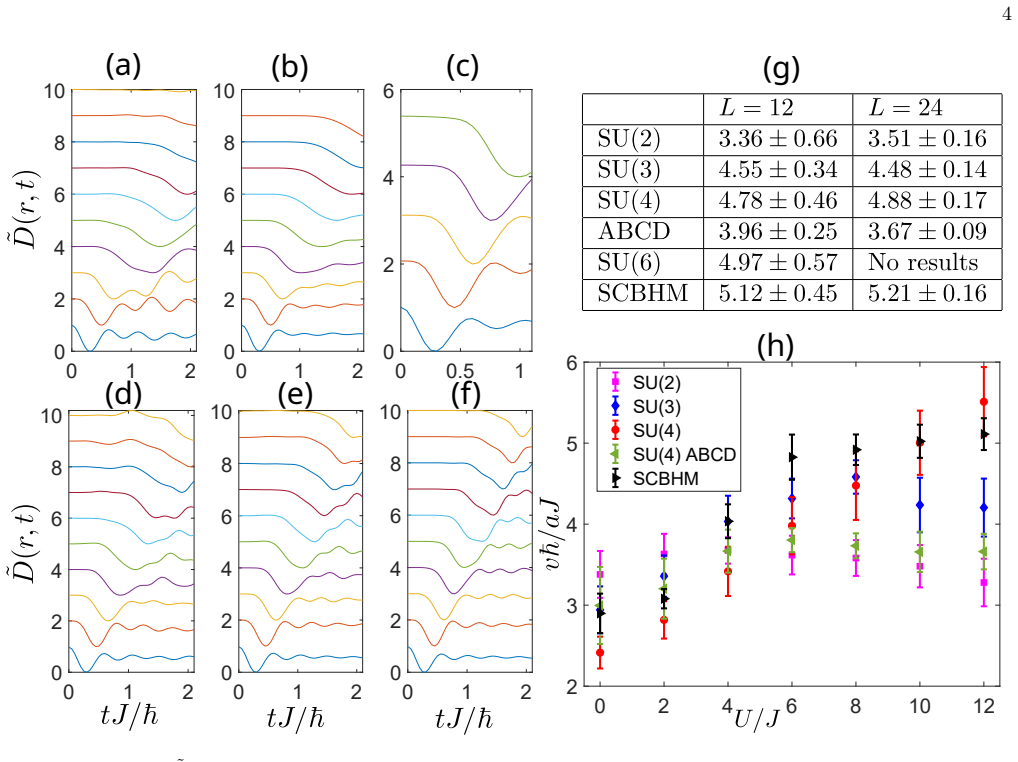
The paper's central claim is that flavor entanglement in the 1/N-filled Mott insulating initial state of the 1D SU(N) Fermi-Hubbard model collectively enhances the effective hopping of doublon excitations for N>2: the equal-superposition doublon collective state has matrix element K/J=(N−1−1/N_F)/(N/2−1/N_F), so K exceeds J for N>2, approaches 2(1−1/N)J for large systems, and tends to the single-component Bose-Hubbard value 2J as N→∞, while holon hopping remains J. From this the paper conjectures the correlation-front velocity v_SU(N)=(4(1−1/N)+2)J for large lattices, interpolating between the SU(2) bound 4J and the bosonic 6J. Numerical evaluation of the density-density correlation after th
Load-bearing premise
The load-bearing premise is that the correlation front in the full model is governed by the effective hopping K of the equal-superposition doublon state, and that the front velocity is the sum of the doublon and holon velocities — even though for N>2 with N_P>N that superposition does not form a closed sector, and the paper itself describes K as 'some indication of the propagation speed' rather than a proven bound.
Editorial extensions
If this is right
- If the conjecture holds, an SU(N) simulator provides a front velocity tunable from 4J to 6J by changing N alone.
- A flavor-product initial state shows no enhancement, implying a direct signature: the effect disappears when flavor entanglement is destroyed, e.g., by raising the initial temperature.
- For N=2 the exact restricted-sector analysis gives no enhancement, so the SU(2) bound v≤4J is robust for all interactions.
- For large N, correlation propagation in the Fermi-Hubbard model becomes indistinguishable from that of the single-component Bose-Hubbard model in the same geometry.
- The predicted N-dependence is testable with existing quantum-gas-microscope setups using alkaline-earth atoms with N=3,4,6 flavors.
Reading between the lines
- [Editorial inference] The counting mechanism behind K should transfer to other entangled initial states with flavor-symmetric superpositions, such as multicolor ladders or spin-orbital systems, giving analogous velocity boosts with different prefactors.
- [Editorial inference] Because the closed-sector proof is exact only at N_P=N, the quantitative conjecture is most fragile in the dilute limit; a direct measurement of the doublon bandwidth for N_P≫N would either validate or break the (4(1−1/N)+2)J formula.
- [Editorial inference] The front velocity could serve as a dynamical thermometer: measuring it as a function of initial temperature would map the crossover from entangled (enhanced) to classical (unenhanced) transport.
- [Editorial inference] If the enhancement persists in higher-dimensional SU(N) Hubbard models, it could affect thermalization fronts and entanglement growth, not just density-density correlations.
Editorial analysis
A structured set of objections, weighed in public.
Referee Report
Summary. The paper studies quench dynamics of the one-dimensional SU(N) Fermi-Hubbard model starting from a 1/N-filled Mott insulator at U→∞ and suddenly reducing U to a finite value. For N>2, the initial Mott state carries flavor entanglement (a (N−1)-component Luttinger liquid). The authors derive a combinatorial expression, Eq. (3), for the effective hopping K of an equal-superposition doublon state in a restricted one-doublon Fock space. This K exceeds J for N>2 and tends to 2(1−1/N)J for large systems, approaching the SCBHM doublon hopping 2J as N→∞; holon hopping remains J. They conjecture the correlation-front velocity v_SU(N) = (4(1−1/N)+2)J and support the qualitative N-dependence with MPS time evolution for N=2,3,4,6, together with a product-state control that shows no enhancement. The supplement contains ED spectra for restricted doublon/holon models and a proof that SU(N) fermions with N≥N_P reproduce bosonic matrix elements in the 1PF subsector.
Significance. The paper identifies a concrete and experimentally relevant mechanism: flavor entanglement in the initial Mott state enhances doublon mobility, leading to a N-dependent correlation-front velocity measurable with quantum-gas microscopes. Strengths include the parameter-free combinatorial derivation of K, the product-state control, the MPS numerics that reproduce the predicted qualitative ordering, and the supplement's general equivalence between SU(N) fermions and bosons in the N≥N_P sector. However, the quantitative velocity formula is only a conjecture: the exact sector calculation holds for N_P=N, while the quench simulations have N_F>1 where the equal-superposition sector is not closed. Table S1 shows the exact doublon bandwidth exceeds the naive K-based estimate by 11–15% in that regime, so the mapping from K to the front velocity is not quantitatively controlled. The abstract's 'we show' is stronger than the evidence and the paper's own conclusion.
major comments (3)
- [Analytical calculations, Eq. (3) and following paragraph; Suppl. S1.1.2] The closed-sector derivation is exact only for N_F=1 (N_P=N) or N=2. For the physical regime N_P>N, the paper concedes that the equal-superposition doublon states do not separate into their own sector, so Eq. (3) is only 'some indication' of the propagation speed. Since the MPS quenches use L=24 and N_F between 2 and 8, the analytical argument does not by itself establish the abstract's claim that v_SU(N) becomes equal to the SCBHM velocity in the large-N limit. The derivation-to-conjecture gap should be made explicit, and the abstract should be worded accordingly.
- [Numerical calculations, Fig. 2(g)-(h); Table S1] The data support the qualitative ordering (SU(2)<SU(3),SU(4),SU(6)<SCBHM, with the ABCD product state showing no enhancement), but they do not independently determine the functional form (1−1/N). The paper admits 'achievable L and N are so limited that it is hard to say anything quantitative.' Moreover, the additive rule v_doublon+v_holon is assumed without derivation, and Table S1 shows the exact doublon bandwidth exceeds the naive K-based estimate by 11–15% for N_P>N. The velocity formula should be presented as a heuristic extrapolation, not as a result established by the numerics.
- [Abstract and Summary/outlook] The abstract says 'we show that entanglement ... leads to collective enhancement ... becoming equal to the velocity of the Bose-Hubbard model in the large-N limit,' while the Summary calls the formula a conjecture. This mismatch in certainty is load-bearing for the paper's central claim. In addition, the Summary states that the velocity 'approaches J a/¯h, the same value as that of the SCBHM,' which is inconsistent with the conjectured formula v_SU(N)=(4(1−1/N)+2)J, whose large-N limit is 6J a/ar h. Please correct the typo and align the abstract with the conclusion.
minor comments (5)
- [Abstract] Typo: 'replusive' should be 'repulsive'.
- [Main text, near Fig. 2] Typo: 'dependendce' should be 'dependence'. Also, Fig. 2 caption: 'The table in Fig. 2(g)' should be 'the data in Fig. 2(g)' since (g) is a plot.
- [Supplemental Material, Table S1] In the SU(4), N_P=8 row, K/J is listed as 1.857, but Eq. (3) gives (N−1−1/N_F)/(N/2−1/N_F) = (4−1−1/2)/(2−1/2) = 5/3 ≈ 1.667 for N_F=2. The listed ΔE_K=6.337 is consistent with K=5/3, suggesting a typo in the K column.
- [Supplemental Material, Eq. (S2)] There is an unmatched parenthesis in the product term: 'L+1−3NF−jNF)' should presumably be 'L+1−3NF−jNF'.
- [Supplemental Material, S1.1.3 and S1.2] The term 'unconnected sectors' is used; for consistency with the main text, 'disconnected sectors' would be clearer.
Circularity Check
No significant circularity: the doublon hopping K is derived by parameter-free combinatorial counting and the velocity formula is explicitly presented as a conjecture, with its limitations admitted in the text.
full rationale
The central analytical quantity, K/J = (N-1-1/N_F)/(N/2-1/N_F) (Eq. 3), is obtained from combinatorial counting of doublon configurations (Q1 and Q2 in Eqs. S1-S2), not fitted to the numerical quench data. The velocity claim v_SU(N) = (4(1-1/N)+2)J is explicitly called a 'conjecture' in the Summary and is not presented as a derived theorem. The paper also plainly states its own limitations: for N>2 and N_P>N 'the equal doublon superposition states will not separate into their own sector' and K 'gives some indication of the propagation speed', and later admits 'achievable L and N are so limited that it is hard to say anything quantitative.' Thus the quantitative formula is an extrapolation from a heuristic model, not a fitted parameter renamed as a prediction. The numerical velocities are extracted by fits, but the conjectured formula is not obtained by fitting those velocities; it is a parameter-free combination of the asymptotic K and a holon contribution, and the paper does not claim to have derived this additivity. The holon model and the N=N_P closed-sector arguments are proved self-containedly in the supplement using Fourier transforms and explicit matrix-element calculations. Self-citations (Refs. 22, 24, 27, 46) are used for numerical methodology and context, not as the load-bearing justification of the central claim. No step reduces to its own inputs by construction, so no circularity is present. The weakness of the velocity conjecture is a concern about derivation completeness or correctness risk, not circularity.
Assumptions & free parameters
free parameters (4)
- Conjecture coefficients for v_SU(N) =
v = (4(1-1/N)+2)J
- U_ini = 40J cutoff =
40J
- U_fin = 8J primary final interaction =
8J
- MPS bond dimension / Trotter step =
not stated
assumptions (5)
- domain assumption Density correlations after the quench are carried dominantly by holon-doublon excitations.
- ad hoc to paper For N>2 and N_P>N, the equal-superposition collective doublon states dominate the correlation velocity.
- domain assumption The DMRG ground state at U_ini=40J faithfully represents the U=infinity Mott insulator with a (N-1)-component Tomonaga-Luttinger flavor sector.
- ad hoc to paper The front velocity equals v_doublon + v_holon.
- standard math Ground-state sector of SU(N) fermions for N>=N_P (1PF sector) is equivalent to single-component bosons.
Cite this review
Pith. "Pith review of Entanglement-enhanced correlation propagation in the one-dimensional SU($N$) Fermi-Hubbard model." pith.science (2026). https://pith.science/paper/TWMXWY7P
@misc{pith2026251025358,
  author       = {Pith},
  title        = {Pith review of: Entanglement-enhanced correlation propagation in the one-dimensional SU($N$) Fermi-Hubbard model},
  year         = {2026},
  howpublished = {\url{https://pith.science/paper/TWMXWY7P}},
  note         = {Machine review of arXiv:2510.25358}
}
abstract
We investigate the dynamics of correlation propagation in the one-dimensional Fermi-Hubbard model with SU($N$) symmetry when the repulsive-interaction strength is quenched from a large value, at which the ground state is a Mott-insulator with $1/N$ filling, to an intermediate value. From approximate analytical insights based on a simple model that captures the essential physics of the doublon excitations, we show that entanglement in the initial state leads to collective enhancement of the propagation velocity $v_{\text{SU}(N)}$ when $N>2$, becoming equal to the velocity of the Bose-Hubbard model in the large-$N$ limit. These results are supported by numerical calculations of the density-density correlation in the quench dynamics for $N=2,3,4,$ and $6$.
Figures

Forward citations
Cited by 1 Pith paper
-
First and second quantized digital quantum simulations of bosonic systems
For fixed particle and mode numbers, first-quantized bosonic encodings beat second-quantized ones in gate count for k-RDM terms and standard Hamiltonians, with unary first-quantized cheapest in gates and binary first-...
Reference graph
Works this paper leans on
-
[1]
Gross and I
C. Gross and I. Bloch, Science357, 995 (2017)
2017
-
[2]
Sch¨ afer, T
F. Sch¨ afer, T. Fukuhara, S. Sugawa, Y. Takasu, and Y. Takahashi, Nat. Rev. Phys.2, 411 (2020)
2020
-
[3]
Browaeys and T
A. Browaeys and T. Lahaye, Nat. Phys.16, 132 (2020)
2020
-
[4]
Morgado and S
M. Morgado and S. Whitlock, A VS Quantum Sci.3, 023501 (2021)
2021
-
[5]
Blatt and C
R. Blatt and C. F. Roos, Nat. Phys.8, 277 (2012)
2012
-
[6]
X. Wu, X. Liang, Y. Tian, F. Yang, C. Chen, Y.-C. Liu, M. K. Tey, and L. You, Chin. Phys. B30, 020305 (2021)
2021
-
[7]
Monroe, W
C. Monroe, W. C. Campbell, L.-M. Duan, Z.-X. Gong, A. V. Gorshkov, P. W. Hess, R. Islam, K. Kim, N. M. Linke, P. Richerme, C. Senko, and N. Y. Yao, Rev. Mod. Phys.93, 025001 (2021)
2021
-
[8]
Lamata, A
L. Lamata, A. Parra-Rodriguez, M. Sanz, and E. Solano, Advances in Physics: X, 3:1, 1457981 (2018)
2018
Show all 48 references
-
[9]
K. He, X. Geng, R. Huang, J. Liu, and W. Chen, Chin. Phys. B30, 080304 (2021)
2021
-
[10]
Cheneau, P
M. Cheneau, P. Barmettler, D. Poletti, M. Endres, P. Schauß, T. Fukuhara, C. Gross, I. Bloch, C. Kollath, and S. Kuhr, Nature481, 484 (2012)
2012
-
[11]
Takasu, T
Y. Takasu, T. Yagami, H. Asaka, Y. Fukushima, K. Na- gao, S. Goto, I. Danshita, and Y. Takahashi, Sci. Adv. 6, eaba9255 (2020)
2020
-
[12]
Richerme, Z.-X
P. Richerme, Z.-X. Gong, A. Lee, C. Senko, J. Smith, M. Foss-Feig, S. Michalakis, A. V. Gorshkov, and C. Monroe, Nature511, 198 (2014)
2014
-
[13]
Jurcevic, B
P. Jurcevic, B. P. Lanyon, P. Hauke, C. Hempel, P. Zoller, R. Blatt, and C. F. Roos, Nature511, 202 (2014)
2014
-
[14]
C. Chen, G. Emperauger, G. Bornet, F. Caleca, B. G´ ely, M. Bintz, S. Chatterjee, V. Liu, D. Barredo, N. Y. Yao, T. Lahaye, F. Mezzacapo, T. Roscilde, and A. Browaeys, Science389, 483 (2025)
2025
-
[15]
Gong and R
Z. Gong and R. Hamasaki, Int. J. Mod. Phys. B36, 2230007 (2022)
2022
-
[16]
Cheneau,The Physics and Mathematics of Elliot Lieb: The 90th Anniversary Volume I, edited by R
M. Cheneau,The Physics and Mathematics of Elliot Lieb: The 90th Anniversary Volume I, edited by R. K. Frank, A. Laptev, M. Lewin, and R. Seiringer, Chap. 10 (EMS Press, Berlin, 2022)
2022
-
[17]
Barmettler, D
P. Barmettler, D. Poletti, M. Cheneau, and C. Kollath, Phys. Rev. A85, 053625 (2012)
2012
-
[18]
Natu and E
S. Natu and E. J. Mueller, Phys. Rev. A87, 063616 (2013)
2013
-
[19]
Hauke and L
P. Hauke and L. Tagliacozzo, Phys. Rev. Lett.111, 207202 (2013)
2013
-
[20]
M. R. C. Fitzpatrick and M. P. Kennett, Phys. Rev. A 98, 053618 (2018). 6
2018
-
[21]
Cevolani, J
L. Cevolani, J. Despres, G. Carleo, L. Tagliacozzo, and L. Sanchez-Palencia, Phys. Rev. B98, 024302 (2018)
2018
-
[22]
Nagao, M
K. Nagao, M. Kunimi, Y. Takasu, Y. Takahashi, and I. Danshita, Phys. Rev. A99, 023622 (2019)
2019
-
[23]
Despres, L
J. Despres, L. Villa, and L. Sanchez-Palencia, Sci. Rep. 9, 4135 (2019)
2019
-
[24]
Nagao, Y
K. Nagao, Y. Takasu, Y. Takahashi, and I. Danshita, Phys. Rev. Res.3, 043091 (2021)
2021
-
[25]
Mokhtari-Jazi, M
A. Mokhtari-Jazi, M. R. C. Fitzpatrick, and M. P. Ken- nett, Phys. Rev. A103, 023334 (2021)
2021
-
[26]
J. T. Schneider, J. Despres, S. J. Thomson, L. Tagli- acozzo, and L. Sanchez-Palencia, Phys. Rev. Res.3, L012022 (2021)
2021
-
[27]
Kaneko and I
R. Kaneko and I. Danshita, Commun. Phys.5, 65 (2022)
2022
-
[28]
Nagao and S
K. Nagao and S. Yunoki, Phys. Rev. A111, 023315 (2025)
2025
-
[29]
S. Taie, R. Yamazaki, S. Sugawa, and Y. Takahashi, Nat. Phys.8, 825 (2012)
2012
-
[30]
Hofrichter, L
C. Hofrichter, L. Riegger, F. Scazza, M. H¨ ofer, D. R. Fer- nandes, I. Bloch, and S. F¨ olling, Phys. Rev. X6, 021030 (2016)
2016
-
[31]
Ozawa, S
H. Ozawa, S. Taie, Y. Takasu, and Y. Takahashi, Phys. Rev. Lett.121, 225303 (2018)
2018
-
[32]
S. Taie, E. Ibarra-Garc ´ ıa-Padilla, N. Nishizawa, Y. Takasu, Y. Kuno, H.-T. Wei, R. T. Scalettar, K. R. A. Hazzard, and Y. Takahashi, Nat. Phys.18, 1356 (2022)
2022
-
[33]
D. Tusi, L. Franchi, L. F. Livi, K. Baumann, D. Bene- dicto Orenes, L. Del Re, R. E. Barfknecht, T.-W. Zhou, M. Inguscio, G. Cappellini, M. Capone, J. Catani, and L. Fallani, Nat. Phys. 18, 1201 (2022)
2022
-
[34]
Pasqualetti, O
G. Pasqualetti, O. Bettermann, N. D. Oppong, E. Ibarra- Garc ´ ıa-Padilla, S. Dasgupta, R. T. Scalettar, K. R. A. Hazzard, I. Bloch, and S. F¨ olling, Phys. Rev. Lett.132, 083401 (2024)
2024
-
[35]
Cazalilla and A
M. Cazalilla and A. M. Rey, Rep. Prog. Phys.77, 124401 (2014)
2014
-
[36]
C. He, E. Hajiyev, Z. Ren, B. Song, and G.-B. Jo, J. Phys.: At. Mol. Opt. Phys.52, 102001 (2019)
2019
-
[37]
Ibarra-Garc ´ ıa-Padilla and S
E. Ibarra-Garc ´ ıa-Padilla and S. Choudhury, J. Phys.: Condens. Matter37, 083003 (2025)
2025
-
[38]
Bonnes, K
L. Bonnes, K. R. A. Hazzard, S. R. Manmana, A. M. Rey, and S. Wessel, Phys. Rev. Lett.109, 205305 (2012)
2012
-
[39]
Capponi, P
S. Capponi, P. Lecheminant, and K. Totsuka367, 50 (2016)
2016
-
[40]
Yamamoto, J
R. Yamamoto, J. Kobayashi, T. Kuno, K. Kato, and Y. Takahashi, New J. Phys.18, 023016 (2016)
2016
-
[41]
Miranda, R
M. Miranda, R. Inoue, N. Tambo, and M. Kozuma, Phys. Rev. A96, 043626 (2017)
2017
-
[42]
S. Buob, J. H¨ oschele, V. Makhalov, A. Rubio-Abadal, and L. Tarruel, PRX Quantum 5, 020316 (2024)
2024
-
[43]
See Supplemental Material at [URL will be inserted by publisher]
-
[44]
Vidal, Phys
G. Vidal, Phys. Rev. Lett.93, 040502 (2004)
2004
-
[45]
Schollw¨ ock, Ann
U. Schollw¨ ock, Ann. Phys.326, 96 (2011)
2011
-
[46]
Mikkelsen and I
M. Mikkelsen and I. Danshita, Phys. Rev. A107, 043313 (2023)
2023
-
[47]
S. R. White, Phys. Rev. Lett.69, 2863 (1992)
1992
-
[48]
Entanglement-enhanced correlation propagation in the one-dimensional SU(N) Fermi-Hubbard model
M. Fishman, S. R. White, and E. M. Stoudenmire, Sci- Post Phys. Codebases 4 (2022). 7 Supplemental Material: “Entanglement-enhanced correlation propagation in the one-dimensional SU(N) Fermi-Hubbard model” S1. Restricted F ock-space representations for doublons and holons S.1....
2022
Reviewed August 4, 2026 · model on record in the stance chip above.
Discussion (0). Continue with ORCID to comment.