REVIEW 4 major objections 5 minor 50 references
SGNL: Scalable Low-Latency Gravitational Wave Detection Pipeline for Compact Binary Mergers
T0 review · 4 major / 5 minor · reviewed 2026-08-03 · deepseek-v4-flash
Pith's one-line read A reimplementation of the gravitational-wave matched-filtering search reports the same detections at a median latency of 5.4 seconds, down from 9.3 seconds.
desk verdict Useful engineering paper with a real latency win; sensitivity claims need quantified uncertainties before I'd trust the equivalence. read the letter →
The pith
A machine-rendered reading of the paper's core claim, the machinery that carries it, and where it could break.
The reading
What carries the argument
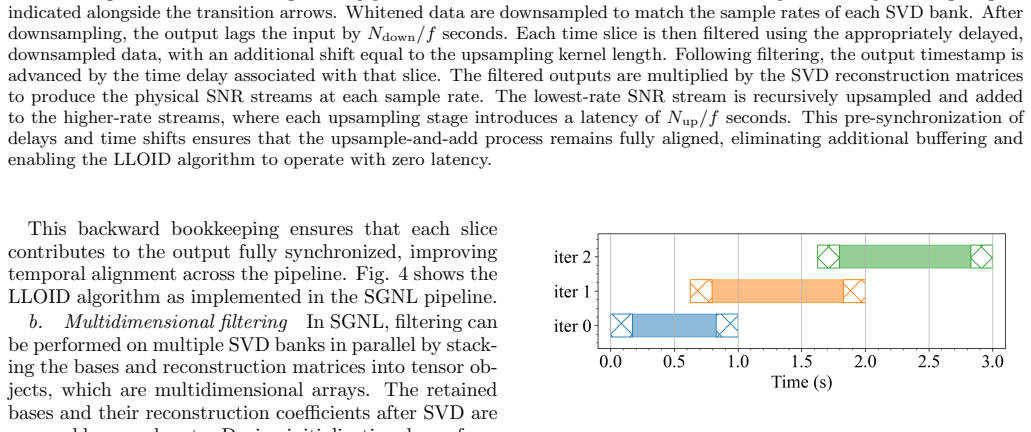
The Low-Latency Online Inspiral Detection (LLOID) algorithm, which compresses a large template bank using singular value decomposition and splits templates into downsampled time slices, is reimplemented with a pre-synchronization step. For each time slice, the needed input segment is identified from the slice's known time delay plus the cumulative half-lengths of all upsampling kernels, so contributions from all slices align in the final SNR series with zero added latency. Filtering, reconstruction, and coincidence checks are expressed as batched tensor operations, enabling GPU execution.
What would settle it
Run SGNL and GstLAL on the same 40-day mock dataset with identical template banks (both checkerboard halves), identical operating time, identical SNR interpolation, and the same background KDE kernel, then count recovered injections per false-alarm threshold. If the ratio of recovered injections falls below the expected ~97% of the full bank by more than the Poisson counting uncertainty, the claim of sensitivity consistency fails.
Extended reading notes
Core claim
The core discovery is that a from-scratch reimplementation of the LLOID matched-filtering algorithm can match the established search's sensitivity while systematically eliminating latency. The latency reduction comes from pre-synchronizing LLOID time slices: the pipeline computes in advance exactly which segment of each downsampled stream each slice needs, so filtering, reconstruction, and the upsample-and-add combination align exactly with no extra buffering or trimming. The paper also reports that filtering, trigger finding, and coincidence formation are tensorized and run on GPUs, and that with one checkerboard half of the template bank and float16 precision, the event recovery and sensit
Load-bearing premise
The paper assumes that running one checkerboard half of the template bank on SGNL with float16 precision is a fair proxy for the full-bank GstLAL search, relying on a published 97% sensitivity factor and on 'statistical and systematic uncertainties' that are never quantified; if the mock challenge conditions or that factor are unrepresentative, the sensitivity-consistency claim is not established.
Editorial extensions
If this is right
- Alerts for binary-merger signals reach the public a median of 5.4 seconds after merger, down from 9.3 seconds, improving chances for early electromagnetic follow-up.
- The GPU-batched filtering core makes the search scalable to larger template banks and future detector networks without a proportional rise in compute cost.
- The Python-based architecture lowers the barrier to extending the search with new signal models or machine-learning components.
- The pre-synchronization scheme eliminates extra buffering latency without changing the LLOID physics, so existing ranking statistics and background estimation carry over unchanged.
Reading between the lines
- The pre-synchronization bookkeeping is a general recipe for any multirate filter-bank pipeline: if each stage's delay and kernel lengths are known, output alignment can be computed in advance, eliminating buffer-induced latency beyond the physical filter delays.
- The sensitivity comparison rests on one checkerboard half of the template bank and a published 97% sensitivity factor; a direct test with both halves and float32 precision would show whether the claimed equivalence holds exactly or accepts a small sensitivity loss in exchange for speed.
- Because float16 rounding and trigger-window boundary effects shifted one known event's SNR and false-alarm rate, near-threshold triggers are the place where SGNL may diverge from the baseline; rerunning the mock challenge with higher precision and shifted trigger windows would quantify this risk.
Editorial analysis
A structured set of objections, weighed in public.
Referee Report
Summary. The paper presents SGNL, a Python/PyTorch reimplementation of the GstLAL inspiral matched-filtering pipeline. It replaces GStreamer with the SGN streaming framework, reimplements the LLOID filtering core on GPU, and introduces a pre-synchronization scheme for multirate time-slice reconstruction. The authors validate SGNL on a 40-day Mock Data Challenge with roughly 50,000 injections, using one checkerboard half of the O4 template bank, float16 precision, and 38 NVIDIA A2 GPUs. They report that eight of nine known GWTC-3 events are recovered with network SNR within 1% of GstLAL, that the recovered-injection VT ratio is consistent with GstLAL within statistical and systematic uncertainties, and that the median GraceDB latency is 5.4 s versus 9.3 s for GstLAL, a 42% reduction. The abstract, however, quotes 4.7 s versus 9.0 s.
Significance. If the sensitivity and latency claims are established, SGNL would be a valuable, maintainable, GPU-scalable alternative to GstLAL for low-latency CBC searches. The paper's strengths are its direct large-scale empirical comparison with an independently operated pipeline, a clear architectural description, and the availability of the code base. The core physics is not novel, but the engineering contribution is timely and potentially useful for future observing runs. The main weakness is that the central sensitivity-consistency claim rests on an unquantified uncertainty statement and on a non-equivalent test bed; these issues are addressable but currently leave the headline result less certain than the text suggests.
major comments (4)
- [Sec. III C 1 / Fig. 7] The central claim that "the VT of SGNL is consistent with GstLAL within statistical and systematic uncertainties" is not quantitatively supported. Fig. 7 shows VT ratios without error bars, and no statistical or systematic uncertainty is computed anywhere in the text. With ~50,000 injections, the statistical error on a recovered-injection fraction is very small, so even a few-percent VT deficit can be many sigma. Please provide binomial or bootstrap confidence intervals on the VT ratios and a quantitative decomposition of the systematic contributions named in the text (single-checkerboard factor, operating time, dropped data, lack of sub-sample interpolation, float16).
- [Sec. III / MDC setup] The comparison is not apples-to-apples. SGNL ran one checkerboard half of the O4 bank while GstLAL ran the full two-checkerboard bank. The 97% single-checkerboard sensitivity factor is imported from Sakon et al. [14], a bank-quality study, rather than measured on this MDC with SGNL's float16 GPU pipeline and STRIKE ranking statistic. The GW200202 154313 case in Table I, where the GstLAL-preferred event came from the unused checkerboard, illustrates that single-checkerboard choice can affect individual recoveries. The post hoc explanations (trigger-window edges, KDE kernel, data gaps) are plausible but suggest sensitivity to uncontrolled details. Please either run SGNL on both checkerboards for a subset of the MDC, measure the single-checkerboard sensitivity factor on this injection set, or otherwise place a quantitative bound on this correction.
- [Sec. III / float16] The pipeline uses float16 for filtering, trigger generation, coincidence, and background accumulation, but the manuscript contains no validation that half-precision does not bias SNR estimates or ranking statistics. Matched-filter outputs are sums over many products, where float16 rounding can be non-negligible, especially for low-SNR or marginal triggers. Please quantify the float16 effect, e.g., by comparing float32 and float16 on a subset of the MDC injections or on the known events, and state the resulting shift in VT and FAR.
- [Abstract vs Sec. III D / Conclusion] The abstract reports a median latency of 4.7 s versus 9.0 s for GstLAL, while Sec. III D and the Conclusion report 5.4 s versus 9.3 s. These correspond to different reductions (about 48% versus 42%). Since the latency improvement is a headline result, the numbers must be reconciled and consistently reported throughout.
minor comments (5)
- [Eqs. (3), (5), (6)] The notation for SVD reconstruction coefficients is inconsistent: Eq. (3) uses v^s_il and the text refers to reconstruction coefficients, while Eq. (6) uses \nu^s_il. Please unify the symbol and define it once near Eq. (3).
- [Fig. 7 caption] Typo: "difference source classes" should read "different source classes."
- [Fig. 4 caption] The phrase "enabling the LLOID algorithm to operate with zero latency" overstates the result; the pre-synchronization eliminates additional latency from multirate reconstruction, but the pipeline still has intrinsic latency from FFT, filtering, and trigger windows. Suggest rewording to "zero additional latency."
- [Sec. III D] The term "GstLAL's SNR optimizer" is used without explanation or reference. If it is an internal component of the GstLAL MDC configuration, clarify what it does and why it is excluded.
- [Sec. II C 2 a / Eq. (4)] The downsampling kernel description defines c as the half-length and then states c = f N_down; for the upsampling kernel, the text says total length 2f N_up + 1. The relationship between c and N_up/N_down is confusing; please define the kernel length and half-length consistently for both resampling stages.
Circularity Check
No circularity: sensitivity and latency claims are empirical MDC measurements against GstLAL, not fitted inputs renamed as predictions.
full rationale
The paper's central claims are empirical measurements, not predictions derived from fitted inputs. Sensitivity is quantified by Eq. 12, <VT> = (found/total)<VT>_inj, where 'found' is the number of MDC injections recovered below a FAR threshold, and the SGNL/GstLAL comparison in Fig. 7 is a ratio of those measured counts. Latency in Fig. 8 is the measured GraceDB receive time minus coalescence time, with medians 5.4 s and 9.3 s; no parameter is fitted to the target result and then renamed a prediction. The one imported quantitative factor, the 97% single-checkerboard sensitivity from [14], is an external template-bank result; even if author lists overlap, it is not derived from SGNL's MDC output, so it is an independent input rather than a self-citation forcing the conclusion. GstLAL is an independently operated code base, and references to GstLAL papers describe the baseline method rather than supplying the claimed improvement. The main weaknesses -- unquantified 'statistical and systematic uncertainties,' Fig. 7 without error bars, the non-equivalent test beds (one checkerboard, float16, different hardware and MDC iteration), and the post-hoc explanation of GW200202 154313 -- are evidential and experimental-fairness concerns, not derivation-to-input circularity. There is also a numerical inconsistency between the abstract (4.7/9.0 s) and Sec. III D (5.4/9.3 s), but that is a reporting issue, not a circular reduction.
Assumptions & free parameters
free parameters (7)
- FFT block length N =
4 s
- Zero-padding window Z =
1 s
- PSD median count n_med =
7
- Downsampling filter half-length N_down =
32 samples
- Upsampling filter half-length N_up =
8 samples
- Trigger SNR threshold =
rho = 4
- Coincidence buffer =
0.005 s
assumptions (7)
- domain assumption Matched filtering with whitened templates is the optimal detection statistic under stationary Gaussian noise.
- domain assumption PSD bins are chi-squared distributed so the geometric mean can be recovered from the median by a constant factor.
- domain assumption SVD compression of the template bank with truncation level L_s preserves matched-filter sensitivity.
- standard math Time-sliced downsampling to the Nyquist rate of each slice does not lose SNR.
- domain assumption A single checkerboard half of the O4 template bank retains 97% sensitivity of the full bank.
- domain assumption The GstLAL MDC results from a different iteration are a valid baseline for SGNL comparison.
- domain assumption Float16 GPU arithmetic does not materially bias SNR, xi-squared, or FAR statistics.
Cite this review
Pith. "Pith review of SGNL: Scalable Low-Latency Gravitational Wave Detection Pipeline for Compact Binary Mergers." pith.science (2026). https://pith.science/paper/BPR544IE
@misc{pith2026251104730,
  author       = {Pith},
  title        = {Pith review of: SGNL: Scalable Low-Latency Gravitational Wave Detection Pipeline for Compact Binary Mergers},
  year         = {2026},
  howpublished = {\url{https://pith.science/paper/BPR544IE}},
  note         = {Machine review of arXiv:2511.04730}
}
read the original abstract
We present SGNL, a scalable, low-latency gravitational-wave search pipeline. It reimplements the core matched-filtering principles of the GstLAL pipeline within a modernized framework. The Stream Graph Navigator library, a lightweight Python streaming framework, replaces GstLAL's GStreamer infrastructure, simplifying pipeline construction and enabling flexible, modular graph design. The filtering core is reimplemented in PyTorch, allowing SGNL to leverage GPU acceleration for improved computational scalability. We describe the pipeline architecture and introduce a novel implementation of the Low-Latency Online Inspiral Detection algorithm in which components are pre-synchronized to reduce latency. Results from 40 days of data show that SGNL's event recovery and sensitivity are consistent with GstLAL's within statistical and systematic uncertainties. Notably, SGNL achieves a median latency of 4.7 seconds, compared to 9.0 seconds for GstLAL.
Figures


Figures from the paper (3 more)


Reference graph
Works this paper leans on
-
[14]
This calculation requires collecting back- ground noise distributions for each detector and for each SVD bin
Significance estimation SGNL refactored GstLAL’s likelihood ratio calcu- lations for ranking statistics into a modular library, STRIKE [27]. This calculation requires collecting back- ground noise distributions for each detector and for each SVD bin. Background collection uses the SNR andξ 2 values of triggers that exceed the SNR threshold during the trig...
-
[1]
These data contain both gravitational-wave strain and state vector channels, the latter providing data qual- ity information from auxiliary detector channels
Data ingestion Gravitational-wave data from the L VK detectors are distributed in low latency to shared memory on the LIGO Data Grid in one-second chunks as Gravitational-Wave Frame (GWF) files, typically at a sample rate of 16384 Hz. These data contain both gravitational-wave strain and state vector channels, the latter providing data qual- ity informati...
-
[2]
1: Workflow of the SGNL online inspiral pipeline
PSD estimation and whitening The SGNL pipeline reimplements the GstLAL PSD es- timation and whitening method [11, 26] in Python within 3 FIG. 1: Workflow of the SGNL online inspiral pipeline. Data from multiple detectors are read in a single source element, including both strain and state vector channels. Invalid segments flagged by the state vector are g...
-
[3]
glitches,
Threshold gating L VK detector strain data contain non-Gaussian, short- duration noise transients, or “glitches,” which can mimic gravitational-wave signals from high-mass compact bi- naries. The SGNL pipeline employs the same gating method as GstLAL to address these artifacts [11, 12]. Once the data are whitened, giving them unit variance, any brief excu...
-
[4]
If half-precision computation is enabled, the data are converted accordingly at this stage
Transferring data to GPU In SGNL’s GPU mode, whitened and gated data from each detector are synchronized and transferred to the GPU. If half-precision computation is enabled, the data are converted accordingly at this stage. When running in CPU mode, this step is a no-op. C. The LLOID filtering algorithm The SGNL analysis builds upon the time-domain match...
-
[5]
Templates are first divided into groups [11, 14]
SVD bank construction The SVD bank construction follows the LLOID algo- rithm, combining time slicing and SVD to compress the template bank. Templates are first divided into groups [11, 14]. Within each group, templates are whitened and then divided into time slices. The time slices within a group share the same time boundaries across templates. Each slic...
-
[6]
Downsampling of whitened dataEach template time slice requires a specific sample rate, so the input detector data is downsampled to match the rate of each time slice
Filtering workflow a. Downsampling of whitened dataEach template time slice requires a specific sample rate, so the input detector data is downsampled to match the rate of each time slice. This produces multiple downsampled streams that correspond to the different time slice rates. Downsampling is implemented using a sinc-windowed sinc kernel: g[k] = ...
-
[7]
Pre-synchronization of time slicesIn SGNL, time slices are pre-synchronized before filtering rather than only aligned after the LLOID pipeline output
Extensions in SGNL a. Pre-synchronization of time slicesIn SGNL, time slices are pre-synchronized before filtering rather than only aligned after the LLOID pipeline output. For each time slices, SGNL identifies exactly which segment of the downsampled inputx s[k] is needed so that, after filtering, reconstruction, and upsampling, the slice’s contribution ...
Show all 50 references
-
[8]
The time delayz s of the time slices
-
[9]
Using these offsets, SGNL identifies the exact portion of each downsampled stream to process, avoiding unneces- sary reads and eliminating added latency
The cumulative half-lengths of all upsampling ker- nels between the slice’s ratef s and the maximum ratef 0. Using these offsets, SGNL identifies the exact portion of each downsampled stream to process, avoiding unneces- sary reads and eliminating added latency. The recursive ...
-
[10]
For each FIG
Trigger identification After the LLOID filtering algorithm, the 2Mreal tem- plate filters produce 2MSNR time series, with the real and imaginary components corresponding to the SNR outputs of each of theMtemplate waveforms. For each FIG. 5: Overlapping and streaming behavior d...
-
[11]
Signal-Based Consistency Test For each SNR peak identified during the trigger identi- fication stage, a signal-consistency statistic is computed as ξ2 j = R δt −δt dt|z j(t)−z j(0)Rj(t)|2 R δt −δt dt 2−2|R j(t)|2 , j∈[0, M−1],(10) whereξ 2 j quantifies the consistency of the S...
-
[12]
The event time for each single-detector trigger is defined as the time of the SNR peak
Coincidence Formation To suppress false alarms, candidate events must occur in temporal coincidence across multiple detectors. The event time for each single-detector trigger is defined as the time of the SNR peak. For every trigger in one detec- tor, the pipeline checks if tr...
-
[13]
Within each subbank, events are then clustered, and only the event with the highest network SNR is retained, en- suring that at most one event is kept per subbank
Clustering After coincidence formation, each event may consist of a variable number of coincident triggers across detectors. Within each subbank, events are then clustered, and only the event with the highest network SNR is retained, en- suring that at most one event is kept p...
-
[15]
If the F AR is below the public alert threshold, the event with the maximum SNR is se- lected
Event candidate alerting After the likelihood ratio is calculated and F AR is as- signed, events that pass the upload threshold are inter- nally aggregated across subbanks to select a local candi- date within a program. If the F AR is below the public alert threshold, the even...
-
[16]
checkerboarded
Monitoring metrics Metrics from each event, including SNR, likelihood ra- tio, and F AR, and latency at various pipeline stages, are sent to Kafka topics. Metrics from multiple inspiral pro- grams are aggregated and stored in an InfluxDB [29]. Grafana [30] panels are then used...
2020
-
[17]
found inst
Search Sensitivity We use the spacetime volume, or sensitivity volume- time (VT), to quantify the analysis sensitivity. The co- moving volume is defined as [32, 33] Vc = 4πDH Z z 0 dz (1 +z)D 2 A E(z) ,(11) wherezis the redshift,D H is the Hubble distance,D A is the angular di...
-
[18]
The LIGO Scientific Collaboration, the Virgo Col- laboration, the KAGRA Collaboration, A. G. Abac, I. Abouelfettouh, F. Acernese, K. Ackley, C. Adam- cewicz, S. Adhicary, D. Adhikari, N. Adhikari, R. X. Ad- hikari, V. K. Adkins, S. Afroz, A. Agapito, D. Agarwal, M. Agathos, N....
2025 arXiv
-
[19]
Aasiet al.(LIGO Scientific Collaboration), Advanced LIGO, Classical and Quantum Gravity32, 074001 (2015)
J. Aasiet al.(LIGO Scientific Collaboration), Advanced LIGO, Classical and Quantum Gravity32, 074001 (2015)
2015
-
[20]
Acerneseet al., Advanced Virgo: a second-generation interferometric gravitational wave detector, Classical and Quantum Gravity32, 024001 (2014)
F. Acerneseet al., Advanced Virgo: a second-generation interferometric gravitational wave detector, Classical and Quantum Gravity32, 024001 (2014)
2014
-
[21]
Akutsuet al., Overview of KAGRA: Detector design and construction history, Progress of Theoretical and Ex- perimental Physics2021, 05A101 (2020)
T. Akutsuet al., Overview of KAGRA: Detector design and construction history, Progress of Theoretical and Ex- perimental Physics2021, 05A101 (2020)
2020
-
[22]
B. P. Abbottet al.(LIGO Scientific Collaboration and Virgo Collaboration), GWTC-1: A Gravitational-Wave Transient Catalog of Compact Binary Mergers Observed by LIGO and Virgo during the First and Second Observ- ing Runs, Phys. Rev. X9, 031040 (2019)
2019
-
[23]
R. Abbottet al.(LIGO Scientific Collaboration and Virgo Collaboration), GWTC-2: Compact Binary Co- alescences Observed by LIGO and Virgo during the First Half of the Third Observing Run, Phys. Rev. X11, 021053 (2021)
2021
-
[24]
R. Abbottet al.(LIGO Scientific Collaboration, Virgo Collaboration, and KAGRA Collaboration), GWTC-3: Compact Binary Coalescences Observed by LIGO and Virgo during the Second Part of the Third Observing Run, Phys. Rev. X13, 041039 (2023)
2023
-
[25]
Collaboration, Gravitational-wave candi- date event database,https://gracedb.ligo.org/ superevents/public/
L.-V.-K. Collaboration, Gravitational-wave candi- date event database,https://gracedb.ligo.org/ superevents/public/
-
[26]
C. S. Unnikrishnan, IndIGO and Ligo-India Scope and Plans for Gravitational Wave Research and Preci- sion Metrology in India, International Journal of Mod- ern Physics D22, 1341010 (2013), arXiv:1510.06059 [physics.ins-det]
2013 arXiv
-
[27]
C. S. Unnikrishnan, LIGO-India: A decadal assessment on its scope, relevance, progress and future, International Journal of Modern Physics D33, 2450025 (2024)
2024
-
[28]
Messicket al., Analysis framework for the prompt dis- covery of compact binary mergers in gravitational-wave data, Phys
C. Messicket al., Analysis framework for the prompt dis- covery of compact binary mergers in gravitational-wave data, Phys. Rev. D95, 042001 (2017)
2017
-
[29]
Ewinget al., Performance of the low-latency Gst- LAL inspiral search towards LIGO, Virgo, and KAGRA’s fourth observing run, Phys
B. Ewinget al., Performance of the low-latency Gst- LAL inspiral search towards LIGO, Virgo, and KAGRA’s fourth observing run, Phys. Rev. D109, 042008 (2024)
2024
-
[30]
Tsukadaet al., Improved ranking statistics of the GstLAL inspiral search for compact binary coalescences, Phys
L. Tsukadaet al., Improved ranking statistics of the GstLAL inspiral search for compact binary coalescences, Phys. Rev. D108, 043004 (2023)
2023
-
[31]
Sakonet al., Template bank for compact binary merg- ers in the fourth observing run of Advanced LIGO, Ad- vanced Virgo, and KAGRA, Phys
S. Sakonet al., Template bank for compact binary merg- ers in the fourth observing run of Advanced LIGO, Ad- vanced Virgo, and KAGRA, Phys. Rev. D109, 044066 (2024)
2024
-
[32]
Joshi, L
P. Joshi, L. Tsukada, C. Hanna, S. Adhicary, D. Mukher- jee, W. Niu, S. Sakon, D. Singh, P. Baral, A. Baylor, K. Cannon, S. Caudill, B. Cousins, J. D. E. Creighton, B. Ewing, H. Fong, R. N. George, P. Godwin, R. Harada, Y.-J. Huang, R. Huxford, J. Kennington, S. Kuwa- hara, A....
2025 arXiv
-
[33]
Cannon, S
K. Cannon, S. Caudill, C. Chan, B. Cousins, J. D. Creighton, B. Ewing, H. Fong, P. Godwin, C. Hanna, S. Hooper, R. Huxford, R. Magee, D. Meacher, C. Mes- sick, S. Morisaki, D. Mukherjee, H. Ohta, A. Pace, S. Privitera, I. de Ruiter, S. Sachdev, L. Singer, D. Singh, R. Tapia, L...
2021
-
[34]
B. P. Abbottet al.(LIGO Scientific Collaboration and Virgo Collaboration), GW170817: Observation of Grav- itational Waves from a Binary Neutron Star Inspiral, Phys. Rev. Lett.119, 161101 (2017)
2017
-
[35]
Cannon, R
K. Cannon, R. Cariou, A. Chapman, M. Crispin-Ortuzar, N. Fotopoulos, M. Frei, C. Hanna, E. Kara, D. Kep- pel, L. Liao, S. Privitera, A. Searle, L. Singer, and A. Weinstein, TOW ARD EARLY-W ARNING DETEC- TION OF GRA VITATIONAL W A VES FROM COM- PACT BINARY COALESCENCE, The Astr...
2012
-
[36]
GStreamer,https://gstreamer.freedesktop.org/ documentation/index.html
-
[37]
SGNL,https://git.ligo.org/greg/sgnl()
-
[38]
SGN,https://git.ligo.org/greg/sgn()
-
[39]
Huang, C
Y.-J. Huang, C. Hanna, B. Ewing, P. Godwin, J. Gon- salves, R. Magee, C. Messick, L. Tsukada, Z. Yarbrough, P. Joshi, J. Kennington, W. Niu, J. Rollins, and U. Shah, Scalable matched-filtering pipeline for gravitational-wave searches of compact binary mergers, Phys. Rev. D112,...
2025
-
[40]
SGN-TS,https://git.ligo.org/greg/sgn-ts()
-
[41]
SGN-LIGO,https://git.ligo.org/greg/sgn-ligo()
-
[42]
LIGO Scientific Collaboration, LIGO Algorithm Library - LALSuite, free software (GPL) (2018)
2018
-
[43]
Tsukada, K
L. Tsukada, K. Cannon, C. Hanna, D. Keppel, D. Meacher, and C. Messick, Application of a zero- latency whitening filter to compact binary coalescence gravitational-wave searches, Phys. Rev. D97, 103009 (2018)
2018
-
[44]
STRIKE,https://git.ligo.org/greg/strike
-
[45]
Bottle: Python web framework,https://bottlepy.org/ docs/dev/
-
[46]
InfluxDB,https://www.influxdata.com/
-
[47]
Grafana,https://grafana.com/
-
[48]
S. S. Chaudhary, A. Toivonen, G. Waratkar, G. Mo, D. Chatterjee, S. Antier, P. Brockill, M. W. Cough- lin, R. Essick, S. Ghosh, S. Morisaki, P. Baral, A. Baylor, N. Adhikari, P. Brady, G. C. Davies, T. D. Canton, M. Cavaglia, J. Creighton, S. Choud- hary, Y.-K. Chu, P. Clearwa...
2024
-
[49]
D. W. Hogg, Distance measures in cosmology (1999), arXiv:astro-ph/9905116
1999 arXiv
-
[50]
H.-Y. Chen, D. E. Holz, J. Miller, M. Evans, S. Vitale, and J. Creighton, Distance measures in gravitational- wave astrophysics and cosmology, Class. Quant. Grav. 38, 055010 (2021), arXiv:1709.08079 [astro-ph.CO]
2021 arXiv
Reviewed August 3, 2026 · model on record in the stance chip above.
Discussion (0). Continue with ORCID to comment.