REVIEW 5 major objections 5 minor 70 references
QiVC-Net: Quantum-Inspired Variational Convolutional Network, with Application to Biosignal Classification
T0 review · 5 major / 5 minor · reviewed 2026-08-03 · deepseek-v4-flash
Pith's one-line read By rotating a layer's weights inside a random low-dimensional subspace, QiVC-Net reaches about 97.8% accuracy on two heart-sound benchmarks while keeping predictions well calibrated.
desk verdict A concrete structured-noise mechanism worth engaging, but the 97.8–97.9% accuracies rest on an underspecified cross-validation split that could be leaking subjects across folds. read the letter →
The pith
A machine-rendered reading of the paper's core claim, the machinery that carries it, and where it could break.
The reading
What carries the argument
The quantum-inspired rotated ensemble (QiRE), specifically Equation (5): ε_final = ε − QQᵀε + QUQᵀε, where Q spans a random k-dimensional subspace of the flattened kernel vector and U is a Haar-drawn orthogonal matrix. This is the load-bearing mechanism: it swaps the subspace component of the variational noise with a rotated version, and for Haar U it preserves the norm exactly, giving a structured, geometry-aware perturbation that carries the argument. The rest of the architecture (the RFR block, composite loss, and KL term) supports this sampling step.
What would settle it
Run the same training on CirCor with a strict subject-level split (all recordings from one subject in a single fold) and compare the average accuracy to the reported 97.89; a drop of more than a few points would show the headline is inflated. As a second check, measure the norm of ε_final at each training step to confirm the paper's claimed norm-preservation holds in the actual implementation.
Extended reading notes
Core claim
The central claim is that a convolutional layer can represent weight uncertainty more faithfully through norm-preserving subspace rotations than through independent Gaussian noise. QiRE flattens the kernel, picks a random k-dimensional subspace via QR decomposition, rotates a normalized noise vector by a Haar orthogonal matrix U within it, and forms the final sample as ε − QQᵀε + QUQᵀε. For Haar U this exactly preserves the norm, so the perturbation is a rotation of the original noise rather than an unstructured draw. The paper reports that QiVC-Net reaches 97.84% and 97.89% accuracy on two public heart-sound benchmarks, with balanced sensitivity/specificity and low calibration error.
Load-bearing premise
The reported 97.8% accuracies assume the 5-fold cross-validation splits subjects, not segments; the paper does not state the split unit, and if segments from the same subject appear in both training and validation on the pediatric CirCor dataset, the numbers could be inflated by intra-subject leakage.
Editorial extensions
If this is right
- On the CinC 2016 benchmark, QiVC-Net reaches 97.84% average accuracy, above the best prior result cited in the paper (96.51%).
- On the CirCor 2022 benchmark, it reaches 97.89% average accuracy, above the best prior result (92.10%).
- The QiVConv layer adds no extra learnable parameters, so the reported gains in accuracy and calibration come at negligible computational cost.
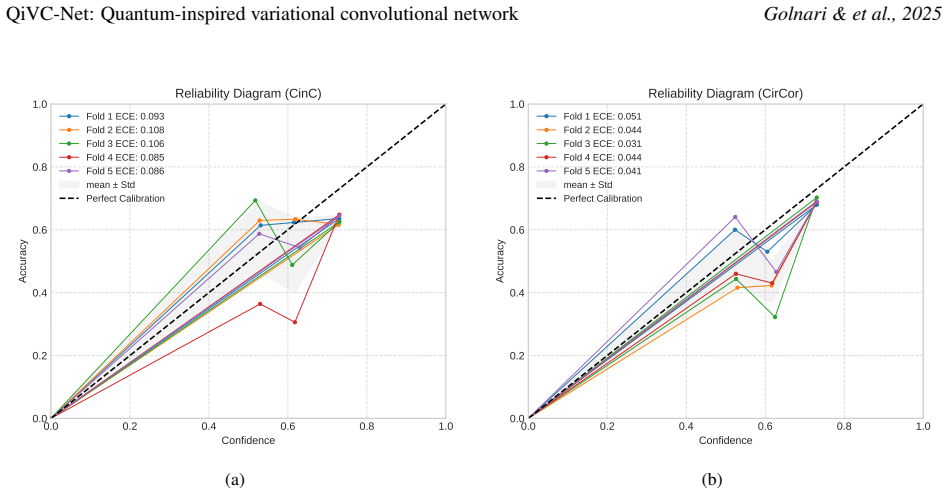
- Reliability diagrams show expected calibration errors below 0.11 on CinC and below 0.06 on CirCor, meaning predicted confidence tracks empirical accuracy.
- Under additive noise, accuracy stays above 0.96 at high SNR and degrades gradually to about 0.76–0.82 at 5 dB, indicating robustness.
Reading between the lines
- If the normative claim holds, it implies that the structure of variational noise — not just its variance — determines calibration in Bayesian deep learning. A direct test would be to ablate the Haar rotation: replacing U with a fixed random orthogonal matrix should measurably raise ECE if the geometry is doing the work.
- The unfalsified protocol detail (whether cross-validation splits are done per subject or per segment) is the readiest threat to the headline numbers; on CirCor, where multiple recordings share a subject, a per-subject split is the only clean check.
- Because QiVConv is parameter-free, it could be dropped into any convolutional architecture; testing it on ECG or EEG classification would show whether the benefit transfers beyond heart sounds.
- The subspace dimension k (set to 5) is a new hyperparameter; a principled selection rule, e.g., tied to the kernel size or the intrinsic dimensionality of the weights, would strengthen the method's practical claim.
Editorial analysis
A structured set of objections, weighed in public.
Referee Report
Summary. The paper proposes QiVC-Net, a convolutional network whose novel component is a quantum-inspired rotated ensemble (QiRE) layer. QiRE generates structured, geometry-preserving stochastic perturbations of convolutional weights by projecting a normalized Gaussian noise vector onto a random low-dimensional subspace and rotating it with a Haar-distributed orthogonal matrix (Eqs. (2)–(5)), with an optional decoherence mask (Eq. (6)). The method is evaluated on two phonocardiogram datasets, CinC 2016 and CirCor 2022, where accuracy values of 97.84% and 97.89% are reported, together with calibration and noise-robustness analyses. The authors claim state-of-the-art performance and argue that the structured, norm-preserving noise improves uncertainty modeling and robustness without adding learnable parameters.
Significance. If the central claim holds, QiRE would be a lightweight, parameter-free way to inject structured stochasticity into convolutional layers, potentially useful for Bayesian-style uncertainty estimation in signal classification. The conceptual link to unitary evolution is appealing, and the implementation is made publicly available. However, the current empirical support is not yet convincing: the evaluation protocol is under-specified, no same-architecture baselines are provided, and the comparisons to prior work use incompatible setups. The method itself is concrete and testable, so the shortcomings are addressable through additional experiments rather than being fundamental flaws.
major comments (5)
- [§4.5, §5 (Table 5)] The cross-validation split unit is never stated. §4.2 converts recordings into many 4-second non-overlapping windows; CinC has 409 subjects (one recording each) and CirCor has 942 subjects (3,136 recordings, up to five per subject). If 'stratified 5-fold cross-validation' is performed at the segment level, windows from the same subject can appear in both training and validation, leaking subject-specific acoustic/background information and inflating accuracy, specificity, sensitivity, F1, ECE, and all robustness curves. The text gives no fold sizes, no grouping variable, and no indication of subject-disjoint splitting. This is the central SOTA claim: a subject-disjoint rerun is required, with per-subject aggregated predictions (e.g., majority voting) if windows are used as instances.
- [§3.1–3.2, Table 6] The benchmark comparisons are protocol-incompatible. For CinC the paper uses only the training-a subset (409 recordings) and states 'only training-a contains actual PCG recordings,' which is inaccurate: the CinC challenge includes several PCG subsets, and most published methods use the full training set or official challenge folds. For CirCor the paper keeps only Absent/Present murmur labels and excludes Unknown, while several compared methods use different label schemes or three-class outputs. The 1–6 point differences in Table 6 may therefore reflect data subset and label choices rather than algorithmic superiority. Please evaluate under the official challenge protocol, or explicitly mark Table 6 as non-comparable.
- [§5 (no baseline/ablation)] There is no in-architecture control. The paper never compares QiVC-Net against a deterministic CNN with the same RFR backbone, nor against a plain variational CNN that uses unstructured Gaussian reparameterization. The claimed benefits of QiRE (accuracy, calibration, robustness) are supported only by external numbers and by Figures 5–7, which contain no baseline curves. Same-architecture ablations (deterministic, Gaussian-reparameterized, QiRE) on the same folds and preprocessing are necessary to attribute the observed behavior to the QiRE mechanism.
- [§5, after Table 5] The reported CinC F1-score is internally inconsistent. The text states 'F1-score of 97.41%,' while the Average row of Table 5 lists 95.60% (the mean of the per-fold F1 values 96.73, 93.45, 97.56, 95.82, 94.43 is 95.60). Table 6 also lists 95.60%. This is a headline metric and should be corrected and consistently reported.
- [§4.1.2, Eq. (6)] The 'norm-preserving' claim is only exact for Eq. (5). The optional decoherence step in Eq. (6) is part of the default configuration (p=0.05) and replaces some components with 1/√N, which changes the exact norm of ε_final. The text repeatedly says the noise preserves 'norm and coherence' or 'overall variance.' This may be true in expectation under the Bernoulli mask, but it is not exact. Please either set p=0 in the main experiments or qualify the norm-preservation statements to the pre-decoherence stage.
minor comments (5)
- [Algorithm 1, line 20] Line 20 uses 'ϵ ← ϵ0/∥ϵ0∥2', but ϵ0 is not defined inside the function; the function samples ϵ from N(0, I_N) on line 19. The normalization should be applied to ϵ.
- [§3.2, first sentence] Typo: 'cataset' should be 'dataset.'
- [Figure 8] The legend for the CinC panel says 'Normal/Murmur,' but the CinC classes are Normal/Abnormal. This should be corrected for consistency.
- [§4.1, 'no additional parameters'] The text says the QiVC layer 'does not introduce additional learnable parameters,' but the variational formulation introduces μ and σ parameters. Clarify that QiRE itself adds no parameters beyond the variational mean and scale.
- [Reproducibility] The GitHub repository is mentioned, but the paper does not describe the code structure, dependencies, or exact commands to reproduce the results. Since the submission is in a journal context, please include a reproducibility section or appendix.
Circularity Check
No significant circularity: the QiRE sampling rule is a concrete algorithmic transformation and the reported accuracies are empirical outcomes, with only non-load-bearing self-citations.
full rationale
The paper's central derivation is the QiRE sampling mechanism in Eqs. (2)-(6), culminating in Eq. (5): epsilon_final = epsilon - QQ^T epsilon + Q U Q^T epsilon. This is an explicit, self-contained algorithmic procedure: Q is a random orthonormal basis from the QR decomposition of a Gaussian matrix, U is sampled from Haar(SO(k)), and the norm preservation is a direct mathematical identity, not an assumption fitted to the benchmarks. No parameter is fitted to a subset of data and then renamed as a prediction; the reported accuracies, sensitivities, specificities, F1-scores, calibration curves, and robustness plots are measured empirical results on the CinC and CirCor datasets. The self-citations that appear, such as [53] for the dynamic loss weighting and [54] for early stopping/checkpointing, are contextual and not load-bearing for the central claim; the method's novelty claim does not reduce to any self-cited uniqueness theorem or fitted ansatz. The unresolved ambiguity about whether the 5-fold cross-validation is subject-disjoint is a legitimate correctness/external-validity risk, but it is not a form of circularity: it does not make the paper's equations equivalent to its inputs. Under the required standard of exhibiting a specific reduction, no circular step is present.
Assumptions & free parameters
free parameters (5)
- Subspace dimension k =
5
- Decoherence probability p =
0.05
- Prior variance σ²_prior =
0.01
- KL scaling λ =
1e-5
- Window length / resampling =
4 s / 2000 samples
assumptions (4)
- standard math Standard weight-space variational inference with a Gaussian mean-field posterior q(W|µ, σ) and prior p(W|σ_prior), with reparameterization.
- domain assumption QR-based sampled orthonormal basis and QR-derived orthogonal matrix are statistically interchangeable with true Haar-uniform subspace and rotation samplers; the optimization is unaffected by this approximation.
- ad hoc to paper The 4-second non-overlapping Windows can be treated as pseudo-independent samples for the purpose of stratified cross-validation.
- domain assumption The selected comparison numbers from other papers are meaningful baselines under the same task and data split.
invented entities (1)
-
QiRE (quantum-inspired rotated ensemble) mechanism and its 'depolarizing decoherence mask'
Cite this review
Pith. "Pith review of QiVC-Net: Quantum-Inspired Variational Convolutional Network, with Application to Biosignal Classification." pith.science (2026). https://pith.science/paper/Z2FTX5HL
@misc{pith2026251105730,
  author       = {Pith},
  title        = {Pith review of: QiVC-Net: Quantum-Inspired Variational Convolutional Network, with Application to Biosignal Classification},
  year         = {2026},
  howpublished = {\url{https://pith.science/paper/Z2FTX5HL}},
  note         = {Machine review of arXiv:2511.05730}
}
read the original abstract
In this paper, a learning framework is introduced which incorporates principles of probabilistic inference, variational optimization, and geometry-preserving operations inspired by quantum transformations. The central innovation of this quantum-inspired variational convolution (QiVC) lies in its quantum-inspired rotated ensemble (QiRE) mechanism. QiRE performs differentiable low-dimensional subspace rotations of convolutional weights. By drawing a mathematical analogy from unitary evolution, this approach enables structured uncertainty modeling that respects the intrinsic geometry of the parameter space. To demonstrate its practical potential, the concept is instantiated in a QiVC-based convolutional network (QiVC-Net) and evaluated in the context of biosignal classification, focusing on phonocardiogram (PCG) recordings. The proposed QiVC-Net integrates an architecture in which the QiVC layer does not introduce additional parameters, instead performing an ensemble rotation of the convolutional weights through a structured mechanism ensuring robustness without added highly computational burden. Experiments on two benchmark datasets, PhysioNet CinC 2016 and PhysioNet CirCor DigiScope 2022, show that QiVC-Net achieves state-of-the-art performance, reaching accuracies of 97.84% and 97.89%, respectively. These findings highlight the versatility of the QiVC framework and its promise for advancing uncertainty-aware modeling in real-world biomedical signal analysis. The implementation of the QiVConv layer is available in GitHub for public use.
Figures


Figures from the paper (5 more)



Reference graph
Works this paper leans on
-
[1]
Dropout as a bayesian approximation: Representing model uncertainty in deep learning
Yarin Gal and Zoubin Ghahramani. Dropout as a bayesian approximation: Representing model uncertainty in deep learning. pages 1050–1059, 2016
2016
-
[2]
What uncertainties do we need in bayesian deep learning for computer vision? Advances in neural information processing systems, 30, 2017
Alex Kendall and Yarin Gal. What uncertainties do we need in bayesian deep learning for computer vision? Advances in neural information processing systems, 30, 2017
2017
-
[3]
A review of uncertainty quantification in deep learning: Techniques, applications and challenges.Information fusion, 76:243–297, 2021
Moloud Abdar, Farhad Pourpanah, Sadiq Hussain, Dana Rezazadegan, Li Liu, Mohammad Ghavamzadeh, Paul Fieguth, Xiaochun Cao, Abbas Khosravi, U Rajendra Acharya, et al. A review of uncertainty quantification in deep learning: Techniques, applications and challenges.Information fusion, 76:243–297, 2021
2021
-
[4]
Improving model calibration with accuracy versus uncertainty optimiza- tion.Advances in Neural Information Processing Systems, 33:18237–18248, 2020
Ranganath Krishnan and Omesh Tickoo. Improving model calibration with accuracy versus uncertainty optimiza- tion.Advances in Neural Information Processing Systems, 33:18237–18248, 2020
2020
-
[5]
Measuring robustness to natural distribution shifts in image classification.Advances in Neural Information Processing Systems, 33:18583–18599, 2020
Rohan Taori, Achal Dave, Vaishaal Shankar, Nicholas Carlini, Benjamin Recht, and Ludwig Schmidt. Measuring robustness to natural distribution shifts in image classification.Advances in Neural Information Processing Systems, 33:18583–18599, 2020
2020
-
[6]
Cambridge University Press, 2020
Jun John Sakurai and Jim Napolitano.Modern quantum mechanics. Cambridge University Press, 2020. 16 QiVC-Net: Quantum-inspired variational convolutional networkGolnari & et al., 2025
2020
-
[7]
Training deep quantum neural networks.Nature communications, 11(1):808, 2020
Kerstin Beer, Dmytro Bondarenko, Terry Farrelly, Tobias J Osborne, Robert Salzmann, Daniel Scheiermann, and Ramona Wolf. Training deep quantum neural networks.Nature communications, 11(1):808, 2020
2020
-
[8]
Shaozhi Li, M Sabbir Salek, Binayyak Roy, Yao Wang, and Mashrur Chowdhury. Quantum-inspired weight- constrained neural network: Reducing variable numbers by 100x compared to standard neural networks.arXiv preprint arXiv:2412.19355, 2024
arXiv 2024
Show all 70 references
-
[9]
Functional variational bayesian neural networks
Shengyang Sun, Guodong Zhang, Jiaxin Shi, and Roger Grosse. Functional variational bayesian neural networks. arXiv preprint arXiv:1903.05779, 2019
1903 arXiv
-
[10]
John Wiley & Sons, 2020
Saeid Sanei, Delaram Jarchi, and Anthony G Constantinides.Body sensor networking, design and algorithms. John Wiley & Sons, 2020
2020
-
[11]
Deep learning in heart sound analysis: from techniques to clinical applications.Health Data Science, 4:0182, 2024
Qinghao Zhao, Shijia Geng, Boya Wang, Yutong Sun, Wenchang Nie, Baochen Bai, Chao Yu, Feng Zhang, Gongzheng Tang, Deyun Zhang, et al. Deep learning in heart sound analysis: from techniques to clinical applications.Health Data Science, 4:0182, 2024
2024
-
[12]
Advances in ecg and pcg-based cardiovascular disease classification: a review of deep learning and machine learning methods.Journal of Big Data, 11(1):159, 2024
Asmaa Ameen, Ibrahim Eldesouky Fattoh, Tarek Abd El-Hafeez, and Kareem Ahmed. Advances in ecg and pcg-based cardiovascular disease classification: a review of deep learning and machine learning methods.Journal of Big Data, 11(1):159, 2024
2024
-
[13]
Algorithms for automatic analysis and classification of heart sounds–a systematic review.IEEE Access, 7:8316–8345, 2018
Amit Krishna Dwivedi, Syed Anas Imtiaz, and Esther Rodriguez-Villegas. Algorithms for automatic analysis and classification of heart sounds–a systematic review.IEEE Access, 7:8316–8345, 2018
2018
-
[14]
Cardiac anomaly detection considering an additive noise and convolutional distortion model of heart sound recordings
Farhat Binte Azam, Md Istiaq Ansari, Shoyad Ibn Sabur Khan Nuhash, Ian McLane, and Taufiq Hasan. Cardiac anomaly detection considering an additive noise and convolutional distortion model of heart sound recordings. Artificial Intelligence in Medicine, 133:102417, 2022
2022
-
[15]
Deep learning for medical anomaly detection–a survey.ACM Computing Surveys (CSUR), 54(7):1–37, 2021
Tharindu Fernando, Harshala Gammulle, Simon Denman, Sridha Sridharan, and Clinton Fookes. Deep learning for medical anomaly detection–a survey.ACM Computing Surveys (CSUR), 54(7):1–37, 2021
2021
-
[16]
Simple and powerful pcg classification method based on selection and transfer learning for precision medicine application.Bioengineering, 10(3):294, 2023
Ahmed Barnawi, Mehrez Boulares, and Rim Somai. Simple and powerful pcg classification method based on selection and transfer learning for precision medicine application.Bioengineering, 10(3):294, 2023
2023
-
[17]
A novel embedded system design for the detection and classification of cardiac disorders.Computational Intelligence, 37(4):1844–1864, 2021
Umair Riaz, Sumair Aziz, Muhammad Umar Khan, Syed Azhar Ali Zaidi, Muhammad Ukasha, and Aamir Rashid. A novel embedded system design for the detection and classification of cardiac disorders.Computational Intelligence, 37(4):1844–1864, 2021
2021
-
[18]
Bidirectional recurrent neural networks.IEEE transactions on Signal Processing, 45(11):2673–2681, 1997
Mike Schuster and Kuldip K Paliwal. Bidirectional recurrent neural networks.IEEE transactions on Signal Processing, 45(11):2673–2681, 1997
1997
-
[19]
Phonocardiographic sensing using deep learning for abnormal heartbeat detection.IEEE Sensors Journal, 18(22):9393–9400, 2018
Siddique Latif, Muhammad Usman, Rajib Rana, and Junaid Qadir. Phonocardiographic sensing using deep learning for abnormal heartbeat detection.IEEE Sensors Journal, 18(22):9393–9400, 2018
2018
-
[20]
Advanced ensemble learning-based cnn-bilstm network for cardiovascular disease classification using ecg and pcg signal.Biomedical Signal Processing and Control, 108:107846, 2025
Ehsanhosein Kalatehjari, Mohammad Mehdi Hosseini, Ali Harimi, and Vahid Abolghasemi. Advanced ensemble learning-based cnn-bilstm network for cardiovascular disease classification using ecg and pcg signal.Biomedical Signal Processing and Control, 108:107846, 2025
2025
-
[21]
Enhanced coronary artery disease classification through feature engineering and one-dimensional convolutional neural network.IEEE Access, 2025
Atitaya Phoemsuk and Vahid Abolghasemi. Enhanced coronary artery disease classification through feature engineering and one-dimensional convolutional neural network.IEEE Access, 2025
2025
-
[22]
Weight uncertainty in neural network
Charles Blundell, Julien Cornebise, Koray Kavukcuoglu, and Daan Wierstra. Weight uncertainty in neural network. pages 1613–1622, 2015
2015
-
[23]
Multiplicative normalizing flows for variational bayesian neural networks
Christos Louizos and Max Welling. Multiplicative normalizing flows for variational bayesian neural networks. pages 2218–2227, 2017
2017
-
[24]
Application of petersen graph pattern technique for automated detection of heart valve diseases with pcg signals.Information Sciences, 565:91–104, 2021
Turker Tuncer, Sengul Dogan, Ru-San Tan, and U Rajendra Acharya. Application of petersen graph pattern technique for automated detection of heart valve diseases with pcg signals.Information Sciences, 565:91–104, 2021
2021
-
[25]
S1 and s2 heart sound recognition using deep neural networks.IEEE Transactions on Biomedical Engineering, 64(2):372–380, 2016
Tien-En Chen, Shih-I Yang, Li-Ting Ho, Kun-Hsi Tsai, Yu-Hsuan Chen, Yun-Fan Chang, Ying-Hui Lai, Syu-Siang Wang, Yu Tsao, and Chau-Chung Wu. S1 and s2 heart sound recognition using deep neural networks.IEEE Transactions on Biomedical Engineering, 64(2):372–380, 2016
2016
-
[26]
Time– frequency-domain deep learning framework for the automated detection of heart valve disorders using pcg signals
Jay Karhade, Shaswati Dash, Samit Kumar Ghosh, Dinesh Kumar Dash, and Rajesh Kumar Tripathy. Time– frequency-domain deep learning framework for the automated detection of heart valve disorders using pcg signals. ieee transactions on instrumentation and measurement, 71:1–11, 2022
2022
-
[27]
Cardi-net: A deep neural network for classification of cardiac disease using phonocardiogram signal.Computer Methods and Programs in Biomedicine, 219:106727, 2022
Juwairiya Siraj Khan, Manoj Kaushik, Anushka Chaurasia, Malay Kishore Dutta, and Radim Burget. Cardi-net: A deep neural network for classification of cardiac disease using phonocardiogram signal.Computer Methods and Programs in Biomedicine, 219:106727, 2022. 17 QiVC-Net: Quant...
2022
-
[28]
Ai-cardiocare: artificial intelligence based device for cardiac health monitoring.IEEE Transactions on Human-Machine Systems, 52(6):1292–1302, 2022
Rakesh Chandra Joshi, Juwairiya Siraj Khan, Vinay Kumar Pathak, and Malay Kishore Dutta. Ai-cardiocare: artificial intelligence based device for cardiac health monitoring.IEEE Transactions on Human-Machine Systems, 52(6):1292–1302, 2022
2022
-
[29]
A novel transfer learning-based approach for screening pre-existing heart diseases using synchronized ecg signals and heart sounds
Ramith Hettiarachchi, Udith Haputhanthri, Kithmini Herath, Hasindu Kariyawasam, Shehan Munasinghe, Kithmin Wickramasinghe, Duminda Samarasinghe, Anjula De Silva, and Chamira US Edussooriya. A novel transfer learning-based approach for screening pre-existing heart diseases usin...
2021
-
[30]
Heartbeat murmurs detection in phonocardiogram recordings via transfer learning
Omair Rashed Abdulwareth Almanifi, Ahmad Fakhri Ab Nasir, Mohd Azraai Mohd Razman, Rabiu Muazu Musa, and Anwar PP Abdul Majeed. Heartbeat murmurs detection in phonocardiogram recordings via transfer learning. Alexandria Engineering Journal, 61(12):10995–11002, 2022
2022
-
[31]
Phonocardiogram classification by learning from positive and unlabeled examples.IEEE Transactions on Instrumentation and Measurement, 73:1–14, 2024
Ebrahim A Nehary and Sreeraman Rajan. Phonocardiogram classification by learning from positive and unlabeled examples.IEEE Transactions on Instrumentation and Measurement, 73:1–14, 2024
2024
-
[32]
A new adaptive line enhancer based on singular spectrum analysis.IEEE Transactions on Biomedical Engineering, 59(2):428–434, 2011
Saeid Sanei, Tracey KM Lee, and Vahid Abolghasemi. A new adaptive line enhancer based on singular spectrum analysis.IEEE Transactions on Biomedical Engineering, 59(2):428–434, 2011
2011
-
[33]
Murmur separation and classification from heart sound using constrained singular spectrum analysis and wavelet transform
Yuanyang Qi and Saeid Sanei. Murmur separation and classification from heart sound using constrained singular spectrum analysis and wavelet transform. In2024 Asia Pacific Signal and Information Processing Association Annual Summit and Conference (APSIPA ASC), pages 1–5. IEEE, 2024
2024
-
[34]
Shichao Ma, Junyi Chen, and Joshua WK Ho. An edge-device-compatible algorithm for valvular heart diseases screening using phonocardiogram signals with a lightweight convolutional neural network and self-supervised learning.Computer Methods and Programs in Biomedicine, 243:107906, 2024
2024
-
[35]
Automated detection of heart valve disorders with time-frequency and deep features on pcg signals
Özkan Arslan. Automated detection of heart valve disorders with time-frequency and deep features on pcg signals. Biomedical Signal Processing and Control, 78:103929, 2022
2022
-
[36]
Han Li, Xinpei Wang, Changchun Liu, Qiang Zeng, Yansong Zheng, Xi Chu, Lianke Yao, Jikuo Wang, Yu Jiao, and Chandan Karmakar. A fusion framework based on multi-domain features and deep learning features of phonocardiogram for coronary artery disease detection.Computers in biol...
2020
-
[37]
Phonocardiogram signal analysis for classification of coronary artery diseases using mfcc and 1d adaptive local ternary patterns.Computers in Biology and Medicine, 138:104926, 2021
Khushbakht Iqtidar, Usman Qamar, Sumair Aziz, and Muhammad Umar Khan. Phonocardiogram signal analysis for classification of coronary artery diseases using mfcc and 1d adaptive local ternary patterns.Computers in Biology and Medicine, 138:104926, 2021
2021
-
[38]
The circor digiscope dataset: from murmur detection to murmur classification.IEEE journal of biomedical and health informatics, 26(6):2524–2535, 2021
Jorge Oliveira, Francesco Renna, Paulo Dias Costa, Marcelo Nogueira, Cristina Oliveira, Carlos Ferreira, Alípio Jorge, Sandra Mattos, Thamine Hatem, Thiago Tavares, et al. The circor digiscope dataset: from murmur detection to murmur classification.IEEE journal of biomedical a...
2021
-
[39]
Quantum-inspired machine learning: a survey.arXiv preprint arXiv:2308.11269, 2023
Larry Huynh, Jin Hong, Ajmal Mian, Hajime Suzuki, Yanqiu Wu, and Seyit Camtepe. Quantum-inspired machine learning: a survey.arXiv preprint arXiv:2308.11269, 2023
2023 arXiv
-
[40]
Quantum processor-inspired machine learning in the biomedical sciences.Patterns, 2(6), 2021
Richard Y Li, Sharvari Gujja, Sweta R Bajaj, Omar E Gamel, Nicholas Cilfone, Jeffrey R Gulcher, Daniel A Lidar, and Thomas W Chittenden. Quantum processor-inspired machine learning in the biomedical sciences.Patterns, 2(6), 2021
2021
-
[41]
A quantum-inspired similarity measure for the analysis of complete weighted graphs.IEEE transactions on cybernetics, 50(3):1264–1277, 2019
Lu Bai, Luca Rossi, Lixin Cui, Jian Cheng, and Edwin R Hancock. A quantum-inspired similarity measure for the analysis of complete weighted graphs.IEEE transactions on cybernetics, 50(3):1264–1277, 2019
2019
-
[42]
Advancing motor imagery eeg classification by quantum feature integration and quantum support vector machines.Applied Acoustics, 240:110976, 2025
Rajveer Singh Lalawat, Varun Bajaj, Prabin Kumar Padhy, and Chun-Yu Lin. Advancing motor imagery eeg classification by quantum feature integration and quantum support vector machines.Applied Acoustics, 240:110976, 2025
2025
-
[43]
Qucnet: quantum-inspired convolutional neural networks for optimized thyroid nodule classification.IEEE Access, 12:27829–27842, 2024
Gunti Swathi, Ali Altalbe, and R Prasanna Kumar. Qucnet: quantum-inspired convolutional neural networks for optimized thyroid nodule classification.IEEE Access, 12:27829–27842, 2024
2024
-
[44]
Towards quantum-inspired evolutionary algorithms for denoising pcg signals
Lubna Siddiqui, Ashish Mani, and Jaspal Singh. Towards quantum-inspired evolutionary algorithms for denoising pcg signals. pages 1–6, 2024
2024
-
[45]
Pretrained quantum-inspired deep neural network for natural language processing.IEEE Transactions on Cybernetics, 54(10):5973–5985, 2024
Jinjing Shi, Tian Chen, Wei Lai, Shichao Zhang, and Xuelong Li. Pretrained quantum-inspired deep neural network for natural language processing.IEEE Transactions on Cybernetics, 54(10):5973–5985, 2024
2024
-
[46]
Innovative deep learning and quantum entropy techniques for brain tumor mri image edge detection and classification model.Alexandria Engineering Journal, 122:588–604, 2025
Ahmed Alamri, S Abdel-Khalek, Adel A Bahaddad, and Ahmed Mohammed Alghamdi. Innovative deep learning and quantum entropy techniques for brain tumor mri image edge detection and classification model.Alexandria Engineering Journal, 122:588–604, 2025
2025
-
[47]
Toward quantum federated learning.IEEE Transactions on Neural Networks and Learning Systems, 2025
Chao Ren, Rudai Yan, Huihui Zhu, Han Yu, Minrui Xu, Yuan Shen, Yan Xu, Ming Xiao, Zhao Yang Dong, Mikael Skoglund, et al. Toward quantum federated learning.IEEE Transactions on Neural Networks and Learning Systems, 2025. 18 QiVC-Net: Quantum-inspired variational convolutional ...
2025
-
[48]
Quantum-inspired seagull optimised deep belief network approach for cardiovascular disease prediction.PeerJ Computer Science, 10:e2498, 2024
D Banumathy, T Vetriselvi, K Venkatachalam, and Jaehyuk Cho. Quantum-inspired seagull optimised deep belief network approach for cardiovascular disease prediction.PeerJ Computer Science, 10:e2498, 2024
2024
-
[49]
Classification of heart sound recordings-the physionet computing in cardiology challenge 2016.PhysioNet, 2016
Chengyu Liu, David Springer, Benjamin Moody, Ikaro Silva, Alistair Johnson, Maryam Samieinasab, Reza Sameni, Roger Mark, and Gari D Clifford. Classification of heart sound recordings-the physionet computing in cardiology challenge 2016.PhysioNet, 2016
2016
-
[50]
The circor digiscope phonocardiogram dataset
Jorge Oliveira, Francesco Renna, Paulo Costa, Marcelo Nogueira, Ana Cristina Oliveira, Andoni Elola, Carlos Ferreira, Alipio Jorge, Ali Bahrami Rad, Matthew Reyna, et al. The circor digiscope phonocardiogram dataset. In IEEE Conference, 2022
2022
-
[51]
Auto-encoding variational bayes.arXiv preprint arXiv:1312.6114, 2013
Diederik P Kingma and Max Welling. Auto-encoding variational bayes.arXiv preprint arXiv:1312.6114, 2013
2013 arXiv
-
[52]
Quantum-based optimization methods for the linear redundancy allocation problem: A comparative analysis.Reliability Engineering & System Safety, 262:111153, 2025
Isis Didier Lins, Lavínia Maria Mendes Araújo, Caio Bezerra Souto Maior, Erico Souza Teixeira, Pâmela Thays Lins Bezerra, Márcio José das Chagas Moura, and Enrique López Droguett. Quantum-based optimization methods for the linear redundancy allocation problem: A comparative an...
2025
-
[53]
Amin Golnari and Mostafa Diba. Adaptive real-time multi-loss function optimization using dynamic memory fusion framework: A case study on breast cancer segmentation.Biomedical Signal Processing and Control, 111:108388, 2026
2026
-
[54]
Probabilistic deep learning and transfer learning for robust cryptocurrency price prediction.Expert Systems with Applications, 255:124404, 2024
Amin Golnari, Mohammad Hossein Komeili, and Zahra Azizi. Probabilistic deep learning and transfer learning for robust cryptocurrency price prediction.Expert Systems with Applications, 255:124404, 2024
2024
-
[55]
Yi-Tang Hsieh, Hsien-Kuan Liu, Jiunn-Ren Wu, Ting-Yu Yan, Yu-Jung Huang, MeiHui Guo, and Ming-Chun Yang. Development and validation of an integrated residual-recurrent neural network model for automated heart murmur detection in pediatric populations.Scientific Reports, 15(1):...
2025
-
[56]
Heart murmur and abnormal pcg detection via wavelet scattering transform & a 1d-cnn.IEEE Sensors Journal, 2025
Ahmed Patwa, Muhammad Mahboob Ur Rahman, and Tareq Y AI-Naffouri. Heart murmur and abnormal pcg detection via wavelet scattering transform & a 1d-cnn.IEEE Sensors Journal, 2025
2025
-
[57]
Classification of heart sounds using convolutional neural network.Applied Sciences, 10(11):3956, 2020
Fan Li, Hong Tang, Shang Shang, Klaus Mathiak, and Fengyu Cong. Classification of heart sounds using convolutional neural network.Applied Sciences, 10(11):3956, 2020
2020
-
[58]
Computer-aided phonocardiogram classification using multidomain time and frequency features
Jehan Dastagir, Faiq Ahmad Khan, Muhammad Salman Khan, and Kaleem Nawaz Khan. Computer-aided phonocardiogram classification using multidomain time and frequency features. In2021 International Conference on Artificial Intelligence (ICAI), pages 50–55. IEEE, 2021
2021
-
[59]
Automatic classification of normal–abnormal heart sounds using convolution neural network and long-short term memory.Electronics, 11(8):1246, 2022
Ding Chen, Weipeng Xuan, Yexing Gu, Fuhai Liu, Jinkai Chen, Shudong Xia, Hao Jin, Shurong Dong, and Jikui Luo. Automatic classification of normal–abnormal heart sounds using convolution neural network and long-short term memory.Electronics, 11(8):1246, 2022
2022
-
[60]
Automatic heart sound classification from segmented/unsegmented phonocardiogram signals using time and frequency features.Physiological measurement, 41(5):055006, 2020
Faiq Ahmad Khan, Anam Abid, and Muhammad Salman Khan. Automatic heart sound classification from segmented/unsegmented phonocardiogram signals using time and frequency features.Physiological measurement, 41(5):055006, 2020
2020
-
[61]
Automated heart sound classification system from unsegmented phonocardiogram (pcg) using deep neural network.Physical and Engineering Sciences in Medicine, 43(2):505–515, 2020
Palani Thanaraj Krishnan, Parvathavarthini Balasubramanian, and Snekhalatha Umapathy. Automated heart sound classification system from unsegmented phonocardiogram (pcg) using deep neural network.Physical and Engineering Sciences in Medicine, 43(2):505–515, 2020
2020
-
[62]
Auto- mated heart sound activity detection from pcg signal using time–frequency-domain deep neural network.IEEE Transactions on Instrumentation and Measurement, 71:1–10, 2022
Samit Kumar Ghosh, RN Ponnalagu, Rajesh Kumar Tripathy, Ganapati Panda, and Ram Bilas Pachori. Auto- mated heart sound activity detection from pcg signal using time–frequency-domain deep neural network.IEEE Transactions on Instrumentation and Measurement, 71:1–10, 2022
2022
-
[63]
Low-cost fpga implementation of deep learning-based heart sound segmentation for real-time cvds screening.IEEE Transactions on Instrumentation and Measurement, 73:1–16, 2024
Daniel Enériz, Antonio J Rodriguez-Almeida, Himar Fabelo, Samuel Ortega, Francisco J Balea-Fernandez, Gustavo M Callico, Nicolás Medrano, and Belén Calvo. Low-cost fpga implementation of deep learning-based heart sound segmentation for real-time cvds screening.IEEE Transaction...
2024
-
[64]
Autonomous learning multiple-model zero-order classifier for heart sound classification.Applied Soft Computing, 94:106449, 2020
Eduardo Soares, Plamen Angelov, and Xiaowei Gu. Autonomous learning multiple-model zero-order classifier for heart sound classification.Applied Soft Computing, 94:106449, 2020
2020
-
[65]
Development of a classification model for pediatric cardiac abnormality detection through the integration of child physiological data and phonocardiogram features
Yu-Yu Yen, Chun Chang, Jui-Hung Kao, and Woei-Chyn Chu. Development of a classification model for pediatric cardiac abnormality detection through the integration of child physiological data and phonocardiogram features. InInternational Conference on Innovative Computing, pages...
2025
-
[66]
Murmur identification and outcome prediction in phonocardio- grams using deep features based on stockwell transform.Scientific Reports, 14(1):7592, 2024
Omid Dehghan Manshadi and Sara Mihandoost. Murmur identification and outcome prediction in phonocardio- grams using deep features based on stockwell transform.Scientific Reports, 14(1):7592, 2024
2024
-
[67]
Multiscale analysis of heart sound signals in the wavelet domain for heart murmur detection.Scientific Reports, 15(1):10315, 2025
Dixon Vimalajeewa, Chihoon Lee, and Brani Vidakovic. Multiscale analysis of heart sound signals in the wavelet domain for heart murmur detection.Scientific Reports, 15(1):10315, 2025. 19 QiVC-Net: Quantum-inspired variational convolutional networkGolnari & et al., 2025
2025
-
[68]
Intelligent cardiac auscultation for murmur detection via parallel-attentive models with uncertainty estimation
Zixing Zhang, Tao Pang, Jing Han, and Björn W Schuller. Intelligent cardiac auscultation for murmur detection via parallel-attentive models with uncertainty estimation. InICASSP 2024-2024 IEEE International Conference on Acoustics, Speech and Signal Processing (ICASSP), pages ...
2024
-
[69]
Heart murmur classification using transfer learning and snapshot ensemble method
Truc Thi Kim Nguyen, Phuoc Nguyen Duy V o, Tra Thi Bich Le, and Si Van Nguyen. Heart murmur classification using transfer learning and snapshot ensemble method. InProceedings of the 2024 9th International Conference on Intelligent Information Technology, pages 454–459, 2024
2024
-
[70]
An optimal approach for heart sound classification using grid search in hyperparameter optimization of machine learning.Bioengineering, 10(1):45, 2022
Yunendah Nur Fuadah, Muhammad Adnan Pramudito, and Ki Moo Lim. An optimal approach for heart sound classification using grid search in hyperparameter optimization of machine learning.Bioengineering, 10(1):45, 2022. 20
2022
Reviewed August 3, 2026 · model on record in the stance chip above.
Discussion (0). Continue with ORCID to comment.