REVIEW 2 major objections 5 minor 2 cited by
The halo mass function can be predicted to about 1% at Δ=200, and to about 3% on unseen cosmologies, once non-universality is modelled with the integrated growth history and the local spectral slope.
Reviewed by Pith at T0; open to challenge. T0 means a machine referee read the full paper against a public rubric. the ladder, T0–T4 →
T0 review · deepseek-v4-flash
2026-08-03 21:03 UTC pith:LSZM3VGK
load-bearing objection A genuinely useful Δ=200 HMF fitting function, but the advertised virial interpolation is not reproducible as written because Eq. (15) goes undefined below Δ≈135. the 2 major comments →
Evolution mapping III: A new recipe for the halo mass function
The pith
A machine-rendered reading of the paper's core claim, the machinery that carries it, and where it could break.
Core claim
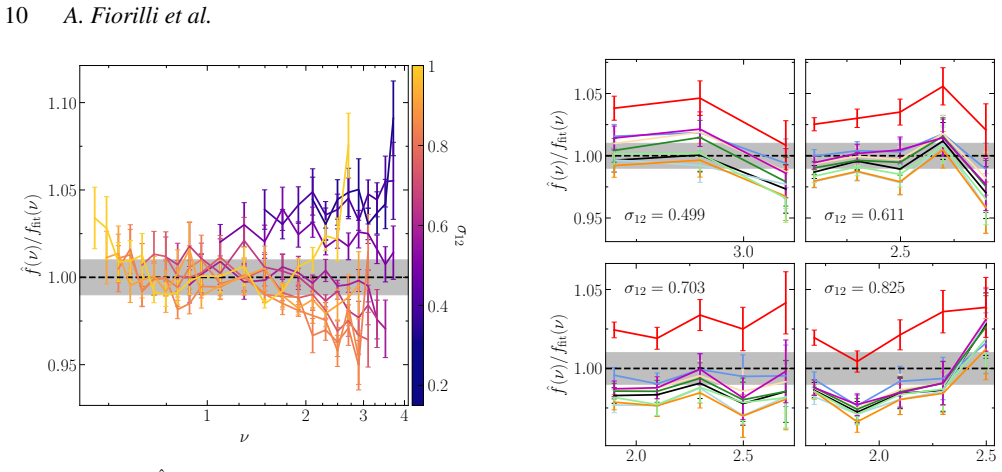
The paper's central claim is that the previously known non-universality of the halo multiplicity function—its residual dependence on cosmology and time beyond the peak height ν—can be described almost entirely by two variables: x̃, the integrated growth-history parameter, and n_eff, the effective spectral slope of the linear power spectrum at the characteristic peak height ν=1. The proposed model writes f(ν)=A0ν(Aν^a+Bν^b)exp(-Cν²), where A, B, a and b are linear functions of n_eff and x̃, and the memory scale η of the Gaussian kernel in x̃ is a free parameter. Calibrated to N-body simulations spanning very different expansion histories and power-spectrum shapes, the model reproduces the sim
What carries the argument
The central object is the integrated growth-history parameter x̃, defined as x̃(τ|η)=∫_{-∞}^{τ} dτ' x(τ') G(τ'-τ|η), with τ=ln σ12, x=Ωm(z)/f²(z), and G a one-sided Gaussian kernel of width η. It condenses the recent evolution of the matter density and linear growth rate into a single number, capturing differences between cosmologies that share the same linear power spectrum at the same clustering amplitude. The model feeds x̃, together with the effective spectral index n_eff at ν=1, into a universal functional form f(ν)=A0ν(Aν^a+Bν^b)exp(-Cν²), with parameters A=1+An n_eff, B=B0+Bx x̃+Bn n_eff, a=an n_eff, b=bn n_eff. The nine calibrated parameters include the memory scale η, which the data
Load-bearing premise
The load-bearing premise is that a single fitted memory scale η per overdensity threshold—and interpolated all parameters between thresholds—can fully encode how the halo mass function depends on the entire growth history; the systematic residual trends and reversed model ordering in the virial-mass test indicate this premise is only approximately met.
What would settle it
A concrete test: measure the halo mass function at Δ=200 in two cosmologies that have identical linear power spectra at the same σ12 but whose x(τ) histories cross (for example, one with early versus late dark-energy onset), and check whether the model with one η can match both simultaneously to better than a few percent. Alternatively, fit the model parameters directly to virial-mass haloes and compare the best-fit η and residuals with the interpolated predictions; if direct fitting yields a significantly different η or clearly smaller residuals, the interpolation scheme fails.
If this is right
- Cluster abundance analyses can adopt the Δ=200 recipe with roughly 1% accuracy in the mass function, directly reducing a dominant systematic in cosmological parameter constraints.
- The model's accuracy on uncalibrated cosmologies with different power-spectrum shapes (within about 3%) means it can be applied without retuning to a broad family of ΛCDM-like models.
- The continuous interpolation in Δ extends the recipe to any mass definition in the range 150–1600, and even to virial masses outside the calibrated range, with accuracy within about 5%.
- Compared to existing recipes, the model captures non-universal features—the spread of the mass function across different growth histories at fixed linear power spectrum—that other formulations miss or reproduce only by introducing spurious redshift dependence.
Where Pith is reading between the lines
- The mild trends and model-ordering reversal seen when interpolating to virial masses suggest that one memory scale per threshold is an approximation; a natural extension is to let the Gaussian width η vary with peak height, or to include a second moment of the x(τ) history, which could restore accuracy for arbitrary mass definitions.
- Because the model already reduces the non-universality of the HMF to the same x̃ that explains power-spectrum non-universality, a unified description of halo abundance, bias and concentration may be within reach—each observable sharing the same x̃ argument.
- The recipe's algebraic form makes it a natural basis for an emulator built on the full simulation suite the authors plan to exploit in future work, potentially pushing accuracy below the per-cent level and extending to massive-neutrino cosmologies.
- That n_eff evaluated at ν=1 suffices instead of a full ν-dependent shape implies the shape dependence acts mainly through the typical collapsing mass scale; this could be stress-tested on a cosmology with a strongly tilted power spectrum.
Editorial analysis
A structured set of objections, weighed in public.
Referee Report
Summary. The paper calibrates a new semi-analytic halo mass function (HMF) fitting function within the Evolution Mapping framework. The multiplicity function of Eq. (11) extends a Tinker-like ansatz by including dependence on the effective spectral index n_eff and on x-tilde, an integrated growth-history variable defined in Eq. (8). The model is calibrated against the Aletheia and AletheiaMass N-body simulations for ten overdensity thresholds from Δ=150 to 1600, with careful attention to binning bias, cosmic variance, and resolution convergence. For the reference Δ=200 definition, the authors report per-cent-level residuals on the calibration suite, 3% residuals on the out-of-sample AletheiaEmu shapes, and roughly 5% residuals on Uchuu and on virial-overdensity catalogues. The paper additionally supplies interpolating formulae, Eq. (15), to make the model usable at intermediate overdensities, including the virial overdensity.
Significance. If the advertised accuracy survives scrutiny, this is a useful contribution: it extends Evolution Mapping from the power spectrum and velocity statistics to the HMF, provides a physically motivated alternative to redshift-dependent fitting functions, and ships a practical recipe for arbitrary overdensity thresholds. The paper has real strengths: the estimator in Eq. (13) avoids a known binning bias; the N_min convergence criteria are conservative; the AletheiaEmu and Uchuu comparisons are genuine out-of-sample tests; and the comparison with Tinker, Despali, and Euclid fitting functions is informative. The central Δ=200 calibration claim appears well supported. However, the advertised virial/interpolation component is not reproducible as written because part of Eq. (15) is undefined on the virial range used in the validation figures.
major comments (2)
- [§4.2, Eq. (15), and Figs. 8, 9, 11] Equation (15) contains A_n = 0.292 (y − 2.13)^0.67 and b_n = −0.86 (y − 2.0)^0.20. Over the virial range used in Figs. 8, 9, and 11, y = log10 Δvir is below 2.13 for essentially all displayed snapshots, and below 2.0 for the σ12=0.9 and 1.0 AletheiaMass snapshots (Δvir ≈ 94 and ≈ 88). Raising a negative base to a non-integer power is undefined in real arithmetic, so the plotted virial predictions cannot be reproduced from the stated recipe. This does not invalidate the Δ=200 calibration, but it directly undermines the paper's advertised interpolation/virial-accuracy claim. Please specify a real-valued continuation (or restrict the domain), report the values actually used to produce Figs. 8, 9, and 11, and re-evaluate the virial residuals after the fix. The systematic trends and reversed Aletheia ordering in Fig. 9 should be revisited in that light, since they may be artifacts of the unde
- [§5.1 and Fig. 10] The abstract and conclusions say the model 'maintains' per-cent-level accuracy on cosmologies with different power-spectrum shapes, but Fig. 10 shows residuals that are mostly within 3%, not 1%. This is a wording issue rather than a technical error, but the quantified claims in the abstract should match the plotted out-of-sample accuracy; otherwise readers may over-interpret the headline accuracy.
minor comments (5)
- [Fig. 9 caption] Typo: 'parameteter values' should be 'parameter values'.
- [Table 5 caption] Typo: 'formultiplicity' should be 'for the multiplicity'.
- [§3.2 and Appendix A] The meaning of STRICT_SO_MASSES is confusing. The main text says bound-only masses are obtained by setting STRICT_SO_MASSES=0, while Appendix A says STRICT_SO_MASSES=1 'prevents the code from excluding particles that are not gravitationally bound.' If both statements are literally true, the flag name is misleading; please clarify the configuration semantics.
- [Eq. (15)] The interpolation for log10 η is written as a function of Δ/1000, while the other coefficients are written in terms of y=log10 Δ. For consistency, express all terms in the same variable, and state the domain over which each power-law term is intended to be used.
- [Table 5 and §4.2] For Δ=1400 and 1600, the table reports only upper bounds on η (log10 η < −2.0 and < −2.4), while the text sets η=0 in this regime. The sentence recommending use of the tabulated fitted values for the ten calibrated thresholds should be reconciled with this fiat replacement.
Circularity Check
No significant circularity: the model is explicitly calibrated, x̃ is computed from growth history rather than from the HMF, and the out-of-sample AletheiaEmu/Uchuu tests are genuine predictions.
full rationale
The paper's derivation chain is a calibration, not an ab initio prediction. The nine parameters of Eq. (11) are fitted to N-body HMF measurements at ten overdensity thresholds (Section 4), and the paper states that η is treated as a free parameter: 'we do not assume a fixed memory scale. Instead, we will treat η as a free parameter in our model'. The variable x̃ of Eq. (8) is computed from Ωm(z)/f²(z) and the integrated growth history, not from the measured HMF; even though η is fitted, the non-universality variable itself is external to the HMF data. The Δ=200 claim is validated against AletheiaMass and Aletheia, while AletheiaEmu (Fig. 10) and Uchuu (Fig. 11) are held out, so those tests are genuine out-of-sample predictions. The self-citations (Sánchez et al. 2022, 2025; Esposito et al. 2024) are present and frame the 'physical motivation', but no load-bearing step reduces to an unverified prior result: x̃'s defining equation is given in the text, and the fit is scored directly against simulations. The paper itself flags the virial interpolation limitation ('This limitation likely explains the slight trend in Fig. 8'), which is an acknowledged accuracy caveat, not circularity. Separately, but not a circularity issue, Eq. (15) contains A_n = 0.292(y−2.13)^0.67 and b_n = −0.86(y−2.0)^0.20; for the Bryan & Norman virial overdensity Δvir ≈ 104 at z=0 (y ≈ 2.017), these powers have negative bases and are undefined in real arithmetic, so the advertised virial validation is not fully reproducible from the stated recipe. This is a correctness/reproducibility concern that does not affect the circularity score.
Axiom & Free-Parameter Ledger
free parameters (10)
- A0 =
0.42 (Δ=150) to 0.89 (Δ=1600)
- A_n =
0.040 to 0.294
- a_n =
0.212 to 0.234
- B0 =
-0.6 (posterior peak; fixed to -0.6 in Table 5)
- B_x =
1.21 (Δ=150) to -0.06 (Δ=1600)
- B_n =
0.148 to -0.06
- b_n =
-0.59 to -0.83
- C =
0.431 to 0.63
- eta (log10) =
-0.37 (Δ=150) to < -2.4 (Δ=1600)
- Δ-interpolation coefficients =
Various, Eq. (15)
axioms (7)
- domain assumption Spherical collapse threshold δc = 1.686 (EdS value) is used for all cosmologies; its cosmology dependence is absorbed by other parameters.
- ad hoc to paper The multiplicity function form of Eq. (11) (Tinker-like with additive n_eff and x-tilde terms) is a valid universal ansatz across cosmologies and mass definitions.
- ad hoc to paper x-tilde defined in Eq. (8) with a one-sided Gaussian kernel G(τ'-τ|η) captures the relevant growth-history dependence, with η as the memory scale.
- domain assumption Evaluating the effective spectral index n_eff at ν=1 is sufficient to capture the shape dependence of the HMF.
- domain assumption Off-diagonal terms of the covariance matrix of the measured multiplicity function are negligible.
- domain assumption The linear halo bias of Tinker et al. (2010) accurately estimates cosmic variance errors on the HMF.
- domain assumption Paired-and-fixed initial conditions do not introduce biases beyond the quoted uncertainties.
read the original abstract
We present a new prescription for the halo mass function (HMF) built upon the Evolution Mapping framework. This approach provides a physical motivation to parametrise the non-universality of the HMF in terms of the recent history of structure formation and the local shape of the linear matter power spectrum. Our model was calibrated against measurements from N-body simulations, with halo samples defined by ten overdensity thresholds, $\Delta$, ranging from 150 to 1600 times the mean background matter density. For our reference mass definition, $\Delta=200$, the calibrated fitting function achieves per cent-level accuracy across a wide range of masses, redshifts, and structure formation histories, and maintains this performance when tested on cosmologies with different linear power spectrum shapes. This high level of accuracy is maintained across other mass definitions, degrading only slightly to the 5 per cent level at the highest values of $\Delta$. We also provide fitting formulae to interpolate the parameters as a function of $\Delta$, which allows for accurate modelling of HMFs defined by intermediate overdensities, with accuracy still well within 5 per cent when tested on halo catalogues defined by the virial overdensity threshold. Compared to other commonly used recipes, our prescription yields competitive or superior accuracy across all redshifts and cosmologies, successfully capturing the non-universal features of the HMF where other models exhibit systematic deviations. This work provides a high-precision modelling tool for cluster abundance analyses, and demonstrates the power of the evolution mapping framework for building accurate models of observables in the non-linear regime.
Figures




Forward citations
Cited by 2 Pith papers
-
Improved recipes for peculiar velocity power spectra using Evolution Mapping
Improved fitting functions for P_θθ(k) and P_δθ(k) parametrized by σ12 achieve 1-2% accuracy across cosmologies and outperform existing prescriptions.
-
PHANTOM: A MATLAB and Octave Toolbox Connecting Linear Field Statistics to Dark Matter Halo Observables
PHANTOM is a public MATLAB/Octave toolbox for linear field statistics and halo observables in dark matter cosmology, validated to sub-percent agreement with Python packages colossus, hmf, and halomod.
Reference graph
Works this paper leans on
-
[1]
write newline
" write newline "" before.all 'output.state := FUNCTION fin.entry write newline FUNCTION new.block output.state before.all = 'skip after.block 'output.state := if FUNCTION new.sentence output.state after.block = 'skip output.state before.all = 'skip after.sentence 'output.state := if if FUNCTION not #0 #1 if FUNCTION and 'skip pop #0 if FUNCTION or pop #1...
-
[2]
Abbott T. M. C., et al., 2021, @doi [ ] 10.3847/1538-4365/ac00b3 , https://ui.adsabs.harvard.edu/abs/2021ApJS..255...20A 255, 20
-
[3]
Angulo R. E., Pontzen A., 2016, @doi [ ] 10.1093/mnrasl/slw098 , https://ui.adsabs.harvard.edu/abs/2016MNRAS.462L...1A 462, L1
-
[4]
Angulo R. E., Baugh C. M., Frenk C. S., Lacey C. G., 2014, @doi [ ] 10.1093/mnras/stu1084 , https://ui.adsabs.harvard.edu/abs/2014MNRAS.442.3256A 442, 3256
-
[5]
Asgari M., Mead A. J., Heymans C., 2023, @doi [The Open Journal of Astrophysics] 10.21105/astro.2303.08752 , https://ui.adsabs.harvard.edu/abs/2023OJAp....6E..39A 6, 39
Pith/arXiv arXiv 2023
-
[6]
Non-linear Dynamics and Mass Function of Cosmic Structures: I Analytical Results
Audit E., Teyssier R., Alimi J. M., 1997, @doi [ ] 10.48550/arXiv.astro-ph/9704023 , https://ui.adsabs.harvard.edu/abs/1997A&A...325..439A 325, 439
work page internal anchor Pith review Pith/arXiv arXiv doi:10.48550/arxiv.astro-ph/9704023 1997
-
[7]
Baumann D., Nicolis A., Senatore L., Zaldarriaga M., 2012, @doi [ ] 10.1088/1475-7516/2012/07/051 , https://ui.adsabs.harvard.edu/abs/2012JCAP...07..051B 2012, 051
-
[8]
Behroozi P. S., Wechsler R. H., Wu H.-Y., 2013, @doi [ ] 10.1088/0004-637X/762/2/109 , https://ui.adsabs.harvard.edu/abs/2013ApJ...762..109B 762, 109
-
[9]
Berlind A. A., Weinberg D. H., 2002, @doi [ ] 10.1086/341469 , https://ui.adsabs.harvard.edu/abs/2002ApJ...575..587B 575, 587
doi:10.1086/341469 2002
-
[10]
Bernardeau F., Colombi S., Gazta \ n aga E., Scoccimarro R., 2002, @doi [ ] 10.1016/S0370-1573(02)00135-7 , https://ui.adsabs.harvard.edu/abs/2002PhR...367....1B 367, 1
-
[11]
Betancort-Rijo J. E., Montero-Dorta A. D., 2006, @doi [ ] 10.1086/510582 , https://ui.adsabs.harvard.edu/abs/2006ApJ...653L..77B 653, L77
-
[12]
Bhattacharya S., Heitmann K., White M., Luki \'c Z., Wagner C., Habib S., 2011, @doi [ ] 10.1088/0004-637X/732/2/122 , https://ui.adsabs.harvard.edu/abs/2011ApJ...732..122B 732, 122
-
[13]
Bocquet S., Saro A., Dolag K., Mohr J. J., 2016, @doi [ ] 10.1093/mnras/stv2657 , https://ui.adsabs.harvard.edu/abs/2016MNRAS.456.2361B 456, 2361
-
[14]
Bocquet S., Heitmann K., Habib S., Lawrence E., Uram T., Frontiere N., Pope A., Finkel H., 2020, @doi [ ] 10.3847/1538-4357/abac5c , https://ui.adsabs.harvard.edu/abs/2020ApJ...901....5B 901, 5
-
[15]
Bond J. R., Cole S., Efstathiou G., Kaiser N., 1991, @doi [ ] 10.1086/170520 , https://ui.adsabs.harvard.edu/abs/1991ApJ...379..440B 379, 440
doi:10.1086/170520 1991
-
[16]
Bond J. R., Kofman L., Pogosyan D., 1996, @doi [ ] 10.1038/380603a0 , https://ui.adsabs.harvard.edu/abs/1996Natur.380..603B 380, 603
doi:10.1038/380603a0 1996
-
[17]
Bryan G. L., Norman M. L., 1998, @doi [ ] 10.1086/305262 , https://ui.adsabs.harvard.edu/abs/1998ApJ...495...80B 495, 80
doi:10.1086/305262 1998
-
[18]
Differentiable Halo Mass Prediction and the Cosmology-Dependence of Halo Mass Functions
Buisman J., List F., Hahn O., 2025, @doi [arXiv e-prints] 10.48550/arXiv.2507.03074 , https://ui.adsabs.harvard.edu/abs/2025arXiv250703074B p. arXiv:2507.03074
work page internal anchor Pith review Pith/arXiv arXiv doi:10.48550/arxiv.2507.03074 2025
-
[19]
Carrasco J. J. M., Hertzberg M. P., Senatore L., 2012, @doi [Journal of High Energy Physics] 10.1007/JHEP09(2012)082 , https://ui.adsabs.harvard.edu/abs/2012JHEP...09..082C 2012, 82
-
[20]
Cooray A., Sheth R., 2002, @doi [ ] 10.1016/S0370-1573(02)00276-4 , https://ui.adsabs.harvard.edu/abs/2002PhR...372....1C 372, 1
-
[21]
Corasaniti P. S., Achitouv I., 2011, @doi [ ] 10.1103/PhysRevLett.106.241302 , https://ui.adsabs.harvard.edu/abs/2011PhRvL.106x1302C 106, 241302
-
[22]
Costanzi M., Villaescusa-Navarro F., Viel M., Xia J.-Q., Borgani S., Castorina E., Sefusatti E., 2013, @doi [ ] 10.1088/1475-7516/2013/12/012 , https://ui.adsabs.harvard.edu/abs/2013JCAP...12..012C 2013, 012
-
[23]
Courtin J., Rasera Y., Alimi J. M., Corasaniti P. S., Boucher V., F \"u zfa A., 2011, @doi [ ] 10.1111/j.1365-2966.2010.17573.x , https://ui.adsabs.harvard.edu/abs/2011MNRAS.410.1911C 410, 1911
arXiv 2011
-
[24]
Crocce M., Scoccimarro R., 2006, @doi [ ] 10.1103/PhysRevD.73.063519 , https://ui.adsabs.harvard.edu/abs/2006PhRvD..73f3519C 73, 063519
-
[25]
Crocce M., Fosalba P., Castander F. J., Gazta \ n aga E., 2010, @doi [ ] 10.1111/j.1365-2966.2009.16194.x , https://ui.adsabs.harvard.edu/abs/2010MNRAS.403.1353C 403, 1353
arXiv 2010
-
[26]
Crocce M., Pueblas S., Scoccimarro R., 2012, 2LPTIC: 2nd-order Lagrangian Perturbation Theory Initial Conditions , Astrophysics Source Code Library, record ascl:1201.005 ( @eprint ascl 1201.005 )
2012
-
[27]
D'Amico G., Musso M., Nore \ n a J., Paranjape A., 2011, @doi [ ] 10.1088/1475-7516/2011/02/001 , https://ui.adsabs.harvard.edu/abs/2011JCAP...02..001D 2011, 001
-
[28]
DESI Collaboration et al., 2016, @doi [arXiv e-prints] 10.48550/arXiv.1611.00036 , https://ui.adsabs.harvard.edu/abs/2016arXiv161100036D p. arXiv:1611.00036
-
[29]
DESI Collaboration et al., 2025, @doi [arXiv e-prints] 10.48550/arXiv.2503.14745 , https://ui.adsabs.harvard.edu/abs/2025arXiv250314745D p. arXiv:2503.14745
-
[30]
Despali G., Giocoli C., Angulo R. E., Tormen G., Sheth R. K., Baso G., Moscardini L., 2016, @doi [ ] 10.1093/mnras/stv2842 , https://ui.adsabs.harvard.edu/abs/2016MNRAS.456.2486D 456, 2486
-
[31]
Diemer B., 2020, @doi [ ] 10.3847/1538-4357/abbf52 , https://ui.adsabs.harvard.edu/abs/2020ApJ...903...87D 903, 87
-
[32]
Efstathiou G., Frenk C. S., White S. D. M., Davis M., 1988, @doi [ ] 10.1093/mnras/235.3.715 , https://ui.adsabs.harvard.edu/abs/1988MNRAS.235..715E 235, 715
-
[33]
Esposito M., S \'a nchez A. G., Bel J., Ruiz A. N., 2024, @doi [ ] 10.1093/mnras/stae2351 , https://ui.adsabs.harvard.edu/abs/2024MNRAS.534.3906E 534, 3906
-
[34]
Euclid Collaboration et al., 2023, @doi [ ] 10.1051/0004-6361/202244674 , https://ui.adsabs.harvard.edu/abs/2023A&A...671A.100E 671, A100
-
[35]
Euclid Collaboration et al., 2025, @doi [ ] 10.1051/0004-6361/202450810 , https://ui.adsabs.harvard.edu/abs/2025A&A...697A...1E 697, A1
-
[36]
Evrard A. E., et al., 2002, @doi [ ] 10.1086/340551 , https://ui.adsabs.harvard.edu/abs/2002ApJ...573....7E 573, 7
doi:10.1086/340551 2002
-
[37]
Fiorino L., Contarini S., Marulli F., S \'a nchez A. G., Baldi M., Fiorilli A., Moscardini L., 2025, @doi [ ] 10.1088/1475-7516/2025/06/053 , https://ui.adsabs.harvard.edu/abs/2025JCAP...06..053F 2025, 053
-
[38]
Garny M., Taule P., 2021, @doi [ ] 10.1088/1475-7516/2021/01/020 , https://ui.adsabs.harvard.edu/abs/2021JCAP...01..020G 2021, 020
-
[39]
Gavas S., Bagla J., Khandai N., Kulkarni G., 2023, @doi [ ] 10.1093/mnras/stad935 , https://ui.adsabs.harvard.edu/abs/2023MNRAS.521.5960G 521, 5960
-
[40]
Ghirardini V., et al., 2024, @doi [ ] 10.1051/0004-6361/202348852 , https://ui.adsabs.harvard.edu/abs/2024A&A...689A.298G 689, A298
-
[41]
Gunn J. E., Gott III J. R., 1972, @doi [ ] 10.1086/151605 , https://ui.adsabs.harvard.edu/abs/1972ApJ...176....1G 176, 1
doi:10.1086/151605 1972
-
[42]
Guo N., Lucie-Smith L., Peiris H. V., Pontzen A., Piras D., 2024, @doi [ ] 10.1093/mnras/stae1696 , https://ui.adsabs.harvard.edu/abs/2024MNRAS.532.4141G 532, 4141
-
[43]
Gupta S., Pfeifer S., Ganeshaiah Veena P., Hellwing W. A., 2024, @doi [ ] 10.1103/PhysRevD.110.083520 , https://ui.adsabs.harvard.edu/abs/2024PhRvD.110h3520G 110, 083520
-
[44]
V., 2003, @doi [ ] 10.1086/345846 , https://ui.adsabs.harvard.edu/abs/2003ApJ...584..702H 584, 702
Hu W., Kravtsov A. V., 2003, @doi [ ] 10.1086/345846 , https://ui.adsabs.harvard.edu/abs/2003ApJ...584..702H 584, 702
doi:10.1086/345846 2003
-
[45]
Huchra J. P., Geller M. J., 1982, @doi [ ] 10.1086/160000 , https://ui.adsabs.harvard.edu/abs/1982ApJ...257..423H 257, 423
doi:10.1086/160000 1982
-
[46]
Ishiyama T., Fukushige T., Makino J., 2009, @doi [ ] 10.1093/pasj/61.6.1319 , https://ui.adsabs.harvard.edu/abs/2009PASJ...61.1319I 61, 1319
-
[47]
Ishiyama T., et al., 2021, @doi [ ] 10.1093/mnras/stab1755 , https://ui.adsabs.harvard.edu/abs/2021MNRAS.506.4210I 506, 4210
-
[48]
Ivezi \'c Z ., et al., 2019, @doi [ ] 10.3847/1538-4357/ab042c , https://ui.adsabs.harvard.edu/abs/2019ApJ...873..111I 873, 111
-
[49]
Jedamzik K., 1995, @doi [ ] 10.1086/175936 , https://ui.adsabs.harvard.edu/abs/1995ApJ...448....1J 448, 1
-
[51]
Juan E., Salvador-Sol \'e E., Dom \`e nech G., Manrique A., 2014, @doi [ ] 10.1093/mnras/stu187 , https://ui.adsabs.harvard.edu/abs/2014MNRAS.439.3156J 439, 3156
-
[52]
Kitayama T., Suto Y., 1996, @doi [ ] 10.1086/177797 , https://ui.adsabs.harvard.edu/abs/1996ApJ...469..480K 469, 480
doi:10.1086/177797 1996
-
[53]
Lacey C., Cole S., 1993, @doi [ ] 10.1093/mnras/262.3.627 , https://ui.adsabs.harvard.edu/abs/1993MNRAS.262..627L 262, 627
-
[54]
Lacey C., Cole S., 1994, @doi [ ] 10.1093/mnras/271.3.676 , https://ui.adsabs.harvard.edu/abs/1994MNRAS.271..676L 271, 676
-
[55]
Lange J. U., 2023, @doi [Monthly Notices of the Royal Astronomical Society] 10.1093/mnras/stad2441 , 525, 3181
-
[56]
Laureijs R., et al., 2011, @doi [arXiv e-prints] 10.48550/arXiv.1110.3193 , https://ui.adsabs.harvard.edu/abs/2011arXiv1110.3193L p. arXiv:1110.3193
-
[57]
Li Y., Smith R. E., 2025, @doi [ ] 10.1093/mnras/staf981 , https://ui.adsabs.harvard.edu/abs/2025MNRAS.541.1070L 541, 1070
-
[58]
LoVerde M., Miller A., Shandera S., Verde L., 2008, @doi [ ] 10.1088/1475-7516/2008/04/014 , https://ui.adsabs.harvard.edu/abs/2008JCAP...04..014L 2008, 014
-
[59]
Maleubre S., Eisenstein D. J., Garrison L. H., Joyce M., 2024, @doi [ ] 10.1093/mnras/stad3569 , https://ui.adsabs.harvard.edu/abs/2024MNRAS.527.5603M 527, 5603
-
[60]
Matarrese S., Verde L., Jimenez R., 2000, @doi [ ] 10.1086/309412 , https://ui.adsabs.harvard.edu/abs/2000ApJ...541...10M 541, 10
doi:10.1086/309412 2000
-
[61]
McClintock T., et al., 2019, @doi [ ] 10.3847/1538-4357/aaf568 , https://ui.adsabs.harvard.edu/abs/2019ApJ...872...53M 872, 53
-
[62]
D., Beckman R
McKay M. D., Beckman R. J., Conover W. J., 1979, Technometrics, 21, 239
1979
-
[63]
Monaco P., 1995, @doi [ ] 10.1086/175853 , https://ui.adsabs.harvard.edu/abs/1995ApJ...447...23M 447, 23
doi:10.1086/175853 1995
-
[64]
Musso M., Sheth R. K., 2014, @doi [ ] 10.1093/mnras/stt2387 , https://ui.adsabs.harvard.edu/abs/2014MNRAS.438.2683M 438, 2683
-
[65]
Musso M., Sheth R. K., 2021, @doi [ ] 10.1093/mnras/stab2640 , https://ui.adsabs.harvard.edu/abs/2021MNRAS.508.3634M 508, 3634
-
[66]
Ondaro-Mallea L., Angulo R. E., Zennaro M., Contreras S., Aric \`o G., 2022, @doi [ ] 10.1093/mnras/stab3337 , https://ui.adsabs.harvard.edu/abs/2022MNRAS.509.6077O 509, 6077
-
[67]
Peacock J. A., Heavens A. F., 1990, @doi [ ] 10.1093/mnras/243.1.133 , https://ui.adsabs.harvard.edu/abs/1990MNRAS.243..133P 243, 133
-
[68]
Peebles P. J. E., 1980, The large-scale structure of the universe . Princeton University Press
1980
-
[69]
Pezzotta A., et al., 2025, @doi [ ] 10.1103/vy3h-p92n , https://ui.adsabs.harvard.edu/abs/2025PhRvD.112b3520P 112, 023520
-
[70]
Planck Collaboration et al., 2016, @doi [ ] 10.1051/0004-6361/201525830 , https://ui.adsabs.harvard.edu/abs/2016A&A...594A..13P 594, A13
-
[71]
Planck Collaboration et al., 2020, @doi [ ] 10.1051/0004-6361/201833910 , https://ui.adsabs.harvard.edu/abs/2020A&A...641A...6P 641, A6
-
[72]
Predehl P., et al., 2021, @doi [ ] 10.1051/0004-6361/202039313 , https://ui.adsabs.harvard.edu/abs/2021A&A...647A...1P 647, A1
-
[73]
Press W. H., Schechter P., 1974, @doi [ ] 10.1086/152650 , https://ui.adsabs.harvard.edu/abs/1974ApJ...187..425P 187, 425
doi:10.1086/152650 1974
-
[74]
Reed D. S., Bower R., Frenk C. S., Jenkins A., Theuns T., 2007, @doi [ ] 10.1111/j.1365-2966.2006.11204.x , https://ui.adsabs.harvard.edu/abs/2007MNRAS.374....2R 374, 2
arXiv 2007
-
[75]
S \'a ez-Casares I., Rasera Y., Richardson T. R. G., Corasaniti P. S., 2024, @doi [ ] 10.1051/0004-6361/202450193 , https://ui.adsabs.harvard.edu/abs/2024A&A...691A.323S 691, A323
-
[76]
S \'a nchez A. G., 2020, @doi [ ] 10.1103/PhysRevD.102.123511 , https://ui.adsabs.harvard.edu/abs/2020PhRvD.102l3511S 102, 123511
-
[77]
S \'a nchez A. G., Ruiz A. N., Jara J. G., Padilla N. D., 2022, @doi [ ] 10.1093/mnras/stac1656 , https://ui.adsabs.harvard.edu/abs/2022MNRAS.514.5673S 514, 5673
-
[78]
G., et al., 2025, arXiv e-prints, https://ui.adsabs.harvard.edu/abs/2025arXiv251113826S p
S\'anchez A. G., et al., 2025, arXiv e-prints, https://ui.adsabs.harvard.edu/abs/2025arXiv251113826S p. arXiv:2511.13826
Pith/arXiv arXiv 2025
-
[79]
Sartoris B., et al., 2016, @doi [ ] 10.1093/mnras/stw630 , https://ui.adsabs.harvard.edu/abs/2016MNRAS.459.1764S 459, 1764
-
[80]
Seppi R., et al., 2021, @doi [ ] 10.1051/0004-6361/202039123 , https://ui.adsabs.harvard.edu/abs/2021A&A...652A.155S 652, A155
- [81]
discussion (0)
Sign in with ORCID, Apple, or X to comment. Anyone can read and Pith papers without signing in.