REVIEW 4 major objections 5 minor 1 cited by
Dark bubble cosmology predicts gravity weakens below L~10^-5 m, yielding V=-G4M(1/rho - 3L^2/(2rho^3)+...) and a radiation-only inflationary phase.
Reviewed by Pith at T0; open to challenge. T0 means a machine referee read the full paper against a public rubric. the ladder, T0–T4 →
T0 review · deepseek-v4-flash
2026-08-03 19:59 UTC pith:PU7KTDP3
load-bearing objection Dark bubble paper makes a concrete, testable micron-scale prediction that gravity weakens, but the headline potential rests on an asserted massless-to-massive step, so treat it as conditional. the 4 major comments →
Weak gravity at micron scales from dark bubble cosmology and its cosmological consequences
The pith
A machine-rendered reading of the paper's core claim, the machinery that carries it, and where it could break.
Core claim
Central claim: on the dark bubble, 4D gravity turns off at distances below the AdS scale L ~ 10^-5 m. Eq. (67): V(rho) = -G4 M4 [1/rho - 3L^2/(2rho^3) + ...]; at rho -> 0 the potential becomes G5 M4 / rho^2 (eq. 64), i.e. gravity is much weaker than Newtonian. If correct, tabletop experiments can detect the departure, and the same shutting-off generates a radiation-only inflationary phase with H ~ sqrt(3) k for over 30 e-folds (eq. 75).
Load-bearing premise
The derivation of the modified potential relies on the 'dark bubble holography' condition in Section II.C: one assumes the bulk is 'as empty and simple as possible' and that the hologram at a non-dynamical cutoff 'is a perfect representation of the theory on the brane.' The text concedes this is 'not a necessary condition.' This mixed-boundary choice provides the missing equation (50) that fixes B+(q) in terms of A+(q); without it the junction conditions leave the system underdetermined. The cosmology additionally uses the tuned choice M+ = 2M- to recover the standard radiation-dominated Friedmann equation (eq. 73).
Editorial analysis
A structured set of objections, weighed in public.
Referee Report
Summary. The paper studies linearized gravity around a localized source in the dark bubble model of 5D AdS cosmology. It claims that the 4D gravitational force is cut off below the AdS length L ~ 10^-5 m, with the Newtonian potential replaced by a much weaker 5D 1/rho^2 potential at small distances [Eqs. (60)-(67)]. The same suppression is then applied to homogeneous radiation cosmology, producing an inflationary phase with H^2 = 3k^2 for more than 30 e-folds [Eqs. (74)-(75)]. The paper also proposes a 5D AdS black hole as the nucleation catalyst, estimates the resulting positive-curvature density parameter as Omega_c ~ 5 x 10^-4 [Eq. (81)], and speculates about AdS black shells as black-hole mimickers. The technical framework is the Israel junction conditions for an asymmetric brane, closed by an assumed holographic mixed-boundary condition in Section II.C.
Significance. If the central derivation is correct, the paper gives a clear, falsifiable prediction that distinguishes the dark bubble from other extra-dimensional scenarios: gravity becomes weaker, not stronger, below L ~ 10^-5 m, within reach of tabletop experiments. The q -> 0 limit correctly reproduces linearized 4D general relativity, and the q -> infinity limit reproduces 5D gravity; obtaining both limits from a single linearized junction calculation is a genuine strength. The potential in Eq. (67) is sufficiently explicit to be tested by short-range gravity experiments, and the cosmological Omega_c prediction is also concrete. However, the finite-q regime, which contains the new physics, rests on an admitted non-necessary holographic assumption and on a step for massive sources that is asserted rather than derived. The cosmological section additionally uses a tuned mass ratio. The significance is therefore conditional, but the paper is a worthy contribution if these gaps are either filled or clearly labeled as assumptions.
major comments (4)
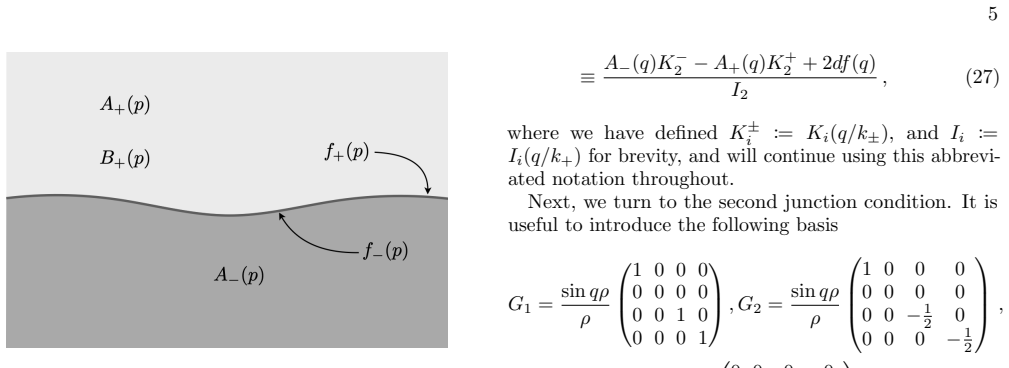
- The point-mass potential, Eq. (67), is obtained by substituting the massless A_-(q) from Eq. (51) into a formula for a massive source, Eq. (60). For a point mass the trace is nonzero, so Eq. (58) gives F(p) = -k_- k_+ M(p)/(3p^2), and the brane bending is nonzero. The paper cites reference [9] only for the p -> 0 limit (Eq. (59)) and then states, without a calculation, that the full result to all orders q 'must be given by' Eq. (60), with G(q) taken from the massless A_-(q) expression. No argument is given that the coordinate transformation removing F(p) leaves Eq. (50) intact, nor that A_-(q) is unchanged at finite q. Since Eq. (67) is a series expansion of this G(q), a trace-dependent correction would directly change the predicted force at rho ~ L. This is a load-bearing gap in the derivation of the headline experimental prediction.
- Equation (50) is the 'missing condition' that closes the junction-condition system. The paper explicitly concedes that the holographic representation condition is 'not a necessary condition' and that the bulk is assumed to be 'as empty and simple as possible.' Setting Delta-kappa1 = 1 reproduces the observed 4D Newton constant, so the q -> 0 limit is imposed rather than derived. The large-q limit (63) is independent of Delta-kappa1, but the intermediate behavior in Eq. (61) and the expansion in Eq. (67) depend on eta and hence on this choice. The authors should either present Eq. (50) as a model-dependent input with a clear statement of its consequences, or provide an independent argument selecting this mixed-boundary condition.
- The standard radiation Friedmann equation is recovered only after imposing M_+ = 2 M_-, which is introduced by hand. The paper says this choice is 'equivalent to the choices made for localized matter,' but no derivation is given, and it is not a consequence of the junction conditions alone. The inflationary phase in Eq. (75) and the subsequent nucleation analysis in Section IV.C rely on this tuned ratio. If M_+ = 2 M_- is a free parameter, the cosmological predictions, including the claimed >30 e-folds, are not unique unless the model provides a separate mechanism fixing the mass ratio.
- The numerical prediction Omega_c ~ 5 x 10^-4 is built on the interval 0.0178 < chi < 0.0363 for the initial 5D black-hole mass, obtained from the barrier analysis in Section IV.C. That analysis uses a Hamiltonian that is only quadratic for small momenta, and the paper states that actual tunneling amplitudes are left to future work. The prediction also imports g_s = (2/3) alpha_em from reference [7]. This is a legitimate speculation, but it should be presented as a preliminary estimate rather than a firm prediction of the model.
minor comments (5)
- Typo: 'the first few terms at larger' should read 'at large r' or 'at large rho.' Also, 'Einsten' appears in the text after Eq. (59).
- The treatment of the point-mass delta function is terse. The normalization factors in Eqs. (54)-(56) would be easier to follow with an explicit statement that M(p) is the Fourier-sine transform of a delta function in the sense used in the main text.
- The caption says 'Upper curves correspond to ordinary 4D gravity, while the lower curves correspond to the 4D universe on a dark bubble.' Since the figure shows one curve per panel, the intended comparison should be stated more explicitly; otherwise the reader may be uncertain which curve is which.
- The discussion of active versus passive gravitational mass is interesting but somewhat phenomenological. It should be made clear that this is an interpretation of the linearized result, not a derivation of a new equivalence-principle violation beyond the model's assumptions.
- Reference [8] dates to 2015; more recent short-range gravity bounds would strengthen the introduction and the claim that L ~ 10^-5 m is close to current experimental sensitivity.
Circularity Check
Central small-scale weakening is independent of the tunings, but the 'unique' potential is partly built from fitted low-q limits and an asserted massless-to-massive extension; partial circularity.
specific steps
-
fitted input called prediction
[Section II.C.1 (dark bubble holography), Eqs. (48)-(53)]
"We need Δκ1 = 1 to reproduce the expected 4D gravity. This implies that Newton’s constant in the hologram is a factor z2 c /z2 0 larger than on the dark bubble."
The junction conditions leave B+(q) undetermined; the missing relation (50) is fixed by choosing Δκ1 = 1 to match the observed 4D Newton constant. Substituting this into the q→0 limit (53) then returns exactly 16πG4M(q)/q2, i.e. the Newtonian 1/ρ part of the headline potential (67) is an input, not a derived prediction. The genuinely new small-ρ weakening comes from the q→∞ regime where η cancels, so this tuning does not by itself fabricate the micron-scale claim.
-
other
[Section IV.A, Eqs. (72)-(75)]
"provided that we make the choice M+ = 2M−, which is equivalent to the choices made for localized matter. This is just the Friedmann equation for a universe with radiation."
The standard radiation-dominated Friedmann equation is recovered by imposing M+ = 2M−, and the same choice is then used in eq. (74) to obtain the early-time H2 = 3k2 inflationary phase. Thus the late-time GR branch is a tuned input rather than a prediction. However, the small-a inflationary phase follows from the shutting off of 4D gravity at high densities and is not simply a restatement of the tuned ratio, so this is a parameter-consistency condition rather than a full circular derivation.
-
other
[Section II.E, Eqs. (58)-(61)]
"We conclude that the full result to all orders q, with non-vanishing trace, must be given by (60), where G(q) = ... To get the first line, we note that (59) should be compared with the limit taken in (53), while the full expression needs (51)."
For a massive point source F(p) is nonzero, so the brane bends; only the p→0 limit was derived in [9]. The finite-q G(q) inserted into the massive-source metric is taken from the massless A−(q) solution (51), with no calculation showing that the coordinate transformation removing F(p) leaves the massless relation intact at finite q. The micron-scale potential (67) is therefore built by substituting a massless-source transfer function into a massive-source formula. I flag this as an omitted derivation / unsupported extension rather than a strict textbook circularity; if the trace does not decouple, the headline experimental prediction is unsupported.
full rationale
The core claim that 4D gravity weakens below the AdS scale L is not simply the tuning restated: the q→∞ limit (63) is independent of Δκ1/η, so the 5D G5/ρ2 regime survives the choices used to fix the Newtonian and radiation limits. Likewise, the early-time H2 = 3k2 phase follows from the small-a structure rather than from the particular M+/M− ratio. Nevertheless, the announced ‘unique’ potential is not fully derived from first principles: Δκ1 = 1 is explicitly fitted to reproduce observed 4D gravity, M+ = 2M− is chosen to reproduce standard radiation cosmology, and the finite-q massive-source result is asserted by transplanting the massless A−(q) formula into the massive metric. The self-citations [9,17] are load-bearing for the p→0 limit and the holographic boundary-condition prescription, but the paper states the key assumption openly (‘not a necessary condition’), so I treat this as partial circularity rather than a complete reduction. Score 4: some tunings and a derivation gap surround the central claim, but the central small-scale weakening has independent asymptotic content.
Axiom & Free-Parameter Ledger
free parameters (4)
- Delta-kappa1 (holographic counterterm coefficient) =
1 (chosen)
- M+/M- ratio =
2 (chosen)
- AdS scale L (k = 1/L) =
~1e-5 m via N ~ 1e60 from measured Lambda
- Nucleation mass parameter chi = M- / (k^2 G5) =
0.0178 < chi < 0.0363
axioms (7)
- standard math Israel junction conditions and Gauss-Codazzi equations relate brane stress-energy to 5D geometry
- domain assumption 5D bulk is AdS-Schwarzschild, eq. (1), with k_+ < k_- and brane tension below critical
- domain assumption AdS/CFT dictionary with mixed boundary conditions and holographic renormalization applies to the dark bubble
- ad hoc to paper The bulk is 'as empty and simple as possible' and the hologram perfectly represents brane physics
- ad hoc to paper M+ = 2M- is the unique choice for standard radiation cosmology and matching G(q)
- domain assumption Small-mass linearization G4 M << L, with O(Delta-k) corrections dropped
- domain assumption Relation g_s = (2/3) alpha_em from earlier dark-bubble Reissner-Nordstrom matching
invented entities (2)
-
5D AdS black hole catalyst at nucleation
independent evidence
-
AdS black shell on the dark bubble (black hole mimicker)
no independent evidence
read the original abstract
The dark bubble model makes a positive cosmological constant natural in string theory, and predicts several new physical phenomena within reach in the near future. In this paper we study the experimental consequences of the model for the strength of gravity at scales of order $10^{-5}$m. Contrary to other models of gravity involving extra dimensions, the dark bubble model predicts gravity to become weaker rather than stronger at small scales, compared to Newtonian gravity. In particular, we provide explicit predictions of measurable deviations using table top experiments. We also show how the same effect reduces the effective force of gravity at high energy densities in cosmology, leading to a period of early inflation without the need for anything beyond radiation. We also discuss the quantum origin of the universe with a 5D black hole acting as a catalyst for the nucleation of the dark bubble and how it accounts for the present matter content in the universe. This leads to a prediction of $\Omega_c \approx 5\times 10^{-4}$ for a positive curvature of the universe, suggesting an explanation of the why-now-problem of the cosmological constant. We end by speculating on how to incorporate AdS black shells as black hole mimickers within the dark bubble model.
Figures



Forward citations
Cited by 1 Pith paper
-
Dark bubbles, dark dimensions and fat gravitons
The dark bubble model realizes the dark dimension and fat graviton proposals by predicting a micron-sized extra dimension, gravity weakening at that scale, a tens-of-TeV string scale, and measurable positive spatial c...
Reference graph
Works this paper leans on
-
[1]
Time independent 4D-cutoff 6
-
[2]
Time dependent 4D-cutoff 7 D. Massless sources 7 E. Massive sources 9 F. Examining the gravitational potential 10 III. Why the dark bubble might not have an EFT 10 IV. Cosmological consequences 12 A. Gravity gets weaker at high densities 12 B. An inflationary phase 13 C. Nucleation 13 D. Late time observational consequences 14 V. What about black holes in...
Pith/arXiv arXiv 2025
-
[3]
Time independent 4D-cutoff The procedure follows that of [17]. We start by recalling the junction conditions on the dark bubble, which give rise to the 4D Einstein equation, σ+ρ r = 3 8πG5z0 q k2 −z2 0 + ˙z2 0 + 1−2G 5M−/z2 0 − 3 8πG5z0 q k2 +z2 0 + ˙z2 0 + 1−2G 5M+/z2 0 ≈ 3k− 8πG5 − 3k+ 8πG5 + 3 16πk−G5 ˙z2 0 z2 0 + 1 z2 0 − 2G5M− z4 0 − 3 16πk+G5 ˙z2 0 ...
-
[4]
−3k + + r 2 π Z ∞ 0 dp× × p(B+(p)I1( p k2 +zc )−A +(p)K1( p k2 +zc )) 2k3 +rzc sin(pr) # zck+≫1 − − − − − →1 8πG5
Time dependent 4D-cutoff Let us introduce a time independent cutoff in 5D at a constant z = zc ≫z 0(t). The value of zc is arbitrary as long as it is large. As the universe expands, we might at some point need to increase it. Beyond this, the actual value of the cutoff should not affect the 4D physics. At the expanding non-dynamical cutoff, there will be ...
-
[5]
That is, physics is invariant up to scaling
As we saw earlier, this is needed to compensate for the 1 /z4 c decrease in the energy density such that the dimensionless combination ϵG2 4, with ϵ as the energy density, is invariant. That is, physics is invariant up to scaling. Note that the sublead- ing term ∼ 1/z2 c in A+(p), is multiplied with an extra factor 1/z2 c from eq. (48) in eq. (47). This j...
-
[6]
I. Basile, A. Borys, and J. Masias, Dark bubble cosmology and the equivalence principle, (2025), arXiv:2507.03748 [hep-ph]
Pith/arXiv arXiv 2025
-
[7]
10 Furthermore, we see that the Friedmann equation at even higher densities, will be dominated by the G5 term that previously was subleading
∼ 1/(l4 s), which corresponds to energy densities of order string scale. 10 Furthermore, we see that the Friedmann equation at even higher densities, will be dominated by the G5 term that previously was subleading. Again, this is in line with the properties of the gravitational force outlined earlier in the paper. B. An inflationary phase Let us now try t...
-
[8]
J. Murata and S. Tanaka, A review of short-range gravity experiments in the LHC era, Class. Quant. Grav.32, 033001 (2015), arXiv:1408.3588 [hep-ex]
Pith/arXiv arXiv 2015
-
[9]
From here on, we absorb z0 and use the physical 4D momentum q
the result in thep→0 limit was shown to be hab =− 16πG4 q2 Tab − 1 2 T ηab ,(59) in perfect agreement with 4D general relativity. From here on, we absorb z0 and use the physical 4D momentum q. In fact, this is a highly non-trivial check that the dark bubble reproduces relativistic gravity in line with Einsten gravity. As explained above, we will use a dif...
-
[10]
S. Banerjee, U. Danielsson, G. Dibitetto, S. Giri, and M. Schillo, Emergent de Sitter Cosmology from Decaying Anti–de Sitter Space, Phys. Rev. Lett.121, 261301 (2018), arXiv:1807.01570 [hep-th]
Pith/arXiv arXiv 2018
-
[11]
S. Banerjee, U. Danielsson, and S. Giri, Curing with Hemlock: Escaping the swampland using instabilities from string theory, Int. J. Mod. Phys. D30, 2142029 (2021), arXiv:2103.17121 [hep-th]
Pith/arXiv arXiv 2021
-
[12]
U. Danielsson, D. Panizo, and R. Tielemans, Gravita- tional waves in dark bubble cosmology, Phys. Rev. D106, 024002 (2022), arXiv:2202.00545 [hep-th]
Pith/arXiv arXiv 2022
-
[13]
U. Danielsson, O. Henriksson, and D. Panizo, Stringy realization of a small and positive cosmological constant in dark bubble cosmology, Phys. Rev. D107, 026020 (2023), arXiv:2211.10191 [hep-th]
Pith/arXiv arXiv 2023
-
[14]
I. Basile, U. Danielsson, S. Giri, and D. Panizo, Shed- ding light on dark bubble cosmology, JHEP02(02), 112, arXiv:2310.15032 [hep-th]
-
[15]
U. Danielsson and D. Panizo, Experimental tests of dark bubble cosmology, Phys. Rev. D109, 026003 (2024), arXiv:2311.14589 [hep-th]
Pith/arXiv arXiv 2024
-
[16]
Padilla, Infra-red modification of gravity from asym- metric branes, Class
A. Padilla, Infra-red modification of gravity from asym- metric branes, Class. Quant. Grav.22, 1087 (2005), arXiv:hep-th/0410033. 17
Pith/arXiv arXiv 2005
-
[17]
S. Banerjee, U. Danielsson, and S. Giri, Dark bubbles: decorating the wall, JHEP04(04), 085, arXiv:2001.07433 [hep-th]
Pith/arXiv arXiv 2001
-
[18]
J. D. Brown and C. Teitelboim, Neutralization of the Cos- mological Constant by Membrane Creation, Nucl. Phys. B297, 787 (1988)
1988
-
[19]
S. Banerjee, U. Danielsson, G. Dibitetto, S. Giri, and M. Schillo, de Sitter Cosmology on an expanding bubble, JHEP10(10), 164, arXiv:1907.04268 [hep-th]
Pith/arXiv arXiv 1907
-
[20]
S. Banerjee, U. Danielsson, and S. Giri, Bubble needs strings, JHEP21(21), 250, arXiv:2009.01597 [hep-th]
Pith/arXiv arXiv 2009
-
[21]
S. Banerjee, U. Danielsson, and S. Giri, Features of a dark energy model in string theory, Phys. Rev. D108, 126009 (2023), arXiv:2212.14004 [hep-th]
Pith/arXiv arXiv 2023
-
[22]
In our case α+ = k2 +a2 + 1 − 2G5M+/a2, while α− = k2 +a2 + 1
is H= 2π 2a3 σ− 3(β− −β +) 8πG5a = 2π2a3σ− 6π2a2 8πG5 α− +α + −2 √α−α+ cosh 4G5p 3πa2 1/2 = 0,(76) with respect to proper timeτ, with cosh 4G5p 3πa2 = β−β+ −˙a2 √α−α+ ,(77) where β± = p α± + ˙a2. In our case α+ = k2 +a2 + 1 − 2G5M+/a2, while α− = k2 +a2 + 1. We have also added 12 This is similar to string gas cosmology [25, 26]. 13 Note the parallel with ...
2022
-
[23]
J. Garriga and T. Tanaka, Gravity in the brane world, Phys. Rev. Lett.84, 2778 (2000), arXiv:hep-th/9911055
Pith/arXiv arXiv 2000
-
[24]
S. B. Giddings, E. Katz, and L. Randall, Linearized gravity in brane backgrounds, JHEP03, 023, arXiv:hep- th/0002091
-
[25]
S. Banerjee, U. Danielsson, and M. Zemsch, The dark bubbleography, JHEP02(02), 102, arXiv:2311.16242 [hep-th]
-
[26]
G. Compere and D. Marolf, Setting the boundary free in AdS/CFT, Class. Quant. Grav.25, 195014 (2008), arXiv:0805.1902 [hep-th]
Pith/arXiv arXiv 2008
-
[27]
S. Banerjee, S. Bhowmick, A. Sahay, and G. Siopsis, Generalized Holographic Cosmology, Class. Quant. Grav. 30, 075022 (2013), arXiv:1207.2983 [hep-th]
Pith/arXiv arXiv 2013
-
[28]
S. de Haro, S. N. Solodukhin, and K. Skenderis, Holo- graphic reconstruction of space-time and renormalization in the AdS / CFT correspondence, Commun. Math. Phys. 217, 595 (2001), arXiv:hep-th/0002230
Pith/arXiv arXiv 2001
-
[29]
V. Fragkos and I. Pikovski, Probing classical and quan- tum violations of the equivalence of active and passive gravitational mass, (2025), arXiv:2503.16198 [quant-ph]
Pith/arXiv arXiv 2025
-
[30]
U. H. Danielsson, D. Panizo, R. Tielemans, and T. Van Riet, Higher-dimensional view on quantum cosmol- ogy, Phys. Rev. D104, 086015 (2021), arXiv:2105.03253 [hep-th]
Pith/arXiv arXiv 2021
-
[31]
Vilenkin, Creation of Universes from Nothing, Phys
A. Vilenkin, Creation of Universes from Nothing, Phys. Lett. B117, 25 (1982)
1982
-
[32]
Vilenkin, Quantum Creation of Universes, Phys
A. Vilenkin, Quantum Creation of Universes, Phys. Rev. D30, 509 (1984)
1984
-
[33]
R. H. Brandenberger and C. Vafa, Superstrings in the Early Universe, Nucl. Phys. B316, 391 (1989)
1989
-
[34]
R. H. Brandenberger, String Gas Cosmology (2008) arXiv:0808.0746 [hep-th]
Pith/arXiv arXiv 2008
-
[35]
R. Gregory, I. G. Moss, and B. Withers, Black holes as bubble nucleation sites, JHEP03, 081, arXiv:1401.0017 [hep-th]
-
[36]
T. Hertog, R. Tielemans, and T. Van Riet, Cosmic eggs to relax the cosmological constant, JCAP08(08), 064, arXiv:2101.01437 [hep-th]
-
[37]
U. Danielsson and V. Van Hemelryck, Charged Nariai black holes on the dark bubble, Class. Quant. Grav.41, 245011 (2024), arXiv:2405.13679 [hep-th]
Pith/arXiv arXiv 2024
-
[38]
U. H. Danielsson, G. Dibitetto, and S. Giri, Black holes as bubbles of AdS, JHEP10(10), 171, arXiv:1705.10172 [hep-th]
-
[39]
L. Randall and R. Sundrum, An Alternative to compact- ification, Phys. Rev. Lett.83, 4690 (1999), arXiv:hep- th/9906064
arXiv 1999
-
[40]
L. Randall and R. Sundrum, A Large mass hierarchy from a small extra dimension, Phys. Rev. Lett.83, 3370 (1999), arXiv:hep-ph/9905221
Pith/arXiv arXiv 1999
-
[41]
S. Giri, U. Danielsson, L. Lehner, and F. Pretorius, Ex- ploring black hole mimickers: Electromagnetic and gravi- tational signatures of AdS black shells, Phys. Rev. D111, 024007 (2025), arXiv:2405.08062 [gr-qc]
Pith/arXiv arXiv 2025
discussion (0)
Sign in with ORCID, Apple, or X to comment. Anyone can read and Pith papers without signing in.