REVIEW 4 major objections 4 minor 52 references
Tensor Network Lattice Boltzmann Method for Data-Compressed Fluid Simulations
T0 review · 4 major / 4 minor · reviewed 2026-08-03 · deepseek-v4-flash
Pith's one-line read Matrix-product-state lattice Boltzmann compresses a pin-fin flow 120-fold on a fixed grid
desk verdict A genuinely new MPS-LBM construction with honest benchmarks, but the '>100x compression' headline only holds for a translationally symmetric pin-fin case; complex geometry buys only CR≈2.3. read the letter →
The pith
A machine-rendered reading of the paper's core claim, the machinery that carries it, and where it could break.
The reading
What carries the argument
The key object is the matrix product state (MPS): each particle-distribution field is reshaped by interleaving the binary digits of all spatial coordinates (scale-ordering), then factored into a chain of small tensors linked by bond indices of dimension chi. Three operations carry the method: elementwise addition and multiplication on MPS (the latter via a two-sweep alternating least squares at O(n chi^4)), exact shift streaming as a matrix product operator of bond dimension at most 3, and a binary geometry mask, also an MPS, which enforces bounce-back at immersed objects.
What would settle it
Run a high-Reynolds homogeneous turbulent flow with MPS-LBM at resolutions 64, 128, and 256, and record the bond dimension needed to keep the kinetic-energy error below 1%. If chi must grow roughly in proportion to resolution (so the compression ratio tends to 1), the central logarithmic-scaling claim collapses.
Extended reading notes
Core claim
The central claim is that lattice-Boltzmann distribution functions, after a scale-ordering rearrangement of grid indices, have an approximately low-rank matrix-product decomposition, so the whole flow state can be evolved in compressed form: collision via elementwise MPS operations, streaming via exact low-rank shift operators, and no-slip boundaries via masked bounce-back. The paper's benchmarks show that this yields reference-level accuracy for a 3D Taylor-Green vortex, blood flow in an aneurysm, and a pin-fin heat sink, with compression ratios of roughly 13-120 depending on geometry and bond dimension.
Load-bearing premise
The load-bearing premise is that the flow's particle-distribution fields stay well-approximated by an MPS with a small, fixed bond dimension as resolution and physical complexity grow; the paper's own results show bond dimension must rise for the aneurysm and for late-time Taylor-Green evolution.
Editorial extensions
If this is right
- Memory per lattice site becomes logarithmic in resolution, so larger domains fit in the same memory if the bond dimension stays fixed.
- Complex 3D geometries require no grid refinement or special interpolation; the binary mask handles them directly.
- The weakly compressible 1/rho approximation adds error only at O(Ma^6), well below the lattice Boltzmann method's inherent compressibility error.
- Compression ratio is bounded below by the complexity of the geometry mask; simple periodic geometries compress best.
- If the bond dimension scales sublinearly with flow complexity, the method extends classical LBM to much larger resolutions; the paper claims this holds for the tested configurations.
Reading between the lines
- The realistic scope is flows with strong scale locality; developed turbulence with a wide inertial range likely requires chi to grow with resolution, erasing the advantage.
- For complex geometries, the mask bond dimension sets a floor on achievable compression (the aneurysm case shows CR drops to about 2.3), so 'two orders of magnitude' is geometry-dependent, not universal.
- A fair test would be a high-Reynolds turbulent channel or homogeneous isotropic turbulence, measuring how chi must grow for fixed error as resolution doubles.
- The MPS compression layer is orthogonal to grid-based adaptivity, so it could be combined with multiresolution methods rather than replacing them.
Editorial analysis
A structured set of objections, weighed in public.
Referee Report
Summary. The paper develops an MPS-based formulation of the lattice Boltzmann method (MPS-LBM). Each PDF component is represented as an MPS on a scale-ordered binary grid; collision is performed with compressed elementwise addition/multiplication, streaming with exact low-rank shift MPOs, and no-slip/inflow/outflow/immersed boundaries with binary masks and bounce-back. The authors present three 3D benchmarks (Taylor-Green vortex at Re=800 on 256^3; a 64^3 aneurysm with time-dependent inflow; a 256^3 pin-fin heat sink), plus 2D test cases and appendices on the inverse-density Taylor expansion, runtime scaling, and symmetric mask construction. The central claims are that MPS-LBM preserves the LBM algorithmic structure, achieves compression ratios exceeding two orders of magnitude in some cases, and scales as O(nχ^4) in time and logarithmically in grid resolution.
Significance. The algebraic core of the paper is sound and clearly presented. The shift-MPO construction (Sec. 2.5) is exact with bond dimension ≤3, and the block-diagonal addition and Kronecker-delta multiplication are standard and correctly adapted to LBM. The extension to mask-based bounce-back and time-dependent inflow/outflow is a genuine step beyond earlier MPS-CFD work, and the paper is honest about failure modes at low bond dimension (e.g., TGV at χ=64/98, aneurysm at χ≤102). The runtime scaling data and the inverse-density ablation in Appendix B are useful. If the claims are confirmed after revision, the method could make LBM memory requirements much smaller for low-rank flows. However, the empirical support for the headline ">100x at high fidelity" is currently limited to a single symmetric case, and the complex-geometry case shows almost no compression once mask storage is included. Code and data are not yet available, which limits reproducibility.
major comments (4)
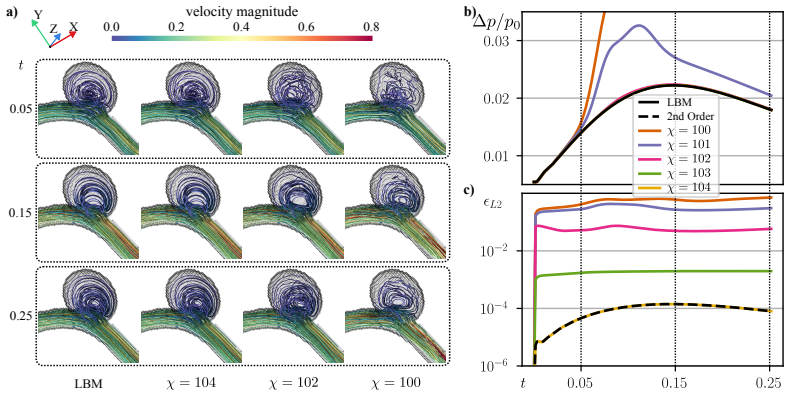
- [Abstract; Secs. 5.1–5.3] The claim that MPS-LBM 'reproduces the reference solution with high fidelity while achieving compression ratios exceeding two orders of magnitude' is not supported by the reported data. In the only >100x case (pin-fin, χ=64, CR≈120, Sec. 5.3, Fig. 8c), the velocity l2 error is ~0.2 and the text states that 'errors are dominated by the MPS decomposition'; the case with near-negligible pressure error is χ=128 with CR≈42. For TGV (Sec. 5.1), χ=98 gives CR≈64 but fails to reproduce the small-scale structures at late times, while χ=128 (CR≈42) is required for near-reference evolution. For the aneurysm (Sec. 5.2), the only complex-geometry case, CR_104≈2.3 and χ_mask≈98 serves as a lower bound. Thus the >100x result is confined to a translationally symmetric configuration, and no experiment demonstrates >100x compression together with high velocity-field fidelity.
- [Eqs. (45)–(46); Sec. 5.2] The compression ratio counts only PDF degrees of freedom; the stored geometry mask MPS is not included in NVPS_MPS. In the aneurysm case the mask has χ_mask=98, comparable to the PDF bond dimension χ=104, so including the mask roughly halves the reported CR_104≈2.3 to a value close to unity. Since the mask is part of the stored state in MPS-LBM (Sec. 3.2.1), the CR metric should either include the mask cost or be explicitly labeled 'PDF-only compression'; otherwise the complex-geometry memory advantage is overstated.
- [Sec. 3.2, Eq. (34); Table B.1] The text states that the second-order Taylor expansion of 1/ρ 'introduces an error that scales as O(Ma^6)'. The fitted exponents in Table B.1 are 2.401, 4.513, and 6.457 for first, second, and third order. The second-order measurement is therefore ~Ma^1.5 higher error than claimed. The pointwise remainder of the expansion may indeed be O(Ma^6), but the measured velocity-field error is not; the text should either report the scaling of the hydrodynamic error or explain the discrepancy. As written, the error budget in Sec. 3.2 is not consistent with the paper's own measurements.
- [Secs. 1 and 6; Figs. 6 and 8] The asymptotic claims ('logarithmic scaling in the spatial resolution and quartic scaling in bond dimension') hold for fixed bond dimension, but the paper does not characterize how χ must grow with physical complexity. The reported experiments show χ increasing with flow complexity (TGV late time, aneurysm above mask rank, pin-fin from χ=32 to χ=128 for accuracy). Without evidence on the growth of χ with Reynolds number, geometry complexity, or resolution, the 'scalable paradigm' statement in the abstract and Sec. 6 is premature. I recommend adding a systematic error-versus-χ study for at least one case and rewording the scaling claims to make the low-rank assumption explicit.
minor comments (4)
- [Sec. 2.3] The two-sweep ALS is a heuristic; no convergence diagnostic is reported. Since the compressed multiplication is the main nonlinear operation, please include at least one measurement of the ALS residual (e.g., ||A−B⊙C||/||B⊙C|| as a function of sweeps) to support the choice.
- [Eq. (46)] The notation '2D' is ambiguous (2^D vs 2D). Since the scale-ordering in Sec. 2.4 gives each core physical dimension 2^D, please clarify which is used; this affects all reported CR numbers.
- [Sec. 5.3] The statement 'at CR128≈42 ... the deviation becomes negligible' refers to the pressure drop, while ε_l2 of velocity is still ~0.1 (Fig. 8c); please qualify the statement.
- [Data/Code Availability] The paper states code and data will be published after peer review. For a methods paper of this type, providing the code at least at the revision stage would materially strengthen the reproducibility claims.
Circularity Check
No circularity: MPS-LBM is benchmarked against an independent classical LBM reference, with bond dimensions swept and failure modes reported rather than fitted.
full rationale
The paper's derivation chain is self-contained. The MPS-LBM algorithm is constructed from standard MPS operations (Section 2) and the BGK lattice Boltzmann update (Section 3); the scale-ordering and shift-MPO constructions are credited to prior independent work [12, 18, 31], not to a circular self-citation. The compression claim (CR > 100) is an empirical report from a numerical benchmark against a separate classical LBM implementation (Section 4.2, Eqs. 42-46), and the bond dimensions chi are swept rather than fitted to the reference solution. The paper transparently documents where compression fails: TGV requires chi=128 for near-reference evolution, the aneurysm reaches only CR_104 ≈ 2.3 with chi_mask serving as a lower bound, and the pin-fin's CR_64 ≈ 120 is accompanied by l2 velocity errors near 0.2, attributed explicitly to the MPS decomposition (Section 5.3). The CR definition (Eqs. 45-46) counts only PDF parameters and excludes the stored geometry mask; this is a limitation of the reported metric and an overstatement of practical memory savings for mask-dominated cases, but it is an accounting/scope issue, not a circular reduction of a prediction to an input. No parameter is fitted to the target observable, no uniqueness theorem is imported from the same authors, and no central claim is defined in terms of the result it purports to predict. Accordingly, the circularity score is 0.
Assumptions & free parameters
free parameters (5)
- Bond dimension chi per experiment =
64-256 (TGV); 100-104 (aneurysm); 32-128 (pin-fin); 16 (2D cases)
- ALS sweep count in compressed multiplication =
2 (full forward/backward sweeps)
- Taylor order of 1/rho expansion =
2nd order (Eq. 34)
- Mask bond dimension chi_mask =
98 (aneurysm), 16 (pin-fin)
- Aneurysm viscosity nu =
1.12e-5 m^2/s
assumptions (6)
- standard math Any tensor admits an MPS/TT decomposition via sequential SVD with optimal l2 truncation at each step (Sec. 2.1).
- standard math Cyclic/non-cyclic shift matrices factor into QTT MPO cores of bond dimension <= 3 (Sec. 2.5, Eqs. 19-28).
- domain assumption BGK LBM at low Mach number approximates incompressible Navier-Stokes with O(Ma^2) error (Sec. 3.1).
- ad hoc to paper The fixed two-sweep ALS iteration (Sec. 2.3) converges to a near-optimal approximation of the elementwise product.
- domain assumption Flow PDFs in scale-ordered form stay low-rank: fixed chi suffices at given fidelity as resolution/complexity grows.
- domain assumption Error metrics against the paper's own LBM implementation are a valid proxy for physical accuracy (Sec. 4.2).
Cite this review
Pith. "Pith review of Tensor Network Lattice Boltzmann Method for Data-Compressed Fluid Simulations." pith.science (2026). https://pith.science/paper/XASU6ZK2
@misc{pith2026251207615,
  author       = {Pith},
  title        = {Pith review of: Tensor Network Lattice Boltzmann Method for Data-Compressed Fluid Simulations},
  year         = {2026},
  howpublished = {\url{https://pith.science/paper/XASU6ZK2}},
  note         = {Machine review of arXiv:2512.07615}
}
read the original abstract
Resolving unsteady transport phenomena in geometrically complex domains is traditionally constrained by polynomial scaling of computational cost with spatial resolution. While methods based on tensor-network data representations or matrix-product states (MPS) data encodings have emerged as a technique to systematically reduce degrees of freedom, existing formulations do not extend to complex geometries and complex flow physics. Both capabilities are offered by lattice Boltzmann methods, for which we develop a generalized MPS formulation. This development marks a paradigm shift from classical methods that rely on explicit grid refinement for data reduction. Instead, our approach exploits non-local correlations in the MPS representation to systemically compress the global fluid state directly without modifying the underlying grid. We benchmark the proposed solver against classical LBM using three-dimensional flows through structured media and vascular geometries. The results confirm that the MPS formulation reproduces the reference solution with high fidelity while achieving compression ratios exceeding two orders of magnitude, positioning tensor networks or MPS encodings as a scalable paradigm for continuum mechanics on high-performance GPU hardware.
Figures


Figures from the paper (5 more)



Reference graph
Works this paper leans on
-
[1]
M. Berger, P. Colella, Local adaptive mesh refinement for shock hy- drodynamics, Journal of Computational Physics 82 (1) (1989) 64–84. doi:10.1016/0021-9991(89)90035-1. URLhttps://linkinghub.elsevier.com/retrieve/pii/ 0021999189900351
-
[2]
A. Harten, Multiresolution algorithms for the numerical solution of hyper- bolic conservation laws, Communications on Pure and Applied Mathematics 48 (12) (1995) 1305–1342.doi:10.1002/cpa.3160481201. URLhttps://onlinelibrary.wiley.com/doi/10.1002/ cpa.3160481201
-
[3]
L. Han, X. Hu, N. Adams, Adaptive multi-resolution method for com- pressible multi-phase flows with sharp interface model and pyramid 32 data structure, Journal of Computational Physics 262 (2014) 131–152. doi:10.1016/j.jcp.2013.12.061. URLhttps://linkinghub.elsevier.com/retrieve/pii/ S0021999114000230
-
[4]
J. Kaiser, D. Appel, F. Fritz, S. Adami, N. Adams, A multiresolu- tion local-timestepping scheme for particle–laden multiphase flow simulations using a level-set and point-particle approach, Computer Methods in Applied Mechanics and Engineering 384 (2021) 113966. doi:10.1016/j.cma.2021.113966. URLhttps://linkinghub.elsevier.com/retrieve/pii/ S0045782521003030
arXiv 2021
-
[5]
N. Hoppe, S. Adami, N. A. Adams, A parallel modular computing envi- ronment for three-dimensional multiresolution simulations of compressible flows, Computer Methods in Applied Mechanics and Engineering 391 (2022) 114486.doi:10.1016/j.cma.2021.114486. URLhttps://linkinghub.elsevier.com/retrieve/pii/ S004578252100699X
arXiv 2022
-
[6]
U. Schollwöck, The density-matrix renormalization group in the age of matrix product states, Annals of Physics 326 (1) (2011) 96–192.doi: 10.1016/j.aop.2010.09.012. URLhttps://www.sciencedirect.com/science/article/ pii/S0003491610001752
-
[7]
I. V . Oseledets, Tensor-Train Decomposition, SIAM Journal on Scientific Computing 33 (5) (2011) 2295–2317, publisher: Society for Industrial and Applied Mathematics.doi:10.1137/090752286. URLhttps://epubs.siam.org/doi/10.1137/090752286
-
[8]
R. Orús, A practical introduction to tensor networks: Matrix product states and projected entangled pair states, Annals of Physics 349 (2014) 117–158. doi:10.1016/j.aop.2014.06.013. URLhttps://www.sciencedirect.com/science/article/ pii/S0003491614001596
Show all 52 references
-
[9]
S. R. White, Density matrix formulation for quantum renormalization groups, Physical Review Letters 69 (19) (1992) 2863–2866, publisher: American Physical Society.doi:10.1103/PhysRevLett.69.2863. 33 URLhttps://link.aps.org/doi/10.1103/PhysRevLett. 69.2863
1992 doi
-
[10]
Vidal, Entanglement Renormalization, Physical Review Let- ters 99 (22) (2007) 220405, publisher: American Physical Society
G. Vidal, Entanglement Renormalization, Physical Review Let- ters 99 (22) (2007) 220405, publisher: American Physical Society. doi:10.1103/PhysRevLett.99.220405. URLhttps://link.aps.org/doi/10.1103/PhysRevLett. 99.220405
2007 doi
-
[11]
Verstraete, V
F. Verstraete, V . Murg, J. Cirac, Matrix product states, projected en- tangled pair states, and variational renormalization group methods for quantum spin systems, Advances in Physics 57 (2) (2008) 143–224. arXiv:https://doi.org/10.1080/14789940801912366, doi:10.1080/14789940...
2008 doi
-
[12]
Gourianov, M
N. Gourianov, M. Lubasch, S. Dolgov, Q. Y . van den Berg, H. Babaee, P. Givi, M. Kiffner, D. Jaksch, A quantum-inspired approach to exploit turbulence structures, Nature Computational Science 2 (1) (2022) 30–37, publisher: Nature Publishing Group. doi:10.1038/s43588-021-00181-...
2022 doi
-
[13]
Eisert, M
J. Eisert, M. Cramer, M. B. Plenio, Colloquium: Area laws for the entanglement entropy, Rev. Mod. Phys. 82 (2010) 277–306. doi:10.1103/RevModPhys.82.277. URLhttps://link.aps.org/doi/10.1103/RevModPhys. 82.277
2010 doi
-
[14]
Kiffner, D
M. Kiffner, D. Jaksch, Tensor network reduced order models for wall- bounded flows, Physical Review Fluids 8 (12) (2023) 124101, publisher: American Physical Society.doi:10.1103/PhysRevFluids.8. 124101. URLhttps://link.aps.org/doi/10.1103/ PhysRevFluids.8.124101
2023 doi
-
[15]
I. V . Oseledets, S. V . Dolgov, Solution of Linear Systems and Matrix Inver- sion in the TT-Format, SIAM Journal on Scientific Computing 34 (5) (2012) A2718–A2739, publisher: Society for Industrial and Applied Mathematics. 34 doi:10.1137/110833142. URLhttps://epubs.siam.org/d...
2012 doi
-
[16]
R. D. Peddinti, S. Pisoni, A. Marini, P. Lott, H. Argentieri, E. Tiunov, L. Aolita, Quantum-inspired framework for computational fluid dynamics, Communications Physics 7 (1) (2024) 1–7, publisher: Nature Publishing Group.doi:10.1038/s42005-024-01623-8. URLhttps://www.nature.co...
2024 doi
- [17]
-
[18]
Hölscher, P
L. Hölscher, P. Rao, L. Müller, J. Klepsch, A. Luckow, T. Stollen- werk, F. K. Wilhelm, Quantum-inspired fluid simulation of two- dimensional turbulence with GPU acceleration, Physical Review Re- search 7 (1) (2025) 013112, publisher: American Physical Society. doi:10.1103/Phy...
2025 doi
-
[19]
Ghahremani, H
B. Ghahremani, H. Babaee, Cross interpolation for solving high-dimensional dynamical systems on low-rank Tucker and tensor train manifolds, Com- puter Methods in Applied Mechanics and Engineering 432 (2024) 117385. doi:10.1016/j.cma.2024.117385. URLhttps://linkinghub.elsevier....
2024
-
[20]
Thai Tran, D
Q. Thai Tran, D. P. Truong, Kim Ø Rasmussen, B. Alexandrov, A tensor train-based isogeometric solver for large-scale 3D poisson problems, Computer Methods in Applied Mechanics and Engineering 453 (2026) 118802.doi:10.1016/j.cma.2026.118802. URLhttps://linkinghub.elsevier.com/r...
2026
-
[21]
P. L. Bhatnagar, E. P. Gross, M. Krook, A Model for Collision Pro- cesses in Gases. I. Small Amplitude Processes in Charged and Neutral One-Component Systems, Physical Review 94 (3) (1954) 511–525. doi:10.1103/PhysRev.94.511. URLhttps://link.aps.org/doi/10.1103/PhysRev.94. 511
1954 doi
-
[22]
Dupuis, B
A. Dupuis, B. Chopard, Theory and applications of an alternative lattice Boltzmann grid refinement algorithm, Physical Review E 67 (6) (2003) 066707.doi:10.1103/PhysRevE.67.066707. URLhttps://link.aps.org/doi/10.1103/PhysRevE.67. 066707
2003 doi
-
[23]
Eitel-Amor, M
G. Eitel-Amor, M. Meinke, W. Schröder, A lattice-Boltzmann method with hierarchically refined meshes, Computers & Fluids 75 (2013) 127–139. doi:10.1016/j.compfluid.2013.01.013. URLhttps://linkinghub.elsevier.com/retrieve/pii/ S0045793013000315
2013 doi
-
[24]
Liu, F.-B
Z. Liu, F.-B. Tian, X. Feng, An efficient geometry-adaptive mesh refinement framework and its application in the immersed boundary lattice Boltzmann method, Computer Methods in Applied Mechanics and Engineering 392 (2022) 114662.doi:10.1016/j.cma.2022.114662. URLhttps://linkin...
2022
-
[25]
Bellotti, L
T. Bellotti, L. Gouarin, B. Graille, M. Massot, Multidimensional fully adaptive lattice Boltzmann methods with error control based on multires- olution analysis, Journal of Computational Physics 471 (2022) 111670. doi:10.1016/j.jcp.2022.111670. URLhttps://linkinghub.elsevier.c...
2022
-
[26]
Verstraete, J
F. Verstraete, J. I. Cirac, Renormalization algorithms for quantum-many body systems in two and higher dimensions (2004).arXiv:cond-mat/ 0407066. URLhttps://arxiv.org/abs/cond-mat/0407066
2004 arXiv
-
[27]
E. M. Stoudenmire, S. R. White, Minimally entangled typical thermal state algorithms, New Journal of Physics 12 (5) (2010) 055026.doi:10.1088/ 36 1367-2630/12/5/055026. URLhttps://doi.org/10.1088/1367-2630/12/5/055026
2010 doi
- [28]
-
[29]
Unfried, J
J. Unfried, J. Hauschild, F. Pollmann, Fast time evolution of matrix prod- uct states using the qr decomposition, Phys. Rev. B 107 (2023) 155133. doi:10.1103/PhysRevB.107.155133. URLhttps://link.aps.org/doi/10.1103/PhysRevB.107. 155133
2023 doi
-
[30]
Bradbury, R
J. Bradbury, R. Frostig, P. Hawkins, M. J. Johnson, C. Leary, D. Maclaurin, G. Necula, A. Paszke, J. VanderPlas, S. Wanderman-Milne, Q. Zhang, JAX: composable transformations of Python+NumPy programs (2018). URLhttp://github.com/jax-ml/jax
2018
-
[31]
V . A. Kazeev, B. N. Khoromskij, Low-Rank Explicit QTT Representation of the Laplace Operator and Its Inverse, SIAM Journal on Matrix Analysis and Applications 33 (3) (2012) 742–758.doi:10.1137/100820479. URLhttp://epubs.siam.org/doi/10.1137/100820479
2012 doi
-
[32]
H. Chen, S. Chen, W. H. Matthaeus, Recovery of the Navier-Stokes equations using a lattice-gas Boltzmann method, Physical Review A 45 (8) (1992) R5339–R5342.doi:10.1103/PhysRevA.45.R5339. URLhttps://link.aps.org/doi/10.1103/PhysRevA.45. R5339
1992 doi
-
[33]
S. Chen, G. D. Doolen, LATTICE BOLTZMANN METHOD FOR FLUID FLOWS, Annual Review of Fluid Mechanics 30 (1) (1998) 329–364. doi:10.1146/annurev.fluid.30.1.329. URLhttps://www.annualreviews.org/doi/10.1146/ annurev.fluid.30.1.329
1998 doi
-
[34]
T. Abe, Derivation of the Lattice Boltzmann Method by Means of the Discrete Ordinate Method for the Boltzmann Equation, Jour- nal of Computational Physics 131 (1) (1997) 241–246.doi: 10.1006/jcph.1996.5595. 37 URLhttps://linkinghub.elsevier.com/retrieve/pii/ S0021999196955953
1997
-
[35]
He, L.-S
X. He, L.-S. Luo, Theory of the lattice Boltzmann method: From the Boltzmann equation to the lattice Boltzmann equation, Physical Review E 56 (6) (1997) 6811–6817.doi:10.1103/PhysRevE.56.6811. URLhttps://link.aps.org/doi/10.1103/PhysRevE.56. 6811
1997 doi
-
[36]
Sanavio, S
C. Sanavio, S. Succi, Lattice boltzmann–carleman quantum algorithm and circuit for fluid flows at moderate reynolds number, A VS Quantum Science 6 (2) (2024) 023802.doi:10.1116/5.0195549. URLhttps://doi.org/10.1116/5.0195549
2024 doi
-
[37]
He, L.-S
X. He, L.-S. Luo, Lattice boltzmann model for the incompressible navier– stokes equation, Journal of statistical Physics 88 (3) (1997) 927–944
1997
-
[38]
Krüger, H
T. Krüger, H. Kusumaatmaja, A. Kuzmin, O. Shardt, G. Silva, E. M. Viggen, The Lattice Boltzmann Method: Principles and Practice, Grad- uate Texts in Physics, Springer International Publishing, Cham, 2017. doi:10.1007/978-3-319-44649-3. URLhttp://link.springer.com/10.1007/ 978-...
2017 doi
-
[39]
X. He, Q. Zou, L.-S. Luo, M. Dembo, Analytic solutions of simple flows and analysis of nonslip boundary conditions for the lattice Boltzmann BGK model, Journal of Statistical Physics 87 (1-2) (1997) 115–136.doi:10. 1007/BF02181482. URLhttp://link.springer.com/10.1007/BF02181482
1997 doi
-
[40]
D. P. Ziegler, Boundary conditions for lattice Boltzmann simulations, Jour- nal of Statistical Physics 71 (5-6) (1993) 1171–1177.doi:10.1007/ BF01049965. URLhttp://link.springer.com/10.1007/BF01049965
1993 doi
-
[41]
Izquierdo, N
S. Izquierdo, N. Fueyo, Characteristic nonreflecting boundary conditions for open boundaries in lattice Boltzmann methods, Physical Review E 78 (4) (2008) 046707.doi:10.1103/PhysRevE.78.046707. URLhttps://link.aps.org/doi/10.1103/PhysRevE.78. 046707 38
2008 doi
-
[42]
Nathen, D
P. Nathen, D. Gaudlitz, M. Krause, N. Adams, On the stability and accu- racy of the bgk, mrt and rlb boltzmann schemes for the simulation of turbu- lent flows, Communications in Computational Physics 23 (2018) 846–876. doi:10.4208/cicp.OA-2016-0229
2018 doi
-
[43]
Horvat, S
M. Horvat, S. B. Lunowa, D. Sytnyk, B. Wohlmuth, A lattice boltzmann method for non-newtonian blood flow in coiled intracranial aneurysms, in: A. Sequeira, A. Silvestre, S. S. Valtchev, J. Janela (Eds.), Numerical Math- ematics and Advanced Applications ENUMATH 2023, V olume 1...
2023
-
[44]
Shahsavar, M
A. Shahsavar, M. Shahmohammadi, I. B. Askari, Cfd simulation of the im- pact of tip clearance on the hydrothermal performance and entropy gener- ation of a water-cooled pin-fin heat sink, International Communications in Heat and Mass Transfer 126 (2021) 105400.doi:https://doi....
2021
-
[45]
Karani, C
H. Karani, C. Huber, Lattice boltzmann formulation for conjugate heat transfer in heterogeneous media, Phys. Rev. E 91 (2015) 023304. doi:10.1103/PhysRevE.91.023304. URLhttps://link.aps.org/doi/10.1103/PhysRevE.91. 023304
2015 doi
-
[46]
d’Humières, I
D. d’Humières, I. Ginzburg, M. Krafczyk, P. Lallemand, L.-S. Luo, Multiple-relaxation-time lattice boltzmann models in three dimensions, Philosophical Transactions of the Royal Society A 360 (1792) (2002) 437–451.doi:10.1098/rsta.2001.0955
2002
-
[47]
M. R. Swift, E. Orlandini, W. R. Osborn, J. M. Yeomans, Lattice boltzmann simulations of liquid-gas and binary fluid systems, Phys. Rev. E 54 (1996) 5041–5052.doi:10.1103/PhysRevE.54.5041. URLhttps://link.aps.org/doi/10.1103/PhysRevE.54. 5041
1996 doi
-
[48]
Tiwari, J
A. Tiwari, J. Iaconis, J. Jojo, S. Ray, M. Roetteler, C. Hill, J. Pathak, Algorithmic Advances Towards a Realizable Quantum Lattice Boltzmann Method, arXiv:2504.10870 [quant-ph] (Apr. 2025).doi:10.48550/ 39 arXiv.2504.10870. URLhttp://arxiv.org/abs/2504.10870
2025 arXiv
-
[49]
Wawrzyniak, J
D. Wawrzyniak, J. Winter, S. Schmidt, T. Indinger, C. F. Janßen, U. Schramm, N. A. Adams, A quantum algorithm for the lattice-Boltzmann method advection-diffusion equation, Computer Physics Communications 306 (2025) 109373.doi:10.1016/j.cpc.2024.109373. URLhttps://www.scienced...
2025
-
[50]
Tennie, S
F. Tennie, S. Laizet, S. Lloyd, L. Magri, Quantum computing for nonlinear differential equations and turbulence, Nature Reviews Physics 7 (4) (2025) 220–230.doi:10.1038/s42254-024-00799-w. URLhttps://doi.org/10.1038/s42254-024-00799-w
2025 doi
-
[51]
X. Shan, H. Chen, Lattice Boltzmann model for simulating flows with mul- tiple phases and components, Physical Review E 47 (3) (1993) 1815–1819. doi:10.1103/PhysRevE.47.1815. URLhttps://link.aps.org/doi/10.1103/PhysRevE.47. 1815
1993 doi
-
[52]
D. G. a. Smith, J. Gray, opt_einsum - a python package for optimizing con- traction order for einsum-like expressions, Journal of Open Source Software 3 (26) (2018) 753.doi:10.21105/joss.00753. URLhttps://doi.org/10.21105/joss.00753 40
2018 doi
Reviewed August 3, 2026 · model on record in the stance chip above.
Discussion (0). Continue with ORCID to comment.