REVIEW 3 major objections 4 minor 3 cited by
The paper claims that a genuinely new ultraviolet fixed point of quantum gravity exists—distinct from the standard Reuter fixed point—in which the Planck mass grows with a scalar field, and it finds numerical scaling solutions for this fixe
Reviewed by Pith at T0; open to challenge. T0 means a machine referee read the full paper against a public rubric. the ladder, T0–T4 →
T0 review · deepseek-v4-flash
2026-08-03 16:15 UTC pith:OYKKTT3X
load-bearing objection Real new content in the kinetial computation, but the existence claim rests on an omitted cutoff-correction term that is cited rather than estimated in this setting; still deserves a serious referee. the 3 major comments →
Scaling solutions for gauge invariant flow equations in dilaton quantum gravity
The pith
A machine-rendered reading of the paper's core claim, the machinery that carries it, and where it could break.
Core claim
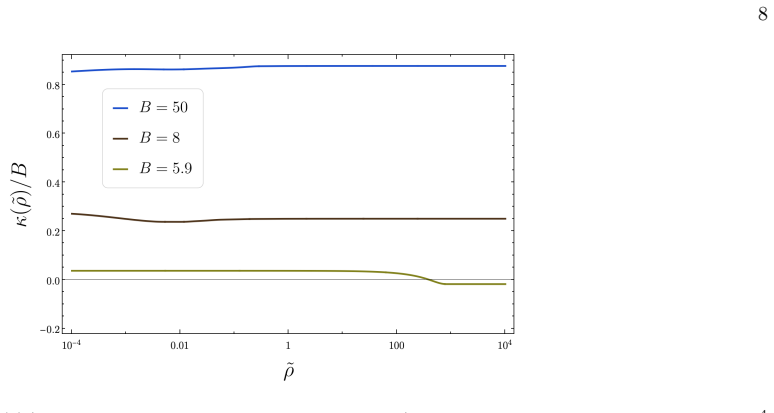
The central discovery is the existence of global scaling solutions of the gauge-invariant flow equations in the two-derivative truncation of the effective action. For these solutions the dimensionless squared Planck mass w(ρ̃) approaches ξ∞ρ̃ for large field, the dimensionless potential u(ρ̃) approaches the constant u∞ = 3/(128π²), and the kinetial κ(ρ̃) crosses over between two plateaus. The crossover scale is set by w0/ξ∞. The scaling solutions form a continuous family labelled by B = 6 + κ∞/ξ∞, with stability requiring B > 0 and κ0 > 0. The paper further shows that a constant (Reuter-type) solution for u and w is inconsistent with a positive κ0 unless an anomalous dimension η ≈ 0.0116 is
What carries the argument
The central object is the gauge-invariant functional flow equation together with the 'physical gauge fixing' (β = −1, α → 0) that decouples physical metric fluctuations from gauge modes. The effective action is the variable-gravity action with three free functions U(ρ), K(ρ), F(ρ). The flow is converted into scaling equations for the dimensionless functions u, w, κ of ρ̃ = ρ/k². Solving these second-order differential equations on the whole range 0 ≤ ρ̃ < ∞, with boundary conditions from the infrared expansion at ρ̃ → ∞ and the ultraviolet expansion at ρ̃ → 0, yields the scaling solutions. The heat kernel method provides the flow kernels M U, M F, M K. Stability is enforced by positivity of
Load-bearing premise
The paper's load-bearing structural assumption is that corrections to the one-loop flow equation arising from the field-dependence of the infrared cutoff are negligible; if they are not small in the ultraviolet scaling region, the reported scaling solutions could be artifacts rather than genuine fixed points.
What would settle it
Compute the cutoff-field-dependence corrections (the omitted pieces cited from the simplified flow equation setting) directly in the ultraviolet scaling region and check whether the scaling solutions for u, w, κ persist. Alternatively, extend the truncation to include R² or other higher-derivative terms and test whether the w(ρ̃) ≈ ξ∞ρ̃ scaling solution still exists or disappears.
If this is right
- If the dilaton fixed point exists, a scalar singlet coupled to gravity is ultraviolet complete, and the Planck mass grows as F(ρ) ∝ ρ at large field, making particle-to-Planck mass ratios constant (quantum scale symmetry).
- The scaling solution connects the infrared fixed point (ρ̃ → ∞, free massless graviton and scalar) to the ultraviolet fixed point (ρ̃ → 0), linking short-distance and long-distance physics; in particular, the late-time behavior of dynamical dark energy is tied to the large-ρ̃ form of the effective potential.
- The gauge-invariant flow equation permits negative kinetial values at large ρ̃ (κ∞ < 0) within the stable region B > 0, partially covering the conformal regime.
- The extended Reuter fixed point also appears in this setting, with a gravitational contribution to the scalar anomalous dimension η ≈ 0.0116.
- For large ρ̃, u(ρ̃) is nearly flat and w(ρ̃) ≈ w0 + ξ∞ρ̃, consistent with earlier studies; the paper argues these features are robust against changes in the flow equation and truncation.
Where Pith is reading between the lines
- The omission of corrections from the field-dependence of the infrared cutoff—acknowledged in the paper as potentially small—leaves an assumption that should be checked directly in the ultraviolet scaling region; if sizable, the reported scaling solutions could be artifacts of the simplified one-loop form.
- The restriction to vanishing scalar anomalous dimension excludes a wider class of scaling solutions; allowing a ρ̃-dependent anomalous dimension could change the nature of the ultraviolet fixed point, as the paper itself notes.
- Extending the truncation to include higher-derivative terms (e.g., R²) might reduce the continuous family of scaling solutions to a discrete set or eliminate the w(ρ̃) ∼ ρ̃ solutions altogether; the paper explicitly lists this as an open possibility.
- If the continuous family persists in higher truncations, the parameter B could become a physical free parameter, yielding a one-parameter family of possible cosmologies—an implication the paper leaves implicit.
Editorial analysis
A structured set of objections, weighed in public.
Referee Report
Summary. The paper investigates scaling solutions of gauge-invariant functional flow equations for a scalar field nonminimally coupled to gravity, in the two-derivative truncation (1) with three functions U(ρ), K(ρ), F(ρ). The authors derive flow equations (5)–(7) using a physical gauge fixing and heat-kernel techniques, then solve the scaling equations (11)–(13) numerically. They report global solutions where u(ρ̃) is almost constant, w(ρ̃) ≈ w0 + ξ∞ρ̃ for large ρ̃, and κ(ρ̃) interpolates between a negative IR value and a positive UV value. The paper argues that this strengthens the evidence for a dilaton quantum gravity fixed point distinct from the extended Reuter fixed point. Detailed appendices provide the computation of the flow kernels, comparisons with earlier work (Ref. [142]), and a discussion of anomalous dimensions.
Significance. If correct, the paper provides a nontrivial example of a UV fixed point with a field-dependent Planck mass, which is relevant for asymptotic safety and for cosmological applications such as inflation and dynamical dark energy. The technical derivations are transparent and include explicit heat-kernel coefficients, a physical-gauge decomposition, and a comparison with previous truncations. The main claim, however, is conditional: the flow equations are the 'simple one-loop form' with field-dependent cutoff corrections omitted, and the quantitative results depend on an unspecified regulator profile. Because the paper itself acknowledges these limitations, its contribution is best viewed as evidence within a specific approximation, not as a definitive proof of the fixed point.
major comments (3)
- [Section I, Eqs. (5)–(7)] The central derivation omits correction terms arising from the field-dependence of the IR cutoff. The paper states in Section I that these corrections were estimated to be small in Ref. [144], but that estimate was made for a simplified flow equation, not for the present gravity-scalar system. In the present setting the cutoff depends on the macroscopic fields through w(ρ̃) and κ(ρ̃), and the omitted terms involve derivatives of R_k with respect to these fields. Since the scaling solutions are global and the claim concerns existence of a fixed point, the applicability of the Ref. [144] estimate must be justified. A quantitative estimate, or at least a clear argument why the corrections are subleading in the UV and IR regions, is needed before the reported solutions can be attributed to the gauge-invariant flow.
- [Appendix E and Section III] The regulator profile R_k(z) is never explicitly specified. The flow kernels M_U, M_F, M_K are obtained via heat-kernel threshold integrals Q_n, which depend on the shape of R_k. The paper only mentions a 'type-II cutoff' for the TT mode and gives no explicit profile for any mode. As a result, the numerical values (e.g., u0=0.0055, w0=0.0277, B_c≈5.7, η=0.0116) and even the existence of solutions for a given B are not reproducible. Please specify the regulator used in the numerical calculations, or demonstrate that the qualitative existence and the asymptotic forms are independent of this choice.
- [Section V] The paper restricts attention to scaling solutions with vanishing scalar anomalous dimension η=0, stating that this is the case for solutions with κ(ρ̃→0) finite. The central claim that the argument for the dilaton fixed point is strengthened is therefore conditional on this restriction. Section V shows that η≠0 leads to κ(ρ̃)∼1/ρ̃ and different UV behavior, but these solutions are not pursued. Please clarify whether the η=0 assumption is a necessary part of the fixed-point definition or merely a simplifying choice, and comment on how the existence claim might change if η≠0 solutions are included.
minor comments (4)
- [Section III, Figure 1] The function ξ̃(ρ̃) = (w(ρ̃)-w0)/ρ̃ is plotted for ρ̃ down to 0, but the ratio is 0/0 at ρ̃=0. Please define its value at the origin or restrict the plot to ρ̃>0.
- [Section IV.A] The expansions in terms of y=1/ρ̃ and x=y/ξ∞ are introduced, but the relation between x and the original variables is not stated explicitly. It would be helpful to define x = 1/(ξ∞ρ̃) clearly.
- [Appendix E] The paper refers to a 'type-II cutoff function named in Ref. [171]' but does not give its explicit form. Since the threshold functions depend on this choice, the omission is significant (see Major Comment 2).
- [Appendix F] In the derivation of the kinetial flow, the notation G_ph is used for the propagator and later for the Green's function. This is confusing; please use distinct symbols.
Circularity Check
No significant circularity: scaling solutions are genuine outputs of the boundary-value problem; the omitted-cutoff-correction caveat is a stated approximation assumption, not a constructed prediction.
full rationale
The central claim is not forced by the inputs. The scaling equations (11)-(13) are obtained from the flow equations (5)-(7) by imposing ∂t u = ∂t w = ∂t κ = 0; the global solution is a two-point boundary-value problem. The asymptotic IR conditions (u → 3/(128π²), w ≈ w0 + ξ∞ρ̃, κ∞ = ξ∞(B−6)) are the defining properties of the dilaton fixed point under investigation; the UV values and stability conditions, e.g. the non-existence of a constant solution (eqs. (30)-(33)), are computed outputs, not inserted results. The continuous B-family is presented as a numerical observation, and the paper explicitly leaves open whether extended truncations reduce it. The main caveat is in Section I: 'The field-dependence of the cutoff introduces correction terms to the simple one-loop form of the exact functional flow equation. In the setting of the simplified flow equation [144] these corrections have been estimated and found to be small. We omit them in the present work.' This is a self-cited approximation assumption that could affect the validity of eqs. (5)-(7) if wrong, but it is not a reduction of an output to an input: [144] is an external estimate, and the existence claim does not follow tautologically from the citation. Refs. [141,142] are used for comparison and nomenclature, not to fix the numerical solution. No circular step can be exhibited; the score reflects only a minor same-author citation in the justification of an approximation.
Axiom & Free-Parameter Ledger
free parameters (5)
- B = 6 + κ∞/ξ∞ =
B > 5.7; Fig.1 uses B=5.7, Fig.4 uses B=8 and 50
- w0 =
0.0277
- κ∞ (or ε∞ = κ∞/ξ∞) =
κ∞ = -0.3 for B=5.7 in Fig.1
- ξ∞ =
1
- Regulator profile R_k(z) =
unspecified
axioms (6)
- ad hoc to paper The field-dependent cutoff correction terms (beyond the simple one-loop form) are small and can be omitted.
- domain assumption The two-derivative truncation (U, K, F) is sufficient for the UV fixed point; higher-derivative terms such as R² are negligible.
- standard math The maximally symmetric background and the heat-kernel expansion keeping only b0 and b2 coefficients are sufficient to extract the beta functions for U, F and K.
- domain assumption The physical gauge fixing (β=-1, α→0) removes gauge modes without affecting physical fluctuations.
- domain assumption For the dilaton scaling solutions, the scalar anomalous dimension vanishes for all ρ̃.
- domain assumption The IR fixed point corresponds to a decoupled free massless scalar plus graviton, giving u∞ = 3/(128π²).
read the original abstract
We discuss the ultraviolet fixed point of asymptotically safe dilaton quantum gravity. It differs from the Reuter fixed point by the dependence of the Planck mass on a scalar field. The gauge invariant functional flow equation in the most general approximation with up to two derivatives strengthens the argument for the existence of this fixed point. The quantum effective action obtained from the scaling solution for dilaton quantum gravity can describe inflation for early cosmology and dynamical dark energy for late cosmology.
Figures




Forward citations
Cited by 3 Pith papers
-
Asymptotic behaviour of the derivative expansion in the ERG
The derivative expansion of the exact renormalization group is divergent for generic operators in any dimension, but behaves as an asymptotic series that converges to high order in common applications.
-
Starobinsky-inflation in asymptotically safe shift-symmetric scalar-tensor theory
Starobinsky inflation rules out two of three non-Gaussian fixed points in asymptotically safe scalar-tensor theories, identifying viable RG trajectories from the remaining fixed point.
-
Fermi scale from quantum gravity scaling solution
The Fermi/Planck ratio is claimed to be predictable from the analyticity of the quantum-gravity scaling solution for the cosmon-Higgs coupling, with numerics showing the coupling flows to a tiny, near-critical value.
Reference graph
Works this paper leans on
-
[1]
physical gauge fixing
Setup In this work, we intend to set up the system of a singlet scalar fieldϕnonminimally coupled to gravity using the FRG equation (A1). In such a system, we give the effective action as Γk = ΓSG k + Γgf + Γgh .(A2) Here, our truncated scalar-gravity part Γ SG k is given by Γ(SG) k = Z x √g U(ρ) + K(ρ) 2 gµν∂µϕ∂νϕ− F(ρ) 2 R .(A3) We have defined the fiel...
-
[2]
To derive the explicit form for the metric two-point function, we split the metric fluctuations into physical and gauge fluctuations [169]
Physical metric decomposition A key quantity for the flow equation is the inverse propagator or 1PI two-point function, as given by the matrix of second functional derivatives of Γ k. To derive the explicit form for the metric two-point function, we split the metric fluctuations into physical and gauge fluctuations [169]. Accordingly, we decompose the met...
-
[3]
We start with the Gaussian integral for the metric fluctuationsh µν
Jacobians The decompositions of the metric fluctuation (A13) and the ghost fields (A15) yield Jacobians of the path integral measures for different modes. We start with the Gaussian integral for the metric fluctuationsh µν. In the maximally symmetric space (A5), the Gaussian integrals for each mode in the physical metric decomposition read 1 = Z Dhµν exp ...
-
[4]
The TT-projection operator is given by P (t)µνρσ = 1 2 (P µρP νσ +P µσP νρ)− 1 3 P µνP ρσ ,(C5) withP µν defined by eq
T ransverse-traceless tensor For thet µν mode, we obtain the Hessian as Γ(2) (tt) µνρσ = F 2 ¯DT −U P (t)µνρσ ,(C3) where we define the derivative operator ¯DT = ¯∆T + 2 ¯R 3 ,(C4) 16 with the Laplacian ¯∆T =− ¯D2 acting on transverse traceless tensor fields (spin-2 fields). The TT-projection operator is given by P (t)µνρσ = 1 2 (P µρP νσ +P µσP νρ)− 1 3 ...
-
[5]
Note that ¯D1 is defined in eq
T ransverse vector The Hessian for the spin-1 gauge modeυ µ is given by Γ(2) (υυ) µν = 1 α F ¯D1 ¯D1 +α ¯R 2 −α U F P (v)µν ,(C6) withP (v) the projection operator on the vector mode,P (v) µµ = 3. Note that ¯D1 is defined in eq. (A18). Forα→0 the inverse propagator for the gauge-vector mode becomes independent ofU lim α→0 α Γ(2) k µν υυ =F ¯D1 2 P (v)µν ....
-
[6]
Scalars We next turn to the Hessian for the scalar modes. In the (σ, u, φ)-field basis, we obtain Γ(2) (00) = Γ(2) (00) grav 1 2 −F ′ ¯∆S + ¯R 4 +U ′ ¯ϕ 1 4 −F ′ ¯R+ 2U ′ ¯ϕ ¯∆S 1 2 −F ′ ¯∆S + ¯R 4 +U ′ ¯ϕ 1 4 −F ′ ¯R+ 2U ′ ¯ϕ ¯∆S K ¯∆S +m 2(¯ρ)−1 2 ξ(¯ρ)¯R ,(C8) where we definem 2(¯ρ) =U′ + 2¯ρU′′ andξ(¯ρ) =F ′ + 2¯ρF′′. Here th...
-
[7]
T” and “TT
Ghost fields Finally, the Hessians for the ghost field obtains from eq. (A8) as Γ(2) ( ¯C⊥C⊥) µν = ¯D1 P (v)µν ,Γ (2) ( ¯CC) = ¯∆S + ¯R β−3 ¯∆S .(C13) Note that ¯D1 is defined in eq. (A18). Appendix D: Heat kernel evaluation of the flow generator Let us briefly summarize the formulas of the heat kernel method in gravity. Suppose that the flow generatorζ k...
-
[8]
Physical metric fluctuations We first evaluate the contributions from the physical fluctuations. There are the TT mode (t µν) and the physical spin-0 modes (φand ˜σ), whose forms of the flow generators are given by π2 = 1 2 Tr(2) ∂tRk Γ(2) k +R k tt ,(E2) π0 = 1 2 Tr(0) ∂tRk Γ(2) k +R k ph +J ˜σ,(E3) respectively. The two-point functions Γ (2) k for the T...
-
[9]
P˜σ˜σP˜σφ Pφ˜σ Pφφ ! 0 (V (2) ph )12(∂2) (V (2) ph )21(∂2)B ! P˜σ˜σP˜σφ Pφ˜σ Pφφ ! ∂tR˜σ˜σ k ∂tR˜σφ k ∂tRφ˜σ k ∂tRφφ k !# + 1 2 1 (4π)2 Z x tr
Measure contribution We now calculate the measure contributionη k. This contribution takes a simple form [143] ηk =− 1 2 Tr(1) ∂tPk ¯D1 Pk ¯D1 − 1 2 Tr(0) ∂tPk ¯D0 Pk ¯D0 ,(E22) with ¯D1 = ¯∆V − ¯R 4 , ¯D0 = ¯∆S − ¯R 4 .(E23) To see this, we evaluate each contributions from measure modes which arises from the gauge fluctuations, the ghost fluctuations, an...
-
[10]
[142] finds u0 = 0.0006460, w 0 = 0.002757, η=−∂ t logκ 0 = 1.6669.(G5) 25
Small field limit The small-field expansion for the flow kernels are u(˜ρ) = ∞X n=0 un n! ˜ρn =u 0 +u 1 ˜ρ+· · ·,(G1) w(˜ρ) = ∞X n=0 wn n! ˜ρn =w 0 +w 1 ˜ρ+· · ·,(G2) κ(˜ρ) = ∞X n=0 κn n! ˜ρn =κ 0 +κ 1 ˜ρ+· · ·.(G3) In our work we find a UV fixed point u0 = 0.0055, w 0 = 0.0277, η=−∂ t logκ 0 = 0.0116,(G4) while Ref. [142] finds u0 = 0.0006460, w 0 = 0.00...
-
[11]
To compare the results between ours and Ref
Large field limit Next we consider the large-field expansion of the flow kernels in terms ofx= 1/(ξ ∞ ˜ρ). To compare the results between ours and Ref. [142], we make its ansatz as u(x) =u ∞ + ∞X n=0 un n! xn ,(G6) w(x) =x −1 + ∞X n=0 tn n! xn ,(G7) κ(x) =ε ∞ξ∞ +ξ ∞ ∞X n=1 kn n! xn ,(G8) for which we have ∂tu=−4u−2x ∂u ∂x + AV B3 + CV B4 x ,(G9) ∂tw=−2w−2...
-
[12]
A. H. Guth,The Inflationary Universe: A Possible Solution to the Horizon and Flatness Problems,Phys. Rev. D23 (1981) 347
1981
-
[13]
Sato,First-order phase transition of a vacuum and the expansion of the Universe,Mon
K. Sato,First-order phase transition of a vacuum and the expansion of the Universe,Mon. Not. Roy. Astron. Soc.195 (1981) 467
1981
-
[14]
A. D. Linde,Chaotic Inflation,Phys. Lett. B129(1983) 177
1983
-
[15]
Wetterich,Cosmology and the Fate of Dilatation Symmetry,Nucl
C. Wetterich,Cosmology and the Fate of Dilatation Symmetry,Nucl. Phys. B302(1988) 668 [1711.03844]
Pith/arXiv arXiv 1988
-
[16]
Ratra and P
B. Ratra and P. J. E. Peebles,Cosmological Consequences of a Rolling Homogeneous Scalar Field,Phys. Rev. D37 (1988) 3406
1988
-
[17]
E. J. Copeland, M. Sami and S. Tsujikawa,Dynamics of dark energy,Int. J. Mod. Phys. D15(2006) 1753 [hep-th/0603057]
Pith/arXiv arXiv 2006
-
[18]
Wetterich,Variable gravity Universe,Phys
C. Wetterich,Variable gravity Universe,Phys. Rev. D89(2014) 024005 [1308.1019]
Pith/arXiv arXiv 2014
-
[19]
Wetterich,Universe without expansion,Phys
C. Wetterich,Universe without expansion,Phys. Dark Univ.2(2013) 184 [1303.6878]
Pith/arXiv arXiv 2013
-
[20]
Wetterich,Cosmon inflation,Phys
C. Wetterich,Cosmon inflation,Phys. Lett. B726(2013) 15 [1303.4700]
Pith/arXiv arXiv 2013
-
[21]
Wetterich,Inflation, quintessence, and the origin of mass,Nucl
C. Wetterich,Inflation, quintessence, and the origin of mass,Nucl. Phys.B897(2015) 111 [1408.0156]
Pith/arXiv arXiv 2015
-
[22]
Wetterich,Primordial cosmic fluctuations for variable gravity,JCAP05(2016) 041 [1511.03530]
C. Wetterich,Primordial cosmic fluctuations for variable gravity,JCAP05(2016) 041 [1511.03530]. 28
Pith/arXiv arXiv 2016
-
[23]
M. Wali Hossain, R. Myrzakulov, M. Sami and E. N. Saridakis,Unification of inflation and dark energy ` a la quintessential inflation,Int. J. Mod. Phys. D24(2015) 1530014 [1410.6100]
Pith/arXiv arXiv 2015
-
[24]
M. W. Hossain, R. Myrzakulov, M. Sami and E. N. Saridakis,Variable gravity: A suitable framework for quintessential inflation,Phys. Rev. D90(2014) 023512 [1402.6661]
Pith/arXiv arXiv 2014
-
[25]
J. Rubio and C. Wetterich,Emergent scale symmetry: Connecting inflation and dark energy,Phys. Rev. D96(2017) 063509 [1705.00552]
Pith/arXiv arXiv 2017
-
[26]
D. Bettoni and J. Rubio,Quintessential Inflation: A Tale of Emergent and Broken Symmetries,Galaxies10(2022) 22 [2112.11948]
Pith/arXiv arXiv 2022
-
[27]
Wetterich,Quantum scale symmetry,1901.04741
C. Wetterich,Quantum scale symmetry,1901.04741
Pith/arXiv arXiv 1901
-
[28]
Weinberg,Ultraviolet divergences in quantum theories of gravitation,General Relativity: An Einstein Centenary Survey edited by S
S. Weinberg,Ultraviolet divergences in quantum theories of gravitation,General Relativity: An Einstein Centenary Survey edited by S. W. Hawking, and W. Israel, (Cambridge University Press, Cambridge, England), Chap. 16(1979)
1979
-
[29]
Reuter,Nonperturbative evolution equation for quantum gravity,Phys
M. Reuter,Nonperturbative evolution equation for quantum gravity,Phys. Rev.D57(1998) 971 [hep-th/9605030]
Pith/arXiv arXiv 1998
-
[30]
Souma,Nontrivial ultraviolet fixed point in quantum gravity,Prog
W. Souma,Nontrivial ultraviolet fixed point in quantum gravity,Prog. Theor. Phys.102(1999) 181 [hep-th/9907027]
Pith/arXiv arXiv 1999
-
[31]
Wetterich,Exact evolution equation for the effective potential,Phys
C. Wetterich,Exact evolution equation for the effective potential,Phys. Lett.B301(1993) 90 [1710.05815]
Pith/arXiv arXiv 1993
-
[32]
O. Lauscher and M. Reuter,Flow equation of quantum Einstein gravity in a higher derivative truncation,Phys. Rev. D 66(2002) 025026 [hep-th/0205062]
Pith/arXiv arXiv 2002
-
[33]
A. Codello and R. Percacci,Fixed points of higher derivative gravity,Phys. Rev. Lett.97(2006) 221301 [hep-th/0607128]
Pith/arXiv arXiv 2006
-
[34]
K. Falls, D. F. Litim, K. Nikolakopoulos and C. Rahmede,A bootstrap towards asymptotic safety,1301.4191
-
[35]
K. Falls, D. F. Litim, K. Nikolakopoulos and C. Rahmede,Further evidence for asymptotic safety of quantum gravity, Phys. Rev.D93(2016) 104022 [1410.4815]
Pith/arXiv arXiv 2016
-
[36]
K. Falls, C. R. King, D. F. Litim, K. Nikolakopoulos and C. Rahmede,Asymptotic safety of quantum gravity beyond Ricci scalars,Phys. Rev.D97(2018) 086006 [1801.00162]
Pith/arXiv arXiv 2018
-
[37]
K. G. Falls, D. F. Litim and J. Schr¨ oder,Aspects of asymptotic safety for quantum gravity,Phys. Rev. D99(2019) 126015 [1810.08550]
Pith/arXiv arXiv 2019
-
[38]
Y. Kluth and D. F. Litim,Fixed points of quantum gravity and the dimensionality of the UV critical surface,Phys. Rev. D108(2023) 026005 [2008.09181]
Pith/arXiv arXiv 2023
-
[39]
Y. Kluth and D. F. Litim,Functional renormalization for f(Rµνρσ) quantum gravity,Phys. Rev. D106(2022) 106022 [2202.10436]
Pith/arXiv arXiv 2022
-
[40]
J. A. Dietz and T. R. Morris,Asymptotic safety in the f(R) approximation,JHEP01(2013) 108 [1211.0955]
Pith/arXiv arXiv 2013
-
[41]
J. A. Dietz and T. R. Morris,Redundant operators in the exact renormalisation group and in the f(R) approximation to asymptotic safety,JHEP07(2013) 064 [1306.1223]
Pith/arXiv arXiv 2013
-
[42]
G. P. De Brito, N. Ohta, A. D. Pereira, A. A. Tomaz and M. Yamada,Asymptotic safety and field parametrization dependence in thef(R)truncation,Phys. Rev.D98(2018) 026027 [1805.09656]
Pith/arXiv arXiv 2018
-
[43]
N. Ohta and R. Percacci,Higher Derivative Gravity and Asymptotic Safety in Diverse Dimensions,Class. Quant. Grav. 31(2014) 015024 [1308.3398]
Pith/arXiv arXiv 2014
-
[44]
N. Ohta and R. Percacci,Ultraviolet Fixed Points in Conformal Gravity and General Quadratic Theories,Class. Quant. Grav.33(2016) 035001 [1506.05526]
Pith/arXiv arXiv 2016
-
[45]
D. Benedetti, P. F. Machado and F. Saueressig,Asymptotic safety in higher-derivative gravity,Mod. Phys. Lett.A24 (2009) 2233 [0901.2984]
Pith/arXiv arXiv 2009
-
[46]
D. Benedetti, P. F. Machado and F. Saueressig,Taming perturbative divergences in asymptotically safe gravity,Nucl. Phys.B824(2010) 168 [0902.4630]
Pith/arXiv arXiv 2010
-
[47]
D. Benedetti, K. Groh, P. F. Machado and F. Saueressig,The Universal RG Machine,JHEP06(2011) 079 [1012.3081]
Pith/arXiv arXiv 2011
-
[48]
K. Groh, S. Rechenberger, F. Saueressig and O. Zanusso,Higher Derivative Gravity from the Universal Renormalization Group Machine,PoSEPS-HEP2011(2011) 124 [1111.1743]
Pith/arXiv arXiv 2011
-
[49]
E. Manrique, M. Reuter and F. Saueressig,Bimetric Renormalization Group Flows in Quantum Einstein Gravity, Annals Phys.326(2011) 463 [1006.0099]
Pith/arXiv arXiv 2011
-
[50]
I. Donkin and J. M. Pawlowski,The phase diagram of quantum gravity from diffeomorphism-invariant RG-flows, 1203.4207
-
[51]
N. Christiansen, D. F. Litim, J. M. Pawlowski and A. Rodigast,Fixed points and infrared completion of quantum gravity,Phys. Lett.B728(2014) 114 [1209.4038]
Pith/arXiv arXiv 2014
-
[52]
N. Christiansen, B. Knorr, J. M. Pawlowski and A. Rodigast,Global Flows in Quantum Gravity,Phys. Rev.D93(2016) 044036 [1403.1232]
Pith/arXiv arXiv 2016
-
[53]
Christiansen,Four-Derivative Quantum Gravity Beyond Perturbation Theory,1612.06223
N. Christiansen,Four-Derivative Quantum Gravity Beyond Perturbation Theory,1612.06223
-
[54]
N. Christiansen, K. Falls, J. M. Pawlowski and M. Reichert,Curvature dependence of quantum gravity,Phys. Rev.D97 (2018) 046007 [1711.09259]
Pith/arXiv arXiv 2018
-
[55]
A. Eichhorn, P. Labus, J. M. Pawlowski and M. Reichert,Effective universality in quantum gravity,SciPost Phys.5 (2018) 031 [1804.00012]
Pith/arXiv arXiv 2018
-
[56]
A. Eichhorn, S. Lippoldt, J. M. Pawlowski, M. Reichert and M. Schiffer,How perturbative is quantum gravity?,Phys. Lett.B792(2019) 310 [1810.02828]
Pith/arXiv arXiv 2019
-
[57]
A. Codello, G. D’Odorico and C. Pagani,Consistent closure of renormalization group flow equations in quantum gravity, Phys. Rev.D89(2014) 081701 [1304.4777]
Pith/arXiv arXiv 2014
-
[58]
M. Demmel, F. Saueressig and O. Zanusso,RG flows of Quantum Einstein Gravity in the linear-geometric approximation,Annals Phys.359(2015) 141 [1412.7207]. 29
Pith/arXiv arXiv 2015
-
[59]
J. Biemans, A. Platania and F. Saueressig,Quantum gravity on foliated spacetimes: Asymptotically safe and sound, Phys. Rev.D95(2017) 086013 [1609.04813]
Pith/arXiv arXiv 2017
-
[60]
H. Gies, B. Knorr, S. Lippoldt and F. Saueressig,Gravitational Two-Loop Counterterm Is Asymptotically Safe,Phys. Rev. Lett.116(2016) 211302 [1601.01800]
Pith/arXiv arXiv 2016
-
[61]
G. P. de Brito and A. D. Pereira,Unimodular quantum gravity: Steps beyond perturbation theory,JHEP09(2020) 196 [2007.05589]
Pith/arXiv arXiv 2020
-
[62]
G. P. de Brito, A. D. Pereira and A. F. Vieira,Exploring new corners of asymptotically safe unimodular quantum gravity,Phys. Rev. D103(2021) 104023 [2012.08904]
Pith/arXiv arXiv 2021
-
[63]
G. P. de Brito, O. Melichev, R. Percacci and A. D. Pereira,Can quantum fluctuations differentiate between standard and unimodular gravity?,JHEP12(2021) 090 [2105.13886]
Pith/arXiv arXiv 2021
-
[64]
S. Gonzalez-Martin, T. R. Morris and Z. H. Slade,Asymptotic solutions in asymptotic safety,Phys. Rev.D95(2017) 106010 [1704.08873]
Pith/arXiv arXiv 2017
-
[65]
A. Baldazzi and K. Falls,Essential Quantum Einstein Gravity,Universe7(2021) 294 [2107.00671]
Pith/arXiv arXiv 2021
-
[66]
A. Baldazzi, K. Falls and R. Ferrero,Relational observables in asymptotically safe gravity,Annals Phys.440(2022) 168822 [2112.02118]
Pith/arXiv arXiv 2022
-
[67]
G. P. de Brito and A. Eichhorn,Nonvanishing gravitational contribution to matter beta functions for vanishing dimensionful regulators,Eur. Phys. J. C83(2023) 161 [2201.11402]
Pith/arXiv arXiv 2023
-
[68]
J. M. Pawlowski and M. Reichert,Quantum gravity: a fluctuating point of view,Front. Phys.8(2020) 551848 [2007.10353]
Pith/arXiv arXiv 2020
-
[69]
K. Falls, N. Ohta and R. Percacci,Towards the determination of the dimension of the critical surface in asymptotically safe gravity,Phys. Lett. B810(2020) 135773 [2004.04126]
Pith/arXiv arXiv 2020
-
[70]
B. Knorr,The derivative expansion in asymptotically safe quantum gravity: general setup and quartic order,SciPost Phys. Core4(2021) 020 [2104.11336]
Pith/arXiv arXiv 2021
-
[71]
A. Mitchell, T. R. Morris and D. Stulga,Provable properties of asymptotic safety in f(R) approximation,JHEP01 (2022) 041 [2111.05067]
Pith/arXiv arXiv 2022
-
[72]
T. R. Morris and D. Stulga,The functionalf(R)approximation,2210.11356
-
[73]
S. Sen, C. Wetterich and M. Yamada,Asymptotic freedom and safety in quantum gravity,JHEP03(2022) 130 [2111.04696]
Pith/arXiv arXiv 2022
-
[74]
A. Eichhorn, R. R. L. dos Santos and F. Wagner,Shift-symmetric Horndeski gravity in the asymptotic-safety paradigm, JCAP02(2023) 052 [2212.08441]
Pith/arXiv arXiv 2023
-
[75]
F. Saueressig and J. Wang,Foliated asymptotically safe gravity in the fluctuation approach,JHEP09(2023) 064 [2306.10408]
Pith/arXiv arXiv 2023
-
[76]
M. Becker, A. Kurov and F. Saueressig,Remarks on the origin of almost-Gaussian scaling in asymptotically safe quantum gravity,Phys. Rev. D110(2024) 126003 [2402.01075]
Pith/arXiv arXiv 2024
-
[77]
H. Kawai and N. Ohta,Wave function renormalization in asymptotically safe quantum gravity,Phys. Rev. D111(2025) 046012 [2412.08808]
Pith/arXiv arXiv 2025
-
[78]
H. Kawai and N. Ohta,Standard running, “physical running”, cosmological constant and Newton coupling,Phys. Lett. B 868(2025) 139781 [2505.16578]
Pith/arXiv arXiv 2025
-
[79]
F. Saueressig and J. Wang,Foliated asymptotically safe gravity: Lorentzian signature fluctuations from the Wick rotation,Phys. Rev. D111(2025) 106007 [2501.03752]
Pith/arXiv arXiv 2025
-
[80]
J. M. Pawlowski, M. Reichert and J. Wessely,Self-consistent graviton spectral function in Lorentzian quantum gravity, 2507.22169
discussion (0)
Sign in with ORCID, Apple, or X to comment. Anyone can read and Pith papers without signing in.