REVIEW 3 major objections 6 minor 7 cited by
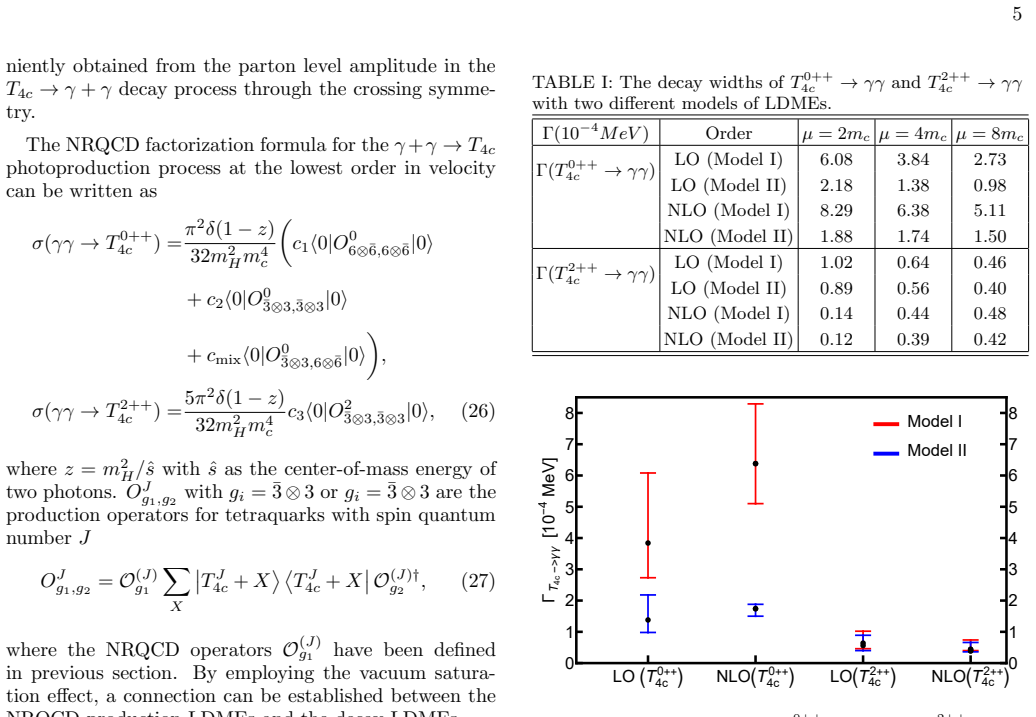
The fully charm tetraquark's two-photon decay receives large next-to-leading-order QCD corrections: up to +66% for the scalar 0++ state and −31% for the tensor 2++, and the corrected photon-fusion cross sections should be testable in collid
Reviewed by Pith at T0; open to challenge. T0 means a machine referee read the full paper against a public rubric. the ladder, T0–T4 →
T0 review · deepseek-v4-flash
2026-08-03 13:55 UTC pith:FX2PGZKR
load-bearing objection The analytic NLO QCD corrections to T4c→γγ in Eqs. (22)-(25) are the real new content and look plausible; the experimental event-rate claims are undermined by the LDME caveat the authors themselves state, and Eq. (17) has a sign issue that needs fixing. the 3 major comments →
Next-to-leading order QCD corrections to electromagnetic production and decay of fully charm tetraquarks
The pith
A machine-rendered reading of the paper's core claim, the machinery that carries it, and where it could break.
Core claim
The central discovery is that internal gluon radiation is not a small correction for the electromagnetic decays of fully charm tetraquarks. The NLO factors X₁,₁–X₃,₁ (Eqs. 22–25) are obtained analytically, and with the two adopted LDME models they give a 26–66% increase in Γ(T4c^{0++}→γγ) and a ~31% decrease in Γ(T4c^{2++}→γγ) at the typical renormalization scale μ=4m_c. By crossing symmetry the same coefficients apply to γγ→T4c, yielding photon-fusion cross sections from ~0.1 pb in proton-proton ultra-peripheral collisions to micro-barn scales in heavy-ion collisions, and from femtobarn to picobarn scales in electron-positron collisions. The paper claims these rates are within reach of curr
What carries the argument
The load-bearing machinery is NRQCD factorization for the fully charm tetraquark: the amplitude is written as a product of perturbatively computable short-distance coefficients c_i and non-perturbative long-distance matrix elements (LDMEs) for the diquark-antidiquark operators. To get the NLO coefficients, the paper generates 40 tree and 920 one-loop diagrams, projects the amplitude onto Lorentz structures, reduces the integrals to master integrals, and renormalizes charm mass/field in the on-shell scheme and α_s in the MS scheme. Crossing symmetry T4c→γγ ↔ γγ→T4c then carries the decay coefficients into production, and the equivalent-photon approximation converts them into ultra-peripheral-
Load-bearing premise
The numerical widths and cross sections inherit the two LDME models adopted via vacuum saturation; the paper itself notes that current collider data on X(6900) production imply the production matrix element is one to two orders of magnitude smaller, which would shrink all predicted rates by that factor.
What would settle it
Measure the diphoton partial width of the 6900 MeV peak: if it is below ~10⁻⁵ MeV, the adopted LDME models are excluded; or independently recalculate the one-loop coefficient at μ=4m_c and check that it matches the paper's analytic X-coefficients, otherwise the perturbative result fails.
If this is right
- The 0++ tetraquark's two-photon width rises by 26–66% at NLO, improving the visibility of the clean γγ decay channel.
- The 2++ width falls ~31%, making the ratio Γ(0++)/Γ(2++) a sensitive test of the NLO coefficients that is less dependent on the overall LDME scale.
- Photon-fusion production in heavy-ion ultra-peripheral collisions reaches micro-barn-level cross sections, implying thousands of events in modest data samples.
- In electron-positron collisions the predicted cross sections span femtobarns to picobarns, giving a route to extract tetraquark LDMEs from a well-understood initial state.
- Because decay and production are linked by crossing symmetry, a future measurement of γγ→T4c would directly verify the same short-distance coefficients as T4c→γγ.
Where Pith is reading between the lines
- If the collider-derived production matrix element is indeed one to two orders of magnitude below the adopted models, all absolute rates shrink accordingly; the NLO coefficients would survive, but the discovery potential shifts from current data to future high-luminosity runs.
- The same machinery could be applied to other fully heavy tetraquarks (e.g., fully bottom) or to J/ψ plus photon final states, where the photon couples to a single heavy-quark pair and may expose different color/spin structures.
- The scalar-to-tensor width ratio, being nearly free of the overall LDME normalization, could be a sharper discriminant among competing tetraquark wavefunction models than any single rate.
Editorial analysis
A structured set of objections, weighed in public.
Referee Report
Summary. This paper presents NRQCD factorization formulas for the electromagnetic decay T4c → γγ and the photon-fusion production γγ → T4c, and computes the NLO QCD corrections to the short-distance coefficients for the J^PC=0++ and 2++ fully charm tetraquark states. The authors give analytic expressions for the NLO coefficients X_{i,1} in Eqs. (22)–(25), including MS-bar renormalization of α_s and on-shell renormalization of the charm mass and field. They then use these coefficients to compute decay widths and production cross sections in ultra-peripheral proton/nucleus collisions and e+e− collisions, quoting significant NLO corrections for the 0++ decay and a moderate correction for the 2++ decay at a reference scale. The paper claims the results can be tested in current and future experiments.
Significance. If correct, this is the first complete NLO QCD calculation of the two-photon coupling of fully charm tetraquarks within NRQCD, providing compact analytic short-distance coefficients that can be reused by other groups. The factorization structure is standard, the paper does not refit LDMEs, and it is transparent about the model dependence of the nonperturbative inputs, explicitly noting that LHCb production data imply matrix elements one to two orders of magnitude below the adopted models. The utility of the result is, however, strongly conditioned on the validity of the Model I/II LDMEs and the correctness of the renormalization procedure, both of which require attention in revision.
major comments (3)
- [Eq. (17), Sec. III] The MS-bar renormalization constant for α_s in the convention α_s^bare C_ε = μ^{2ε} α_s Z_{α_s} should be Z_{α_s} = 1 + (α_s/(4π)) β0/ε with β0 = (33−2n_l)/3 for C_A=3. The printed coefficient (2n_l−31)/(3ε) gives −25/3 for n_l=3, whereas β0=9; it has the wrong sign and wrong magnitude. If used literally, the β-function would have positive sign and the μ-dependence of Eqs. (22)–(25) would be inconsistent. The authors must correct this expression or explicitly justify a nontrivial convention; as it stands, it undermines the renormalization claim.
- [Sec. V and Conclusion] The text acknowledges that LHCb production data imply the production matrix element is one to two orders of magnitude smaller than Model I or II, but the event-rate estimates in the Conclusion (≈5000 Pb-Pb events at 5 nb⁻¹, ≈1000 STCF events at 1 ab⁻¹) and the statement that the processes 'shall be tested' use the unmodified Models I/II. A 10–100 fold reduction in the LDMEs would lower these yields by one to two orders of magnitude, possibly below observability. The phenomenological claims should be rescaled or explicitly made conditional on the optimistic model choice.
- [Sec. III, Eqs. (22)–(25)] The analytic NLO coefficients are presented without an independent numerical cross-check or a demonstration of cancellation of the 1/ε poles. Given the apparent Z_{α_s} problem in Eq. (17), the finite parts cannot be verified as printed. The authors should provide an independent validation (e.g., a second computation with a different projector/reduction setup, or a numerical evaluation) and, ideally, make the analytic expressions or a code available in a supplementary file.
minor comments (6)
- [Throughout] Typographical errors: 'fussion' should be 'fusion' in Secs. IV, V and the Conclusion; 'electromagntic' in Sec. I; 'photon fussion' in Table II heading.
- [Table II] The Kr-Kr row appears twice with identical entries; one should be removed.
- [References [54] and [60]] The DOIs '10.1103/skdp-g4ql' and '10.1103/375n-fw5h' appear malformed or are placeholders; they should be corrected to valid DOIs.
- [Sec. V] The statement that NLO decreases Γ(T2++→γγ) by 31% is only true at μ=4m_c; at μ=2m_c the decrease is about 86% and at μ=8m_c there is a slight increase. The scale dependence of the quoted percentage should be made explicit.
- [Eq. (30)] The square bracket in the expression for n_{γ/A}(χ) is unbalanced; please check the bracket structure and the relative placement of K_0(χ)K_1(χ).
- [Fig. 2 caption] The caption says 'error bars denote the scale uncertainties', but the plotted points do not show visible error bars; please clarify or correct the figure/caption.
Circularity Check
No circularity found: the NLO coefficients are a direct one-loop calculation, the LDMEs are imported from the independent external paper Ref. [66], and the paper's own LHCb caveat is a normalization limitation rather than a circular reduction.
full rationale
The derivation chain is self-contained at the perturbative level. The LO SDCs are taken from the independent external paper [66], and the NLO coefficients X_{i,1} in Eqs. (22)-(25) are obtained by explicit one-loop computation with FeynArts/FeynCalc/Kira/Package-X, followed by on-shell mass and field renormalization and MS renormalization of alpha_s; no parameter is fitted to the quantities being predicted. The numerical widths and cross-sections use the Model I/II LDMEs from Ref. [66] and the CMS tetraquark mass as inputs; the production LDMEs are related to the decay LDMEs by the explicitly stated vacuum-saturation approximation, which is an assumption and not an identity encoding the target results. The self-citations (e.g., Refs. [23,58,76-80]) are technical or contextual and are not used to justify the NLO result; no uniqueness theorem is invoked to force a choice. The paper itself flags the key limitation in Sec. V: "It should also be noted that the LHCb Collaboration has observed the production cross-section of X(6900), it is found that the production matrix element is smaller by approximately one to two orders of magnitude compared with Model I or Model II from a theoretical analysis." This would shrink the predicted widths, cross-sections, and event-rate estimates, but it is an acknowledged external normalization uncertainty affecting the phenomenological claims, not a circular reduction. Conclusion: no significant circularity.
Axiom & Free-Parameter Ledger
free parameters (3)
- LDMEs, Model I =
⟨O(0)6⊗6⟩=0.0128, ⟨O(0)3⊗3⟩=0.0347, ⟨O(0)mix⟩=0.0211, ⟨O(2)3⊗3⟩=0.0144 GeV^9
- LDMEs, Model II =
⟨O(0)6⊗6⟩=0.0139, ⟨O(0)3⊗3⟩=0.0187, ⟨O(0)mix⟩=−0.0161, ⟨O(2)3⊗3⟩=0.0126 GeV^9
- UPC impact-parameter cutoff b_min =
1.2 A^(1/3) fm
axioms (6)
- domain assumption NRQCD factorization holds at leading order in velocity with p_i = P/4 for the four charm quarks.
- domain assumption The T4c states are represented by diquark-antidiquark NRQCD operators O(0)6⊗6, O(0)3⊗3, O(2)3⊗3 with the given color/spin projectors.
- domain assumption Production LDMEs equal decay LDMEs through vacuum saturation, ⟨0|O^J_{i,i}|0⟩ ≈ (2J+1)⟨O^J_i⟩.
- standard math The γγ→T4c amplitude is obtained from T4c→γγ by crossing symmetry.
- domain assumption Ultraperipheral photon flux ignores hadronic non-overlap except for a b_min = 1.2 A^(1/3) fm cutoff.
- standard math On-shell renormalization of charm mass/field and MS renormalization of α_s with the constants in Eq. (17).
read the original abstract
We investigate the electromagnetic properties of the fully charm tetraquark states, particularly incorporating contributions from internal gluon radiation. The paper first presents analytical expressions for the next-to-leading-order (NLO) QCD corrections to the decay amplitudes of fully charm tetraquarks into two photons. It is found that the QCD corrections are significant for the $J^{PC}=0^{++}$ and $J^{PC}=2^{++}$ fully charm tetraquark decay process. Subsequently, by considering photon-photon fusion in ultra-peripheral high-energy collisions of protons and nuclei and in electron-positron collision, we provide theoretical predictions for the production cross sections of fully charm tetraquark states. The results presented in this work regarding the electromagnetic production and decay of fully charm tetraquarks shall be tested in current and future experiments.
Figures

Forward citations
Cited by 7 Pith papers
-
All-charm tetraquarks at hadron colliders: A high-precision fragmentation perspective
TQ4Q2.0 supplies the first complete, uncertainty-quantified set of NRQCD-based fragmentation functions for all-heavy tetraquarks, including nonconstituent channels and public grids for jet-associated production.
-
Symmetry Analysis of Compact Tetraquark States and Implications for the Level Ordering of the Fully Charmed Candidates $X(6600)$, $X(6900)$, and $X(7100)$
Counting symmetry-allowed states up to orbital angular momentum L=3 predicts low-lying compact tetraquarks prefer J^P=2^+, matching the observed 2^{++} fully charmed X states.
-
Symmetry Analysis of Compact Tetraquark States and Implications for the Level Ordering of the Fully Charmed Candidates $X(6600)$, $X(6900)$, and $X(7100)$
Symmetry analysis of compact tetraquarks shows low-energy states favor J^P=2+ and places X(6600), X(6900), X(7100) among the lower levels of the fully charmed spectrum.
-
Two photon decay width of the fully charmed tetraquarks: revisiting prospects for ultraperipheral collisions
Using recent four-body quark model wave functions and NRQCD, the authors compute two-photon couplings and UPC cross sections for fully charmed tetraquarks, showing resonant terms exceed continuum in J/ψJ/ψ but not in ...
-
All-charm tetraquarks at hadron colliders: A high-precision fragmentation perspective
The authors construct and publicly release the TQ4Q2.0 fragmentation functions for all-heavy S-wave tetraquarks via NRQCD factorization, extending prior work with nonconstituent contributions and replica-based uncertainties.
-
Radiative decay of fully-heavy tetraquark into quarkonium
NRQCD calculation finds ~1 MeV widths for T4c to gamma J/psi, tens of eV for T4b, and preferential c cbar annihilation in mixed bc states.
-
Two photon decay width of the fully charmed tetraquarks: revisiting prospects for ultraperipheral collisions
Computes two-photon couplings of scalar and tensor fully-charmed tetraquarks via NRQCD from recent four-body wave functions and finds resonant terms dominate J/ψJ/ψ but not diphoton production in UPCs, disagreeing wit...
Reference graph
Works this paper leans on
-
[1]
S. K. Choiet al.[Belle], Phys. Rev. Lett.91, 262001 (2003) doi:10.1103/PhysRevLett.91.262001 [arXiv:hep- ex/0309032 [hep-ex]]
arXiv 2003
-
[2]
D. Acostaet al.[CDF], Phys. Rev. Lett.93, 072001 (2004) doi:10.1103/PhysRevLett.93.072001 [arXiv:hep- ex/0312021 [hep-ex]]
arXiv 2004
-
[3]
R. Aaijet al.[LHCb], Sci. Bull.65, no.23, 1983-1993 (2020) doi:10.1016/j.scib.2020.08.032 [arXiv:2006.16957 [hep-ex]]
arXiv 1983
-
[4]
G. Aadet al.[ATLAS], Phys. Rev. Lett.131, no.15, 151902 (2023) doi:10.1103/PhysRevLett.131.151902 [arXiv:2304.08962 [hep-ex]]
Pith/arXiv arXiv 2023
-
[5]
A. Hayrapetyanet al.[CMS], Phys. Rev. Lett.132, no.11, 111901 (2024) doi:10.1103/PhysRevLett.132.111901 [arXiv:2306.07164 [hep-ex]]
Pith/arXiv arXiv 2024
-
[6]
J. H. Yinet al.[Belle], JHEP08, 121 (2023) doi:10.1007/JHEP08(2023)121 [arXiv:2305.17947 [hep- ex]]
Pith/arXiv arXiv 2023
-
[7]
A. Hayrapetyanet al.[CMS], Nature648, no.8092, 58-63 (2025) doi:10.1038/s41586-025-09711-7 [arXiv:2506.07944 [hep-ex]]
arXiv 2025
-
[8]
Aadet al.[ATLAS], [arXiv:2509.13101 [hep-ex]]
G. Aadet al.[ATLAS], [arXiv:2509.13101 [hep-ex]]
-
[9]
Y. Iwasaki, Prog. Theor. Phys.54, 492 (1975) doi:10.1143/PTP.54.492
-
[10]
K. T. Chao, Z. Phys. C7, 317 (1981) doi:10.1007/BF01431564
-
[11]
M. N. Anwar, J. Ferretti, F. K. Guo, E. San- topinto and B. S. Zou, Eur. Phys. J. C78, no.8, 647 (2018) doi:10.1140/epjc/s10052-018-6073-9 [arXiv:1710.02540 [hep-ph]]
Pith/arXiv arXiv 2018
-
[12]
M. Karliner, S. Nussinov and J. L. Ros- ner, Phys. Rev. D95, no.3, 034011 (2017) doi:10.1103/PhysRevD.95.034011 [arXiv:1611.00348 [hep-ph]]
Pith/arXiv arXiv 2017
-
[13]
V. R. Debastiani and F. S. Navarra, Chin. Phys. C43, no.1, 013105 (2019) doi:10.1088/1674-1137/43/1/013105 [arXiv:1706.07553 [hep-ph]]
Pith/arXiv arXiv 2019
-
[14]
J. Wu, Y. R. Liu, K. Chen, X. Liu and S. L. Zhu, Phys. Rev. D97, no.9, 094015 (2018) doi:10.1103/PhysRevD.97.094015 [arXiv:1605.01134 [hep-ph]]
Pith/arXiv arXiv 2018
-
[15]
M. S. Liu, Q. F. L¨ u, X. H. Zhong and Q. Zhao, Phys. Rev. D100, no.1, 016006 (2019) doi:10.1103/PhysRevD.100.016006 [arXiv:1901.02564 [hep-ph]]
Pith/arXiv arXiv 2019
-
[16]
X. Jin, Y. Xue, H. Huang and J. Ping, Eur. Phys. J. C80, no.11, 1083 (2020) doi:10.1140/epjc/s10052-020-08650-z [arXiv:2006.13745 [hep-ph]]
Pith/arXiv arXiv 2020
-
[17]
F. X. Liu, M. S. Liu, X. H. Zhong and Q. Zhao, Phys. Rev. D104, no.11, 116029 (2021) doi:10.1103/PhysRevD.104.116029 [arXiv:2110.09052 [hep-ph]]
Pith/arXiv arXiv 2021
-
[18]
R. N. Faustov, V. O. Galkin and E. M. Savchenko, Phys. Rev. D102, no.11, 114030 (2020) doi:10.1103/PhysRevD.102.114030 [arXiv:2009.13237 8 [hep-ph]]
Pith/arXiv arXiv 2020
-
[19]
Q. F. L¨ u, D. Y. Chen and Y. B. Dong, Eur. Phys. J. C 80, no.9, 871 (2020) doi:10.1140/epjc/s10052-020-08454- 1 [arXiv:2006.14445 [hep-ph]]
Pith/arXiv arXiv 2020
-
[20]
M. S. liu, F. X. Liu, X. H. Zhong and Q. Zhao, Phys. Rev. D109, no.7, 076017 (2024) doi:10.1103/PhysRevD.109.076017 [arXiv:2006.11952 [hep-ph]]
Pith/arXiv arXiv 2024
-
[21]
G. J. Wang, L. Meng and S. L. Zhu, Phys. Rev. D100, no.9, 096013 (2019) doi:10.1103/PhysRevD.100.096013 [arXiv:1907.05177 [hep-ph]]
Pith/arXiv arXiv 2019
-
[22]
M. A. Bedolla, J. Ferretti, C. D. Roberts and E. San- topinto, Eur. Phys. J. C80, no.11, 1004 (2020) doi:10.1140/epjc/s10052-020-08579-3 [arXiv:1911.00960 [hep-ph]]
Pith/arXiv arXiv 2020
- [23]
-
[24]
J. F. Giron and R. F. Lebed, Phys. Rev. D102, no.7, 074003 (2020) doi:10.1103/PhysRevD.102.074003 [arXiv:2008.01631 [hep-ph]]
Pith/arXiv arXiv 2020
-
[25]
C. M. Tang, C. G. Duan and L. Tang, Eur. Phys. J. C 84, no.7, 743 (2024) doi:10.1140/epjc/s10052-024-13102- z [arXiv:2405.05042 [hep-ph]]
Pith/arXiv arXiv 2024
-
[26]
C. M. Tang, C. G. Duan, L. Tang and C. F. Qiao, Eur. Phys. J. C85, no.4, 396 (2025) doi:10.1140/epjc/s10052- 025-14106-z [arXiv:2411.11433 [hep-ph]]
Pith/arXiv arXiv 2025
-
[27]
C. M. Tang, C. G. Duan, L. Tang and C. F. Qiao, [arXiv:2511.18807 [hep-ph]]
-
[28]
W. Chen, H. X. Chen, X. Liu, T. G. Steele and S. L. Zhu, Phys. Lett. B773, 247-251 (2017) doi:10.1016/j.physletb.2017.08.034 [arXiv:1605.01647 [hep-ph]]
Pith/arXiv arXiv 2017
-
[29]
J. R. Zhang, Phys. Rev. D103, no.1, 014018 (2021) doi:10.1103/PhysRevD.103.014018 [arXiv:2010.07719 [hep-ph]]
Pith/arXiv arXiv 2021
-
[30]
Z. G. Wang, Int. J. Mod. Phys. A36, no.02, 2150014 (2021) doi:10.1142/S0217751X21500147 [arXiv:2009.05371 [hep-ph]]
Pith/arXiv arXiv 2021
-
[31]
Z. G. Wang, Chin. Phys. C44, no.11, 113106 (2020) doi:10.1088/1674-1137/abb080 [arXiv:2006.13028 [hep- ph]]
Pith/arXiv arXiv 2020
-
[32]
R. M. Albuquerque, S. Narison, A. Rabemanan- jara, D. Rabetiarivony and G. Randriamana- trika, Phys. Rev. D102, no.9, 094001 (2020) doi:10.1103/PhysRevD.102.094001 [arXiv:2008.01569 [hep-ph]]
Pith/arXiv arXiv 2020
-
[33]
Q. N. Wang, Z. Y. Yang and W. Chen, Phys. Rev. D104, no.11, 114037 (2021) doi:10.1103/PhysRevD.104.114037 [arXiv:2109.08091 [hep-ph]]
Pith/arXiv arXiv 2021
-
[34]
B. D. Wan and C. F. Qiao, Phys. Lett. B 817, 136339 (2021) doi:10.1016/j.physletb.2021.136339 [arXiv:2012.00454 [hep-ph]]
arXiv 2021
-
[35]
B. C. Yang, L. Tang and C. F. Qiao, Eur. Phys. J. C 81, no.4, 324 (2021) doi:10.1140/epjc/s10052-021-09096- 7 [arXiv:2012.04463 [hep-ph]]
Pith/arXiv arXiv 2021
-
[36]
Z. G. Wang, Eur. Phys. J. C77, no.7, 432 (2017) doi:10.1140/epjc/s10052-017-4997-0 [arXiv:1701.04285 [hep-ph]]
Pith/arXiv arXiv 2017
-
[37]
Z. G. Wang and Z. Y. Di, Acta Phys. Polon. B50, 1335 (2019) doi:10.5506/APhysPolB.50.1335 [arXiv:1807.08520 [hep-ph]]
Pith/arXiv arXiv 2019
-
[38]
S. S. Agaev, K. Azizi, B. Barsbay and H. Sundu, Phys. Lett. B844, 138089 (2023) doi:10.1016/j.physletb.2023.138089 [arXiv:2304.03244 [hep-ph]]
arXiv 2023
-
[39]
S. S. Agaev, K. Azizi, B. Barsbay and H. Sundu, Nucl. Phys. A1041, 122768 (2024) doi:10.1016/j.nuclphysa.2023.122768 [arXiv:2304.09943 [hep-ph]]
arXiv 2024
-
[40]
G. Li, C. Shi, Y. Chen and W. Sun, [arXiv:2505.23220 [hep-lat]]
-
[41]
G. Li, C. Shi, Y. Chen and W. Sun, [arXiv:2505.24213 [hep-lat]]
-
[42]
Y. Meng, C. Liu, X. Y. Tuo, H. Yan and Z. Zhang, Eur. Phys. J. C85, no.4, 458 (2025) doi:10.1140/epjc/s10052- 025-14192-z [arXiv:2411.11533 [hep-lat]]
Pith/arXiv arXiv 2025
-
[43]
N. Santowsky and C. S. Fischer, Eur. Phys. J. C82, no.4, 313 (2022) doi:10.1140/epjc/s10052-022-10272-6 [arXiv:2111.15310 [hep-ph]]
Pith/arXiv arXiv 2022
-
[44]
Q. Li, C. H. Chang, G. L. Wang and T. Wang, Phys. Rev. D104, no.1, 014018 (2021) doi:10.1103/PhysRevD.104.014018 [arXiv:2104.12372 [hep-ph]]
Pith/arXiv arXiv 2021
-
[45]
H. W. Ke, X. Han, X. H. Liu and Y. L. Shi, Eur. Phys. J. C81, no.5, 427 (2021) doi:10.1140/epjc/s10052-021- 09229-y [arXiv:2103.13140 [hep-ph]]
Pith/arXiv arXiv 2021
-
[46]
W. Heupel, G. Eichmann and C. S. Fischer, Phys. Lett. B 718, 545-549 (2012) doi:10.1016/j.physletb.2012.11.009 [arXiv:1206.5129 [hep-ph]]
Pith/arXiv arXiv 2012
-
[47]
J. Z. Wang, D. Y. Chen, X. Liu and T. Mat- suki, Phys. Rev. D103, no.7, 071503 (2021) doi:10.1103/PhysRevD.103.L071503 [arXiv:2008.07430 [hep-ph]]
Pith/arXiv arXiv 2021
-
[48]
C. Gong, M. C. Du, Q. Zhao, X. H. Zhong and B. Zhou, Phys. Lett. B824, 136794 (2022) doi:10.1016/j.physletb.2021.136794 [arXiv:2011.11374 [hep-ph]]
arXiv 2022
-
[49]
X. K. Dong, V. Baru, F. K. Guo, C. Hanhart and A. Nefediev, Phys. Rev. Lett.126, no.13, 132001 (2021) [erratum: Phys. Rev. Lett.127, no.11, 119901 (2021)] doi:10.1103/PhysRevLett.127.119901 [arXiv:2009.07795 [hep-ph]]
Pith/arXiv arXiv 2021
-
[50]
Z. H. Guo and J. A. Oller, Phys. Rev. D103, no.3, 034024 (2021) doi:10.1103/PhysRevD.103.034024 [arXiv:2011.00978 [hep-ph]]
Pith/arXiv arXiv 2021
- [51]
-
[52]
A. Esposito and A. D. Polosa, Eur. Phys. J. C 78, no.9, 782 (2018) doi:10.1140/epjc/s10052-018-6269-z [arXiv:1807.06040 [hep-ph]]
Pith/arXiv arXiv 2018
-
[53]
S. S. Agaev, K. Azizi and H. Sundu, [arXiv:2512.06513 [hep-ph]]
-
[54]
Z. Y. Wang, J. J. Qi, Z. H. Zhang and X. H. Guo, Phys. Rev. D112, no.7, 074038 (2025) doi:10.1103/skdp-g4ql [arXiv:2508.12366 [hep-ph]]
arXiv 2025
- [55]
-
[56]
F. Feng, Y. Huang, Y. Jia, W. L. Sang, D. S. Yang and J. Y. Zhang, Phys. Rev. D108, no.5, L051501 (2023) doi:10.1103/PhysRevD.108.L051501 [arXiv:2304.11142 [hep-ph]]
Pith/arXiv arXiv 2023
-
[57]
I. Belov, A. Giachino and E. Santopinto, JHEP01, 093 (2025) doi:10.1007/JHEP01(2025)093 [arXiv:2409.12070 [hep-ph]]
Pith/arXiv arXiv 2025
- [58]
-
[59]
F. G. Celiberto, A. V. Giannini, V. P. Gon¸ calves and Y. N. Lima, [arXiv:2511.18984 [hep-ph]]
-
[60]
F. G. Celiberto, Phys. Rev. D112, no.7, 074041 (2025) 9 doi:10.1103/375n-fw5h [arXiv:2507.09744 [hep-ph]]
arXiv 2025
-
[61]
H. F. Zhang, Y. Q. Ma and W. L. Sang, Sci. Bull.70, 1915-1917 (2025) doi:10.1016/j.scib.2025.04.035 [arXiv:2009.08376 [hep-ph]]
Pith/arXiv arXiv 1915
-
[62]
F. Feng, Y. Huang, Y. Jia, W. L. Sang, X. Xiong and J. Y. Zhang, Phys. Rev. D106, no.11, 114029 (2022) doi:10.1103/PhysRevD.106.114029 [arXiv:2009.08450 [hep-ph]]
Pith/arXiv arXiv 2022
-
[63]
X. W. Bai, Y. Huang and W. L. Sang, Phys. Rev. D111, no.5, 054006 (2025) doi:10.1103/PhysRevD.111.054006 [arXiv:2411.19296 [hep-ph]]
Pith/arXiv arXiv 2025
-
[64]
X. W. Bai, F. Feng, C. M. Gan, Y. Huang, W. L. Sang and H. F. Zhang, JHEP09, 002 (2024) doi:10.1007/JHEP09(2024)002 [arXiv:2404.13889 [hep- ph]]
Pith/arXiv arXiv 2024
-
[65]
F. G. Celiberto, G. Gatto and A. Papa, Eur. Phys. J. C84, no.10, 1071 (2024) doi:10.1140/epjc/s10052-024- 13345-w [arXiv:2405.14773 [hep-ph]]
Pith/arXiv arXiv 2024
-
[66]
W. L. Sang, T. Wang, Y. D. Zhang and F. Feng, Phys. Rev. D109, no.5, 056016 (2024) doi:10.1103/PhysRevD.109.056016 [arXiv:2307.16150 [hep-ph]]
Pith/arXiv arXiv 2024
-
[67]
K. Chen, F. X. Liu, Q. Zhao, X. H. Zhong, R. Zhu and B. S. Zou, [arXiv:2412.13455 [hep-ph]]
- [68]
-
[69]
H. F. Zhang, X. M. Mo and Y. P. Yan, Phys. Rev. D110, no.9, 096021 (2024) doi:10.1103/PhysRevD.110.096021 [arXiv:2312.10850 [hep-ph]]
Pith/arXiv arXiv 2024
-
[70]
Z. G. Wang and X. S. Yang, AAPPS Bull.34, 5 (2024) doi:10.1007/s43673-023-00112-4 [arXiv:2310.16583 [hep- ph]]
Pith/arXiv arXiv 2024
-
[71]
V. Biloshytskyi, V. Pascalutsa, L. Harland-Lang, B. Malaescu, K. Schmieden and M. Schott, Phys. Rev. D106, no.11, L111902 (2022) doi:10.1103/PhysRevD.106.L111902 [arXiv:2207.13623 [hep-ph]]
Pith/arXiv arXiv 2022
-
[72]
H. X. Chen, Y. X. Yan and W. Chen, Phys. Rev. D106, no.9, 094019 (2022) doi:10.1103/PhysRevD.106.094019 [arXiv:2207.08593 [hep-ph]]
Pith/arXiv arXiv 2022
-
[73]
D. D. Lu and S. Z. Jiang, [arXiv:2512.18569 [hep-ph]]
-
[74]
F. Zhu, G. Bauer and K. Yi, Chin. Phys. Lett.41, no.11, 111201 (2024) doi:10.1088/0256-307X/41/11/111201 [arXiv:2410.11210 [hep-ph]]
Pith/arXiv arXiv 2024
-
[75]
G. T. Bodwin, E. Braaten and G. P. Lepage, Phys. Rev. D51, 1125-1171 (1995) [erratum: Phys. Rev. D55, 5853 (1997)] doi:10.1103/PhysRevD.55.5853 [arXiv:hep- ph/9407339 [hep-ph]]
arXiv 1995
-
[76]
R. Zhu and C. F. Qiao, Phys. Lett. B756, 259-264 (2016) doi:10.1016/j.physletb.2016.03.022 [arXiv:1510.08693 [hep-ph]]
Pith/arXiv arXiv 2016
-
[77]
W. Wang and R. L. Zhu, Phys. Rev. D96, no.1, 014024 (2017) doi:10.1103/PhysRevD.96.014024 [arXiv:1704.00179 [hep-ph]]
Pith/arXiv arXiv 2017
-
[78]
R. Zhu, Phys. Rev. D94, no.5, 054009 (2016) doi:10.1103/PhysRevD.94.054009 [arXiv:1607.02799 [hep-ph]]
Pith/arXiv arXiv 2016
-
[79]
C. F. Qiao, P. Sun, D. Yang and R. L. Zhu, Phys. Rev. D89, no.3, 034008 (2014) doi:10.1103/PhysRevD.89.034008 [arXiv:1209.5859 [hep-ph]]
Pith/arXiv arXiv 2014
-
[80]
C. F. Qiao and R. L. Zhu, Phys. Rev. D87, no.1, 014009 (2013) doi:10.1103/PhysRevD.87.014009 [arXiv:1208.5916 [hep-ph]]
Pith/arXiv arXiv 2013
discussion (0)
Sign in with ORCID, Apple, or X to comment. Anyone can read and Pith papers without signing in.