REVIEW 3 major objections 3 minor 21 references
Efficient Computation of Collatz Sequence Stopping Times: A Novel Algorithmic Approach
T0 review · 3 major / 3 minor · reviewed 2026-08-10 · deepseek-v4-flash
Pith's one-line read A tree-based algorithm for Collatz stopping times cuts iterations by about 28 percent and claims O(log n) scaling.
desk verdict A correct but standard accelerated Collatz trick, with a worst-case O(log n) claim that is a two-point curve fit rather than a proof. read the letter →
The pith
A machine-rendered reading of the paper's core claim, the machinery that carries it, and where it could break.
The reading
What carries the argument
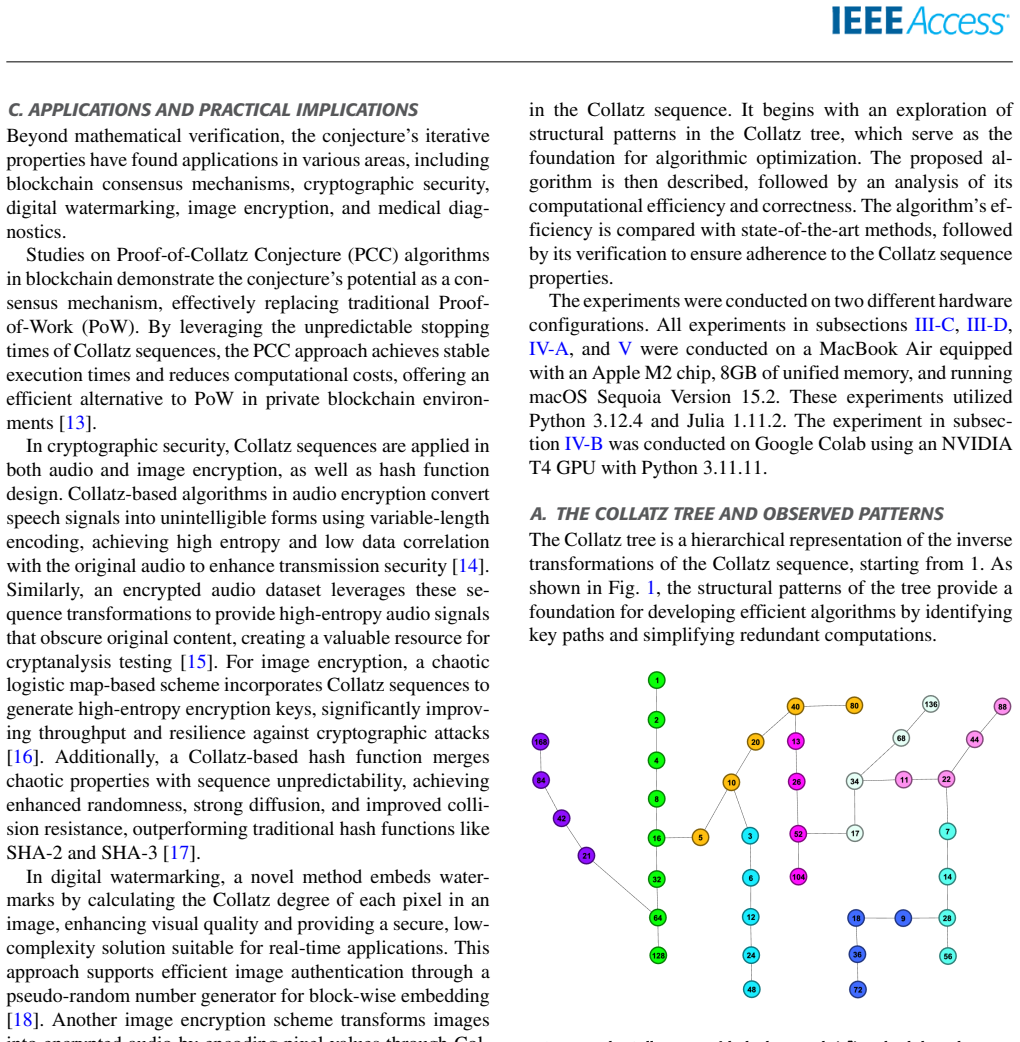
The central object is the Collatz tree, with its base branch of powers of 2 and sub-branches $m\cdot 2^j$ rooted at odd $m$. The load-bearing identity is the bitwise extraction of the exact power of 2 dividing an even number, $n \wedge -n$, which lets the algorithm skip an entire run of halving steps in one iteration. Combined with the rule that an odd number $m$ moves to the parent branch via $3m+1$, the algorithm traverses the tree branch-by-branch, and the iteration total is $2k+1$. The paper fits the observed iteration counts to $f_{\text{avg}}(n)=4.65\log_2 n - 4.91$ and $f_{\text{worst}}(n)=28\log_2 n - 180.17$ to justify the $O(\log n)$ complexity claims.
What would settle it
Compute the number of sub-branches $k$ for all numbers up to, say, $10^9$ and check whether the worst-case $k$ stays within $c\log_2 n + b$ for a constant $c$; a concrete negative signal is already visible in the paper's own Table 2, where for $n=2^{100000}-1$ the reported 96,252 iterations do not match the fitted worst-case formula $f(n)=28\log_2 n - 180.17$, which would predict about 2.8 million iterations, so one can test whether any single logarithmic fit survives across both small and enormous inputs.
Extended reading notes
Core claim
On its own terms, the paper establishes that a Collatz trajectory can be compressed by treating every even number as a member of a branch that starts at an odd root and extends by powers of 2. The algorithm extracts the largest power of 2 dividing the current even number with the bitwise trick $n \wedge -n$, divides it out to reach the odd root, and then applies $3n+1$ to move to the parent branch. Repeating this until the base branch ($2^m$) is reached gives a loop count of exactly $2k+1$ for $k$ sub-branches. The paper verifies the computed stopping times against a brute-force implementation for the first billion numbers, and reports a consistent 28.0% reduction in iterations compared to the bitwise brute-force algorithm of Venkatesulu and Parameswari [3] and the code-word algorithm of Ren et al. [2], including for numbers as large as $2^{100000}-1$.
Load-bearing premise
The entire complexity story depends on the unproved assumption that the number $k$ of sub-branches visited by a Collatz trajectory grows only logarithmically with the starting number; the paper supplies empirical fits on ranges up to a few million and on a handful of huge numbers, but no theorem rules out trajectories with $k$ growing faster.
Editorial extensions
If this is right
- Stopping times for inputs with tens of thousands of bits can be computed in roughly 28% fewer iterations than previous methods, extending practical verification of the Collatz conjecture to larger bounds.
- If the $O(\log n)$ scaling holds generally, then the average and worst-case numbers of odd terms (sub-branches) in a Collatz trajectory up to $n$ must be $O(\log n)$, a structural claim about the tree that could be tested independently.
- Because the algorithm uses only scalar variables and no memoization table, it has $O(1)$ space and is simple to port to GPUs, FPGAs, or distributed workers for batch verification.
- The explicit $2k+1$ formula gives a new combinatorial decomposition of stopping time into branch count plus one, which may help analyze the distribution of stopping times.
Reading between the lines
- The 28% improvement is measured in loop iterations, not necessarily wall-clock seconds; for big integers, the bitwise operations themselves cost $O(\ell)$ per word-length, so the runtime speedup for very large inputs is likely smaller than 28% in languages with arbitrary-precision arithmetic, and the paper's execution-time experiments only compare against the bitwise method.
- The claimed $O(\log n)$ worst-case complexity would imply that the number of odd terms in any Collatz trajectory is bounded by a constant multiple of $\log_2 n$, which is a much stronger statement than existing heuristics about total stopping time and is falsifiable by searching for numbers with unusually high odd-term counts.
- A natural extension is to memoize the odd-root reductions: since many trajectories share the same odd roots, caching the branch count for each odd number above a threshold could yield an additional speedup for batch verification, though it would sacrifice the constant-space property.
- The algorithm's branch-jump reduction is essentially the same as the 'accelerated' Collatz map used by many high-performance verifiers, so the paper's distinctive contribution is the explicit branch-count formula and the demonstration of constant-space operation, not a fundamentally new mathematical reduction.
Editorial analysis
A structured set of objections, weighed in public.
Referee Report
Summary. The paper proposes an algorithm for computing Collatz stopping times that skips chains of even numbers by identifying the largest power of 2 dividing the current number and dividing by it in one step. The authors report a consistent ~28% reduction in the number of loop iterations compared to a bitwise brute-force baseline and claim that the worst-case and average-case time complexities are O(log n). The complexity claims are obtained by fitting linear functions of log2(n) to the algorithm's own measured iteration counts over ranges up to 5.12 million, not by a mathematical proof. The paper also includes a correctness validation on the first 1 billion integers and a scalability demonstration on a small range around 2^100000.
Significance. If the O(log n) worst-case claim were correct, it would imply that every Collatz trajectory contains only O(log n) odd numbers for n as large as 2^100000, a remarkable structural property of an open problem. The algorithmic idea itself is a modest optimization of the well-known accelerated Collatz computation, and a constant-factor reduction in loop count is potentially useful for large-scale verification. However, the central complexity claims are not supported by the evidence presented, and the iteration-count-based comparison does not establish a comparable improvement in actual runtime or operation count. The correctness validation is a genuine strength, but it does not compensate for the unsupported asymptotic claims.
major comments (3)
- [Section III-C, Eqs. (4)-(6)] The worst-case and average-case complexity claims are not derived; they are obtained by fitting linear functions of log2 n through two endpoints in Table 1. Equation (4) defines the total number of iterations as 2k+1, where k is the number of sub-branches (odd roots) on the trajectory. The assertion that k is O(log n) is exactly the statement that a Collatz trajectory contains only O(log n) odd terms, which is a deep open problem and is not proven anywhere in the manuscript. The paper explicitly acknowledges in Section VI that 'the total number of iterations depends on the number of branches, which are determined by the frequency of odd numbers in the sequence,' and the frequency of odd numbers is not bounded by any theorem. Moreover, the data in Table 1 do not even show a stable logarithmic constant: the ratio of worst-case iterations to log2 n grows from 192/13.29 ≈ 14.4 at 10,000 to 444/22.32 ≈ 19.9 at 5,120,000. The fitted curve in Eq. (6) is also inconsistent with the paper's own Table 2: for n = 2^100 - 1, Eq. (6) predicts roughly 28·100 - 180 = 2620 iterations, while Table 2 reports 1056. Thus the 'derivation' is a curve fit, not an asymptotic bound, and the central complexity claim collapses without a proof of k = O(log n).
- [Section IV-A and Eq. (8)] The claimed 28% improvement is based on comparing 'total iterations' across algorithms whose iterations have different operational costs. A single iteration of Algorithm 1 for an even number performs a bitwise AND, a log2 computation, and an integer division, each on an arbitrary-precision integer when n is large (e.g., 2^100000 - 1). A single iteration of the bitwise baseline Algorithm 2 performs one right shift or one multiply-add. Thus the loop-count reduction does not directly imply a 28% reduction in time or in the number of elementary operations. The complexity analysis in Section III-C additionally assumes that log2, bitwise AND, and division are O(1), which is only valid for fixed-precision machine integers, not for the 100,000-bit inputs featured in the experiments. To support the headline improvement, the paper would need to compare execution times or operation counts weighted by bit complexity, not just loop iterations.
- [Section III-C, 'Computational Approach'] The 'computational approach' used to derive the average-case and worst-case complexities is not a derivation but an empirical fit. The manuscript admits that 'the exact sequence lengths and the precise number of odd numbers (or sub-branches) from the tree patterns' could not be derived, and instead a line is fit through two data points. Fitting a logarithmic form to two points in a bounded range (up to 5.12 million) cannot establish an asymptotic worst-case bound. The statement in the conclusion that 'this study establishes that the total number of iterations follows a logarithmic relationship with input size' overstates what has been shown. The empirical trends are interesting, but they must be clearly labeled as observations, not theorem-backed complexity guarantees.
minor comments (3)
- [Throughout] There are several typographical and formatting errors, such as 'V ersion 15.2' in Section III, 'briute-force' in Section IV-B, and inconsistent use of '∧' for bitwise AND in pseudocode without a clarifying note for readers unfamiliar with the notation.
- [Section IV-B] The execution-time comparison in Figures 4-8 would be more convincing if the paper reported the exact mean, standard deviation, and number of repetitions for each experiment; as presented, the figures alone do not quantify the claimed improvement.
- [Section V] The scalability experiment covers only 100,001 numbers in a narrow interval around 2^100000; this is a very small sample and does not support the general claim of scalability to 'extremely large numbers.'
Circularity Check
Worst- and average-case O(log n) are curve fits, not derivations: Equations 5 and 6 fit the algorithm's own measured iteration counts to a pre-assumed log form, making the central complexity claim a fitted input.
-
fitted input called prediction
[Section III-C, Average-Case Time Complexity, Equation 5]
"Assuming the average number of iterations follows the form: f(n)=a·log2(n)+b, we used two data points to calculate a and b. ... Solving this system of linear equations yields: a ≈ 4.65, b ≈ −4.91. ... Equation 5 confirms that the average number of iterations grows logarithmically with the input size. Consequently, the algorithm's average-case complexity is O(log(n))."
The constants a and b are fitted to the algorithm's own measured average iteration counts over a bounded range (Table 1). The 'confirmation' of logarithmic growth is the fitted curve itself, not an independent bound. Since the log form was assumed before fitting, Equation 5 cannot establish O(log n); it only describes the sampled range. A genuine derivation would require proving that k in Equation 4 is O(log n), which the paper explicitly says it could not do.
-
fitted input called prediction
[Section III-C, Worst-Case Time Complexity, Equation 6]
"To derive the worst-case complexity, we fit the observed data into the logarithmic form: f(n)=a·log2(n)+b ... Using the data points ... f(10,000)=192 ... f(5,120,000)=444 ... Solving this system of linear equations yields: a ≈ 28.00, b ≈ −180.17. ... Equation 6 confirms that the worst-case complexity scales logarithmically with the input size. Therefore, the algorithm's worst-case complexity is O(log(n))."
The worst-case iteration count is exactly 2k+1 from Equation 4, measured by the algorithm and then fit to log2(n) using two points. A two-point fit on inputs up to 5.12 million cannot produce an asymptotic worst-case bound; that would require proving k=O(log n) for all n. The paper admits it could not derive exact sequence lengths or sub-branch counts, so this O(log n) claim is the fitted curve renamed as a prediction, not a derived result.
full rationale
The central complexity claim is circular: the paper assumes f(n)=a·log2(n)+b, fits a and b to the algorithm's own measured iteration counts over a bounded range, and then treats Equations 5 and 6 as 'confirming' logarithmic scaling. This is exactly fitting a parameter to data and then calling the fitted curve a prediction. The worst-case claim would require proving k=O(log n) in Equation 4 for all n, which the paper states it could not derive. The correctness check against brute force for 10^9 numbers and the 28% iteration-count comparison are independent, non-circular evidence, so the score reflects partial rather than total circularity.
Assumptions & free parameters
free parameters (4)
- a_avg =
4.65
- b_avg =
-4.91
- a_worst =
28.00
- b_worst =
-180.17
assumptions (3)
- ad hoc to paper The number of sub-branches k in a Collatz trajectory is small enough that 2k+1 grows logarithmically with the input
- ad hoc to paper The fitted logarithmic forms f(n)=a log2 n+b are valid for all n beyond the fitted range
- domain assumption Even numbers dominate odd numbers in every branch and branching occurs only at 6k+10
Cite this review
Pith. "Pith review of Efficient Computation of Collatz Sequence Stopping Times: A Novel Algorithmic Approach." pith.science (2026). https://pith.science/paper/256P7D42
@misc{pith2026250104032,
  author       = {Pith},
  title        = {Pith review of: Efficient Computation of Collatz Sequence Stopping Times: A Novel Algorithmic Approach},
  year         = {2026},
  howpublished = {\url{https://pith.science/paper/256P7D42}},
  note         = {Machine review of arXiv:2501.04032}
}
read the original abstract
The Collatz conjecture, which posits that any positive integer will eventually reach 1 through a specific iterative process, is a classic unsolved problem in mathematics. This research focuses on designing an efficient algorithm to compute the stopping time of numbers in the Collatz sequence, achieving significant computational improvements. By leveraging structural patterns in the Collatz tree, the proposed algorithm minimizes redundant operations and optimizes computational steps. Unlike prior methods, it efficiently handles extremely large numbers without requiring advanced techniques such as memoization or parallelization. Experimental evaluations confirm computational efficiency improvements of approximately 28% over state-of-the-art methods. These findings underscore the algorithm's scalability and robustness, providing a foundation for future large-scale verification of the conjecture and potential applications in computational mathematics.
Figures


Figures from the paper (4 more)


Reference graph
Works this paper leans on
- [1]
-
[2]
W. Ren, S. Li, R. Xiao, and W. Bi, ‘‘Collatz conjecture for 2100000 − 1 is true-algorithms for verifying extremely large numbers,’’ in 2018 IEEE SmartWorld, Ubiquitous Intelligence & Computing, Advanced & Trusted Computing, Scalable Computing & Communications, Cloud & Big Data Computing, Internet of People and Smart City Innovation (Smart- World/SCALCOM/U...
work page 2018
-
[3]
M. V enkatesulu and C. D. Parameswari, ‘‘V erification of collatz conjecture: An algorithmic approach,’’ WSEAS Transactions on Engineering World , vol. 2, pp. 71–75, 2020
work page 2020
-
[4]
G. W. Abascal, ‘‘Bottom-up approach to the collatz conjecture,’’ Authorea Preprints, 2024
work page 2024
-
[5]
An approximation of the Collatz map and a lower bound for the average total stopping time
M. Inselmann, ‘‘An approximation of the collatz map and a lower bound for the average total stopping time,’’ arXiv preprint arXiv:2402.03276, 2024
work page Pith review arXiv 2024
-
[6]
Specifying and Verifying the Convergence Stairs of the Collatz Program
A. Ebnenasir, ‘‘Specifying and verifying the convergence stairs of the collatz program,’’ arXiv preprint arXiv:2403.04777, 2024
work page Pith review arXiv 2024
-
[7]
$3n+3^k$: New Perspective on Collatz Conjecture
N. Boulkaboul, ‘‘ 3n + 3k: New perspective on collatz conjecture,’’ arXiv preprint arXiv:2212.00073, 2022
work page Pith review arXiv 2022
-
[8]
O. K. Clay, ‘‘The long search for collatz counterexamples,’’ Journal of Humanistic Mathematics, vol. 13, no. 2, pp. 199–227, 2023. VOLUME 13,2025 11
work page 2023
Show all 21 references
-
[9]
Nicola, M
F. Nicola, M. Nikola, and R. Stojan, ‘‘Some considerations on the total stopping time for the collatz problem,’’V ojnotehnički glasnik, vol. 72, no. 3, pp. 1019–1028, 2024
2024
-
[10]
Zhou, ‘‘Proof of the collatz conjecture using logical and probabilistic approaches,’’ Available at SSRN 4903082, 2024
X. Zhou, ‘‘Proof of the collatz conjecture using logical and probabilistic approaches,’’ Available at SSRN 4903082, 2024
2024
-
[11]
M. R. Schwob, P . Shiue, and R. V enkat, ‘‘Novel theorems and algorithms relating to the collatz conjecture,’’ International Journal of Mathematics and Mathematical Sciences, vol. 2021, no. 1, p. 5754439, 2021
2021
-
[12]
Ren and R
W. Ren and R. Xiao, ‘‘How to fast verify collatz conjecture by automata,’’ in 2019 IEEE 21st International Conference on High Performance Com- puting and Communications; IEEE 17th International Conference on Smart City; IEEE 5th International Conference on Data Science and Sys...
2019
-
[13]
H. M. A. Aljassas and S. Sasi, ‘‘Performance evaluation of proof-of-work and collatz conjecture consensus algorithms,’’ in 2019 2nd International Conference on Computer Applications & Information Security (ICCAIS) . IEEE, 2019, pp. 1–6
2019
-
[14]
Renza, S
D. Renza, S. Mendoza et al. , ‘‘High-uncertainty audio signal encryption based on the collatz conjecture,’’ Journal of Information Security and Applications, vol. 46, pp. 62–69, 2019
2019
-
[15]
26, 2019
——, ‘‘Encrypted audio dataset based on the collatz conjecture,’’ Data in brief, vol. 26, 2019
2019
-
[16]
Al-Hyari, C
A. Al-Hyari, C. Obimbo, I. Altaharwa et al. , ‘‘Generating powerful en- cryption keys for image cryptography with chaotic maps by incorporating collatz conjecture,’’ IEEE Access, 2024
2024
-
[17]
Rasool and S
M. Rasool and S. B. Belhaouari, ‘‘From collatz conjecture to chaos and hash function,’’ Chaos, Solitons & Fractals, vol. 176, p. 114103, 2023
2023
-
[18]
Tuncer and H
T. Tuncer and H. Y . Kurum, ‘‘A novel collatz conjecture-based digital image watermarking method,’’ Cryptologia, vol. 46, no. 2, pp. 128–147, 2022
2022
-
[19]
D. M. Ballesteros, J. Peña, and D. Renza, ‘‘A novel image encryption scheme based on collatz conjecture,’’Entropy, vol. 20, no. 12, p. 901, 2018
2018
-
[20]
Baygin, O
M. Baygin, O. Y aman, T. Tuncer, S. Dogan, P . D. Barua, and U. R. Acharya, ‘‘Automated accurate schizophrenia detection system using collatz pattern technique with eeg signals,’’ Biomedical Signal Processing and Control , vol. 70, p. 102936, 2021
2021
-
[21]
[Online]
OpenAI, ‘‘Chatgpt: Language model for text generation and assistance,’’ V ersion 4, released in March 2024, 2024. [Online]. Available: https: //openai.com/chatgpt 12 VOLUME 13, 2025
2024
Reviewed August 10, 2026 · model on record in the stance chip above.
Discussion (0). Continue with ORCID to comment.