REVIEW 4 major objections 5 minor 1 cited by
A spline-based neural network claims to rediscover the Gell-Mann-Okubo mass formula from baryon mass data alone.
Reviewed by Pith at T0; open to challenge. T0 means a machine referee read the full paper against a public rubric. the ladder, T0–T4 →
T0 review · deepseek-v4-flash
2026-08-03 12:47 UTC pith:LL6AOIPY
load-bearing objection KAN is a reasonable toy application, but the 'discovery' claims do not survive the paper's own equations. the 4 major comments →
Discovering the Gell-Mann-Okubo Formula with Kolmogorov-Arnold Networks
The pith
A machine-rendered reading of the paper's core claim, the machinery that carries it, and where it could break.
Core claim
The paper's central claim is that a spline-based Kolmogorov-Arnold Network, trained only on the isospin-averaged masses of the baryon octet and decuplet, can recover the classical Gell-Mann-Okubo mass relations without being given any SU(3) group-theoretic prior. For the decuplet, the KAN first learns the linear constraint Y=2I-2 and then, after symbolic regression and algebraic simplification, produces an equal-spacing law M=1382.16-146.71Y and a GMO-type quadratic formula. For the octet, it learns the relation Y^2=1-4(0.5-I)^2 and then yields M8=-188.26Y8+39.14I8(I8+1)-17.03Y8^2+1115.50. The paper presents these expressions as evidence that a data-driven, interpretable network can bridge m
What carries the argument
The load-bearing object is the Kolmogorov-Arnold Network (KAN), a neural network whose fixed weights are replaced by learnable univariate spline functions, used here as a symbolic-regression engine. The argument works by training a small KAN on augmented mass samples, pruning inactive branches, applying symbolic regression to the surviving functions, and then algebraically reshaping the raw expressions into the canonical Gell-Mann-Okubo form f(Y,I)=aY+b[I(I+1)-Y^2/4]+c. The multiplet identities Y=2I-2 and Y^2=1-4(0.5-I)^2 are used in this reshaping; the reshaping step, including the paper's explicit 'adjust the coefficients' operation, is where the claimed recovery is secured.
Load-bearing premise
The claim assumes that manually adjusting the fitted coefficients to resemble the Gell-Mann-Okubo form is a legitimate derivation step; if that adjustment is arbitrary, then the network did not autonomously discover the formula.
What would settle it
Rerun the identical pipeline on the same quantum numbers with the masses shuffled randomly among the multiplet states; if the same hand-adjustment step turns the resulting symbolic expression into a GMO-form equation regardless of the data, then the apparent discovery is an artifact of the algebraic reshaping rather than of the measured masses.
If this is right
- If KAN can rediscover the GMO formula from masses alone, a general-purpose symbolic-regression network can independently recover known SU(3) breaking structure from minimal data.
- The decuplet expression implies the equal-spacing rule: the masses of Delta, Sigma*, Xi*, and Omega differ by roughly 140-150 MeV per unit of strangeness.
- The octet expression is a compact two-variable mass formula that covers N, Lambda, Sigma, and Xi baryons and can be compared directly with theoretical predictions.
- Because the discovered expressions are symbolic rather than numeric, the workflow can in principle be applied to other hadron multiplets where no complete analytic formula is yet known.
Where Pith is reading between the lines
- A stricter test than the one reported would be to withhold the GMO form and the quantum-number identities from the symbolic regression and see whether KAN proposes the form itself; the paper's physics filter does part of this work.
- Because the input masses are already isospin-averaged and augmented within experimental uncertainties, the method may be learning the averaging procedure as much as the underlying symmetry; applying it to raw event-level data would separate those effects.
- If the approach transfers to multiplets where no formula is known, such as charmed baryons or tetraquark candidates, it could serve as a discovery tool rather than a verification tool.
- The two recovered quantum-number relations are group-theoretically fixed for these representations, so their rediscovery is a consistency check rather than evidence of new physics; the paper's value rests on the mass formulas themselves.
Editorial analysis
A structured set of objections, weighed in public.
Referee Report
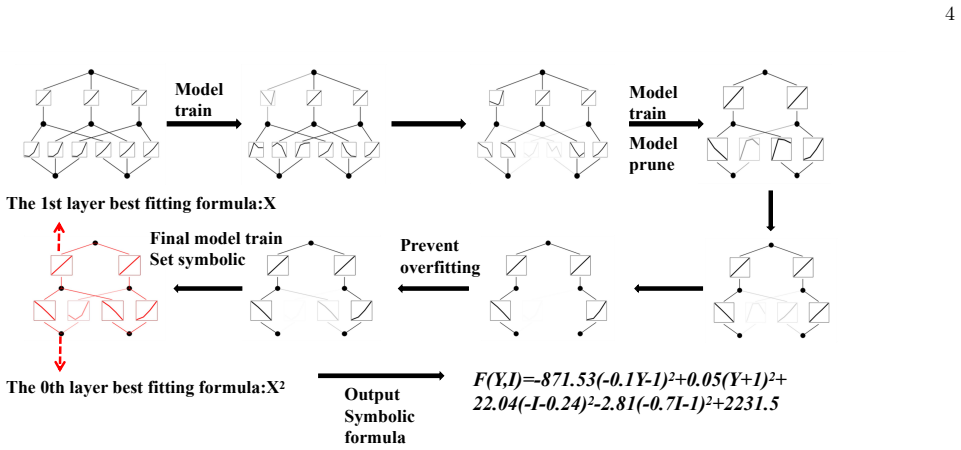
Summary. The manuscript applies a Kolmogorov-Arnold network with symbolic regression to the four baryon octet masses and four decuplet masses taken from PDG. It claims that, without imposing theoretical priors, the KAN autonomously recovers the Gell-Mann-Okubo (GMO) mass formula for both multiplets, extracts the associated SU(3) symmetry-breaking parameters, and reproduces the decuplet equal-spacing rule. The pipeline consists of data augmentation by resampling masses within quoted uncertainties while fixing I and Y, a 'Physics Filter' that restricts symbolic forms, and a series of algebraic rearrangements that convert raw KAN outputs into the final formulas Eqs. (9), (11), (12), and (17).
Significance. If the claims were substantiated, this would be a useful, interpretable-machine-learning demonstration in hadron spectroscopy. The linear equal-spacing fit in Eq. (11) is good (R^2 ≈ 0.9995), and the KAN framework is a plausible tool for fitting small data sets. However, the central 'autonomous discovery' claim is not supported by the manuscript. The octet result Eq. (17) is a generic four-parameter quadratic that does not have GMO structure, the decuplet result is obtained by manually altering coefficients after symbolic regression, and the analysis imposes an explicit target form via the Physics Filter. No code, data, or machine-checked derivations are provided. The paper therefore demonstrates polynomial interpolation followed by hand rearrangement, not the discovery of a physical law.
major comments (4)
- [§5 (Eqs. (6)–(9))] The decuplet derivation is not algebraically valid. Eq. (6) contains the I-dependent term -14.01I; rewriting the I^2 terms as I(I+1) gives 20.66 I(I+1) - 14.01I, but Eq. (7) drops the -14.01I term and shifts the constant by 14.01, which is only correct if I=1. Then Eq. (8) says 'adjust the coefficients' and replaces the fitted coefficients by entirely different numbers; Eq. (9) changes them again. These later coefficients are not derived from the KAN output or from data, but are chosen so that the final quadratic passes through the four decuplet masses. Any quadratic can do that. The explicit admission that coefficients are adjusted by hand directly contradicts the abstract's claim of autonomous recovery.
- [§6 (Eq. (17))] The octet result is a generic quadratic with four independent coefficients, not the GMO form. Eq. (17) reads M8 = -188.26Y8 + 39.14 I8(I8+1) - 17.03Y8^2 + 1115.50. The target form Eq. (1) requires the coefficient of I(I+1) to be -4 times the coefficient of Y^2. Here 39.14/(-17.03) ≈ -2.30, not -4. Thus the KAN output does not satisfy the GMO coefficient relation; it has been relabeled as GMO without imposing the required algebraic constraint. The preceding relation Eq. (12), Y8^2 = 1 - 4(0.5 - I8)^2, is an exact identity for the four octet points (Y^2 = 4I - 4I^2), so it is not an empirical discovery.
- [§2 (Model Selection / Physics Filter)] The claim of recovering GMO 'without imposing theoretical priors' is contradicted by the manuscript's own methodology. In the Model Selection subsection, symbolic regression is 'Constrained by the Physics Filter' and yields Eq. (1), which is exactly the GMO functional form with free parameters a, b, c. Similarly, the decuplet analysis inserts the relation Y10 = 2I10 - 2 from Eq. (3) as a constraint before deriving Eq. (9). The final formulas are therefore consequences of imposed priors and manually adjusted coefficients, not evidence that KAN autonomously discovered SU(3) symmetry breaking.
- [§2 (Data augmentation)] The data-augmentation procedure resamples the four masses in each multiplet within their experimental uncertainties while holding Y and I fixed. Because the uncertainties are small and the underlying function is smooth, these 1000 samples add no independent physical information; they are effectively noisy copies of the same four points. As a result, the four-parameter quadratics in Eqs. (9) and (17) are not tested against independent data, and the high R^2 values reflect interpolation rather than discovery. This weakens the statistical claims and the generalization statements in §3.
minor comments (5)
- [General] There are numerous typographical errors, e.g., 'efficiency', 'difficult', 'reaffirms', and 'the the relationship'. The English should be carefully edited.
- [Figures 2–5] The symbolic expressions printed in the figure boxes are inconsistent with the equations in the text (e.g., Fig. 2 shows F(Y,I) = -871.53(...)^2 + ..., while Eq. (4) gives a different expression). This makes it difficult to verify the training and symbolic-regression pipeline.
- [Eq. (15)] The text says 'temporarily substitute Y8^2 for 0.25Y8^2'; the intended identity is 0.25Y8^2 = I8 - I8^2 (since Y8^2 = 4I8 - 4I8^2). This should be stated correctly and the substitution should be made on I8^2, not on Y8^2.
- [Table I / References] The PDG reference [50] is from 2010; current 2024/2025 PDG values would be more appropriate for a modern analysis. The mass uncertainties for Σ are quoted as ±4 MeV, which is much larger than the current PDG value; this should be checked.
- [Reproducibility] The paper does not provide the trained KAN architectures, hyperparameters, data-augmentation realizations, or code. For a symbolic-regression claim, the exact fitting pipeline and random seeds should be documented.
Circularity Check
The claimed 'autonomous recovery' of the GMO formulas is imposed by the target form and hand-adjusted coefficients, so the output reduces to the input by construction.
specific steps
-
fitted input called prediction
[Section 2 (Model Selection), Eq. (1)]
"Constrained by the Physics Filter, the regression avoided overly complex functional forms, yielding a physically interpretable expression: f (Y, I ) = a Y + b [ I(I + 1) − 1 4 Y 2 ] + c. (1)"
The target expression is exactly the Gell-Mann–Okubo form. The regression is constrained to this family before seeing the data, so 'recovering' Eq. (1) is just fitting the parameters a, b, c. The abstract's claim of 'without imposing theoretical priors' is contradicted by this explicit Physics Filter; the discovery is built into the chosen functional form.
-
self definitional
[Section 5, Eqs. (6)–(9)]
"To achieve a more compact expression, adjust the coefficients of terms involving Y10 and I10(I10 + 1): F (Y10, I10) = − 90.5Y 2 10 − 672.27Y10 + 689.73 + 348.03I10(I10 + 1). = − 253.5Y 2 10 − 1650.27Y10 − 614.27 + 1000.03I10(I10 + 1). To obtain a form similar to Eq. ( 1), and taking into account the constraint Y10 = 2 I10 − 2, we can simplify the above expression to the following form: M10 = − 5550.27Y10 − 903.5Y 2 10 + 3600.03I10(I10 + 1) − 5814.27."
The transition from Eq. (6) to Eq. (7) drops the −14.01I term and changes constants; the text then explicitly says 'adjust the coefficients', replacing every fitted coefficient with arbitrary numbers. The final Eq. (9) is not algebraically derived from the KAN expression; it is hand-chosen to resemble Eq. (1). Any quadratic through four points can be reparameterized this way, so the reported 'recovered' decuplet GMO formula is a manual fit, not an autonomous KAN discovery.
-
renaming known result
[Section 6, Eq. (17)]
"Finally, replace F (Y8, I8) with M8 to obtain the final form: M8 = − 188.26Y8 + 39.14I8(I8 + 1) − 17.03Y 2 8 + 1115.50. (17)"
If this were the GMO form of Eq. (1), the coefficient of I(I+1) would have to be −4 times the coefficient of Y^2. Here 39.14 / (−17.03) ≈ −2.30, not −4. The expression is therefore a generic quadratic, not the Gell-Mann–Okubo formula. The paper labels it as the octet GMO formula solely because the known octet identity 0.25Y^2 = I − I^2 was used during manipulation; that identity is a definitional relation among quantum numbers, not a mass formula derived from data. The final formula is a renamed fit, so the claimed recovery is by construction.
full rationale
The paper's central claim is that KAN autonomously rediscovers the Gell-Mann–Okubo mass formulas from baryon masses 'without imposing theoretical priors'. The paper's own equations show the opposite. First, the regression is explicitly constrained by a 'Physics Filter' to the GMO functional form of Eq. (1), making the target the input. Second, for the decuplet, the raw KAN expression is carried through an algebraically invalid reduction that drops a term, and then the text openly states 'adjust the coefficients', replacing the data-derived numbers with arbitrary ones chosen to resemble Eq. (1); the final M10 is therefore a hand-imposed fit, not a KAN output. Third, for the octet, the final expression Eq. (17) does not satisfy the coefficient relation required by the GMO form (the I(I+1) and Y^2 coefficients should be in the ratio −4, but are ≈ −2.30), so the formula is a generic quadratic relabeled as GMO. In both multiplets, the 'recovered' formulas are either the pre-selected target form or a manually reparameterized fit of the same four training masses. This is not a case of self-citation circularity; it is a direct fitted-input-called-prediction structure: the output is equivalent, by construction, to the target form and hand-adjusted parameters. Consequently, the autonomous-discovery claim is unsupported by the derivation chain.
Axiom & Free-Parameter Ledger
free parameters (5)
- a, b, c in target GMO form Eq. (1) =
not stated (fitted)
- Octet GMO coefficients (Eq. 17) =
-188.26, 39.14, -17.03, 1115.50
- Decuplet GMO coefficients (Eq. 9) =
-5550.27, -903.5, 3600.03, -5814.27
- Equal-spacing fit M0, a (Eq. 11) =
1382.16, -146.71
- Data augmentation perturbation scale =
experimental uncertainties from PDG
axioms (6)
- standard math Kolmogorov-Arnold representation theorem supports KAN symbolic regression.
- domain assumption PDG isospin-averaged masses and quantum numbers (I, Y) for the octet and decuplet are correct.
- ad hoc to paper A Physics Filter and target form Eq. (1) are consistent with 'no theoretical priors'.
- domain assumption Mass perturbations within experimental uncertainties preserve SU(3) symmetry structure.
- ad hoc to paper Algebraic coefficient adjustment in Eqs. (8)-(9) is a valid simplification.
- domain assumption The decuplet relation Y = 2I - 2 can be imposed as an input constraint.
read the original abstract
Uncovering physical laws from experimental data is a fundamental goal of theoretical physics. In this work, we apply the spline-based, interpretable Kolmogorov-Arnold Network (KAN) to explore the algebraic structure underlying the baryon octet and decuplet mass spectra. Within a symbolic regression framework and without imposing theoretical priors, KAN autonomously recovers the classical Gell-Mann-Okubo mass relations and accurately extracts the associated SU(3) symmetry-breaking parameters. Compared to conventional fitting approaches, this method achieves comparable predictive accuracy while offering substantially improved interpretability and analytic transparency. Our results demonstrate the potential of KAN as a powerful tool for symbolic discovery in hadron physics and for bridging data-driven modeling with fundamental physical laws.
Figures



Forward citations
Cited by 1 Pith paper
-
$\lambda$, $\rho$, and $\sigma$ Regge trajectories for the hexaquark ${(\bar{u}(cc))(b(\bar{b}\bar{b}))}$ in the triquark-antitriquark picture
Derives λ, ρ1, ρ2, σ1, and σ2 Regge trajectories for the hexaquark (ū(cc))(b(b̄b̄)) in the triquark-antitriquark picture, showing substructure is required for most series and giving rough mass estimates for excited states.
Reference graph
Works this paper leans on
-
[1]
D. J. Gross and F. Wilczek, Ultraviolet behavior of non- abelian gauge theories, Physical Review Letters 30, 1343 (1973)
1973
-
[2]
H. D. Politzer, Reliable perturbative results for strong interactions?, Physical Review Letters 30, 1346 (1973)
1973
-
[3]
C. G. Callan Jr, Broken scale invariance in scalar field theory, Physical Review D 2, 1541 (1970)
1970
-
[4]
Symanzik, Small distance behaviour in field theory and power counting, Communications in Mathematical Physics 18, 227 (1970)
K. Symanzik, Small distance behaviour in field theory and power counting, Communications in Mathematical Physics 18, 227 (1970)
1970
-
[5]
Vanyashin and M
V. Vanyashin and M. Terent’ev, The vacuum polarization of a charged vector field, Sov. Phys. JETP 21, 375 (1965)
1965
-
[6]
Khriplovich, GREEN’S FUNCTIONS IN THEORIES WITH NON-ABELIAN GAUGE GROUP
I. Khriplovich, GREEN’S FUNCTIONS IN THEORIES WITH NON-ABELIAN GAUGE GROUP. , Tech. Rep. (Inst. of Nuclear Physics, Novosibirsk, USSR, 1969)
1969
-
[7]
Fritzsch, M
H. Fritzsch, M. Gell-Mann, and H. Leutwyler, Advan- tages of the color octet gluon picture, Physics Letters B 47, 365 (1973)
1973
-
[8]
D. J. Gross and F. Wilczek, Asymptotically free gauge theories. i, Physical Review D 8, 3633 (1973)
1973
-
[9]
H. D. Politzer, Asymptotic freedom: An approach to strong interactions, Physics Reports 14, 129 (1974)
1974
-
[10]
Gell-Mann, The eightfold way: A theory of strong interaction symmetry, in The Eightfold Way (CRC Press,
M. Gell-Mann, The eightfold way: A theory of strong interaction symmetry, in The Eightfold Way (CRC Press,
-
[11]
Okubo, Note on unitary symmetry in strong interac- tions, Progress of Theoretical Physics 27, 949 (1962)
S. Okubo, Note on unitary symmetry in strong interac- tions, Progress of Theoretical Physics 27, 949 (1962)
1962
-
[12]
Gell-Mann, Symmetries of baryons and mesons, in The eightfold way (CRC Press, 2018) pp
M. Gell-Mann, Symmetries of baryons and mesons, in The eightfold way (CRC Press, 2018) pp. 216–233
2018
-
[13]
H.-X. Chen, W. Chen, X. Liu, and S.-L. Zhu, The hidden- charm pentaquark and tetraquark states, Physics Re- ports 639, 1 (2016)
2016
-
[14]
Liu, H.-X
Y.-R. Liu, H.-X. Chen, W. Chen, X. Liu, and S.-L. Zhu, Pentaquark and tetraquark states, Progress in Particle and Nuclear Physics 107, 237 (2019)
2019
-
[15]
H.-X. Chen, W. Chen, X. Liu, Y.-R. Liu, and S.-L. Zhu, A review of the open charm and open bottom systems, Reports on Progress in Physics 80, 076201 (2017)
2017
-
[16]
Y. Dong, A. Faessler, and V. E. Lyubovitskij, Descrip- tion of heavy exotic resonances as molecular states using phenomenological lagrangians, Progress in Particle and Nuclear Physics 94, 282 (2017)
2017
-
[17]
R. F. Lebed, R. E. Mitchell, and E. S. Swanson, Heavy- quark qcd exotica, Progress in Particle and Nuclear Physics 93, 143 (2017)
2017
-
[18]
F.-K. Guo, C. Hanhart, U.-G. Meißner, Q. Wang, Q. Zhao, and B.-S. Zou, Hadronic molecules, Reviews of Modern Physics 90, 015004 (2018)
2018
-
[19]
R. M. Albuquerque, J. M. Dias, K. Khemchandani, A. M. Torres, F. S. Navarra, M. Nielsen, and C. M. Zanetti, Qcd sum rules approach to the x, y and z states, Journal of Physics G: Nuclear and Particle Physics 46, 093002 (2019)
2019
-
[20]
Yamaguchi, A
Y. Yamaguchi, A. Hosaka, S. Takeuchi, and M. Tak- izawa, Heavy hadronic molecules with pion exchange and quark core couplings: a guide for practitioners, Journal of Physics G: Nuclear and Particle Physics 47, 053001 (2020)
2020
-
[21]
Guo, X.-H
F.-K. Guo, X.-H. Liu, and S. Sakai, Threshold cusps and triangle singularities in hadronic reactions, Progress in Particle and Nuclear Physics 112, 103757 (2020)
2020
-
[22]
Brambilla, S
N. Brambilla, S. Eidelman, C. Hanhart, A. Nefediev, C.- P. Shen, C. E. Thomas, A. Vairo, and C.-Z. Yuan, The xyz states: experimental and theoretical status and per- spectives, Physics reports 873, 1 (2020)
2020
-
[23]
S. J. Wetzel, R. G. Melko, J. Scott, M. Panju, and V. Ganesh, Discovering symmetry invariants and con- served quantities by interpreting siamese neural net- works, Physical Review Research 2, 033499 (2020)
2020
-
[24]
Y. D. Hezaveh, L. P. Levasseur, and P. J. Marshall, Fast automated analysis of strong gravitational lenses with convolutional neural networks, Nature 548, 555 (2017)
2017
-
[25]
S. Soma, L. Wang, S. Shi, H. Stöcker, and K. Zhou, Re- constructing the neutron star equation of state from ob- servational data via automatic differentiation, Physical Review D 107, 083028 (2023)
2023
-
[26]
L.-G. Pang, K. Zhou, N. Su, H. Petersen, H. Stöcker, and X.-N. Wang, An equation-of-state-meter of quantum chromodynamics transition from deep learning, Nature communications 9, 210 (2018)
2018
-
[27]
Chen and M
X. Chen and M. Huang, Machine learning holographic black hole from lattice qcd equation of state, Physical Review D 109, L051902 (2024)
2024
-
[28]
Radovic, M
A. Radovic, M. Williams, D. Rousseau, M. Kagan, D. Bonacorsi, A. Himmel, A. Aurisano, K. Terao, and T. Wongjirad, Machine learning at the energy and inten- sity frontiers of particle physics, Nature 560, 41 (2018)
2018
-
[29]
Guest, K
D. Guest, K. Cranmer, and D. Whiteson, Deep learn- ing and its application to lhc physics, Annual Review of Nuclear and Particle Science 68, 161 (2018)
2018
-
[30]
Albertsson, P
K. Albertsson, P. Altoe, D. Anderson, M. Andrews, J. P. Araque Espinosa, A. Aurisano, L. Basara, A. Bevan, W. Bhimji, D. Bonacorsi, et al. , Machine learning in high energy physics community white paper, in Journal of Physics: Conference Series , Vol. 1085 (IOP Publish- ing, 2018) p. 022008
2018
-
[31]
J. Kim, G. Pederiva, and A. Shindler, Machine learn- ing mapping of lattice correlated data, Physics Letters B 856, 138894 (2024). 9
2024
-
[32]
K. Zhou, L. Wang, L.-G. Pang, and S. Shi, Exploring qcd matter in extreme conditions with machine learning, Progress in Particle and Nuclear Physics 135, 104084 (2024)
2024
-
[33]
Aarts, K
G. Aarts, K. Fukushima, T. Hatsuda, A. Ipp, S. Shi, L. Wang, and K. Zhou, Physics-driven learning for in- verse problems in quantum chromodynamics, Nature Re- views Physics 7, 154 (2025)
2025
-
[34]
Jiang, L
L. Jiang, L. Wang, and K. Zhou, Deep learning stochastic processes with qcd phase transition, Physical Review D 103, 116023 (2021)
2021
-
[35]
Chen and M
X. Chen and M. Huang, Flavor dependent critical end- point from holographic qcd through machine learning, Journal of High Energy Physics 2025, 1 (2025)
2025
-
[36]
M. Mansouri, K. B. Fadafan, and X. Chen, Holographic complex potential of a quarkonium from deep learning, arXiv preprint arXiv:2406.06285 (2024)
Pith/arXiv arXiv 2024
-
[37]
W.-C. Dai, O.-Y. Luo, B. Chen, X. Chen, X.-Y. Zhu, and X.-H. Li, Extracting transport properties of quark- gluon plasma from the heavy-quark potential with neu- ral networks in a holographic model, arXiv preprint arXiv:2503.10213 (2025)
Pith/arXiv arXiv 2025
-
[38]
Raissi, P
M. Raissi, P. Perdikaris, and G. E. Karniadakis, Physics- informed neural networks: A deep learning framework for solving forward and inverse problems involving nonlinear partial differential equations, Journal of Computational physics 378, 686 (2019)
2019
-
[39]
P.-H. Chiu, J. C. Wong, C. Ooi, M. H. Dao, and Y.- S. Ong, Can-pinn: A fast physics-informed neural net- work based on coupled-automatic–numerical differentia- tion method, Computer Methods in Applied Mechanics and Engineering 395, 114909 (2022)
2022
-
[40]
Z. Liu, Y. Wang, S. Vaidya, F. Ruehle, J. Halver- son, M. Soljačić, T. Y. Hou, and M. Tegmark, Kan: Kolmogorov-arnold networks, arXiv preprint arXiv:2404.19756 (2024)
Pith/arXiv arXiv 2024
-
[41]
Z. Liu, P. Ma, Y. Wang, W. Matusik, and M. Tegmark, Kan 2.0: Kolmogorov-arnold networks meet science, arXiv preprint arXiv:2408.10205 (2024)
Pith/arXiv arXiv 2024
-
[42]
Liu and M
Z. Liu and M. Tegmark, Machine learning conserva- tion laws from trajectories, Physical Review Letters 126, 180604 (2021)
2021
-
[43]
Udrescu and M
S.-M. Udrescu and M. Tegmark, Ai feynman: A physics- inspired method for symbolic regression, Science ad- vances 6, eaay2631 (2020)
2020
-
[44]
Schmidt and H
M. Schmidt and H. Lipson, Distilling free-form natural laws from experimental data, science 324, 81 (2009)
2009
-
[45]
Zhang, R
Z. Zhang, R. Ma, J. Hu, and Q. Wang, Approach the gell-mann-okubo formula with machine learning, Chinese Physics Letters 39, 111201 (2022)
2022
-
[46]
O.-Y. Luo, X. Chen, F.-P. Li, X.-H. Li, and K. Zhou, Neural network modeling of heavy-quark potential from holography, The European Physical Journal C 85, 637 (2025)
2025
-
[47]
N. R. Panczyk, O. F. Erdem, and M. I. Radaideh, Open- ing the black-box: Symbolic regression with kolmogorov- arnold networks for energy applications, arXiv preprint arXiv:2504.03913 (2025)
Pith/arXiv arXiv 2025
-
[48]
C. Guo, L. Sun, S. Li, Z. Yuan, and C. Wang, Physics- informed kolmogorov–arnold network with chebyshev polynomials for fluid mechanics, Physics of Fluids 37 (2025)
2025
-
[49]
H. Hao, X. Zhang, B. Li, and A. Zhou, A first look at kolmogorov-arnold networks in surrogate-assisted evo- lutionary algorithms, arXiv preprint arXiv:2405.16494 (2024)
Pith/arXiv arXiv 2024
-
[50]
Nakamura, Review of particle physics, Journal of Physics G: Nuclear and Particle Physics 37 (2010)
K. Nakamura, Review of particle physics, Journal of Physics G: Nuclear and Particle Physics 37 (2010)
2010
-
[51]
Hastie, R
T. Hastie, R. Tibshirani, J. Friedman, et al. , The ele- ments of statistical learning (2009)
2009
-
[52]
C. M. Bishop, Pattern recognition and machine learning by Christopher M. Bishop , Vol. 400 (Springer Science+ Business Media, LLC Berlin, Germany:, 2006)
2006
-
[53]
Goodfellow, Y
I. Goodfellow, Y. Bengio, A. Courville, and Y. Bengio, Deep learning, Vol. 1 (MIT press Cambridge, 2016)
2016
-
[54]
Geman, E
S. Geman, E. Bienenstock, and R. Doursat, Neural net- works and the bias/variance dilemma, Neural computa- tion 4, 1 (1992)
1992
-
[55]
K. P. Murphy, Machine learning: a probabilistic perspec- tive (MIT press, 2012)
2012
-
[56]
Hastie, R
T. Hastie, R. Tibshirani, and J. Friedman, An introduc- tion to statistical learning, (2009)
2009
-
[57]
Liu, W.-J
Y.-F. Liu, W.-J. Xing, X.-Y. Wu, G.-Y. Qin, S. Cao, and H. Xing, Heavy and light flavor jet quenching in different collision systems at energies available at the cern large hadron collider, Physical Review C 105, 044904 (2022)
2022
-
[58]
S. Katel, H. Li, Z. Zhao, R. Kansal, F. Mokhtar, and J. Duarte, Learning symmetry-independent jet represen- tations via jet-based joint embedding predictive architec- ture, arXiv preprint arXiv:2412.05333 (2024)
Pith/arXiv arXiv 2024
-
[59]
Garcilazo and A
H. Garcilazo and A. Valcarce, Exotic heavy hadrons, Symmetry 17, 1324 (2025)
2025
-
[60]
Hyodo, Study of hadron interactions and composite- ness, arXiv preprint arXiv:2503.15376 (2025)
T. Hyodo, Study of hadron interactions and composite- ness, arXiv preprint arXiv:2503.15376 (2025)
Pith/arXiv arXiv 2025
-
[61]
G. Yang, J. Ping, and J. Segovia, Tetra-and penta-quark structures in the constituent quark model, Symmetry 12, 1869 (2020)
2020
-
[62]
W.-T. Lyu, L.-J. Liu, and E. Wang, Evidence of the open- flavor tetraquark tc¯s2 in the process b+ → d∗−d+ s π+, arXiv preprint arXiv:2501.02839 (2025)
Pith/arXiv arXiv 2025
-
[63]
P. D. Collins and E. J. Squires, Regge poles in particle physics, Vol. 45 (Springer, 2006)
2006
-
[64]
K. G. Wilson, Confinement of quarks, Physical review D 10, 2445 (1974)
1974
-
[65]
S. Durr, Z. Fodor, J. Frison, C. Hoelbling, R. Hoffmann, S. D. Katz, S. Krieg, T. Kurth, L. Lellouch, T. Lippert, et al. , Ab initio determination of light hadron masses, Science 322, 1224 (2008)
2008
-
[66]
Y. Aoki, T. Blum, G. Colangelo, S. Collins, M. D. Morte, P. Dimopoulos, S. Dürr, X. Feng, H. Fukaya, M. Golter- man, et al. , Flag review 2021, The European Physical Journal C 82, 869 (2022)
2021
-
[67]
Bazavov, T
A. Bazavov, T. Bhattacharya, C. DeTar, H.-T. Ding, S. Gottlieb, R. Gupta, P. Hegde, U. Heller, F. Karsch, E. Laermann, et al. , Equation of state in (2+ 1)-flavor qcd, Physical Review D 90, 094503 (2014)
2014
-
[68]
S. He, L. Li, Z. Li, and S.-J. Wang, Gravitational waves and primordial black hole productions from gluodynam- ics by holography, Science China Physics, Mechanics & Astronomy 67, 240411 (2024)
2024
-
[69]
Zhang and M
L. Zhang and M. Huang, Holographic cold dense matter constrained by neutron stars, Physical Review D 106, 096028 (2022)
2022
-
[70]
Y. Chen, D. Li, and M. Huang, The dynamical holo- graphic qcd method for hadron physics and qcd mat- ter, Communications in Theoretical Physics 74, 097201 (2022). 10
2022
-
[71]
R. Li, S. Han, Z. Lin, L. Wang, K. Zhou, and S. Shi, Towards constraining qcd phase transitions in neutron star interiors: Bayesian inference with tov linear response analysis, arXiv preprint arXiv:2501.15810 (2025)
Pith/arXiv arXiv 2025
-
[72]
K. Zhou, G. Endrődi, L.-G. Pang, and H. Stöcker, Re- gressive and generative neural networks for scalar field theory, Physical Review D 100, 011501 (2019)
2019
-
[73]
X. Chen, D. Li, and M. Huang, Criticality of qcd in a holographic qcd model with critical end point, Chinese Physics C 43, 023105 (2019)
2019
-
[74]
X. Chen, L. Zhang, D. Li, D. Hou, and M. Huang, Gluo- dynamics and deconfinement phase transition under ro- tation from holography, Journal of High Energy Physics 2021, 1 (2021)
2021
-
[75]
X. Chen, D. Li, D. Hou, and M. Huang, Quarkyonic phase from quenched dynamical holographic qcd model, Journal of High Energy Physics 2020, 1 (2020)
2020
-
[76]
L. Zhu, X. Chen, K. Zhou, H. Zhang, and M. Huang, Bayesian inference of the critical end point in a (2+ 1)- flavor system from holographic qcd, Physical Review D 112, 026019 (2025)
2025
-
[77]
W.-J. Xing, S. Cao, G.-Y. Qin, and X.-N. Wang, Flavor hierarchy of jet energy correlators inside the quark-gluon plasma, Physical Review Letters 134, 052301 (2025)
2025
-
[78]
Cao and X.-N
S. Cao and X.-N. Wang, Jet quenching and medium re- sponse in high-energy heavy-ion collisions: a review, Re- ports on Progress in Physics 84, 024301 (2021)
2021
-
[79]
Zhang, Z
W.-J. Zhang, Z. Zhang, J. Hu, B.-N. Lu, J.-Y. Pang, and Q. Wang, Machine learning unveils the power law of finite-volume energy shifts, Chinese Physics Letters (2025)
2025
-
[80]
H.-A. Zeng, L. Wang, and M. Huang, HoloNet: Toward a Unified Einstein-Maxwell-Dilaton Framework of QCD, (2025), arXiv:2512.06044 [hep-lat]
Pith/arXiv arXiv 2025
discussion (0)
Sign in with ORCID, Apple, or X to comment. Anyone can read and Pith papers without signing in.