REVIEW 3 major objections 4 minor 61 references
Electric Penrose process in the spacetime of a quantum-corrected Reissner-Nordstr\"om black hole
T0 review · 3 major / 4 minor · reviewed 2026-08-03 · deepseek-v4-flash
Pith's one-line read This paper proves that in a covariant quantum-corrected Reissner-Nordström black hole, the electric Penrose process can still extract energy, but the quantum parameter ζ shrinks the ergoregion, lowers efficiency, and under critical conditio
desk verdict The ζ-suppression of the electric Penrose process is solid and worth publishing, but the claimed rigorous escape proof is only a local velocity condition and silently assumes q1>0. read the letter →
The pith
A machine-rendered reading of the paper's core claim, the machinery that carries it, and where it could break.
The reading
What carries the argument
The central object is the effective potential for radial motion of a charged particle on the equatorial plane, V± = qQ/r ± sqrt(f(r)(1+L²/r²)), together with the sign analysis of its derivative at the turning point. The proof that particle 3 escapes relies on comparing the derivative terms T1 and T2 for particles 1 and 3, using the inequality chain in Appendix A that reduces to the algebraic condition L1²(M1²−1)/(r_t²+L1²) < M1K−1, all under the metric conditions f(r)>0 and f'(r)>0 outside the horizon. The quantum-corrected metric is f(r) = (1 − 2M/r + Q²/r²)(1 + ζ²/r²(1 − 2M/r + Q²/r²)), and the generalized ergoregion boundary is set by V+=0, which depends on q, L, and ζ.
What would settle it
A numerical integration of the radial equation (2.13) for the L2=0 case with q1<0, using the same parameters as Table I, could settle whether the escape theorem holds for the opposite charge sign; if a returning trajectory appears, the proof's sign assumption is essential. Even more directly, finding any spherically symmetric metric with f(r)>0 and f'(r)>0 outside the horizon for which the L2=0 electric Penrose process produces a particle 3 that reaches a turning point and falls back would violate the claimed universal escape.
Extended reading notes
Core claim
Under the simplified electric Penrose process with the splitting point coinciding with the turning point and zero angular momentum for the infalling fragment (L2=0), the energy-gaining fragment particle 3 always escapes to a distant observer with net energy gain, as long as the charge of the infalling particle is positive (q1>0, so q3>M1q1>0). The proof uses only f(r)>0 and f'(r)>0 outside the event horizon, making the escape theorem applicable to a wide range of charged black hole models. In the special process where the initial particle is bound inside the effective-potential peak, the fragment can either escape or fall in depending on the distance of the turning point; under critical cond
Load-bearing premise
The escape theorem assumes the infalling particle has positive charge (so the inequality q3 > M1q1 > 0 holds), and it verifies only that the fragment's effective potential is decreasing at the turning point, not that it stays below the fragment's energy at every larger radius.
Editorial extensions
If this is right
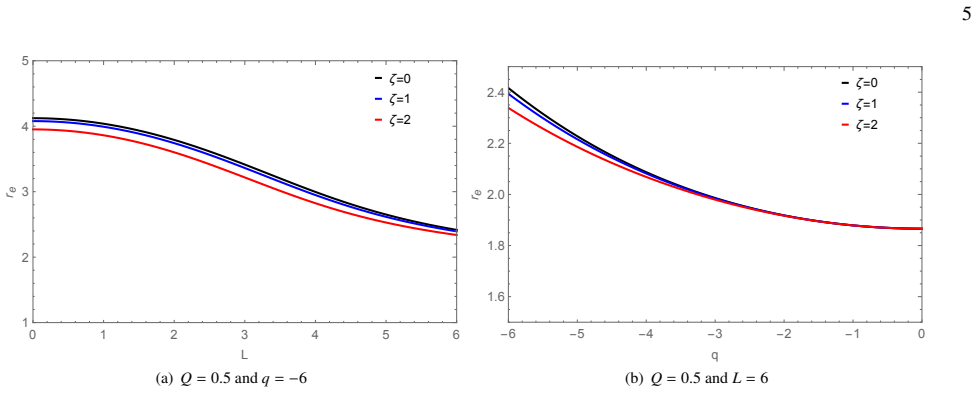
- Energy-extraction efficiency η decreases monotonically as ζ increases and drops to zero beyond a critical ζ where the ergoregion boundary re falls inside the turning point, halting the process.
- The generalized ergoregion boundary re shrinks with increasing ζ, so the quantum-corrected black hole has a smaller effective energy-extraction region than the classical Reissner-Nordström black hole for the same charge parameters.
- For L2=0, the high-energy fragment always escapes to a distant observer; the escape theorem holds for any spherically symmetric charged black hole metric with f(r)>0 and f'(r)>0 outside the horizon, not just the quantum-corrected solution.
- In the special process where the initial particle is bound inside the potential peak, a fragment that would escape in the classical spacetime can become trapped when ζ is nonzero, due to the outward shift of the effective-potential peak of particle 3.
- ζ has a weak effect on trajectory shapes in generic cases, but the qualitative escape-to-trap transition provides a measurable kinematic signature for distinguishing quantum-corrected from classical black holes via charged-particle orbits.
- The framework extends directly to other gravitational models where the same mild conditions on f(r) hold, offering a general test of alternative gravity theories.
- When the turning point r_t is too close to the horizon, particle 3 can fall into the black hole instead of escaping, demonstrating that the special electric Penrose process has two possible dynamical outcomes depending on r_t.
- The proof relies only on f'>0 and f>0 outside the horizon, so the escape result is model-independent within that broad class.
Editorial analysis
A structured set of objections, weighed in public.
Referee Report
Summary. The paper analyzes the electric Penrose process for charged test particles around the covariant quantum-corrected Reissner-Nordström black hole of Ref. [58]. The authors derive the equations of motion and effective potential, study the generalized ergoregion boundary and the energy-extraction efficiency as functions of the quantum parameter ζ, and examine the subsequent motion of the fragments produced by the splitting. For the simplified case L2=0 with the splitting at the common turning point, they claim a rigorous proof that the high-energy fragment particle 3 always escapes to a distant observer, and that this conclusion holds for a broad class of metric functions. They also identify a critical regime in which particle 1 is bound but particle 3 can escape, and show that ζ can switch the outcome from escape to trapping.
Significance. If the main claims are correct, the paper provides a concrete application of the electric Penrose process to a popular quantum-corrected black-hole model and offers a potentially model-independent escape theorem. The qualitative results — that ζ contracts the generalized ergoregion, lowers the efficiency, and can cause a qualitative escape-to-trapping transition for particle 3 — are physically interesting and presented with explicit trajectories and effective-potential plots. The derivation is self-contained and does not rely on numerical fitting. However, the advertised rigorous escape theorem is not demonstrated as stated, and there is an apparent sign inconsistency in the central conservation equation. These issues affect the paper's main novel claim and must be resolved before publication.
major comments (3)
- [§IV and Appendix A] The proof establishes at most V'_3(r_t)<0 at the splitting point. Eq. (4.2) and Eqs. (A1)–(A19) evaluate all quantities at the fixed point r_t; the appendix never treats r as a variable. A negative derivative at r_t guarantees only that particle 3 initially moves outward; escape to a distant observer requires V_3(r)<E_3 for all r>r_t, i.e. absence of a second turning point. The appendix heading claims V'_3<0 for r≥r_t, but no such global statement is proved. Therefore the abstract's 'rigorously prove ... can always escape' and the concluding paragraph of Sec. IV overstate the logical strength of the result.
- [§IV, Eq. (4.5)] The inequality chain q3 > M1 q1 > 0 assumes q1>0, which is never stated as a prerequisite. If q1<0, the step from Eq. (A13) to Eq. (A14) divides by the negative quantity 2 q1 Q S1, reversing the inequality, and Eq. (A15) no longer follows from charge conservation. The theorem should either explicitly state q1>0 as a hypothesis or provide a separate treatment for the q1<0 case. As written, the claimed universal escape result does not cover all allowed charge configurations.
- [§III, Eqs. (3.7) and (3.10)] Eq. (3.7) and Eq. (3.10) contain an apparent sign inconsistency. With є_i ≡ E_i − q_i Q/r_t and the turning-point condition є_i^2 = f(r_t)(1+L_i^2/r_t^2), the expression √{−є_i^2+f(r_t)} is imaginary for L_i≠0, so Eq. (3.10) cannot be the conservation constraint that leads to Eqs. (3.12)–(3.15). The later formulas use the opposite sign, √{є_i^2−f(r_t)}, suggesting a typographical sign error rather than a conceptual one. Nevertheless, the printed derivation cannot be reproduced as it stands and should be corrected.
minor comments (4)
- [Fig. 12 caption] The caption lists 'particle 2' twice; one of these should presumably be 'particle 3'.
- [Eq. (4.7) and Sec. IV] The root r_z in Eq. (4.7) and the statement that G(r)≤0 for r≥r_z use the explicit form of the metric (2.2). If the escape claim is meant to apply to a wide class of charged black holes, the manuscript should identify which steps rely on the specific f(r) and which steps are truly model-independent.
- [Figs. 9, 11, 13] The insets showing the detailed behavior near the turning points are very small and hard to read. Larger panels or separate zoomed figures would help the reader verify the claimed qualitative changes.
- [Sec. II A] The statement that the root of Eq. (2.7) is always less than r_+ is asserted without proof. A short argument or a reference would be useful.
Circularity Check
No circularity: derivation is self-contained from the given quantum-corrected metric; self-citations are background, not load-bearing.
full rationale
The core derivation chain begins with the quantum-corrected RN metric (2.1)-(2.2), taken as input from Ref. [58]. All subsequent results—effective potential (2.13)-(2.14), ergoregion boundary (3.1), energy conservation equations (3.2)-(3.10), efficiency (3.20)-(3.21), and the escape inequalities in Sec. IV/Appendix A—are derived algebraically from this metric, the test-particle Lagrangian (2.8), and standard conservation laws. No parameter is fitted to data and then renamed a prediction. The escape proof uses hypotheses L2=0, q2<0, f'(r)>0 and the conservation-derived inequality q3>M1 q1>0; the conclusion V'_3<0 at r_t does not appear among the assumptions. The self-citations (e.g., Refs. [30,31,58]) supply the background effective-quantum-gravity model and previous studies of the same spacetime; they do not replace a derivation step or assert the present target result. Possible logical gaps—the proof establishes only a local outward motion at r_t rather than global escape for all r>r_t, and Eq. (4.5) silently assumes q1>0—are correctness issues, not circularity, because the derivation is not equivalent to its conclusion by construction. Similarly, the qualitative ζ results are numerical consequences of the displayed potential, not renamed inputs. Therefore no circular step is present.
Assumptions & free parameters
free parameters (5)
- quantum parameter ζ =
varied 0..7
- BH mass M =
1
- particle parameters (m_i, q_i) =
m1=2, q1=3.3; m2=0.9, q2=-6; m3=1, q3=12
- turning point r_t =
2.4, 1.9, 1.93, 3
- angular momentum L2 =
0 in proof; varied 0,1,2 in efficiency
assumptions (6)
- domain assumption Test particle approximation (neglect backreaction)
- domain assumption Quantum-corrected RN metric with f(r) as in Eq. (2.2) is the correct spacetime
- standard math 4-momentum and charge are conserved at splitting
- domain assumption f'(r)>0 and f(r)>0 outside the horizon
- ad hoc to paper q1>0 (unstated)
- ad hoc to paper Splitting point coincides with turning point of all particles
Cite this review
Pith. "Pith review of Electric Penrose process in the spacetime of a quantum-corrected Reissner-Nordstr\"om black hole." pith.science (2026). https://pith.science/paper/ZUZ6CNJP
@misc{pith2026260101508,
  author       = {Pith},
  title        = {Pith review of: Electric Penrose process in the spacetime of a quantum-corrected Reissner-Nordstr\"om black hole},
  year         = {2026},
  howpublished = {\url{https://pith.science/paper/ZUZ6CNJP}},
  note         = {Machine review of arXiv:2601.01508}
}
abstract
In this paper, we study the electric Penrose process for charged particles in the spacetime of a covariant quantum-corrected Reissner-Nordstr\"om black hole. We first derive the equations of motion for charged particles around the black hole, and then analyze how the quantum parameter $\zeta$ modifies the generalized ergoregion boundary and affects the energy-extraction efficiency. We further analyze the subsequent motion of charged particles in the electric Penrose process, and rigorously prove that under specific simplified conditions, the resulting fragment particle can always escape to a distant observer with a net energy gain, a conclusion applicable to a wide range of charged black hole models. Finally, we study the electric Penrose process in a critical regime where the initial particle is bound, yet its high-energy fragment particle may still escape. A key finding is that while $\zeta$ slightly alters the particle trajectories, it can qualitatively alter outcomes near critical conditions, causing a fragment particle that would escape in the classical black hole spacetime to become trapped in the quantum-corrected one. These results collectively demonstrate the obstructive effect of quantum corrections on the Penrose process and provide potential kinematic signatures to distinguish the quantum-corrected from classical Reissner-Nordstr\"om black holes.
Figures


Figures from the paper (11 more)



Reference graph
Works this paper leans on
- [58]
-
[1]
B. P. Abbottet al.(LIGO Scientific Collaboration and Virgo Collaboration), Observation of Gravitational Waves from a Bi- nary Black Hole Merger, inCentennial of General Relativity: A 12 Celebration, edited by C. A. Z. Vasconcellos (World Scientific, Singapore, 2017)
2017
-
[2]
(4.5), this leads directly to M1K−1<RK−1.(A15) Likewise, if the inequality L2 1(M 2 1−1) r2 t +L 2 1 <M 1K−1 (A16) holds, then Eq
After simplification, we obtain L2 1(M 2 1−1) r2 t +L 2 1 <RK−1.(A14) Together with Eq. (4.5), this leads directly to M1K−1<RK−1.(A15) Likewise, if the inequality L2 1(M 2 1−1) r2 t +L 2 1 <M 1K−1 (A16) holds, then Eq. (A14) is automatically satisfied. Inserting the explicit form ofKfrom Eq. (A10) and setting U≡ L2 1(M 2 1−1) r2 t +L 2 1 ,(A17) we can rew...
-
[3]
Consequently, particle 3 carries a higher energy E3 (>E 1) and returns to infinity along an outgoing geodesic. The energy extracted from the BH in this process isE 3−E 1; theoretical analyses show that up to about 29% of the total energy of the rotating BH can be extracted [5]. To date, the Penrose process and its various extensions remain an active resea...
arXiv 2026
-
[4]
Akiyamaet al.(Event Horizon Telescope Collaboration), First Sagittarius A* Event Horizon Telescope results
K. Akiyamaet al.(Event Horizon Telescope Collaboration), First Sagittarius A* Event Horizon Telescope results. I. The shadow of the supermassive black hole in the center of the Milky Way, Astrophys. J. Lett.930, L12 (2022)
2022
-
[5]
Falcke, K
H. Falcke, K. Mannheim, and P. L. Biermann, The Galactic cen- ter radio jet, Astron. Astrophys.278, L1 (1993)
1993
-
[6]
Penrose and R
R. Penrose and R. M. Floyd, Extraction of rotational energy from a black hole, Nature229, 177 (1971)
1971
-
[7]
S. M. Wagh and N. Dadhich, The energetics of black holes in electromagnetic fields by the Penrose process, Phys. Rept.183, 137 (1989)
1989
Show all 61 references
-
[8]
Patel, K
V . Patel, K. Acharya, P. Bambhaniya, and P. S. Joshi, Energy ex- traction from Janis-Newman-Winicour naked singularity, Phys. Rev. D107, 064036 (2023)
2023
-
[9]
O. B. Zaslavskii, General properties of the Penrose process with neutral particles in the equatorial plane, Phys. Rev. D108, 084022 (2023)
2023
-
[10]
Ruffini, M
R. Ruffini, M. Prakapenia, H. Quevedo, and S. Zhang, Single versus the Repetitive Penrose Process in a Kerr Black Hole, Phys. Rev. Lett.134, 081403 (2025)
2025
-
[11]
D. P. Viththani, T. Bhanja, V . Patel, and P. S. Joshi, Magnetic Penrose process and Kerr black hole mimickers, Phys. Rev. D 110, 123035 (2024)
2024
-
[12]
A. Kar, A. Dey, and S. Kar, A note on the Penrose process in rotating regular black holes, arXiv:2510.11364
-
[13]
Zhao, Z.-Y
Z. Zhao, Z.-Y . Fan, X. Wang, M. Guo, and B. Chen, Probing the Penrose process: Images of split hotspots and their observa- tional signatures, arXiv:2510.27409
-
[14]
Wang and X.-X
K. Wang and X.-X. Zeng, Repetitive Penrose process in Kerr-de Sitter black holes, arXiv:2512.05491
-
[15]
Denardo and R
G. Denardo and R. Ruffini, On the energetics of Reissner Nord- str¨om geometries, Phys. Lett. B45, 259 (1973)
1973
-
[16]
Denardo, L
G. Denardo, L. Hively, and R. Ruffini, On the generalized er- gosphere of the Kerr-Newman geometry, Phys. Lett. B50, 270 (1974)
1974
-
[17]
Dadhich, On energetics of a charged black hole relative to tachyons, Phys
N. Dadhich, On energetics of a charged black hole relative to tachyons, Phys. Lett. A68, 291 (1978)
1978
-
[18]
Kokubu, S.-L
T. Kokubu, S.-L. Li, P. Wu, and H. Yu, Confined Penrose pro- cess with charged particles, Phys. Rev. D104, 104047 (2021)
2021
-
[19]
O. B. Zaslavskii, General properties of the electric Penrose pro- cess, Phys. Rev. D109, 124053 (2024)
2024
-
[20]
L. T. Sanches and M. Richartz, Energy extraction from non- coalescing black hole binaries, Phys. Rev. D104, 124025 (2021)
2021
-
[21]
A. Baez, N. Breton, and I. Cabrera-Munguia, Energy extraction in electrostatic extreme binary black holes, Phys. Rev. D106, 124042 (2022)
2022
-
[22]
Tursunov, B
A. Tursunov, B. Juraev, Z. Stuchl ´ık, and M. Kolo ˇs, Electric Penrose process: High-energy acceleration of ionized particles by nonrotating weakly charged black hole, Phys. Rev. D104, 084099 (2021)
2021
-
[23]
Vertogradov, Extraction energy from charged Vaidya black hole via the Penrose process, Commun
V . Vertogradov, Extraction energy from charged Vaidya black hole via the Penrose process, Commun. Theor. Phys.75, 045404 (2023)
2023
-
[24]
Xamidov, P
T. Xamidov, P. Sheoran, S. Shaymatov, and T. Zhu, Energy ex- traction from loop quantum black holes: The role of magnetic Penrose process and quantum gravity effects with astrophysical insights, J. Cosmol. Astropart. Phys. 03 (2025) 053
2025
-
[25]
Alloqulov and S
M. Alloqulov and S. Shaymatov, Electric Penrose process and the accretion disk around a 4D-charged Einstein-Gauss-Bonnet black hole, Eur. Phys. J. Plus139, 731 (2024)
2024
-
[26]
Vertogradov and A
V . Vertogradov and A. Rincon, Energy extraction and evolution of regular black holes: The case of Bardeen spacetime, Phys. Dark Universe50, 102066 (2025)
2025
-
[27]
Feiteira, J
D. Feiteira, J. P. S. Lemos, and O. B. Zaslavskii, Penrose pro- cess in Reissner-Nordstr¨om-AdS black hole spacetimes: Black hole energy factories and black hole bombs, Phys. Rev. D109, 064065 (2024)
2024
-
[28]
A. Baez, N. Breton, and I. Cabrera-Munguia, Energy extraction from a Reissner-Nordstr ¨om–de Sitter black hole, Phys. Rev. D 110, 064065 (2024)
2024
-
[29]
Feiteira, J
D. Feiteira, J. P. S. Lemos, and O. B. Zaslavskii, Penrose and super-Penrose energy extraction from a Reissner-Nordstr ¨om black hole spacetime with a cosmological constant through the Ba ˜nados-Silk-West mechanism, Phys. Rev. D111, 024022 (2025)
2025
-
[30]
H. Chen, H. Xu, Y . Zhan, and S.-J. Zhang, Electric Penrose process in Ay ´on-Beato-Garc´ıa(-dS) black holes, arXiv:2508.12657
-
[31]
Hu, R.-G
L. Hu, R.-G. Cai, and S.-J. Wang, Third law of repetitive elec- tric Penrose process, arXiv:2510.26866
-
[32]
Zhang, J
C. Zhang, J. Lewandowski, Y . Ma, and J. Yang, Black holes and covariance in effective quantum gravity, Phys. Rev. D111, L081504 (2025)
2025
-
[33]
Zhang, J
C. Zhang, J. Lewandowski, Y . Ma, and J. Yang, Black holes and covariance in effective quantum gravity: A solution without Cauchy horizons, Phys. Rev. D112, 044054 (2025)
2025
-
[34]
R. A. Konoplya and O. S. Stashko, Probing the effective quan- tum gravity via quasinormal modes and shadows of black holes, Phys. Rev. D111, 104055 (2025)
2025
-
[35]
W. Liu, D. Wu, and J. Wang, Light rings and shadows of static black holes in effective quantum gravity, Phys. Lett. B858, 139052 (2024)
2024
-
[36]
Liu, M.-Y
H. Liu, M.-Y . Lai, X.-Y . Pan, H. Huang, and D.-C. Zou, Gravi- tational lensing effect of black holes in effective quantum grav- ity, Phys. Rev. D110, 104039 (2024)
2024
-
[37]
Li and X
H. Li and X. Zhang, Gravitational lensing effects from mod- els of loop quantum gravity with rigorous quantum parameters, Universe10, 421 (2024)
2024
-
[38]
Y . Wang, A. Vachher, Q. Wu, T. Zhu, and S. G. Ghosh, Strong gravitational lensing by static black holes in effective quantum gravity, Eur. Phys. J. C85, 302 (2025)
2025
-
[39]
Skvortsova, Quantum corrected black holes: Testing the correspondence between grey-body factors and quasinormal modes, Eur
M. Skvortsova, Quantum corrected black holes: Testing the correspondence between grey-body factors and quasinormal modes, Eur. Phys. J. C85, 854 (2025)
2025
-
[40]
Z. Ban, J. Chen, and J. Yang, Shadows of rotating black holes in effective quantum gravity, Eur. Phys. J. C85, 878 (2025)
2025
-
[41]
Y . Du, Y . Liu, and X. Zhang, Spinning particle dynamics and the innermost stable circular orbit in covariant loop quantum gravity, J. Cosmol. Astropart. Phys. 05 (2025) 045
2025
-
[42]
J. Lin, X. Zhang, and M. Bravo-Gaete, Mass inflation and strong cosmic censorship conjecture in the covariant quantum black hole, Phys. Rev. D111, 106025 (2025)
2025
-
[43]
Shu and J.-H
Y .-H. Shu and J.-H. Huang, Circular orbits and thin accretion disk around a quantum corrected black hole, Phys. Lett. B864, 139411 (2025)
2025
-
[44]
Y . Liu, J. Jiang, and B. Sun, Repulsive effect of covariant effec- tive quantum gravity, Phys. Rev. D112, 124042 (2025)
2025
-
[45]
Cafaro, L
L. Cafaro, L. Cipriani, F. Fazzini, and F. Soltani, Stellar collapse with pressure in effective loop quantum gravity, Phys. Rev. D 111, 124006 (2025)
2025
-
[46]
R. A. Konoplya and O. S. Stashko, Transition from regular black holes to wormholes in covariant effective quantum grav- ity: Scattering, quasinormal modes, and Hawking radiation, Phys. Rev. D111, 084031 (2025)
2025
-
[47]
Chen and J
J. Chen and J. Yang, Shadows and optical appearance of 13 quantum-corrected black holes illuminated by static thin accre- tions, Eur. Phys. J. C85, 512 (2025)
2025
-
[48]
Ai, R.-T
W.-J. Ai, R.-T. Chen, L.-G. Zhu, and J.-P. Wu, Probing loop quantum effects through solar system experiments: Observa- tional signatures and parameter constraints, Eur. Phys. J. C85, 792 (2025)
2025
-
[49]
B. C. L ¨utf¨uo˘glu, Long-lived quasinormal modes around regu- lar black holes and wormholes in covariant effective quantum gravity, J. Cosmol. Astropart. Phys. 06 (2025) 057
2025
-
[50]
Chen and J
J. Chen and J. Yang, Periodic orbits and gravitational wave- forms in quantum-corrected black hole spacetimes, Eur. Phys. J. C85, 726 (2025)
2025
-
[51]
Motaharfar and P
M. Motaharfar and P. Singh, Love numbers of covariant loop quantum black holes, Phys. Rev. D112, 066008 (2025)
2025
-
[52]
Sahlmann and C
H. Sahlmann and C. Zhang, Dust shell in effective loop quan- tum black hole model, Phys. Rev. D112, 084079 (2025)
2025
-
[53]
Zhang and Z
C. Zhang and Z. Cao, Covariant Dynamics from Static Spher- ically Symmetric Geometries, Phys. Rev. Lett.135, 261401 (2025)
2025
-
[54]
Calz `a, D
M. Calz `a, D. Pedrotti, G.-W. Yuan, and S. Vagnozzi, Primordial regular black holes as all the dark matter. III. Covariant canoni- cal quantum gravity models, Phys. Rev. D112, 124015 (2025)
2025
-
[55]
Umarov, F
D. Umarov, F. Atamurotov, S. G. Ghosh, A. Abdujabbarov, and G. Mustafa, Dynamics of spinning particles around static black holes in effective quantum gravity, Eur. Phys. J. C85, 800 (2025)
2025
-
[56]
Liu and X
Y . Liu and X. Zhang, Quasinormal modes and tidal Love num- bers of covariant effective quantum black holes with cosmolog- ical constant, arXiv:2509.12013
-
[57]
Huang, J
S. Huang, J. Chen, and J. Yang, Image of a quantum-corrected black hole without Cauchy horizons illuminated by a static thin accretion disk, arXiv:2510.09956
-
[59]
X. Liu, W. Liu, and S.-M. Wu, Entanglement degrada- tion of static black holes in effective quantum gravity, arXiv:2511.12245
-
[60]
J. Yang, C. Zhang, and Y . Ma, Covariant effective spacetimes of spherically symmetric electrovacuum with a cosmological constant, Phys. Rev. D112, 064049 (2025)
2025
-
[61]
Pugliese, H
D. Pugliese, H. Quevedo, and R. Ruffini, Motion of charged test particles in Reissner-Nordstr ¨om spacetime, Phys. Rev. D 83, 104052 (2011)
2011
Reviewed August 3, 2026 · model on record in the stance chip above.
Discussion (0). Sign in to comment.