REVIEW 4 major objections 5 minor 2 cited by
This paper claims that a diffusion model with per-site noise-level conditioning can reconstruct missing hydrogen positions in crystals from the host lattice alone, exceeding a 97 percent success rate and often finding more stable configurat
Reviewed by Pith at T0; open to challenge. T0 means a machine referee read the full paper against a public rubric. the ladder, T0–T4 →
T0 review · deepseek-v4-flash
2026-08-03 12:38 UTC pith:VCNKAV4W
load-bearing objection Solid application paper, but the 97% 'reconstruction' rate is an LES rate against MLIP-relaxed references—don't read it as pure structural recovery. the 4 major comments →
Score-based diffusion models for accurate crystal-structure inpainting and reconstruction of hydrogen positions
The pith
A machine-rendered reading of the paper's core claim, the machinery that carries it, and where it could break.
Core claim
The central claim is that missing hydrogen sites can be inpainted into a known host crystal by a diffusion model that is trained position-only and with per-site noise levels — during training, a fraction of sites are assigned near-zero noise, teaching the model that some sites (hosts) are clean and fixed while others (the H atoms) carry noise. At inference, clean host coordinates are reinserted at every reverse-diffusion step, so denoising targets only the unknown region. Single-trial structural matching reaches about 88 percent on DFT-relaxed references; generating k=10 samples and selecting the lowest-energy one with an equivariant MLIP raises the combined structural-or-lower-energy rate t
What carries the argument
The key mechanism is per-site noise-level conditioning, an adaptation of the TD-Paint image-inpainting trick: instead of one noise level for the whole structure, the model is trained so that a fraction of sites receive a near-zero timestep while the rest receive the usual sampled timestep. In the reverse process the known host coordinates are reinserted exactly at each step (equation combining masked and known sites), which lets the model condition on clean, noise-free context rather than a noisy version of it. This is carried by retraining the MatterGen diffusion architecture to denoise only fractional coordinates, together with a sampling protocol that generates k=10-30 candidates, ranks t
Load-bearing premise
The pipeline assumes the number of missing hydrogen sites is known before inpainting starts, and all headline success-rate numbers are measured under that assumption; the paper's own 20-structure proof of concept for estimating the count recovers it in only 17 of 20 cases.
What would settle it
Run the recommended pos-only-TD pipeline on a benchmark where the number of missing hydrogen sites is deliberately mis-specified by ±1 (over- or under-inpaint), and measure the structural-or-lower-energy success rate; or evaluate the full pipeline that first estimates N_H via the SI S1E convex-hull screening and then inpaints. Since the count estimator alone is right only 17/20 times, a significant drop from the headline 97 percent would show the claim is contingent on knowing N_H.
If this is right
- If the claim holds, hydrogen positions in existing crystal-structure databases can be computationally completed or corrected from the host lattice at above 97 percent success, replacing neutron-scattering experiments for many routine determinations.
- The pipeline works directly on experimental host structures, not only DFT-relaxed ones, so it can be applied to raw database entries where hydrogen is missing or guessed.
- Because the model is hydrogen-agnostic and trained only to place sites, the same weights should transfer to other insertion problems such as Li or Na intercalation in cathodes without retraining.
- Performance persists beyond the training regime: cells with 21 to 40 atoms retain high success rates even though the model was trained on cells up to 20 atoms, suggesting the approach scales with fine-tuning to larger structures.
- Replacing MLIP energy selection with DFT selection raises the success rate to about 99 percent, and even single-point DFT energies recover most of the gain, giving a tunable cost-accuracy trade-off.
Where Pith is reading between the lines
- I infer that the practical end-to-end accuracy on real database entries is likely lower than 97 percent, because the headline numbers assume the number of missing hydrogen sites is known; the paper's own proof-of-concept for estimating that number recovers it in only 17 of 20 structures, so the joint count-and-position problem is unsolved.
- The observation that most structurally non-matching predictions are more stable than experimental references suggests the method doubles as a database-error detector: it points to entries whose reported hydrogen placements are suspect and supplies better candidates.
- A natural testable extension is to apply the same per-site conditioning to partial occupancies or to predict muon stopping sites in one pass, since the model never needs to know which species are being placed.
- The DFT-based electrostatic reconstruction, which struggles because of its greedy one-at-a-time search, becomes a useful comparison point: a global generative sampler avoids the greedy pitfall, which is one reason the diffusion approach succeeds where the physics-based one saturates near 87 percent.
Editorial analysis
A structured set of objections, weighed in public.
Referee Report
Summary. The paper adapts MatterGen, a score-based diffusion model for crystal generation, to the task of reconstructing missing hydrogen positions in crystal structures. The authors retrain a position-only variant and combine it with the TD-Paint inpainting strategy, which assigns near-zero noise to known sites during training. Given a host structure and the known number N_H of missing hydrogen sites, the method initializes random H positions, denoises them, performs NequIP-based constrained and full relaxations, and selects the lowest-energy candidate among k generated samples. Benchmarks are carried out on hydrogen-containing structures from MC3D, using both DFT-relaxed references and the underlying experimental structures. The main reported quantity is a 'Lower Energy or Structural' (LES) success rate, which counts a structural match with the reference or, failing that, a predicted configuration that is more stable than the reference. The recommended k=10 pipeline is reported to achieve 97.8% (DFT+MLIP) and 97.2% (EXP+MLIP) LES on structures up to 20 atoms. The paper also benchmarks a DFT-based electrostatic-potential reconstruction method and provides open code, data, and provenance-tracking workflows.
Significance. If the claims hold, the work is a useful and timely contribution: it transfers image-inpainting methodology to crystallography, demonstrates that a position-only diffusion model with per-site noise conditioning outperforms both the original MatterGen and a DFT-based electrostatic approach, and includes several careful benchmark design elements. The authors remove overlapping training structures and matching prototypes, quantify train/test similarity, validate non-matching stable predictions with DFT, and ship reproducible code and AiiDA provenance. These are genuine strengths. The main caveats are that the headline LES metric conflates exact reconstruction with discovery of lower-energy structures, the reported end-to-end rates are computed against NequIP-relaxed references rather than the original DFT/experimental structures, and the method requires N_H as input, while the joint count-and-position problem is only addressed as a proof-of-concept. These issues do not invalidate the core methodology but they do affect how the central claims should be stated and evaluated.
major comments (4)
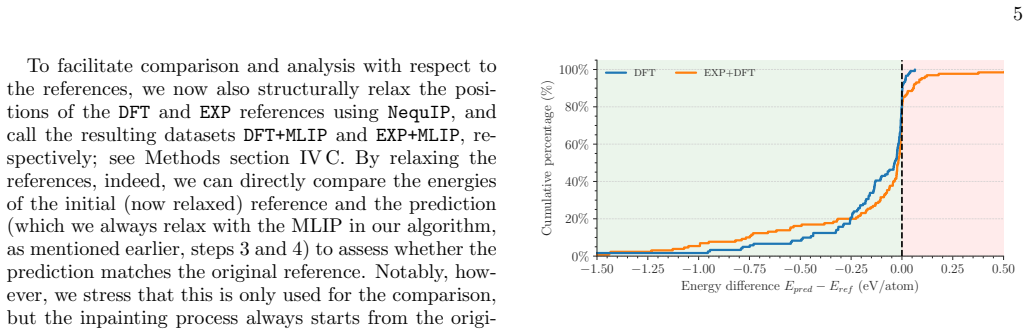
- [II B, Table I] The LES success definition counts a non-matching prediction that is more stable than the reference as a success. This conflates exact reconstruction of known H positions with the separate claim of discovering a lower-energy configuration. The 97% figure in the abstract and Table I is therefore not a pure 'reconstruction' rate. Please report the structural-match-only rate for the recommended k=10 pipeline, both against the original DFT/EXP references and against the +MLIP references. Fig. 4 encodes this information visually, but no numeric end-to-end value is given; SI Fig. S5 shows only RMSD distributions, not final success rates.
- [IV C, Fig. 2c] The headline rates are evaluated on DFT+MLIP and EXP+MLIP, i.e. references relaxed with the same NequIP potential that relaxes the predictions in workflow steps 3-4. This introduces shared-model bias: a prediction can match the NequIP-relaxed reference even when it does not reproduce the original DFT or experimental hydrogen positions. The paper should report the equivalent structural-only and LES rates for k=10 against the original, unrelaxed DFT and EXP structures. Without this, the abstract's claim about starting from DFT- or experiment-derived structures is not directly supported by the headline number.
- [Workflow step 1, SI S1 E] The pipeline requires N_H, the number of missing hydrogen sites, as input; the proof-of-concept for estimating it recovers the correct count in only 17/20 structures and often yields multiple candidate counts. All headline success rates are conditional on a known N_H. The manuscript should state this limitation prominently, ideally in the abstract or discussion, and, if the method is intended for databases with omitted H atoms, report the joint count-and-position success rate. As written, the title and abstract can be read as solving the full reconstruction problem.
- [SI S1 A 4, IV C] The SNR value of 0.2 was selected by optimizing the structural matching rate on the same DFT/EXP evaluation sets used for the final benchmarks; no independent validation split is described for this hyperparameter. Even if the dependence is weak (Fig. S4), the reported numbers are post-selection estimates. Please clarify whether SNR was chosen on a hold-out subset or on all test structures, and report final LES rates under neighboring SNR values to quantify the sensitivity.
minor comments (5)
- [Abstract] 'starting both from structures that were already relaxed with DFT, or directly from experimentally determined host structures' is grammatically awkward; consider rephrasing.
- [Table I] Clarify that the bracketed values refer to 21-40 atom cells, and state whether these numbers are NequIP-evaluated, DFT-confirmed, or a mixture. The 'DFT+MLIP' and 'EXP+MLIP' names could also be made more explicit, e.g. 'NequIP-relaxed DFT references'.
- [Fig. 4b caption] Typo: '21 to 40 toms' should be 'atoms'.
- [IV C] The SNR adjustment from 0.4 to 0.2 is mentioned in model training, but the rationale appears only in SI S1 A 4; a one-sentence pointer in the main text would help the reader.
- [IV D] The number of structures removed due to failed DFT relaxations could be stated for each dataset separately, since removal after seeing the outcome can in principle bias the success-rate estimate.
Circularity Check
No significant circularity: the central claim is an empirical benchmark with disclosed success criteria, not a derivation forced by construction.
full rationale
The paper makes no first-principles derivation; its central claim is an empirical success rate for a diffusion-model inpainting pipeline benchmarked against crystallographic reference structures. The success metric is explicitly and repeatedly defined: 'a successful prediction ... either resulting in a structural match ... or in an energetically more stable configuration' (Section II B), and the abstract discloses the same 'structural match or ... more stable configuration' definition. The lower-energy component is validated by independent DFT relaxations (Fig. 3), so it is not merely asserted by construction. The evaluation uses NequIP-relaxed references for the headline numbers (Methods IV C), but this is a benchmark/reference choice, not a fitted parameter renamed as a prediction; the paper also reports comparisons against the original DFT/EXP references in SI Fig. S5. Known limitations are stated rather than hidden: the number of missing H sites is assumed known (workflow step 1), and the proof-of-concept for estimating N_H succeeds in only 17/20 cases (SI Table S1). Self-citations to MC3D, XtalPaint, and AiiDA are contextual: MC3D is an externally curated database of experimental/DFT structures, not a result whose derivation is being claimed here, so the self-citations do not carry the load of the benchmark conclusion. No equation in the paper equals its input by construction, and no fitted quantity is relabeled as a prediction. The LES criterion and MLIP-relaxed evaluation raise questions about what exactly is being measured, but those are correctness/interpretation concerns, not circularity.
Axiom & Free-Parameter Ledger
free parameters (3)
- SNR (coordinate signal-to-noise ratio in Langevin sampling) =
0.2
- p (fraction of known sites assigned near-zero timestep in TD-Paint training) =
20%
- MLIP relaxation force threshold fmax =
0.01 eV/Å
axioms (6)
- standard math Score-based diffusion SDE framework and MatterGen training are valid for this task.
- domain assumption Host structure (non-H sites and lattice) is correct and fixed during inpainting.
- domain assumption The number of missing hydrogen sites N_H is known.
- ad hoc to paper LES success definition (structural match OR more stable than reference) is a valid measure of reconstruction.
- domain assumption NequIP energies approximate DFT for selecting the lowest-energy sample.
- domain assumption DFT (PBE/SSSP) energies are ground truth for stability comparisons.
read the original abstract
Generative AI models, such as score-based diffusion models, have recently advanced the field of computational materials science by enabling the generation of new materials with desired properties. In addition, these models could also be leveraged to reconstruct crystal structures for which partial information is available. One relevant example is the reliable determination of atomic positions occupied by hydrogen atoms in hydrogen-containing crystalline materials. While crucial to the analysis and prediction of many materials properties, the identification of hydrogen positions can however be difficult and expensive, as it is challenging in X-ray scattering experiments and often requires dedicated neutron scattering measurements. As a consequence, inorganic crystallographic databases frequently report lattice structures where hydrogen atoms have been either omitted or inserted with heuristics or by chemical intuition. Here, we combine diffusion models from the field of materials science with techniques originally developed in computer vision for image inpainting. We present how this knowledge transfer across domains enables a much faster and more accurate completion of host structures, compared to unconditioned diffusion models or previous approaches solely based on DFT. Overall, our approach exceeds a success rate of 97% in terms of finding a structural match or predicting a more stable configuration than the initial reference, when starting both from structures that were already relaxed with DFT, or directly from the experimentally determined host structures.
Figures



Forward citations
Cited by 2 Pith papers
-
Generative and multimodal AI for materials prediction and design: Progress, challenges, and perspectives
Generative and multimodal AI can propose compositionally new materials, but a three-level novelty taxonomy shows current evidence supports only structural novelty, not physical or deployment novelty.
-
Quantum annealing for materials
Presents a path-integral molecular dynamics implementation of quantum annealing for global optimization of atomic structures using empirical or machine-learned potentials.
Reference graph
Works this paper leans on
-
[1]
Additional checks were done and decreasing the thresholds had only minor impact on the matching rate
Structural matches Structural matches were determined usingpymatgen’s StructureMatcherwith the default tolerances ltol=0.2, stol=0.3 and angle tol=5. Additional checks were done and decreasing the thresholds had only minor impact on the matching rate. Also, compared to other works related to crystal structure prediction, the thresholds adopted here are so...
-
[2]
K. Ryan, J. Lengyel, and M. Shatruk, Journal of the American Chemical Society140, 10158 (2018)
2018
-
[3]
Cheng, X.-G
G. Cheng, X.-G. Gong, and W.-J. Yin, Nature Commu- nications13, 1492 (2022)
2022
-
[4]
T. Xie, X. Fu, O.-E. Ganea, R. Barzilay, and T. Jaakkola, arXiv preprint arXiv:2110.06197 (2022)
Pith/arXiv arXiv 2022
-
[5]
H. Park, Z. Li, and A. Walsh, Matter7, 2355 (2024)
2024
-
[6]
E. V. Podryabinkin, E. V. Tikhonov, A. V. Shapeev, and A. R. Oganov, Physical Review B99, 064114 (2019)
2019
-
[7]
S. Kim, J. Noh, G. H. Gu, A. Aspuru-Guzik, and Y. Jung, ACS Central Science6, 1412 (2020)
2020
-
[8]
Y. Zhao, E. M. D. Siriwardane, Z. Wu, N. Fu, M. Al- Fahdi, M. Hu, and J. Hu, npj Computational Materials 9, 38 (2023)
2023
- [9]
-
[10]
Y. Song, J. Sohl-Dickstein, D. P. Kingma, A. Ku- mar, S. Ermon, and B. Poole, arXiv preprint arXiv:2011.13456 (2021)
Pith/arXiv arXiv 2011
-
[11]
C. Zeni, R. Pinsler, D. Z¨ ugner, A. Fowler, M. Horton, X. Fu, Z. Wang, A. Shysheya, J. Crabb´ e, S. Ueda, R. Sor- dillo, L. Sun, J. Smith, B. Nguyen, H. Schulz, S. Lewis, C.-W. Huang, Z. Lu, Y. Zhou, H. Yang, H. Hao, J. Li, C. Yang, W. Li, R. Tomioka, and T. Xie, Nature639, 624 (2025)
2025
-
[12]
D. Levy, S. S. Panigrahi, S.-O. Kaba, Q. Zhu, K. L. K. Lee, M. Galkin, S. Miret, and S. Ravanbakhsh, arXiv preprint arXiv:2502.03638 (2025)
Pith/arXiv arXiv 2025
-
[13]
R. Jiao, W. Huang, P. Lin, J. Han, P. Chen, Y. Lu, and Y. Liu, arXiv preprint arXiv:2309.04475 (2024)
Pith/arXiv arXiv 2024
-
[14]
X. Luo, Z. Wang, P. Gao, J. Lv, Y. Wang, C. Chen, and Y. Ma, npj Computational Materials10, 254 (2024)
2024
-
[15]
Z. Li, R. Mrad, R. Jiao, G. Huang, J. Shan, S. Chu, and Y. Chen, iScience28, 111659 (2025)
2025
-
[16]
Pakornchote, N
T. Pakornchote, N. Choomphon-anomakhun, S. Arrerut, C. Atthapak, S. Khamkaeo, T. Chotibut, and T. Bovorn- ratanaraks, Scientific Reports14, 1275 (2024)
2024
-
[17]
A. R. Oganov, A. O. Lyakhov, and M. Valle, Accounts of Chemical Research44, 227 (2011)
2011
-
[18]
S. M. Woodley and R. Catlow, Nature Materials7, 937 (2008)
2008
-
[19]
P.-P. D. Breuck, H. A. Piracha, G.-M. Rignanese, and M. A. L. Marques, arXiv preprint arXiv:2501.16051 (2025)
Pith/arXiv arXiv 2025
-
[20]
X. Dai, P. Zhong, B. Deng, Y. Chen, and G. Ceder, in ICML 2024 AI for Science Workshop(2024)
2024
-
[21]
Mazloomi and C
K. Mazloomi and C. Gomes, Renewable and Sustainable Energy Reviews16, 3024 (2012)
2012
-
[22]
L. Ge, B. Zhang, W. Huang, Y. Li, L. Hou, J. Xiao, Z. Mao, and X. Li, Journal of Energy Storage75, 109307 (2024)
2024
-
[23]
C. G. Van de Walle and J. Neugebauer, Annual Review of Materials Research36, 179 (2006)
2006
-
[24]
S. Guo, X. Li, J. Li, and B. Wei, Nature Communications 12, 1343 (2021)
2021
-
[25]
K. C. Christoforidis and P. Fornasiero, ChemCatChem 9, 1523 (2017)
2017
-
[26]
J. Roth, E. Tsitrone, A. Loarte, T. Loarer, G. Coun- sell, R. Neu, V. Philipps, S. Brezinsek, M. Lehnen, P. Coad, C. Grisolia, K. Schmid, K. Krieger, A. Kallen- bach, B. Lipschultz, R. Doerner, R. Causey, V. Alimov, W. Shu, O. Ogorodnikova, A. Kirschner, G. Federici, and A. Kukushkin, Journal of Nuclear Materials390-391, 1 (2009)
2009
-
[27]
Machida, H
A. Machida, H. Saitoh, H. Sugimoto, T. Hattori, A. Sano- Furukawa, N. Endo, Y. Katayama, R. Iizuka, T. Sato, M. Matsuo, S.-i. Orimo, and K. Aoki, Nature Commu- nications5(2014)
2014
-
[28]
Cheng, C
H. Cheng, C. Lu, J. Liu, Y. Yan, X. Han, H. Jin, Y. Wang, Y. Liu, and C. Wu, Progress in Natural Sci- ence: Materials International27, 66–73 (2017)
2017
-
[29]
Woi´ nska, S
M. Woi´ nska, S. Grabowsky, P. M. Dominiak, K. Wo´ zniak, and D. Jayatilaka, Science Advances2, e1600192 (2016)
2016
-
[30]
J. Cui, D. L. Olmsted, A. K. Mehta, M. Asta, and S. E. Hayes, Angewandte Chemie International Edition 58, 4210–4216 (2019)
2019
-
[31]
Palatinus, P
L. Palatinus, P. Br´ azda, P. Boullay, O. Perez, M. Klemen- tov´ a, S. Petit, V. Eigner, M. Zaarour, and S. Mintova, Science355, 166–169 (2017)
2017
-
[32]
Komander, T
K. Komander, T. Tran, J. Saha, M. V. Moro, G. K. P´ alsson, M. Wolff, and D. Primetzhofer, Phys. Rev. Lett. 127, 136102 (2021)
2021
-
[33]
A. Jain, S. P. Ong, G. Hautier, W. Chen, W. D. Richards, S. Dacek, S. Cholia, D. Gunter, D. Skinner, G. Ceder, and K. A. Persson, APL Materials1, 011002 (2013)
2013
-
[34]
Kirklin, J
S. Kirklin, J. E. Saal, B. Meredig, A. Thompson, J. W. Doak, M. Aykol, S. R¨ uhl, and C. Wolverton, npj Com- putational Materials1, 1 (2015)
2015
-
[35]
Schmidt, H.-C
J. Schmidt, H.-C. Wang, T. F. T. Cerqueira, S. Botti, and M. A. L. Marques, Scientific Data9, 64 (2022)
2022
-
[36]
L. Barroso-Luque, M. Shuaibi, X. Fu, B. M. Wood, M. Dzamba, M. Gao, A. Rizvi, C. L. Zitnick, and Z. W. Ulissi, arXiv preprint arXiv:2410.12771 (2024)
Pith/arXiv arXiv 2024
-
[37]
M. K. Horton, P. Huck, R. X. Yang, J. M. Munro, S. Dwaraknath, A. M. Ganose, R. S. Kingsbury, M. Wen, J. X. Shen, T. S. Mathis, A. D. Kaplan, K. Berket, J. Riebesell, J. George, A. S. Rosen, E. W. C. Spotte- Smith, M. J. McDermott, O. A. Cohen, A. Dunn, M. C. Kuner, G.-M. Rignanese, G. Petretto, D. Waroquiers, S. M. Griffin, J. B. Neaton, D. C. Chrzan, M....
2025
-
[38]
S. P. Huber, M. Minotakis, M. Bercx, T. Reents, K. Eimre, N. Paulish, N. H¨ ormann, M. Uhrin, N. Marzari, and G. Pizzi, arXiv preprint arXiv:2508.19223 (2025)
arXiv 2025
-
[39]
A. D. Kaplan, R. Liu, J. Qi, T. W. Ko, B. Deng, J. Riebe- sell, G. Ceder, K. A. Persson, and S. P. Ong, arXiv preprint arXiv:2503.04070 (2025)
arXiv 2025
-
[40]
J. Chen, J. Guo, E. Fako, and P. Schwaller, arXiv preprint arXiv:2511.03112 (2025), arXiv preprint arXiv:2511.03112
arXiv 2025
-
[41]
Guiding generative models to un- cover diverse and novel crystals via reinforcement learn- ing,
H. Park and A. Walsh, “Guiding generative models to un- cover diverse and novel crystals via reinforcement learn- ing,” (2025), arXiv preprint arXiv:2511.07158
arXiv 2025
-
[42]
A. Lugmayr, M. Danelljan, A. Romero, F. Yu, R. Tim- ofte, and L. V. Gool, arXiv preprint arXiv:2201.09865 (2022)
Pith/arXiv arXiv 2022
-
[43]
T. Mayet, P. Shamsolmoali, S. Bernard, E. Granger, R. H´ erault, and C. Chatelain, arXiv preprint arXiv:2410.09306 (2024)
Pith/arXiv arXiv 2024
-
[44]
Riebesell, R
J. Riebesell, R. E. A. Goodall, P. Benner, Y. Chiang, B. Deng, G. Ceder, M. Asta, A. A. Lee, A. Jain, and K. A. Persson, Nature Machine Intelligence7, 836 (2025)
2025
-
[45]
H. Yang, C. Hu, Y. Zhou, X. Liu, Y. Shi, J. Li, G. Li, Z. Chen, S. Chen, C. Zeni, M. Horton, R. Pinsler, A. Fowler, D. Z¨ ugner, T. Xie, J. Smith, L. Sun, Q. Wang, L. Kong, C. Liu, H. Hao, and Z. Lu, arXiv preprint arXiv:2405.04967 (2024)
Pith/arXiv arXiv 2024
-
[46]
Batzner, A
S. Batzner, A. Musaelian, L. Sun, M. Geiger, J. P. Mailoa, M. Kornbluth, N. Molinari, T. E. Smidt, and B. Kozinsky, Nature Communications13, 2453 (2022)
2022
-
[47]
Batatia, P
I. Batatia, P. Benner, Y. Chiang, A. M. Elena, D. P. Kov´ acs, J. Riebesell, X. R. Advincula, M. Asta, M. Avaylon, W. J. Baldwin, F. Berger, N. Bernstein, A. Bhowmik, F. Bigi, S. M. Blau, V. C˘ arare, M. Ceriotti, S. Chong, J. P. Darby, S. De, F. Della Pia, V. L. Deringer, R. Elijoˇ sius, Z. El-Machachi, E. Fako, F. Falcioni, A. C. Ferrari, J. L. A. Gardn...
2025
-
[48]
B. Rhodes, S. Vandenhaute, V. ˇSimkus, J. Gin, J. God- win, T. Duignan, and M. Neumann, arXiv preprint arXiv:2504.06231 (2025)
Pith/arXiv arXiv 2025
-
[49]
H. Yu, M. Giantomassi, G. Materzanini, J. Wang, and G.-M. Rignanese, Materials Genome Engineering Ad- vances2, e58 (2024)
2024
-
[50]
Mazitov, F
A. Mazitov, F. Bigi, M. Kellner, P. Pegolo, D. Tisi, G. Fraux, S. Pozdnyakov, P. Loche, and M. Ceriotti, Nature Communications16(2025)
2025
-
[51]
Zhong, X
P. Zhong, X. Dai, B. Deng, G. Ceder, and K. A. Persson, Materials Horizons12, 9669–9678 (2025)
2025
-
[52]
Kahle, A
L. Kahle, A. Marcolongo, and N. Marzari, Physical Re- view Materials2, 065405 (2018)
2018
-
[53]
Nequip & allegro foundation potentials,
S. R. Kavanagh and M. G. . Harvard, “Nequip & allegro foundation potentials,” (2025)
2025
-
[54]
Graˇ zulis, A
S. Graˇ zulis, A. Daˇ skeviˇ c, A. Merkys, D. Chateigner, L. Lutterotti, M. Quir´ os, N. R. Serebryanaya, P. Moeck, R. T. Downs, and A. Le Bail, Nucleic Acids Research 40, D420 (2012)
2012
-
[55]
Zagorac, H
D. Zagorac, H. M¨ uller, S. Ruehl, J. Zagorac, and S. Rehme, Journal of Applied Crystallography52, 918 (2019)
2019
-
[56]
Materials platform for data science,
“Materials platform for data science,”https://www. mpds.io/
-
[57]
Generative model for large-cell crystal struc- ture,
D. Lee, E. H. Kim, J. H. Gu, G. S. Hyo, C. Kim, and S. Park, “Generative model for large-cell crystal struc- ture,” (2025)
2025
-
[58]
J. S. M¨ oller, D. Ceresoli, T. Lancaster, N. Marzari, and S. J. Blundell, Physical Review B87, 121108 (2013)
2013
-
[59]
J. S. M¨ oller, P. Bonf` a, D. Ceresoli, F. Bernardini, S. J. Blundell, T. Lancaster, R. De Renzi, N. Marzari, I. Watanabe, S. Sulaiman, and M. I. Mohamed-Ibrahim, Physica Scripta88, 068510 (2013)
2013
-
[60]
I. J. Onuorah, M. Bonacci, M. M. Isah, M. Mazzani, R. De Renzi, G. Pizzi, and P. Bonf` a, Digital Discovery 4, 523 (2025)
2025
-
[61]
XtalPaint,
“XtalPaint,”https://github.com/psi-lms/XtalPaint (2025)
2025
-
[62]
Pizzi, A
G. Pizzi, A. Cepellotti, R. Sabatini, N. Marzari, and B. Kozinsky, Computational Materials Science111, 218 (2016)
2016
-
[63]
S. P. Huber, S. Zoupanos, M. Uhrin, L. Talirz, L. Kahle, R. H¨ auselmann, D. Gresch, T. M¨ uller, A. V. Yakutovich, C. W. Andersen, F. F. Ramirez, C. S. Adorf, F. Gargiulo, S. Kumbhar, E. Passaro, C. Johnston, A. Merkys, A. Ce- pellotti, N. Mounet, N. Marzari, B. Kozinsky, and G. Pizzi, Scientific Data7, 300 (2020)
2020
-
[64]
Uhrin, S
M. Uhrin, S. P. Huber, J. Yu, N. Marzari, and G. Pizzi, Computational Materials Science187, 110086 (2021)
2021
-
[65]
J. Zhuang, Y. Zeng, W. Liu, C. Yuan, and K. Chen, arXiv preprint arXiv:2312.03594 (2024)
Pith/arXiv arXiv 2024
-
[66]
Corneanu, R
C. Corneanu, R. Gadde, and A. M. Martinez, in2024 IEEE/CVF Winter Conference on Applications of Com- puter Vision (WACV)(IEEE, Waikoloa, HI, USA, 2024) pp. 4322–4331
2024
-
[67]
Schneuing, C
A. Schneuing, C. Harris, Y. Du, K. Didi, A. Jamasb, I. Igashov, W. Du, C. Gomes, T. L. Blundell, P. Lio, M. Welling, M. Bronstein, and B. Correia, Nature Com- putational Science4, 899 (2024)
2024
-
[68]
R. E. A. Goodall, A. S. Parackal, F. A. Faber, R. Armiento, and A. A. Lee, Science Advances8, eabn4117 (2022)
2022
-
[69]
A. S. Parackal, R. E. A. Goodall, F. A. Faber, and R. Armiento, Physical Review Materials8, 103801 (2024)
2024
-
[70]
Giannozzi, S
P. Giannozzi, S. Baroni, N. Bonini, M. Calandra, R. Car, C. Cavazzoni, D. Ceresoli, G. L. Chiarotti, M. Cococ- cioni, I. Dabo, A. Dal Corso, S. de Gironcoli, S. Fabris, G. Fratesi, R. Gebauer, U. Gerstmann, C. Gougoussis, A. Kokalj, M. Lazzeri, L. Martin-Samos, N. Marzari, F. Mauri, R. Mazzarello, S. Paolini, A. Pasquarello, L. Paulatto, C. Sbraccia, S. S...
2009
-
[71]
Giannozzi, O
P. Giannozzi, O. Andreussi, T. Brumme, O. Bunau, M. B. Nardelli, M. Calandra, R. Car, C. Cavazzoni, D. Ceresoli, M. Cococcioni, N. Colonna, I. Carnimeo, A. D. Corso, S. de Gironcoli, P. Delugas, R. A. DiStasio, A. Ferretti, A. Floris, G. Fratesi, G. Fugallo, R. Gebauer, U. Gerstmann, F. Giustino, T. Gorni, J. Jia, M. Kawa- mura, H.-Y. Ko, A. Kokalj, E. K¨...
2017
-
[72]
AiiDA Quantum ESPRESSO,
“AiiDA Quantum ESPRESSO,”https://github.com/ aiidateam/aiida-quantumespresso(2025)
2025
-
[73]
G. d. M. Nascimento, F. J. dos Santos, M. Bercx, D. Grassano, G. Pizzi, and N. Marzari, arXiv preprint /arXiv.2504.03962 (2025)
Pith/arXiv arXiv 2025
-
[74]
Prandini, A
G. Prandini, A. Marrazzo, I. E. Castelli, N. Mounet, and N. Marzari, npj Computational Materials4, 72 (2018)
2018
-
[75]
aiida-hydrogen-restorer,
“aiida-hydrogen-restorer,”https://github.com/ psi-lms/aiida-hydrogen-restorer(2025)
2025
-
[76]
van der Walt, J
S. van der Walt, J. L. Sch¨ onberger, J. Nunez-Iglesias, F. Boulogne, J. D. Warner, N. Yager, E. Gouillart, T. Yu, and the scikit-image contributors, PeerJ2, e453 (2014)
2014
-
[77]
Talirz, S
L. Talirz, S. Kumbhar, E. Passaro, A. V. Yakutovich, V. Granata, F. Gargiulo, M. Borelli, M. Uhrin, S. P. Huber, S. Zoupanos, C. S. Adorf, C. W. Andersen, O. Sch¨ utt, C. A. Pignedoli, D. Passerone, J. VandeVon- dele, T. C. Schulthess, B. Smit, G. Pizzi, and N. Marzari, Scientific Data7(2020)
2020
-
[78]
T. Reents, A. Cantarella, M. Bercx, P. Bonf` a, and G. Pizzi, Materials Cloud Archive (2025), 10.24435/materialscloud:gz-mt, 10.24435/materialscloud:gz-mt
-
[79]
AiiDA WorkGraph,
“AiiDA WorkGraph,”https://github.com/aiidateam/ aiida-workgraph(2025)
2025
-
[80]
AiiDA PythonJob,
“AiiDA PythonJob,”https://github.com/aiidateam/ aiida-pythonjob(2025)
2025
discussion (0)
Sign in with ORCID, Apple, or X to comment. Anyone can read and Pith papers without signing in.