REVIEW 3 major objections 5 minor 76 references
Thermodynamic and Dynamical Properties of Phantom Charged Black Holes in 4D Einstein-Gauss-Bonnet Gravity
T0 review · 3 major / 5 minor · reviewed 2026-08-03 · deepseek-v4-flash
Pith's one-line read An exact charged black hole solution combines four-dimensional Einstein-Gauss-Bonnet gravity with ModMax electrodynamics, screening the electric charge by e^−γ and predicting stable remnants.
desk verdict Same 4D-EGB charged black hole with q² screened by e^{-γ}; competently computed but neither new nor as advertised, and the stability claims sit on the unphysical T<0 branch. read the letter →
The pith
A machine-rendered reading of the paper's core claim, the machinery that carries it, and where it could break.
The reading
What carries the argument
The load-bearing object is the negative-branch metric function F(r) of Eq. (22), obtained by the dimensional-regularization prescription α→α/(D−4) followed by D→4. It is the single input for every subsequent computation: horizon equation, mass, temperature, entropy, specific heat, free energy, effective potential for geodesics, and scalar-perturbation potential. The ModMax Lagrangian L=S cosh γ−√(S^2+P^2) sinh γ supplies the electromagnetic sector, a conformally invariant, electric-magnetic-duality-preserving nonlinear electrodynamics, but in the purely electric case its entire effect enters through the replacement q^2→q^2 e^{−γ}.
What would settle it
Take the full D-dimensional field equations of the action without the coupling rescaling, carry out the limit D→4 on the equations themselves, and check whether an extra scalar degree of freedom survives; if it does, the metric F(r) given in Eq. (22) is a solution of a different scalar-tensor theory, and the paper's identification with pure 4D Gauss-Bonnet gravity is falsified.
Extended reading notes
Core claim
The paper's core claim is that the negative-branch metric F(r)=1+r^2/(2α)[1−√(1+4α/r^2(2M/r−q^2 e^{−γ}/r^2))] is an exact static, spherically symmetric black hole solution of regularized 4D Einstein-Gauss-Bonnet gravity sourced by a purely electric ModMax field. The solution reduces to the known ModMax–Reissner-Nordström black hole as α→0 and to the usual 4D-EGB black hole as γ→0, and the parameter combination q^2 e^{−γ} controls the effective charge. From this metric the paper derives a minimum mass M_min=√(q^2 e^{−γ}+α), a Hawking temperature with a maximum and associated divergent specific heat, an ISCO whose radius shrinks with α and grows with γ, and a scalar quasinormal spectrum in whi
Load-bearing premise
Everything rests on the dimensional-regularization limit (rescaling the Gauss-Bonnet coupling by 1/(D−4) and taking D→4) being a valid route to pure-metric four-dimensional Gauss-Bonnet gravity; if that limit secretly requires an extra scalar field, the parameter α does not label a well-defined 4D higher-curvature theory.
Editorial extensions
If this is right
- If the solution is exact, the black hole cannot evaporate below the mass M_min=√(q^2 e^{−γ}+α); Hawking radiation halts, leaving a stable remnant.
- The Hawking temperature has a maximum and the specific heat diverges at two radii, so the evaporation history and thermodynamic-stability regions are qualitatively different from the Maxwell case.
- The ISCO radius decreases with the Gauss-Bonnet coupling α and increases with the ModMax parameter γ, so accretion-disk observations could in principle distinguish these two parameters.
- All computed scalar quasinormal modes have negative imaginary parts; if this extends to the full perturbation spectrum, the black hole is linearly stable.
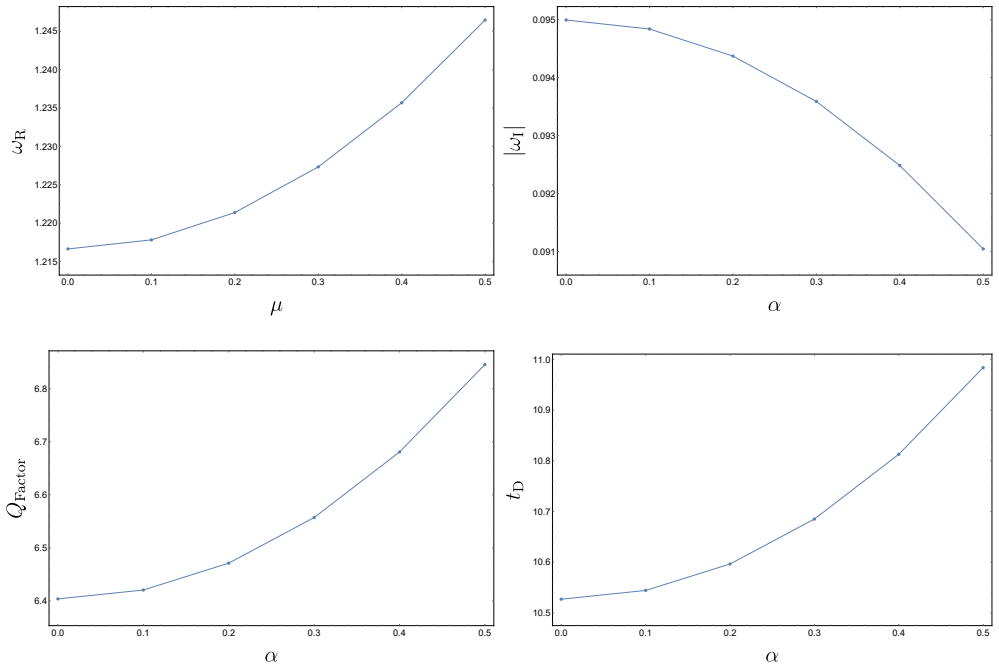
- The quasiclassical spectrum shifts systematically with α and γ (higher α → longer-lived oscillations; higher γ → shorter-lived), giving a target pattern for black-hole spectroscopy.
Reading between the lines
- I note that the document's outer abstract and title describe a 'phantom' electromagnetic field, while the full text consistently works with ModMax electrodynamics; these are physically different theories, and the body's identification should be taken as canonical for the results presented.
- Even granting the metric, the claimed linear stability is computed only for a test scalar field; extrapolating to gravitational perturbations would require a separate analysis, and Gauss-Bonnet theories in other dimensions are known to exhibit tensor instabilities.
- Since the entropy S=πr_+^2+4πα ln r_+ is independent of γ while mass and temperature depend on γ only through q^2 e^{−γ}, a measurement of any two of these could isolate the ModMax screening from the bare charge.
- The eikonal QNM damping tends to a constant independent of ℓ, consistent with the geometric-optics relation to the photon sphere; comparing the photon-sphere radius inferred from QNMs with the ISCO inferred from accretion could provide a consistency test of the e^{−γ} screening.
Editorial analysis
A structured set of objections, weighed in public.
Referee Report
Summary. The paper derives a static, spherically symmetric charged black hole solution in four-dimensional Einstein-Gauss-Bonnet gravity coupled to ModMax nonlinear electrodynamics, Eq. (22), using the Glavan-Lin regularization α→α/(D−4). From this metric function the authors compute the horizon structure, mass, Hawking temperature, entropy, specific heat, Helmholtz free energy, geodesic motion and ISCO parameters, and the quasinormal spectrum of a massive scalar field using sixth-order WKB with Padé approximants and the Pöschl–Teller approximation. The paper reports a minimum-mass remnant, a temperature maximum, modified ISCO radii as α and γ vary, and QNM frequencies that depend on α, γ, and μ, and concludes linear stability from the negativity of Im ω.
Significance. If the underlying 4D EGB framework is accepted, the paper provides a complete and internally consistent thermodynamic and dynamical analysis of a new exact solution, with a useful parameter study. The algebraic derivation of the metric function is standard and correct conditional on the regularization, and the entropy follows self-consistently from dM/T. A genuine strength is the high-ℓ agreement between the WKB-Padé and Pöschl–Teller frequencies in Table 4 (agreement to ~0.1%), which gives confidence in the QNM numerics. The work is less significant if the Glavan-Lin limit is not a well-defined pure-metric theory, because the same expressions can be reinterpreted in a well-defined scalar-tensor theory only with extra work. The paper does not engage the substantial literature questioning the D→4 limit, and it contains an error in the local thermodynamic stability analysis. These issues currently prevent the results from being fully established.
major comments (3)
- [Sec. 2, Eq. (18)] The D→4 limit of the Gauss-Bonnet term is not unique for a purely metric theory; a large body of work (e.g., Gurses–Sisman–Tekin, Arrechea–del Rio–Senovilla, Fernandes–Mulhem–et al.) shows that the limit introduces a scalar degree of freedom and depends on the regularization scheme. The paper cites Glavan–Lin [17] and the Horndeski equivalence [21] but does not demonstrate that Eq. (22) is a solution of that scalar-tensor theory, nor does it address the counterarguments. Since every subsequent result is computed from Eq. (22), the claim that α labels a well-defined 4D-EGB theory is load-bearing and currently unsupported.
- [Sec. 3, Eqs. (37)-(38) and Fig. 4] The paper claims two divergence points for the specific heat, r1 and r2, and two locally stable physical regions (0<r+<r1 and rroot<r+<r2). However, for Q=e^{-γ}q²>0 and α>0, the expression (9Q+11α)(Q+3α) is always greater than (3Q+5α)², so the quantity inside the square root in Eq. (37) yields r1²<0. Thus r1 is always imaginary; the specific heat has only one positive divergence, r2. Consequently, the stated stable regions are incorrect, and the claim that small black holes with 0<r+<r1 are physical contradicts the earlier statement that r+<sqrt(α+e^{-γ}q²) have negative temperature. This is a substantive error in the thermodynamic analysis.
- [Sec. 3, Eq. (40) and Fig. 5] The Helmholtz free energy is used to conclude that small black holes are globally stable and large black holes are not. However, the spacetime is asymptotically flat (F→1 as r→∞), and the sign of F=M−TS relative to zero is not a valid global-stability criterion in the canonical ensemble without a reference background; e.g., Schwarzschild black holes have negative F but are thermodynamically unstable. The global-stability conclusion is therefore not established and needs either a proper ensemble comparison or a demonstrated reference state.
minor comments (5)
- [Title and Abstract] The title refers to 'phantom charged black holes', while the full text consistently uses 'ModMax' electrodynamics, which is not a phantom field. The abstract in the header also mentions 'absence of critical thermodynamic behavior', a claim not developed in the body. These inconsistencies should be resolved.
- [Sec. 3, Eq. (28)] The surface gravity is defined as κ=(1/2π)F'(r)|_{r+}, which would give T=F'/(4π²), inconsistent with the standard T=F'/(4π) used in Eq. (29). The prefactor should be 1/2, not 1/2π.
- [Sec. 5, Eqs. (55)-(56)] The symbol G(r) is reused for the metric function F(r), whereas G was earlier defined as F−1 in Eq. (20). This causes confusion in the radial wave equation and effective potential.
- [Sec. 5.2] The conclusion of 'linear stability' is based on WKB results for a finite set of low-lying modes and on the positivity of the effective potential. This supports stability for the modes considered but is not a proof; the wording should be softened.
- [General] There are numerous typographical and reference-quality issues (e.g., 'gravty', 'tthe', Ref. [8] dated 2025 instead of 2005, Ref. [12] incomplete) that should be corrected in a revised version.
Circularity Check
No significant circularity: the metric is derived algebraically from the stated action and all subsequent results are direct computations from it.
full rationale
The paper's central claim is the metric function Eq. (22), obtained by substituting a static, spherically symmetric ansatz and a purely electric ModMax field into the action, applying the stated D→4 regularization, and solving the resulting ordinary differential equation Eq. (19). No input quantity is defined in terms of an output: M, q, α, and γ are fixed inputs, and the reported thermodynamic quantities, geodesic relations, ISCO values, and scalar quasinormal frequencies are all computed directly from that metric function. The entropy, for example, follows from integrating dM/T rather than being imposed beforehand, so there is no fitted-input-called-prediction or self-definitional loop. The self-citations (Refs. [38], [61], [72-75]) appear only in literature surveys or as methodological references for WKB methods; none carries the central derivation. The Glavan-Lin D→4 limit is indeed contested in the literature, but a contested premise is a correctness risk, not circularity. Likewise, the abstract's claim of verification by time-domain evolution is not substantiated in the text, but that is an evidentiary gap, not a circular reduction. Thus no circular step is present and the derivation chain is self-contained in the relevant sense.
Assumptions & free parameters
free parameters (5)
- GB coupling alpha =
scanned: 0.1-1.0 (tables); 0.1-0.8 (ISCO)
- ModMax parameter gamma =
scanned: 0-1.0 (tables); 0.1-0.8 (ISCO)
- electric charge q =
q = 1 in all numerical work
- scalar field mass mu =
0 and 0.2 (Table 3); 0-0.5 (Fig. 13)
- black hole mass M =
M = 1 (normalization)
assumptions (6)
- domain assumption Glavan-Lin D -> 4 regularization (alpha -> alpha/(D-4), then D -> 4) yields a consistent 4D theory of Gauss-Bonnet gravity.
- domain assumption Purely electric ModMax configuration (P = 0) with gauge potential A_t = epsilon(r) captures the physically relevant sector.
- domain assumption ModMax Lagrangian (Eq. 3) with gamma >= 0 is the correct conformal and duality-invariant extension of Maxwell theory.
- standard math Entropy follows from dM = T dS at fixed charge, giving S = pi r+^2 + 4 pi alpha ln r+.
- domain assumption Sixth-order WKB with Pade approximants reliably computes the scalar QNM spectrum when l >= n, and the series has converged at sixth order.
- standard math The negative branch of the metric is physical; the positive branch is discarded as graviton-unstable.
Cite this review
Pith. "Pith review of Thermodynamic and Dynamical Properties of Phantom Charged Black Holes in 4D Einstein-Gauss-Bonnet Gravity." pith.science (2026). https://pith.science/paper/JNA3KBIO
@misc{pith2026260102717,
  author       = {Pith},
  title        = {Pith review of: Thermodynamic and Dynamical Properties of Phantom Charged Black Holes in 4D Einstein-Gauss-Bonnet Gravity},
  year         = {2026},
  howpublished = {\url{https://pith.science/paper/JNA3KBIO}},
  note         = {Machine review of arXiv:2601.02717}
}
read the original abstract
We present charged black hole solutions of regularized four dimensional Einstein Gauss Bonnet gravity coupled to a phantom electromagnetic field. We investigate the combined effects of higher curvature corrections and phantom charge on the horizon structure, thermodynamics, geodesic motion, and scalar perturbations. The phantom sector exhibits properties that differ qualitatively from those of the ordinary Maxwell case, including the absence of critical thermodynamic behavior and persistent thermal instability. Circular geodesics and accretion efficiency are also significantly modified. Quasinormal modes are computed using the sixth-order WKB approximation and verified through time-domain evolution. The results reveal characteristic signatures of both the Gauss Bonnet coupling and phantom electrodynamics, while confirming linear stability against scalar perturbations.
Figures


Figures from the paper (10 more)


Reference graph
Works this paper leans on
-
[76]
Ferrari, B
V. Ferrari, B. Mashhoon, Phys. Rev. D 30, 295 (1984) 25
1984
-
[17]
Glavan, C
D. Glavan, C. Lin, Phys. Lett.B 805, 135468 (2020)
2020
-
[21]
Lu, Yi Pang, Phys
H. Lu, Yi Pang, Phys. Lett. B 809, 135717 (2020)
2020
-
[1]
Joyce, B
A. Joyce, B. Jain, J. Khoury and Mark Trodden, Physics Reports 568,1 (2015)
2015
-
[2]
Barack et al., Class
L. Barack et al., Class. Quantum. Grav. 36, 143001 (2019)
2019
-
[3]
B. P. Abbott et al., Phys. Rev. Lett. 116, 061102 (2016)
2016
-
[4]
B. P. Abbott et al., Phys. Rev. Lett. 116, 241103(2016)
2016
-
[5]
B. P. Abbott et al., Phys. Rev. Lett. 118, 221101 (2017)
2017
Show all 76 references
-
[6]
B. P. Abbott et al., Phys. Rev. Lett. 119, 141101 (2017)
2017
-
[7]
Lovelock, J
D. Lovelock, J. Math. Phys. 12, 498 (1971)
1971
-
[8]
Dotti, R
G. Dotti, R. J. Gleiser, Class. Quantum Grav. 22, L1 (2025)
2025
-
[9]
Dotti, R
G. Dotti, R. J. Gleiser, Phys. Rev. D 72, 044018 (2005)
2005
-
[10]
R. J. Gleiser, G. Dotti, Phys. Rev. D 72, 124002 (2005)
2005
-
[11]
Beroiz, G
M. Beroiz, G. Dotti, R. J. Gleiser, Phys. Rev. D 76, 024012 (2007)
2007
-
[12]
R. A. Konoplya, A. Zhidenko, Phys. Rev. D 77, 104004 (2008)
2008
-
[13]
Candelas, G
P. Candelas, G. T. Horowitz, A. Strominger, E. Witten, Nucl. Phys. B 258, 46 (1985)
1985
-
[14]
Zwiebach, Phys
B. Zwiebach, Phys. Lett. B 156, 315 (1985)
1985
-
[15]
Zumino, Physics Reports 137, 109 (1986)
B. Zumino, Physics Reports 137, 109 (1986)
1986
-
[16]
D. J. Gross and J. H. Sloan, Nucl. Phys. B 291, 41 (1987)
1987
-
[18]
Y.Tomozawa, arXiv:1107.1424
-
[19]
Cognola, R
G. Cognola, R. Myrzakulov, L. Sebastiani, S. Zerbini, Phys. Rev. D 88, 024006 (2013)
2013
-
[20]
Rong-Gen Cai, Li-Ming Cao, N. Ohta, J. High Energ. Phys. 2010, 82 (2010)
2010
-
[22]
K. Aoki, M. A. Gorji and S. Mukohyama, Phys. Lett. B 810, 135843 (2020) 23
2020
-
[23]
C. Liu, T. Zhu and Q. Wu, Chin. Phys. C 45, 015105 (2021)
2021
-
[24]
Guo and P
M. Guo and P. C. Li, Eur. Phys. J. C 80, 588 (2020)
2020
-
[25]
SW. Wei, YX. Liu, Eur. Phys. J. Plus 136, 436 (2021)
2021
-
[26]
Zubair, M
M. Zubair, M. A. Raza, Phys. Dark Universe 40, 101200 (2023)
2023
-
[27]
Malafarina, B
D. Malafarina, B. Toshmatov and N. Dadhich, Phys. Dark Universe 30, 100598 (2020)
2020
-
[28]
S. A. H. Mansoori, Phys. Dark Universe 31, 100776 (2021)
2021
-
[29]
X. H. Ge and S. J. Sin, Eur. Phys. J. C 80, 695 (2020)
2020
-
[30]
Rayimbaev, A
J. Rayimbaev, A. Abdujabbarov, B. Turimov and F. Atamurotov, arXiv:2004.10031
2004 arXiv
-
[31]
Chakraborty and N
S. Chakraborty and N. Dadhich, Phys. Dark Universe 30, 100658 (2020)
2020
-
[32]
Odintsov, V.K
S.D. Odintsov, V.K. Oikonomou, Phys.Lett B 805, 135437 (2020)
2020
-
[33]
Z. C. Lin, K. Yang, S. W. Wei, Y. Q. Wang and Y. X. Liu, Eur.Phys. J. C 80, 1033 (2020)
2020
-
[34]
Shaymatov, J
S. Shaymatov, J. Vrba, D. Malafarina, B. Ahmedov and Z. Stuchlik, Phys. Dark Universe 30, 100648 (2020)
2020
-
[35]
Ul Islam, R
S. Ul Islam, R. Kumar, S. G. Ghosh, JCAP 2020,30 (2020)
2020
-
[36]
S. G. Ghosh, D. V. Singh, R.Kumar, S. D. Maharaj, Ann. Phys. 424, 168347 (2021)
2021
-
[37]
J. M. Ladino1, E. Larranaga, Int. J.Theo. Phys. 62, 209 (2023)
2023
-
[38]
Birkandan, Nucl
B.Hamil and T. Birkandan, Nucl. Phys. B 1020, 117145 (2025)
2025
-
[39]
Physik 98, 714 (1936)
W.Heisenberg, E.Euler, Z. Physik 98, 714 (1936)
1936
-
[40]
J.Schwinger,Phys. Rev. 82, 664 (1951)
1951
-
[41]
S.L.Adler, Ann. Phys. 67, 599 (1971)
1971
-
[42]
Salim, Phys
V.A.De Lorenci, R.Klippert, M.Novello, J.S. Salim, Phys. Rev. D 65, 063501 (2002)
2002
-
[43]
In: Conference Proceedings of GR5 Non-Singular General Relativistic Gravi- tational Collapse: Tbilisi, Georgia, USSR, p
Bardeen, J.M., 1968. In: Conference Proceedings of GR5 Non-Singular General Relativistic Gravi- tational Collapse: Tbilisi, Georgia, USSR, p. 174
1968
-
[44]
Ayon-Beato, A
E. Ayon-Beato, A. Garcia, Phys. Rev. Lett. 80, 5056 (1998)
1998
-
[45]
M. Born, L. Infeld, Proc. R. Soc. Lond. A 144 (852), 425 (1934)
1934
-
[46]
Gibbons, D.A
G.W. Gibbons, D.A. Rasheed, Nucl. Phys. B 454, 185 (1995)
1995
-
[47]
Bandos, K
I. Bandos, K. Lechner, D. Sorokin, P.K. Townsend, Phys. Rev. D 102, 121703 (2020)
2020
-
[48]
Kosyakov, Phys
B.P. Kosyakov, Phys. Lett. B 810, 135840 (2020)
2020
-
[49]
Flores-Alfonso, B
D. Flores-Alfonso, B. A. González-Morales, R. Linares, and M. Maceda, Phys. Lett. B 812, 136011 (2021)
2021
-
[50]
Bandos, K
I. Bandos, K. Lechner, D. Sorokin, P.K. Townsend, JHEP 2021, 22 (2021)
2021
-
[51]
Eslam Panah , N
B. Eslam Panah , N. Heidari, J.High Energy Astrophysics 45, 181 (2025) 24
2025
-
[52]
Eslam Panah, Phys
B. Eslam Panah, Phys. Lett. B 868, 139711 (2025)
2025
-
[53]
Eslam Panah, B Hazarika, P Phukon, PTEP 2024 , 083 (2024)
B. Eslam Panah, B Hazarika, P Phukon, PTEP 2024 , 083 (2024)
2024
-
[54]
A. Q. Baptista and M. L. Penafiel, Phys. Rev D 112, 024037 (2025)
2025
-
[55]
R. C. Pantig, L. Mastrototaro, G. Lambiase, and A. Övgün, Eur.Phys. J. C 82, 1155 (2022)
2022
-
[56]
Barrientos, A
J. Barrientos, A. Cisterna, D. Kubiznak, and J. Oliva, Phys. Lett. B 834, 137447 (2022)
2022
-
[57]
Habib Mazharimousavi, Int
S. Habib Mazharimousavi, Int. J.Geo. Meth.Mod. Phys. 19,2250204 (2022)
2022
-
[58]
Guzman-Herrera and N
E. Guzman-Herrera and N. Breton, J. Cosmol. Astropart.Phys. 01,041 (2024)
2024
-
[59]
Guzman-Herrera, A
E. Guzman-Herrera, A. Montiel, and N. Breton, J. Cosmol.Astropart. Phys. 11, 002 (2024)
2024
-
[60]
Bokulic and C
A. Bokulic and C. A. Herdeiro, Phys. Rev. D 111, 064046 (2025)
2025
-
[61]
Eslam Panah, B
B. Eslam Panah, B. Hamil, Manuel E. Rodrigues, arXiv:2512.22654 [gr-qc]
-
[62]
Lanczos, Ann
C. Lanczos, Ann. of Math. 39, 842 (1938)
1938
-
[63]
Wheeler, Nucl
J.T. Wheeler, Nucl. Phys.B 268, 737 (1986)
1986
-
[64]
Vishveshwara, Nature 227, 936 (1970)
C.V. Vishveshwara, Nature 227, 936 (1970)
1970
-
[65]
Kokkotas, B.G
K.D. Kokkotas, B.G. Schmidt, Living Rev. Relativ. 2, 2 (1999)
1999
-
[66]
S. S. Hegde, V. Subramanyan, B. Bradlyn, and S. Vishveshwara, Phys. Rev. Lett. 123, 156802 (2019)
2019
-
[67]
R. A. Konoplya, Rev. Mod. Phys. 83, 793 (2011)
2011
-
[68]
Iyer and C
S. Iyer and C. M. Will, Phys. Rev. D 35, 3621 (1987)
1987
-
[69]
R. A. Konoplya, Phys. Rev. D 68, 024018 (2003)
2003
-
[70]
A.Konoplya, J
R. A.Konoplya, J. Phys. Stud. 8, 93 (2004)
2004
-
[71]
J.Matyjasek and M.Opala, Phys. Rev. D 96, 024011 (2017)
2017
-
[72]
B.Hamil, B. C. Lutfuoglu, Fortsch. Phys 73, 2400105 (2025)
2025
-
[73]
B.Hamil, B. C. Lutfuoglu, Ann. Phys. 472, 169861 (2025)
2025
-
[74]
B.Hamil, B. C. Lutfuoglu, Dark Universe 44, 101484 (2024)
2024
-
[75]
B.Hamil, B. C. Lutfuoglu, Gen Relativ Gravit 57, 140 (2025)
2025
Reviewed August 3, 2026 · model on record in the stance chip above.
Discussion (0). Sign in to comment.