REVIEW 4 major objections 5 minor 77 references
Subspace Selected Variational Quantum Configuration Interaction with a Partial Walsh Series
T0 review · 4 major / 5 minor · reviewed 2026-08-03 · deepseek-v4-flash
Pith's one-line read A variational quantum eigensolver ansatz encodes a configuration-interaction wavefunction as a uniform superposition over selected determinants followed by a diagonal Walsh-operator product, yielding exact full-CI energies with a gate count
desk verdict Promising ansatz and strong numerics undercut by a normalization error in the exact-encoding claim and a wrong 50% success probability. read the letter →
The pith
A machine-rendered reading of the paper's core claim, the machinery that carries it, and where it could break.
The reading
What carries the argument
The central object is the dilated diagonal unitary U = [[Σ+ , 0], [0, Σ−]] acting on the system plus one ancilla, where Σ+ and Σ− are conjugate diagonal matrices whose average reproduces the CI coefficient matrix. U is implemented as a product of Walsh operators e^{i a_j w_j}, with Walsh coefficients a_j obtained from the CI coefficients by a restricted Walsh-Fourier transform over the D selected determinants. This identity is what converts a nonunitary coefficient-encoding problem into a concrete circuit: a superposition over the subspace, a Walsh-operator product, and a post-selected ancilla measurement.
What would settle it
Take the paper's H2 FCI example: two determinants, coefficients c ≈ 0.99 and c ≈ 0.14. Compute Σ±k from Eq. (4): the first entry has magnitude √2·0.99 ≈ 1.40 > 1, so the matrix is not a valid unitary. A direct numerical check of the circuit's dilation therefore fails, which would disprove the exact-encoding claim as written unless an alternative normalization is supplied.
Extended reading notes
Core claim
The central claim is that any CI wavefunction over a chosen subspace of Slater determinants can be prepared exactly on a quantum computer: uniformly superpose the D bitstrings of the subspace, then apply a diagonal operator whose eigenvalues are the CI coefficients, embedded as a unitary on an extra ancilla qubit via a dilation. Because the diagonal operator is written as a product of Walsh operators (diagonal Pauli strings), it can be implemented with RZ rotation angles given by the Walsh transform of the coefficient vector, using O(D) CNOT gates and exactly D rotation parameters. The paper argues this gives an exact representation of the FCI state when all determinants are included, near-e
Load-bearing premise
The claim that the circuit exactly encodes the CI wavefunction rests on an unstated normalization condition: after the subspace superposition, every target coefficient must satisfy |c_k| ≤ 1/√D (in magnitude, up to the ancilla dilation), and the paper's own H2 example exceeds this bound.
Editorial extensions
If this is right
- With a full CI expansion, the ansatz yields the exact ground state with a circuit whose CNOT count is linear in the number of Slater determinants, matching or beating conventional hardware-efficient VQE circuits.
- Within a selected-CI subspace, energies improve systematically as the subspace grows, with fidelity rising from 0.991 to 0.994 to 1.000 in the paper's H2O example as the threshold tightens.
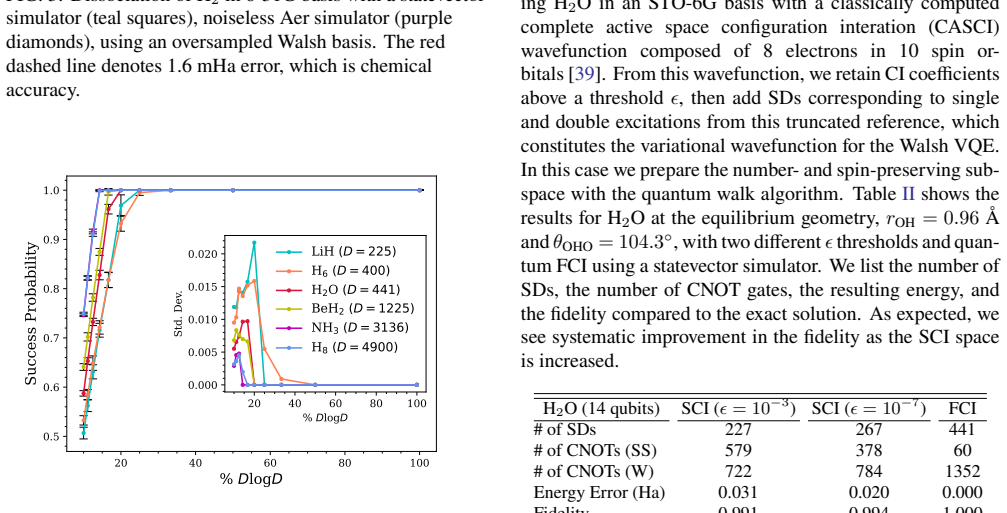
- For large problems, choosing D log D random Walsh functions instead of D exactly yields a full-rank transform with probability approaching 1 as D grows, trading a small amount of overparameterization for an O(D^2 log D) classical preprocessing cost.
- Because the ansatz is diagonal and commutative, it does not form a 2-design, which the paper argues mitigates barren plateaus and spurious local minima during the VQE optimization.
- The subspace-selection step is independent of the ansatz, so the method can impose particle-number, spin, or other symmetries by choosing the superposition, and extends to any Hamiltonian written in a qubit basis.
Reading between the lines
- A direct extension the paper only hints at: replacing the uniform superposition with a symmetry-adapted one (translational, parity) would let the same Walsh encoding prepare ground states of lattice models, not just molecules.
- The random oversampling result suggests an empirical rule: roughly half of D log D Walsh functions suffice for full rank. Testing this on larger D could turn a probabilistic statement into a practical heuristic with a proven success probability.
- Because the ansatz is diagonal, it could be composed with non-diagonal cluster operators to form a hybrid ansatz for multireference coupled-cluster, a direction the paper mentions as future work.
Editorial analysis
A structured set of objections, weighed in public.
Referee Report
Summary. The paper proposes a variational quantum eigensolver (VQE) ansatz for molecular ground states. A uniform superposition over selected Slater determinants is acted on by a diagonal unitary built from Walsh operators, dilated with one ancilla; the resulting amplitudes are supposed to encode the CI coefficients. The authors claim exact FCI/SCI state preparation with a number of CNOT gates linear in the number of determinants D, a constant 50% success probability, and absence of barren-plateau overparameterization. They present simulations for H2, H6, H2O, and a hardware demonstration for H2 on IBMQ Torino.
Significance. The numerical demonstrations are encouraging, and the idea of a systematically improvable, diagonal, subspace-selected ansatz is potentially interesting. The paper also ships code and data on Zenodo, which is a concrete strength. However, the central exact-encoding derivation is not self-consistent: the normalization of the subspace superposition is mishandled in Eq. (5), the success probability is not 50% for general D, and Eq. (7) identifies the Walsh coefficients with the transform of the CI coefficients rather than with the transform of the phase angles required by Eq. (6). These are load-bearing issues for the main claim, and the scaling statements in the abstract and conclusions are also inconsistent. The method may be salvageable after a substantial revision, but the paper as written does not establish its central theoretical claims.
major comments (4)
- [Theory and Methods, Eqs. (3)-(5)] The exact-encoding equation omits the normalization of |S>. With |S> = D^{-1/2} Σ_k |ψ_k>, the ancilla-|0> branch before postselection is (1/2)(Σ+ + Σ-)|S> = Σ|S> = D^{-1/2} Σ_k c_k |ψ_k> = D^{-1/2}|Ψ>, not |Ψ>. The postselection probability is ||Σ|S>||^2 = (1/D) Σ_k |c_k|^2 = 1/D, not 50%, except for D=2. The sentence claiming each conditioned wavefunction has unit norm and that each outcome occurs half the time is therefore incorrect. For H6 (D=400) the success probability would be 0.25%, which materially affects the practical claim.
- [Theory and Methods, Eqs. (6)-(7)] The Walsh coefficients a_j in Eq. (7) are defined as the Walsh-Hadamard transform of the CI coefficients c_k, but the diagonal entries of U in Eq. (6) are exp(i Σ_j a_j (-1)^{<k,j>}). To represent Σ+ = diag(c_k + i sqrt(1-c_k^2)), the phases must be arccos(c_k), so the correct relation is a_j = 2^{-r} Σ_k arccos(c_k) (-1)^{<k,j>}. As written, Eq. (7) does not provide a unitary whose diagonal is Σ±, and the exact-encoding claim is not derivable. The full-rank/oversampling analysis is performed on the linear map c -> a, not on the actual state-preparation map, so it does not establish expressibility of the final wavefunction.
- [Results and Conclusions, scaling claims] The scaling claims are inconsistent: the abstract and Results state O(D) CNOTs for the Walsh ansatz, while Conclusions states O(D log D) CNOTs. Moreover, no circuit decomposition is supplied for Eq. (6) that justifies either count. A product over O(D log D) Walsh operators implemented with standard Gray-code methods would cost O(r D log D) two-qubit gates in general. Table I reports numerical counts, but no formula or derivation is given. Since the claimed linear scaling is one of the central selling points, this needs to be stated precisely and proved or corrected.
- [Results, Table II and VQE optimization] The paper reports that the quantum FCI result matches classical FCI to machine precision, but it does not clarify whether Eq. (7) was used as an initialization or as an exact encoding, nor how many VQE iterations were required. Given the inconsistency between Eqs. (6) and (7), the numerical exactness cannot be attributed to the Walsh-series construction from the written theory. The role of Eq. (7) in the optimizer should be stated explicitly, and the numerical results should be re-analyzed under the corrected Walsh-phase relation.
minor comments (5)
- [Eq. (4)] The expression inside the square root is typeset as '1 - c_k/||c_k||', which is dimensionally inconsistent. It should presumably be 1 - (c_k/||c||)^2, with ||c|| the norm of the full CI vector. Please correct the notation.
- [Figure 2] The text says the Torino noisy simulator is shown with blue circles and the Torino device with green triangles, but the legend lists 'ibmq_torino' (blue) and 'fake_torino' (green). The colors are swapped relative to the text.
- [Results, Figure 3] The text in the Results section says the example is H2O in a 6-31G basis, but Figure 3 is captioned as the dissociation of H2 in 6-31G. Please correct the mismatch in the text, figure caption, or both.
- [Theory/Conclusions] The manuscript states both that the O(D log D) Walsh circuit is 'overparameterized' and that the ansatz 'introduces no overparameterization of the chosen subspace.' These statements should be explicitly separated into the QR mode and the random-oversampling mode.
- [Throughout] There are several typos, e.g., 'resuling' in the abstract, 'probabalistical' in the introduction, and 'dissocation' in the Figure 2 caption. A careful proofreading pass is needed.
Circularity Check
No material circularity: the variational energy results are not fitted to FCI outputs, and the self-citation [46] supplies a standard dilation identity that is restated in Eq. (4).
full rationale
The central construction (Eqs. 4-7) is a state-preparation ansatz: the diagonal matrices Sigma_+ and Sigma_- are defined so that (Sigma_+ + Sigma_-)/2 equals diag(c_k), and the ancilla-dilated circuit is intended to prepare the CI state |Psi>. This is a construction, not a prediction derived from the thing it predicts. The reported ground-state energies come from VQE optimization against Hamiltonian expectation values, not from inserting classically computed FCI coefficients into the circuit and calling the resulting energy a prediction. The self-citation [46] is used for the diagonal-operator dilation identity, but the identity is also stated explicitly in the text and is a simple algebraic fact, so the load-bearing step does not reduce to an unverified self-citation chain. No uniqueness theorem from the authors' prior work is invoked, and no fitted parameter is renamed as a prediction. There are serious internal correctness concerns that are not circularity: Eq. (5) drops the 1/sqrt(D) normalization if |S> is the normalized uniform superposition, making the claimed 50% success probability incorrect (it would be 1/D), and Eq. (7) sets Walsh coefficients to the transform of c_k rather than of arccos(c_k) required by Eq. (4). These are mathematical errors in the printed derivation, not circular reductions of the paper's claims to their inputs. Under the specified rubric, the paper's derivation chain is not circular.
Assumptions & free parameters
free parameters (2)
- Walsh oversampling ratio α =
≈0.5 (50% of D log D observed to give full-rank WFT)
- SCI truncation threshold ε =
10^-3 and 10^-7 in Table II
assumptions (5)
- domain assumption The dilated diagonal operator U = [[Σ+,0],[0,Σ-]] with Σ± = C ± i√(1-C²) is a valid unitary dilation for a diagonal operator C with |C_kk|≤1.
- standard math Any diagonal unitary on r qubits can be decomposed as ∏_j e^{i a_j w_j} using O(2^r) Walsh operators (Welch et al.).
- standard math Randomly selecting O(D log D) Walsh functions gives a full-rank Walsh-Fourier transform with probability 1 - O(1/D) (Tropp).
- domain assumption The molecular electronic Hamiltonian (Eq. 1) maps via Jordan-Wigner to a qubit Hamiltonian.
- domain assumption Uniform superpositions over selected Slater determinant subspaces can be prepared with Dicke/quantum walk algorithms.
Cite this review
Pith. "Pith review of Subspace Selected Variational Quantum Configuration Interaction with a Partial Walsh Series." pith.science (2026). https://pith.science/paper/BBPDCDFQ
@misc{pith2026260107037,
  author       = {Pith},
  title        = {Pith review of: Subspace Selected Variational Quantum Configuration Interaction with a Partial Walsh Series},
  year         = {2026},
  howpublished = {\url{https://pith.science/paper/BBPDCDFQ}},
  note         = {Machine review of arXiv:2601.07037}
}
read the original abstract
Estimating the ground-state energy of a quantum system is one of the most promising applications for quantum algorithms. Here we propose a variational quantum eigensolver (VQE) \emph{Ansatz} for finding ground state configuration interaction (CI) wavefunctions. We map CI for fermions to a quantum circuit using a subspace superposition, then apply diagonal Walsh operators to encode the wavefunction. The algorithm can be used to solve both full CI and selected CI wavefunctions, resuling in exact and near-exact solutions for electronic ground states. Both the subspace selection and wavefunction \emph{Ansatz} can be applied to any Hamiltonian that can be written in a qubit basis. The algorithm bypasses costly classical matrix diagonalizations, which is advantageous for large-scale applications. We demonstrate results for several molecules using quantum simulators and hardware.
Figures


Figures from the paper (1 more)
Reference graph
Works this paper leans on
-
[1]
D. S. Abrams and S. Lloyd, Simulation of many-body fermi systemsonauniversalquantumcomputer,Phys.Rev.Lett.79, 2586 (1997)
1997
-
[2]
D. S. Abrams and S. Lloyd, Quantum algorithm providing exponential speed increase for finding eigenvalues and eigen- vectors, Phys. Rev. Lett.83, 5162 (1999)
1999
-
[3]
McArdle, T
S. McArdle, T. Jones, S. Endo, Y. Li, S. C. Benjamin, and X. Yuan, Variational ansatz-based quantum simulation of imaginary time evolution, npj Quantum Information5, 75 (2019)
2019
-
[4]
Aspuru-Guzik, A
A. Aspuru-Guzik, A. D. Dutoi, P. J. Love, and M. Head- Gordon, Simulated Quantum Computation of Molecular En- ergies, Science309, 1704 (2005)
2005
-
[5]
Almeida,I.Kassal,J.D.Biamonte,M.Mohseni,B.J.Powell, M
B.P.Lanyon,J.D.Whitfield,G.G.Gillett,M.E.Goggin,M.P. Almeida,I.Kassal,J.D.Biamonte,M.Mohseni,B.J.Powell, M. Barbieri, A. Aspuru-Guzik, and A. G. White, Towards quantumchemistryonaquantumcomputer,NatureChemistry 2, 106 (2010)
2010
-
[6]
McArdle, S
S. McArdle, S. Endo, A. Aspuru-Guzik, S. C. Benjamin, and X. Yuan, Quantum computational chemistry, Rev. Mod. Phys. 92, 015003 (2020)
2020
-
[7]
P. J. J. O’Malley, R. Babbush, I. D. Kivlichan, J. Romero, J. R. McClean, R. Barends, J. Kelly, P. Roushan, A. Tran- ter, N. Ding, B. Campbell, Y. Chen, Z. Chen, B. Chiaro, A.Dunsworth,A.G.Fowler,E.Jeffrey,E.Lucero,A.Megrant, J. Y. Mutus, M. Neeley, C. Neill, C. Quintana, D. Sank, A. Vainsencher, J. Wenner, T. C. White, P. V. Coveney, P. J. Love, H. Neven...
2016
-
[8]
A.Peruzzo,J.McClean,P.Shadbolt,M.-H.Yung,X.-Q.Zhou, P. J. Love, A. Aspuru-Guzik, and J. L. O’Brien, A variational eigenvalue solver on a photonic quantum processor, Nature Communications5, 4213 (2014)
2014
Show all 77 references
-
[9]
J.R.McClean,J.Romero,R.Babbush,andA.Aspuru-Guzik, Thetheoryofvariationalhybridquantum-classicalalgorithms, New Journal of Physics18, 023023 (2016)
2016
-
[10]
P.G.Szalay,T.Müller,G.Gidofalvi,H.Lischka,andR.Shep- ard, Multiconfiguration Self-Consistent Field and Multiref- erence Configuration Interaction Methods and Applications, Chemical Reviews112, 108 (2012)
2012
-
[11]
Chan, C.-M
J.P.F.LeBlanc,A.E.Antipov,F.Becca,I.W.Bulik,G.K.-L. Chan, C.-M. Chung, Y. Deng, M. Ferrero, T. M. Henderson, C. A. Jiménez-Hoyos, E. Kozik, X.-W. Liu, A. J. Millis, N. V. Prokof’ev, M. Qin, G. E. Scuseria, H. Shi, B. V. Svistunov, L. F. Tocchio, I. S. Tupitsyn, S. R. White, S....
2015
-
[12]
Gagliardi, D
L. Gagliardi, D. G. Truhlar, G. Li Manni, R. K. Carlson, C. E. Hoyer, and J. L. Bao, Multiconfiguration Pair-Density Functional Theory: A New Way To Treat Strongly Correlated Systems, Accounts of Chemical Research50, 66 (2017)
2017
-
[13]
S.PaschenandQ.Si,Quantumphasesdrivenbystrongcorre- lations, Nature Reviews Physics3, 9 (2021)
2021
-
[14]
A.Katabarwa,K.Gratsea,A.Caesura,andP.D.Johnson,Early fault-tolerant quantum computing, PRX Quantum5, 020101 (2024)
2024
-
[15]
A.Y.Kitaev,Quantummeasurementsandtheabelianstabilizer problem (1995), arXiv:quant-ph/9511026 [quant-ph]
1995 arXiv
-
[16]
J. Du, N. Xu, X. Peng, P. Wang, S. Wu, and D. Lu, NMR implementation of a molecular hydrogen quantum simulation with adiabatic state preparation, Phys. Rev. Lett.104, 030502 (2010)
2010
-
[17]
J. Yu, J. R. Moreno, J. T. Iosue, L. Bertels, D. Claudino, B.Fuller,P.Groszkowski,T.S.Humble,P.Jurcevic,W.Kirby, T. A. Maier, M. Motta, B. Pokharel, A. Seif, A. Shehata, K. J. Sung,M.C.Tran,V.Tripathi,A.Mezzacapo,andK.Sharma, Quantum-centricalgorithmforsample-basedkrylovdiagon...
2025
-
[18]
Motta, C
M. Motta, C. Sun, A. T. K. Tan, M. J. O’Rourke, E. Ye, A. J. Minnich,F.G.S.L.Brandão,andG.K.-L.Chan,Determining eigenstates and thermal states on a quantum computer using quantum imaginary time evolution, Nature Physics16, 205 (2020)
2020
-
[19]
S.E.SmartandD.A.Mazziotti,Quantumsolverofcontracted eigenvalue equations for scalable molecular simulations on quantum computing devices, Phys. Rev. Lett.126, 070504 (2021)
2021
-
[20]
Paesani, A
S. Paesani, A. A. Gentile, R. Santagati, J. Wang, N. Wiebe, D. P. Tew, J. L. O’Brien, and M. G. Thompson, Experimental bayesianquantumphaseestimationonasiliconphotonicchip, Phys. Rev. Lett.118, 100503 (2017)
2017
-
[21]
Kandala, A
A. Kandala, A. Mezzacapo, K. Temme, M. Takita, M. Brink, J. M. Chow, and J. M. Gambetta, Hardware-efficient varia- tional quantum eigensolver for small molecules and quantum magnets, Nature549, 242 (2017)
2017
-
[22]
Zhang, T
Z.-J. Zhang, T. H. Kyaw, J. S. Kottmann, M. Degroote, and A.Aspuru-Guzik,Mutualinformation-assistedadaptivevaria- tionalquantumeigensolver,QuantumScienceandTechnology 6, 035001 (2021)
2021
-
[23]
Zhang, L
Y. Zhang, L. Cincio, C. F. A. Negre, P. Czarnik, P. J. Coles, P. M. Anisimov, S. M. Mniszewski, S. Tretiak, and P. A. Dub, Variational quantum eigensolver with reduced circuit com- plexity, npj Quantum Information8, 96 (2022)
2022
-
[24]
H.R.Grimsley,S.E.Economou,E.Barnes,andN.J.Mayhall, An adaptive variational algorithm for exact molecular simu- lations on a quantum computer, Nature Communications10, 3007 (2019)
2019
-
[25]
Y. S. Yordanov, V. Armaos, C. H. W. Barnes, and D. R. M. Arvidsson-Shukur, Qubit-excitation-based adaptive varia- tional quantum eigensolver, Communications Physics4, 228 (2021)
2021
-
[26]
H. L. Tang, V. Shkolnikov, G. S. Barron, H. R. Grimsley, N.J.Mayhall,E.Barnes,andS.E.Economou,Qubit-ADAPT- VQE: An Adaptive Algorithm for Constructing Hardware- Efficient Ansätze on a Quantum Processor, PRX Quantum 2, 020310 (2021)
2021
-
[27]
P. G. Anastasiou, Y. Chen, N. J. Mayhall, E. Barnes, and S. E. Economou, TETRIS-ADAPT-VQE: An adaptive algo- rithm that yields shallower, denser circuit Ansätze, Physical Review Research6, 013254 (2024)
2024
-
[28]
Ramôa, P
M. Ramôa, P. G. Anastasiou, L. P. Santos, N. J. Mayhall, E. Barnes, and S. E. Economou, Reducing the resources re- quiredbyADAPT-VQEusingcoupledexchangeoperatorsand improvedsubroutines,npjQuantumInformation11,86(2025)
2025
-
[29]
Kanno, M
K. Kanno, M. Kohda, R. Imai, S. Koh, K. Mitarai, W. Mizukami, and Y. O. Nakagawa, Quantum-selected con- figuration interaction: classical diagonalization of hamilto- nians in subspaces selected by quantum computers (2023), arXiv:2302.11320 [quant-ph]
2023 arXiv
-
[30]
Barison, J
S. Barison, J. Robledo Moreno, and M. Motta, Quantum- centriccomputationofmolecularexcitedstateswithextended sample-basedquantumdiagonalization,QuantumScienceand Technology10, 025034 (2025)
2025
-
[31]
Robledo-Moreno, M
J. Robledo-Moreno, M. Motta, H. Haas, A. Javadi-Abhari, P. Jurcevic, W. Kirby, S. Martiel, K. Sharma, S. Sharma, T. Shirakawa, I. Sitdikov, R.-Y. Sun, K. J. Sung, M. Takita, M. C. Tran, S. Yunoki, and A. Mezzacapo, Chemistry be- yond the scale of exact diagonalization on a qua...
2025
-
[32]
K.Sugisaki,S.Kanno,T.Itoko,R.Sakuma,andN.Yamamoto, Hamiltonian simulation-based quantum-selected configura- tion interaction for large-scale electronic structure calcula- tionswithaquantumcomputer,PhysicalChemistryChemical Physics27, 20869 (2025)
2025
-
[33]
Danilov, J
D. Danilov, J. Robledo-Moreno, K. J. Sung, M. Motta, and J. Shee, Enhancing the Accuracy and Efficiency of Sample- Based Quantum Diagonalization with Phaseless Auxiliary- FieldQuantumMonteCarlo,JournalofChemicalTheoryand Computation21, 11585 (2025)
2025
-
[34]
J. R. McClean, S. Boixo, V. N. Smelyanskiy, R. Babbush, and H.Neven,Barrenplateausinquantumneuralnetworktraining landscapes, Nature Communications9, 4812 (2018)
2018
-
[35]
Larocca, S
M. Larocca, S. Thanasilp, S. Wang, K. Sharma, J. Bia- monte, P. J. Coles, L. Cincio, J. R. McClean, Z. Holmes, and M.Cerezo,Barrenplateausinvariationalquantumcomputing, Nature Reviews Physics7, 174 (2025)
2025
-
[36]
Qi, C.-H
J. Qi, C.-H. H. Yang, P.-Y. Chen, and M.-H. Hsieh, Random- matrix-induced simplicity bias in over-parameterized varia- tional quantum circuits (2026), arXiv:2601.01877 [quant-ph]
2026
-
[37]
Motta, K
M. Motta, K. J. Sung, K. B. Whaley, M. Head-Gordon, and J.Shee,Bridgingphysicalintuitionandhardwareefficiencyfor correlated electronic states: the local unitary cluster Jastrow ansatz for electronic structure, Chemical Science14, 11213 7 (2023)
2023
-
[38]
Sauer, and J
P.Reinholdt,K.M.Ziems,E.R.Kjellgren,S.Coriani,S.P.A. Sauer, and J. Kongsted, Critical Limitations in Quantum- SelectedConfigurationInteractionMethods,JournalofChem- ical Theory and Computation21, 6811 (2025)
2025
-
[39]
Szabo and N
A. Szabo and N. S. Ostlund,Modern quantum chemistry: in- troduction to advanced electronic structure theory(Courier Corporation, 2012)
2012
-
[40]
G. H. Booth, A. Grüneis, G. Kresse, and A. Alavi, Towards anexactdescriptionofelectronicwavefunctionsinrealsolids, Nature493, 365 (2013)
2013
-
[41]
A. A. Holmes, N. M. Tubman, and C. J. Umrigar, Heat-Bath Configuration Interaction: An Efficient Selected Configura- tion Interaction Algorithm Inspired by Heat-Bath Sampling, JournalofChemicalTheoryandComputation12,3674(2016), publisher: American Chemical Society
2016
-
[42]
R. H. Dicke, Coherence in spontaneous radiation processes, Phys. Rev.93, 99 (1954)
1954
-
[43]
M. A. Nielsen and I. L. Chuang,Quantum Computation and Quantum Information: 10th Anniversary Edition(Cambridge University Press, 2010)
2010
-
[44]
Bärtschi and S
A. Bärtschi and S. Eidenbenz, Deterministic preparation of dicke states, inInternational Symposium on Fundamentals of Computation Theory(Springer, 2019) pp. 126–139
2019
-
[45]
Gonzales, R
A. Gonzales, R. Herrman, C. Campbell, I. Gaidai, J. Liu, T.Tomesh,andZ.H.Saleem,Efficientsparsestatepreparation via quantum walks, npj Quantum Information11, 143 (2025)
2025
-
[46]
A. W. Schlimgen, K. Head-Marsden, L. M. Sager-Smith, P. Narang, and D. A. Mazziotti, Quantum state preparation and nonunitary evolution with diagonal operators, Phys. Rev. A106, 022414 (2022)
2022
-
[47]
Golubov, A
B. Golubov, A. Efimov, and V. Skvortsov,Walsh Se- ries and Transforms: Theory and Applications, edited by M. Hazewinkel, Mathematics and Its Applications, Vol. 64 (Springer Netherlands, Dordrecht, 1991)
1991
-
[48]
Welch, D
J. Welch, D. Greenbaum, S. Mostame, and A. Aspuru-Guzik, Efficient quantum circuits for diagonal unitaries without an- cillas, New Journal of Physics16, 033040 (2014)
2014
-
[49]
J.A.Tropp,Improvedanalysisofthesubsampledrandomized hadamard transform, Advances in Adaptive Data Analysis03, 115 (2011)
2011
-
[50]
Virtanen, R
P. Virtanen, R. Gommers, T. E. Oliphant, M. Haber- land, T. Reddy, D. Cournapeau, E. Burovski, P. Peterson, W. Weckesser, J. Bright,et al., Scipy 1.0: fundamental al- gorithms for scientific computing in python, Nature methods 17, 261 (2020)
2020
-
[51]
R. J. Bartlett and M. Musiał, Coupled-cluster theory in quan- tum chemistry, Reviews of Modern Physics79, 291 (2007)
2007
-
[52]
Q. Sun, T. C. Berkelbach, N. S. Blunt, G. H. Booth, S. Guo, Z. Li, J. Liu, J. D. McClain, E. R. Sayfutyarova, S. Sharma, S. Wouters, and G. K.-L. Chan, PySCF: the Python-based simulations of chemistry framework, WIREs Computational Molecular Science8, e1340 (2018)
2018
-
[53]
J.D.Whitfield,J.Biamonte,andA.Aspuru-Guzik,Simulation of electronic structure Hamiltonians using quantum comput- ers, Molecular Physics109, 735 (2011)
2011
-
[54]
J. R. McClean, N. C. Rubin, K. J. Sung, I. D. Kivlichan, X. Bonet-Monroig, Y. Cao, C. Dai, E. S. Fried, C. Gidney, B. Gimby, P. Gokhale, T. Häner, T. Hardikar, V. Havlíček, O. Higgott, C. Huang, J. Izaac, Z. Jiang, X. Liu, S. McArdle, M.Neeley,T.O’Brien,B.O’Gorman,I.Ozfidan,M....
2020
-
[55]
Javadi-Abhari, M
A. Javadi-Abhari, M. Treinish, K. Krsulich, C. J. Wood, J. Lishman, J. Gacon, S. Martiel, P. D. Nation, L. S. Bishop, A. W. Cross, B. R. Johnson, and J. M. Gambetta, Quantum computing with qiskit (2024), arXiv:2405.08810 [quant-ph]
2024 arXiv
-
[56]
AbuGhanem, IBM quantum computers: evolution, perfor- mance, and future directions, The Journal of Supercomputing 81, 687 (2025)
M. AbuGhanem, IBM quantum computers: evolution, perfor- mance, and future directions, The Journal of Supercomputing 81, 687 (2025)
2025
-
[57]
D.Aharonov,V.Jones,andZ.Landau,APolynomialQuantum AlgorithmforApproximatingtheJonesPolynomial,Algorith- mica55, 395 (2009)
2009
-
[58]
W. J. Hehre, R. F. Stewart, and J. A. Pople, Self-Consistent Molecular-OrbitalMethods.I.UseofGaussianExpansionsof Slater-TypeAtomicOrbitals,TheJournalofChemicalPhysics 51, 2657 (1969)
1969
-
[59]
Ditchfield, W
R. Ditchfield, W. J. Hehre, and J. A. Pople, Self-consistent molecular-orbital methods. IX. an extended gaussian-type ba- sis for molecular-orbital studies of organic molecules, The Journal of Chemical Physics54, 724 (1971)
1971
-
[60]
Angeli, R
C. Angeli, R. Cimiraglia, S. Evangelisti, T. Leininger, and J.-P. Malrieu, Introduction ofN-electron valence states for multireference perturbation theory, The Journal of Chemical Physics114, 10252 (2001)
2001
-
[61]
N. M. Tubman, J. Lee, T. Y. Takeshita, M. Head-Gordon, and K. B. Whaley, A deterministic alternative to the full configu- ration interaction quantum Monte Carlo method, The Journal of Chemical Physics145, 044112 (2016)
2016
-
[62]
J. B. Schriber and F. A. Evangelista, Communication: An adaptiveconfigurationinteractionapproachforstronglycorre- latedelectronswithtunableaccuracy,TheJournalofChemical Physics144, 161106 (2016)
2016
-
[63]
Ragone, B
M. Ragone, B. N. Bakalov, F. Sauvage, A. F. Kemper, C. Or- tiz Marrero, M. Larocca, and M. Cerezo, A Lie algebraic theoryofbarrenplateausfordeepparameterizedquantumcir- cuits, Nature Communications15, 7172 (2024)
2024
-
[64]
Altland and M
A. Altland and M. R. Zirnbauer, Nonstandard symmetry classes in mesoscopic normal-superconducting hybrid struc- tures, Phys. Rev. B55, 1142 (1997)
1997
-
[65]
D. P. Arovas, E. Berg, S. A. Kivelson, and S. Raghu, The HubbardModel,AnnualReviewofCondensedMatterPhysics 13, 10.1146/annurev-conmatphys-031620-102024 (2022)
2022 doi
-
[66]
B. T. Gard, L. Zhu, G. S. Barron, N. J. Mayhall, S. E. Economou, and E. Barnes, Efficient symmetry-preserving state preparation circuits for the variational quantum eigen- solver algorithm, npj Quantum Information6, 10 (2020)
2020
-
[67]
Lacroix, Symmetry-assisted preparation of entangled many-body states on a quantum computer, Phys
D. Lacroix, Symmetry-assisted preparation of entangled many-body states on a quantum computer, Phys. Rev. Lett. 125, 230502 (2020)
2020
-
[68]
Selvarajan, M
R. Selvarajan, M. Sajjan, and S. Kais, Variational Quantum Circuits to Prepare Low Energy Symmetry States, Symmetry 14, 457 (2022)
2022
-
[69]
R. I. Nepomechie, F. Ravanini, and D. Raveh, Spin-sDicke States and Their Preparation, Advanced Quantum Technolo- gies7, 2400057 (2024)
2024
-
[70]
A. Rupp, J. Pelzl, C. Paar, M. Mertens, and A. Bogdanov, A Parallel Hardware Architecture for fast Gaussian Elimination over GF(2), in2006 14th Annual IEEE Symposium on Field- Programmable Custom Computing Machines(2006)pp.237– 248
2006
-
[71]
Christofides, The asymptotic complexity of matrix reduc- tion over finite fields (2014), arXiv:1406.5826 [cs.DS]
D. Christofides, The asymptotic complexity of matrix reduc- tion over finite fields (2014), arXiv:1406.5826 [cs.DS]
2014 arXiv
-
[72]
ePrint Arch
G.V.Bard,Acceleratingcryptanalysiswiththemethodoffour Russians, IACR Cryptol. ePrint Arch. , 251 (2006). 8
2006
-
[73]
Camarero, Simple, fast and practicable algorithms for cholesky, lu and qr decomposition using fast rectangular ma- trix multiplication (2018), arXiv:1812.02056 [cs.NA]
C. Camarero, Simple, fast and practicable algorithms for cholesky, lu and qr decomposition using fast rectangular ma- trix multiplication (2018), arXiv:1812.02056 [cs.NA]
2018 arXiv
-
[74]
D. A. Fedorov, B. Peng, N. Govind, and Y. Alexeev, VQE method: a short survey and recent developments, Materials Theory6, 2 (2022)
2022
-
[75]
Wossnig, I
J.Tilly, H.Chen, S.Cao, D.Picozzi, K.Setia, Y.Li, E.Grant, L. Wossnig, I. Rungger, G. H. Booth, and J. Tennyson, The variational quantum eigensolver: A review of methods and best practices, Physics Reports986, 1 (2022)
2022
-
[76]
J.Rissler,R.M.Noack,andS.R.White,Measuringorbitalin- teractionusingquantuminformationtheory,ChemicalPhysics 323, 519 (2006)
2006
-
[77]
Appendix: Device detail We used Qiskit version 1.2.2 along with used SamplerV2 class with no error mitigation or suppression
K.Aydogan,A.R.Spak,K.Head-Marsden,andA.Schlimgen, Subspace selected variational quantum configuration interac- tion with a partial Walsh series, Zenodo (2026), 10.5281/zen- odo.18214599. Appendix: Device detail We used Qiskit version 1.2.2 along with used SamplerV2 class with ...
2026 doi
Reviewed August 3, 2026 · model on record in the stance chip above.
Discussion (0). Continue with ORCID to comment.