REVIEW 3 major objections 6 minor 1 cited by
This paper shows that a differentiable simulator can learn Fokker-Planck collision operators directly from plasma phase-space snapshots, achieving lower rollout error than particle-track statistics and matching analytical theory.
Reviewed by Pith at T0; open to challenge. T0 means a machine referee read the full paper against a public rubric. the ladder, T0–T4 →
T0 review · deepseek-v4-flash
2026-08-03 10:10 UTC pith:ZSKAKJXN
load-bearing objection Solid inverse-problem approach with honest benchmarking; main gap is unverified Markovian/cadence assumption. the 3 major comments →
Learning collision operators from plasma phase space data using differentiable simulators
The pith
A machine-rendered reading of the paper's core claim, the machinery that carries it, and where it could break.
Core claim
The central discovery is that the inverse problem of extracting a Fokker-Planck operator from kinetic data can be solved by optimizing for long-term phase-space prediction rather than for short-time velocity-change statistics. Tracking the evolution of multiple subpopulations that cover distinct velocity regions breaks the inherent non-uniqueness of fitting advection and diffusion from a single distribution, and temporal unrolling through a differentiable solver biases the recovered coefficients toward operators that reproduce the dynamics over many time steps. In the non-relativistic, electrostatic limit, the retrieved operators agree with the theoretical finite-size particle-in-cell collis
What carries the argument
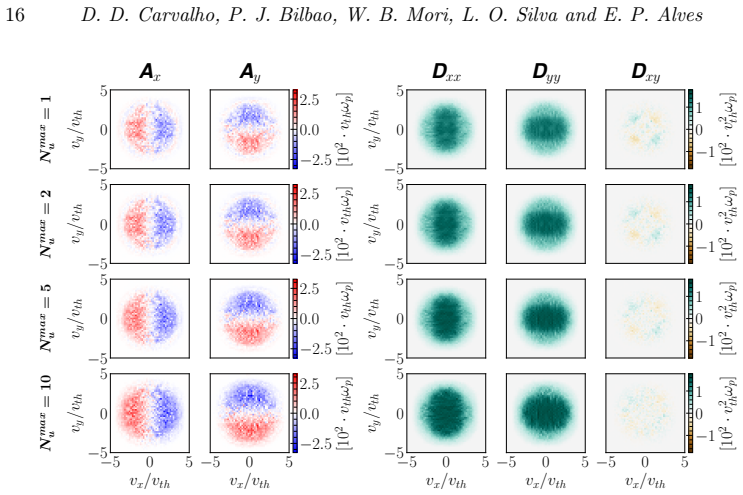
The central object is the Fokker-Planck operator written as ∂_t f = -∇_v·(A f) + ½ ∇_v·[∇_v·(D f)], with advection vector A and diffusion tensor D to be learned. The machinery that carries the argument is a differentiable Fokker-Planck solver: phase-space distributions are advanced with an explicit Euler step using centered finite differences, while gradients of the rollout error with respect to A and D are backpropagated through the unrolled trajectory. To make the inverse problem well-posed, the paper uses several specially selected subpopulations (centered normals, rings, quadrants) whose joint evolution constrains the operator, longer temporal unrolling during training to improve long-te
Load-bearing premise
The load-bearing premise is that the true particle dynamics in each simulation are exactly reproduced by a single, time-independent Fokker-Planck operator acting linearly in velocity space, an assumption enforced in practice by discarding all simulations with more than 1% total-energy drift.
What would settle it
A definitive test: apply the identical pipeline to a plasma in a regime where the Fokker-Planck assumption is expected to fail — for example, a strongly coupled or relativistically hot plasma — and check whether any time-independent A and D can drive the rollout error below the level of the training data noise while remaining consistent across disjoint subpopulations. If no operator reproduces the phase-space evolution, or if the recovered coefficients depend on which subpopulations are used, the central claim that this data contains a unique FP collision operator is falsified.
If this is right
- Learned operators improve on particle-track estimates for long-term rollout accuracy, since they are optimized to match the phase-space dynamics at many future times rather than one-step moments.
- The method avoids storing full particle trajectories: only phase-space snapshots are needed, substantially reducing memory costs for large 3D simulations and enabling higher-cadence diagnostics.
- No prior knowledge of the relevant time scales is needed, because the optimization does not require choosing a statistically linear measurement interval.
- The recovered operators match the theoretical electrostatic PIC collision operator down to small corrections, validating both the theory and the approach across shape functions, grids, particle weights, and thermal velocities.
- Because the operator form is fixed but coefficients are free, the same pipeline can be applied to learn operators in regimes where closed-form theory is missing, such as relativistic or electromagnetically dominated collisions.
Where Pith is reading between the lines
- If the approach transfers to relativistic, electromagnetically dominated plasmas, it could provide empirical collision operators for astrophysical and inertial-confinement settings where the standard Fokker-Planck coefficients are expected to break down — the authors state this as future work, but the implied payoff is direct reduced models for transport and acceleration.
- The method doubles as a model-class probe: if a dataset cannot be reproduced by any time-independent Fokker-Planck operator with the enforced symmetries, that failure would itself diagnose non-Markovian or time-varying collision dynamics, turning the optimizer into a test of the FP hypothesis.
- Using phase-space snapshots from experimental diagnostics (e.g., laser-scattering or radiation-belt measurements) rather than particle-in-cell data is a natural extension, since the learning pipeline never requires particle identities — though the inference would inherit the limited velocity-space coverage of the experiment.
Editorial analysis
A structured set of objections, weighed in public.
Referee Report
Summary. The paper proposes an inverse-problem framework for learning Fokker-Planck advection and diffusion coefficients directly from phase-space distribution data, using a differentiable Fokker-Planck solver and gradient-based optimization. The method is tested on 2D electromagnetic PIC simulations of uniform thermal plasmas, with operators parameterized as discrete tensors, neural networks, and a multi-simulation neural network. The central quantitative claim is that operators learned from phase-space subpopulation evolution achieve long-term rollout errors comparable to or better than standard particle-track estimates, while requiring only phase-space diagnostics. The paper also compares the recovered coefficients with the analytic finite-size PIC collision operator of Touati et al. (2022) for varied shape functions, grid resolutions, particle-per-cell, and thermal velocities, reporting excellent agreement. Strengths include a substantial simulation dataset, explicit rollout-error comparisons, a careful discussion of non-uniqueness, and the use of temporal unrolling and symmetry constraints.
Significance. If the central claims hold, the method is a practically useful tool for extracting interpretable collision operators from kinetic simulations without storing particle tracks, and it provides the first broad quantitative verification of the theoretical PIC collision operator in a fully electromagnetic PIC code. The paper is honest about the Markovian/time-homogeneous assumption and about the energy-filter criterion, and it ships a self-contained comparison against the existing theory. However, two load-bearing points need attention before the claims can be accepted at face value: (i) the recovered operator is tested at a single diagnostic cadence per simulation, so cadence-dependence of the learned coefficients is not assessed; and (ii) the multi-simulation neural network is evaluated on simulations used in training, so the paper does not yet demonstrate parameter-space generalization. These issues do not invalidate the per-simulation methodology, but they limit the strength of the advertised generalizations.
major comments (3)
- [§2.1, §3.2, §3.3, §4]
- [§3.2, §3.5, Supplementary S7]
- [Supplementary S2, Table S1, §3.5, Fig. 10]
minor comments (6)
- [Abstract] Typo: "wide rage" should be "wide range."
- [§2.2] Duplicate phrase: "advection and diffusion and diffusion coefficients" should be "advection and diffusion coefficients."
- [§4] Duplicate phrase: "directions for for future work" should be "directions for future work."
- [Figure 10] The legend in the bottom two rows uses "Stats" while the text and top row use "Tracks"; unify the nomenclature.
- [Eq. (3.1)] The sentence following Eq. (3.1) about the L1 norm is garbled in the text and should be typeset properly.
- [Supplementary S4] The notation for the number of dumped time-steps in a track-statistics interval is called both N_d and N_t in the text and in Figure S5; choose one symbol to avoid confusion with the rollout length N_t.
Circularity Check
No significant circularity: operators are fitted to external PIC phase-space data and tested on held-out subpopulations; the Touati et al. comparison is a parameter-free external check, with only a minor self-citation from overlapping authors.
full rationale
The paper's derivation chain is: (i) generate PIC phase-space data with OSIRIS (an external first-principles electromagnetic simulation), (ii) fit A,D within the Fokker-Planck ansatz (1.1) by minimizing the rollout loss (2.6) against those data, (iii) evaluate the fitted operator on held-out test subpopulations (Rings, Quadrants), and (iv) compare the retrieved operator with the Touati et al. (2022) theory (1.2-1.5). None of these steps reduces to its own inputs: the target trajectories are produced by self-consistent PIC dynamics rather than by solving the FP equation being learned; the learned A,D are not used to generate the data they are validated against; and the theory is a parameter-free analytic prediction evaluated at the externally set simulation parameters (Nppc, m, Δx/λD, vth), with its stated electrostatic/no-aliasing assumptions not including the fitted values. The A/D non-uniqueness is explicitly acknowledged (S5) and mitigated with multiple subpopulations and temporal unrolling, so the split between advection and diffusion is not fixed by construction. The claim that phase-space-learned operators beat particle-track estimates is supported by rollout MAE on training- and test-subpopulations; note that the evaluation metric coincides with the training objective and that Tracks operators are integrated at Δtdump/10, which is a fairness caveat rather than circularity. The only circularity-adjacent factor is that the validation theory (Touati et al. 2022) is co-authored by two of the present authors (Mori, Silva); however, this is not load-bearing because the theory is re-derived in S1 from stated assumptions, is parameter-free, and is externally falsifiable against the present PIC data. Disclosed limitations — discarding runs with ΔE/E > 10^-2 (S2), the high-v extrapolation caveat (S9.1), and the absence of a diagnostic-cadence invariance test — affect the interpretation of the recovered operator as a physical rather than cadence-effective object (a correctness risk), but do not constitute circular reasoning.
Axiom & Free-Parameter Ledger
free parameters (3)
- Discrete operator tensor values (A_x, A_y, Dxx, Dyy, Dxy) =
5 × Nv×Nv values per simulation (Nv=51), e.g. ~13,000 numbers
- Neural network weights (PS-NN, PS-NN-Multi) =
2-3 hidden layers × 128 neurons, values not given
- Temporal unroll length and curriculum =
N_u_max = 10, curriculum stages in Table S2
axioms (4)
- domain assumption Collision dynamics follow a linear Fokker-Planck equation with advection A and diffusion D (Eq. 1.1)
- domain assumption The operator is time-independent and spatially uniform
- domain assumption Each subpopulation evolves independently under the same A,D (test-particle/linearity)
- standard math The theoretical PIC collision operator (Touati et al. 2022, Eqs. 1.2-1.5) is correct for the tested electrostatic regime
read the original abstract
We propose a methodology to infer collision operators from phase space data of plasma dynamics. Our approach combines a differentiable kinetic simulator, whose core component in this work is a differentiable Fokker-Planck solver, with a gradient-based optimisation method to learn the collisional operators that best describe the phase space dynamics. We test our method using data from two-dimensional Particle-in-Cell simulations of spatially uniform thermal plasmas, and learn the collision operator that captures the self-consistent electromagnetic interaction between finite-size charged particles over a wide variety of simulation parameters. We demonstrate that the learned operators are more accurate than alternative estimates based on particle tracks, while making no prior assumptions about the relevant time scales of the processes and significantly reducing memory requirements. We find that the retrieved operators, obtained in the non-relativistic regime, are in excellent agreement with theoretical predictions derived for electrostatic scenarios. Our results show that differentiable simulators offer a powerful and computational efficient approach to infer novel operators for a wide rage of problems, such as electromagnetically dominated collisional dynamics and stochastic wave-particle interactions.
Figures




Forward citations
Cited by 1 Pith paper
-
Learning time-dependent and integro-differential collision operators from plasma phase space data using differentiable simulators
Differentiable simulators recover time-dependent integro-differential collision operators from PIC-generated plasma data that reproduce phase-space evolution more accurately than particle-track statistics.
Reference graph
Works this paper leans on
-
[1]
In Proceedings of the 29th ACM International Conference on Architectural Support for Programming Languages and Operating Systems, Volume 2\/ , pp
Ansel, Jason , Yang, Edward , He, Horace , Gimelshein, Natalia , Jain, Animesh , Voznesensky, Michael , Bao, Bin , Bell, Peter , Berard, David , Burovski, Evgeni & others 2024 Pytorch 2: Faster machine learning through dynamic python bytecode transformation and graph compilation. In Proceedings of the 29th ACM International Conference on Architectural Sup...
2024
-
[2]
Oxford University Press
Atzeni, Stefano & Meyer-ter Vehn, J \"u rgen 2004 The Physics of Inertial Fusion: BeamPlasma Interaction, Hydrodynamics, Hot Dense Matter\/ . Oxford University Press
2004
-
[3]
Journal of Computational Physics 363 , 178--199
Averkin, Sergey N & Gatsonis, Nikolaos A 2018 A parallel electrostatic particle-in-cell method on unstructured tetrahedral grids for large-scale bounded collisionless plasma simulations . Journal of Computational Physics 363 , 178--199
2018
-
[4]
Physics of Plasmas 19 (3)
Baalrud, Scott D 2012 Transport coefficients in strongly coupled plasmas . Physics of Plasmas 19 (3)
2012
-
[5]
Physics of Plasmas 21 (5)
Baalrud, Scott D & Daligault, J \'e r \^o me 2014 Extending plasma transport theory to strong coupling through the concept of an effective interaction potential . Physics of Plasmas 21 (5)
2014
-
[6]
Plasma Physics and Controlled Fusion 48 (3), R37
Bell, AR , Robinson, APL , Sherlock, M , Kingham, RJ & Rozmus, W 2006 Fast electron transport in laser-produced plasmas and the kalos code for solution of the vlasov--fokker--planck equation . Plasma Physics and Controlled Fusion 48 (3), R37
2006
-
[7]
Plasma Physics and Controlled Fusion 66 (3), 035014
Bell, AR & Sherlock, M 2024 The fastvfp code for solution of the vlasov--fokker--planck equation . Plasma Physics and Controlled Fusion 66 (3), 035014
2024
-
[8]
Physics of Plasmas 32 (3)
Bergeson, Scott , Schlitters, Matthew , Miller, Matthew , Farley, Ben , Sieverts, Devin , Murillo, Michael S & Haack, Jeffrey R 2025 Experimental and computational study of phase space dynamics in strongly coupled plasmas with steep density gradients . Physics of Plasmas 32 (3)
2025
-
[9]
CRC press
Birdsall, Charles K & Langdon, A Bruce 2018 Plasma physics via computer simulation\/ . CRC press
2018
-
[10]
Naval Research Laboratory
Boris, Jay P & Shanny, Ramy A 1972 Proceedings [of The] 4th Conference on Numerical Simulation of Plasmas\/ . Naval Research Laboratory
1972
-
[11]
Physical Review Letters 59 (16), 1817
Braams, Bastiaan J & Karney, Charles FF 1987 Differential form of the collision integral for a relativistic plasma . Physical Review Letters 59 (16), 1817
1987
-
[12]
arXiv preprint arXiv:2202.03376
Brandstetter, Johannes , Worrall, Daniel & Welling, Max 2022 Message passing neural pde solvers . arXiv preprint arXiv:2202.03376
Pith/arXiv arXiv 2022
-
[13]
Proceedings of the National Academy of Sciences 113 (15), 3932--3937
Brunton, Steven L , Proctor, Joshua L & Kutz, J Nathan 2016 Discovering governing equations from data by sparse identification of nonlinear dynamical systems . Proceedings of the National Academy of Sciences 113 (15), 3932--3937
2016
-
[14]
Journal of Geophysical Research: Space Physics 127 (7), e2022JA030377
Camporeale, Enrico , Wilkie, George J , Drozdov, Alexander Y & Bortnik, Jacob 2022 Data-driven discovery of fokker-planck equation for the earth's radiation belts electrons using physics-informed neural networks . Journal of Geophysical Research: Space Physics 127 (7), e2022JA030377
2022
-
[15]
Machine Learning: Science and Technology 5 (2), 025048
Carvalho, Diogo D , Ferreira, Diogo R & Silva, Luis O 2024 Learning the dynamics of a one-dimensional plasma model with graph neural networks . Machine Learning: Science and Technology 5 (2), 025048
2024
-
[16]
Journal of Physics A: Mathematical and General 39 (17), 4411
Chabrier, Gilles , Saumon, D & Potekhin, AY 2006 Dense plasmas in astrophysics: from giant planets to neutron stars . Journal of Physics A: Mathematical and General 39 (17), 4411
2006
-
[17]
SIAM Journal on Scientific Computing 43 (3), B811--B830
Chen, Xiaoli , Yang, Liu , Duan, Jinqiao & Karniadakis, George Em 2021 Solving inverse stochastic problems from discrete particle observations using the fokker--planck equation and physics-informed neural networks . SIAM Journal on Scientific Computing 43 (3), B811--B830
2021
-
[18]
Journal of Computational Physics 492 , 112400
Chung, Kyoungseoun , Fei, Fei , Gorji, M Hossein & Jenny, Patrick 2023 Data-driven stochastic particle scheme for collisional plasma simulations . Journal of Computational Physics 492 , 112400
2023
-
[19]
Computer Physics Communications 135 (2), 144--153
Esirkepov, T Zh 2001 Exact charge conservation scheme for particle-in-cell simulation with an arbitrary form-factor . Computer Physics Communications 135 (2), 144--153
2001
-
[20]
In Computational Science—ICCS 2002: International Conference Amsterdam, The Netherlands, April 21--24, 2002 Proceedings, Part III 2\/ , pp
Fonseca, Ricardo A , Silva, Luis O , Tsung, Frank S , Decyk, Viktor K , Lu, Wei , Ren, Chuang , Mori, Warren B , Deng, Shaogui , Lee, Shiyoun , Katsouleas, T & others 2002 Osiris: A three-dimensional, fully relativistic particle in cell code for modeling plasma based accelerators. In Computational Science—ICCS 2002: International Conference Amsterdam, The...
2002
-
[21]
Academic press
Fried, Burton D & Conte, Samuel D 1961 The plasma dispersion function: the Hilbert transform of the Gaussian\/ . Academic press
1961
-
[22]
Journal of Computational Physics 228 (10), 3742--3761
Gatsonis, Nikolaos A & Spirkin, Anton 2009 A three-dimensional electrostatic particle-in-cell methodology on unstructured delaunay--voronoi grids . Journal of Computational Physics 228 (10), 3742--3761
2009
-
[23]
Journal of Fluid Mechanics 996 , A25
Gurevich, Daniel R , Golden, Matthew R , Reinbold, Patrick AK & Grigoriev, Roman O 2024 Learning fluid physics from highly turbulent data using sparse physics-informed discovery of empirical relations (spider) . Journal of Fluid Mechanics 996 , A25
2024
-
[24]
Journal of Computational Physics 8 (1), 19--44
Hockney, RW 1971 Measurements of collision and heating times in a two-dimensional thermal computer plasma . Journal of Computational Physics 8 (1), 19--44
1971
-
[25]
Mathematics 9 (12), 1384
Holloway, Ian , Wood, Aihua & Alekseenko, Alexander 2021 Acceleration of boltzmann collision integral calculation using machine learning . Mathematics 9 (12), 1384
2021
-
[26]
Journal of Computational Physics 419 , 109665
Hwang, Hyung Ju , Jang, Jin Woo , Jo, Hyeontae & Lee, Jae Yong 2020 Trend to equilibrium for the kinetic fokker-planck equation via the neural network approach . Journal of Computational Physics 419 , 109665
2020
-
[27]
arXiv preprint arXiv:2410.12683
Joglekar, Archis S 2024 Generative neural reparameterization for differentiable pde-constrained optimization . arXiv preprint arXiv:2410.12683
Pith/arXiv arXiv 2024
-
[28]
Journal of Plasma Physics 88 (6), 905880608
Joglekar, Archis S & Thomas, Alexander GR 2022 Unsupervised discovery of nonlinear plasma physics using differentiable kinetic simulations . Journal of Plasma Physics 88 (6), 905880608
2022
-
[29]
Machine Learning: Science and Technology 4 (3), 035049
Joglekar, Archis S & Thomas, Alexander GR 2023 Machine learning of hidden variables in multiscale fluid simulation . Machine Learning: Science and Technology 4 (3), 035049
2023
-
[30]
Physics of Plasmas 31 (2)
Jubin, Sierra , Powis, Andrew Tasman , Villafana, Willca , Sydorenko, Dmytro , Rauf, Shahid , Khrabrov, Alexander V , Sarwar, Salman & Kaganovich, Igor D 2024 Numerical thermalization in 2d pic simulations: Practical estimates for low-temperature plasma simulations . Physics of Plasmas 31 (2)
2024
-
[31]
arXiv preprint arXiv:2205.04611
Karnakov, Petr , Litvinov, Sergey & Koumoutsakos, Petros 2022 Optimizing a discrete loss (odil) to solve forward and inverse problems for partial differential equations using machine learning tools . arXiv preprint arXiv:2205.04611
Pith/arXiv arXiv 2022
-
[32]
Japanese Journal of Applied Physics 61 (8), 086002
Kawaguchi, Satoru & Murakami, Tomoyuki 2022 Physics-informed neural networks for solving the boltzmann equation of the electron velocity distribution function in weakly ionized plasmas . Japanese Journal of Applied Physics 61 (8), 086002
2022
-
[33]
Physics Reports 449 (4-5), 77--130
Killian, Thomas C , Pattard, T , Pohl, T & Rost, JM 2007 Ultracold neutral plasmas . Physics Reports 449 (4-5), 77--130
2007
-
[34]
arXiv preprint arXiv:1412.6980
Kingma, Diederik P 2014 Adam: A method for stochastic optimization . arXiv preprint arXiv:1412.6980
Pith/arXiv arXiv 2014
-
[35]
Journal of Machine Learning Research 24 (89), 1--97
Kovachki, Nikola , Li, Zongyi , Liu, Burigede , Azizzadenesheli, Kamyar , Bhattacharya, Kaushik , Stuart, Andrew & Anandkumar, Anima 2023 Neural operator: Learning maps between function spaces with applications to pdes . Journal of Machine Learning Research 24 (89), 1--97
2023
-
[36]
In 73rd Annual Gaseous Electronics Virtual Conference\/
Kushner, Mark J 2020 Plasma science 2020 decadal survey: Overview and opportunities for the low temperature plasma community. In 73rd Annual Gaseous Electronics Virtual Conference\/ . APS
2020
-
[37]
Landau, Lev D 1936 Die kinetische gleichung fuer den fall coulombscher wechselwirkung . Phys. Z. Sowjet. 10 (1936) 10 , 163
1936
-
[38]
In Proceedings of the fourth conference on numerical simulation of plasmas\/ , pp
Langdon, A Bruce 1970 Nonphysical modifications to oscillations, fluctuations, and collisions due to space-time differencing. In Proceedings of the fourth conference on numerical simulation of plasmas\/ , pp. 467--495
1970
-
[39]
The Physics of Fluids 13 (8), 2115--2122
Langdon, A Bruce & Birdsall, Charles K 1970 Theory of plasma simulation using finite-size particles . The Physics of Fluids 13 (8), 2115--2122
1970
-
[40]
Journal of Computational Physics 480 , 112031
Lee, Jae Yong , Jang, Juhi & Hwang, Hyung Ju 2023 oppinn: Physics-informed neural network with operator learning to approximate solutions to the fokker-planck-landau equation . Journal of Computational Physics 480 , 112031
2023
-
[41]
ESAIM: Mathematical Modelling and Numerical Analysis 55 (5), 1803--1846
Lee, Jae Yong , Jang, Jin Woo & Hwang, Hyung Ju 2021 The model reduction of the vlasov--poisson--fokker--planck system to the poisson--nernst--planck system via the deep neural network approach . ESAIM: Mathematical Modelling and Numerical Analysis 55 (5), 1803--1846
2021
-
[42]
arXiv preprint arXiv:2504.20408
Lee, Jae Yong , Jung, Gwang Jae , Lim, Byung Chan & Hwang, Hyung Ju 2025 Fourierspecnet: Neural collision operator approximation inspired by the fourier spectral method for solving the boltzmann equation . arXiv preprint arXiv:2504.20408
arXiv 2025
-
[43]
arXiv preprint arXiv:2402.16613
Lee, Jae Yong , Schotth \"o fer, Steffen , Xiao, Tianbai , Krumscheid, Sebastian & Frank, Martin 2024 Structure-preserving operator learning: Modeling the collision operator of kinetic equations . arXiv preprint arXiv:2402.16613
Pith/arXiv arXiv 2024
-
[44]
arXiv preprint arXiv:2010.08895
Li, Zongyi , Kovachki, Nikola , Azizzadenesheli, Kamyar , Liu, Burigede , Bhattacharya, Kaushik , Stuart, Andrew & Anandkumar, Anima 2020 Fourier neural operator for parametric partial differential equations . arXiv preprint arXiv:2010.08895
Pith/arXiv arXiv 2020
-
[45]
SIAM Journal on Scientific Computing 46 (2), C186--C215
Li, Zhengyi , Wang, Yanli , Liu, Hongsheng , Wang, Zidong & Dong, Bin 2024 Solving the boltzmann equation with a neural sparse representation . SIAM Journal on Scientific Computing 46 (2), C186--C215
2024
-
[46]
Computer Methods in Applied Mechanics and Engineering 433 , 117441
List, Bjoern , Chen, Li-Wei , Bali, Kartik & Thuerey, Nils 2025 Differentiability in unrolled training of neural physics simulators on transient dynamics . Computer Methods in Applied Mechanics and Engineering 433 , 117441
2025
-
[47]
Journal of Computational Physics 447 , 110676
Lou, Qin , Meng, Xuhui & Karniadakis, George Em 2021 Physics-informed neural networks for solving forward and inverse flow problems via the boltzmann-bgk formulation . Journal of Computational Physics 447 , 110676
2021
-
[48]
arXiv preprint arXiv:1910.03193
Lu, Lu , Jin, Pengzhan & Karniadakis, George Em 2019 Deeponet: Learning nonlinear operators for identifying differential equations based on the universal approximation theorem of operators . arXiv preprint arXiv:1910.03193
Pith/arXiv arXiv 2019
-
[49]
The Physics of Fluids 18 (12), 1740--1747
Matsuda, Y & Okuda, H 1975 Collisions in multi-dimensional plasma simulations . The Physics of Fluids 18 (12), 1740--1747
1975
-
[50]
Physics of Plasmas 30 (9)
McDevitt, Christopher J 2023 A physics-informed deep learning model of the hot tail runaway electron seed . Physics of Plasmas 30 (9)
2023
-
[51]
Physics of Plasmas 32 (4)
McDevitt, Christopher J , Arnaud, Jonathan S & Tang, Xian-Zhu 2025 a\/ An efficient surrogate model of secondary electron formation and evolution . Physics of Plasmas 32 (4)
2025
-
[52]
Physics of Plasmas 32 (4)
McDevitt, Christopher J , Arnaud, Jonathan S & Tang, Xian-Zhu 2025 b\/ A physics-constrained deep learning treatment of runaway electron dynamics . Physics of Plasmas 32 (4)
2025
-
[53]
Physics Today 57 (7), 32--38
Merlino, Robert L & Goree, John A 2004 Dusty plasmas in the laboratory, industry, and space . Physics Today 57 (7), 32--38
2004
-
[54]
Journal of Plasma Physics 87 (2), 905870211
Miller, Marco Andres , Churchill, Randy Michael , Dener, Alp , Chang, Choong-Seock , Munson, Todd & Hager, Robert 2021 Encoder--decoder neural network for solving the nonlinear fokker--planck--landau collision operator in xgc . Journal of Plasma Physics 87 (2), 905870211
2021
-
[55]
Journal of Computational Physics 470 , 111541
Miller, Sean T , Roberts, Nathan V , Bond, Stephen D & Cyr, Eric C 2022 Neural-network based collision operators for the boltzmann equation . Journal of Computational Physics 470 , 111541
2022
-
[56]
Journal of Computational Physics 523 , 113665
Noh, Hyeongjun , Lee, Jimin & Yoon, Eisung 2025 Fpl-net: A deep learning framework for solving the nonlinear fokker--planck--landau collision operator for anisotropic temperature relaxation . Journal of Computational Physics 523 , 113665
2025
-
[57]
SIAM Journal on Scientific Computing 47 (2), C451--C474
Oh, Jaemin , Cho, Seung Yeon , Yun, Seok-Bae , Park, Eunbyung & Hong, Youngjoon 2025 Separable physics-informed neural networks for solving the bgk model of the boltzmann equation . SIAM Journal on Scientific Computing 47 (2), C451--C474
2025
-
[58]
The Physics of Fluids 13 (8), 2123--2134
Okuda, Hideo & Birdsall, Charles K 1970 Collisions in a plasma of finite-size particles . The Physics of Fluids 13 (8), 2123--2134
1970
-
[59]
In DPP 2025\/
Park, Ryan Minard , Moore, Christopher H & Baalrud, Scott D 2025 Numerical thermalization in 3d pic simulations. In DPP 2025\/ . APS
2025
-
[60]
Physical Review E 93 (5), 053208
Pike, OJ & Rose, SJ 2016 Transport coefficients of a relativistic plasma . Physical Review E 93 (5), 053208
2016
-
[61]
, Everson, Erik T
Plasmapy, Community , Murphy, Nicholas A. , Everson, Erik T. , Stańczak-Marikin, Dominik , Heuer, Peter V. , Kozlowski, Pawel M. , Johnson, Elliot T. , Malhotra, Ritiek , Schaffner, David A. , Vincena, Stephen T. , Abler, Mel , Addison, James , Ahamed, Ataf Fazledin , Alarcon, Paula Valentina , Antognetti, Benjamin , Arran, Christopher , Bagherianlemraski...
2024
-
[62]
arXiv preprint arXiv:2001.04385
Rackauckas, Christopher , Ma, Yingbo , Martensen, Julius , Warner, Collin , Zubov, Kirill , Supekar, Rohit , Skinner, Dominic , Ramadhan, Ali & Edelman, Alan 2020 Universal differential equations for scientific machine learning . arXiv preprint arXiv:2001.04385
Pith/arXiv arXiv 2020
-
[63]
Journal of Computational Physics 378 , 686--707
Raissi, Maziar , Perdikaris, Paris & Karniadakis, George E 2019 Physics-informed neural networks: A deep learning framework for solving forward and inverse problems involving nonlinear partial differential equations . Journal of Computational Physics 378 , 686--707
2019
-
[64]
Physics of Plasmas 4 (5), 1286--1296
Reynolds, Mark Anthony , Fried, BD & Morales, GJ 1997 Velocity--space drag and diffusion in a model, two-dimensional plasma . Physics of Plasmas 4 (5), 1286--1296
1997
-
[65]
Physical Review 107 (1), 1
Rosenbluth, Marshall N , MacDonald, William M & Judd, David L 1957 Fokker-planck equation for an inverse-square force . Physical Review 107 (1), 1
1957
-
[66]
Science Advances 3 (4), e1602614
Rudy, Samuel H , Brunton, Steven L , Proctor, Joshua L & Kutz, J Nathan 2017 Data-driven discovery of partial differential equations . Science Advances 3 (4), e1602614
2017
-
[67]
Journal of Computational Physics 231 (3), 1051--1079
Thomas, Alexander GR , Tzoufras, M , Robinson, APL , Kingham, Robert J , Ridgers, CP , Sherlock, Mark & Bell, AR 2012 A review of vlasov--fokker--planck numerical modeling of inertial confinement fusion plasma . Journal of Computational Physics 231 (3), 1051--1079
2012
-
[68]
Plasma Physics and Controlled Fusion 64 (11), 115014
Touati, Micha \"e l , Codur, Romain , Tsung, Frank , Decyk, Viktor K , Mori, Warren B & Silva, Luis O 2022 Kinetic theory of particle-in-cell simulation plasma and the ensemble averaging technique . Plasma Physics and Controlled Fusion 64 (11), 115014
2022
-
[69]
Journal of Computational Physics 230 (17), 6475--6494
Tzoufras, M , Bell, AR , Norreys, PA & Tsung, Frank S 2011 A vlasov--fokker--planck code for high energy density physics . Journal of Computational Physics 230 (17), 6475--6494
2011
-
[70]
Physics of Plasmas 20 (5)
Tzoufras, M , Tableman, A , Tsung, FS , Mori, WB & Bell, AR 2013 A multi-dimensional vlasov-fokker-planck code for arbitrarily anisotropic high-energy-density plasmas . Physics of Plasmas 20 (5)
2013
-
[71]
Neural Networks p
Wang, Taorui , Hu, Zheyuan , Kawaguchi, Kenji , Zhang, Zhongqiang & Karniadakis, George Em 2025 Tensor neural networks for high-dimensional fokker-planck equations . Neural Networks p. 107165
2025
-
[72]
The Astrophysical Journal Letters 893 (1), L7
Wong, Kai , Zhdankin, Vladimir , Uzdensky, Dmitri A , Werner, Gregory R & Begelman, Mitchell C 2020 First-principles demonstration of diffusive-advective particle acceleration in kinetic simulations of relativistic plasma turbulence . The Astrophysical Journal Letters 893 (1), L7
2020
-
[73]
arXiv preprint arXiv:2502.03042
Wong, Kai W , Zhdankin, Vladimir , Uzdensky, Dmitri A , Werner, Gregory R & Begelman, Mitchell C 2025 Energy diffusion and advection coefficients in kinetic simulations of relativistic plasma turbulence . arXiv preprint arXiv:2502.03042
arXiv 2025
-
[74]
Journal of Computational Physics 443 , 110521
Xiao, Tianbai & Frank, Martin 2021 Using neural networks to accelerate the solution of the boltzmann equation . Journal of Computational Physics 443 , 110521
2021
-
[75]
Journal of Computational Physics 490 , 112317
Xiao, Tianbai & Frank, Martin 2023 Relaxnet: A structure-preserving neural network to approximate the boltzmann collision operator . Journal of Computational Physics 490 , 112317
2023
-
[76]
Chaos: An Interdisciplinary Journal of Nonlinear Science 30 (1)
Xu, Yong , Zhang, Hao , Li, Yongge , Zhou, Kuang , Liu, Qi & Kurths, J \"u rgen 2020 Solving fokker-planck equation using deep learning . Chaos: An Interdisciplinary Journal of Nonlinear Science 30 (1)
2020
-
[77]
IEEE Transactions on antennas and propagation 14 (3), 302--307
Yee, Kane 1966 Numerical solution of initial boundary value problems involving maxwell's equations in isotropic media . IEEE Transactions on antennas and propagation 14 (3), 302--307
1966
-
[78]
Zaharia, Matei A. , Chen, Andrew , Davidson, Aaron , Ghodsi, Ali , Hong, Sue Ann , Konwinski, Andy , Murching, Siddharth , Nykodym, Tomas , Ogilvie, Paul , Parkhe, Mani , Xie, Fen & Zumar, Corey 2018 Accelerating the Machine Learning Lifecycle with MLflow . IEEE Data Eng. Bull. 41 , 39--45
2018
-
[79]
In Mathematical and scientific machine learning\/ , pp
Zhai, Jiayu , Dobson, Matthew & Li, Yao 2022 A deep learning method for solving fokker-planck equations. In Mathematical and scientific machine learning\/ , pp. 568--597 . PMLR
2022
-
[80]
International Journal of Non-Linear Mechanics 147 , 104202
Zhang, Yang & Yuen, Ka-Veng 2022 Physically guided deep learning solver for time-dependent fokker--planck equation . International Journal of Non-Linear Mechanics 147 , 104202
2022
discussion (0)
Sign in with ORCID, Apple, or X to comment. Anyone can read and Pith papers without signing in.