REVIEW 2 major objections 3 minor 83 references
A search of 138 fb^-1 of LHC proton collisions finds no dark matter signal in events with a Higgs boson decaying to bottom quarks, and sets new exclusion limits on two benchmark models.
Reviewed by Pith at T0; open to challenge. T0 means a machine referee read the full paper against a public rubric. the ladder, T0–T4 →
T0 review · deepseek-v4-flash
2026-08-03 10:02 UTC pith:F3FWFKBS
load-bearing objection Solid, incremental mono-Higgs search with clean control-region design; the CR-to-SR shape transfer is a real question but not a fatal one. the 2 major comments →
Search for dark matter produced in association with a Higgs boson decaying to bottom quarks in proton-proton collisions at sqrt{s} = 13 TeV
The pith
A machine-rendered reading of the paper's core claim, the machinery that carries it, and where it could break.
Core claim
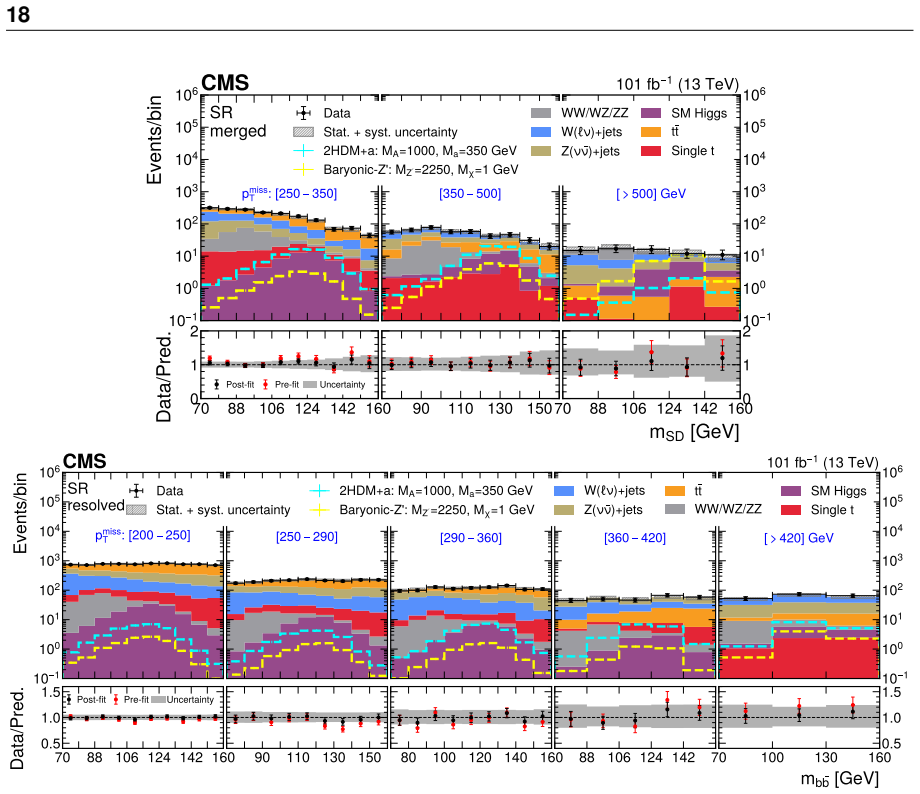
The central claim is that no dark matter signal is observed in the mono-Higgs final state where the Higgs boson decays to bottom quarks. The analysis uses both a Lorentz-boosted (merged) topology and a resolved topology, covering a wide range of Higgs transverse momentum. A two-dimensional maximum likelihood fit is performed to the signal regions and control regions, with the dominant tt and Z(nu nu)+jets backgrounds estimated from data using lepton-enriched control regions. The observed data are consistent with the background-only hypothesis. The paper then interprets this null result in two simplified models, setting upper limits at 95% confidence level. For the baryonic-Z' model, Z' boson
What carries the argument
The central object is the mono-Higgs signature: an event with large missing transverse momentum (p_T^miss) recoiling against a Higgs boson candidate decaying to a pair of bottom quarks. The analysis categorizes events into a merged topology where the two b quarks are collimated into a single large-radius jet, and a resolved topology with two separately resolved b-tagged jets. The signal extraction relies on a two-dimensional maximum likelihood fit over the Higgs candidate mass and p_T^miss, where the dominant backgrounds are estimated from data using control regions: single-lepton events for tt and dilepton events for Z(nu nu)+jets. The key mechanism is the simultaneous fit that ties the Hig
Load-bearing premise
The load-bearing premise is that the shape of the Higgs-boson-candidate mass distribution in the control regions is identical to that in the signal region up to a single scale factor, after all selections, for the dominant tt and Z(nu nu)+jets backgrounds.
What would settle it
A concrete observation that would falsify the central claim would be a significant excess of events in the signal region over the background prediction, peaking at the Higgs boson mass in the m_SD or m_bb distribution. For example, if a scan over m_Z' showed an observed limit that deviates from the expected limit by more than 2 standard deviations in a correlated way across p_T^miss bins, it might indicate a signal. Alternatively, if a closure test using simulated pseudo-data shows that the control-region transfer systematically biases the background estimate by more than the assigned uncertai
If this is right
- If no signal exists, then the null result tightens constraints on the baryonic-Z' model, excluding mediators below 2.25 TeV and thus narrowing the parameter space for this spin-1 mediator dark matter scenario.
- For the 2HDM+a model, the exclusions on mA, ma, sin(theta), and tan(beta) reduce the viable parameter space for this two-Higgs-doublet plus pseudoscalar mediator framework, complementing constraints from other searches.
- The improved sensitivity from the neural-network-based tagger for boosted h->bb decays demonstrates that particle-flow-based deep learning taggers can significantly enhance searches for heavy resonances in boosted topologies.
- The combined 2016-2018 dataset provides a consistent interpretation across a total luminosity of 138 fb^-1, matching the dataset size of the analogous ATLAS search and enabling direct cross-experiment comparisons.
- The agreement between data and background predictions in the control regions validates the background estimation procedure for this final state, supporting the reliability of the exclusion limits.
Where Pith is reading between the lines
- The null result implies that any new physics producing mono-Higgs events with h->bb must have a cross section below the observed upper limits, which is a direct input to global fits of dark matter models; one could combine these limits with other mono-X searches to further constrain the coupling structure.
- The sensitivity of this search is limited by the systematic uncertainty on the control-region-to-signal-region transfer; a future analysis could reduce this by using an ABCD method or a fully data-driven shape estimate from sidebands, potentially improving the limits.
- The analysis covers only the h->bb decay mode, which has the largest branching fraction; extending the same strategy to other Higgs decay modes (e.g., h->gamma gamma or h->WW*) could probe complementary regions of the model parameter space.
- The HL-LHC will provide much more data; based on the current scaling, one could project that the baryonic-Z' mass exclusion might extend to around 3-4 TeV, though this would depend on the background systematic scaling.
Editorial analysis
A structured set of objections, weighed in public.
Referee Report
Summary. The paper presents a search for dark matter produced in association with a Higgs boson decaying to a bottom quark-antiquark pair, using 101 fb^-1 of 2017-2018 CMS data and a statistical combination with a previous 2016 search (35.9 fb^-1). Events are separated into merged (boosted) and resolved categories, targeting the mono-h(bb) final state. The dominant tt and Z(nu nu)+jets backgrounds are estimated from dedicated single-lepton and dilepton control regions, and a two-dimensional binned maximum likelihood fit is performed over the Higgs-candidate mass and pTmiss (or recoil U) distributions. No significant deviation from the standard model background prediction is observed. The results are interpreted in the baryonic-Z' and 2HDM+a models, yielding improved 95% CL exclusion limits: Z' masses below 2.25 TeV for m_chi=1 GeV, and heavy pseudoscalar masses between 850 and 1300 GeV for m_a=350 GeV.
Significance. If the result stands, it provides the most stringent CMS limits to date in the mono-Higgs h->bb channel and demonstrates the value of modern jet tagging techniques (ParticleNet-MD) and the combined 2016-2018 dataset. The paper is careful in its construction of orthogonal categories, and the systematic uncertainty table (Table 3) is comprehensive. The analysis is reproducible in principle through the HEPData record, and the null result is a concrete, falsifiable constraint on two important simplified dark matter models. The main value is as a competitive experimental constraint rather than a new methodological development; its significance is therefore incremental but solid.
major comments (2)
- [5.3, Tables 1 and 2] The transfer of the dominant tt and Z+jets mass shapes from control regions to signal regions is load-bearing but not validated. Section 5.3 states that the SR Higgs-candidate mass distribution in each pTmiss bin is 'tied to the corresponding U window in the CRs via a scale factor'. A single scale factor per bin absorbs normalization differences, but the CR and SR selections differ in ways that can change the m_SD or m_bb shape: the merged SR requires N_bjets=0 while the t(l) CR requires N_bjets=1; the merged Z(ll) CR drops the ParticleNet-MD double-b tag; the resolved t(l) CR allows N_jets>=1 while the SR requires N_jets<=2; and the resolved Z(ll) CR drops b tagging on both jets. The shape-based systematics listed in Section 6 (JES, b-tagging efficiency, PDF/scale) are not derived from these selection differences and cannot fully cover a shape distortion induced by, e.g., a correlation
- [Figures 3-6 and Section 5.3] The post-fit agreement in the control regions does not by itself validate the shape transfer to the signal regions. The fit can absorb global normalization differences or broad shape changes through nuisance parameters, but a per-bin scale factor cannot correct for a mass-dependent shape difference that varies across the m_SD/m_bb window. To support the central claim that the observed SR data agree with the background prediction, the authors should show pre-fit SR mass templates derived from the CR shapes, or a validation in the SR sidebands (e.g., outside the 70-160 GeV window) where the CR-derived background can be compared to data before unblinding the signal window. Without such a closure check, the background estimation in the SR rests on an unverified assumption.
minor comments (3)
- [Section 5] Typo: 'analyis regions' should be 'analysis regions'; 'analys' appears in the same section.
- [Section 5.3] The scale-factor nuisance parameter is described only vaguely; it would be useful to state whether it is freely floating per U-bin or constrained by a prior, and whether it is common to electron and muon CRs.
- [Tables 1 and 2] The resolved t(l) CR column shows N_jets>=1 while the SR requires N_jets<=2; this difference is a specific example of the shape-transfer issue raised above and should be highlighted in the text or a footnote.
Circularity Check
No significant circularity: the analysis is a direct experimental search whose background model is data-driven and whose signal hypothesis is externally defined.
full rationale
The paper reports a search for DM+Higgs production in the h->bb channel. The central claim, that observed data agree with the SM background prediction, is a fitted outcome rather than an input: the signal strength mu is the free parameter extracted by the maximum-likelihood fit, and the exclusion limits are obtained by comparing observed data with background-only fits. The dominant backgrounds tt and Z(nu nu)+jets are estimated from dedicated control regions via scale factors, with the CR-to-SR shape transfer being a modeling assumption subject to systematic uncertainties, not a circular reuse of the target result. Signal cross sections and kinematic distributions come from externally defined benchmark models (baryonic-Z' and 2HDM+a) generated with MadGraph, and the quoted branching fraction for h->bb is taken from the PDG. Self-citations, e.g. the previous CMS 2016 search, are used for comparison and statistical combination, but the new exclusion limits are not derived from those earlier results; they are obtained from the present data and fit. No fitted parameter is renamed as a prediction, no uniqueness theorem is imported from the authors' own work, and no ansatz is smuggled in via self-citation. Therefore the derivation chain is self-contained with respect to its target claim, and there is no circularity.
Axiom & Free-Parameter Ledger
free parameters (8)
- m_{Z'} (baryonic Z' mediator mass) =
scanned 100-3500 GeV
- m_chi (dark matter candidate mass) =
scanned 1-800 GeV
- g_q (Z'-quark coupling) =
0.25 (fixed benchmark)
- g_chi (Z'-DM coupling) =
1 (fixed benchmark)
- m_a, m_A (2HDM+a pseudoscalar masses) =
scanned; benchmark m_a=350, m_A=1000 GeV
- sin(theta) (2HDM+a mixing angle) =
scanned; fixed 0.35 for mass scans
- tan(beta) (2HDM+a vacuum expectation value ratio) =
scanned; fixed 1 for mass scans
- lambda_3 = lambda_P1 = lambda_P2 =
3 (fixed benchmark)
axioms (6)
- domain assumption The CR-to-SR transfer via scale factors captures all relevant differences between control regions and signal regions for tt and Z+jets backgrounds.
- domain assumption Monte Carlo simulation of signal and background, after data-derived corrections, accurately models kinematics and detector response.
- domain assumption The benchmark simplified models (baryonic Z' and 2HDM+a) are the correct theoretical frameworks for interpretation.
- standard math The asymptotic CLs approximation is valid for 95% confidence-level limits in this analysis regime.
- domain assumption The h->bb branching fraction is 0.582.
- domain assumption Detector performance, trigger, b-tagging, and ParticleNet-MD tagger calibrations are correctly measured and corrected.
read the original abstract
A search for dark matter particles produced in association with a Higgs boson decaying to a bottom quark-antiquark pair in proton-proton collisions at $\sqrt{s}$ = 13 TeV is presented. The data, collected with the CMS detector at the LHC, correspond to an integrated luminosity of 101 fb$^{-1}$. The analysis is performed in exclusive categories targeting both Lorentz-boosted (merged) and resolved b jet pair topologies, covering a wide range of Higgs boson transverse momentum. A statistical combination is made with a previous search using data collected in 2016 and corresponding to an integrated luminosity of 35.9 fb$^{-1}$. The observed data agree with the standard model background predictions. Constraints are placed on models predicting new particles or interactions, such as those in the simplified frameworks of baryonic-Z' and 2HDM+a, where the latter is a type-II two-Higgs-doublet model featuring a heavy pseudoscalar with an additional light pseudoscalar. Upper limits at 95% confidence level are set on the production cross section for these models. For the baryonic-Z' model, Z' boson masses below 2.25 TeV are excluded for a dark matter particle candidate mass of 1 GeV. In the 2HDM+a model, heavy pseudoscalar masses between 850 and 1300 GeV are excluded for a light pseudoscalar mass of 350 GeV.
Figures




Reference graph
Works this paper leans on
-
[1]
Planck 2018 results. I. Overview and the cosmological legacy of Planck
Planck Collaboration, “Planck 2018 results. I. Overview and the cosmological legacy of Planck”,Astron. Astrophys.641(2020) A1,doi:10.1051/0004-6361/201833880, arXiv:1807.06205. References 23
Pith/arXiv arXiv 2018
-
[2]
Dark matter candidates from particle physics and methods of detection
J. L. Feng, “Dark matter candidates from particle physics and methods of detection”, Ann. Rev. Astron. Astrophys.48(2010) 495, doi:10.1146/annurev-astro-082708-101659,arXiv:1003.0904
Pith/arXiv arXiv 2010
-
[3]
On the relic, cosmic abundance of stable weakly interacting massive particles
R. J. Scherrer and M. S. Turner, “On the relic, cosmic abundance of stable weakly interacting massive particles”,Phys. Rev. D33(1986) 1585, doi:10.1103/PhysRevD.33.1585. [Erratum:doi:10.1103/PhysRevD.34.3263]
-
[4]
Cosmological constraints on the properties of weakly interacting massive particles
G. Steigman and M. S. Turner, “Cosmological constraints on the properties of weakly interacting massive particles”,Nucl. Phys. B253(1985) 375, doi:10.1016/0550-3213(85)90537-1
-
[5]
G. Jungman, M. Kamionkowski, and K. Griest, “Supersymmetric dark matter”,Phys. Rept.267(1996) 195,doi:10.1016/0370-1573(95)00058-5, arXiv:hep-ph/9506380
Pith/arXiv arXiv 1996
-
[6]
ATLAS Collaboration, “Observation of a new particle in the search for the standard model Higgs boson with the ATLAS detector at the LHC”,Phys. Lett. B716(2012) 1, doi:10.1016/j.physletb.2012.08.020,arXiv:1207.7214
Pith/arXiv arXiv 2012
-
[7]
Observation of a new boson at a mass of 125 GeV with the CMS experiment at the LHC
CMS Collaboration, “Observation of a new boson at a mass of 125 GeV with the CMS experiment at the LHC”,Phys. Lett. B716(2012) 30, doi:10.1016/j.physletb.2012.08.021,arXiv:1207.7235
Pith/arXiv arXiv 2012
-
[8]
Observation of a new boson with mass near 125 GeV in pp collisions at √s=7 and 8 TeV
CMS Collaboration, “Observation of a new boson with mass near 125 GeV in pp collisions at √s=7 and 8 TeV”,JHEP06(2013) 081, doi:10.1007/JHEP06(2013)081,arXiv:1303.4571
Pith/arXiv arXiv 2013
-
[9]
Mono-Higgs-boson: A new collider probe of dark matter
L. Carpenter et al., “Mono-Higgs-boson: A new collider probe of dark matter”,Phys. Rev. D89(2014) 075017,doi:10.1103/PhysRevD.89.075017,arXiv:1312.2592
Pith/arXiv arXiv 2014
-
[10]
Mono-Higgs detection of dark matter at the LHC
A. Berlin, T. Lin, and L.-T. Wang, “Mono-Higgs detection of dark matter at the LHC”, JHEP06(2014) 078,doi:10.1007/JHEP06(2014)078,arXiv:1402.7074
Pith/arXiv arXiv 2014
-
[11]
Searching for dark matter at LHC with mono-Higgs production
A. A. Petrov and W. Shepherd, “Searching for dark matter at LHC with mono-Higgs production”,Phys. Lett. B730(2014) 178,doi:10.1016/j.physletb.2014.01.051, arXiv:1311.1511
Pith/arXiv arXiv 2014
-
[12]
Particle dark matter: evidence, candidates and constraints
G. Bertone, D. Hooper, and J. Silk, “Particle dark matter: evidence, candidates and constraints”,Phys. Rept.405(2005) 279,doi:10.1016/j.physrep.2004.08.031, arXiv:hep-ph/0404175
Pith/arXiv arXiv 2005
-
[13]
The minimal model of nonbaryonic dark matter: a singlet scalar
C. P . Burgess, M. Pospelov, and T. ter Veldhuis, “The minimal model of nonbaryonic dark matter: a singlet scalar”,Nucl. Phys. B619(2001) 709, doi:10.1016/S0550-3213(01)00513-2,arXiv:hep-ph/0011335
Pith/arXiv arXiv 2001
-
[14]
Heavy dark matter through the Higgs portal
J. March-Russell, S. M. West, D. Cumberbatch, and D. Hooper, “Heavy dark matter through the Higgs portal”,JHEP07(2008) 058, doi:10.1088/1126-6708/2008/07/058,arXiv:0801.3440
Pith/arXiv arXiv 2008
-
[15]
Dark matter benchmark models for early LHC Run 2 searches: Report of the ATLAS/CMS dark matter forum
D. Abercrombie et al., “Dark matter benchmark models for early LHC Run 2 searches: Report of the ATLAS/CMS dark matter forum”,Phys. Dark Univ.27(2020) 100371, doi:10.1016/j.dark.2019.100371,arXiv:1507.00966. 24
arXiv 2020
-
[16]
LHC Dark Matter Working Group: Next-generation spin-0 dark matter models
T. Abe et al., “LHC Dark Matter Working Group: Next-generation spin-0 dark matter models”,Phys. Dark Univ.27(2020) 100351,doi:10.1016/j.dark.2019.100351, arXiv:1810.09420
arXiv 2020
-
[17]
Simplified dark matter models with two Higgs doublets: I. Pseudoscalar mediators
M. Bauer, U. Haisch, and F. Kahlhoefer, “Simplified dark matter models with two Higgs doublets: I. Pseudoscalar mediators”,JHEP05(2017) 138, doi:10.1007/JHEP05(2017)138,arXiv:1701.07427
Pith/arXiv arXiv 2017
-
[18]
Theory and phenomenology of two-Higgs-doublet models
G. C. Branco et al., “Theory and phenomenology of two-Higgs-doublet models”,Phys. Rept.516(2012) 1,doi:10.1016/j.physrep.2012.02.002,arXiv:1106.0034
Pith/arXiv arXiv 2012
-
[19]
CMS Collaboration, “Search for dark matter produced in association with a Higgs boson decaying to a pair of bottom quarks in proton-proton collisions at √s=13 TeV”,Eur. Phys. J. C79(2019) 280,doi:10.1140/epjc/s10052-019-6730-7, arXiv:1811.06562
Pith/arXiv arXiv 2019
-
[20]
ATLAS Collaboration, “Search for dark matter produced in association with a standard model Higgs boson decaying into b-quarks using the full Run 2 dataset from the ATLAS detector”,JHEP11(2021) 209,doi:10.1007/JHEP11(2021)209, arXiv:2108.13391
Pith/arXiv arXiv 2021
-
[21]
Identifying boosted objects withN-subjettiness
J. Thaler and K. Van Tilburg, “Identifying boosted objects withN-subjettiness”,JHEP03 (2011) 015,doi:10.1007/JHEP03(2011)015,arXiv:1011.2268
Pith/arXiv arXiv 2011
-
[22]
HEPData record for this analysis, 2026.doi:10.17182/hepdata.167738
-
[23]
The CMS experiment at the CERN LHC
CMS Collaboration, “The CMS experiment at the CERN LHC”,JINST3(2008) S08004, doi:10.1088/1748-0221/3/08/S08004
-
[24]
Development of the CMS detector for the CERN LHC Run 3
CMS Collaboration, “Development of the CMS detector for the CERN LHC Run 3”, JINST19(2024) P05064,doi:10.1088/1748-0221/19/05/P05064, arXiv:2309.05466
Pith/arXiv arXiv 2024
-
[25]
Performance of the CMS Level-1 trigger in proton-proton collisions at √s=13 TeV
CMS Collaboration, “Performance of the CMS Level-1 trigger in proton-proton collisions at √s=13 TeV”,JINST15(2020) P10017,doi:10.1088/1748-0221/15/10/P10017, arXiv:2006.10165
Pith/arXiv arXiv 2020
-
[26]
CMS Collaboration, “The CMS trigger system”,JINST12(2017) P01020, doi:10.1088/1748-0221/12/01/P01020,arXiv:1609.02366
Pith/arXiv arXiv 2017
-
[27]
Parton distributions from high-precision collider data
NNPDF Collaboration, “Parton distributions from high-precision collider data”,Eur. Phys. J. C77(2017) 663,doi:10.1140/epjc/s10052-017-5199-5, arXiv:1706.00428
Pith/arXiv arXiv 2017
-
[28]
Event generator tunes obtained from underlying event and multiparton scattering measurements
CMS Collaboration, “Event generator tunes obtained from underlying event and multiparton scattering measurements”,Eur. Phys. J. C76(2016) 155, doi:10.1140/epjc/s10052-016-3988-x,arXiv:1512.00815
Pith/arXiv arXiv 2016
-
[29]
T. Sj ¨ostrand et al., “An introduction toPYTHIA8.2”,Comput. Phys. Commun.191(2015) 159,doi:10.1016/j.cpc.2015.01.024,arXiv:1410.3012
Pith/arXiv arXiv 2015
-
[30]
Extraction and validation of a new set of CMSPYTHIA8 tunes from underlying-event measurements
CMS Collaboration, “Extraction and validation of a new set of CMSPYTHIA8 tunes from underlying-event measurements”,Eur. Phys. J. C80(2020) 4, doi:10.1140/epjc/s10052-019-7499-4,arXiv:1903.12179. References 25
Pith/arXiv arXiv 2020
-
[31]
GEANT4 Collaboration, “GEANT4—a simulation toolkit”,Nucl. Instrum. Meth. A506 (2003) 250,doi:10.1016/S0168-9002(03)01368-8
-
[32]
J. Alwall et al., “The automated computation of tree-level and next-to-leading order differential cross sections, and their matching to parton shower simulations”,JHEP07 (2014) 079,doi:10.1007/JHEP07(2014)079,arXiv:1405.0301
Pith/arXiv arXiv 2014
-
[33]
A new method for combining NLO QCD with shower Monte Carlo algorithms
P . Nason, “A new method for combining NLO QCD with shower Monte Carlo algorithms”,JHEP11(2004) 040,doi:10.1088/1126-6708/2004/11/040, arXiv:hep-ph/0409146
Pith/arXiv arXiv 2004
-
[34]
Matching NLO QCD computations with parton shower simulations: thePOWHEGmethod
S. Frixione, P . Nason, and C. Oleari, “Matching NLO QCD computations with parton shower simulations: thePOWHEGmethod”,JHEP11(2007) 070, doi:10.1088/1126-6708/2007/11/070,arXiv:0709.2092
Pith/arXiv arXiv 2007
-
[35]
A general framework for implementing NLO calculations in shower Monte Carlo programs: thePOWHEG BOX
S. Alioli, P . Nason, C. Oleari, and E. Re, “A general framework for implementing NLO calculations in shower Monte Carlo programs: thePOWHEG BOX”,JHEP06(2010) 043, doi:10.1007/JHEP06(2010)043,arXiv:1002.2581
Pith/arXiv arXiv 2010
-
[36]
CMS Collaboration, “Measurement of differential cross sections for the production of top quark pairs and of additional jets in lepton+jets events from pp collisions at√s=13 TeV”,Phys. Rev. D97(2018) 112003,doi:10.1103/PhysRevD.97.112003, arXiv:1803.08856
Pith/arXiv arXiv 2018
-
[37]
Single-topt-channel hadroproduction in the four-flavors scheme withPOWHEGand aMC@NLO
R. Frederix, E. Re, and P . Torrielli, “Single-topt-channel hadroproduction in the four-flavors scheme withPOWHEGand aMC@NLO”,JHEP09(2012) 130, doi:10.1007/JHEP09(2012)130,arXiv:1207.5391
Pith/arXiv arXiv 2012
-
[38]
Single-top Wt-channel production matched with parton showers using the POWHEGmethod
E. Re, “Single-top Wt-channel production matched with parton showers using the POWHEGmethod”,Eur. Phys. J. C71(2011) 1547, doi:10.1140/epjc/s10052-011-1547-z,arXiv:1009.2450
Pith/arXiv arXiv 2011
-
[39]
J. Alwall et al., “Comparative study of various algorithms for the merging of parton showers and matrix elements in hadronic collisions”,Eur. Phys. J. C53(2008) 473, doi:10.1140/epjc/s10052-007-0490-5,arXiv:0706.2569
Pith/arXiv arXiv 2008
-
[40]
Merging meets matching inMC@NLO
R. Frederix and S. Frixione, “Merging meets matching inMC@NLO”,JHEP12(2012) 061, doi:10.1007/JHEP12(2012)061,arXiv:1209.6215
Pith/arXiv arXiv 2012
-
[41]
Particle-flow reconstruction and global event description with the CMS detector
CMS Collaboration, “Particle-flow reconstruction and global event description with the CMS detector”,JINST12(2017) P10003,doi:10.1088/1748-0221/12/10/P10003, arXiv:1706.04965
Pith/arXiv arXiv 2017
-
[42]
Technical proposal for the Phase-II upgrade of the Compact Muon Solenoid
CMS Collaboration, “Technical proposal for the Phase-II upgrade of the Compact Muon Solenoid”, CMS Technical Proposal CERN-LHCC-2015-010, CMS-TDR-15-02, 2015. doi:10.17181/CERN.VU8I.D59J
-
[43]
Electron and photon reconstruction and identification with the CMS experiment at the CERN LHC
CMS Collaboration, “Electron and photon reconstruction and identification with the CMS experiment at the CERN LHC”,JINST16(2021) P05014, doi:10.1088/1748-0221/16/05/P05014,arXiv:2012.06888
Pith/arXiv arXiv 2021
-
[44]
ECAL 2016 refined calibration and Run 2 summary plots
CMS Collaboration, “ECAL 2016 refined calibration and Run 2 summary plots”, CMS Detector Performance Note CMS-DP-2020-021, 2020. 26
2016
-
[45]
CMS Collaboration, “Performance of the CMS muon detector and muon reconstruction with proton-proton collisions at √s=13 TeV”,JINST13(2018) P06015, doi:10.1088/1748-0221/13/06/P06015,arXiv:1804.04528
Pith/arXiv arXiv 2018
-
[46]
CMS Collaboration, “Performance of reconstruction and identification ofτleptons decaying to hadrons andν τ in pp collisions at √s=13 TeV”,JINST13(2018) P10005, doi:10.1088/1748-0221/13/10/P10005,arXiv:1809.02816
Pith/arXiv arXiv 2018
-
[47]
Identification of hadronic tau lepton decays using a deep neural network
CMS Collaboration, “Identification of hadronic tau lepton decays using a deep neural network”,JINST17(2022) P07023,doi:10.1088/1748-0221/17/07/P07023, arXiv:2201.08458
Pith/arXiv arXiv 2022
-
[48]
The anti-kT jet clustering algorithm
M. Cacciari, G. P . Salam, and G. Soyez, “The anti-kT jet clustering algorithm”,JHEP04 (2008) 063,doi:10.1088/1126-6708/2008/04/063,arXiv:0802.1189
Pith/arXiv arXiv 2008
-
[49]
M. Cacciari, G. P . Salam, and G. Soyez, “FASTJETuser manual”,Eur. Phys. J. C72(2012) 1896,doi:10.1140/epjc/s10052-012-1896-2,arXiv:1111.6097
Pith/arXiv arXiv 2012
-
[50]
Pileup mitigation at CMS in 13 TeV data
CMS Collaboration, “Pileup mitigation at CMS in 13 TeV data”,JINST15(2020) P09018, doi:10.1088/1748-0221/15/09/P09018,arXiv:2003.00503
Pith/arXiv arXiv 2020
-
[51]
Pileup per particle identification
D. Bertolini, P . Harris, M. Low, and N. Tran, “Pileup per particle identification”,JHEP10 (2014) 059,doi:10.1007/JHEP10(2014)059,arXiv:1407.6013
Pith/arXiv arXiv 2014
-
[52]
Jet energy scale and resolution in the CMS experiment in pp collisions at 8 TeV
CMS Collaboration, “Jet energy scale and resolution in the CMS experiment in pp collisions at 8 TeV”,JINST12(2017) P02014, doi:10.1088/1748-0221/12/02/P02014,arXiv:1607.03663
Pith/arXiv arXiv 2017
-
[53]
Jet energy scale and resolution measurements with legacy Run 2 data collected by CMS at 13 TeV
CMS Collaboration, “Jet energy scale and resolution measurements with legacy Run 2 data collected by CMS at 13 TeV”, CMS Detector Performance Note CMS-DP-2021-033, 2021
2021
-
[54]
CMS Collaboration, “Performance of missing transverse momentum reconstruction in proton-proton collisions at √s=13 TeV using the CMS detector”,JINST14(2019) P07004,doi:10.1088/1748-0221/14/07/P07004,arXiv:1903.06078
Pith/arXiv arXiv 2019
-
[55]
Better jet clustering algorithms
Y. L. Dokshitzer, G. D. Leder, S. Moretti, and B. R. Webber, “Better jet clustering algorithms”,JHEP08(1997) 001,doi:10.1088/1126-6708/1997/08/001, arXiv:hep-ph/9707323
Pith/arXiv arXiv 1997
-
[56]
Hadronization corrections to jet cross-sections in deep inelastic scattering
M. Wobisch and T. Wengler, “Hadronization corrections to jet cross-sections in deep inelastic scattering”, inProc. Workshop on Monte Carlo Generators for HERA Physics: Hamburg, Germany, April 27–30, 1998, p. 270. 1998.arXiv:hep-ph/9907280
Pith/arXiv arXiv 1998
-
[57]
Towards an understanding of jet substructure
M. Dasgupta, A. Fregoso, S. Marzani, and G. P . Salam, “Towards an understanding of jet substructure”,JHEP09(2013) 029,doi:10.1007/JHEP09(2013)029, arXiv:1307.0007
Pith/arXiv arXiv 2013
-
[58]
Jet substructure as a new Higgs search channel at the LHC
J. M. Butterworth, A. R. Davison, M. Rubin, and G. P . Salam, “Jet substructure as a new Higgs search channel at the LHC”,Phys. Rev. Lett.100(2008) 242001, doi:10.1103/PhysRevLett.100.242001,arXiv:0802.2470
Pith/arXiv arXiv 2008
-
[59]
A. J. Larkoski, S. Marzani, G. Soyez, and J. Thaler, “Soft drop”,JHEP05(2014) 146, doi:10.1007/JHEP05(2014)146,arXiv:1402.2657. References 27
Pith/arXiv arXiv 2014
-
[60]
Jet flavour classification using DeepJet
E. Bols et al., “Jet flavour classification using DeepJet”,JINST15(2020) P12012, doi:10.1088/1748-0221/15/12/P12012,arXiv:2008.10519
Pith/arXiv arXiv 2020
-
[61]
Identification of heavy-flavour jets with the CMS detector in pp collisions at 13 TeV
CMS Collaboration, “Identification of heavy-flavour jets with the CMS detector in pp collisions at 13 TeV”,JINST13(2018) P05011, doi:10.1088/1748-0221/13/05/P05011,arXiv:1712.07158
Pith/arXiv arXiv 2018
-
[62]
Performance summary of AK4 jet b tagging with data from proton-proton collisions at 13 TeV with the CMS detector
CMS Collaboration, “Performance summary of AK4 jet b tagging with data from proton-proton collisions at 13 TeV with the CMS detector”, CMS Detector Performance Note CMS-DP-2023-005, 2023
2023
-
[63]
Jet tagging via particle clouds
H. Qu and L. Gouskos, “Jet tagging via particle clouds”,Phys. Rev. D101(2020) 056019, doi:10.1103/PhysRevD.101.056019,arXiv:1902.08570
Pith/arXiv arXiv 2020
-
[64]
Calibration of the mass-decorrelated PARTICLENETtagger for boosted bb and c c jets using LHC Run 2 data
CMS Collaboration, “Calibration of the mass-decorrelated PARTICLENETtagger for boosted bb and c c jets using LHC Run 2 data”, CMS Detector Performance Note CMS-DP-2022-005, 2024
2022
-
[65]
CMS Collaboration, “Performance of heavy-flavour jet identification in Lorentz-boosted topologies in proton-proton collisions at √s=13 TeV”,JINST20(2025) P11006, doi:10.1088/1748-0221/20/11/P11006,arXiv:2510.10228
arXiv 2025
-
[66]
Precision luminosity measurement in proton-proton collisions at√s=13 TeV in 2015 and 2016 at CMS
CMS Collaboration, “Precision luminosity measurement in proton-proton collisions at√s=13 TeV in 2015 and 2016 at CMS”,Eur. Phys. J. C81(2021) 800, doi:10.1140/epjc/s10052-021-09538-2,arXiv:2104.01927
Pith/arXiv arXiv 2015
-
[67]
CMS luminosity measurement for the 2017 data-taking period at√s=13 TeV
CMS Collaboration, “CMS luminosity measurement for the 2017 data-taking period at√s=13 TeV”, CMS Physics Analysis Summary CMS-PAS-LUM-17-004, 2018
2017
-
[68]
CMS luminosity measurement for the 2018 data-taking period at√s=13 TeV
CMS Collaboration, “CMS luminosity measurement for the 2018 data-taking period at√s=13 TeV”, CMS Physics Analysis Summary CMS-PAS-LUM-18-002, 2019
2018
-
[69]
Precision luminosity measurement in proton-proton collisions at√s=13 TeV with the CMS detector
CMS Collaboration, “Precision luminosity measurement in proton-proton collisions at√s=13 TeV with the CMS detector”, CMS Physics Analysis Summary CMS-PAS-LUM-20-001, 2025
2025
-
[70]
Measurement of the inelastic proton-proton cross section at√s=13 TeV
CMS Collaboration, “Measurement of the inelastic proton-proton cross section at√s=13 TeV”,JHEP07(2018) 161,doi:10.1007/JHEP07(2018)161, arXiv:1802.02613
Pith/arXiv arXiv 2018
-
[71]
CMS Collaboration, “Search for new particles in events with energetic jets and large missing transverse momentum in proton-proton collisions at √s=13 TeV”,JHEP11 (2021) 153,doi:10.1007/JHEP11(2021)153,arXiv:2107.13021
Pith/arXiv arXiv 2021
-
[72]
PDF4LHC recommendations for LHC Run 2
J. Butterworth et al., “PDF4LHC recommendations for LHC Run 2”,J. Phys. G43(2016) 023001,doi:10.1088/0954-3899/43/2/023001,arXiv:1510.03865
Pith/arXiv arXiv 2016
-
[73]
CMS Collaboration, “Observation of the associated production of a single top quark and a W boson in pp collisions at √s=8 TeV”,Phys. Rev. Lett.112(2014) 231802, doi:10.1103/PhysRevLett.112.231802,arXiv:1401.2942
Pith/arXiv arXiv 2014
-
[74]
Measurements of inclusive W and Z cross sections in pp collisions at √s=7 TeV
CMS Collaboration, “Measurements of inclusive W and Z cross sections in pp collisions at √s=7 TeV”,JHEP01(2011) 080,doi:10.1007/JHEP01(2011)080, arXiv:1012.2466. 28
Pith/arXiv arXiv 2011
-
[75]
CMS Collaboration, “Measurement of the ZZ production cross section and Z→ℓ +ℓ−ℓ′+ℓ′− branching fraction in pp collisions at √s=13 TeV”,Phys. Lett. B763 (2016) 280,doi:10.1016/j.physletb.2016.10.054,arXiv:1607.08834
Pith/arXiv arXiv 2016
-
[76]
CMS Collaboration, “Measurement of the inclusive and differential WZ production cross sections, polarization angles, and triple gauge couplings in pp collisions at √s=13 TeV”, JHEP07(2022) 032,doi:10.1007/JHEP07(2022)032,arXiv:2110.11231
Pith/arXiv arXiv 2022
-
[77]
The CMS statistical analysis and combination tool:COMBINE
CMS Collaboration, “The CMS statistical analysis and combination tool:COMBINE”, Comput. Softw. Big Sci.8(2024) 19,doi:10.1007/s41781-024-00121-4, arXiv:2404.06614
Pith/arXiv arXiv 2024
-
[78]
Fitting using finite Monte Carlo samples
R. Barlow and C. Beeston, “Fitting using finite Monte Carlo samples”,Comput. Phys. Commun.77(1993) 219,doi:10.1016/0010-4655(93)90005-W
-
[79]
Confidence level computation for combining searches with small statistics
T. Junk, “Confidence level computation for combining searches with small statistics”, Nucl. Instrum. Meth. A434(1999) 435,doi:10.1016/S0168-9002(99)00498-2, arXiv:hep-ex/9902006
Pith/arXiv arXiv 1999
-
[80]
Presentation of search results: The CL s technique
A. L. Read, “Presentation of search results: The CL s technique”,J. Phys. G28(2002) 2693, doi:10.1088/0954-3899/28/10/313
discussion (0)
Sign in with ORCID, Apple, or X to comment. Anyone can read and Pith papers without signing in.