REVIEW 4 major objections 4 minor 40 references
In AdS black holes with nonlinear electrodynamics, isentropic absorption of a charged particle is classically forbidden but proceeds by quantum tunneling; smaller holes tunnel more readily, and stronger nonlinearity suppresses it.
Reviewed by Pith at T0; open to challenge. T0 means a machine referee read the full paper against a public rubric. the ladder, T0–T4 →
T0 review · deepseek-v4-flash
2026-08-03 09:25 UTC pith:3D6P7J7R
load-bearing objection Clean classical argument and a reasonable framework transfer, but the tunneling probabilities rest on an underived action formula, missing numerical parameters, and a direct EH contradiction. the 4 major comments →
Nonperturbative Isentropic Processes in AdS Black Holes with Nonlinear Electrodynamics
The pith
A machine-rendered reading of the paper's core claim, the machinery that carries it, and where it could break.
Core claim
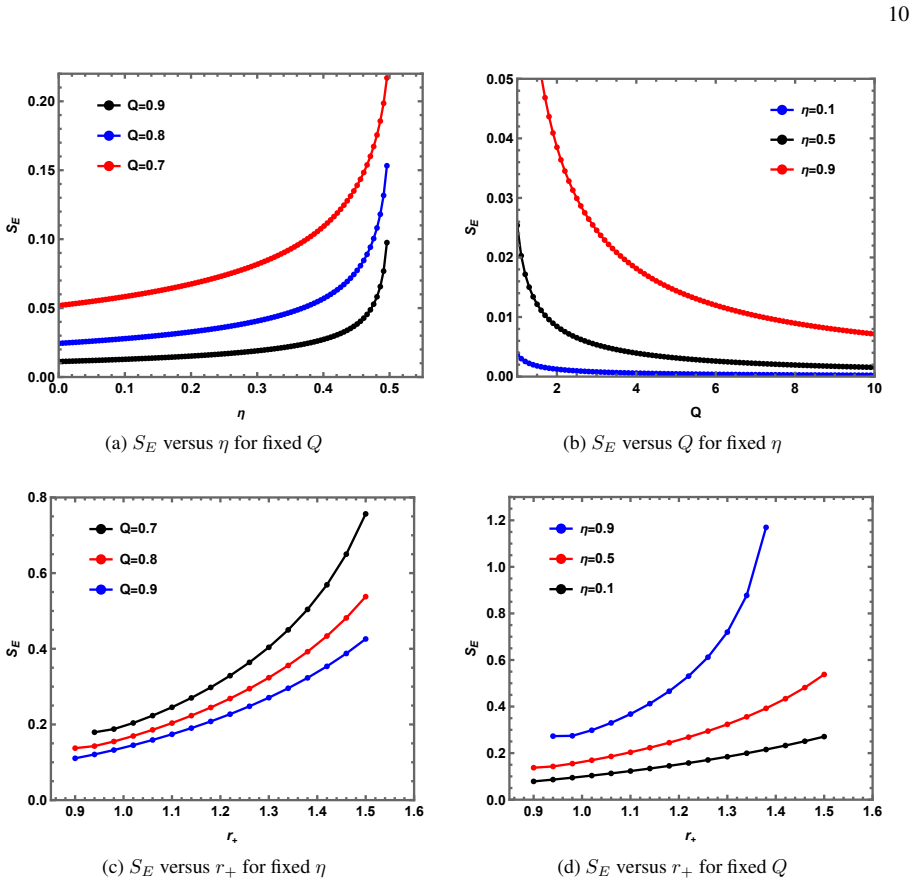
In each of the four models — NED-AdS, ModMax-AdS, Euler-Heisenberg-AdS, and Born-Infeld-AdS — the paper considers a charged test particle with energy fixed by the isentropic condition E = qΦ(r+). Near the horizon the radial effective potential satisfies V_eff(r+)=0 and dV_eff/dr|_{r+}=4πT > 0, so V_eff is positive just outside the horizon: the particle is reflected at an outer turning point r2 and can never classically reach the hole. The quantum amplitude to tunnel through the barrier is evaluated in the semiclassical approximation, giving Γ ~ e^{-2S_E} with S_E = ∫_{r+}^{r2} dr/√V_eff. Numerically integrating this action for the four backgrounds, the paper reports that S_E increases as the
What carries the argument
The central object is the Euclidean action S_E = ∫_{r+}^{r2} dr/√V_eff, built from the radial effective potential V_eff(r) of a charged test particle under the isentropic energy condition E = qΦ. Its defining property is the near-horizon behaviour V_eff'(r+)=4πT > 0, which creates the classically forbidden interval [r2, r+]. This action enters the WKB transition amplitude as K ~ e^{-S_E}, giving a tunneling probability Γ ~ e^{-2S_E}; all reported parameter dependences are read off from numerical evaluation of this single integral.
Load-bearing premise
The load-bearing premise is the Euclidean-action prescription S_E = ∫_{r2}^{r+} dr/√V_eff stated in Eqs. (24)–(27) of Sec. III.1: the paper never derives this from the charged particle action in the curved background, never checks it against the known Reissner–Nordström limit, and leaves the numerical setup (AdS scale l, Newton constant G) unspecified, so the reported parameter dependences stand or fall with this formula.
What would settle it
Evaluate the barrier integral S_E = ∫_{r+}^{r2} dr/√V_eff for the Reissner–Nordström limit (all nonlinear couplings set to zero) and compare against the known RN result from Ref. [30]; if the numbers disagree, the Euclidean-action formula underlying all the plots is invalid. Alternatively, derive the Euclidean Lagrangian from the charged-particle worldline action in one of the NED backgrounds and check whether it reduces to Eq. (27).
If this is right
- In all four NLED-AdS backgrounds the isentropic absorption of a charged particle is classically forbidden; only tunneling permits it.
- Stronger nonlinear electrodynamics generally lowers the tunneling probability, so the NLED couplings act as an entropy-bound enforcing mechanism.
- Smaller black holes have larger tunneling rates, so the late stages of black hole evaporation are the regime where nonperturbative isentropic absorption is most relevant.
- The Born–Infeld case shows that not every nonlinear electrodynamics modifies the barrier equally; the tunneling probability is nearly insensitive to β.
- The results extend the earlier Reissner–Nordström and Kerr–Newman findings to NLED-modified spacetimes, supporting a universality conjecture.
Where Pith is reading between the lines
- A direct extension would be to compare Γ_tunnel with the Hawking emission rate as a function of horizon radius; if the tunneling channel ever dominates for near-extremal black holes, it would give an observational handle on entropy-bound violations.
- The Euler–Heisenberg inversion (larger a lowers S_E for fixed Q) is a natural stress test: a higher-resolution scan of the a–Q plane would show whether the universality conjecture survives or needs a caveat.
- Because the numerical setup omits the AdS scale l and Newton constant G, the absolute values of S_E are not fixed; rescaling the action by the black hole temperature T would sharpen the parameter trends.
- The small-black-hole trend suggests that remnant or final-stage black holes could absorb charge isentropically with appreciable probability; whether this alters information-paradox resolutions via remnants is a question the paper raises but leaves open.
Editorial analysis
A structured set of objections, weighed in public.
Referee Report
Summary. This paper studies isentropic absorption (dM = Φ dQ) of a charged test particle by four AdS black hole spacetimes with nonlinear electrodynamics: NED-AdS, ModMax-AdS, Euler-Heisenberg-AdS, and Born-Infeld-AdS. For each model the authors write down the radial effective potential of Eq. (10), observe that Veff(r+) = 0 and Veff'(r+) = 4πT > 0, and conclude that the process is classically forbidden, with a classically forbidden region between an outer turning point r2 and the horizon r+. They then assert a Euclidean-action formula S_E = ∫ dr/√Veff, evaluate it numerically, and interpret Γ ∼ e^{-2S_E}. The main claims are that stronger nonlinear-electrodynamics parameters suppress the tunnelling probability, that larger black hole charge enhances it, that smaller horizon radius enhances it, and that this small-black-hole behaviour may be universal and relevant to entropy bounds.
Significance. If established, the quantitative results would extend the nonperturbative entropy-bound-violation channel of Mann and Yeom to a broad class of NLED-AdS black holes and would identify a striking small-black-hole enhancement. The classical no-go part is sound: the near-horizon argument Veff(r+) = 0 and Veff'(r+) = 4πT > 0 is clean, although the general statement already appears in Ref. [31] for all stationary, nonextremal, axisymmetric black holes, so the novelty resides in the Euclidean-action computation. That computation, however, is the weakest point: the central formula is asserted rather than derived, the numerical setup is under-specified, and the paper contains a direct contradiction between the Euler-Heisenberg section and the conclusions. The claimed universality and entropy-bound implications are therefore not supported by the manuscript as it stands.
major comments (4)
- [Sec. III.1, Eqs. (19)-(27)] The quantitative core of the paper, S_E = ∫_{r2}^{r+} dr/√Veff, is never derived. The path-integral discussion in Eqs. (19)-(21) is schematic, and Eq. (27) is simply asserted; no Euclidean Lagrangian L_E, integration measure, affine parameter, or relation between L_E and Veff is provided. For a relativistic charged particle in a static metric, the standard WKB/instanton action is based on the canonical radial momentum, whose integrand has a different form (typically √Veff/f) and different parameter dependence. The formula is also not checked against the known Reissner-Nordström limit when b→0, η→0, a→0, or β→∞. Since every reported parameter dependence of the tunnelling probability is read off S_E, this unsupported prescription is load-bearing.
- [Secs. III.1-III.4 and Figs. 2-8] The numerical computations are not reproducible. The metric functions contain the AdS length l and Newton constant G (Eqs. (16), (31), (36), (41)), and M is determined by f(r+)=0, yet the manuscript never specifies l, G, or M for any of the plotted curves. Only m=0.0002 and q=0.005 are given, and the Born-Infeld figure captions do not even list those. Without these values the outer turning point r2, the Euclidean action, and the claimed monotonicities cannot be verified. In addition, no condition ensuring the existence of both turning points or of a non-extremal horizon is stated for the ranges of r+ and Q shown.
- [Sec. III.3 vs. Sec. IV] There is a direct internal contradiction for the Euler-Heisenberg model. In Sec. III.3 the text states that for fixed charge Q the Euclidean action decreases with increasing a, implying that increasing nonlinearity enhances tunnelling, and Fig. 6(a) is consistent with this. The concluding section, however, states that for the NED, ModMax, and Euler-Heisenberg systems the Euclidean action increases with the nonlinear parameters, leading to suppression. The abstract's blanket claim that tunnelling is 'increasingly suppressed as the strength of the non-linearity is enhanced' is therefore contradicted by the Euler-Heisenberg results as presented. This affects the claimed universality of the main result.
- [Sec. III.4, Eq. (42)] The Born-Infeld effective potential is written with a plus sign in front of the squared term, while Eq. (10) requires a minus sign: Veff = -(1/m^2)(E - qΦ)^2 + f(r). If the displayed expression was used in the numerics, the barrier shape and hence the Euclidean action for the Born-Infeld model would be affected. At minimum, the equation as printed is not the effective potential derived from Eq. (10).
minor comments (4)
- [Eq. (30)] The line element contains 'r^2(dθ^2 + r^2 sin^2 θ dφ^2)'; the extra r^2 inside the parentheses is a typographical error.
- [Sec. III.4] The text says 'we compute the Euclidean action in equation 37' but the intended reference is Eq. (27).
- [Figs. 2-8] Units and dimensions are not stated. Quantities such as Q, b, η, a, β, m, q, and r+ are treated as dimensionless in the plots, but the metric functions imply definite length/charge scales. The authors should specify the conventions or introduce dimensionless variables.
- [IV] The conclusion summarizes the Euler-Heisenberg charge dependence as 'the action increases beyond a certain Q', but the body text says the increase occurs after a non-monotonic regime; this should be reconciled for clarity.
Circularity Check
No circularity found: the derivation is self-contained and parameter scans are not fitted to the output.
full rationale
The paper's derivation chain is: (i) choose a known NLED-AdS metric and electrostatic potential; (ii) impose the isentropic condition E - qΦ = 0, yielding a positive effective potential barrier; (iii) compute the Euclidean action S_E = ∫_{r2}^{r+} dr / √V_eff following the external WKB prescription of Ref. [30]; (iv) numerically integrate and plot S_E versus b, η, a, β, Q, and r_+. None of the parameters are fitted to the plotted outcome; they are scanned inputs, and S_E is not re-injected as an input. Eq. (27) is imported from an external reference (Mann and Yeom), not from the present authors' prior work, so there is no self-citation chain bearing weight. The reported parameter dependences are direct numerical consequences of the assumed formula rather than circular reductions. Concerns that Eq. (27) is not derived from the charged-particle action or not benchmarked against the Reissner-Nordström limit are validity/correctness critiques, not circularity. Similarly, the Euler-Heisenberg section's internal contradiction (Fig. 6 shows S_E decreasing with a, while Sec. IV says it increases) is an inconsistency, not a circular step. Accordingly, no specific circular step can be exhibited, and the circularity score is 0.
Axiom & Free-Parameter Ledger
free parameters (5)
- test particle mass m =
0.0002 (units unspecified)
- test particle charge q =
0.005 (units unspecified)
- nonlinearity parameters b, η, a, β =
varied over ranges (e.g., b=0.02-0.18, η=0.1-0.9, a=0.1-0.5, β=1-500)
- AdS length l and Newton constant G =
not stated
- black hole mass M =
implicit through r_+
axioms (5)
- domain assumption The isentropic condition for a charged particle reduces to E - qΦ = 0 (Eq. 12).
- domain assumption The quantum transition amplitude is dominated by a Wick-rotated saddle point and Γ ≈ e^{-2S_E} (Eqs. 19-23).
- ad hoc to paper The Euclidean action is S_E = ∫_{r2}^{r+} dr / sqrt(V_eff) (Eq. 27).
- domain assumption For each of the four models, dV_eff/dr|_{r_+} = 4πT > 0.
- domain assumption The four NLED black-hole metrics and potentials from Refs. [32-37] are correct.
read the original abstract
We study the isentropic processes in a class of Anti de Sitter black holes coupled to non-linear electrodynamics. We demonstrate that such processes are classically forbidden but can proceed via quantum mechanical tunnelling. We compute the Euclidean action associated with the tunnelling process and analyze its dependence on the black hole charge, horizon radius, and the non-linear electrodynamics parameters characterizing each model. We find that the tunnelling probability is increasingly suppressed as the strength of the non-linearity is enhanced. We further find that smaller black holes exhibit a significantly higher tunnelling probability compared to larger ones, indicating a departure from classical behaviour. We conjecture that this behaviour may be universal across a broad class of black hole spacetimes. We discuss the implications of our results for entropy bounds and their potential relevance to the black hole information loss paradox.
Figures




Reference graph
Works this paper leans on
-
[1]
Particle Creation by Black Holes,
S. W. Hawking, “Particle Creation by Black Holes,” Commun. Math. Phys.43(1975), 199-220 [erratum: Com- mun. Math. Phys.46(1976), 206] doi:10.1007/BF02345020
-
[2]
Breakdown of Predictability in Gravitational Collapse,
S. W. Hawking, “Breakdown of Predictability in Gravitational Collapse,” Phys. Rev. D14, 2460-2473 (1976)
1976
-
[3]
Semi-classical black holes with large N re-scaling and information loss problem,
D. Yeom and H. Zoe, “Semi-classical black holes with large N re-scaling and information loss problem,” Int. J. Mod. Phys. A26, 3287-3314 (2011) [arXiv:0907.0677 [hep-th]]
Pith/arXiv arXiv 2011
-
[4]
Black Holes: Complementarity or Firewalls?,
A. Almheiri, D. Marolf, J. Polchinski and J. Sully, “Black Holes: Complementarity or Firewalls?,” JHEP02, 062 (2013) [arXiv:1207.3123 [hep-th]]
Pith/arXiv arXiv 2013
-
[5]
The LargeNlimit of superconformal field theories and supergravity,
J. M. Maldacena, “The LargeNlimit of superconformal field theories and supergravity,” Adv. Theor. Math. Phys.2, 231-252 (1998) [arXiv:hep-th/9711200 [hep-th]]
Pith/arXiv arXiv 1998
-
[6]
Difficulties for the Evolution of Pure States Into Mixed States,
T. Banks, L. Susskind and M. E. Peskin, “Difficulties for the Evolution of Pure States Into Mixed States,” Nucl. Phys. B244, 125-134 (1984)
1984
-
[7]
Summary of Parallel Session: Black Hole Evaporation and Information Loss Paradox,
Y . C. Ong and D. Yeom, “Summary of Parallel Session: Black Hole Evaporation and Information Loss Paradox,” Proceedings of the 2nd LeCosPA Symposium [arXiv:1602.06600 [hep-th]]
-
[8]
Black holes and entropy,
J. D. Bekenstein, “Black holes and entropy,” Phys. Rev. D7, 2333-2346 (1973)
1973
-
[9]
Some properties of Noether charge and a proposal for dynamical black hole entropy,
V . Iyer and R. M. Wald, “Some properties of Noether charge and a proposal for dynamical black hole entropy,” Phys. Rev. D50, 846-864 (1994) [arXiv:gr-qc/9403028 [gr-qc]]
Pith/arXiv arXiv 1994
-
[10]
Generalized second law of thermodynamics in black hole physics,
J. D. Bekenstein, “Generalized second law of thermodynamics in black hole physics,” Phys. Rev. D9, 3292-3300 (1974) doi:10.1103/PhysRevD.9.3292
-
[11]
J. D. Bekenstein, “Black holes and entropy,” Phys. Rev. D7(1973), 2333-2346 doi:10.1103/PhysRevD.7.2333
-
[12]
Black holes and the second law,
J. D. Bekenstein, “Black holes and the second law,” Lett. Nuovo Cim.4, 737-740 (1972) doi:10.1007/BF02757029
-
[13]
A Universal Upper Bound on the Entropy to Energy Ratio for Bounded Systems,
J. D. Bekenstein, “A Universal Upper Bound on the Entropy to Energy Ratio for Bounded Systems,” Phys. Rev. D23(1981), 287 doi:10.1103/PhysRevD.23.287
-
[14]
What exactly does Bekenstein bound?,
P. Hayden and J. Wang, “What exactly does Bekenstein bound?,” Quantum9(2025), 1664 doi:10.22331/q-2025- 03-20-1664 [arXiv:2309.07436 [hep-th]]
Pith/arXiv arXiv 2025
-
[15]
Bound states and the Bekenstein bound,
R. Bousso, “Bound states and the Bekenstein bound,” JHEP02(2004), 025 doi:10.1088/1126-6708/2004/02/025 17 [arXiv:hep-th/0310148 [hep-th]]
Pith/arXiv arXiv 2004
-
[16]
A proof of the Bekenstein bound for any strength of gravity through holography,
A. Pesci, “A proof of the Bekenstein bound for any strength of gravity through holography,” Class. Quant. Grav. 27(2010), 165006 doi:10.1088/0264-9381/27/16/165006 [arXiv:0903.0319 [gr-qc]]
Pith/arXiv arXiv 2010
-
[17]
R. Brustein and G. Veneziano, “A Causal entropy bound,” Phys. Rev. Lett.84(2000), 5695-5698 doi:10.1103/PhysRevLett.84.5695 [arXiv:hep-th/9912055 [hep-th]]
Pith/arXiv arXiv 2000
-
[18]
Acceleration Radiation and Generalized Second Law of Thermodynamics,
W. G. Unruh and R. M. Wald, “Acceleration Radiation and Generalized Second Law of Thermodynamics,” Phys. Rev. D25(1982), 942-958 doi:10.1103/PhysRevD.25.942
-
[19]
Entropy bounds, acceleration radiation, and the generalized second law
W. G. Unruh and R. M. Wald, “Entropy bounds, acceleration radiation, and the generalized second law” Phys. Rev. D27(1983), 2271-2276 doi:10.1103/PhysRevD.27.2271
-
[20]
Bekenstein bound and uncertainty relations,
L. Buoninfante, G. G. Luciano, L. Petruzziello and F. Scardigli, “Bekenstein bound and uncertainty relations,” Phys. Lett. B824(2022), 136818 doi:10.1016/j.physletb.2021.136818 [arXiv:2009.12530 [hep-th]]
arXiv 2022
-
[21]
Covariant entropy bound beyond general relativity,
T. Matsuda and S. Mukohyama, “Covariant entropy bound beyond general relativity,” Phys. Rev. D103(2021) no.2, 024002 doi:10.1103/PhysRevD.103.024002 [arXiv:2007.14015 [hep-th]]
Pith/arXiv arXiv 2021
-
[22]
A Covariant entropy conjecture,
R. Bousso, “A Covariant entropy conjecture,” JHEP07(1999), 004 doi:10.1088/1126-6708/1999/07/004 [arXiv:hep-th/9905177 [hep-th]]
Pith/arXiv arXiv 1999
-
[23]
Generalized covariant entropy bound in Einstein gravity with quadratic curvature correc- tions,
H. Zhu and J. Jiang, “Generalized covariant entropy bound in Einstein gravity with quadratic curvature correc- tions,” JHEP05(2024), 286 doi:10.1007/JHEP05(2024)286 [arXiv:2311.05352 [gr-qc]]
Pith/arXiv arXiv 2024
-
[24]
Proof of classical versions of the Bousso entropy bound and of the generalized second law,
E. E. Flanagan, D. Marolf and R. M. Wald, “Proof of classical versions of the Bousso entropy bound and of the generalized second law,” Phys. Rev. D62(2000), 084035 doi:10.1103/PhysRevD.62.084035 [arXiv:hep- th/9908070 [hep-th]]
arXiv 2000
-
[25]
Bekenstein bound from the Pauli principle: a brief introduction,
G. Acquaviva, A. Iorio and L. Smaldone, “Bekenstein bound from the Pauli principle: a brief introduction,” PoS ICHEP2020, 681 (2021) doi:10.22323/1.390.0681 [arXiv:2011.05176 [hep-th]]
Pith/arXiv arXiv 2021
-
[26]
Bekenstein-Hawking Entropy and Strange Metals,
S. Sachdev, “Bekenstein-Hawking Entropy and Strange Metals,” Phys. Rev. X5, no.4, 041025 (2015) doi:10.1103/PhysRevX.5.041025 [arXiv:1506.05111 [hep-th]]
Pith/arXiv arXiv 2015
-
[27]
Remarks on the Sachdev-Ye-Kitaev model,
J. Maldacena and D. Stanford, “Remarks on the Sachdev-Ye-Kitaev model,” Phys. Rev. D94, no.10, 106002 (2016) doi:10.1103/PhysRevD.94.106002 [arXiv:1604.07818 [hep-th]]
Pith/arXiv arXiv 2016
-
[28]
Quasiparticle picture from the Bekenstein bound,
G. Acquaviva, A. Iorio and M. Scholtz, “Quasiparticle picture from the Bekenstein bound,” PoSCORFU2017, 206 (2017) doi:10.22323/1.318.0206 [arXiv:1712.05275 [hep-th]]
Pith/arXiv arXiv 2017
-
[29]
Entropy bounds and black hole remnants,
J. D. Bekenstein, “Entropy bounds and black hole remnants,” Phys. Rev. D49, 1912-1921 (1994) doi:10.1103/PhysRevD.49.1912 [arXiv:gr-qc/9307035 [gr-qc]]
Pith/arXiv arXiv 1912
-
[30]
R. B. Mann and D. h. Yeom, “Isentropic process of Reissner-Nordstr ¨om black holes: A possible excess of the entropy bound via a nonperturbative channel,” Phys. Rev. D112, no.6, 064042 (2025) doi:10.1103/t9px-txyf [arXiv:2505.01663 [gr-qc]]
Pith/arXiv arXiv 2025
-
[31]
Isentropic processes for axisymmetric black holes,
N. K. Dubey and S. Kolekar, “Isentropic processes for axisymmetric black holes,” Phys. Rev. D112, no.8, 084018 (2025) doi:10.1103/731x-38lt [arXiv:2507.08547 [gr-qc]]
arXiv 2025
-
[32]
NED-AdS black holes, extended phase space thermodynamics and Joule–Thomson expansion,
S. I. Kruglov, “NED-AdS black holes, extended phase space thermodynamics and Joule–Thomson expansion,” Nucl. Phys. B984, 115949 (2022) doi:10.1016/j.nuclphysb.2022.115949 [arXiv:2209.10524 [physics.gen-ph]]
arXiv 2022
-
[33]
Regular magnetic black holes and monopoles from nonlinear electrodynamics,
K. A. Bronnikov, “Regular magnetic black holes and monopoles from nonlinear electrodynamics,” Phys. Rev. D63, 044005 (2001) doi:10.1103/PhysRevD.63.044005 [arXiv:gr-qc/0006014 [gr-qc]]
Pith/arXiv arXiv 2001
-
[34]
Y . Sekhmani, S. K. Maurya, M. K. Jasim, ˙I. Sakallı, J. Rayimbaev and I. Ibragimov, “Thermodynamics and phase transition of anti de Sitter black holes with ModMax nonlinear electrodynamics and perfect fluid dark matter,” Eur. Phys. J. C85(2025) no.3, 229 doi:10.1140/epjc/s10052-025-13932-5
-
[35]
LECTURES ON NON LINEAR ELECTRODYNAMICS,
J. Plebanski, “LECTURES ON NON LINEAR ELECTRODYNAMICS,” RX-476
-
[36]
Duality Rotations and TypeDSolutions to Einstein Equations With Nonlinear Electromagnetic Sources,
I. H. Salazar, A. Garcia and J. Plebanski, “Duality Rotations and TypeDSolutions to Einstein Equations With Nonlinear Electromagnetic Sources,” J. Math. Phys.28(1987), 2171-2181 doi:10.1063/1.527430
doi:10.1063/1.527430 1987
-
[37]
Foundations of the new field theory,
M. Born and L. Infeld, “Foundations of the new field theory,” Proc. Roy. Soc. Lond. A144(1934) no.852, 425-451 doi:10.1098/rspa.1934.0059
arXiv 1934
-
[38]
Lessons from the information paradox,
S. Raju, “Lessons from the information paradox,” Phys. Rept.943(2022), 1-80 doi:10.1016/j.physrep.2021.10.001 [arXiv:2012.05770 [hep-th]]
Pith/arXiv arXiv 2022
-
[39]
The Page curve of Hawking radiation from semiclassical geometry,
A. Almheiri, R. Mahajan, J. Maldacena and Y . Zhao, “The Page curve of Hawking radiation from semiclassical geometry,” JHEP03(2020), 149 doi:10.1007/JHEP03(2020)149 [arXiv:1908.10996 [hep-th]]
Pith/arXiv arXiv 2020
-
[40]
Observations of Hawking radiation: the Page curve and baby universes,
D. Marolf and H. Maxfield, “Observations of Hawking radiation: the Page curve and baby universes,” JHEP04 (2021), 272 doi:10.1007/JHEP04(2021)272 [arXiv:2010.06602 [hep-th]]
Pith/arXiv arXiv 2021
discussion (0)
Sign in with ORCID, Apple, or X to comment. Anyone can read and Pith papers without signing in.