REVIEW 3 major objections 4 minor 3 cited by
Provable Quantum Speedups for Reaction-Rate Estimation in High-Dimensional Fokker-Planck Dynamics
T0 review · 3 major / 4 minor · reviewed 2026-08-03 · deepseek-v4-flash
Pith's one-line read A quantum circuit estimates high-dimensional reaction rates with cost sublinear in time and polynomial in particle number, beating the sharpest known classical worst-case bounds by bypassing the postselection bottleneck of dissipative-dynam
desk verdict A genuinely new quantum algorithm for Fokker-Planck observables, but the end-to-end speedup is conditional on state preparation that becomes exponentially hard in the rare-event regime. read the letter →
The pith
A machine-rendered reading of the paper's core claim, the machinery that carries it, and where it could break.
The reading
What carries the argument
Engine of the paper: Gaussian linear combination of Hamiltonian simulations (Gaussian-LCHS). The identity e^{−x²t} = (2π)^{−1/2}∫ e^{−k²/4t} e^{−ikx} dk is applied to the matrix square root A with −A² = H_β; the Gaussian kernel e^{−k²/4t} decays fast enough that the quadrature truncation scale is O(√(t log(1/ε))), which is what makes the cost sublinear in time. Two supporting gadgets carry the argument: a non-unitary overlap circuit—a modified Hadamard test in which the LCU ancilla registers are never post-selected, so ⟨P|e^{TH_β}|R⟩ is read from a measurement whose variance stays O(1) as T grows—and multiplexed QSP, which evaluates all quadrature unitaries e^{−ik_jA} through one shared max-
What would settle it
Implement the overlap circuit for a one-dimensional double-well potential, where the reactive flux can be computed exactly by dense linear algebra on the discretized Fokker-Planck generator. Comparing the number of circuit repetitions and gate count actually needed to reach error ε against the predicted Õ(1/ε)√t scaling would settle the core claims: if the required samples grow like e^{Θ(tΔ)} for spectral gap Δ, the Ω(1) success-probability claim fails; if instead the ε-dependence is visibly steeper than 1/ε at fixed t, the amplitude-estimation speedup claim fails.
Extended reading notes
Core claim
The central claim: the stability-dissipation conflict—exponential decay in success probability that plagues quantum simulation of non-unitary dynamics—disappears when the goal is estimating matrix elements instead of preparing solution states. Writing the Fokker-Planck generator in self-adjoint form H_β = −Σ_j A_j†A_j, the paper represents the propagator e^{TH_β} = e^{−TA²} as a Gaussian linear combination of unitaries e^{−ikA}, then extracts the reactive flux ⟨P|e^{TH_β}|R⟩ via a Hadamard-test-style overlap circuit that succeeds with probability Ω(1), independent of T. The proved gate count for error ε is Õ((η^{5/2}√(tβ)α_V + η^{3/2}√(t/β)N)/ε); paired with a proven Ω(η) Lipschitz lower bou
Load-bearing premise
The polynomial end-to-end complexity assumes oracles that prepare the Boltzmann-weighted reactant and product states efficiently; the paper's own preparation protocol requires local strong convexity and an augmentation stiffness κ that blows up as the inverse fourth power of the region's equilibrium probability, so for the exponentially rare reactant regions where reaction rates are hardest to compute the polynomial scaling is not established.
Editorial extensions
If this is right
- If the central claim holds, a fault-tolerant quantum computer would estimate the reactive flux—and hence the time-dependent reaction rate k_RP(T)—of an η-particle system with polynomial-in-η, sublinear-in-T, 1/ε-scaling gates, in the oracle model assumed.
- The same Gaussian-LCHS plus overlap circuit applies to any dynamical correlation function expressible as a propagator overlap ⟨A, e^{tF}B⟩_μ, including transport coefficients and Van Hove structure factors; the paper states this generality explicitly.
- Hitting times and transition-state probabilities reduce to the same overlap machinery, so the algorithm extends beyond rates to first-passage quantities.
- The proven Ω(η) Lipschitz lower bound for pair potentials means the classical step-size bound in the nonconvex Langevin analysis degrades exponentially with particle number in the worst case—a structural fact about classical trajectory methods, independent of the quantum construction.
- Because the success probability is independent of T, amplitude estimation can be appended to reach Heisenberg-limited 1/ε scaling, and the paper notes that for threshold-type questions ('is the rate below 10⁻⁶?') the query count becomes genuinely better than classical sampling.
Reading between the lines
- Editorial inference: the exponential-in-η separation relies on comparing against worst-case analytical bounds for nonconvex Langevin simulation; specialized classical heuristics (biased sampling, adaptive multilevel splitting, tensor-network solvers) are explicitly outside that bound, so the practical advantage may be smaller or larger than the asymptotic comparison suggests, depending on the pote
- Editorial inference: the paper's own state-preparation theorem carries the κ ∈ O(1/(Z_R² β ε⁴)) stiffness penalty, which is exponential in the barrier height for a genuinely rare reactant region. A testable consequence: end-to-end advantage should first appear in moderately activated regimes (Z_R not exponentially small) or in correlation-function settings that need no reactant/product region at a
- Editorial inference: the non-unitary overlap circuit's 'no postselection' property is a structural result about estimating matrix elements of dissipative generators with negative logarithmic norm; it suggests a general recipe—for any generator expressible as a sum of squares, correlation functions of the semigroup are as easy as Hamiltonian simulation, not as hard as state preparation.
- Editorial inference: since the algorithm's time cost scales as √t, it is naturally suited to short-horizon reactive fluxes and transport coefficients rather than steady-state limits, where the mixing-time gap would re-enter; this points to low-temperature metastable systems with a large effective gap as the sweet spot for a practical demonstration.
Editorial analysis
A structured set of objections, weighed in public.
Referee Report
Summary. The paper develops a quantum algorithm for estimating reaction-rate overlaps ν_RP(T)=⟨P|e^{T H_β}|R⟩ for high-dimensional Fokker–Planck dynamics. The main technical ingredients are: (i) a self-adjoint sum-of-squares representation of the Fokker–Planck generator as H_β=−∑A_j^†A_j; (ii) a Gaussian-LCHS identity expressing e^{−tA^2} as a linear combination of unitaries e^{−ikA}; (iii) a multiplexed QSP construction that implements all quadrature terms with O(α_A√t) queries to a block encoding of A; and (iv) a modified Hadamard/LCU circuit that estimates ⟨P|e^{tH_β}|R⟩ without post-selecting on the LCU success branch. The paper claims a gate complexity Õ((η^{5/2}√(tβ)α_V + η^{3/2}√(t/β)N)/ε) for the reactive flux, and compares this with worst-case classical Langevin-simulation bounds that are exponential in particle number η. The core derivations are conditional on efficient oracles O_R and O_P preparing the reactant and product states, and the paper provides one concrete state-preparation route in Theorem 4. I assess the conditional overlap-estimation theorem and the Gaussian-LCHS analysis as largely sound, but the end-to-end speedup claim is not currently established in the rare-event regime, and there is a separate error-analysis gap in the overlap circuit when the LCHS unitaries are only approximately implemented.
Significance. If the conditional results hold as stated, the Gaussian-LCHS representation and the multiplexed QSP construction are valuable technical contributions: they give sublinear-in-time block encodings of non-unitary propagators and a way to estimate matrix elements without the usual exponential post-selection penalty. The explicit gate counts and error bounds in Appendices E and J are a strength, as is the honest comparison to worst-case classical analytical bounds. However, the advertised 'provable quantum speedup for reaction-rate estimation' is not yet fully supported. The only concrete state-preparation subroutine (Theorem 4) has complexity controlled by κ=O(1/(Z_R^2βε^4)), which becomes exponentially large for rare-event regions with exponentially small equilibrium weight Z_R. Thus the polynomial end-to-end scaling in η, T, and ε is established only under an efficient-state-oracle assumption, not for the hard reaction-rate regime. The paper is therefore best viewed as a rigorous conditional overlap-estimation algorithm with a substantial open problem in state preparation, rather than as a complete end-to-end speedup.
major comments (3)
- [§III.C, Lemma 3; §IV.B, Lemma 6; Appendix G] The end-to-end scaling in Eq. (65) is not established for rare-event regions. The only concrete reactant/product state-preparation construction, Theorem 4, has query complexity Õ(√(ηd/(2m))(βηL(α_V+κ)+N/L)), with κ chosen in Lemma 10 as κ∈O(1/(Z_R^2βε^4)). For a physically relevant rare-event region, Z_R=∫_R e^{−βV}dx decays exponentially in the barrier height, so κ and the state-preparation cost grow exponentially before the flux-estimation circuit is ever reached. The paper acknowledges in Sec. V that detailed implementation of state preparation is future work, but the proposal actually provided does not bridge the gap; it moves the exponential hardness into the state-preparation oracle. The abstract's statement that the reactive flux can be estimated with the stated gate count is therefore only valid conditional on an efficient oracle for |R⟩ and |P⟩, not for the rare-event regime whe
- [Appendix A, Theorem 1] The non-unitary overlap circuit is analyzed under the assumption that the U_l in the LCU are exact unitaries. Lemma 3 explicitly states 'provided the U_l are unitaries', and the derivation in Appendix G traces the circuit with exact U_l. In the actual implementation, however, each e^{−ik_jA} is only approximated by a QSP polynomial P_j(A/α), and the multiplexed QSP construction (Lemma 6) outputs a state of the form Σ_j c_j P_j(A/α)|ψ⟩|0⟩|j⟩+|⊥⟩, with an explicit residual |⊥⟩ component. Theorem 8 uses this approximate implementation inside the overlap circuit, but no bound is provided for the contribution of the |⊥⟩ terms to the measured Pauli-Z expectation or to the amplitude-estimation estimate. As written, the proof of the overlap-estimation claim does not cover the circuit that Theorem 8 actually uses. I expect the gap can be closed by a standard perturbation argument, but the missing
- The proof of Theorem 1 contains an unjustified step. From Lipschitz continuity of ∇V and differentiability one obtains sup|V''|=γ, but the proof then asserts 'there exists r0>0 such that V''(r0)≥γ/2'. This is not a consequence of sup|V''|=γ; one can only guarantee |V''(r0)|≥γ/2. If V'' is everywhere non-positive, the displayed identity v^T H v = 4V''(r_ij) for the test vector is negative, and the claimed lower bound γη/4 does not follow. The theorem is likely true as stated (one can handle the negative case by taking absolute values or reversing the test-vector sign), but the proof as written is incomplete. Since the exponential-in-η classical bound in Eq. (11) depends on Lip(∇V_pair)=Ω(ηγ), this proof should be repaired before the classical-comparison claim is relied upon.
minor comments (4)
- Eq. (61) states ⟨Φ|Z_0|Φ⟩=1/(2α_g) Re⟨P|e^{tH_β}|P⟩, but the quantity of interest is ⟨P|e^{tH_β}|R⟩. The R/P mismatch appears to be a typo (compare Eq. (59)), but it is confusing in the central circuit analysis.
- The abstract contains an apparent LaTeX artifact: 'blue{direct solution of the PDE is intractable...}' should be cleaned up before publication.
- In the proof of Lemma 15, the notation α is used in the bound M∈O(α√(t log(1/ε))) and in the exponent after Eq. (E10), but the lemma statement only introduces α implicitly via the block-encoding subnormalization factor. Please state explicitly what α is in the lemma statement and proof to avoid ambiguity.
- The state |Φ⟩ written after Eq. (60) is not normalized; the subsequent expectation-value calculation is up to the usual Hadamard-test normalization, but explicitly writing the omitted factor would improve readability.
Circularity Check
No significant circularity: the central overlap-estimation and Gaussian-LCHS derivations are self-contained; state-preparation is an explicit input, and the classical comparison rests on an external published bound.
full rationale
The paper's core derivation chain is not circular. The reactive flux νRP(T) = ⟨P|e^{Hβ T}|R⟩ is defined as a matrix element of the self-adjoint Fokker-Planck generator Hβ obtained by an explicit similarity transformation (Eq. 14), and the Gaussian-LCHS representation is derived from the exact Fourier identity e^{-x^2 t} = (2π)^{-1/2}∫ f_t(k)e^{-ikx}dk (Eqs. 25-28), with truncation, quadrature, and finite-precision errors bounded in Lemmas 14-17. The overlap circuit is analyzed by a direct computation (Appendix G) producing P(0) = 1/2(1 + α^{-1} Re⟨φ|H|ψ⟩), with no fitted parameter and no postselection hidden in the claimed cost. The gate counts in Theorem 8 are obtained by composing explicit block-encoding subroutines (Theorem 5, Corollary 1, Lemma 6) rather than by assuming the result. The comparison to classical complexity uses the externally published worst-case bound of Ref. [47] (Eq. 11), and the paper's own Theorem 1 only supplies the Lipschitz scaling needed to evaluate that external bound; this is not a self-referential reduction. The references to the authors' own prior work (e.g., Refs. [84,85,93]) are limited to QSP phase-factor stability and speculative future directions, so they are not load-bearing. The main caveat is that Theorem 8 assumes efficient oracles O_R, O_P, and the only explicit construction (Theorem 4) has cost scaling with κ = O(1/(Z_R^2 β ε^4)), which can be exponentially large for rare reactant regions. This is an incompleteness/correctness caveat about end-to-end scaling, not circularity: the overlap-estimation theorem remains a conditional statement with independent mathematical content, and the paper explicitly acknowledges that state preparation is left for future work (Sec. V). No quantity is fitted to data, and no prediction is renamed from a fitting parameter.
Assumptions & free parameters
assumptions (4)
- standard math The Fokker-Planck generator F can be similarity-transformed to a self-adjoint Schrödinger-type operator Hβ = β^{-1}Δ - β/4||∇V||^2 + 1/2 ΔV.
- domain assumption The potential V is confining and, for the complexity bounds, a polynomial of degree 2k in pairwise distances with no linear term, with α_V = max |V'(r)/r| finite.
- domain assumption For the classical comparison, R ∈ O(1) (the radius outside which V is strongly convex) and the Lipschitz constant γ of the single-particle potential gradient is fixed; then Lip(∇V_pair) = Θ(ηγ).
- ad hoc to paper Quantum state preparation oracles for |R> and |P> are available; for locally convex regions a warm start with constant overlap exists.
Cite this review
Pith. "Pith review of Provable Quantum Speedups for Reaction-Rate Estimation in High-Dimensional Fokker-Planck Dynamics." pith.science (2026). https://pith.science/paper/SAEADFOP
@misc{pith2026260115523,
  author       = {Pith},
  title        = {Pith review of: Provable Quantum Speedups for Reaction-Rate Estimation in High-Dimensional Fokker-Planck Dynamics},
  year         = {2026},
  howpublished = {\url{https://pith.science/paper/SAEADFOP}},
  note         = {Machine review of arXiv:2601.15523}
}
abstract
The Fokker-Planck equation models rare events across sciences, but blue{direct solution of the PDE is intractable for classical computers due to } its high-dimensional nature. Classical stochastic methods circumvent this curse-of-dimensionality, and serve as the de facto standard for practicing computational scientists. Quantum algorithms for such non-unitary dynamics often suffer from exponential decay in success probability. We introduce a quantum algorithm that overcomes this bottleneck for estimating reaction rates {and dynamical correlation functions more generally}. Using a sum-of-squares representation, we develop a Gaussian linear combination of Hamiltonian simulations (Gaussian-LCHS) to represent the non-unitary propagator with $O\left(\sqrt{t\|H\|\log(1/\epsilon)}\right)$ queries to its block encoding. Crucially, we pair this with {a} novel technique to directly estimate matrix elements without exponential decay. For $\eta$ pairwise interacting particles discretized with $N$ plane waves per degree of freedom, we estimate reactive flux to error $\epsilon$ using $\widetilde{O}\left((\eta^{5/2}\sqrt{t\beta}\alpha_V + \eta^{3/2}\sqrt{t/\beta}N)/\epsilon\right)$ quantum gates, where $\alpha_V = \max_{r}|V'(r)/r|$. We further prove that under comparable worst-case analytical guarantees, the sharpest classical bounds for estimating reaction rates via simulation of the associated overdamped Langevin dynamics scale as $O(t\eta^2 e^{\Omega(\eta)}/\epsilon^4)$, yielding an exponential improvement in $\eta$, a quartic speedup in $\epsilon$, and quadratic speedup in the time horizon $t$. While classical algorithms may outperform these bounds in practice, this work demonstrates a rigorous route toward quantum advantage for high-dimensional dissipative dynamics.
Figures

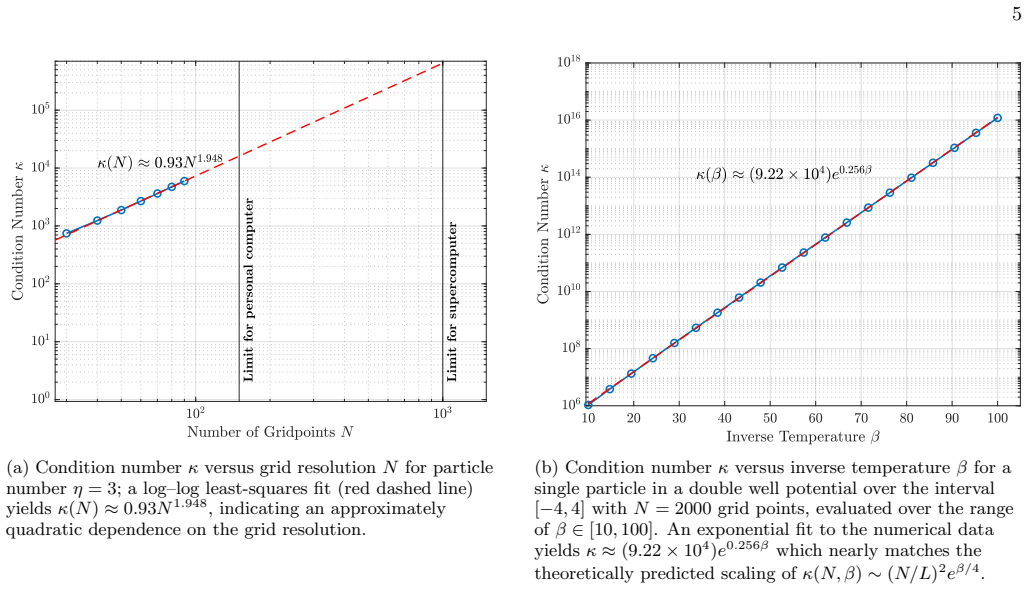

Figures from the paper (6 more)


Forward citations
Cited by 3 Pith papers
-
A Provable Oracle-Free Quantum Algorithm for Nonlinear Dynamics on Hybrid Oscillator-Qubit Processors
Oracle-free hybrid qubit–qumode circuits simulate polynomial-drift nonlinear ODEs via Fokker–Planck Schrödingerisation with O(d^{L+1} n^{L+2}) gates per Trotter step from an exact bipartite Pauli factorisation.
-
Circuit Depth Reduction of One-Ancilla Quantum Differential Equation Solver via Extrapolation
Classical step-size extrapolation reduces the maximum single-run circuit depth of a one-ancilla quantum ODE solver from O(1/ε) to O(polylog(1/ε)) without adding ancillae.
-
A Quantum Path to Partial Differential Equations
Lecture notes that organize quantum PDE algorithms around block encodings of finite-difference and finite-element operators, tracking discretization, preparation, normalization, postselection, and measurement costs.
Reference graph
Works this paper leans on
-
[1]
We remark that weaker conditions can also be used to obtain exponential convergence
Quantum reactant (product) state preparation Our goal is to prepare a quantum state corresponding to p πR(x) whereπ R(x)∝e −βV(x) 1R(x), where the restriction of the potentialV(x)| x∈R ism-strongly convex. We remark that weaker conditions can also be used to obtain exponential convergence. Throughout this section,Rcan be replaced withPfor the preparation ...
-
[2]
Quantum Signal Processing Quantum signal processing (QSP) and its variants [45, 89–91] provides a systematic procedure for implementing a class of polynomial transformations to block encoded matrices. For Hermitian matricesA, the action of a scalar functionfcan be determined by the eigendecomposition ofA=U DU †, as f(A) :=U X i f(λ i)|i⟩ ⟨i|U†,(D6) whereλ...
-
[3]
This is described by the following relationship e−t|x| = 1 π Z ∞ −∞ dk eitk|x| 1 +k 2 ,(D10) which is a Cauchy distribution over the Fourier modes
The original LCHS method The original LCHS method [43] describes the non-unitary propagatore −tH , forH⪰0, in terms of the expectation value over a family of unitariese −itkH , where the probability measure can be obtained in terms of the normalized Fourier coefficients of the exponential functione −t|x|. This is described by the following relationship e−...
-
[4]
Lemma 17(Bound on simulation error and polynomial degree).LetAbe provided as a block encoding with subnor- malization factorαand letKandMbe as in Lemmas 14 and 15 respectively
Simulation error bounds Now we will bound the effect of implementing the unitary terms to finite error in the Gaussian-LCHS formula. Lemma 17(Bound on simulation error and polynomial degree).LetAbe provided as a block encoding with subnor- malization factorαand letKandMbe as in Lemmas 14 and 15 respectively. Let ^eik(j)A be an approximate block encoding o...
-
[24]
Naoufal El Bekri, Lucas Drumetz, and Franck Vermet. FlowKac: An Efficient Neural Fokker-Planck solver using Temporal Normalizing flows and the Feynman Kac-Formula, March 2025. URLhttp://arxiv.org/abs/2503.11427. arXiv:2503.11427 [cs]
arXiv 2025
-
[25]
On minimal and maximal eigenvalue gaps and their causes
Mark Ashbaugh, Evans Harrell, and Roman Svirsky. On minimal and maximal eigenvalue gaps and their causes. Pacific Journal of Mathematics, 147(1):1–24, January 1991. ISSN 0030-8730, 0030-8730. doi:10.2140/pjm.1991.147.1. URL http://msp.org/pjm/1991/147-1/p01.xhtml
-
[26]
An Introduction to the Conjugate Gradient Method Without the Agonizing Pain
Jonathan R Shewchuk. An Introduction to the Conjugate Gradient Method Without the Agonizing Pain. Technical Report, Carnegie Mellon University, USA, February 1994
1994
-
[27]
Tight quantum depth lower bound for solving systems of linear equations
Qisheng Wang and Zhicheng Zhang. Tight quantum depth lower bound for solving systems of linear equations. Phys. Rev. A, 110:012422, Jul 2024. doi:10.1103/PhysRevA.110.012422. URLhttps://link.aps.org/doi/10.1103/PhysRevA.110. 012422
Show all 85 references
-
[28]
On solving classes of positive-definite quantum linear systems with quadratically improved runtime in the condition number
Davide Orsucci and Vedran Dunjko. On solving classes of positive-definite quantum linear systems with quadratically improved runtime in the condition number. Quantum, 5:573, November 2021. ISSN 2521-327X. doi:10.22331/q-2021-11- 08-573. URLhttp://arxiv.org/abs/2101.11868. arXi...
2021 arXiv
-
[29]
Matlab 23.2.0.2380103 (r2023b), 2023
The MathWorks Inc. Matlab 23.2.0.2380103 (r2023b), 2023. URLhttps://www.mathworks.com
2023
-
[30]
Frontier supercomputer hits new highs in third year of exascale.https://www.ornl
Oak Ridge National Laboratory. Frontier supercomputer hits new highs in third year of exascale.https://www.ornl. gov/news/frontier-supercomputer-hits-new-highs-third-year-exascale, 2024
2024
-
[31]
Childs and Robin Kothari
Andrew M. Childs and Robin Kothari. Limitations on the simulation of non-sparse hamiltonians. Quantum Info. Comput., 10(7):669–684, July 2010. ISSN 1533-7146
2010
-
[32]
I. K. Razumov and Yu. N. Gornostyrev. Metastable Nanoprecipitates in Alloys: Phenomenology and Atomistic Simulation. Physics of Metals and Metallography, 125(11):1175–1182, November 2024. ISSN 1555-6190. doi: 10.1134/S0031918X24601719. URLhttps://doi.org/10.1134/S0031918X24601719
2024 doi
-
[33]
Jones, and Vladan Stevanovi´ c
F´ elix Therrien, Eric B. Jones, and Vladan Stevanovi´ c. Metastable materials discovery in the age of large-scale computation. Applied Physics Reviews, 8(3):031310, August 2021. ISSN 1931-9401. doi:10.1063/5.0049453. URLhttps://doi.org/10. 1063/5.0049453
2021 doi
-
[34]
The metastable states of proteins
Debasish Kumar Ghosh and Akash Ranjan. The metastable states of proteins. Protein Science: A Publication of the Protein Society, 29(7):1559–1568, July 2020. ISSN 1469-896X. doi:10.1002/pro.3859
2020 doi
-
[35]
Chong, Ali S
Lillian T. Chong, Ali S. Saglam, and Daniel M. Zuckerman. Path-sampling strategies for simulating rare events in biomolec- ular systems. Current Opinion in Structural Biology, 43:88–94, April 2017. ISSN 1879-033X. doi:10.1016/j.sbi.2016.11.019
2017 doi
-
[36]
Dinner and Martin Karplus
Aaron R. Dinner and Martin Karplus. A metastable state in folding simulations of a protein model. Nature Structural Biology, 5(3):236–241, March 1998. ISSN 1545-9985. doi:10.1038/nsb0398-236. URLhttps://www.nature.com/articles/ nsb0398-236. Publisher: Nature Publishing Group
1998 doi
-
[37]
Metastability: A Potential-Theoretic Approach, volume 351 of Grundlehren der mathematischen Wissenschaften
Anton Bovier and Frank Den Hollander. Metastability: A Potential-Theoretic Approach, volume 351 of Grundlehren der mathematischen Wissenschaften. Springer International Publishing, Cham, 2015. ISBN 978-3-319-24775-5 978-3-319- 24777-9. doi:10.1007/978-3-319-24777-9. URLhttp://...
2015 doi
-
[38]
Nevins and F
D. Nevins and F. J. Spera. Accurate computation of shear viscosity from equilibrium molecular dynamics simulations. Molecular Simulation, 33(15):1261–1266, December 2007. ISSN 0892-7022. doi:10.1080/08927020701675622. URLhttps:// doi.org/10.1080/08927020701675622. Publisher: T...
2007 doi
-
[39]
R. Zwanzig. Time-Correlation Functions and Transport Coefficients in Statistical Mechanics. Annual Review of Physical Chemistry, 16(Volume 16,):67–102, October 1965. ISSN 0066-426X, 1545-1593. doi:10.1146/annurev.pc.16.100165.000435. URLhttps://www.annualreviews.org/content/jo...
1965
-
[40]
Correlations in Space and Time and Born Approximation Scattering in Systems of Interacting Particles
L´ eon Van Hove. Correlations in Space and Time and Born Approximation Scattering in Systems of Interacting Particles. Physical Review, 95(1):249–262, July 1954. ISSN 0031-899X. doi:10.1103/PhysRev.95.249. URLhttps://link.aps.org/ doi/10.1103/PhysRev.95.249
1954 doi
-
[41]
Hansen and I.R
J.P. Hansen and I.R. McDonald. Theory of simple liquids. Academic Press, 2006. ISBN 978-0-08-045507-5. URL https://books.google.com/books?id=Uhm87WZBnxEC. tex.lccn: 2005055205. 24
2006
-
[42]
Statistical-Mechanical Theory of Irreversible Processes
Ryogo Kubo. Statistical-Mechanical Theory of Irreversible Processes. I. General Theory and Simple Applications to Magnetic and Conduction Problems. Journal of the Physical Society of Japan, 12(6):570–586, June 1957. ISSN 0031-9015, 1347-4073. doi:10.1143/JPSJ.12.570. URLhttps:...
1957 doi
-
[43]
Linear combination of Hamiltonian simulation for non-unitary dynamics with optimal state preparation cost, March 2023
Dong An, Jin-Peng Liu, and Lin Lin. Linear combination of Hamiltonian simulation for non-unitary dynamics with optimal state preparation cost, March 2023
2023
-
[44]
Childs, and Lin Lin
Dong An, Andrew M. Childs, and Lin Lin. Quantum algorithm for linear non-unitary dynamics with near-optimal dependence on all parameters, December 2023
2023
-
[45]
Guang Hao Low and Isaac L. Chuang. Optimal Hamiltonian Simulation by Quantum Signal Processing. Physical Review Letters, 118(1):1–5, 2017. ISSN 10797114. doi:10.1103/PhysRevLett.118.010501
2017 doi
-
[46]
Quantum Differential Equation Solvers: Limitations and Fast- Forwarding
Dong An, Jin-Peng Liu, Daochen Wang, and Qi Zhao. Quantum Differential Equation Solvers: Limitations and Fast- Forwarding. Communications in Mathematical Physics, 406(8):189, July 2025. ISSN 1432-0916. doi:10.1007/s00220-025- 05358-7
2025 doi
-
[47]
Chatterji, Yasin Abbasi-Yadkori, Peter L
Xiang Cheng, Niladri S. Chatterji, Yasin Abbasi-Yadkori, Peter L. Bartlett, and Michael I. Jordan. Sharp convergence rates for Langevin dynamics in the nonconvex setting, July 2020. URLhttp://arxiv.org/abs/1805.01648. arXiv:1805.01648 [stat]
2020 arXiv
-
[48]
Dominic W. Berry. High-order quantum algorithm for solving linear differential equations. Journal of Physics A: Mathematical and Theoretical, 47(10):105301, March 2014. ISSN 1751-8113, 1751-8121. doi:10.1088/1751- 8113/47/10/105301
2014 doi
-
[49]
Fast-forwarding quantum algorithms for linear dissipative differential equations, October 2024
Dong An, Akwum Onwunta, and Gengzhi Yang. Fast-forwarding quantum algorithms for linear dissipative differential equations, October 2024. URLhttp://arxiv.org/abs/2410.13189. arXiv:2410.13189
2024
-
[50]
Time-marching based quantum solvers for time-dependent linear differential equa- tions
Di Fang, Lin Lin, and Yu Tong. Time-marching based quantum solvers for time-dependent linear differential equa- tions. Quantum, 7:955, March 2023. doi:10.22331/q-2023-03-20-955. URLhttps://quantum-journal.org/papers/ q-2023-03-20-955/. Publisher: Verein zur F¨ orderung des Ope...
2023 doi
-
[51]
Quantum simulation of partial differential equations via Schrodingerisation, December 2022
Shi Jin, Nana Liu, and Yue Yu. Quantum simulation of partial differential equations via Schrodingerisation, December 2022
2022
-
[52]
Pedro C. S. Costa, Stephen Jordan, and Aaron Ostrander. Quantum Algorithm for Simulating the Wave Equation. Physical Review A, 99(1):012323, January 2019. ISSN 2469-9926, 2469-9934. doi:10.1103/PhysRevA.99.012323. URL http://arxiv.org/abs/1711.05394. arXiv:1711.05394 [quant-ph]
2019 arXiv
-
[53]
Ram, and George Vahala
Efstratios Koukoutsis, Kyriakos Hizanidis, Abhay K. Ram, and George Vahala. Dyson Maps and Unitary Evolution for Maxwell Equations in Tensor Dielectric Media. Physical Review A, 107(4):042215, April 2023. ISSN 2469-9926, 2469-9934. doi:10.1103/PhysRevA.107.042215. URLhttp://ar...
2023 arXiv
-
[54]
Ollitrault, Alexander Miessen, and Ivano Tavernelli
Pauline J. Ollitrault, Alexander Miessen, and Ivano Tavernelli. Molecular Quantum Dynamics: A Quantum Com- puting Perspective. Accounts of Chemical Research, 54(23):4229–4238, December 2021. ISSN 0001-4842. doi: 10.1021/acs.accounts.1c00514. URLhttps://doi.org/10.1021/acs.acco...
2021 doi
-
[55]
Quantum simulation of the Fokker-Planck equation via Schrodingerization, April 2024
Shi Jin, Nana Liu, and Yue Yu. Quantum simulation of the Fokker-Planck equation via Schrodingerization, April 2024
2024
-
[56]
Berry, Robin Kothari, Rolando D
Ryan Babbush, Dominic W. Berry, Robin Kothari, Rolando D. Somma, and Nathan Wiebe. Exponential Quantum Speedup in Simulating Coupled Classical Oscillators. Physical Review X, 13(4):041041, December 2023. ISSN 2160-3308. doi:10.1103/PhysRevX.13.041041. URLhttps://link.aps.org/d...
2023 doi
-
[57]
Krovi, Nuno F
Jin-Peng Liu, Herman Øie Kolden, Hari K. Krovi, Nuno F. Loureiro, Konstantina Trivisa, and Andrew M. Childs. Efficient quantum algorithm for dissipative nonlinear differential equations. Proceedings of the National Academy of Sciences of the United States of America, 118(35):1...
2021
-
[58]
Quantum algorithms for computing observables of nonlinear partial differential equations, 2022
Shi Jin and Nana Liu. Quantum algorithms for computing observables of nonlinear partial differential equations, 2022. URLhttp://arxiv.org/abs/2202.07834. arXiv: 2202.07834
2022 arXiv
-
[59]
Efficient quantum algorithm for nonlinear reaction-diffusion equations and energy estimation, 2022
Dong An, Di Fang, Stephen Jordan, Jin-Peng Liu, Guang Hao Low, and Jiasu Wang. Efficient quantum algorithm for nonlinear reaction-diffusion equations and energy estimation, 2022. URLhttp://arxiv.org/abs/2205.01141. arXiv: 2205.01141
2022 arXiv
-
[60]
Pedro C. S. Costa, Philipp Schleich, Mauro E. S. Morales, and Dominic W. Berry. Further improving quantum algorithms for nonlinear differential equations via higher-order methods and rescaling, December 2023. URLhttp://arxiv.org/abs/ 2312.09518. arXiv:2312.09518 [math-ph, phys...
2023 arXiv
-
[62]
Lowrie, Sam Pallister, and Andrew T
David Jennings, Matteo Lostaglio, Robert B. Lowrie, Sam Pallister, and Andrew T. Sornborger. The cost of solving linear differential equations on a quantum computer: fast-forwarding to explicit resource counts, March 2024. URL http://arxiv.org/abs/2309.07881. arXiv:2309.07881 ...
2024 arXiv
-
[63]
Anirban Narayan Chowdhury and Rolando D. Somma. Quantum algorithms for Gibbs sampling and hitting-time estima- tion, March 2016
2016
-
[64]
Somma, Yigit Subasi, and Burak S ¸ahino˘ glu
Zoe Holmes, Gopikrishnan Muraleedharan, Rolando D. Somma, Yigit Subasi, and Burak S ¸ahino˘ glu. Quantum algorithms from fluctuation theorems: Thermal-state preparation. Quantum, 6:825, October 2022. ISSN 2521-327X. doi:10.22331/q- 2022-10-06-825. URLhttp://arxiv.org/abs/2203....
2022 arXiv
-
[65]
Operator-Level Quantum Acceleration of Non-Logconcave Sampling, May 2025
Jiaqi Leng, Zhiyan Ding, Zherui Chen, and Lin Lin. Operator-Level Quantum Acceleration of Non-Logconcave Sampling, May 2025. URLhttp://arxiv.org/abs/2505.05301. arXiv:2505.05301 [quant-ph]. 25
2025
-
[66]
Supersymmetry and Morse theory
Edward Witten. Supersymmetry and Morse theory. Journal of Differential Geometry, 17(4):661 – 692, 1982. doi: 10.4310/jdg/1214437492. URLhttps://doi.org/10.4310/jdg/1214437492
1982
-
[67]
Committor functions via tensor networks
Yian Chen, Jeremy Hoskins, Yuehaw Khoo, and Michael Lindsey. Committor functions via tensor networks. Journal of Computational Physics, 472:111646, January 2023. ISSN 00219991. doi:10.1016/j.jcp.2022.111646. URLhttps:// linkinghub.elsevier.com/retrieve/pii/S0021999122007094
2023
-
[68]
Solving for high-dimensional committor functions using artificial neural networks
Yuehaw Khoo, Jianfeng Lu, and Lexing Ying. Solving for high-dimensional committor functions using artificial neural networks. Research in the Mathematical Sciences, 6(1):1, October 2018. ISSN 2197-9847. doi:10.1007/s40687-018-0160-2. URLhttps://doi.org/10.1007/s40687-018-0160-2
2018 doi
-
[69]
Estimating committor functions via deep adaptive sampling on rare transition paths
Yueyang Wang, Kejun Tang, Xili Wang, Xiaoliang Wan, Weiqing Ren, and Chao Yang. Estimating committor functions via deep adaptive sampling on rare transition paths. Journal of Computational Physics, 544:114439, January 2026. ISSN 0021-
2026
-
[70]
A semigroup method for high dimensional committor functions based on neural network
Haoya Li, Yuehaw Khoo, Yinuo Ren, and Lexing Ying. A semigroup method for high dimensional committor functions based on neural network. In Proceedings of the 2nd Mathematical and Scientific Machine Learning Conference, pages 598–618. PMLR, April 2022. URLhttps://proceedings.ml...
2022
-
[71]
Point Cloud Discretization of Fokker–Planck Operators for Committor Functions
Rongjie Lai and Jianfeng Lu. Point Cloud Discretization of Fokker–Planck Operators for Committor Functions. Multiscale Modeling & Simulation, 16(2):710–726, January 2018. ISSN 1540-3459, 1540-3467. doi:10.1137/17M1123018. URLhttps: //epubs.siam.org/doi/10.1137/17M1123018
2018 doi
-
[72]
Solving high-dimensional Fokker-Planck equation with functional hierarchical tensor
Xun Tang and Lexing Ying. Solving high-dimensional Fokker-Planck equation with functional hierarchical tensor. Journal of Computational Physics, 511:113110, August 2024. ISSN 00219991. doi:10.1016/j.jcp.2024.113110. URLhttps:// linkinghub.elsevier.com/retrieve/pii/S0021999124003590
2024
-
[73]
A short course on fast multipole methods, 2021
Rick Beatson and Leslie Greengard. A short course on fast multipole methods, 2021. URLhttps://math.nyu.edu/ ~greengar/shortcourse_fmm.pdf
2021
-
[74]
Yi-An Ma, Yuansi Chen, Chi Jin, Nicolas Flammarion, and Michael I. Jordan. Sampling Can Be Faster Than Optimization. Proceedings of the National Academy of Sciences, 116(42):20881–20885, October 2019. ISSN 0027-8424, 1091-6490. doi: 10.1073/pnas.1820003116. URLhttp://arxiv.org...
2019 arXiv
-
[75]
Robert L. Wolpert. Lecture notes on probability and measure theory: Spring 2009, March 2009. URLhttps://www2. stat.duke.edu/courses/Spring09/sta205/lec/topics/stein/Lecture2.pdf
2009
-
[76]
Leimkuhler, C
B. Leimkuhler, C. Matthews, and M. V. Tretyakov. On the long-time integration of stochastic gradient systems.Proceedings of the Royal Society A: Mathematical, Physical and Engineering Sciences, 470(2170):20140120, October 2014. doi: 10.1098/rspa.2014.0120. URLhttps://royalsoci...
2014
-
[77]
Johnson, Amara Katabarwa, and Nathan Wiebe
Matthew Pocrnic, Peter D. Johnson, Amara Katabarwa, and Nathan Wiebe. Constant-Factor Improvements in Quantum Algorithms for Linear Differential Equations, June 2025. URLhttp://arxiv.org/abs/2506.20760. arXiv:2506.20760 [quant-ph]
2025
-
[78]
McClean, Michael Newman, Craig Gidney, Sergio Boixo, and Hartmut Neven
Ryan Babbush, Jarrod R. McClean, Michael Newman, Craig Gidney, Sergio Boixo, and Hartmut Neven. Focus beyond Quadratic Speedups for Error-Corrected Quantum Advantage. PRX Quantum, 2(1):010103, March 2021. ISSN 2691-3399. doi:10.1103/PRXQuantum.2.010103. URLhttps://link.aps.org...
2021 doi
-
[79]
Amplified Amplitude Estimation: Exploiting Prior Knowledge to Improve Estimates of Expectation Values, March 2024
Sophia Simon, Matthias Degroote, Nikolaj Moll, Raffaele Santagati, Michael Streif, and Nathan Wiebe. Amplified Amplitude Estimation: Exploiting Prior Knowledge to Improve Estimates of Expectation Values, March 2024. URL http://arxiv.org/abs/2402.14791. arXiv:2402.14791 [quant-ph]
2024 arXiv
-
[80]
Efficient Quantum Algorithms for Simulating Lindblad Evolution, January 2019
Richard Cleve and Chunhao Wang. Efficient Quantum Algorithms for Simulating Lindblad Evolution, January 2019
2019
-
[81]
Simulating Open Quantum Systems Using Hamiltonian Simulations, November 2023
Zhiyan Ding, Xiantao Li, and Lin Lin. Simulating Open Quantum Systems Using Hamiltonian Simulations, November 2023
2023
-
[82]
Mixing Time of Open Quantum Systems via Hypocoercivity, April 2024
Di Fang, Jianfeng Lu, and Yu Tong. Mixing Time of Open Quantum Systems via Hypocoercivity, April 2024
2024
-
[83]
Single-ancilla ground state preparation via Lindbladians, August 2023
Zhiyan Ding, Chi-Fang Chen, and Lin Lin. Single-ancilla ground state preparation via Lindbladians, August 2023
2023
-
[84]
Optimal zeno dragging for quantum control: a shortcut to zeno with action-based scheduling optimization
Philippe Lewalle, Yipei Zhang, and K Birgitta Whaley. Optimal zeno dragging for quantum control: a shortcut to zeno with action-based scheduling optimization. PRX Quantum, 5(2):020366, 2024
2024
-
[85]
Noise-canceling quantum feedback: non- hermitian dynamics with applications to state preparation and magic state distillation
Tathagata Karmakar, Philippe Lewalle, Yipei Zhang, and K Birgitta Whaley. Noise-canceling quantum feedback: non- hermitian dynamics with applications to state preparation and magic state distillation. arXiv preprint arXiv:2507.05611, 2025
2025
-
[86]
Wadia, Ryan V
Neha S. Wadia, Ryan V. Zarcone, and Michael R. DeWeese. Solution to the Fokker-Planck equation for slowly driven Brownian motion: Emergent geometry and a formula for the corresponding thermodynamic metric. Physical Review E, 105(3):034130, March 2022. ISSN 2470-0045, 2470-0053...
2022 doi
-
[87]
University of Cambridge Graduate Course on kinetic theory, 2025
David Tong. University of Cambridge Graduate Course on kinetic theory, 2025. URLhttps://www.damtp.cam.ac.uk/ user/tong/kinetic.html
2025
-
[88]
Bakry and M
D. Bakry and M. ´Emery. Diffusions hypercontractives. In Jacques Az´ ema and Marc Yor, editors,S´ eminairede Probabilit´ es XIX 1983/84, volume 1123, pages 177–206. Springer Berlin Heidelberg, Berlin, Heidelberg, 1985. ISBN 978-3-540-15230- 9 978-3-540-39397-9. doi:10.1007/BFb...
1983 doi
-
[89]
Guang Hao Low and Isaac L. Chuang. Hamiltonian simulation by qubitization. Quantum, 3:1–23, 2019. ISSN 2521327X. doi:10.22331/q-2019-07-12-163
2019 doi
-
[90]
Quantum singular value transformation and beyond: 26 Exponential improvements for quantum matrix arithmetics
Andr´ as Gily´ en, Yuan Su, Guang Hao Low, and Nathan Wiebe. Quantum singular value transformation and beyond: 26 Exponential improvements for quantum matrix arithmetics. In Proceedings of the 51st Annual ACM SIGACT Symposium on Theory of Computing, pages 193–204, June 2019. d...
2019
-
[91]
Generalized Quantum Signal Processing, August 2023
Danial Motlagh and Nathan Wiebe. Generalized Quantum Signal Processing, August 2023
2023
-
[92]
Lecture Notes on Quantum Algorithms for Scientific Computation, 2022
Lin Lin. Lecture Notes on Quantum Algorithms for Scientific Computation, 2022. URLhttp://arxiv.org/abs/2201. 08309. arXiv: 2201.08309
2022 arXiv
-
[93]
Efficient phase-factor evaluation in quantum signal processing
Yulong Dong, Xiang Meng, K Birgitta Whaley, and Lin Lin. Efficient phase-factor evaluation in quantum signal processing. Physical Review A, 103(4), 2021. ISSN 24699934. doi:10.1103/PhysRevA.103.042419. arXiv: 2002.11649
2021 arXiv
-
[94]
Stable factorization for phase factors of quantum signal processing
Lexing Ying. Stable factorization for phase factors of quantum signal processing. Quantum, 6:842, October 2022. ISSN 2521-327X. doi:10.22331/q-2022-10-20-842. URLhttps://doi.org/10.22331/q-2022-10-20-842
2022 doi
-
[95]
Trefethen
L.N. Trefethen. Approximation Theory and Approximation Practice. Other Titles in Applied Mathematics. Society for Industrial and Applied Mathematics, 2013. ISBN 9781611972399. URLhttps://books.google.com/books?id= En41UGQ6YXsC
2013
-
[96]
Fault-Tolerant Quantum Simulations of Chemistry in First Quantization
Yuan Su, Dominic W Berry, Nathan Wiebe, Nicholas Rubin, and Ryan Babbush. Fault-Tolerant Quantum Simulations of Chemistry in First Quantization. PRX Quantum, 2(4):1–96, 2021. ISSN 26913399. doi:10.1103/PRXQuantum.2.040332. arXiv: 2105.12767v2 ISBN: 2105.12767v3
2021 arXiv
-
[97]
reactant
Yuval R. Sanders, Guang Hao Low, Artur Scherer, and Dominic W. Berry. Black-Box Quantum State Preparation without Arithmetic. Physical Review Letters, 122(2):1–5, 2019. ISSN 10797114. doi:10.1103/PhysRevLett.122.020502. arXiv: 1807.03206. 27 Appendix A: Bound on Lipschitz cons...
2019 arXiv
-
[98]
We will exclusively use the linear combination of unitaries (LCU) approach to constructing block encodings, which we describe here
Block encoding Block encoding is a quantum subroutine that implements the action of a non-unitary matrix in a subspace of a unitary matrix. We will exclusively use the linear combination of unitaries (LCU) approach to constructing block encodings, which we describe here. Suppo...
-
[99]
Lemma 14(Truncation Error).For anyϵ >0there exists aK >2 √ tsuch that Z ∞ −∞ e−k2/4t 2 √ πt eikxdk− Z K −K e−k2/4t 2 √ πt eikxdk ≤ϵ, whereKcan be chosenO q tlog 1 ϵ
T runcation error bounds The error from truncating the domain of integration is characterized by the following lemma. Lemma 14(Truncation Error).For anyϵ >0there exists aK >2 √ tsuch that Z ∞ −∞ e−k2/4t 2 √ πt eikxdk− Z K −K e−k2/4t 2 √ πt eikxdk ≤ϵ, whereKcan be chosenO q tlo...
-
[100]
This is characterized by the following lemma
Quadrature Error Bounds Now, we would like to bound the size of the error introduced from the quadrature scheme onMgrid points. This is characterized by the following lemma. Lemma 15(Quadrature Error).For anyϵ >0, there exists a positive integerM≥2, a set of weightsw j ∈ {0, ....
-
[101]
Lemma 16(Bound on subnormalization factor).The subnormalization factorα g resulting from applying the Gausssian-LCHS formula using Gauss quadrature satisfies αg ∈O(1)
Bound on LCHS subnormalization factor The following lemma characterizes the subnormalization factor from implementing the Gaussian-LCHS using Gauss quadrature as a linear combination of unitaries. Lemma 16(Bound on subnormalization factor).The subnormalization factorα g result...
-
[102]
For symmetric pair wise potentials,V ij =V(r ij), the gradients can be simply expressed, ∇iVij =V ′ (rij) xi −x j rij =−∇ jVij
Block Encoding Potential Gradient We will assume that the potential functions take the form of polynomials, which, due to the assumption ofVbeing confining implies that the polynomial must be of even degree. For symmetric pair wise potentials,V ij =V(r ij), the gradients can b...
-
[103]
Our goal now is to block encode the operation X i∈[dη] |i⟩ ⊗ ∇i (J6) wherek m = 2πm L
Block encoding gradient operator The block encoding of theηd-dimensional gradient operator is significantly simplified in the plane wave basis as the derivative operator takes the form of a scalar multiplication. Our goal now is to block encode the operation X i∈[dη] |i⟩ ⊗ ∇i ...
-
[104]
Proof of Theorem 5 Theorem 5.LetN= 2 n be the number of plane wave modes per degree of freedom, forηparticles occupying a d-dimensional reciprocal latticeG=Z d N , corresponding to a discretization of the real space[−L, L] d for each particle. LetVbe a potential function given...
-
[9991]
URLhttps://www.sciencedirect.com/science/article/pii/S0021999125007211
doi:10.1016/j.jcp.2025.114439. URLhttps://www.sciencedirect.com/science/article/pii/S0021999125007211
2025
Reviewed August 3, 2026 · model on record in the stance chip above.
Discussion (0). Sign in to comment.