REVIEW 4 major objections 5 minor 1 cited by
Fundamental Relations as the Leading Order in Nonlinear Thermoelectric Responses with Time-Reversal Symmetry
T0 review · 4 major / 5 minor · reviewed 2026-08-03 · deepseek-v4-flash
Pith's one-line read For time-reversal-symmetric materials, where linear Hall effects vanish, disorder-induced nonlinear charge and heat currents obey fixed second-order Mott and Wiedemann-Franz relations—with side-jump ratios universal and skew-scattering rati
desk verdict Plausible extension of Mott/WF laws to disorder-induced nonlinear transport, but the central Table II relations rest on a hidden derivation and on omitted terms the authors admit could shift the prefactors — worth a peer review, with a flag. read the letter →
The pith
A machine-rendered reading of the paper's core claim, the machinery that carries it, and where it could break.
The reading
What carries the argument
The semiclassical wave-packet transport theory, in which the second-order response coefficients are written as energy integrals of kernel functions X^in, X^sj, and X^sk weighted by Fermi-function derivatives. The side-jump and skew-scattering kernels each factor into a band-structure-dependent integral times a Fermi-function derivative; the Mott and Wiedemann-Franz relations arise because the coefficients are different moments of the same kernel, yielding fixed ratios. The topological-insulator surface Hamiltonian with hexagonal warping (C3v symmetry) and screened Coulomb impurities supplies the concrete model, with q_s = q_TF/k_F the only parameter governing the skew-scattering ratio P.
What would settle it
Compute or measure the full second-order side-jump coefficients without dropping the Hessian term and the interband Berry-connection terms; if the ratio α^sj_xxy/σ^sj_xxy deviates from -L/3 by more than the leading-order correction even in the clean side-jump regime, the claimed universality fails. Experimentally, measure α_xxy and σ_xxy in a time-reversal-symmetric material where side-jump is the dominant scattering mechanism, identified via the ε_F^2 scaling, and test the ratio against -L/3.
Extended reading notes
Core claim
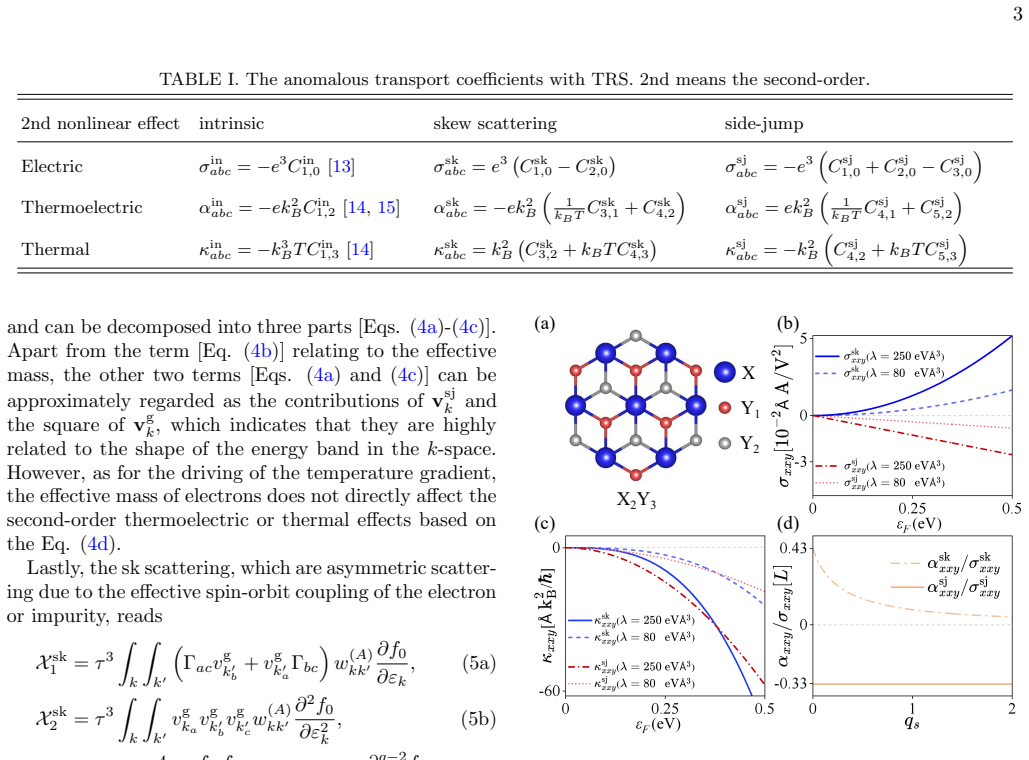
The central discovery is that for time-reversal-symmetric systems, disorder-induced second-order coefficients obey the second-order Mott relation and Wiedemann-Franz law, with distinct forms for the two extrinsic scattering channels. Side-jump transport satisfies α^sj_xxy = −(1/3)L σ^sj_xxy and ∂κ^sj_xxy/∂ε_F = (L/(3e)) σ^sj_xxy, independent of the impurity potential and model details. Skew scattering satisfies α^sk_xxy = L P σ^sk_xxy and ∂κ^sk_xxy/∂ε_F = −(L/e) P σ^sk_xxy, where P is a dimensionless function only of the Thomas-Fermi screening parameter q_s, approaching ≈0.43 in the q_s→0 limit. These relations emerge because the side-jump and skew-scattering kernels in the semiclassical wav
Load-bearing premise
The derivation keeps only the highest-order relaxation-time terms for side-jump and skew scattering, drops the Hessian term (inverse effective mass) under the large-effective-mass approximation, and omits interband Berry-connection contributions; if any of these neglected terms are comparable to the kept terms, the exact prefactors -L/3 and L/(3e) and the q_s-only dependence of P can change.
Editorial extensions
If this is right
- In any time-reversal-symmetric material where side-jump dominates the second-order response, the nonlinear Nernst signal is predicted to be exactly -L/3 times the nonlinear Hall conductivity, regardless of impurity details, warping strength, or band structure—a directly measurable fingerprint.
- The second-order Wiedemann-Franz law means the Fermi-level derivative of the nonlinear thermal conductivity is locked to the nonlinear charge conductivity, allowing cross-checks between independent thermoelectric and transport measurements.
- For skew scattering, all ratios collapse onto a single function of the dimensionless Coulomb screening parameter q_s; experimentally varying carrier density and thus q_s should trace out the predicted P(q_s) curve.
- In the q_s→0 limit, the skew-scattering Mott ratio approaches approximately 0.43L, providing a quantitative zero-screening benchmark for experiments.
- The model predicts distinct power-law scalings—σ^sk ∝ ε_F^4 versus σ^sj ∝ ε_F^2, and κ^sk ∝ ε_F^5 versus κ^sj ∝ ε_F^3—so Fermi-level sweeps alone can separate the two scattering channels before checking the ratio laws.
Reading between the lines
- If the side-jump ratio -L/3 is truly universal beyond the leading-order approximation, it could serve as a diagnostic: any measured deviation in a nominally side-jump-dominated sample would signal the neglected interband Berry-connection contributions or electron-electron interaction effects, placing quantitative bounds on those corrections.
- The q_s-only dependence of P suggests a new way to extract the Thomas-Fermi screening length from macroscopic nonlinear transport—complementing STM and ARPES—by measuring the ratio α_xxy/σ_xxy at several Fermi energies and fitting P(q_s(ε_F)).
- The framework is expected to extend to other symmetries: under PT symmetry or with magnetic order, the quantum metric dipole contributes, and the kernel structure suggests modified but still constrained relations—perhaps with additional metric-dipole-dependent terms, which future density-matrix or diagrammatic calculations could test.
- The mixed second-order response to simultaneous electric field and temperature gradient, which the paper explicitly defers, may obey its own generalized Mott-Wiedemann-Franz relations; the kernel formalism here provides the template to derive them.
Editorial analysis
A structured set of objections, weighed in public.
Referee Report
Summary. The paper develops a semiclassical wave-packet framework for disorder-induced second-order electric, thermoelectric, and thermal conductivities in time-reversal-symmetric (TRS) systems. Applying it to the hexagonal-warping surface states of topological insulators with screened Coulomb impurities, the authors obtain explicit Fermi-level scalings (e.g., σ_sk ∝ ε_F^4, σ_sj ∝ ε_F^2) and propose universal leading-order relations in Table II: for side-jump, α_sj_xxy = −(1/3)L σ_sj_xxy and ∂κ_sj_xxy/∂ε_F = (L/3e) σ_sj_xxy; for skew scattering, α_sk_xxy = L P σ_sk_xxy and ∂κ_sk_xxy/∂ε_F = −(L/e) P σ_sk_xxy, with P claimed to depend only on the Thomas-Fermi screening ratio q_s. The paper also compares the skew-scattering Mott-like relation qualitatively with a recent experiment [48].
Significance. If correct, Table II constitutes novel disorder-induced second-order analogues of the Mott relation and Wiedemann-Franz law, providing testable universal constraints on nonlinear charge and heat currents in TRS materials. The authors are explicit about the model and parameters, and the scaling laws offer concrete predictions. The qualitative agreement with the experimental observation in [48] is a point in favor of the framework, and the paper provides first theoretical predictions for the remaining three relations. However, the central universality claim is currently conditional: the main derivations are deferred to the supplementary material, and the paper itself lists omitted contributions that could change the prefactors.
major comments (4)
- [Final paragraph (limitations)] The load-bearing relations in Table II are derived in the supplementary text [61], not in the main text. The main text only gives the kernel forms in Eqs. (4a)–(5c), which are insufficient for the reader to verify the q_s-only dependence of P or the independence of the side-jump prefactors from the scattering potential. In particular, P is introduced in Table II as a dimensionless quantity determined by q_s, but no explicit expression is given. Please include the derivation (or a detailed outline) in the paper itself, at least for P and for the cancellation steps leading to the exact prefactors −1/3 and 1/3.
- [Eq. (4b) and large-effective-mass approximation] The paper explicitly states: 'We only take into account the contribution of the highest-order relaxation time for sj and sk scattering. We note that there are other contributions related to the interband Berry connection that has no counterpart in linear response, which may also affect the relations.' This caveat directly undermines the claim of universality. For side-jump, the claimed prefactor −L/3 is independent of q_s, but the omitted interband Berry-connection terms likely carry q_s dependence and appear at the same order in τ (τ^2); if so, the independence from the scattering potential is lost. Similarly, the skew-scattering P(q_s) could absorb such corrections. The authors must either include these terms in the calculation or demonstrate that they vanish or are subdominant in the TRS model with Coulomb impurities.
- [Eq. (1)] The Hessian term Γ in Eq. (4b) is neglected by assuming a large effective mass (Γ→0). For the topological-insulator surface Hamiltonian in Eq. (6), the dispersion is gapless and not characterized by a large effective mass near the Dirac point; the Fermi energies considered in Fig. 2 may extend to regions where the effective mass is not large. Please provide a quantitative estimate of the relative size of the Γ term compared to the retained terms in Eqs. (4a) and (4c) for the parameters used, and state the resulting error in the Table II relations.
- [None] The response framework in Eq. (1) omits mixed electric-field and temperature-gradient terms (terms proportional to E·∇T). The relations in Table II connect pure E^2 and pure (∇T)^2 coefficients. Since thermoelectric experiments often involve both drives simultaneously, the mixed terms could contribute to the measured second-order responses and could in principle modify the effective relations. The authors mention these mixed terms are deferred to future work, but the scope of the claimed universality should be explicitly restricted to the diagonal second-order coefficients, and the possible effect of mixed terms should be discussed.
minor comments (5)
- [Final paragraph] Typo: 'and and the second-order thermal effect' should read 'and the second-order thermal effect'.
- [Fig. 2] Typo: 'obervation' should be 'observation'.
- [Text near Fig. 2] The caption says 'ratio α... in unit of L', but the text and Table II refer to P as the skew-scattering prefactor. Please label the vertical axis explicitly (e.g., α_sk_xxy/(L σ_sk_xxy)) and include the numerical value P(0)≈0.43 in the figure or caption. Also 'gray dot line' should be 'gray dotted line'.
- [Reference [66]] The text says 'an increase in the wrapping term'—should be 'warping term'.
- [None] The title of Ref. [66] has a typo: 'Be2Te3' should be 'Bi2Te3'.
Circularity Check
No significant circularity: the second-order Mott/WF relations are computed from stated semiclassical response kernels, not installed as inputs.
full rationale
The paper's load-bearing claim is Table II, which follows from the semiclassical expressions in Table I and the explicit topological-insulator surface-state calculation. The side-jump relations carry universal prefactors (-L/3 and L/(3e)) that are not fit parameters; the skew-scattering factor P is presented as a function of the Coulomb screening parameter q_s with a stated limiting value (~0.43 at q_s to 0), and the relation is therefore a theory-derived proportionality rather than a tautological definition in the main-text derivation. The self-citations (e.g., refs. [14] and [15]) are used as background for intrinsic BCD thermal relations, not as the basis for the new disorder-induced relations, so they are not load-bearing. The final paragraph explicitly lists omitted interband Berry-connection and other contributions ('may also affect the relations'); that is an admitted approximation and a robustness/correctness caveat, not a circular step, because the claimed relations are not redefined to absorb the omitted terms. The paper also checks the skew-scattering Mott-like trend against an external experimental observation (ref. [48]). Without access to the supplementary derivation, the main text does not exhibit a reduction of any predicted relation to its own fitted input. Hence no circularity is established.
Assumptions & free parameters
free parameters (4)
- q_s = q_TF/k_F (Thomas-Fermi screening ratio)
- tau (relaxation time) =
0.1 ps
- lambda (hexagonal warping strength) =
80 and 250 eV Å^3
- v (Dirac velocity) =
3.291 eV Å
assumptions (6)
- domain assumption Semiclassical Boltzmann transport with independent intrinsic/side-jump/skew-scattering channels fully captures the second-order disorder-induced response.
- ad hoc to paper Only the highest-order relaxation-time contribution for side-jump and skew scattering is retained; interband Berry-connection terms are neglected.
- domain assumption Screened Coulomb impurities with Thomas-Fermi screening, V(q)=2παv/(q+q_TF), are the relevant disorder; delta-correlated impurities produce no skew scattering.
- ad hoc to paper Large effective mass: the Hessian term Γ in Eq. (4b) is negligible.
- domain assumption C3v symmetry and time-reversal symmetry hold, so the Berry curvature dipole vanishes and only the xxy-type extrinsic components survive.
- domain assumption The response current formula Eq. (1) excludes mixed E·∇T second-order terms.
Cite this review
Pith. "Pith review of Fundamental Relations as the Leading Order in Nonlinear Thermoelectric Responses with Time-Reversal Symmetry." pith.science (2026). https://pith.science/paper/JFNFCA6I
@misc{pith2026260119625,
  author       = {Pith},
  title        = {Pith review of: Fundamental Relations as the Leading Order in Nonlinear Thermoelectric Responses with Time-Reversal Symmetry},
  year         = {2026},
  howpublished = {\url{https://pith.science/paper/JFNFCA6I}},
  note         = {Machine review of arXiv:2601.19625}
}
abstract
In recent years, nonlinear transport phenomena have garnered significant interest in both theoretical explorations and experiments. In this work, we utilize the semi-classical wave packet theory to calculate disorder-induced second-order transport coefficients: second-order electrical ($\sigma$), thermoelectric ($\alpha$), and thermal ($\kappa$) coefficients, capturing the interplay between side-jump and skew-scattering contributions in systems with time-reversal symmetry. Using a topological insulator model, we quantitatively characterize the Fermi-level dependence of these second-order transport coefficients by explicitly including Coulomb impurity potentials. Furthermore, we elucidate the relationships between these coefficients, establishing the second-order Mott relation and the Wiedemann-Franz law induced by disorder. This study develops a comprehensive theoretical framework elucidating the nonlinear thermoelectric transport mechanisms in quantum material systems.
Figures

Forward citations
Cited by 1 Pith paper
-
Nonlinear spin-Seebeck diode in $f$-wave magnets, third-order spin-Nernst effects in $g$-wave magnets and spin-Nernst effects in $i$-wave altermagnets
A Boltzmann-equation calculation predicts second-order spin-Seebeck currents in f-wave magnets, third-order spin-Nernst currents in g-wave magnets, and linear spin-Nernst currents in i-wave altermagnets, all without s...
Reference graph
Works this paper leans on
-
[48]
H. Liu, J. Li, Z. Zhang,et al., Nonlinear Nernst effect in trilayer graphene at zero magnetic field, Nat. Nanotech- nol.20, 1221–1227 (2025)
2025
-
[61]
[1,2,6,14,16,29,37,38,42,64,66]
The supplementary material gives details of meth- ods and results: SI) Derivation of second-order non- linear thermoelectric effects; SII) The surface state of the topological insulator, which includes refs. [1,2,6,14,16,29,37,38,42,64,66]
-
[1]
Nagaosa, J
N. Nagaosa, J. Sinova, S. Onoda, A. H. MacDonald, and N. P. Ong, Anomalous Hall effect, Rev. Modern Phys. 82, 1539 (2010)
2010
-
[2]
D. Xiao, Y. Yao, Z. Fang, and Q. Niu, Berry-phase effect in anomalous thermoelectric transport, Phys. Rev. Lett. 97, 026603 (2006)
2006
-
[3]
D. L. Bergman and V. Oganesyan, Theory of dissipation- less Nernst effects, Phys. Rev. Lett.104, 066601 (2010)
2010
-
[4]
Zhang, S
C. Zhang, S. Tewari, V. M. Yakovenko, and S. Das Sarma, Anomalous Nernst effect from a chirald-density-wave state in underdoped cuprate superconductors, Phys. Rev. B78, 174508 (2008)
2008
-
[5]
Zhang, S
C. Zhang, S. Tewari, and S. Das Sarma, Berry-phase- mediated topological thermoelectric transport in gapped single and bilayer graphene, Phys. Rev. B79, 245424 (2009)
2009
-
[6]
Zhang, Berry curvature and various thermal Hall ef- fects, New J
L. Zhang, Berry curvature and various thermal Hall ef- fects, New J. Phys.18, 103039 (2016)
2016
Show all 87 references
-
[7]
Jonson and G
M. Jonson and G. D. Mahan, Mott’s formula for the ther- mopower and the Wiedemann-Franz law, Phys. Rev. B 21, 4223 (1980)
1980
-
[8]
Yokoyama and S
T. Yokoyama and S. Murakami, Transverse magnetic heat transport on the surface of a topological insulator, Phys. Rev. B83, 161407 (2011)
2011
-
[9]
N. M. Neil Ashcroft, Solid state physics (Brooks Cole; New edition (2 Jan. 1976), 1976)
1976
-
[10]
Xiao, M.-C
D. Xiao, M.-C. Chang, and Q. Niu, Berry phase effects on electronic properties, Rev. Modern Phys.82, 1959 (2010)
1959
-
[11]
Behnia and H
K. Behnia and H. Aubin, Nernst effect in metals and superconductors: a review of concepts and experiments, Rep. Prog. Phys.79, 046502 (2016)
2016
-
[12]
Ortix, Nonlinear Hall effect with time-reversal sym- metry: Theory and material realizations, Adv
C. Ortix, Nonlinear Hall effect with time-reversal sym- metry: Theory and material realizations, Adv. Quantum Technol.4, 2100056 (2021)
2021
-
[13]
Sodemann and L
I. Sodemann and L. Fu, Quantum Nonlinear Hall Effect Induced by Berry Curvature Dipole in Time-Reversal In- variant Materials, Phys. Rev. Lett.115, 216806 (2015)
2015
-
[14]
Wang, Z.-G
Y. Wang, Z.-G. Zhu, and G. Su, Quantum theory of nonlinear thermal response, Phys. Rev. B106, 035148 (2022)
2022
-
[15]
C. Zeng, S. Nandy, and S. Tewari, Fundamental relations for anomalous thermoelectric transport coefficients in the nonlinear regime, Phys. Rev. Research2, 032066 (2020)
2020
-
[16]
Zhang, Z.-G
Z.-F. Zhang, Z.-G. Zhu, and G. Su, Intrinsic second-order spin current, Phys. Rev. B110, 174434 (2024)
2024
-
[17]
S. Duan, F. Qin, P. Chen, X. Yang, C. Qiu, J. Huang, G. Liu, Z. Li, X. Bi, F. Meng, X. Xi, J. Yao, T. Ideue, B. Lian, Y. Iwasa, and H. Yuan, Berry curvature dipole generation and helicity-to-spin conversion at symmetry- mismatched heterointerfaces, Nat. Nanotechnol.18, 867 (2023)
2023
-
[18]
S.-Y. Xu, Q. Ma, H. Shen, V. Fatemi, S. Wu, T.-R. Chang, G. Chang, A. M. M. Valdivia, C.-K. Chan, Q. D. Gibson, J. Zhou, Z. Liu, K. Watanabe, T. Taniguchi, H. Lin, R. J. Cava, L. Fu, N. Gedik, and P. Jarillo- Herrero, Electrically switchable Berry curvature dipole in the monol...
2018
-
[19]
Ma, S.-Y
Q. Ma, S.-Y. Xu, H. Shen, D. MacNeill, V. Fatemi, T.- R. Chang, A. M. Mier Valdivia, S. Wu, Z. Du, C.-H. Hsu, S. Fang, Q. D. Gibson, K. Watanabe, T. Taniguchi, R. J. Cava, E. Kaxiras, H.-Z. Lu, H. Lin, L. Fu, N. Gedik, and P. Jarillo-Herrero, Observation of the nonlinear Hall ...
2018
-
[20]
K. Kang, T. Li, E. Sohn, J. Shan, and K. F. Mak, Nonlin- ear anomalous Hall effect in few-layer WTe2, Nat. Mater. 18, 324 (2019)
2019
-
[21]
J. Xiao, Y. Wang, H. Wang, C. D. Pemmaraju, S. Wang, P. Muscher, E. J. Sie, C. M. Nyby, T. P. Devereaux, X. Qian, X. Zhang, and A. M. Lindenberg, Berry curva- ture memory through electrically driven stacking transi- tions, Nat. Phys.16, 1028 (2020)
2020
-
[22]
Xiao, D.-F
R.-C. Xiao, D.-F. Shao, Z.-Q. Zhang, and H. Jiang, Two- dimensional metals for piezoelectriclike devices based on Berry-curvature dipole, Phys. Rev. Applied13, 044014 (2020)
2020
-
[23]
Shen, Topological insulators: Dirac equation in condensed matter, Springer Ser
S.-Q. Shen, Topological insulators: Dirac equation in condensed matter, Springer Ser. Solid-State Sci. 0171- 1873,187, 266 (2017)
2017
-
[24]
K. v. Klitzing, G. Dorda, and M. Pepper, New method for high-accuracy determination of the fine-structure con- stant based on quantized Hall resistance, Phys. Rev. Lett. 45, 494 (1980)
1980
-
[25]
D. J. Thouless, M. Kohmoto, M. P. Nightingale, and M. den Nijs, Quantized Hall conductance in a two- dimensional periodic potential, Phys. Rev. Lett.49, 405 (1982)
1982
-
[26]
F. D. M. Haldane, Model for a quantum Hall effect with- out landau levels: Condensed-matter realization of the 6 ”parity anomaly”, Phys. Rev. Lett.61, 2015 (1988)
2015
-
[27]
Z. Z. Du, C. M. Wang, H. -P. Sun, H. -Z. Lu, and X. C. Xie, Quantum theory of the nonlinear Hall effect, Nat. Commun.12, 5038 (2021)
2021
-
[28]
Z. Z. Du, C. M. Wang, S. Li, H.-Z. Lu, and X. C. Xie, Disorder-induced nonlinear Hall effect with time-reversal symmetry, Nat. Commun.10, 3047 (2019)
2019
-
[29]
C. Wang, Y. Gao, and D. Xiao, Intrinsic nonlinear Hall effect in antiferromagnetic tetragonal CuMnAs, Phys. Rev. Lett.127, 277201 (2021)
2021
-
[30]
H. Liu, J. Zhao, Y.-X. Huang, W. Wu, X.-L. Sheng, C. Xiao, and S. A. Yang, Intrinsic second-order anoma- lous Hall effect and its application in compensated anti- ferromagnets, Phys. Rev. Lett.127, 277202 (2021)
2021
-
[31]
J. Duan, Y. Jian, Y. Gao, H. Peng, J. Zhong, Q. Feng, J. Mao, and Y. Yao, Giant second-order nonlinear Hall effect in twisted bilayer graphene, Phys. Rev. Lett.129, 186801 (2022)
2022
-
[32]
K. Das, S. Lahiri, R. B. Atencia, D. Culcer, and A. Agar- wal, Intrinsic nonlinear conductivities induced by the quantum metric, Phys. Rev. B108, l201405 (2023)
2023
-
[33]
J. M. Adhidewata, R. W. M. Komalig, M. S. Ukhtary, A. R. T. Nugraha, B. E. Gunara, and E. H. Hasdeo, Trig- onal warping effects on optical properties of anomalous Hall materials, Phys. Rev. B107, 155415 (2023)
2023
-
[34]
Saha and A
S. Saha and A. Narayan, Nonlinear Hall effect in Rashba systems with hexagonal warping, J. Phys. Condens. Mat- ter35, 485301 (2023)
2023
-
[35]
Y. Wang, Z. Zhang, Z.-G. Zhu, and G. Su, Intrinsic non- linear Ohmic current, Phys. Rev. B109, 085419 (2024)
2024
-
[36]
Isobe, S.-Y
H. Isobe, S.-Y. Xu, and L. Fu, High-frequency rectifi- cation via chiral Bloch electrons, Sci. Adv.6, eaay2497 (2020)
2020
-
[37]
Makushko, S
P. Makushko, S. Kovalev, Y. Zabila, I. Ilyakov, A. Pono- maryov, A. Arshad, G. L. Prajapati, T. V. A. G. de Oliveira, J.-C. Deinert, P. Chekhonin, I. Veremchuk, T. Kosub, Y. Skourski, F. Ganss, D. Makarov, and C. Or- tix, A tunable room-temperature nonlinear Hall effect in ele...
2024
-
[38]
Gao and D
Y. Gao and D. Xiao, Orbital magnetic quadrupole mo- ment and nonlinear anomalous thermoelectric transport, Phys. Rev. B98, 060402 (2018)
2018
-
[39]
C. Zeng, S. Nandy, A. Taraphder, and S. Tewari, Non- linear Nernst effect in bilayer WTe 2, Phys. Rev. B100, 245102 (2019)
2019
-
[40]
Yu, Z.-G
X.-Q. Yu, Z.-G. Zhu, and G. Su, Hexagonal warping induced nonlinear planar Nernst effect in nonmagnetic topological insulators, Phys. Rev. B103, 035410 (2021)
2021
-
[41]
Papaj and L
M. Papaj and L. Fu, Enhanced anomalous Nernst effect in disordered Dirac and Weyl materials, Phys. Rev. B 103, 075424 (2021)
2021
-
[42]
C. Zeng, S. Nandy, and S. Tewari, Nonlinear transport in Weyl semimetals induced by Berry curvature dipole, Phys. Rev. B103, 245119 (2021)
2021
-
[43]
C. Zeng, S. Nandy, and S. Tewari, Chiral anomaly in- duced nonlinear Nernst and thermal Hall effects in Weyl semimetals, Phys. Rev. B105, 125131 (2022)
2022
-
[44]
Zeng, X.-Q
C. Zeng, X.-Q. Yu, Z.-M. Yu, and Y. Yao, Band tilt in- duced nonlinear Nernst effect in topological insulators: An efficient generation of high-performance spin polar- ization, Phys. Rev. B106, l081121 (2022)
2022
-
[45]
Qiang, Z
X.-B. Qiang, Z. Z. Du, H.-Z. Lu, and X. C. Xie, Topological and disorder corrections to the transverse Wiedemann-Franz law and Mott relation in kagome mag- nets and Dirac materials, Phys. Rev. B107, 161302 (2023)
2023
-
[46]
Varshney and A
H. Varshney and A. Agarwal, Intrinsic nonlinear Nernst and Seebeck effect, New J. Phys.27, 083506 (2025)
2025
-
[47]
Zhang, Z.-F
Y.-F. Zhang, Z.-F. Zhang, Z.-G. Zhu, and G. Su, Second- order intrinsic Wiedemann-Franz law, Phys. Rev. B111, 165424 (2025)
2025
-
[49]
Yu, Z.-G
X.-Q. Yu, Z.-G. Zhu, J.-S. You, T. Low, G. Su, Topolog- ical nonlinear anomalous Nernst effect in strained tran- sition metal dichalcogenides, Phys. Rev. B99, 201410 (2019)
2019
-
[50]
Zhou, Z.-F
D.-K. Zhou, Z.-F. Zhang, X.-Q. Yu, Z.-G. Zhu, and G. Su, Fundamental distinction between intrinsic and ex- trinsic nonlinear thermal Hall effects, Phys. Rev. B105, l201103 (2022)
2022
-
[51]
Li and Z.-G
J.-C. Li and Z.-G. Zhu, Intrinsic second-order magnon thermal Hall effect, J. Phys. Condens. Matter36, 395802 (2024)
2024
-
[52]
Itskov, Tensor Algebra and Tensor Analysis for En- gineers: With Applications to Continuum Mechanics, Springer, Cham (2025)
M. Itskov, Tensor Algebra and Tensor Analysis for En- gineers: With Applications to Continuum Mechanics, Springer, Cham (2025)
2025
-
[53]
Li, Nonlinear Optics: Principles and Applications, Springer, Singapore (2017)
C. Li, Nonlinear Optics: Principles and Applications, Springer, Singapore (2017)
2017
-
[54]
Z. Z. Du, H.-Z. Lu, and X. C. Xie, Nonlinear Hall effects, Nat. Rev. Phys.3, 744–752 (2021)
2021
-
[55]
N.-X. Yang, Q. Yan, and Q.-F. Sun, Linear and nonlinear thermoelectric transport in a magnetic topological insu- lator nanoribbon with a domain wall, Phys. Rev. B102, 245412 (2020)
2020
-
[56]
T. A. Costi and V. Zlati´ c, Thermoelectric transport through strongly correlated quantum dots, Phys. Rev. B81, 235127(2010)
2010
-
[57]
Nakai and N
R. Nakai and N. Nagaosa, Nonreciprocal thermal and thermoelectric transport of electrons in noncentrosym- metric crystals, Phys. Rev. B99, 115201 (2019)
2019
-
[58]
Yamaguchi, K
T. Yamaguchi, K. Nakazawa, and A. Yamakage, Micro- scopic theory of nonlinear Hall effect induced by electric field and temperature gradient, Phys. Rev. B109, 205117 (2024)
2024
-
[59]
Yang and B
X. Yang and B. Skinner, Nonlinear thermoelectric effects as a means to probe quantum geometry, arXiv (2025), arXiv:2505.00086 [cond-mat.mes-hall]
2025 arXiv
-
[60]
Yamaguchi, K
T. Yamaguchi, K. Nakazawa, and A. Yamakage, Theory of nonlinear Hall effect induced by electric field and tem- perature gradient in 3D chiral magnetic textures, arXiv (2024), arXiv:2410.00563 [cond-mat.mes-hall]
2024 arXiv
-
[62]
Gao, Semiclassical dynamics and nonlinear charge cur- rent, Front Phys14, 33404 (2019)
Y. Gao, Semiclassical dynamics and nonlinear charge cur- rent, Front Phys14, 33404 (2019)
2019
-
[63]
N. A. Sinitsyn, Q. Niu, J. Sinova, and K. Nomura, Disor- der effects in the anomalous Hall effect induced by Berry curvature, Phys. Rev. B72, 045346 (2005)
2005
-
[64]
N. A. Sinitsyn, Q. Niu, and A. H. MacDonald, Coordi- nate shift in the semiclassical Boltzmann equation and the anomalous Hall effect, Phys. Rev. B73, 075318 (2006). 7
2006
-
[65]
Kuroda, M
K. Kuroda, M. Arita, K. Miyamoto, M. Ye, J. Jiang, A. Kimura, E. E. Krasovskii, E. V. Chulkov, H. Iwasawa, T. Okuda, K. Shimada, Y. Ueda, H. Namatame, and M. Taniguchi, Hexagonally deformed fermi surface of the 3D topological insulator Bi 2Se3, Phys. Rev. Lett.105, 076802 (2010)
2010
-
[66]
Fu, Hexagonal warping effects in the surface states of the topological insulator Be 2Te3, Phys
L. Fu, Hexagonal warping effects in the surface states of the topological insulator Be 2Te3, Phys. Rev. Lett.103, 266801 (2009)
2009
-
[67]
A. Gao, N. Nagaosa, N. Ni, and S.-Y. Xu, Quan- tum geometry phenomena in condensed matter systems, arXiv:2508.00469 (2025)
2025 arXiv
-
[68]
Liu, X.-B
T. Liu, X.-B. Qiang, H.-Z. Lu, and X. C. Xie, Quan- tum geometry in condensed matter, Natl. Sci. Rev.12, nwae334 (2024)
2024
-
[69]
J. Yu, B. A. Bernevig, R. Queiroz, E. Rossi, P. T¨ orm¨ a, and B.-J. Yang, Quantum geometry in quantum materi- als, npj Quantum Mater.10, 1 (2025)
2025
-
[70]
P. He, H. Isobe, D. Zhu, C.-H. Hsu, L. Fu, and H. Yang, Quantum frequency doubling in the topological insulator Bi2Se3, Nat. Commun.12, 689 (2021)
2021
-
[71]
X. F. Lu, C.-P. Zhang, N. Wang, D. Zhao, X. Zhou, W. Gao, X. H. Chen, K. T. Law, and K. P. Loh, Nonlinear transport and radio frequency rectification in BiTeBr at room temperature, Nat. Commun.15, 1 (2024)
2024
-
[72]
Z.-H. Gong, Z. Z. Du, H.-P. Sun, H.-Z. Lu, and X. C. Xie, Nonlinear transport theory at the order of quantum metric, arXiv (2024), arXiv:2410.04995 [cond-mat.mes- hall]
2024 arXiv
-
[73]
C. Xiao, Z. Z. Du, and Q. Niu, Theory of nonlinear Hall effects: Modified semiclassics from quantum kinet- ics, Phys. Rev. B100, 165422 (2019)
2019
-
[74]
Mehraeen, Quantum kinetic theory of quadratic re- sponses, Phys
M. Mehraeen, Quantum kinetic theory of quadratic re- sponses, Phys. Rev. B110, 174423 (2024)
2024
-
[75]
N. A. Sinitsyn, A. H. MacDonald, T. Jungwirth, V. K. Dugaev, and J. Sinova, Anomalous hall effect in a two- dimensional dirac band: The link between the Kubo- Streda formula and the semiclassical Boltzmann equation approach, Phys. Rev. B75, 045315 (2007)
2007
-
[76]
D. E. Parker, T. Morimoto, J. Orenstein, and J. E. Moore, Diagrammatic approach to nonlinear optical re- sponse with application to Weyl semimetals, Phys. Rev. B99, 045121 (2019)
2019
-
[77]
Bruus and K
H. Bruus and K. Flensberg,Many-Body Quantum Theory in Condensed Matter Physics: An Introduction, edited by online (Oxford University Press, 2004)
2004
-
[78]
Bhalla, Intrinsic contribution to nonlinear thermoelec- tric effects in topological insulators, Phys
P. Bhalla, Intrinsic contribution to nonlinear thermoelec- tric effects in topological insulators, Phys. Rev. B103, 115304 (2021)
2021
-
[79]
Varshney, K
H. Varshney, K. Das, P. Bhalla, and A. Agarwal, Quan- tum kinetic theory of nonlinear thermal current, Phys. Rev. B107, 235419 (2023)
2023
-
[80]
D. Ma, Z. F. Zhang, H. Jiang, and X. C. Xie, Quan- tum kinetic theory of the semiclassical side jump, skew scattering, and longitudinal velocity, Phys. Rev. B112, 045136 (2025)
2025
-
[81]
M. Wei, B. Wang, Y. Yu, F. Xu, and J. Wang, Nonlin- ear Hall effect induced by internal Coulomb interaction and phase relaxation process in a four-terminal system with time-reversal symmetry, Phys. Rev. B105, 115411 (2022)
2022
-
[82]
Zhang, F
L. Zhang, F. Xu, J. Chen, Y. Xing, and J. Wang, Quan- tum nonlinear ac transport theory at low frequency, New J. Phys.25, 113006 (2023)
2023
-
[83]
G. Li, M. Wei, F. Xu, and J. Wang, General method for calculating transport properties of disordered mesoscopic systems based on the nonequilibrium Green’s function formalism, Phys. Rev. B111, 035409 (2025)
2025
-
[84]
Pasqua and M
I. Pasqua and M. Fabrizio, Fermi-liquid corrections to the intrinsic anomalous Hall conductivity of topological metals, SciPost Phys.19, 014 (2025)
2025
-
[85]
Jho, J.-H
Y.-S. Jho, J.-H. Han, and K.-S. Kim, Topological fermi- liquid theory for interacting weyl metals with time rever- sal symmetry breaking, Phys. Rev. B95, 205113 (2017)
2017
-
[86]
Chen and D
J.-Y. Chen and D. T. Son, Berry fermi liquid theory, Ann. Phys-new. York.377, 345 (2017)
2017
-
[87]
M. Wang, J. Zhou, and Y. Yao, Linear and non- linear optical responses in Green’s function formula, arXiv:2508.07280 (2025)
2025 arXiv
Reviewed August 3, 2026 · model on record in the stance chip above.
Discussion (0). Continue with ORCID to comment.