REVIEW 2 major objections 4 minor 15 references
ELECTRAFI builds crystal charge densities from analytically transformed Gaussians, matching top accuracy up to 633 times faster and cutting end-to-end DFT cost by about 20 percent.
Reviewed by Pith at T0; open to challenge. T0 means a machine referee read the full paper against a public rubric. the ladder, T0–T4 →
T0 review · deepseek-v4-flash
2026-08-03 07:31 UTC pith:L4L2OZD7
load-bearing objection A mathematically clean Gaussian-to-plane-wave density model with dramatic inference speedups; the reported DFT acceleration is conditional on oracle PAW occupancies, and 'matches or exceeds' overstates accuracy on two benchmarks. the 2 major comments →
Global Plane Waves From Local Gaussians: Periodic Charge Densities in a Blink
The pith
A machine-rendered reading of the paper's core claim, the machinery that carries it, and where it could break.
Core claim
The central claim is that a periodic crystal's valence charge density can be represented as a sum of anisotropic Gaussians whose parameters are predicted locally at atoms, while all nonlocal periodic behavior is handled analytically. Because a Gaussian's Fourier transform is another Gaussian, the model writes down the plane-wave coefficients in closed form (Eqs. 8-10) via the Poisson summation formula; an inverse FFT then yields the periodic, smooth real-space density. This construction keeps the learned quantities local and interpretable, delegates global periodicity to an analytic transform, and avoids both explicit periodic image sums and numerical Fourier transforms. The authors argue th
What carries the argument
The central object is the closed-form Fourier transform of an anisotropic Gaussian combined with the Poisson summation formula. A real-space Gaussian centered at mu with covariance Sigma transforms to the reciprocal-space expression exp(-1/2 G^T Sigma G) exp(-i G . mu); summing these over a finite set of Gaussians gives analytic plane-wave coefficients, and the Poisson summation formula periodizes the density without summing over periodic images. A single inverse FFT then evaluates the periodic density on the grid. This machinery transfers global, long-range, and periodic behavior out of the neural network and into an exact analytic transform, which is what makes inference both fast and fait
Load-bearing premise
The headline speedup assumes access to the converged reference calculation's augmentation occupancies; without that oracle information the ML initial guess is incomplete, and the reported ~20 percent end-to-end time savings may not materialize in real deployments.
What would settle it
Run a DFT calculation initialized only from the ML-predicted smooth density while recomputing all augmentation occupancies from the initial guess rather than borrowing them from a converged reference CHGCAR; if the end-to-end time savings disappears or turns negative, the central deployment claim is falsified.
If this is right
- If correct, machine-learned charge densities become practical as DFT initial guesses: ELECTRAFI reports about a 20 percent reduction in total DFT wall time, where slower models produce a net slowdown once inference cost is counted.
- The plane-wave representation aligns the model with the native representation of plane-wave DFT codes, making integration into existing SCF workflows straightforward.
- Because inference is sub-second, density prediction can serve as a descriptor in repeated-evaluation settings such as molecular dynamics or high-throughput screening without dominating the calculation cost.
- Element-resolved error analysis shows ELECTRAFI is strongest for ionic, closed-shell, and heavy-element systems, while grid-based models handle localized covalent and open-shell transition-metal features better, suggesting the two approaches capture complementary electronic-structure regimes.
- The paper's comparison between DFT-only and total wall-time savings indicates that future density models must be evaluated end-to-end inside a DFT code, not just on grid-level accuracy metrics.
Where Pith is reading between the lines
- The reported ~20 percent end-to-end savings depends on an oracle: augmentation occupancies in the DFT initialization are taken from the converged reference calculation, not predicted. In a real deployment without such reference data, those occupancies would need to be computed or modeled, and the speedup could shrink or disappear.
- The complementary element-wise error profiles suggest a natural follow-up: a hybrid model that uses smooth Gaussian-built plane waves as a global backbone and adds localized, high-spatial-frequency corrections for covalent and transition-metal bonding.
- A testable extension is to train ELECTRAFI with a loss that weights low-frequency plane-wave coefficients more heavily; the paper notes SCF convergence appears governed by long-wavelength modes, so such weighting could directly improve DFT acceleration beyond what NMAE predicts.
- The same analytic-Fourier-plus-IFFT design could transfer to other inverse problems where global measurements are reconstructed from local learned parameters, such as MRI-style k-space reconstruction, as the paper itself hints.
Editorial analysis
A structured set of objections, weighed in public.
Referee Report
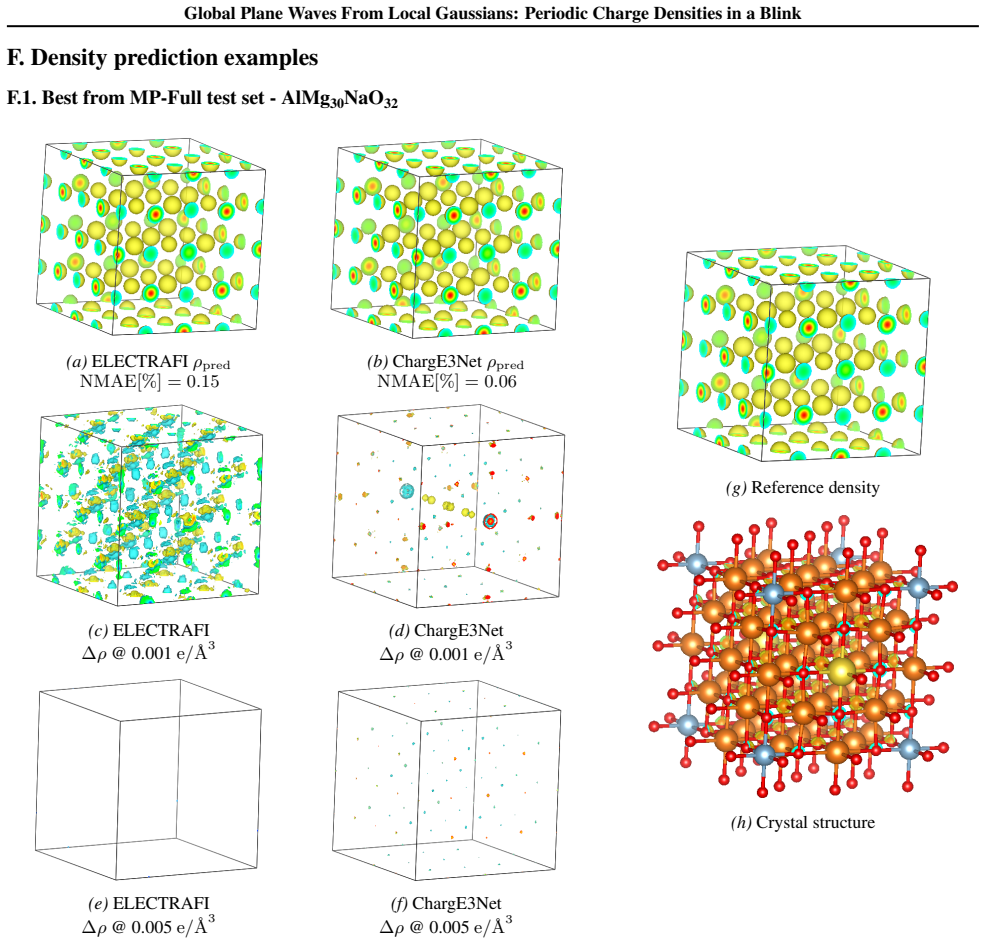
Summary. ELECTRAFI is a graph-neural-network model that predicts periodic charge densities as a mixture of anisotropic Gaussians in real space, uses closed-form Fourier transforms and Poisson summation to obtain analytic plane-wave coefficients, and reconstructs the periodic density with a single inverse FFT. The model is trained on Materials Project (MP-Full) and evaluated on GNoME, ECD-HSE06, MP-Mixed, and Cubic benchmarks. Reported inference is 0.05–0.24 s on an A100, one to two orders of magnitude faster than ChargE3Net, with NMAE 0.58% on MP-Full vs 0.54% for ChargE3Net, 0.93% vs 0.69% on GNoME, and 1.35% vs 1.53% on ECD-HSE06. DFT reinitialization experiments show ~20% total-time savings relative to SAD initialization, which the paper attributes to negligible inference cost.
Significance. The core mathematical construction is elegant and sound: the Gaussian Fourier transform (Eq. 8) and the Poisson-summation periodization (Eq. 6) are closed-form, avoiding explicit periodic image sums and numerical Fourier transforms. The model does not fit plane-wave coefficients directly; the network predicts local Gaussian parameters, and the reciprocal-space coefficients are obtained analytically, so the approach is not circular. If the speed and accuracy numbers are reproducible, the method has practical value for high-throughput DFT initialization and as a fast density surrogate. The paper also provides useful benchmark infrastructure (VASP input reconstruction, element-resolved error analysis). The two central claims overreach, however: the model does not match SOTA accuracy on MP-Full/GNoME, and the end-to-end DFT speedup is measured under a protocol that leaks converged PAW augmentation information. Both issues are fixable by rewording or by an additional experiment.
major comments (2)
- [Abstract; Table 1; §4 (Benchmark results)] The abstract's 'matches or exceeds state-of-the-art accuracy across periodic benchmarks' is not supported by Table 1. On MP-Full ELECTRAFI's NMAE is 0.58% vs 0.54% for ChargE3Net; on GNoME it is 0.93% vs 0.69% — in both cases ELECTRAFI is worse, as the text in §4 acknowledges ('slightly higher error'). The only comparison where ELECTRAFI beats ChargE3Net is ECD-HSE06 (1.35% vs 1.53%). The phrase should be qualified (e.g., 'competitive with or better than' on some benchmarks, 'state-of-the-art efficiency' instead of accuracy), or the abstract should state the trade-off.
- [§4.1, Table 2, Appendix C] The end-to-end DFT speedup is measured with access to converged PAW augmentation occupancies from the reference CHGCAR. Appendix C states: 'we replace only the smooth grid component with the ML prediction and keep augmentation occupancies from the corresponding reference workflow,' and §4.1 says the occupancies 'were taken from the Materials Project dataset or computed self-consistently for the GNoME structures.' The SAD baseline starts from a cold atomic-superposition density without this oracle information. In a real deployment these occupancies are not available; the paper itself notes they are not inferable from CHGCAR. The headline contribution — 'the first model to achieve a consistent reduction in end-to-end DFT computation time' — is therefore conditional. I ask the authors to either (a) clearly mark this assumption in the abstract and conclusions, or (b) run an additional experi
minor comments (4)
- [§3, Eq. (16)] NMAE is defined with integrals over R^3; for a periodic density both the numerator and denominator diverge. The formula should integrate over the unit cell Ω, as in Eq. (11).
- [Abstract; §4] 'up to 633× faster' refers to inference time, not end-to-end DFT time; specify 'inference time' in the abstract to avoid misleading readers.
- [Appendix D, Tables 4–5] The model dimension C=2160 and M=120 Gaussians per electron is large; a brief comment on memory/GPU usage would help reproducibility.
- [Appendix C] The sentence 'This issue exists for all real-space ML density models...' is an important limitation but does not reduce the need to flag it in the main text's headline claims.
Circularity Check
No significant circularity; the main caveat is the oracle augmentation occupancies in the DFT-speedup protocol, which is a deployment limitation rather than a circular derivation.
full rationale
The central derivation is self-contained. ELECTRAFI predicts per-Gaussian weights, centers, and covariances (Eqs. 13-15), then maps them to reciprocal space via the closed-form Gaussian Fourier transform (Eq. 8) and Poisson summation (Eq. 6), with the periodic density recovered by IFFT (Eq. 10). The predicted quantities are Gaussian parameters, not the target plane-wave coefficients; Eq. (9) is an analytic evaluation, and the comparison to reference densities uses a standard NMAE loss (Eq. 16) rather than a fit of the Fourier coefficients themselves. The electron-number rescaling (Eq. 11) enforces a known valence-electron count and is a normalization, not a fitted parameter. The Gaussian-mixture ansatz is attributed to the authors' prior ELECTRA paper (Elsborg et al., 2025), a self-citation, but the current paper independently validates the ansatz on multiple periodic benchmarks, and the Poisson-summation/Fourier-inversion step is newly derived here and does not rest on that citation. No uniqueness theorem is imported from the authors' prior work, and no empirical pattern is merely renamed. The load-bearing caveat is in Appendix C: "we replace only the smooth grid component with the ML prediction and keep augmentation occupancies from the corresponding reference workflow." This means the reported end-to-end DFT speedup assumes access to converged-reference PAW augmentation occupancies, an oracle not available in real deployment. This is a genuine limitation of the headline speedup claim, but it is an experimental-protocol issue, not circularity: the ML smooth density is trained and evaluated independently of the converged DFT result, and the speedup is measured rather than derived from the model's own outputs. No equation or fitted quantity reduces to its own input by construction.
Axiom & Free-Parameter Ledger
free parameters (6)
- Gaussians per electron M =
120 (100 for Cubic)
- Backbone hidden / embedding size C =
2160 (2200 for Cubic)
- Neighbor cutoff radius =
30 Å (20 Å for ECD and Cubic)
- Max neighbors =
300 (200/128 for smaller datasets)
- Number of attention layers / heads =
2 layers, 32 heads
- Learning rate schedule / epochs =
γ=0.70–0.99, 10–140 epochs
axioms (7)
- standard math Poisson summation formula
- standard math Closed-form Fourier transform of an anisotropic Gaussian
- ad hoc to paper Valence electron density is expressible as a sum of a moderate number of anisotropic Gaussians in reciprocal space to ~0.5–1% NMAE
- domain assumption PAW augmentation occupancies can be taken from the reference converged CHGCAR when initializing DFT
- domain assumption The given plane-wave cutoff / FFT grid from CHGCAR is sufficient for accurate density representation
- domain assumption NMAE on the real-space grid is a valid training objective for SCF acceleration
- domain assumption EScAIP unconstrained backbone can predict the required Gaussian parameters
read the original abstract
We introduce ELECTRAFI, a fast, end-to-end differentiable model for predicting periodic charge densities in crystalline materials. ELECTRAFI constructs anisotropic Gaussians in real space and exploits their closed-form Fourier transforms to analytically evaluate plane-wave coefficients via the Poisson summation formula. This formulation delegates non-local and periodic behavior to analytic transforms, enabling reconstruction of the full periodic charge density with a single inverse FFT. By avoiding explicit real-space grid probing, periodic image summation, and spherical harmonic expansions, ELECTRAFI matches or exceeds state-of-the-art accuracy across periodic benchmarks while being up to $633 \times$ faster than the strongest competing method, reconstructing crystal charge densities in a fraction of a second. When used to initialize DFT calculations, ELECTRAFI reduces total DFT compute cost by up to ~20%, whereas slower charge density models negate savings due to high inference times. Our results show that accuracy and inference cost jointly determine end-to-end DFT speedups, and motivate our focus on efficiency.
Figures




Reference graph
Works this paper leans on
-
[4]
Gasteiger, J., Shuaibi, M., Sriram, A., G ¨unnemann, S., Ulissi, Z., Zitnick, C. L., and Das, A. Gemnet-oc: devel- oping graph neural networks for large and diverse molecu- lar simulation datasets.arXiv preprint arXiv:2204.02782,
-
[6]
Kingma, D. P. Adam: A method for stochastic optimization. arXiv preprint arXiv:1412.6980,
-
[11]
Thomas, N., Smidt, T., Kearnes, S., Yang, L., Li, L., Kohlhoff, K., and Riley, P. Tensor field networks: Rotation-and translation-equivariant neural networks for 3d point clouds.arXiv preprint arXiv:1802.08219,
-
[14]
12 Global Plane Waves From Local Gaussians: Periodic Charge Densities in a Blink A. Plane-wave representations in electronic structure theory In electronic structure calculations for periodic systems, plane waves are functions of the form ϕG(r) = exp(iG·r),(17) where G is a reciprocal-lattice vector. Plane waves form a complete, orthonormal basis for squa...
1929
-
[15]
produces its own triplet S[ℓ] i,c,v [ℓ] i,c,T [ℓ] i,c. We aggregate along the layer axis using channel-wise, per-node softmax weights obtained from the layer readouts: α[ℓ] i,c = softmax A[ℓ] i,c = exp A[ℓ] i,c PL m=0 exp A[m] i,c .(25) Where A[ℓ] i,c are logits obtained from a linear layer applied to the node readout r[ℓ] i at layer ℓ and node i, i.e. A[...
2024
-
[2014]
A note on the iterative mri reconstruction from nonuniform k-space data.Inter- national journal of biomedical imaging, 2007(1):024727,
Knopp, T., Kunis, S., and Potts, D. A note on the iterative mri reconstruction from nonuniform k-space data.Inter- national journal of biomedical imaging, 2007(1):024727,
2007
-
[2016]
Li, C., Sharir, O., Yuan, S., and Chan, G. K. Image super- resolution inspired electron density prediction.arXiv preprint arXiv:2402.12335,
-
[2017]
Burger, A., Thiede, L., Rønne, N., Bernales, V ., Vijayku- mar, N., Vegge, T., Bhowmik, A., and Aspuru-Guzik, A. Shoot from the hip: Hessian interatomic potentials without derivatives.arXiv preprint arXiv:2509.21624,
-
[2018]
Tran, A., Mathews, A., Xie, L., and Ong, C. S. Factorized fourier neural operators.arXiv preprint arXiv:2111.13802,
-
[2019]
E., Burbulla, S., de Benito Delgado, M., and Schmid, J
Wagner, J. E., Burbulla, S., de Benito Delgado, M., and Schmid, J. D. Neural operators as fast surrogate models for the transmission loss of parameterized sonic crystals. InNeurIPS 2024 Workshop on Data-driven and Differen- tiable Simulations, Surrogates, and Solvers,
2024
-
[2020]
Liao, Y .-L., Wood, B., Das, A., and Smidt, T. Equiformerv2: Improved equivariant transformer for scaling to higher- degree representations.arXiv preprint arXiv:2306.12059,
-
[2021]
Elsborg, J., Thiede, L., Aspuru-Guzik, A., Vegge, T., and Bhowmik, A. Electra: A cartesian network for 3d charge density prediction with floating orbitals.arXiv preprint arXiv:2503.08305,
-
[2022]
Li, Z., Kovachki, N., Azizzadenesheli, K., Liu, B., Bhat- tacharya, K., Stuart, A., and Anandkumar, A. Fourier neural operator for parametric partial differential equa- tions.arXiv preprint arXiv:2010.08895,
Pith/arXiv arXiv 2010
-
[2024]
Directional message passing for molecular graphs.arXiv preprint arXiv:2003.03123,
Gasteiger, J., Groß, J., and G ¨unnemann, S. Directional message passing for molecular graphs.arXiv preprint arXiv:2003.03123,
Pith/arXiv arXiv 2003
-
[2025]
Kim, S. and Ahn, S. Gaussian plane-wave neural op- erator for electron density estimation.arXiv preprint arXiv:2402.04278,
discussion (0)
Sign in with ORCID, Apple, or X to comment. Anyone can read and Pith papers without signing in.