REVIEW 3 major objections 4 minor 90 references
Superpositions of two Dicke states, already feasible in photonic chips, give near-optimal quantum Fisher information under linear and two-body collective-spin encoding and stay measurably more sensitive to dephasing than GHZ or W-superposit
Reviewed by Pith at T0; open to challenge. T0 means a machine referee read the full paper against a public rubric. the ladder, T0–T4 →
T0 review · deepseek-v4-flash
2026-08-03 06:15 UTC pith:NVXWV6TW
load-bearing objection Solid noiseless Dicke-superposition results, but the headline noise-resilience claims rest on a noise-before-encoding model that the paper never flags; the internal inconsistencies are minor but the noise-ordering issue is not. the 3 major comments →
Dicke superposition probes for noise-resilient Heisenberg and super-Heisenberg Metrology
The pith
A machine-rendered reading of the paper's core claim, the machinery that carries it, and where it could break.
Core claim
The paper establishes that a specific family of permutation-symmetric states—equal superpositions of two Dicke states—provides near-optimal quantum Fisher information under both linear collective-spin encoding and two-body interaction encoding, and that these states retain more phase sensitivity under local phase damping than the standard GHZ and W-superposition probes. For linear generators, an analytic expression yields QFI ≈ (3/4)N^2 for the best choices of Dicke pairs. For two-body Hamiltonians, the paper derives the optimal probe as the equal superposition of the maximum and minimum eigenstates, with QFI equal to the squared spectral range (λmax−λmin)^2, and shows that near-optimal Dick
What carries the argument
The central objects are equal-weight superpositions of two Dicke states, |D_{l,l'}^{(N)}> = (|D_{N−l,l}> + |D_{N−l',l'}>)/√2, where |D_{N−l,l}> is the symmetric N-qubit state with l excitations. The workhorse identity is the pure-state QFI formula FQ = 4(ΔH)^2, which for a superposition of extremal eigenstates reduces to (λmax−λmin)^2. For linear encoding H = J_n, choosing l,l' near N/2 yields FQ≈(3/4)N^2; for two-body Hamiltonians such as J_n^2 and J_n+J_n^2, the optimal probe is the equal superposition of the maximum and minimum eigenstates, and the paper evaluates the resulting super-Heisenberg scaling and compares the dephasing resilience of these optimal probes with near-optimal Dicke s
Load-bearing premise
The noise analysis places the decoherence channel before the unitary phase encoding and then computes the QFI under noiseless evolution, so the predicted robustness is for preparation noise, not for decoherence that occurs while the phase is being imprinted.
What would settle it
Compute the QFI under the same phase-damping, amplitude-damping, and depolarizing channels but with the channel applied during the unitary encoding (interleaved with small increments of e^{-iH dθ}) rather than before it. If the Dicke-superposition advantage over GHZ vanishes in this during-encoding model, the paper's noise-resilience claim is restricted to state-preparation noise.
If this is right
- Near-optimal Dicke superpositions reach FQ ≈ 0.75 N^2 for linear collective-spin encoding, close to the Heisenberg limit N^2, for both odd and even N.
- For two-body generators, probes that superpose the extremal eigenstates attain the spectral bound FQ = (λmax−λmin)^2, which scales as N^4 for J_n^2—super-Heisenberg phase sensitivity.
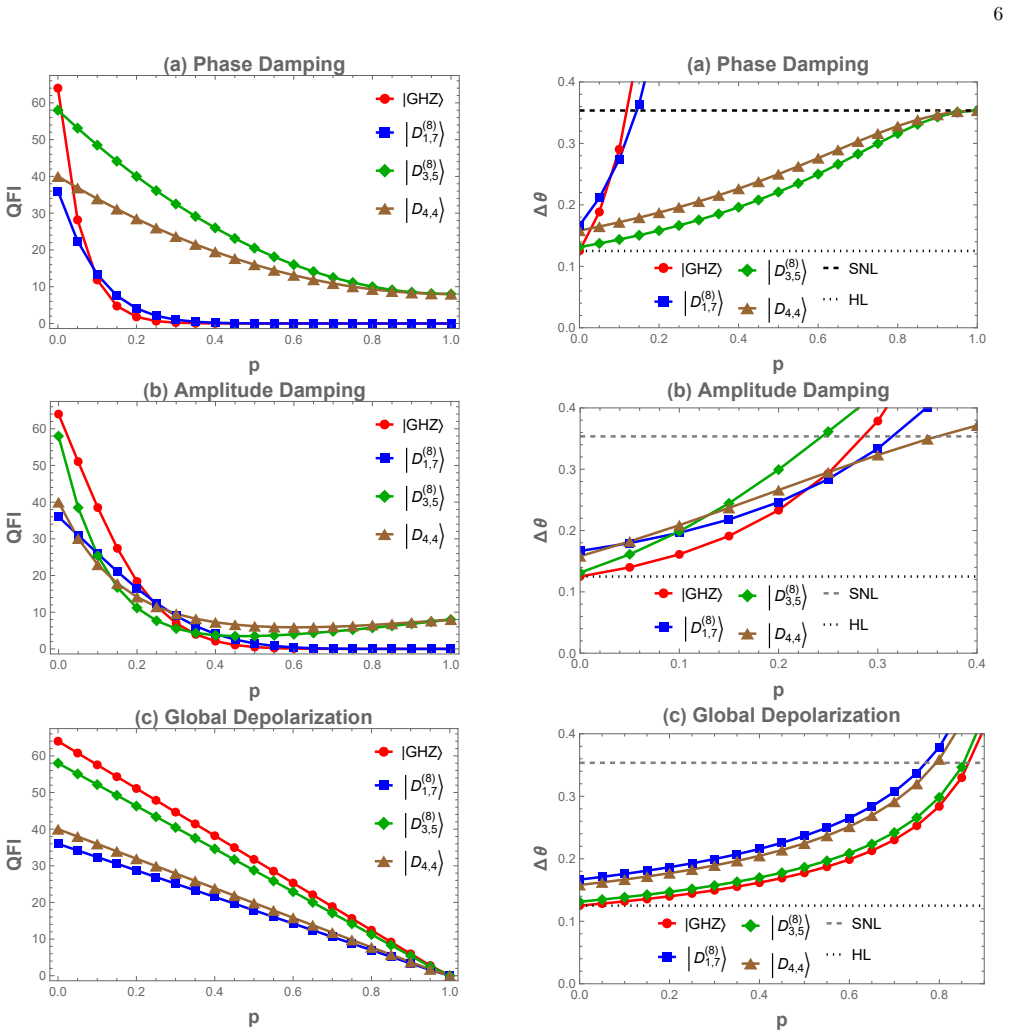
- For N=8, the |D_{3,5}> state retains higher QFI than GHZ, W-superposition, and balanced Dicke states under phase damping, and comparable behavior under global depolarization.
- Near-optimal Dicke superpositions outperform the QFI-optimal two-body probes under local phase damping for the system sizes studied, giving a practical trade-off between ideal sensitivity and noise resilience.
- The benchmarks in the paper's Table III provide concrete reference values (NL-SNL and NL-HL) against which any N=8 probe under J_n^2-type encodings can be judged.
Where Pith is reading between the lines
- The robustness ordering found for state-preparation noise may not survive when decoherence acts during the interrogation; a fair experimental test should specify which noise timing is being probed.
- A natural design principle suggested by the results: spreading the probe over the Dicke manifold averages out transverse dephasing in J_z, which could guide construction of larger-N probes beyond the explicit table entries.
- The same extremal-eigenstate recipe may generalize to k-body generators with k>2, where superpositions of symmetric minimal and maximal eigenstates would give the spectral-range QFI while near-optimal variants could mitigate noise.
- Because Dicke superpositions have already been generated on-chip for four photons, the predicted dephasing resilience could be tested directly on existing platforms by comparing |D_{3,5}> with GHZ and W states under controlled phase damping.
Editorial analysis
A structured set of objections, weighed in public.
Referee Report
Summary. The paper studies the quantum Fisher information (QFI) and phase sensitivity of N-qubit Dicke-state superposition probes under unitary encodings generated by one-body Hamiltonians H = J_n and by two-body Hamiltonians J_n^2, J_n + J_n^2, and their regularized variants (Eq. 29). In the noiseless case it shows that certain Dicke superpositions reach QFI ~ (3/4)N^2 for linear encoding (Eqs. 23–24) and that the optimal pure probes for the two-body Hamiltonians are equal superpositions of the extremal eigenstates, giving F_Q = (λ_max − λ_min)^2 (Table II). The paper then applies local phase-damping, amplitude-damping, and global-depolarizing channels to the probe state before encoding, computes the QFI of the resulting noisy state under a unitary evolution, and compares the robustness of the proposed probes with GHZ, W-superposition, and balanced Dicke states. The central claim is that tailored near-optimal Dicke superpositions are versatile, noise-resilient resources for Heisenberg and super-Heisenberg phase sensing.
Significance. If the results are taken as stated, the paper would identify experimentally relevant, permutation-symmetric probe families that combine near-optimal noiseless QFI with improved robustness under phase damping. The noiseless QFI derivations are largely self-contained and standard: Eq. (10) correctly bounds pure-state QFI by the squared spectral range, and the optimal states in Table II follow from the extremal eigenstates. The paper also usefully unifies linear and two-body metrology benchmarks (NL-SNL/NL-HL) and gives explicit analytic formulas for the two-body optimal probes. However, the noise-resilience claim is not established for the usual metrological scenario in which decoherence acts during the parameter encoding; the present analysis only treats state-preparation noise. There is also a concrete error in Table II for H_2^(3) with odd N, and the notation for the near-optimal Dicke pairs in Table I is inconsistent with the defining equation. These issues affect the reproducibility and the central advertised conclusion, but they are fixable within the scope of the manuscript.
major comments (3)
- [Sec. III.B, Eqs. (25)–(28); Sec. IV.B] The noise is applied to the probe state before the unitary encoding: ρ_noisy is computed from Eq. (25) or (28), and the QFI is then evaluated using Eq. (8) for the noiseless unitary U(θ)=e^{-iHθ}. This is a state-preparation-noise model, not decoherence during the interrogation. In standard noisy metrology the channel acts while the parameter is being encoded, and the QFI is not generally F_Q(Λ(ρ),H); the relative ordering of probes can change. For phase damping in particular, GHZ-type advantage is known to degrade under during-encoding dephasing, so the robustness advantage reported in Figs. 2–3 and 5–7 is computed in a model that does not match the usual sensing setup. The abstract and conclusions claim 'noise-resilient resources' under 'realistic decoherence channels'; as written, that claim is not established. Please either explicitly scope the claim to preparation noise or add a dur
- [Table II, row H_2^(3)] For odd N the table lists λ_min = −N/8 for H_2^(3) = (1/2)(J_n^2 − (N/4)I), but the associated eigenstate |D_{(N−1)/2,(N+1)/2}> has J_n eigenvalue −1/2, giving H_2^(3) eigenvalue (1/2)(1/4 − N/4) = (1−N)/8. The quoted F_Q = (N^2−1)^2/64 follows from λ_min = (1−N)/8, not from −N/8. The table entry should be corrected.
- [Sec. III.A, Eqs. (22)–(24) and Table I] The definitions are inconsistent. Equation (22) restricts l,l' to {1,...,N−2}, but the odd-N condition in Eq. (23), N/2 − l' = ±3/2, gives l' = (N∓3)/2, which for N=5 is l'=1 or 4, with 4 outside the allowed range. The entries in Table I such as (l,l')=(±2,0) and (±4,∓2) cannot be parsed as l values satisfying Eq. (22), and the caption claims these pairs 'maximize the QFI' without a maximization proof. Please clarify the notation (e.g., whether the table lists (M,M') or (l,l')), state the allowed ranges explicitly, and verify the entries against the formulas. This is needed to make the near-optimal probe family reproducible.
minor comments (4)
- [Eq. (5)] The maximization in the definition of QFI should be over POVMs; as written, 'max over ρ,E' is a typo.
- [Fig. 5 caption] The caption labels the optimal probe for H_2^(1) as |ψ^(2)_{(N=8)}> = (|GHZ>_n + |D_{4,4}>_n)/√2, but Eq. (30) shows that this is |ψ^(1)>, not |ψ^(2)>. The label should be corrected.
- [Fig. 6 caption] The caption says 'see Table III' for the near-optimal Dicke superposition states; the relevant table is Table IV.
- [Table IV] The table lists numerical QFI values for near-optimal Dicke superpositions for N=5–8, but the text does not give the formulas or the optimization procedure used to obtain these values. A brief description or analytic expressions would improve reproducibility.
Circularity Check
No significant circularity: the central QFI results follow from standard variance/eigenvalue identities and explicit optimization, not from fitted or self-referential inputs.
full rationale
The paper's derivation chain is self-contained. The optimal two-body probe states in Table II are constructed directly from Eq. (10)-(11): the pure-state QFI bound FQ = 4Δ²H = (λmax−λmin)² is a standard identity, and the 'optimal probes' are the equal superpositions of the extremal eigenstates. The near-optimal linear cases (Eqs. 23-24) and Table IV values are obtained by explicitly evaluating or optimizing FQ over the stated Dicke-superposition family; no fitted parameter is relabeled as a prediction. The noise analysis is transparent: 'For each noise model, the output state ρ_noisy is evaluated from Eq. (25) or Eq. (28). The corresponding QFI is then computed using Eq. (8).' This is a state-preparation-noise model, not a hidden fit. Whether this matches decoherence during interrogation is a modeling-scope question, not a circularity. The only self-citation ([69]) appears in a broad background list on permutation-symmetric states and is not load-bearing. No circular step is present.
Axiom & Free-Parameter Ledger
axioms (5)
- standard math Standard QFI machinery: Cramer-Rao bound, mixed-state QFI formula Eq. (8), and pure-state maximum FQ = (λmax−λmin)^2 for equal superpositions of extremal eigenstates.
- domain assumption Permutation-symmetric subspace restriction: probes and generators are confined to the symmetric Dicke manifold.
- domain assumption Noise acts on the probe before the unitary encoding; channels are local phase damping (Eq. 27), local amplitude damping (Eq. 26), and global depolarization (Eq. 28).
- domain assumption Coupling strengths are set to μ=η=1 for the two-body Hamiltonians.
- domain assumption Numerical optimization over the direction n and over indices (l,l') yields the near-optimal states in Table IV.
read the original abstract
Phase sensing with entangled multi-qubit states in the presence of noise is a central theme of modern quantum metrology. The present work investigates Dicke state superposition probes for quantum phase sensing under parameter encoding generated by one- and two-body interaction Hamiltonians. Under linear collective-spin encoding, near-optimal Dicke superposition states are shown to exhibit significantly enhanced robustness against phase damping noise compared with Greenberger--Horne--Zeilinger (GHZ), W-superposition, and balanced Dicke states, while maintaining favorable metrological performance under realistic decoherence channels. For two-body interactions, optimal probe states maximizing the quantum Fisher information are identified. Their noise resilience and metrological scaling behaviour under phase damping, amplitude damping, and global depolarizing channels are analyzed. The associated near-optimal Dicke superposition states are found to exhibit improved resilience to phase damping, for the system sizes considered. These results establish tailored near-optimal Dicke state superposition probes as versatile and noise-resilient resources for Heisenberg and super-Heisenberg quantum phase sensing governed by one- and two-body interactions.
Figures



Reference graph
Works this paper leans on
-
[1]
S. L. Braunstein and C. M. Caves, Physical Review Let- ters72, 3439 (1994)
1994
-
[2]
J. J. Bollinger, W. M. Itano, D. J. Wineland, and D. J. Heinzen, Physical Review A54, R4649 (1996)
1996
-
[3]
S. F. Huelga, C. Macchiavello, T. Pellizzari, A. K. Ekert, M. B. Plenio, and J. I. Cirac, Physical Review Letters 79, 3865 (1997)
1997
-
[4]
Giovannetti, S
V. Giovannetti, S. Lloyd, and L. Maccone, Science306, 1330 (2004)
2004
-
[5]
Leibfried, M
D. Leibfried, M. D. Barrett, T. Schaetz, J. Britton, J. Chiaverini, W. M. Itano, J. D. Jost, C. Langer, and D. J. Wineland, Science304, 1476 (2004)
2004
-
[6]
Giovannetti, S
V. Giovannetti, S. Lloyd, and L. Maccone, Physical re- view letters96, 010401 (2006)
2006
-
[7]
M. G. Paris, International Journal of Quantum Informa- tion7, 125 (2009)
2009
-
[8]
Pezze, A
L. Pezze, A. Smerzi, M. K. Oberthaler, R. Schmied, and P. Treutlein, Reviews of Modern Physics90, 035005 (2018)
2018
-
[9]
Hyllus, W
P. Hyllus, W. Laskowski, R. Krischek, C. Schwemmer, W. Wieczorek, H. Weinfurter, L. Pezz´ e, and A. Smerzi, Physical Review A—Atomic, Molecular, and Optical Physics85, 022321 (2012)
2012
-
[10]
S. Imai, A. Smerzi, and L. Pezz` e, Physical Review A111, L020402 (2025)
2025
-
[11]
Bhattacharyya, D
A. Bhattacharyya, D. Saha, and U. Sen, Physical Review A112, L030603 (2025)
2025
-
[12]
B. M. Escher, R. L. de Matos Filho, and L. Davidovich, Nature Physics7, 406 (2011)
2011
-
[13]
B. J. Falaye, A. G. Adepoju, A. S. Aliyu, M. M. Melchor, M. S. Liman, O. J. Oluwadare, M. D. Gonz´ alez-Ram ´ ırez, and K. J. Oyewumi, Scientific Reports7, 16622 (2017)
2017
-
[14]
Zhang and L
Z. Zhang and L. Duan, New Journal of Physics16, 103037 (2014)
2014
-
[15]
Li and Z
Y. Li and Z. Ren, Physical Review A107, 012403 (2023)
2023
-
[16]
T´ oth and I
G. T´ oth and I. Apellaniz, Journal of Physics A: Mathe- matical and Theoretical47, 424006 (2014)
2014
-
[17]
Appel´ aniz, M
I. Appel´ aniz, M. Kleinmann, O. G¨ uhne, and G. T´ oth, Physical Review A95, 032330 (2017)
2017
-
[18]
Z. H. Saleem, M. Perlin, A. Shaji, and S. K. Gray, Phys- ical Review A109, 052615 (2024)
2024
-
[19]
X. Yin, Z. Xi, X. Lu, Z. Sun, and X. Wang, Journal of Physics B: Atomic, Molecular and Optical Physics44, 245502 (2011)
2011
-
[20]
Khedif, M
Y. Khedif, M. Daoud, and E. H. Sayouty, Quantum In- formation Processing18, 45 (2019)
2019
-
[21]
Ouyang, N
Y. Ouyang, N. Shettell, and D. Markham, IEEE Trans- actions on Information Theory68, 1809 (2021). 12
2021
-
[22]
L. Chen, L. Lu, L. Xia, Y. Lu, S. Zhu, and X. Ma, Phys- ical Review Letters130, 223601 (2023)
2023
-
[23]
C. W. Helstrom,Quantum Detection and Estimation Theory(Academic Press, New York, 1976)
1976
-
[24]
S. M. Kay,Fundamentals of Statistical Signal Processing, Volume I: Estimation Theory(Prentice Hall, Englewood Cliffs, NJ, 1993)
1993
-
[25]
D. M. Greenberger, M. A. Horne, A. Shimony, and A. Zeilinger, American Journal of Physics58, 1131 (1990)
1990
-
[26]
Zwierz, C
M. Zwierz, C. A. P´ erez-Delgado, and P. Kok, Physical Review A85, 042112 (2012)
2012
-
[27]
Luis, Physics Letters A329, 8 (2004)
A. Luis, Physics Letters A329, 8 (2004)
2004
-
[28]
Boixo, S
S. Boixo, S. T. Flammia, C. M. Caves, and J. M. Geremia, Physical review letters98, 090401 (2007)
2007
-
[29]
Boixo, A
S. Boixo, A. Datta, M. J. Davis, S. T. Flammia, A. Shaji, and C. M. Caves, Physical review letters101, 040403 (2008)
2008
-
[30]
Boixo, A
S. Boixo, A. Datta, S. T. Flammia, A. Shaji, E. Bagan, and C. M. Caves, Physical Review A—Atomic, Molecu- lar, and Optical Physics77, 012317 (2008)
2008
-
[31]
Boixo, A
S. Boixo, A. Datta, M. J. Davis, A. Shaji, A. B. Tacla, and C. M. Caves, Physical Review A—Atomic, Molecu- lar, and Optical Physics80, 032103 (2009)
2009
-
[32]
Pezz´ e and A
L. Pezz´ e and A. Smerzi, Physical review letters102, 100401 (2009)
2009
-
[33]
Gross, T
C. Gross, T. Zibold, E. Nicklas, J. Esteve, and M. K. Oberthaler, Nature464, 1165 (2010)
2010
-
[34]
Zwierz, C
M. Zwierz, C. A. P´ erez-Delgado, and P. Kok, Physical review letters105, 180402 (2010)
2010
-
[35]
Tilma, S
T. Tilma, S. Hamaji, W. J. Munro, and K. Nemoto, Physical Review A81, 022108 (2010)
2010
-
[36]
Braun, G
D. Braun, G. Adesso, F. Benatti, R. Floreanini, U. Mar- zolino, M. W. Mitchell, and S. Pirandola, Reviews of Modern Physics90, 035006 (2018)
2018
-
[37]
K. W. Mahmud, E. Tiesinga, and P. R. Johnson, Physical Review A90, 041602 (2014)
2014
-
[38]
Beau and A
M. Beau and A. del Campo, Physical review letters119, 010403 (2017)
2017
-
[39]
Napolitano, M
M. Napolitano, M. Koschorreck, B. Dubost, N. Behbood, R. Sewell, and M. W. Mitchell, Nature471, 486 (2011)
2011
-
[40]
Tsarev, S
D. Tsarev, S. Arakelian, Y.-L. Chuang, R.-K. Lee, and A. Alodjants, Optics express26, 19583 (2018)
2018
-
[41]
Napolitano and M
M. Napolitano and M. Mitchell, New Journal of Physics 12, 093016 (2010)
2010
-
[42]
M. M. Rams, P. Sierant, O. Dutta, P. Horodecki, and J. Zakrzewski, Physical Review X8, 021022 (2018)
2018
-
[43]
Deng, S.-L
X. Deng, S.-L. Chen, M. Zhang, X.-F. Xu, J. Liu, Z. Gao, X.-C. Duan, M.-K. Zhou, L. Cao, and Z.-K. Hu, Physical Review A104, 012607 (2021)
2021
-
[44]
N. Lordi, J. D. Wilson, M. J. Holland, and J. Combes, arXiv preprint arXiv:2504.03638 (2025)
Pith/arXiv arXiv 2025
-
[45]
J. Yang, S. Pang, A. del Campo, and A. N. Jordan, Phys- ical Review Research4, 013133 (2022)
2022
-
[46]
Liu, L.-N
Q. Liu, L.-N. Wu, J.-H. Cao, T.-W. Mao, X.-W. Li, S.- F. Guo, M. K. Tey, and L. You, Nature Physics18, 167 (2022)
2022
-
[47]
Y. Chu, X. Li, and J. Cai, Physical Review Letters130, 170801 (2023)
2023
-
[48]
Ozaydin and A
F. Ozaydin and A. A. Altintas, Scientific Reports5, 16360 (2015)
2015
-
[49]
M. J. Woolley, G. J. Milburn, and C. M. Caves, New Journal of Physics10, 125018 (2008)
2008
-
[52]
M. W. Mitchell, R. J. Sewell, M. Napolitano, M. Koschor- reck, B. Dubost, N. Behbood, and M. Kubasik, EPJ Web of Conferences57, 03004 (2013)
2013
-
[53]
R. J. Sewell, M. Napolitano, N. Behbood, G. Colangelo, F. Martin Ciurana, and M. W. Mitchell, Physical Review X4, 021045 (2014)
2014
-
[54]
X. Nie, J. Huang, Z. Li, W. Zheng, C. Lee, X. Peng, and J. Du, Science Bulletin63, 469 (2018)
2018
-
[55]
R. Liu, Y. Chen, M. Jiang, X. Yang, Z. Wu, Y. Li, H. Yuan, X. Peng, and J. Du, npj Quantum Information 7, 170 (2021)
2021
-
[56]
Kim, S.-Y
Y. Kim, S.-Y. Yoo, and Y.-H. Kim, Physical Review Let- ters128, 040503 (2022)
2022
-
[57]
Demkowicz-Dobrza´ nski, J
R. Demkowicz-Dobrza´ nski, J. Ko lody´ nski, and M. Gut ¸˘ a, Nature communications3, 1063 (2012)
2012
-
[58]
Ko lody´ nski and R
J. Ko lody´ nski and R. Demkowicz-Dobrza´ nski, New Jour- nal of Physics15, 073043 (2013)
2013
-
[59]
Demkowicz-Dobrza´ nski and L
R. Demkowicz-Dobrza´ nski and L. Maccone, Physical re- view letters113, 250801 (2014)
2014
-
[60]
Alipour, M
S. Alipour, M. Mehboudi, and A. Rezakhani, Physical review letters112, 120405 (2014)
2014
-
[61]
Chen and L.-z
X.-y. Chen and L.-z. Jiang, Physical Review A101, 012308 (2020)
2020
-
[62]
Majorana, Il Nuovo Cimento (1924-1942)9, 43 (1932)
E. Majorana, Il Nuovo Cimento (1924-1942)9, 43 (1932)
1924
-
[63]
R. H. Dicke, Physical review93, 99 (1954)
1954
-
[64]
F. T. Arecchi, E. Courtens, R. Gilmore, and H. Thomas, Physical Review A6, 2211 (1972)
1972
-
[65]
Kitagawa and M
M. Kitagawa and M. Ueda, Physical Review A47, 5138 (1993)
1993
-
[66]
Bastin, S
T. Bastin, S. Krins, P. Mathonet, M. Godefroid, L. Lamata, and E. Solano, Physical review letters103, 070503 (2009)
2009
-
[67]
Aulbach, D
M. Aulbach, D. Markham, and M. Murao, New Journal of Physics12, 073025 (2010)
2010
-
[68]
D. J. Markham, Physical Review A—Atomic, Molecular, and Optical Physics83, 042332 (2011)
2011
-
[69]
A. R. Usha Devi, Sudha, and A. K. Rajagopal, Quantum Information Processing11, 685 (2012)
2012
-
[70]
L¨ ucke, M
B. L¨ ucke, M. Scherer, J. Kruse, L. Pezz´ e, F. Deuret- zbacher, P. Hyllus, O. Topic, J. Peise, W. Ertmer, J. Arlt, L. Santos, A. Smerzi, and C. Klempt, Science334, 773 (2011)
2011
-
[71]
I. D. Leroux, M. H. Schleier-Smith, and V. Vuleti´ c, Phys- ical Review Letters104, 073602 (2010)
2010
-
[72]
J. G. Bohnet, B. C. Sawyer, J. W. Britton, M. L. Wall, A. M. Rey, M. Foss-Feig, and J. J. Bollinger, Science352, 1297 (2016)
2016
-
[73]
Zeiher, R
J. Zeiher, R. Van Bijnen, P. Schauß, S. Hild, J.-y. Choi, T. Pohl, I. Bloch, and C. Gross, Nature Physics12, 1095 (2016)
2016
-
[74]
Baguette, T
D. Baguette, T. Bastin, and J. Martin, Physical Review A90, 032314 (2014)
2014
-
[75]
Wang and D
Z. Wang and D. Markham, Physical review letters108, 210407 (2012)
2012
-
[76]
Wie´ sniak, Scientific Reports11, 14333 (2021)
M. Wie´ sniak, Scientific Reports11, 14333 (2021)
2021
-
[77]
C. Marconi, G. M¨ uller-Rigat, J. Romero-Pallej` a, J. Tura, and A. Sanpera, arXiv preprint arXiv:2506.10185 (2025)
Pith/arXiv arXiv 2025
-
[78]
D¨ ur, G
W. D¨ ur, G. Vidal, and J. I. Cirac, Phys. Rev. A62, 062314 (2000)
2000
-
[79]
Mikami, Y
H. Mikami, Y. Li, and T. Kobayashi, Physical Review 13 A—Atomic, Molecular, and Optical Physics70, 052308 (2004)
2004
-
[80]
Wieczorek, R
W. Wieczorek, R. Krischek, N. Kiesel, P. Michelberger, G. T´ oth, and H. Weinfurter, Phys. Rev. Lett.103, 020504 (2009)
2009
-
[81]
Wieczorek, N
W. Wieczorek, N. Kiesel, C. Schmid, and H. Wein- furter, Physical Review A—Atomic, Molecular, and Op- tical Physics79, 022311 (2009)
2009
-
[82]
Hume, C.-W
D. Hume, C.-W. Chou, T. Rosenband, and D. J. Wineland, Physical Review A—Atomic, Molecular, and Optical Physics80, 052302 (2009)
2009
discussion (0)
Sign in with ORCID, Apple, or X to comment. Anyone can read and Pith papers without signing in.