REVIEW 3 major objections 6 minor 1 cited by
Ab initio nuclear theory can now supply the radiative and recoil corrections that make precision beta decay a sharp probe of beyond-Standard-Model physics.
Reviewed by Pith at T0; open to challenge. T0 means a machine referee read the full paper against a public rubric. the ladder, T0–T4 →
T0 review · deepseek-v4-flash
2026-08-04 00:33 UTC pith:A4JH3AEA
load-bearing objection Useful, readable review of ab initio corrections in beta decay, but the flagship '10^-4 precision' claim rests on EFT LECs set to arbitrary values and an unpublished matching relation. the 3 major comments →
The Role of Ab Initio Beta-Decay Calculations in Light Nuclei for Probes of Physics Beyond the Standard Model
The pith
A machine-rendered reading of the paper's core claim, the machinery that carries it, and where it could break.
Core claim
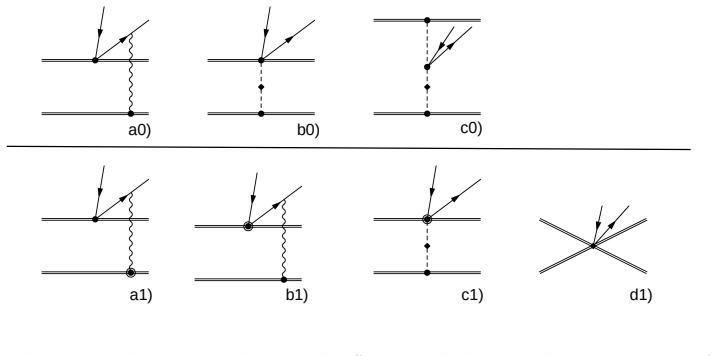
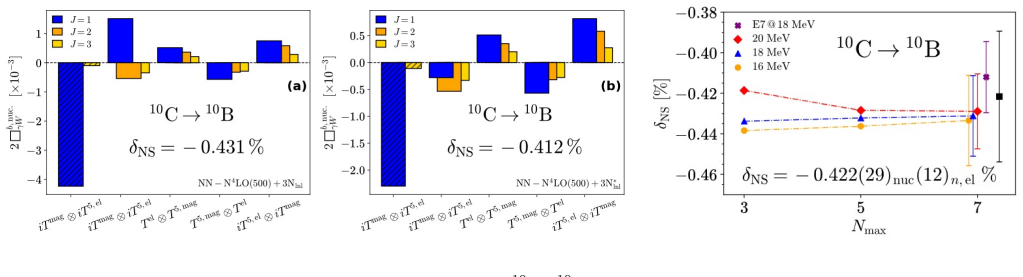
The paper's core claim is that the nuclear-structure-dependent radiative correction δ_NS—historically the largest theory uncertainty in Vud from superallowed decays—can now be computed ab initio by two routes: a current-algebra/dispersive evaluation that sums over all intermediate nuclear states, and an effective-field-theory evaluation using two-body potentials whose matrix elements can be evaluated with quantum Monte Carlo and no-core shell-model methods. The two routes are connected by the identity δ_NS = (2/M_F^(0))⟨V0^mag + V0^{rec,1} + V0^CT⟩, which is intended to fix the two unknown low-energy constants of the EFT approach. Representative results include δ_NS(10C→10B) = -0.422(29)% fr
What carries the argument
The central object is the nuclear γW-box diagram, whose nucleus-dependent part is the correction δ_NS. The argument is carried by the matching identity δ_NS = (2/M_F^(0))⟨V0^mag + V0^{rec,1} + V0^CT⟩, which equates the full current-algebra evaluation (a sum over all intermediate nuclear states) with the effective-field-theory evaluation (ground-state matrix elements of two-body magnetic, recoil, and counterterm potentials). This identity is what would allow the two unknown low-energy constants to be pinned down from one pair of transitions and then reused for other decays. For recoil corrections, the central mechanism is the multipole expansion of the weak current, with subleading multipoles
Load-bearing premise
The load-bearing premise is that the two counterterm low-energy constants of the EFT approach are fixed or bounded by the quoted matching relation δ_NS = (2/M_F^(0))⟨V0^mag + V0^{rec,1} + V0^CT⟩, which the review cites to an unpublished source; if that matching is incomplete, or if the constants differ from the arbitrary ±1/(m_N(2F_π)^2) values used in the table, the central 10^-4 uncertainty claims for Vud are not established.
What would settle it
A lattice QCD calculation of the two-nucleon matrix elements of the counterterm operators would settle whether the assumed natural size of the low-energy constants is correct; if the extracted constants lie outside ±1/(m_N(2F_π)^2), the EFT-based Vud uncertainties of 38–43×10^-5 are underestimates. A complementary direct test: compute δ_NS for 14O by both the current-algebra and EFT methods and require agreement within combined uncertainties.
If this is right
- If the quoted 10^-4 uncertainties hold, δ_NS ceases to be the dominant theory error in Vud, and CKM-unitarity tests from superallowed decays become limited by other sources, including experiment.
- The predicted Standard Model Fierz-like term in 6He (δb ≈ -1.5×10^-3) means future spectrum-shape measurements must subtract this nuclear-structure baseline before attributing any residual distortion to tensor currents.
- The state-dependent recoil form factors for 8Li/8B show near order-of-magnitude differences between the lowest 2+ state and higher-lying states, so angular-correlation experiments that restrict to the lowest state gain a substantial reduction in systematic uncertainty.
- Once the two EFT low-energy constants are fixed through matching, the EFT method can be applied to superallowed transitions where the full intermediate-state sum is computationally prohibitive, extending precision Vud extraction to heavier nuclei.
- The same ab initio machinery is being extended to unique first-forbidden decays, giving complementary sensitivity to right-handed and tensor currents inaccessible in allowed decays.
Where Pith is reading between the lines
- If the matching identity proves complete, the calibrated EFT approach could compute δ_NS for medium-mass superallowed emitters with essentially no additional many-body cost, potentially moving the Vud frontier from A≈14 to the full set of measured superallowed transitions.
- The no-core shell-model result for the induced-tensor form factor in 6He is roughly four times larger than an older shell-model estimate; if confirmed, previous beta-neutrino correlation analyses that used the older value would need revision, and existing tensor-current limits could shift by more than their quoted errors.
- The correlation between recoil form factors and measured quadrupole moments suggests a general strategy for other slowly converging nuclear observables: use precisely measured ground-state properties as anchors to reduce ab initio extrapolation uncertainties.
- A dedicated measurement of the 6He spectrum shape at the target 0.1% precision would test the predicted recoil-induced Fierz term directly; because the predicted value is negative and of order 10^-3, it should appear as a distinct energy dependence rather than a constant shift.
Editorial analysis
A structured set of objections, weighed in public.
Referee Report
Summary. The paper is a review of recent ab initio calculations of radiative and recoil-order corrections to beta decay, covering NCSM, SA-NCSM, and QMC methods and focusing on their implications for precision determinations of V_ud and for searches for BSM tensor and scalar currents. It presents the current-algebra and EFT formalisms for the nuclear-structure-dependent radiative correction delta_NS, reports results for 10C->10B and 14O->14N, and reviews recoil-correction calculations for 6He, 8Li, and 8B decays. The central claim is that ab initio calculations have achieved 'unprecedented precision' and reduced theoretical uncertainties to the order of 10^-4, thereby sharpening tests of the Standard Model.
Significance. If the reported corrections and uncertainties are reliable, the review would document a genuinely important milestone: quantified ab initio control of the nuclear-structure corrections that currently dominate V_ud extractions, plus high-precision recoil corrections for BSM-sensitive observables. The paper is useful as a pedagogical survey of the many-body methods (NCSM, SA-NCSM, GFMC, AFDMC) and of the two theoretical frameworks for delta_NS. It is also honest in several places, e.g., in Eq. (3.30) it explicitly breaks down the NCSM uncertainty sources, and in Table 3.1 it labels the LEC values as 'arbitrary'. However, the review's headline precision claims for the EFT-based V_ud results are conditional on unconstrained LECs and on an unpublished matching relation, and some numerical results are traceable only to private communications. These issues are load-bearing because the abstract and Section 5 promote the precision without those caveats. The recoil-order sections (6He, 8Li, 8B) are on firmer ground, being based on published data with concrete uncertainty estimates, though the 8Li/8B correlation plots rely on linear regressions whose parametric dependence is not fully discuss
major comments (3)
- [Section 3.4, Eqs. (3.37)-(3.43), Table 3.1] The EFT-based V_ud extractions carry uncertainties of 23-43x10^-5 from the two undetermined LECs g_NN_V1 and g_NN_V2. Table 3.1 states these LECs are set to 'arbitrary values' +/-1/(m_N(2F_pi)^2). Because the contact matrix elements enter delta_NS linearly, a sign or factor-of-two change in the true LECs would shift V_ud by an amount comparable to or larger than the quoted total uncertainty. The abstract's 'unprecedented precision' and Section 5's 'uncertainties to the order of 10^-4' therefore overstate what is established for these EFT results. The claims should be qualified as conditional on the assumed LEC values, or the EFT numbers should be presented with an explicit statement that they are not yet a verified precision determination.
- [Section 3.2.3, Eq. (3.26)] The proposed strategy to pin down the LECs rests on the matching relation delta_NS = 2/M_F^(0) <V0^mag + V0^rec,1 + V0^CT>, which is cited to unpublished Ref. [107]. This is the key step that would turn the EFT approach into a predictive tool. Because the derivation is not publicly available, the reader cannot verify that the current-algebra delta_NS indeed contains exactly the counterterm physics encoded in V_CT^0, nor that the operator normalizations in the two approaches match. The review should either outline the derivation or explicitly state that this step is not yet publicly checkable. As written, the conclusion on p. 17 that 'the physics in the counterterms can indeed be obtained explicitly in the current algebra approach' is not verifiable.
- [Section 3.4, footnote 4] The 14O results, including delta^(0)_NS = -2.84(88)x10^-3 and the V_ud value in Eq. (3.42), are said to be 'corrected for the re-evaluation of V_rec^0 matrix element' via private communication with E. Mereghetti and W. Dekens. This makes a central numerical result of the review nontraceable. For a review intended to inform precision experiments and to establish the state of the art, all reported numbers should be traceable to public, citable sources or be explicitly flagged as new/unpublished results supplied by the authors. Otherwise the community cannot independently assess or use these values.
minor comments (6)
- [Abstract and Section 5] Both the abstract and the Section 5 summary refer to '14O->14C', but 14O beta decays to 14N. The correct final nucleus is 14N, as used in Section 3.4. Please correct.
- [Section 3.2.3, final paragraph] Typographical/grammatical issue: 'their connections' should be 'the connection between them'.
- [Eq. (3.2)] The placement of 's' in '2984.431(3)s / (Ft(...))' is visually confusing; consider writing the formula with an explicit 'sec' or 's' in the denominator as in the original literature.
- [Section 4.1, end of first paragraph and Fig. 4 caption] Typo: 'Theresultedcalculations' should be 'The resulting calculations'.
- [Section 4.2, last paragraph] Typo: 'psuedoscalar' should be 'pseudoscalar'.
- [Section 4.3, text after Eq. (4.15)] The sentence 'making our predictions parameters and model (interaction) independent' is ambiguous; it should read 'parameter- and model-(interaction-)independent'.
Circularity Check
No constructed circularity in the reviewed results; one minor self-citation (Eq. 3.26 to unpublished [107]) is load-bearing only for the proposed LEC-fixing strategy, while Table 3.1's arbitrary LECs are an explicit caveat rather than a circular input.
specific steps
-
self citation load bearing
[Section 3.2.3, Eq. (3.26); Ref. [107]]
"As a result, we have the following matching [107]: δNS = 2/M_F^(0) ⟨V0^mag + V0^rec,1 + V0^CT⟩f i. ... So, a useful way to make progress is to first choose a pair of superallowed transitions that can be easily handled in both methods. One then computes the LHS of Eq.(3.26) using the current algebra approach, and the RHS using the EFT approach. With that, we are able to extract the values of the two unknown LECs by the above matching relation."
The matching relation Eq. (3.26) is cited to Ref. [107], an unpublished manuscript by the lead author, and no derivation is given in this review. The text immediately uses it as the basis for the proposed strategy to determine the two LECs g_NN_V1,V2 that dominate the EFT Vud uncertainty (Sec. 3.4). Thus the validity of that proposed LEC-determination path is supported only by a non-public self-citation. However, this affects a future extension, not the central reviewed results (10C/14O δNS, 6He/8Li/8B recoil terms), which are published and benchmarked; hence it is a minor self-citation rather than a fully circular derivation.
full rationale
This paper is a review rather than a new derivation, so most of its quantitative content is reported from published literature (Refs. [13]–[20]) rather than constructed in the text. The central results are benchmarked: the 10C δNS value (Eq. 3.30) is an NCSM calculation with an explicit error budget; the EFT Vud numbers (Eqs. 3.37–3.43) are explicitly conditioned on LECs that Table 3.1 labels 'arbitrary values' and whose contribution is included as the dominant uncertainty, so the precision claim is a caveat or overstatement risk, not a fitted input disguised as a prediction. The 8Li/8B recoil-term 'predictions' are obtained by regression against the experimental quadrupole moment, an independent observable, not against the target recoil form factors. The only self-citation with load-bearing weight for a stated strategy is Eq. (3.26), which cites the corresponding author's unpublished work [107] to justify the matching procedure proposed for pinning down the LECs; this affects a future direction, not the main reviewed results, and is best treated as a verification concern rather than circularity. Overall, no significant circularity is present.
Axiom & Free-Parameter Ledger
free parameters (3)
- g_NN_V1, g_NN_V2 (EFT counterterm LECs) =
+/- 1/(m_N (2F_pi)^2) (arbitrary values, Table 3.1)
- Shadowing scale factor for delta(Box^inel_n)^shad =
0.20
- Linear-regression slope/intercept for j_K/A^2c vs Q(2+) =
Implied by Fig. 4.5 (not tabulated)
axioms (4)
- domain assumption The nuclear Hamiltonian contains at most two- and three-nucleon forces (Eq. 2.1); four-nucleon and higher forces are neglected.
- domain assumption The weak charge/current operators are dominated by one-body terms; two-body currents enter only in some calculations (e.g., 6He with GFMC, Section 4.2).
- domain assumption The single-nucleon inelastic box diagram is unmodified for Q^2 > 2 GeV^2 and modified by at most 20% below (Section 3.3, after Eq. 3.29).
- ad hoc to paper The matching relation Eq. 3.26 equates the current-algebra delta_NS to the sum of EFT two-body potential matrix elements, including the counterterm potential V_CT^0.
Cite this review
Pith. "Pith review of The Role of Ab Initio Beta-Decay Calculations in Light Nuclei for Probes of Physics Beyond the Standard Model." pith.science (2026). https://pith.science/paper/A4JH3AEA
@misc{pith2026260200341,
  author       = {Pith},
  title        = {Pith review of: The Role of Ab Initio Beta-Decay Calculations in Light Nuclei for Probes of Physics Beyond the Standard Model},
  year         = {2026},
  howpublished = {\url{https://pith.science/paper/A4JH3AEA}},
  note         = {Machine review of arXiv:2602.00341}
}
read the original abstract
Precision beta decay experiments serve as powerful probes of physics beyond the Standard Model, enabling stringent tests of fundamental symmetries of nature. In particular, these experiments primarily focus on precise determinations of the Cabibbo-Kobayashi-Maskawa matrix element Vud and the search for exotic weak currents, both of which depend critically on theoretical calculations of radiative, recoil-order, and isospin-breaking corrections with quantified uncertainties. In recent years, ab initio nuclear many-body methods--grounded in realistic nucleon-nucleon interactions and systematically improvable approximations--have advanced considerably in their ability to compute these higher-order corrections for various nuclei. This review provides a comprehensive overview of state-of-the-art ab initio calculations of beta-decay corrections, encompassing both radiative corrections and recoil-order terms, and examines their significance for precision tests of the Standard Model. We discuss the theoretical formalisms employed, including the integration of effective field theory frameworks with many-body approaches. Particular attention is given to recent results for superallowed Fermi decays (e.g., 10C -> 10B and 14O -> 14C) and allowed Gamow-Teller transitions (e.g., 6He -> 6Li, 8Li -> 8Be, 8B -> 8Be), where ab initio calculations have achieved unprecedented precision. We also highlight emerging calculations for unique forbidden decays, which offer complementary sensitivity to BSM physics. Finally, we outline future directions aimed at extending the reach of ab initio calculations to heavier nuclei and additional decay modes, thereby strengthening the synergy between theory and experiment in the ongoing search for new physics.
Figures





Forward citations
Cited by 1 Pith paper
-
Quantum Monte Carlo calculation of $\delta_C$ in the superallowed beta decay of $^{10}$C
Ab initio QMC calculations yield δ_C ≈ 0.15–0.25% for ¹⁰C superallowed beta decay, consistent across phenomenological and chiral interactions within 34–65% relative uncertainties.
Reference graph
Works this paper leans on
-
[1]
V. Cirigliano, S. Gardner, B. Holstein, Beta Decays and Non-Standard Interactions in the LHC Era, Prog. Part. Nucl. Phys. 71 (2013) 93–118.doi:10.1016/j.ppnp.2013.03.005
-
[2]
Naviliat-Cuncic, M
O. Naviliat-Cuncic, M. González-Alonso, Prospects for precision measurements in nuclear decay in the lhc era, Annalen der Physik 525 (8-9) (2013) 600–619
2013
-
[3]
K. K. Vos, H. W. Wilschut, R. G. E. Timmermans, Symmetry violations in nuclear and neutronβdecay, Rev. Mod. Phys. 87 (2015) 1483–1516.doi:10.1103/RevModPhys.87.1483. URLhttps://link.aps.org/doi/10.1103/RevModPhys.87.1483
-
[4]
A. Falkowski, M. González-Alonso, O. Naviliat-Cuncic, Comprehensive analysis of beta decays within and beyond the standard model, Journal of High Energy Physics 2021 (4) (2021) 126.doi:10.1007/JHEP04(2021)126
-
[5]
M. Brodeur, N. Buzinsky, M. Caprio, V. Cirigliano, J. Clark, P. Fasano, J. Formaggio, A. Gallant, A. Garcia, S. Gan- dolfi, et al., Nuclearβdecay as a probe for physics beyond the standard model, arXiv preprint arXiv:2301.03975 (2023)
Pith/arXiv arXiv 2023
-
[6]
Cabibbo, Unitary Symmetry and Leptonic Decays, Phys
N. Cabibbo, Unitary Symmetry and Leptonic Decays, Phys. Rev. Lett. 10 (1963) 531–533.doi:10.1103/ PhysRevLett.10.531
1963
-
[7]
M. Kobayashi, T. Maskawa, CP Violation in the Renormalizable Theory of Weak Interaction, Prog. Theor. Phys. 49 (1973) 652–657.doi:10.1143/PTP.49.652
-
[8]
P. D. Group, P. A. Zyla, R. M. Barnett, J. Beringer, O. Dahl, D. A. Dwyer, D. E. Groom, C. J. Lin, K. S. Lugovsky, E. Pianori, D. J. Robinson, C. G. Wohl, W. M. Yao, K. Agashe, G. Aielli, B. C. Allanach, C. Amsler, M. Antonelli, 35 E. C. Aschenauer, D. M. Asner, H. Baer, S. Banerjee, L. Baudis, C. W. Bauer, J. J. Beatty, V. I. Belousov, S. Bethke, A. Bett...
2020
-
[9]
Cirigliano, A
V. Cirigliano, A. Crivellin, M. Hoferichter, M. Moulson, Scrutinizing ckm unitarity with a new measurement of the kµ3/kµ2 branching fraction, Physics Letters B 838 (2023) 137748
2023
-
[10]
V. Cirigliano, W. Dekens, J. de Vries, E. Mereghetti, T. Tong, Anomalies in global SMEFT analyses. A case study of first-row CKM unitarity, JHEP 03 (2024) 033.doi:10.1007/JHEP03(2024)033
-
[11]
Severijns, M
N. Severijns, M. Beck, O. Naviliat-Cuncic, Tests of the standard electroweak model in nuclear beta decay, Rev. Mod. Phys. 78 (3) (2006) 991
2006
-
[12]
M. González-Alonso, O. Naviliat-Cuncic, N. Severijns, New physics searches in nuclear and neutronβdecay, Prog. Part. Nucl. Phys. 104 (2019) 165–223.doi:https://doi.org/10.1016/j.ppnp.2018.08.002
-
[13]
A. Glick-Magid, C. Forssén, D. Gazda, D. Gazit, P. Gysbers, P. Navrátil, Nuclear ab initio calculations of6He β-decay for beyond the standard model studies, Phys. Lett. B 832 (2022) 137259.doi:https://doi.org/10.1016/ 36 j.physletb.2022.137259. URLhttps://www.sciencedirect.com/science/article/pii/S0370269322003938
arXiv 2022
-
[14]
G. H. Sargsyan, K. D. Launey, M. T. Burkey, A. T. Gallant, N. D. Scielzo, G. Savard, A. Mercenne, T. Dytrych, D. Langr, L. Varriano, B. Longfellow, T. Y. Hirsh, J. P. Draayer, Impact of clustering on the8Liβdecay and recoil form factors, Phys. Rev. Lett. 128 (2022) 202503.doi:10.1103/PhysRevLett.128.202503. URLhttps://link.aps.org/doi/10.1103/PhysRevLett....
-
[15]
G. B. King, A. Baroni, V. Cirigliano, S. Gandolfi, L. Hayen, E. Mereghetti, S. Pastore, M. Piarulli, Ab initio calculation of theβ-decay spectrum of He6, Phys. Rev. C 107 (1) (2023) 015503.doi:10.1103/PhysRevC.107. 015503
-
[16]
B. Longfellow, A. T. Gallant, G. H. Sargsyan, M. T. Burkey, T. Y. Hirsh, G. Savard, N. D. Scielzo, L. Varriano, M. Brodeur, D. P. Burdette, J. A. Clark, D. Lascar, K. D. Launey, P. Mueller, D. Ray, K. S. Sharma, A. A. Valverde, G. L. Wilson, X. L. Yan, Improved tensor current limit from8Bβdecay including new recoil-order calculations, Phys. Rev. Lett. 132...
-
[17]
M. Gennari, M. Drissi, M. Gorchtein, P. Navratil, C.-Y. Seng, Ab Initio Strategy for Taming the Nuclear-Structure Dependence of Vud Extractions: The C10→B10 Superallowed Transition, Phys. Rev. Lett. 134 (1) (2025) 012501. doi:10.1103/PhysRevLett.134.012501
-
[20]
G. B. King, J. Carlson, A. R. Flores, S. Gandolfi, E. Mereghetti, S. Pastore, M. Piarulli, R. B. Wiringa, Quantum Monte Carlo calculation ofδNS in 10C using an effective field theory approach, arXiv preprint arXiv:2509.07310 (9 2025)
Pith/arXiv arXiv 2025
-
[21]
Hergert, A Guided Tour ofab initioNuclear Many-Body Theory, Front
H. Hergert, A Guided Tour ofab initioNuclear Many-Body Theory, Front. in Phys. 8 (2020) 379.doi:10.3389/ fphy.2020.00379
arXiv 2020
-
[22]
A. Ekström, C. Forssén, G. Hagen, G. R. Jansen, W. Jiang, T. Papenbrock, What is ab initio in nuclear theory?, Front. Phys. 11 (2023) 1129094.doi:10.3389/fphy.2023.1129094
arXiv 2023
-
[23]
S. R. Beane, W. Detmold, K. Orginos, M. J. Savage, Nuclear Physics from Lattice QCD, Prog. Part. Nucl. Phys. 66 (2011) 1–40.doi:10.1016/j.ppnp.2010.08.002
-
[24]
R. B. Wiringa, V. G. J. Stoks, R. Schiavilla, Phys. Rev. C 51 (1995) 38
1995
-
[25]
Machleidt, Phys
R. Machleidt, Phys. Rev. C 63 (2001) 024001. 37
2001
-
[26]
P. F. Bedaque, U. van Kolck, Effective field theory for few-nucleon systems, Annu. Rev. Nucl. Part. Sci. 52 (1) (2002) 339–396.doi:10.1146/annurev.nucl.52.050102.090637
arXiv 2002
-
[27]
D. R. Entem, R. Machleidt, Phys. Rev. C 68 (2003) 041001(R)
2003
-
[28]
E. Epelbaum, H. Krebs, U. G. Meißner, Precision nucleon-nucleon potential at fifth order in the chiral expansion, Phys. Rev. Lett. 115 (12) (2015) 122301.doi:10.1103/PhysRevLett.115.122301
-
[29]
H.-W. Hammer, S. König, U. van Kolck, Nuclear effective field theory: Status and perspectives, Rev. Mod. Phys. 92 (2020) 025004.doi:10.1103/RevModPhys.92.025004. URLhttps://link.aps.org/doi/10.1103/RevModPhys.92.025004
-
[30]
D. B. Kaplan, M. J. Savage, M. B. Wise, A New expansion for nucleon-nucleon interactions, Phys. Lett. B 424 (1998) 390–396.doi:10.1016/S0370-2693(98)00210-X
-
[31]
van Kolck, Naturalness in nuclear effective field theories, Eur
U. van Kolck, Naturalness in nuclear effective field theories, Eur. Phys. J. A 56 (3) (2020) 97.doi:10.1140/epja/ s10050-020-00092-1
doi:10.1140/epja/ 2020
-
[32]
Barrett, P
B. Barrett, P. Navrátil, J. Vary, Prog. Part. Nucl. Phys. 69 (2013) 131
2013
-
[33]
B. Verhaar, A method for the elimination of spurious states in the nuclear harmonic oscillator shell model, Nucl. Phys. 21 (1960) 508–525.doi:10.1016/0029-5582(60)90073-0
-
[34]
K. Kravvaris, P. Navrátil, S. Quaglioni, C. Hebborn, G. Hupin, Ab initio informed evaluation of the radiative capture of protons on 7Be, Phys. Lett. B 845 (2023) 138156.doi:10.1016/j.physletb.2023.138156
arXiv 2023
-
[35]
L. Jokiniemi, P. Navrátil, J. Kotila, K. Kravvaris, Muon capture on6Li, 12C, and 16Ofrom ab initio nuclear theory, Phys. Rev. C 109 (2024) 065501.doi:10.1103/PhysRevC.109.065501. URLhttps://link.aps.org/doi/10.1103/PhysRevC.109.065501
-
[36]
R. J. Furnstahl, G. Hagen, T. Papenbrock, Corrections to nuclear energies and radii in finite oscillator spaces, Phys. Rev. C 86 (2012) 031301(R)
2012
-
[37]
S. A. Coon, M. I. Avetian, M. K. G. Kruse, U. van Kolck, P. Maris, J. P. Vary, Convergence properties of ab initio calculations of light nuclei in a harmonic oscillator basis, Phys. Rev. C 86 (2012) 054002.doi:10.1103/PhysRevC. 86.054002. URLhttps://link.aps.org/doi/10.1103/PhysRevC.86.054002
doi:10.1103/physrevc 2012
-
[38]
K. A. Wendt, C. Forssén, T. Papenbrock, D. Sääf, Infrared length scale and extrapolations for the no-core shell model, Phys. Rev. C 91 (2015) 061301
2015
-
[39]
P. Maris, J. P. Vary, A. M. Shirokov, Ab initio no-core full configuration calculations of light nuclei, Phys. Rev. C 79 (2009) 014308.doi:10.1103/PhysRevC.79.014308. URLhttps://link.aps.org/doi/10.1103/PhysRevC.79.014308
-
[40]
D. Shanks, Non-linear transformations of divergent and slowly convergent sequences, Journal of Mathematics and Physics 34 (1-4) (1955) 1–42.doi:10.1002/sapm19553411. 38
-
[41]
A. Bohr, B. R. Mottelson, Nuclear Structure, Vol. 1, Benjamin, New York, 1969
1969
-
[42]
J. P. Elliott, Collective Motion in the Nuclear Shell Model. I. Classification Schemes for States of Mixed Configu- rations, Proc. Roy. Soc. A 245 (1958) 128
1958
-
[43]
J. P. Elliott, Collective Motion in the Nuclear Shell Model. II. The Introduction of Intrinsic Wave-Functions, Proc. Roy. Soc. A 245 (1958) 562
1958
-
[44]
J. P. Elliott, M. Harvey, Collective Motion in the Nuclear Shell Model. III. The Calculation of Spectra, Proc. Roy. Soc. A 272 (1962) 557
1962
-
[45]
Rosensteel, D
G. Rosensteel, D. J. Rowe, Nuclear Sp(3,R) Model, Phys. Rev. Lett. 38 (1977) 10
1977
-
[46]
D. J. Rowe, Microscopic theory of the nuclear collective model, Reports on Progr. in Phys. 48 (1985) 1419
1985
-
[47]
Castaños, J
O. Castaños, J. P. Draayer, Y. Leschber, Z. Phys. A 329 (1988) 33
1988
-
[48]
Leschber, J
Y. Leschber, J. P. Draayer, Phys. Letts. B 190 (1987) 1
1987
-
[49]
K. D. Launey, T. Dytrych, J. P. Draayer, Symmetry-guided large-scale shell-model theory, Prog. Part. Nucl. Phys. 89 (2016) 101 (review).doi:10.1016/j.ppnp.2016.02.001
-
[50]
T. Dytrych, K. D. Launey, J. P. Draayer, D. J. Rowe, J. L. Wood, G. Rosensteel, C. Bahri, D. Langr, R. B. Baker, Physics of nuclei: Key role of an emergent symmetry, Phys. Rev. Lett. 124 (2020) 042501.doi:10.1103/ PhysRevLett.124.042501. URLhttps://link.aps.org/doi/10.1103/PhysRevLett.124.042501
-
[51]
K. T. Hecht, The use of SU(3) in the elimination of spurious center of mass states, Nucl. Phys. A 170 (1) (1971) 34–54.doi:10.1016/0375-9474(71)90681-6
-
[52]
Millener, in: J
D. Millener, in: J. Draayer, J. Janecke (Eds.), Group Theory and Special Symmetries in Nuclear Physics, World Scientific, Singapore, 1992, p. 276
1992
-
[53]
D. Langr, T. Dytrych, J. P. Draayer, K. D. Launey, P. Tvrdík, Efficient algorithm for representations of u(3) in u(n), Computer Physics Communications 244 (2019) 442.doi:10.1016/j.cpc.2019.05.018
-
[54]
D. Borremans, D. L. Balabanski, K. Blaum, W. Geithner, S. Gheysen, P. Himpe, M. Kowalska, J. Lassen, P. Lievens, S. Mallion, R. Neugart, G. Neyens, N. Vermeulen, D. Yordanov, New measurement and reevaluation of the nuclear magnetic andquadrupole moments of 8Liand 9Li, Phys. Rev. C 72 (2005) 044309.doi:10.1103/PhysRevC.72. 044309. URLhttps://link.aps.org/d...
-
[55]
N. Stone, Table of nuclear electric quadrupole moments, Atomic Data and Nuclear Data Tables 111-112 (2016) 1–28.doi:https://doi.org/10.1016/j.adt.2015.12.002. URLhttps://www.sciencedirect.com/science/article/pii/S0092640X16000024
-
[56]
A. C. Dreyfuss, K. D. Launey, J. E. Escher, G. H. Sargsyan, R. B. Baker, T. Dytrych, J. P. Draayer, Clustering and α-capture reaction rate from ab initio symmetry-adapted descriptions of20Ne, Phys. Rev. C 102 (2020) 044608. 39 doi:10.1103/PhysRevC.102.044608. URLhttps://link.aps.org/doi/10.1103/PhysRevC.102.044608
-
[57]
Ruotsalainen, J
P. Ruotsalainen, J. Henderson, G. Hackman, G. H. Sargsyan, K. D. Launey, A. Saxena, P. C. Srivastava, S. R. Stroberg, T. Grahn, J. Pakarinen, G. C. Ball, R. Julin, P. T. Greenlees, J. Smallcombe, C. Andreoiu, N. Bernier, M. Bowry, M. Buckner, R. Caballero-Folch, A. Chester, S. Cruz, L. J. Evitts, R. Frederick, A. B. Garnsworthy, M. Holl, A. Kurkjian, D. K...
2019
-
[58]
J. Williams, G. C. Ball, A. Chester, T. Domingo, A. B. Garnsworthy, G. Hackman, J. Henderson, R. Henderson, R. Krücken, A. Kumar, K. D. Launey, J. Measures, O. Paetkau, J. Park, G. H. Sargsyan, J. Smallcombe, P. C. Srivastava, K. Starosta, C. E. Svensson, K. Whitmore, M. Williams, Structure of28Mgand influence of the neutron pfshell, Phys. Rev. C 100 (201...
-
[59]
K. D. Launey, A. Mercenne, G. H. Sargsyan, H. Shows, R. B. Baker, M. E. Miora, T. Dytrych, J. P. Draayer, Emergent clustering phenomena in the framework of theab initiosymmetry-adapted no-core shell model, in: Proceedings of the 4th International Workshop on ’State of the Art in Nuclear Cluster Physics’ (SOTANCP4), May 2018, Galveston, Texas, Vol. 2038, A...
2018
-
[60]
K. D. Launey, A. Mercenne, T. Dytrych, Nuclear dynamics and reactions in the ab initio symmetry-adapted framework, Annu. Rev. Nucl. Part. Sci. 71 (2021) 253.doi:10.1146/annurev-nucl-102419-033316
-
[61]
R. B. Baker, C. Elster, T. Dytrych, K. D. Launey,Ab initioleading order effective potential for elastic proton scattering based on the symmetry-adapted no-core shell model, Phys. Rev. C 110 (2024) 034605.doi:10.1103/ PhysRevC.110.034605
2024
-
[62]
M. Burrows, R. B. Baker, S. Bacca, K. D. Launey, T. Dytrych, D. Langr, Response functions and giant monopole resonances for light to medium-mass nuclei from theab initiosymmetry-adapted no-core–shell model, J. of Phys. G 52 (3) (2025) 035107.doi:10.1088/1361-6471/adb901
-
[63]
K. D. Launey, T. Dytrych, G. H. Sargsyan, R. B. Baker, J. P. Draayer, Emergent symplectic symmetry in atomic nuclei:Ab initiosymmetry-adapted no-core shell model, Eur. Phys. J. Spec. Top. 229 (2020) 2429.doi:10.1140/ epjst/e2020-000178-3
2020
-
[64]
K. D. Launey, G. H. Sargsyan, A. Mercenne, J. E. Escher, D. C. Mumma, Ab initio symmetry-adapted approaches to nuclear reactions, arXiv preprint arXiv:2510.15171 (2025)
arXiv 2025
-
[65]
G. B. King, L. Andreoli, S. Pastore, M. Piarulli, R. Schiavilla, R. B. Wiringa, J. Carlson, S. Gandolfi, Chiral effective field theory calculations of weak transitions in light nuclei, Phys. Rev. C 102 (2020) 025501.doi:10.1103/ PhysRevC.102.025501. URLhttps://link.aps.org/doi/10.1103/PhysRevC.102.025501 40
-
[66]
J. Carlson, S. Gandolfi, F. Pederiva, S. C. Pieper, R. Schiavilla, K. E. Schmidt, R. B. Wiringa, Quantum Monte Carlo methods for nuclear physics, Rev. Mod. Phys. 87 (2015) 1067.doi:10.1103/RevModPhys.87.1067
-
[67]
Gandolfi, D
S. Gandolfi, D. Lonardoni, A. Lovato, M. Piarulli, Atomic nuclei from quantum monte carlo calculations with chiral eft interactions, Frontiers in Physics 8 (2020) 117
2020
-
[68]
G. B. King, S. Pastore, Recent Progress in the Electroweak Structure of Light Nuclei Using Quantum Monte Carlo Methods, Ann. Rev. Nucl. Part. Sci. 74 (1) (2024) 343–368.doi:10.1146/annurev-nucl-101920-021401
-
[69]
R. B. Wiringa, Variational calculations of few-body nuclei, Phys. Rev. C43 (1991) 1585–1598.doi:10.1103/ PhysRevC.43.1585
1991
-
[70]
M. Piarulli, L. Girlanda, R. Schiavilla, A. Kievsky, A. Lovato, L. E. Marcucci, S. C. Pieper, M. Viviani, R. B. Wiringa, Local chiral potentials with∆-intermediate states and the structure of light nuclei, Phys. Rev. C94 (5) (2016) 054007.doi:10.1103/PhysRevC.94.054007
-
[71]
Piarulli, et al., Light-nuclei spectra from chiral dynamics, Phys
M. Piarulli, et al., Light-nuclei spectra from chiral dynamics, Phys. Rev. Lett. 120 (5) (2018) 052503.doi:10. 1103/PhysRevLett.120.052503
2018
-
[72]
R. B. Wiringa, S. C. Pieper, J. Carlson, V. R. Pandharipande, Quantum Monte Carlo calculations of A = 8 nuclei, Phys. Rev. C62 (2000) 014001.doi:10.1103/PhysRevC.62.014001
-
[74]
K. E. Schmidt, S. Fantoni, A quantum Monte Carlo method for nucleon systems, Phys. Lett. B446 (1999) 99–103. doi:10.1016/S0370-2693(98)01522-6
-
[75]
D. Lonardoni, S. Gandolfi, J. E. Lynn, C. Petrie, J. Carlson, K. E. Schmidt, A. Schwenk, Auxiliary field diffusion Monte Carlo calculations of light and medium-mass nuclei with local chiral interactions, Phys. Rev. C 97 (4) (2018) 044318.doi:10.1103/PhysRevC.97.044318
-
[76]
M. Pervin, S. C. Pieper, R. B.Wiringa, Quantum Monte Carlo calculations of electroweak transition matrix elements in A = 6,7 nuclei, Phys. Rev. C76 (2007) 064319.doi:10.1103/PhysRevC.76.064319
-
[77]
X. Feng, M. Gorchtein, L.-C. Jin, P.-X. Ma, C.-Y. Seng, First-principles calculation of electroweak box diagrams from lattice QCD, Phys. Rev. Lett. 124 (19) (2020) 192002.doi:10.1103/PhysRevLett.124.192002
-
[78]
J.-S. Yoo, T. Bhattacharya, R. Gupta, S. Mondal, B. Yoon, Electroweak box diagram contribution for pion and kaon decay from lattice QCD, Phys. Rev. D 108 (3) (2023) 034508.doi:10.1103/PhysRevD.108.034508
-
[79]
Pocanic, et al., Precise measurement of the pi+ —>pi0 e+ nu branching ratio, Phys
D. Pocanic, et al., Precise measurement of the pi+ —>pi0 e+ nu branching ratio, Phys. Rev. Lett. 93 (2004) 181803.doi:10.1103/PhysRevLett.93.181803
-
[80]
Altmannshofer, et al., PIONEER: Studies of Rare Pion Decays (3 2022)
W. Altmannshofer, et al., PIONEER: Studies of Rare Pion Decays (3 2022)
2022
-
[81]
C.-Y. Seng, M. Gorchtein, H. H. Patel, M. J. Ramsey-Musolf, Reduced Hadronic Uncertainty in the Determination ofV ud, Phys. Rev. Lett. 121 (24) (2018) 241804.doi:10.1103/PhysRevLett.121.241804. 41
-
[82]
C. Y. Seng, M. Gorchtein, M. J. Ramsey-Musolf, Dispersive evaluation of the inner radiative correction in neutron and nuclearβdecay, Phys. Rev. D 100 (1) (2019) 013001.doi:10.1103/PhysRevD.100.013001
-
[83]
C.-Y. Seng, X. Feng, M. Gorchtein, L.-C. Jin, Joint lattice QCD–dispersion theory analysis confirms the quark- mixing top-row unitarity deficit, Phys. Rev. D 101 (11) (2020) 111301.doi:10.1103/PhysRevD.101.111301
discussion (0)
Sign in with ORCID, Apple, or X to comment. Anyone can read and Pith papers without signing in.